Elementary Graph Algorithms
Dr. AMIT KUMAR @JUET
Graphs
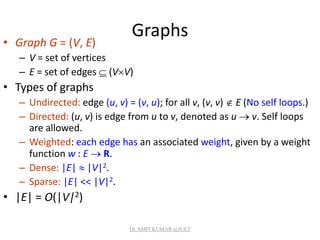
• Graph G = (V, E)
– V = set of vertices
– E = set of edges  (VV)
• Types of graphs
– Undirected: edge (u, v) = (v, u); for all v, (v, v)  E (No self loops.)
– Directed: (u, v) is edge from u to v, denoted as u  v. Self loops
are allowed.
– Weighted: each edge has an associated weight, given by a weight
function w : E  R.
– Dense: |E|  |V|2.
– Sparse: |E| << |V|2.
• |E| = O(|V|2)
Dr. AMIT KUMAR @JUET
Graphs
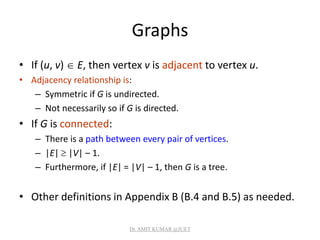
• If (u, v)  E, then vertex v is adjacent to vertex u.
• Adjacency relationship is:
– Symmetric if G is undirected.
– Not necessarily so if G is directed.
• If G is connected:
– There is a path between every pair of vertices.
– |E|  |V| – 1.
– Furthermore, if |E| = |V| – 1, then G is a tree.
• Other definitions in Appendix B (B.4 and B.5) as needed.
Dr. AMIT KUMAR @JUET
Representation of Graphs
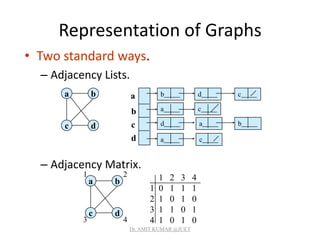
• Two standard ways.
– Adjacency Lists.
– Adjacency Matrix.
a
dc
b a
b
c
d
b
a
d
d c
c
a b
a c
a
dc
b
1 2
3 4
1 2 3 4
1 0 1 1 1
2 1 0 1 0
3 1 1 0 1
4 1 0 1 0
Dr. AMIT KUMAR @JUET
Adjacency Lists
• Consists of an array Adj of |V| lists.
• One list per vertex.
• For u  V, Adj[u] consists of all vertices adjacent to u.
a
dc
b a
b
c
d
b
c
d
d c
a
dc
b a
b
c
d
b
a
d
d c
c
a b
a c
If weighted, store weights also in
adjacency lists.
Dr. AMIT KUMAR @JUET
Storage Requirement
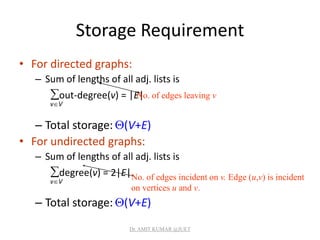
• For directed graphs:
– Sum of lengths of all adj. lists is
out-degree(v) = |E|
vV
– Total storage: (V+E)
• For undirected graphs:
– Sum of lengths of all adj. lists is
degree(v) = 2|E|
vV
– Total storage: (V+E)
No. of edges leaving v
No. of edges incident on v. Edge (u,v) is incident
on vertices u and v.
Dr. AMIT KUMAR @JUET
Pros and Cons: adj list
• Pros
– Space-efficient, when a graph is sparse.
– Can be modified to support many graph variants.
• Cons
– Determining if an edge (u,v) G is not efficient.
• Have to search in u’s adjacency list. (degree(u)) time.
• (V) in the worst case.
Dr. AMIT KUMAR @JUET
Adjacency Matrix
• |V|  |V| matrix A.
• Number vertices from 1 to |V| in some arbitrary
manner.
• A is then given by:


 

otherwise0
),(if1
],[
Eji
ajiA ij
a
dc
b
1 2
3 4
1 2 3 4
1 0 1 1 1
2 0 0 1 0
3 0 0 0 1
4 0 0 0 0
a
dc
b
1 2
3 4
1 2 3 4
1 0 1 1 1
2 1 0 1 0
3 1 1 0 1
4 1 0 1 0
A = AT for undirected graphs.
Dr. AMIT KUMAR @JUET
Space and Time
• Space: (V2).
– Not memory efficient for large graphs.
• Time: to list all vertices adjacent to u: (V).
• Time: to determine if (u, v)  E: (1).
• Can store weights instead of bits for weighted graph.
Dr. AMIT KUMAR @JUET
Graph-searching Algorithms
• Searching a graph:
– Systematically follow the edges of a graph
to visit the vertices of the graph.
• Used to discover the structure of a graph.
• Standard graph-searching algorithms.
– Breadth-first Search (BFS).
– Depth-first Search (DFS).
Dr. AMIT KUMAR @JUET
Breadth-first Search
• Input: Graph G = (V, E), either directed or undirected,
and source vertex s  V.
• Output:
– d[v] = distance (smallest # of edges, or shortest path) from s to
v, for all v  V. d[v] =  if v is not reachable from s.
– [v] = u such that (u, v) is last edge on shortest path s v.
• u is v’s predecessor.
– Builds breadth-first tree with root s that contains all reachable
vertices.
Definitions:
Path between vertices u and v: Sequence of vertices (v1, v2, …, vk) such that
u=v1 and v =vk, and (vi,vi+1)  E, for all 1 i  k-1.
Length of the path: Number of edges in the path.
Path is simple if no vertex is repeated.
Error!
Dr. AMIT KUMAR @JUET
Breadth-first Search
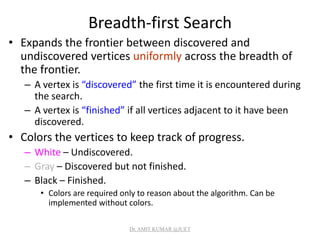
• Expands the frontier between discovered and
undiscovered vertices uniformly across the breadth of
the frontier.
– A vertex is “discovered” the first time it is encountered during
the search.
– A vertex is “finished” if all vertices adjacent to it have been
discovered.
• Colors the vertices to keep track of progress.
– White – Undiscovered.
– Gray – Discovered but not finished.
– Black – Finished.
• Colors are required only to reason about the algorithm. Can be
implemented without colors.
Dr. AMIT KUMAR @JUET
BFS(G,s)
1. for each vertex u in V[G] – {s}
2 do color[u]  white
3 d[u]  
4 [u]  nil
5 color[s]  gray
6 d[s]  0
7 [s]  nil
8 Q  
9 enqueue(Q,s)
10 while Q  
11 do u  dequeue(Q)
12 for each v in Adj[u]
13 do if color[v] = white
14 then color[v]  gray
15 d[v]  d[u] + 1
16 [v]  u
17 enqueue(Q,v)
18 color[u]  black
white: undiscovered
gray: discovered
black: finished
Q: a queue of discovered
vertices
color[v]: color of v
d[v]: distance from s to v
[u]: predecessor of v
Example: animation.
Dr. AMIT KUMAR @JUET
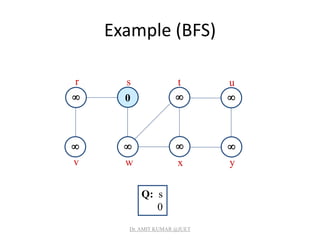
Example (BFS)
 0
  
 

r s t u
v w x y
Q: s
0
Dr. AMIT KUMAR @JUET
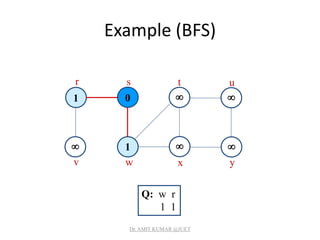
Example (BFS)
1 0
1  
 

r s t u
v w x y
Q: w r
1 1
Dr. AMIT KUMAR @JUET
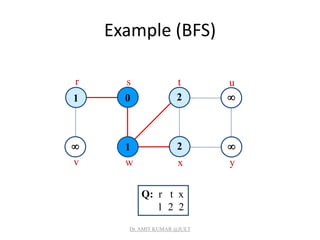
Example (BFS)
1 0
1 2 
2 

r s t u
v w x y
Q: r t x
1 2 2
Dr. AMIT KUMAR @JUET
Example (BFS)
1 0
1 2 
2 
2
r s t u
v w x y
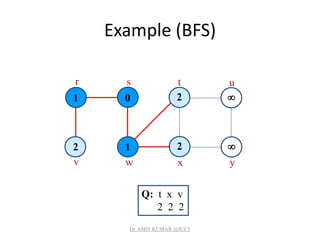
Q: t x v
2 2 2
Dr. AMIT KUMAR @JUET
Example (BFS)
1 0
1 2 
2 3
2
r s t u
v w x y
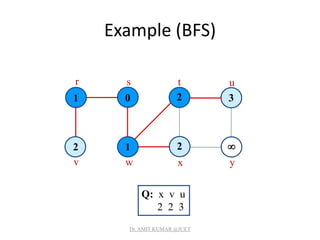
Q: x v u
2 2 3
Dr. AMIT KUMAR @JUET
Example (BFS)
1 0
1 2 3
2 3
2
r s t u
v w x y
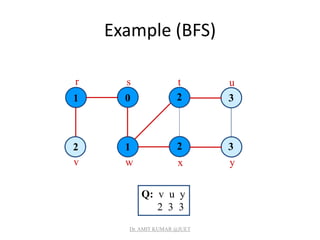
Q: v u y
2 3 3
Dr. AMIT KUMAR @JUET
Example (BFS)
1 0
1 2 3
2 3
2
r s t u
v w x y
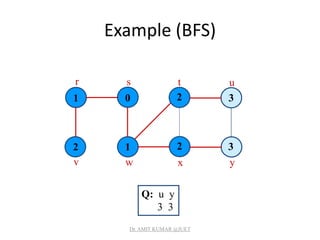
Q: u y
3 3
Dr. AMIT KUMAR @JUET
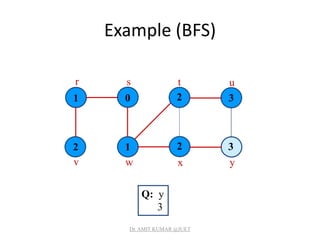
Example (BFS)
1 0
1 2 3
2 3
2
r s t u
v w x y
Q: y
3
Dr. AMIT KUMAR @JUET
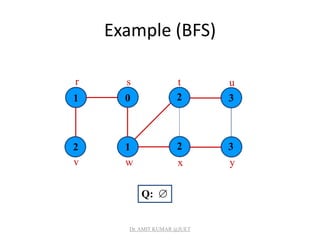
Example (BFS)
1 0
1 2 3
2 3
2
r s t u
v w x y
Q: 
Dr. AMIT KUMAR @JUET
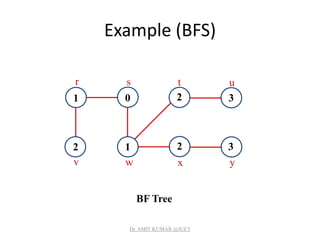
Example (BFS)
1 0
1 2 3
2 3
2
r s t u
v w x y
BF Tree
Dr. AMIT KUMAR @JUET
Analysis of BFS
• Initialization takes O(V).
• Traversal Loop
– After initialization, each vertex is enqueued and dequeued at
most once, and each operation takes O(1). So, total time for
queuing is O(V).
– The adjacency list of each vertex is scanned at most once. The
sum of lengths of all adjacency lists is (E).
• Summing up over all vertices => total running time of BFS
is O(V+E), linear in the size of the adjacency list
representation of graph.
• Correctness Proof
– We omit for BFS and DFS.
– Will do for later algorithms.
Dr. AMIT KUMAR @JUET
Breadth-first Tree
• For a graph G = (V, E) with source s, the predecessor
subgraph of G is G = (V , E) where
– V ={vV : [v]  NIL}{s}
– E ={([v],v)E : v  V - {s}}
• The predecessor subgraph G is a breadth-first tree if:
– V consists of the vertices reachable from s and
– for all vV , there is a unique simple path from s to v in G
that is also a shortest path from s to v in G.
• The edges in E are called tree edges.
|E | = |V | - 1.
Dr. AMIT KUMAR @JUET
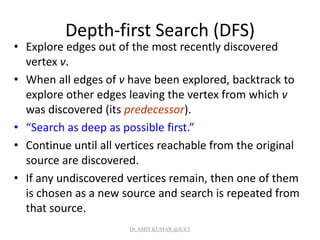
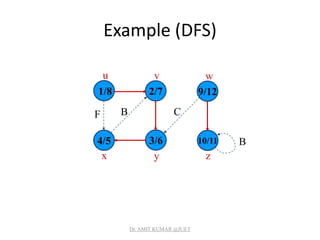
Depth-first Search (DFS)
• Explore edges out of the most recently discovered
vertex v.
• When all edges of v have been explored, backtrack to
explore other edges leaving the vertex from which v
was discovered (its predecessor).
• “Search as deep as possible first.”
• Continue until all vertices reachable from the original
source are discovered.
• If any undiscovered vertices remain, then one of them
is chosen as a new source and search is repeated from
that source.
Dr. AMIT KUMAR @JUET
Depth-first Search
• Input: G = (V, E), directed or undirected. No source
vertex given!
• Output:
– 2 timestamps on each vertex. Integers between 1 and 2|V|.
• d[v] = discovery time (v turns from white to gray)
• f [v] = finishing time (v turns from gray to black)
– [v] : predecessor of v = u, such that v was discovered during
the scan of u’s adjacency list.
• Uses the same coloring scheme for vertices as BFS.
Dr. AMIT KUMAR @JUET
Pseudo-code
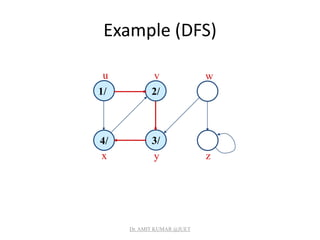
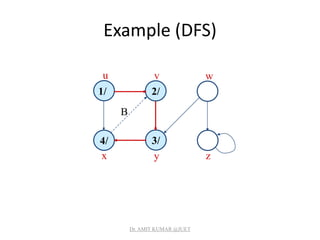
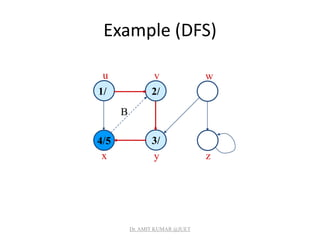
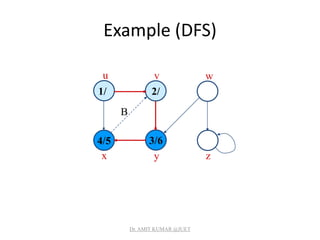
DFS(G)
1. for each vertex u  V[G]
2. do color[u]  white
3. [u]  NIL
4. time  0
5. for each vertex u  V[G]
6. do if color[u] = white
7. then DFS-Visit(u)
Uses a global timestamp time.
DFS-Visit(u)
1. color[u]  GRAY  White vertex u
has been discovered
2. time  time + 1
3. d[u]  time
4. for each v  Adj[u]
5. do if color[v] = WHITE
6. then [v]  u
7. DFS-Visit(v)
8. color[u]  BLACK  Blacken u;
it is finished.
9. f[u]  time  time + 1
Dr. AMIT KUMAR @JUET
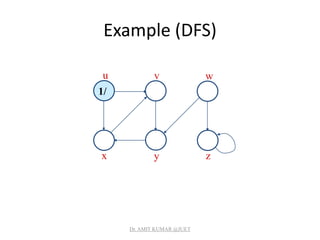
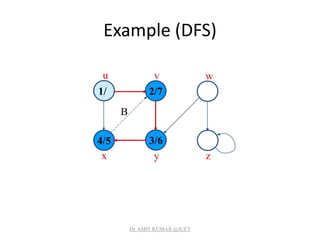
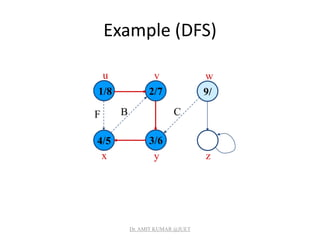
Example (DFS)
1/
u v w
x y z
Dr. AMIT KUMAR @JUET
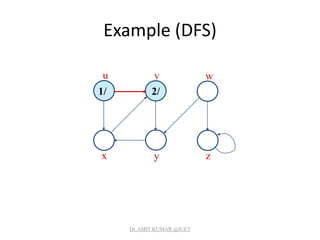
Example (DFS)
1/ 2/
u v w
x y z
Dr. AMIT KUMAR @JUET
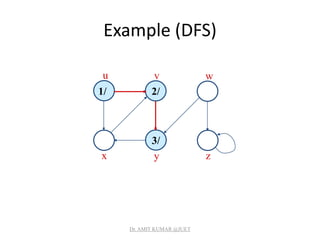
Example (DFS)
1/
3/
2/
u v w
x y z
Dr. AMIT KUMAR @JUET
Example (DFS)
1/
4/ 3/
2/
u v w
x y z
Dr. AMIT KUMAR @JUET
Example (DFS)
1/
4/ 3/
2/
u v w
x y z
B
Dr. AMIT KUMAR @JUET
Example (DFS)
1/
4/5 3/
2/
u v w
x y z
B
Dr. AMIT KUMAR @JUET
Example (DFS)
1/
4/5 3/6
2/
u v w
x y z
B
Dr. AMIT KUMAR @JUET
Example (DFS)
1/
4/5 3/6
2/7
u v w
x y z
B
Dr. AMIT KUMAR @JUET
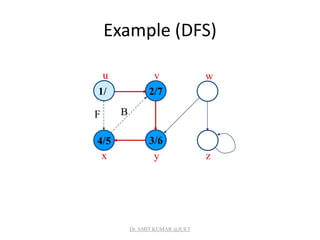
Example (DFS)
1/
4/5 3/6
2/7
u v w
x y z
BF
Dr. AMIT KUMAR @JUET
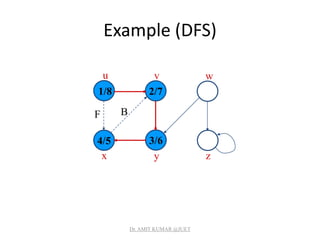
Example (DFS)
1/8
4/5 3/6
2/7
u v w
x y z
BF
Dr. AMIT KUMAR @JUET
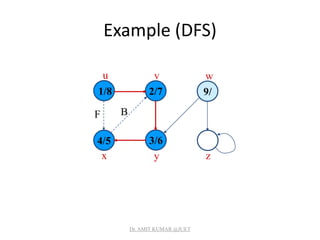
Example (DFS)
1/8
4/5 3/6
2/7 9/
u v w
x y z
BF
Dr. AMIT KUMAR @JUET
Example (DFS)
1/8
4/5 3/6
2/7 9/
u v w
x y z
BF C
Dr. AMIT KUMAR @JUET
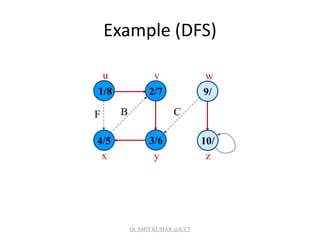
Example (DFS)
1/8
4/5 3/6 10/
2/7 9/
u v w
x y z
BF C
Dr. AMIT KUMAR @JUET
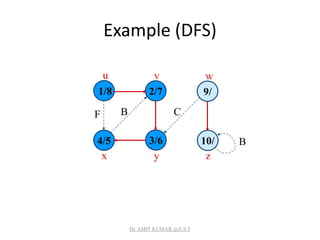
Example (DFS)
1/8
4/5 3/6 10/
2/7 9/
u v w
x y z
BF C
B
Dr. AMIT KUMAR @JUET
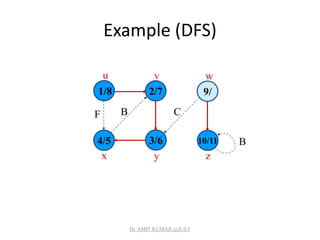
Example (DFS)
1/8
4/5 3/6 10/11
2/7 9/
u v w
x y z
BF C
B
Dr. AMIT KUMAR @JUET
Example (DFS)
1/8
4/5 3/6 10/11
2/7 9/12
u v w
x y z
BF C
B
Dr. AMIT KUMAR @JUET
Analysis of DFS
• Loops on lines 1-2 & 5-7 take (V) time, excluding time
to execute DFS-Visit.
• DFS-Visit is called once for each white vertex vV when
it’s painted gray the first time. Lines 3-6 of DFS-Visit is
executed |Adj[v]| times. The total cost of executing
DFS-Visit is vV|Adj[v]| = (E)
• Total running time of DFS is (V+E).
Dr. AMIT KUMAR @JUET
Depth-First Trees
• Predecessor subgraph defined slightly different from
that of BFS.
• The predecessor subgraph of DFS is G = (V, E) where
E ={([v],v) : v  V and [v]  NIL}.
– How does it differ from that of BFS?
– The predecessor subgraph G forms a depth-first forest
composed of several depth-first trees. The edges in E are
called tree edges.
Definition:
Forest: An acyclic graph G that may be disconnected.
Dr. AMIT KUMAR @JUET
Classification of Edges
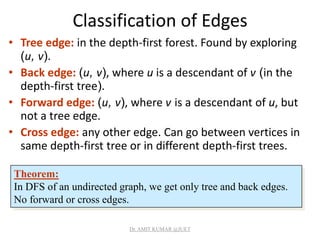
• Tree edge: in the depth-first forest. Found by exploring
(u, v).
• Back edge: (u, v), where u is a descendant of v (in the
depth-first tree).
• Forward edge: (u, v), where v is a descendant of u, but
not a tree edge.
• Cross edge: any other edge. Can go between vertices in
same depth-first tree or in different depth-first trees.
Theorem:
In DFS of an undirected graph, we get only tree and back edges.
No forward or cross edges.
Dr. AMIT KUMAR @JUET

Bfs dfs

  • 1.
  • 2.
    Graphs • Graph G= (V, E) – V = set of vertices – E = set of edges  (VV) • Types of graphs – Undirected: edge (u, v) = (v, u); for all v, (v, v)  E (No self loops.) – Directed: (u, v) is edge from u to v, denoted as u  v. Self loops are allowed. – Weighted: each edge has an associated weight, given by a weight function w : E  R. – Dense: |E|  |V|2. – Sparse: |E| << |V|2. • |E| = O(|V|2) Dr. AMIT KUMAR @JUET
  • 3.
    Graphs • If (u,v)  E, then vertex v is adjacent to vertex u. • Adjacency relationship is: – Symmetric if G is undirected. – Not necessarily so if G is directed. • If G is connected: – There is a path between every pair of vertices. – |E|  |V| – 1. – Furthermore, if |E| = |V| – 1, then G is a tree. • Other definitions in Appendix B (B.4 and B.5) as needed. Dr. AMIT KUMAR @JUET
  • 4.
    Representation of Graphs •Two standard ways. – Adjacency Lists. – Adjacency Matrix. a dc b a b c d b a d d c c a b a c a dc b 1 2 3 4 1 2 3 4 1 0 1 1 1 2 1 0 1 0 3 1 1 0 1 4 1 0 1 0 Dr. AMIT KUMAR @JUET
  • 5.
    Adjacency Lists • Consistsof an array Adj of |V| lists. • One list per vertex. • For u  V, Adj[u] consists of all vertices adjacent to u. a dc b a b c d b c d d c a dc b a b c d b a d d c c a b a c If weighted, store weights also in adjacency lists. Dr. AMIT KUMAR @JUET
  • 6.
    Storage Requirement • Fordirected graphs: – Sum of lengths of all adj. lists is out-degree(v) = |E| vV – Total storage: (V+E) • For undirected graphs: – Sum of lengths of all adj. lists is degree(v) = 2|E| vV – Total storage: (V+E) No. of edges leaving v No. of edges incident on v. Edge (u,v) is incident on vertices u and v. Dr. AMIT KUMAR @JUET
  • 7.
    Pros and Cons:adj list • Pros – Space-efficient, when a graph is sparse. – Can be modified to support many graph variants. • Cons – Determining if an edge (u,v) G is not efficient. • Have to search in u’s adjacency list. (degree(u)) time. • (V) in the worst case. Dr. AMIT KUMAR @JUET
  • 8.
    Adjacency Matrix • |V| |V| matrix A. • Number vertices from 1 to |V| in some arbitrary manner. • A is then given by:      otherwise0 ),(if1 ],[ Eji ajiA ij a dc b 1 2 3 4 1 2 3 4 1 0 1 1 1 2 0 0 1 0 3 0 0 0 1 4 0 0 0 0 a dc b 1 2 3 4 1 2 3 4 1 0 1 1 1 2 1 0 1 0 3 1 1 0 1 4 1 0 1 0 A = AT for undirected graphs. Dr. AMIT KUMAR @JUET
  • 9.
    Space and Time •Space: (V2). – Not memory efficient for large graphs. • Time: to list all vertices adjacent to u: (V). • Time: to determine if (u, v)  E: (1). • Can store weights instead of bits for weighted graph. Dr. AMIT KUMAR @JUET
  • 10.
    Graph-searching Algorithms • Searchinga graph: – Systematically follow the edges of a graph to visit the vertices of the graph. • Used to discover the structure of a graph. • Standard graph-searching algorithms. – Breadth-first Search (BFS). – Depth-first Search (DFS). Dr. AMIT KUMAR @JUET
  • 11.
    Breadth-first Search • Input:Graph G = (V, E), either directed or undirected, and source vertex s  V. • Output: – d[v] = distance (smallest # of edges, or shortest path) from s to v, for all v  V. d[v] =  if v is not reachable from s. – [v] = u such that (u, v) is last edge on shortest path s v. • u is v’s predecessor. – Builds breadth-first tree with root s that contains all reachable vertices. Definitions: Path between vertices u and v: Sequence of vertices (v1, v2, …, vk) such that u=v1 and v =vk, and (vi,vi+1)  E, for all 1 i  k-1. Length of the path: Number of edges in the path. Path is simple if no vertex is repeated. Error! Dr. AMIT KUMAR @JUET
  • 12.
    Breadth-first Search • Expandsthe frontier between discovered and undiscovered vertices uniformly across the breadth of the frontier. – A vertex is “discovered” the first time it is encountered during the search. – A vertex is “finished” if all vertices adjacent to it have been discovered. • Colors the vertices to keep track of progress. – White – Undiscovered. – Gray – Discovered but not finished. – Black – Finished. • Colors are required only to reason about the algorithm. Can be implemented without colors. Dr. AMIT KUMAR @JUET
  • 13.
    BFS(G,s) 1. for eachvertex u in V[G] – {s} 2 do color[u]  white 3 d[u]   4 [u]  nil 5 color[s]  gray 6 d[s]  0 7 [s]  nil 8 Q   9 enqueue(Q,s) 10 while Q   11 do u  dequeue(Q) 12 for each v in Adj[u] 13 do if color[v] = white 14 then color[v]  gray 15 d[v]  d[u] + 1 16 [v]  u 17 enqueue(Q,v) 18 color[u]  black white: undiscovered gray: discovered black: finished Q: a queue of discovered vertices color[v]: color of v d[v]: distance from s to v [u]: predecessor of v Example: animation. Dr. AMIT KUMAR @JUET
  • 14.
    Example (BFS)  0      r s t u v w x y Q: s 0 Dr. AMIT KUMAR @JUET
  • 15.
    Example (BFS) 1 0 1     r s t u v w x y Q: w r 1 1 Dr. AMIT KUMAR @JUET
  • 16.
    Example (BFS) 1 0 12  2   r s t u v w x y Q: r t x 1 2 2 Dr. AMIT KUMAR @JUET
  • 17.
    Example (BFS) 1 0 12  2  2 r s t u v w x y Q: t x v 2 2 2 Dr. AMIT KUMAR @JUET
  • 18.
    Example (BFS) 1 0 12  2 3 2 r s t u v w x y Q: x v u 2 2 3 Dr. AMIT KUMAR @JUET
  • 19.
    Example (BFS) 1 0 12 3 2 3 2 r s t u v w x y Q: v u y 2 3 3 Dr. AMIT KUMAR @JUET
  • 20.
    Example (BFS) 1 0 12 3 2 3 2 r s t u v w x y Q: u y 3 3 Dr. AMIT KUMAR @JUET
  • 21.
    Example (BFS) 1 0 12 3 2 3 2 r s t u v w x y Q: y 3 Dr. AMIT KUMAR @JUET
  • 22.
    Example (BFS) 1 0 12 3 2 3 2 r s t u v w x y Q:  Dr. AMIT KUMAR @JUET
  • 23.
    Example (BFS) 1 0 12 3 2 3 2 r s t u v w x y BF Tree Dr. AMIT KUMAR @JUET
  • 24.
    Analysis of BFS •Initialization takes O(V). • Traversal Loop – After initialization, each vertex is enqueued and dequeued at most once, and each operation takes O(1). So, total time for queuing is O(V). – The adjacency list of each vertex is scanned at most once. The sum of lengths of all adjacency lists is (E). • Summing up over all vertices => total running time of BFS is O(V+E), linear in the size of the adjacency list representation of graph. • Correctness Proof – We omit for BFS and DFS. – Will do for later algorithms. Dr. AMIT KUMAR @JUET
  • 25.
    Breadth-first Tree • Fora graph G = (V, E) with source s, the predecessor subgraph of G is G = (V , E) where – V ={vV : [v]  NIL}{s} – E ={([v],v)E : v  V - {s}} • The predecessor subgraph G is a breadth-first tree if: – V consists of the vertices reachable from s and – for all vV , there is a unique simple path from s to v in G that is also a shortest path from s to v in G. • The edges in E are called tree edges. |E | = |V | - 1. Dr. AMIT KUMAR @JUET
  • 26.
    Depth-first Search (DFS) •Explore edges out of the most recently discovered vertex v. • When all edges of v have been explored, backtrack to explore other edges leaving the vertex from which v was discovered (its predecessor). • “Search as deep as possible first.” • Continue until all vertices reachable from the original source are discovered. • If any undiscovered vertices remain, then one of them is chosen as a new source and search is repeated from that source. Dr. AMIT KUMAR @JUET
  • 27.
    Depth-first Search • Input:G = (V, E), directed or undirected. No source vertex given! • Output: – 2 timestamps on each vertex. Integers between 1 and 2|V|. • d[v] = discovery time (v turns from white to gray) • f [v] = finishing time (v turns from gray to black) – [v] : predecessor of v = u, such that v was discovered during the scan of u’s adjacency list. • Uses the same coloring scheme for vertices as BFS. Dr. AMIT KUMAR @JUET
  • 28.
    Pseudo-code DFS(G) 1. for eachvertex u  V[G] 2. do color[u]  white 3. [u]  NIL 4. time  0 5. for each vertex u  V[G] 6. do if color[u] = white 7. then DFS-Visit(u) Uses a global timestamp time. DFS-Visit(u) 1. color[u]  GRAY  White vertex u has been discovered 2. time  time + 1 3. d[u]  time 4. for each v  Adj[u] 5. do if color[v] = WHITE 6. then [v]  u 7. DFS-Visit(v) 8. color[u]  BLACK  Blacken u; it is finished. 9. f[u]  time  time + 1 Dr. AMIT KUMAR @JUET
  • 29.
    Example (DFS) 1/ u vw x y z Dr. AMIT KUMAR @JUET
  • 30.
    Example (DFS) 1/ 2/ uv w x y z Dr. AMIT KUMAR @JUET
  • 31.
    Example (DFS) 1/ 3/ 2/ u vw x y z Dr. AMIT KUMAR @JUET
  • 32.
    Example (DFS) 1/ 4/ 3/ 2/ uv w x y z Dr. AMIT KUMAR @JUET
  • 33.
    Example (DFS) 1/ 4/ 3/ 2/ uv w x y z B Dr. AMIT KUMAR @JUET
  • 34.
    Example (DFS) 1/ 4/5 3/ 2/ uv w x y z B Dr. AMIT KUMAR @JUET
  • 35.
    Example (DFS) 1/ 4/5 3/6 2/ uv w x y z B Dr. AMIT KUMAR @JUET
  • 36.
    Example (DFS) 1/ 4/5 3/6 2/7 uv w x y z B Dr. AMIT KUMAR @JUET
  • 37.
    Example (DFS) 1/ 4/5 3/6 2/7 uv w x y z BF Dr. AMIT KUMAR @JUET
  • 38.
    Example (DFS) 1/8 4/5 3/6 2/7 uv w x y z BF Dr. AMIT KUMAR @JUET
  • 39.
    Example (DFS) 1/8 4/5 3/6 2/79/ u v w x y z BF Dr. AMIT KUMAR @JUET
  • 40.
    Example (DFS) 1/8 4/5 3/6 2/79/ u v w x y z BF C Dr. AMIT KUMAR @JUET
  • 41.
    Example (DFS) 1/8 4/5 3/610/ 2/7 9/ u v w x y z BF C Dr. AMIT KUMAR @JUET
  • 42.
    Example (DFS) 1/8 4/5 3/610/ 2/7 9/ u v w x y z BF C B Dr. AMIT KUMAR @JUET
  • 43.
    Example (DFS) 1/8 4/5 3/610/11 2/7 9/ u v w x y z BF C B Dr. AMIT KUMAR @JUET
  • 44.
    Example (DFS) 1/8 4/5 3/610/11 2/7 9/12 u v w x y z BF C B Dr. AMIT KUMAR @JUET
  • 45.
    Analysis of DFS •Loops on lines 1-2 & 5-7 take (V) time, excluding time to execute DFS-Visit. • DFS-Visit is called once for each white vertex vV when it’s painted gray the first time. Lines 3-6 of DFS-Visit is executed |Adj[v]| times. The total cost of executing DFS-Visit is vV|Adj[v]| = (E) • Total running time of DFS is (V+E). Dr. AMIT KUMAR @JUET
  • 46.
    Depth-First Trees • Predecessorsubgraph defined slightly different from that of BFS. • The predecessor subgraph of DFS is G = (V, E) where E ={([v],v) : v  V and [v]  NIL}. – How does it differ from that of BFS? – The predecessor subgraph G forms a depth-first forest composed of several depth-first trees. The edges in E are called tree edges. Definition: Forest: An acyclic graph G that may be disconnected. Dr. AMIT KUMAR @JUET
  • 47.
    Classification of Edges •Tree edge: in the depth-first forest. Found by exploring (u, v). • Back edge: (u, v), where u is a descendant of v (in the depth-first tree). • Forward edge: (u, v), where v is a descendant of u, but not a tree edge. • Cross edge: any other edge. Can go between vertices in same depth-first tree or in different depth-first trees. Theorem: In DFS of an undirected graph, we get only tree and back edges. No forward or cross edges. Dr. AMIT KUMAR @JUET