
Chapter 24
Minimum Spanning Trees
Dr. Muhammad Hanif Durad
Department of Computer and Information Sciences
Pakistan Institute Engineering and Applied Sciences
hanif@pieas.edu.pk
Some slides have bee adapted with thanks from some other lectures
available on Internet. It made my life easier, thanks to Allah
Almighty .
Lecture Outline
 Motivation
 Properties of minimum spanning trees
 Kruskal’s algorithm
 Prim’s algorithm
lect13.ppt
Facts about (Free) Trees
 A tree with n vertices has exactly n-1 edges
(|E| = |V| - 1)
 There exists a unique path between any two
vertices of a tree
 Adding any edge to a tree creates a unique cycle;
breaking any edge on this cycle restores a tree
For details see CLRS Appendix B.5.1
Dr. Hanif Durad 3
24.ppt, p-7
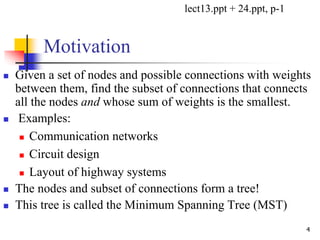
Motivation
 Given a set of nodes and possible connections with weights
between them, find the subset of connections that connects
all the nodes and whose sum of weights is the smallest.
 Examples:
 Communication networks
 Circuit design
 Layout of highway systems
 The nodes and subset of connections form a tree!
 This tree is called the Minimum Spanning Tree (MST)
4
lect13.ppt + 24.ppt, p-1
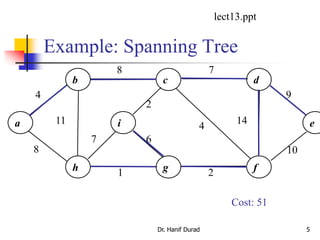
Example: Spanning Tree
Dr. Hanif Durad 5
b c d
h g f
ia e
8 7
1 2
11 14
4
8
7 6
2
4
9
10
Cost: 51
lect13.ppt
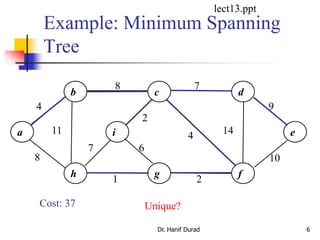
Example: Minimum Spanning
Tree
Dr. Hanif Durad 6
b c d
h g f
ia e
8 7
1 2
11 14
4
8
7 6
2
4
9
10
Cost: 37
lect13.ppt
Unique?
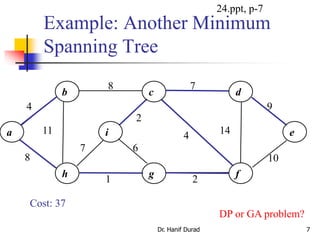
Example: Another Minimum
Spanning Tree
Dr. Hanif Durad 7
b c d
h g f
ia e
8 7
1 2
11 14
4
8
7 6
2
4
9
10
Cost: 37
24.ppt, p-7
DP or GA problem?
Optimal Substructure
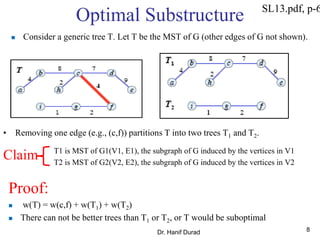
• Removing one edge (e.g., (c,f)) partitions T into two trees T1 and T2.
 Consider a generic tree T. Let T be the MST of G (other edges of G not shown).
T1 is MST of G1(V1, E1), the subgraph of G induced by the vertices in V1
T2 is MST of G2(V2, E2), the subgraph of G induced by the vertices in V2
Claim
SL13.pdf, p-6
Proof:
 w(T) = w(c,f) + w(T1) + w(T2)
 There can not be better trees than T1 or T2, or T would be suboptimal
Dr. Hanif Durad 8
Formal Definition of MST
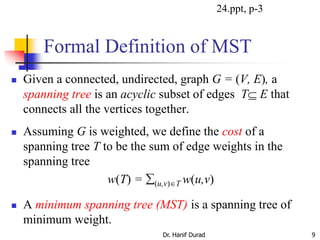
 Given a connected, undirected, graph G = (V, E), a
spanning tree is an acyclic subset of edges T E that
connects all the vertices together.
 Assuming G is weighted, we define the cost of a
spanning tree T to be the sum of edge weights in the
spanning tree
w(T) = (u,v)T w(u,v)
 A minimum spanning tree (MST) is a spanning tree of
minimum weight.
24.ppt, p-3
Dr. Hanif Durad 9
Intuition Behind Greedy MST
 We maintain in a subset of edges A, which will initially
be empty, and we will add edges one at a time, until
equals the MST. We say that a subset A E is viable if
A is a subset of edges in some MST. We say that an
edge (u,v)  E-A is safe if A{(u,v)} is viable.
 Basically, the choice (u,v) is a safe choice to add so that
A can still be extended to form an MST. Note that if A is
viable it cannot contain a cycle. A generic greedy
algorithm operates by repeatedly adding any safe edge to
the current spanning tree.
Dr. Hanif Durad 10
24.ppt, p-8
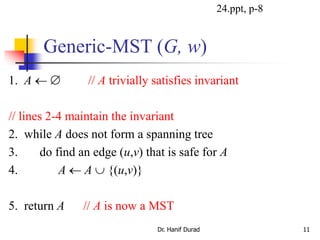
Generic-MST (G, w)
1. A   // A trivially satisfies invariant
// lines 2-4 maintain the invariant
2. while A does not form a spanning tree
3. do find an edge (u,v) that is safe for A
4. A  A  {(u,v)}
5. return A // A is now a MST
Dr. Hanif Durad 11
24.ppt, p-8
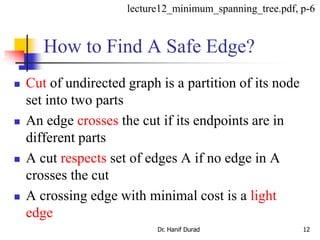
How to Find A Safe Edge?
 Cut of undirected graph is a partition of its node
set into two parts
 An edge crosses the cut if its endpoints are in
different parts
 A cut respects set of edges A if no edge in A
crosses the cut
 A crossing edge with minimal cost is a light
edge
12
lecture12_minimum_spanning_tree.pdf, p-6
Dr. Hanif Durad
Dr. Hanif Durad 13
unit15.ppt, p-8
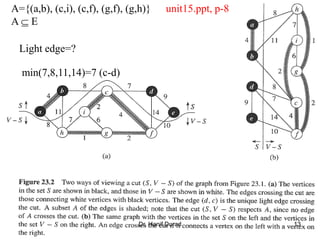
Light edge=?
min(7,8,11,14)=7 (c-d)
A={(a,b), (c,i), (c,f), (g,f), (g,h)}
A  E
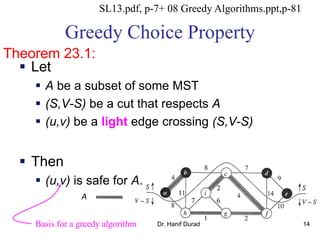
Greedy Choice Property
Theorem 23.1:
SL13.pdf, p-7+ 08 Greedy Algorithms.ppt,p-81
 Let
 A be a subset of some MST
 (S,V-S) be a cut that respects A
 (u,v) be a light edge crossing (S,V-S)
 Then
 (u,v) is safe for A.
A
Basis for a greedy algorithm 14Dr. Hanif Durad
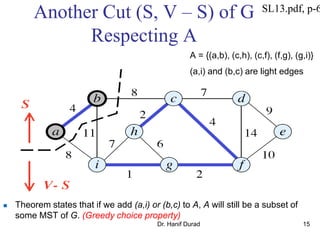
Another Cut (S, V – S) of G
Respecting A
A = {(a,b), (c,h), (c,f), (f,g), (g,i)}
SL13.pdf, p-6
 Theorem states that if we add (a,i) or (b,c) to A, A will still be a subset of
some MST of G. (Greedy choice property)
(a,i) and (b,c) are light edges
15Dr. Hanif Durad
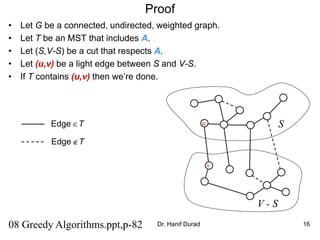
Proof
• Let G be a connected, undirected, weighted graph.
• Let T be an MST that includes A.
• Let (S,V-S) be a cut that respects A.
• Let (u,v) be a light edge between S and V-S.
• If T contains (u,v) then we’re done.
u
v
S
V - S
Edge T
Edge T
16Dr. Hanif Durad08 Greedy Algorithms.ppt,p-82
u
x
v
y
S
V - S
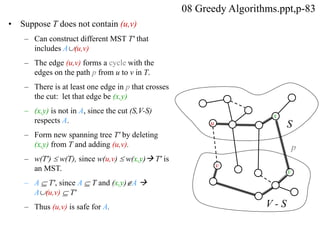
• Suppose T does not contain (u,v)
– Can construct different MST T' that
includes A(u,v)
– The edge (u,v) forms a cycle with the
edges on the path p from u to v in T.
– There is at least one edge in p that crosses
the cut: let that edge be (x,y)
– (x,y) is not in A, since the cut (S,V-S)
respects A.
– Form new spanning tree T' by deleting
(x,y) from T and adding (u,v).
– w(T')  w(T), since w(u,v)  w(x,y) T' is
an MST.
– A  T', since A  T and (x,y)A 
A(u,v)  T'
– Thus (u,v) is safe for A.
p
08 Greedy Algorithms.ppt,p-83
Assignment 1
 Problems 23.1-1 23.1-7, 23.1-10 Page 566
567
 Last Date
 Tuesday -22 June 2010
Dr. Hanif Durad 18
Greedy Algorithms
 Different greedy rules can be used to select the
next vertex to add to the MST being built
1. Krushkal’s Algorithm
2. Prim’s Algorithm
Dr. Hanif Durad 19
SL13.pdf, p-7
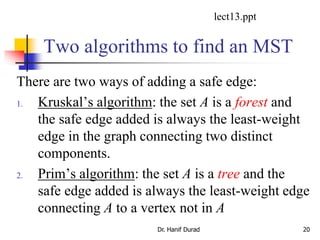
Two algorithms to find an MST
There are two ways of adding a safe edge:
1. Kruskal’s algorithm: the set A is a forest and
the safe edge added is always the least-weight
edge in the graph connecting two distinct
components.
2. Prim’s algorithm: the set A is a tree and the
safe edge added is always the least-weight edge
connecting A to a vertex not in A
Dr. Hanif Durad 20
lect13.ppt
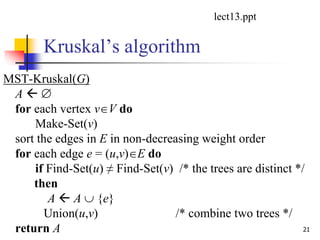
Kruskal’s algorithm
MST-Kruskal(G)
A  
for each vertex vV do
Make-Set(v)
sort the edges in E in non-decreasing weight order
for each edge e = (u,v)E do
if Find-Set(u) ≠ Find-Set(v) /* the trees are distinct */
then
A  A  {e}
Union(u,v) /* combine two trees */
return A 21
lect13.ppt
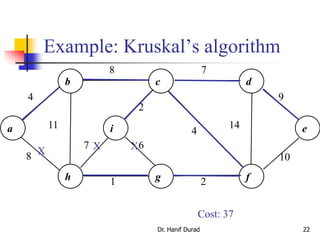
Example: Kruskal’s algorithm
Dr. Hanif Durad 22
b c d
h g f
ia e
8 7
1 2
11 14
4
8
7 6
2
4
9
10
XX
Cost: 37
X
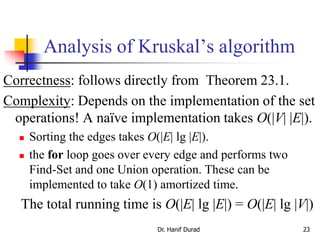
Analysis of Kruskal’s algorithm
Dr. Hanif Durad 23
Correctness: follows directly from Theorem 23.1.
Complexity: Depends on the implementation of the set
operations! A naïve implementation takes O(|V| |E|).
 Sorting the edges takes O(|E| lg |E|).
 the for loop goes over every edge and performs two
Find-Set and one Union operation. These can be
implemented to take O(1) amortized time.
The total running time is O(|E| lg |E|) = O(|E| lg |V|)
Prim’s algorithm
MST-Prim(G, root)
for each vertex vV do
key(v)  ∞; π[v]  null
key(root)  0; Q  V
while Q is not empty do
u  Extract-Min(Q)
for each v that is a neighbor of u do
if vQ and w(u,v) < key(v)
then π[v]  u
key(v)  w(u,v) /*decrease value of key */
Note: A = {(v, [v]) : v  v - {r} - Q}.
21-greedy.ppt
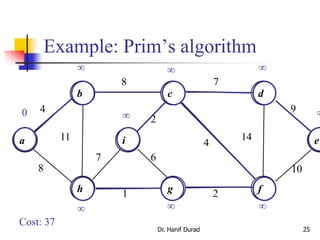
Example: Prim’s algorithm
Dr. Hanif Durad 25
b c d
h g f
ia e
8 7
1 2
11 14
4
8
7 6
2
4
9
10
Cost: 37
∞0
∞ ∞ ∞
∞
∞∞∞
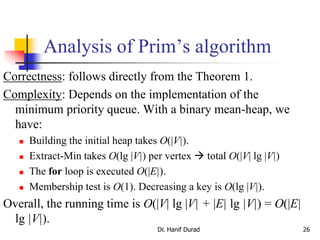
Analysis of Prim’s algorithm
Correctness: follows directly from the Theorem 1.
Complexity: Depends on the implementation of the
minimum priority queue. With a binary mean-heap, we
have:
 Building the initial heap takes O(|V|).
 Extract-Min takes O(lg |V|) per vertex  total O(|V| lg |V|)
 The for loop is executed O(|E|).
 Membership test is O(1). Decreasing a key is O(lg |V|).
Overall, the running time is O(|V| lg |V| + |E| lg |V|) = O(|E|
lg |V|).
Dr. Hanif Durad 26
Assignment 2
 Section Problems 23.2-1 23.2-5, 23.2-8 Page
574 574
 Chapter Problems 23-1, 23-323-4
 C++ coding for Kruskal’s and Prim’s
Algorithms
 Last Date
 Tuesday -22 June 2010
Dr. Hanif Durad 27

Chapter 24 aoa

  • 1.
    Chapter 24 Minimum SpanningTrees Dr. Muhammad Hanif Durad Department of Computer and Information Sciences Pakistan Institute Engineering and Applied Sciences hanif@pieas.edu.pk Some slides have bee adapted with thanks from some other lectures available on Internet. It made my life easier, thanks to Allah Almighty .
  • 2.
    Lecture Outline  Motivation Properties of minimum spanning trees  Kruskal’s algorithm  Prim’s algorithm lect13.ppt
  • 3.
    Facts about (Free)Trees  A tree with n vertices has exactly n-1 edges (|E| = |V| - 1)  There exists a unique path between any two vertices of a tree  Adding any edge to a tree creates a unique cycle; breaking any edge on this cycle restores a tree For details see CLRS Appendix B.5.1 Dr. Hanif Durad 3 24.ppt, p-7
  • 4.
    Motivation  Given aset of nodes and possible connections with weights between them, find the subset of connections that connects all the nodes and whose sum of weights is the smallest.  Examples:  Communication networks  Circuit design  Layout of highway systems  The nodes and subset of connections form a tree!  This tree is called the Minimum Spanning Tree (MST) 4 lect13.ppt + 24.ppt, p-1
  • 5.
    Example: Spanning Tree Dr.Hanif Durad 5 b c d h g f ia e 8 7 1 2 11 14 4 8 7 6 2 4 9 10 Cost: 51 lect13.ppt
  • 6.
    Example: Minimum Spanning Tree Dr.Hanif Durad 6 b c d h g f ia e 8 7 1 2 11 14 4 8 7 6 2 4 9 10 Cost: 37 lect13.ppt Unique?
  • 7.
    Example: Another Minimum SpanningTree Dr. Hanif Durad 7 b c d h g f ia e 8 7 1 2 11 14 4 8 7 6 2 4 9 10 Cost: 37 24.ppt, p-7 DP or GA problem?
  • 8.
    Optimal Substructure • Removingone edge (e.g., (c,f)) partitions T into two trees T1 and T2.  Consider a generic tree T. Let T be the MST of G (other edges of G not shown). T1 is MST of G1(V1, E1), the subgraph of G induced by the vertices in V1 T2 is MST of G2(V2, E2), the subgraph of G induced by the vertices in V2 Claim SL13.pdf, p-6 Proof:  w(T) = w(c,f) + w(T1) + w(T2)  There can not be better trees than T1 or T2, or T would be suboptimal Dr. Hanif Durad 8
  • 9.
    Formal Definition ofMST  Given a connected, undirected, graph G = (V, E), a spanning tree is an acyclic subset of edges T E that connects all the vertices together.  Assuming G is weighted, we define the cost of a spanning tree T to be the sum of edge weights in the spanning tree w(T) = (u,v)T w(u,v)  A minimum spanning tree (MST) is a spanning tree of minimum weight. 24.ppt, p-3 Dr. Hanif Durad 9
  • 10.
    Intuition Behind GreedyMST  We maintain in a subset of edges A, which will initially be empty, and we will add edges one at a time, until equals the MST. We say that a subset A E is viable if A is a subset of edges in some MST. We say that an edge (u,v)  E-A is safe if A{(u,v)} is viable.  Basically, the choice (u,v) is a safe choice to add so that A can still be extended to form an MST. Note that if A is viable it cannot contain a cycle. A generic greedy algorithm operates by repeatedly adding any safe edge to the current spanning tree. Dr. Hanif Durad 10 24.ppt, p-8
  • 11.
    Generic-MST (G, w) 1.A   // A trivially satisfies invariant // lines 2-4 maintain the invariant 2. while A does not form a spanning tree 3. do find an edge (u,v) that is safe for A 4. A  A  {(u,v)} 5. return A // A is now a MST Dr. Hanif Durad 11 24.ppt, p-8
  • 12.
    How to FindA Safe Edge?  Cut of undirected graph is a partition of its node set into two parts  An edge crosses the cut if its endpoints are in different parts  A cut respects set of edges A if no edge in A crosses the cut  A crossing edge with minimal cost is a light edge 12 lecture12_minimum_spanning_tree.pdf, p-6 Dr. Hanif Durad
  • 13.
    Dr. Hanif Durad13 unit15.ppt, p-8 Light edge=? min(7,8,11,14)=7 (c-d) A={(a,b), (c,i), (c,f), (g,f), (g,h)} A  E
  • 14.
    Greedy Choice Property Theorem23.1: SL13.pdf, p-7+ 08 Greedy Algorithms.ppt,p-81  Let  A be a subset of some MST  (S,V-S) be a cut that respects A  (u,v) be a light edge crossing (S,V-S)  Then  (u,v) is safe for A. A Basis for a greedy algorithm 14Dr. Hanif Durad
  • 15.
    Another Cut (S,V – S) of G Respecting A A = {(a,b), (c,h), (c,f), (f,g), (g,i)} SL13.pdf, p-6  Theorem states that if we add (a,i) or (b,c) to A, A will still be a subset of some MST of G. (Greedy choice property) (a,i) and (b,c) are light edges 15Dr. Hanif Durad
  • 16.
    Proof • Let Gbe a connected, undirected, weighted graph. • Let T be an MST that includes A. • Let (S,V-S) be a cut that respects A. • Let (u,v) be a light edge between S and V-S. • If T contains (u,v) then we’re done. u v S V - S Edge T Edge T 16Dr. Hanif Durad08 Greedy Algorithms.ppt,p-82
  • 17.
    u x v y S V - S •Suppose T does not contain (u,v) – Can construct different MST T' that includes A(u,v) – The edge (u,v) forms a cycle with the edges on the path p from u to v in T. – There is at least one edge in p that crosses the cut: let that edge be (x,y) – (x,y) is not in A, since the cut (S,V-S) respects A. – Form new spanning tree T' by deleting (x,y) from T and adding (u,v). – w(T')  w(T), since w(u,v)  w(x,y) T' is an MST. – A  T', since A  T and (x,y)A  A(u,v)  T' – Thus (u,v) is safe for A. p 08 Greedy Algorithms.ppt,p-83
  • 18.
    Assignment 1  Problems23.1-1 23.1-7, 23.1-10 Page 566 567  Last Date  Tuesday -22 June 2010 Dr. Hanif Durad 18
  • 19.
    Greedy Algorithms  Differentgreedy rules can be used to select the next vertex to add to the MST being built 1. Krushkal’s Algorithm 2. Prim’s Algorithm Dr. Hanif Durad 19 SL13.pdf, p-7
  • 20.
    Two algorithms tofind an MST There are two ways of adding a safe edge: 1. Kruskal’s algorithm: the set A is a forest and the safe edge added is always the least-weight edge in the graph connecting two distinct components. 2. Prim’s algorithm: the set A is a tree and the safe edge added is always the least-weight edge connecting A to a vertex not in A Dr. Hanif Durad 20 lect13.ppt
  • 21.
    Kruskal’s algorithm MST-Kruskal(G) A  for each vertex vV do Make-Set(v) sort the edges in E in non-decreasing weight order for each edge e = (u,v)E do if Find-Set(u) ≠ Find-Set(v) /* the trees are distinct */ then A  A  {e} Union(u,v) /* combine two trees */ return A 21 lect13.ppt
  • 22.
    Example: Kruskal’s algorithm Dr.Hanif Durad 22 b c d h g f ia e 8 7 1 2 11 14 4 8 7 6 2 4 9 10 XX Cost: 37 X
  • 23.
    Analysis of Kruskal’salgorithm Dr. Hanif Durad 23 Correctness: follows directly from Theorem 23.1. Complexity: Depends on the implementation of the set operations! A naïve implementation takes O(|V| |E|).  Sorting the edges takes O(|E| lg |E|).  the for loop goes over every edge and performs two Find-Set and one Union operation. These can be implemented to take O(1) amortized time. The total running time is O(|E| lg |E|) = O(|E| lg |V|)
  • 24.
    Prim’s algorithm MST-Prim(G, root) foreach vertex vV do key(v)  ∞; π[v]  null key(root)  0; Q  V while Q is not empty do u  Extract-Min(Q) for each v that is a neighbor of u do if vQ and w(u,v) < key(v) then π[v]  u key(v)  w(u,v) /*decrease value of key */ Note: A = {(v, [v]) : v  v - {r} - Q}. 21-greedy.ppt
  • 25.
    Example: Prim’s algorithm Dr.Hanif Durad 25 b c d h g f ia e 8 7 1 2 11 14 4 8 7 6 2 4 9 10 Cost: 37 ∞0 ∞ ∞ ∞ ∞ ∞∞∞
  • 26.
    Analysis of Prim’salgorithm Correctness: follows directly from the Theorem 1. Complexity: Depends on the implementation of the minimum priority queue. With a binary mean-heap, we have:  Building the initial heap takes O(|V|).  Extract-Min takes O(lg |V|) per vertex  total O(|V| lg |V|)  The for loop is executed O(|E|).  Membership test is O(1). Decreasing a key is O(lg |V|). Overall, the running time is O(|V| lg |V| + |E| lg |V|) = O(|E| lg |V|). Dr. Hanif Durad 26
  • 27.
    Assignment 2  SectionProblems 23.2-1 23.2-5, 23.2-8 Page 574 574  Chapter Problems 23-1, 23-323-4  C++ coding for Kruskal’s and Prim’s Algorithms  Last Date  Tuesday -22 June 2010 Dr. Hanif Durad 27