Optics – geometrical optics
Contents
Postulates of ray optics
Optical components
-Mirrors
-Lenses
-Stops and pupils
Matrix optics
Ray Optics
Ray optics is the simplest theory of light
Light is described by rays that travel in different optical
media in accordance with a set of geometrical rules
Ray optics is also known as Geometrical Optics
Useful for studying image formation
Ray Optics
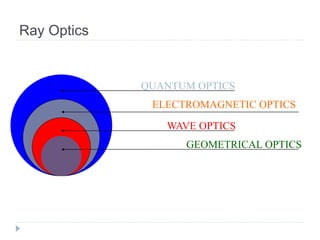
QUANTUM OPTICS
ELECTROMAGNETIC OPTICS
WAVE OPTICS
GEOMETRICAL OPTICS
Postulates of Ray Optics
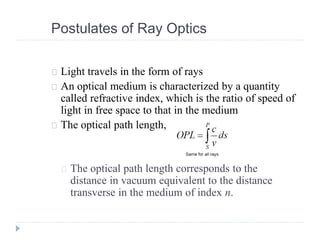
Light travels in the form of rays
An optical medium is characterized by a quantity
called refractive index, which is the ratio of speed of
light in free space to that in the medium
The optical path length,
The optical path length corresponds to the
distance in vacuum equivalent to the distance
transverse in the medium of index n.
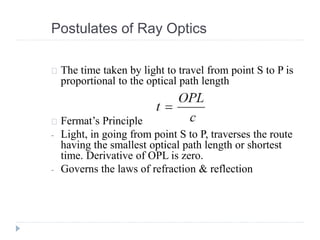
The time taken by light to travel from point S to P is
proportional to the optical path length
Fermat’s Principle
- Light, in going from point S to P, traverses the route
having the smallest optical path length or shortest
time. Derivative of OPL is zero.
- Governs the laws of refraction & reflection
Postulates of Ray Optics
Plane of Incident
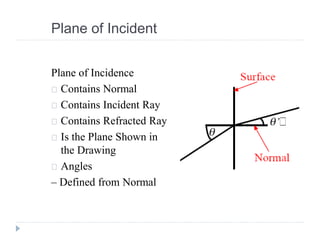
Plane of Incidence
Contains Normal
Contains Incident Ray
Contains Refracted Ray
Is the Plane Shown in
the Drawing
Angles
– Defined from Normal
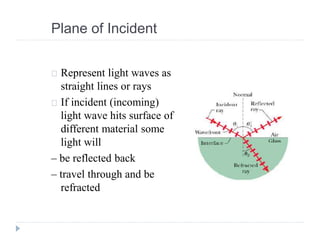
Represent light waves as
straight lines or rays
If incident (incoming)
light wave hits surface of
different material some
light will
– be reflected back
– travel through and be
refracted
Plane of Incident
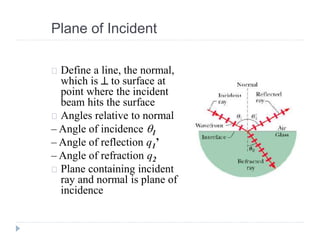
Define a line, the normal,
which is  to surface at
point where the incident
beam hits the surface
Angles relative to normal
– Angle of incidence 1
– Angle of reflection q1’
– Angle of refraction q2
Plane containing incident
ray and normal is plane of
incidence
Plane of Incident
Reflection & Refraction
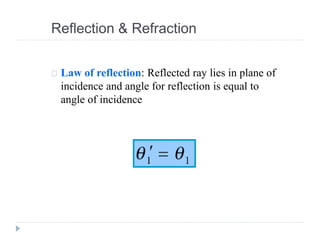
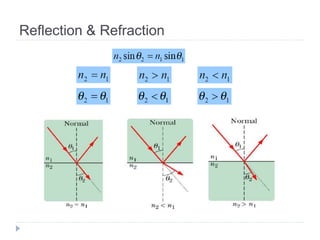
Law of reflection: Reflected ray lies in plane of
incidence and angle for reflection is equal to
angle of incidence
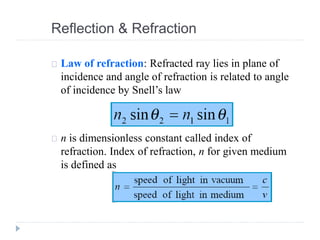
Law of refraction: Refracted ray lies in plane of
incidence and angle of refraction is related to angle
of incidence by Snell’s law
n is dimensionless constant called index of
refraction. Index of refraction, n for given medium
is defined as
Reflection & Refraction
Exercise
Use Fermat’s principle to derive the law of reflection and
law of refraction.
Reflection & Refraction
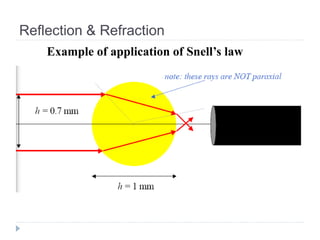
Example of application of Snell’s law
Exercise
A beam of collimated light traveling in air makes an angle of
30o to the normal of a glass plate. If the index of the glass is
ng = 3/2, determine the direction of the transmitted beam
within the plate.
Reflection & Refraction
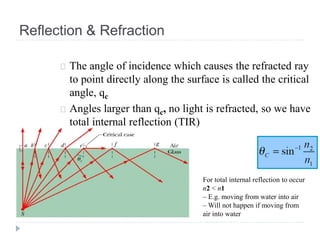
The angle of incidence which causes the refracted ray
to point directly along the surface is called the critical
angle, qc
Angles larger than qc, no light is refracted, so we have
total internal reflection (TIR)
For total internal reflection to occur
n2 < n1
– E.g. moving from water into air
– Will not happen if moving from
air into water
Dispersion
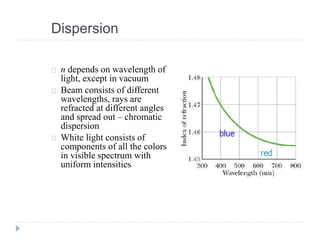
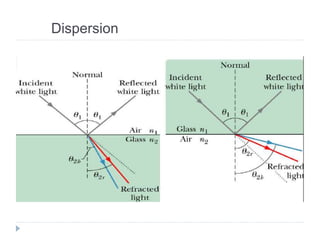
n depends on wavelength of
light, except in vacuum
Beam consists of different
wavelengths, rays are
refracted at different angles
and spread out – chromatic
dispersion
White light consists of
components of all the colors
in visible spectrum with
uniform intensities
Dispersion
Imaging
First, Assume a Point Object
Spherical Wavefronts and Radial Rays
Define Object Location
Find Image Location
Real or Virtual?
Next Assume an Extended Object
Compute Magnification
Transverse, Longitudinal, Angular
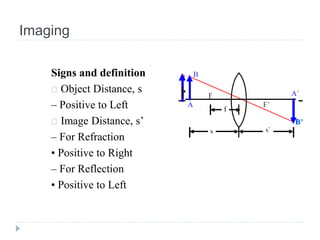
Signs and definition
Object Distance, s
– Positive to Left
Image Distance, s’
– For Refraction
• Positive to Right
– For Reflection
• Positive to Left
B’
Imaging
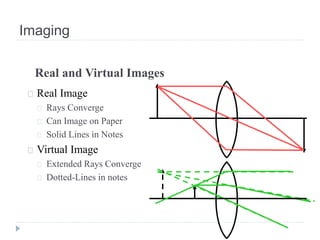
Imaging
Real Image
Rays Converge
Can Image on Paper
Solid Lines in Notes
Virtual Image
Extended Rays Converge
Dotted-Lines in notes
Real and Virtual Images
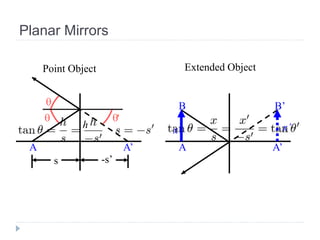
Planar Mirrors
Point Object Extended Object


A A’
-s’s

A A’
B B’
h
x x’
‘
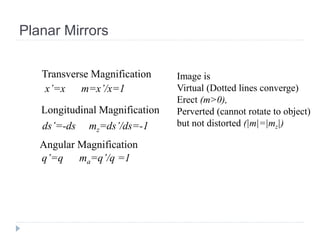
Planar Mirrors
x’=x m=x’/x=1
Transverse Magnification
ds’=-ds mz=ds’/ds=-1
Longitudinal Magnification
q’=q ma=q’/q =1
Angular Magnification
Image is
Virtual (Dotted lines converge)
Erect (m>0),
Perverted (cannot rotate to object)
but not distorted (|m|=|mz|)
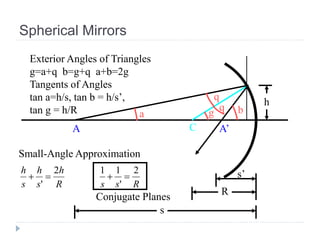
Spherical Mirrors
CA A’
q
q
a bg
s
s’
R
h
Small-Angle Approximation
R
h
s
h
s
h 2
'

Rss
2
'
11

Conjugate Planes
Exterior Angles of Triangles
g=a+q b=g+q a+b=2g
Tangents of Angles
tan a=h/s, tan b = h/s’,
tan g = h/R
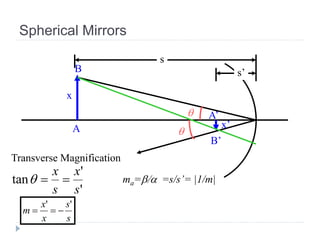
Spherical Mirrors
A
A’
s
s’B
B’
Transverse Magnification
'
'
tan
s
x
s
x

s
s
x
x
m
''

ma=b/a =s/s’= |1/m|
x
x’


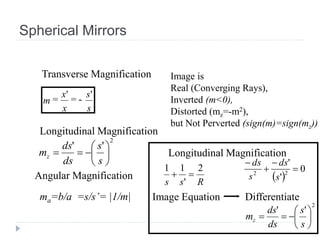
Spherical Mirrors
2
''







s
s
ds
ds
mz
Image is
Real (Converging Rays),
Inverted (m<0),
Distorted (mz=-m2),
but Not Perverted (sign(m)=sign(mz))
ma=b/a =s/s’= |1/m|
Transverse Magnification
Longitudinal Magnification
Angular Magnification
s
s
x
x
m
''
-==
Rss
2
'
11
  
0
'
'
22




s
ds
s
ds
Image Equation Differentiate
2
''







s
s
ds
ds
mz
Longitudinal Magnification
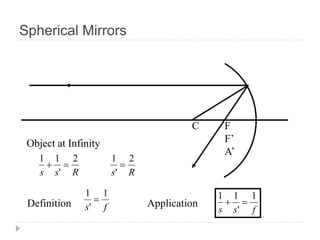
Spherical Mirrors
F
F’
A’
Object at Infinity
Rss
2
'
11

Rs
2
'
1

fs
1
'
1
Definition Application
fss
1
'
11

C
Exercise
Show that a spherical mirror equation is applicable to a
planar reflecting surface.
A one-inch tall candle is set three inches in front of a
concave spherical mirror having a one-foot radius.
Describe the resulting image.

Chapter 2 geometrical_optics_a

  • 1.
  • 2.
    Contents Postulates of rayoptics Optical components -Mirrors -Lenses -Stops and pupils Matrix optics
  • 3.
    Ray Optics Ray opticsis the simplest theory of light Light is described by rays that travel in different optical media in accordance with a set of geometrical rules Ray optics is also known as Geometrical Optics Useful for studying image formation
  • 4.
    Ray Optics QUANTUM OPTICS ELECTROMAGNETICOPTICS WAVE OPTICS GEOMETRICAL OPTICS
  • 5.
    Postulates of RayOptics Light travels in the form of rays An optical medium is characterized by a quantity called refractive index, which is the ratio of speed of light in free space to that in the medium The optical path length, The optical path length corresponds to the distance in vacuum equivalent to the distance transverse in the medium of index n.
  • 6.
    The time takenby light to travel from point S to P is proportional to the optical path length Fermat’s Principle - Light, in going from point S to P, traverses the route having the smallest optical path length or shortest time. Derivative of OPL is zero. - Governs the laws of refraction & reflection Postulates of Ray Optics
  • 7.
    Plane of Incident Planeof Incidence Contains Normal Contains Incident Ray Contains Refracted Ray Is the Plane Shown in the Drawing Angles – Defined from Normal
  • 8.
    Represent light wavesas straight lines or rays If incident (incoming) light wave hits surface of different material some light will – be reflected back – travel through and be refracted Plane of Incident
  • 9.
    Define a line,the normal, which is  to surface at point where the incident beam hits the surface Angles relative to normal – Angle of incidence 1 – Angle of reflection q1’ – Angle of refraction q2 Plane containing incident ray and normal is plane of incidence Plane of Incident
  • 10.
    Reflection & Refraction Lawof reflection: Reflected ray lies in plane of incidence and angle for reflection is equal to angle of incidence
  • 11.
    Law of refraction:Refracted ray lies in plane of incidence and angle of refraction is related to angle of incidence by Snell’s law n is dimensionless constant called index of refraction. Index of refraction, n for given medium is defined as Reflection & Refraction
  • 12.
    Exercise Use Fermat’s principleto derive the law of reflection and law of refraction.
  • 13.
  • 14.
    Reflection & Refraction Exampleof application of Snell’s law
  • 15.
    Exercise A beam ofcollimated light traveling in air makes an angle of 30o to the normal of a glass plate. If the index of the glass is ng = 3/2, determine the direction of the transmitted beam within the plate.
  • 16.
    Reflection & Refraction Theangle of incidence which causes the refracted ray to point directly along the surface is called the critical angle, qc Angles larger than qc, no light is refracted, so we have total internal reflection (TIR) For total internal reflection to occur n2 < n1 – E.g. moving from water into air – Will not happen if moving from air into water
  • 17.
    Dispersion n depends onwavelength of light, except in vacuum Beam consists of different wavelengths, rays are refracted at different angles and spread out – chromatic dispersion White light consists of components of all the colors in visible spectrum with uniform intensities
  • 18.
  • 19.
    Imaging First, Assume aPoint Object Spherical Wavefronts and Radial Rays Define Object Location Find Image Location Real or Virtual? Next Assume an Extended Object Compute Magnification Transverse, Longitudinal, Angular
  • 20.
    Signs and definition ObjectDistance, s – Positive to Left Image Distance, s’ – For Refraction • Positive to Right – For Reflection • Positive to Left B’ Imaging
  • 21.
    Imaging Real Image Rays Converge CanImage on Paper Solid Lines in Notes Virtual Image Extended Rays Converge Dotted-Lines in notes Real and Virtual Images
  • 22.
    Planar Mirrors Point ObjectExtended Object   A A’ -s’s  A A’ B B’ h x x’ ‘
  • 23.
    Planar Mirrors x’=x m=x’/x=1 TransverseMagnification ds’=-ds mz=ds’/ds=-1 Longitudinal Magnification q’=q ma=q’/q =1 Angular Magnification Image is Virtual (Dotted lines converge) Erect (m>0), Perverted (cannot rotate to object) but not distorted (|m|=|mz|)
  • 24.
    Spherical Mirrors CA A’ q q abg s s’ R h Small-Angle Approximation R h s h s h 2 '  Rss 2 ' 11  Conjugate Planes Exterior Angles of Triangles g=a+q b=g+q a+b=2g Tangents of Angles tan a=h/s, tan b = h/s’, tan g = h/R
  • 25.
  • 26.
    Spherical Mirrors 2 ''        s s ds ds mz Image is Real(Converging Rays), Inverted (m<0), Distorted (mz=-m2), but Not Perverted (sign(m)=sign(mz)) ma=b/a =s/s’= |1/m| Transverse Magnification Longitudinal Magnification Angular Magnification s s x x m '' -== Rss 2 ' 11    0 ' ' 22     s ds s ds Image Equation Differentiate 2 ''        s s ds ds mz Longitudinal Magnification
  • 27.
    Spherical Mirrors F F’ A’ Object atInfinity Rss 2 ' 11  Rs 2 ' 1  fs 1 ' 1 Definition Application fss 1 ' 11  C
  • 28.
    Exercise Show that aspherical mirror equation is applicable to a planar reflecting surface. A one-inch tall candle is set three inches in front of a concave spherical mirror having a one-foot radius. Describe the resulting image.