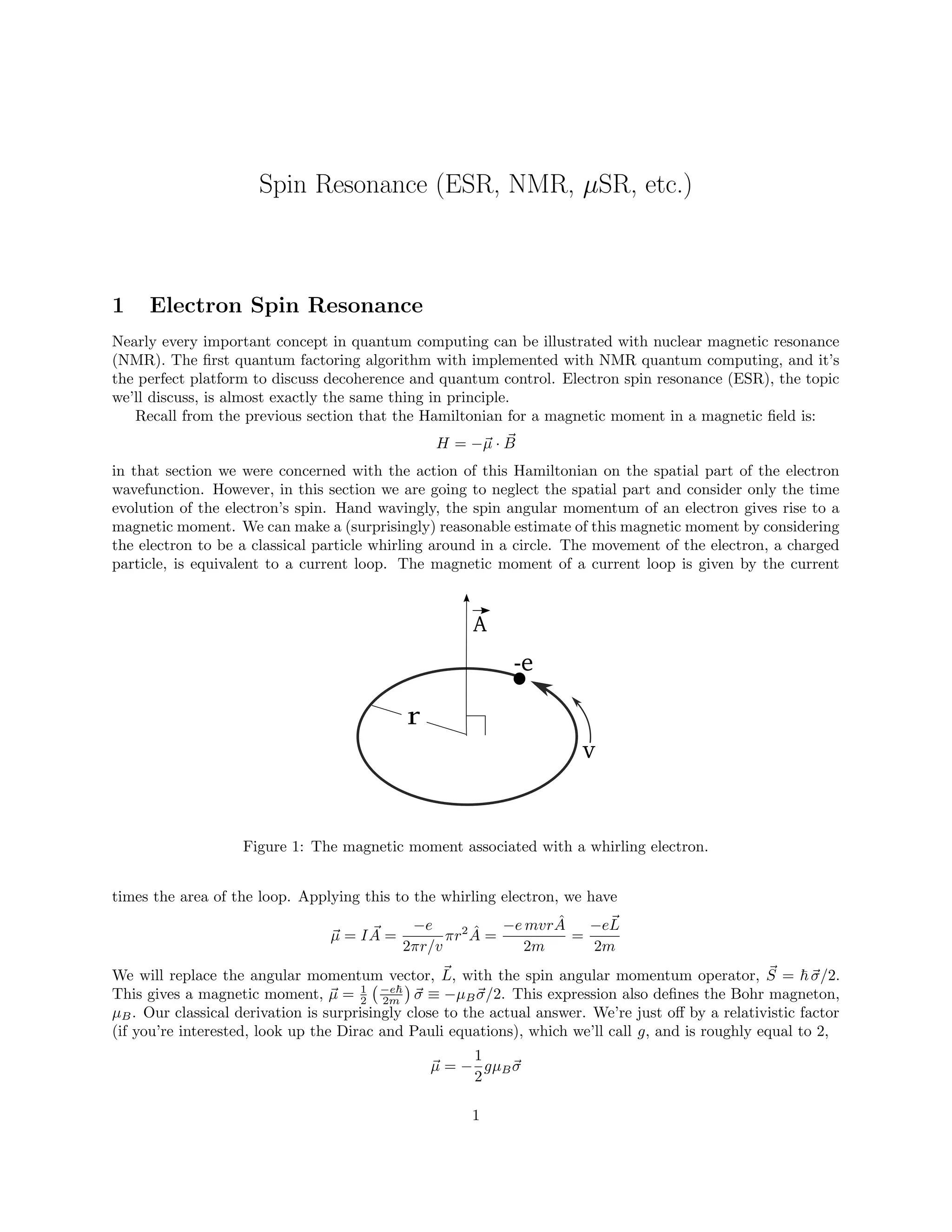
Spin Resonance (ESR, NMR, µSR, etc.)
1 Electron Spin Resonance
Nearly every important concept in quantum computing can be illustrated with nuclear magnetic resonance
(NMR). The first quantum factoring algorithm with implemented with NMR quantum computing, and it’s
the perfect platform to discuss decoherence and quantum control. Electron spin resonance (ESR), the topic
we’ll discuss, is almost exactly the same thing in principle.
Recall from the previous section that the Hamiltonian for a magnetic moment in a magnetic field is:
H = −~
µ · ~
B
in that section we were concerned with the action of this Hamiltonian on the spatial part of the electron
wavefunction. However, in this section we are going to neglect the spatial part and consider only the time
evolution of the electron’s spin. Hand wavingly, the spin angular momentum of an electron gives rise to a
magnetic moment. We can make a (surprisingly) reasonable estimate of this magnetic moment by considering
the electron to be a classical particle whirling around in a circle. The movement of the electron, a charged
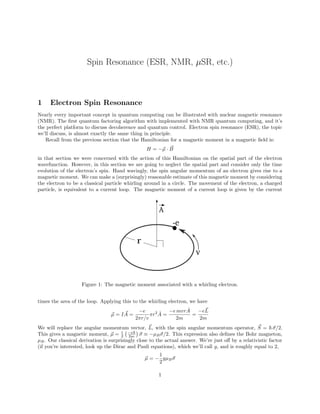
particle, is equivalent to a current loop. The magnetic moment of a current loop is given by the current
A
r
v
-e
Figure 1: The magnetic moment associated with a whirling electron.
times the area of the loop. Applying this to the whirling electron, we have
~
µ = I ~
A =
−e
2πr/v
πr2
 =
−e mvrÂ
2m
=
−e~
L
2m
We will replace the angular momentum vector, ~
L, with the spin angular momentum operator, ~
S = ~~
σ/2.
This gives a magnetic moment, ~
µ = 1
2
−e~
2m

~
σ ≡ −µB~
σ/2. This expression also defines the Bohr magneton,
µB. Our classical derivation is surprisingly close to the actual answer. We’re just off by a relativistic factor
(if you’re interested, look up the Dirac and Pauli equations), which we’ll call g, and is roughly equal to 2,
~
µ = −
1
2
gµB~
σ
1
Now let’s rewrite the Hamiltonian for a spin in a magnetic field using this expression we’ve just derived for
the magnetic moment operator,
H = −~
µ · ~
B =
1
2
gµB~
σ · B ≡
1
2
~γ~
σ · ~
B
This expression defines γ = gµB/~, the gyromagnetic ratio.
So let’s consider the time evolution of a state |ψ(t)i with the initial condition |ψ(t)i = |x̂+i = (|0i + |1i) /
√
2
when placed in a constant magnetic field, ~
B = B0ẑ. The time evolution is given by solving the Schrödinger
equation:
i~
d
dt
|ψ(t)i = H |ψ(t)i
Recall that for a constant Hamiltonian, the evolution can be solved for exactly:
|ψ(t)i = U(t) |ψ(0)i = e−iHt/~
|ψ(0)i
Using the Hamiltonian and initial state above,
|ψ(t)i = e−iγB0σz/2

1
√
2
(|0i + |1i)

=
1
√
2

e−iγB0t/2
|0i + eiγB0t/2
|1i

=
1
√
2
|0i + eiγB0t
|1i

In the last equality we noted that we exploited our freedom to multiply the wavefunction by an arbitrary
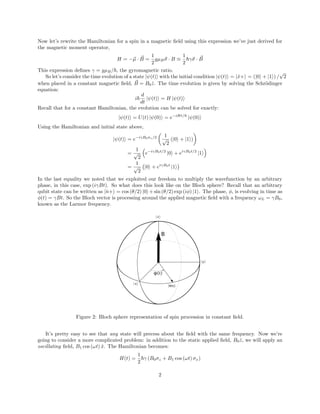
phase, in this case, exp (iγBt). So what does this look like on the Bloch sphere? Recall that an arbitrary
qubit state can be written as |n̂+i = cos (θ/2) |0i+sin (θ/2) exp (iφ) |1i. The phase, φ, is evolving in time as
φ(t) = γBt. So the Bloch vector is processing around the applied magnetic field with a frequency ωL = γB0,
known as the Larmor frequency.
φ(t)
B
z
x
y
ψ(t)
Figure 2: Bloch sphere representation of spin procession in constant field.
It’s pretty easy to see that any state will precess about the field with the same frequency. Now we’re
going to consider a more complicated problem: in addition to the static applied field, B0ẑ, we will apply an
oscillating field, B1 cos (ωt) x̂. The Hamiltonian becomes:
H(t) =
1
2
~γ (B0σz + B1 cos (ωt) σx)
2
Note that, in general, [H(t), H(t0
)] 6= 0, so we cannot write the time evolution operator in the normal way,
U(t) = exp

−i
R t
0
H(t0
) dt0

. Instead, we would have to use something called the time ordering operator, T
←
,
but even that doesn’t help us to put the evolution operator in closed form.
Instead we will take a different approach. What does the evolution of the state look like in a reference
frame that is rotating at the Larmor frequency? To do this, we define a new state variable in this rotating
frame, the unwound state,
|ψ0
(t)i = eiωLσzt/2
|ψ(t)i
Now does this state evolve in time?
i~
d
dt
|ψ0
(t)i = (i~)iωLσz/2 |ψ0
(t)i + eiωLσzt/2
i~
d
dt
|ψ(t)i
= −
~ωLσz
2
|ψ0
(t)i + eiωLσzt/2
H(t) |ψ(t)i
= −
~ωLσz
2
|ψ0
(t)i + eiωLσzt/2
H(t)e−iωLσzt/2
eiωLσzt/2
|ψ(t)i
=

−
~ωLσz
2
+ eiωLt/2
H(t)e−iωLσzt/2

|ψ0
(t)i
= H0
(t) |ψ0
(t)i
Which defines the Hamiltonian in the rotating frame:
H0
(t) =

−
~ωL
2
σz + eiωLσzt/2
H(t)e−iωLσzt/2

We’ll focus on this last term:
eiωLσzt/2
H(t)e−iωLσzt/2
=
~γ
2
eiωLσzt/2
(B0σz + B1 cos (ωt) σx) e−iωLσzt/2
=
~γ
2

B0σz + eiωLσzt/2
B1 cos(ωt)σxe−iωLσzt/2

Let’s rewrite the field as two counter rotating circular waves:
cos(ωt)σx =
1
2
((cos(ωt)σx + sin(ωt)σy) + (cos(ωt)σx − sin(ωt)σy))
= e−iωt
σ+ + eiωt
σ−

+ eiωt
σ+ + e−iωt
σ−

Here we have used the raising and lowering Pauli operators, σ± = (σx ± iσy) /2. Now we need to calculate
the transformation, exp(iασz)σ± exp (−iασz):
eiασz
σ+e−iασz
=

eiα
0
0 e−iα
 
0 1
0 0
 
e−iα
0
0 eiα

=

0 e2iα
0 0

= e2iα
σ+
eiασz
σ+e−iασz
=

eiα
0
0 e−iα
 
0 0
1 0
 
e−iα
0
0 eiα

=

0 0
e−2iα
0

= e−2iα
σ−
So,
H0
(t) = −
~ωL
2
σz +
~γ
2

B0σz + B1eiωLσzt/2
cos (ωt) σxe−iωLσzt/2

= −
~ωL
2
σz +
~ωL
2
σz +
~γ
2

B1eiωLσzt/2
e−iωt
σ+ + eiωt
σ−

+ eiωt
σ+ + e−iωt
σ−

e−iωLσzt/2

=
~γ
2
B1

ei(ωL−ω)t
σ+ + ei(ω−ωL)t
σ−

+

ei(ω+ωL)t
σ+ + e−i(ω+ωL)t
σ−

3
If the frequency of the applied field is oscillating at the Larmor frequency, ωL, then this simplifies:
H0
(t) =
~γ
2
B1 (σ+ + σ−) + e2iωLt
σ+ + e−2iωLt
σ−

However, the second term oscillates so fast that its effect on the qubit dynamics are negligible, so we drop
it. This is known as the rotating wave approximation, or RWA. Setting the applied field frequency to the
Larmor frequency is known as resonance. Our Hamiltonian is then,
H0
(t) =
~γ
2
B1 (σ+ + σ−) =
~γ
2
B1σx
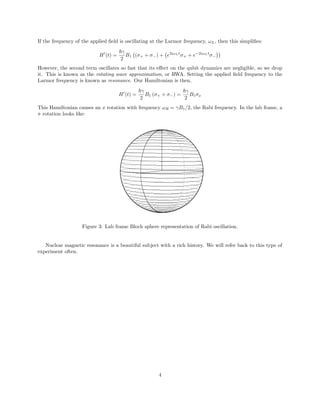
This Hamiltonian causes an x rotation with frequency ωR = γB1/2, the Rabi frequency. In the lab frame, a
π rotation looks like:
Figure 3: Lab frame Bloch sphere representation of Rabi oscillation.
Nuclear magnetic resonance is a beautiful subject with a rich history. We will refer back to this type of
experiment often.
4

Electron spin resonance

  • 1.
    Spin Resonance (ESR,NMR, µSR, etc.) 1 Electron Spin Resonance Nearly every important concept in quantum computing can be illustrated with nuclear magnetic resonance (NMR). The first quantum factoring algorithm with implemented with NMR quantum computing, and it’s the perfect platform to discuss decoherence and quantum control. Electron spin resonance (ESR), the topic we’ll discuss, is almost exactly the same thing in principle. Recall from the previous section that the Hamiltonian for a magnetic moment in a magnetic field is: H = −~ µ · ~ B in that section we were concerned with the action of this Hamiltonian on the spatial part of the electron wavefunction. However, in this section we are going to neglect the spatial part and consider only the time evolution of the electron’s spin. Hand wavingly, the spin angular momentum of an electron gives rise to a magnetic moment. We can make a (surprisingly) reasonable estimate of this magnetic moment by considering the electron to be a classical particle whirling around in a circle. The movement of the electron, a charged particle, is equivalent to a current loop. The magnetic moment of a current loop is given by the current A r v -e Figure 1: The magnetic moment associated with a whirling electron. times the area of the loop. Applying this to the whirling electron, we have ~ µ = I ~ A = −e 2πr/v πr2  = −e mvr 2m = −e~ L 2m We will replace the angular momentum vector, ~ L, with the spin angular momentum operator, ~ S = ~~ σ/2. This gives a magnetic moment, ~ µ = 1 2 −e~ 2m ~ σ ≡ −µB~ σ/2. This expression also defines the Bohr magneton, µB. Our classical derivation is surprisingly close to the actual answer. We’re just off by a relativistic factor (if you’re interested, look up the Dirac and Pauli equations), which we’ll call g, and is roughly equal to 2, ~ µ = − 1 2 gµB~ σ 1
  • 2.
    Now let’s rewritethe Hamiltonian for a spin in a magnetic field using this expression we’ve just derived for the magnetic moment operator, H = −~ µ · ~ B = 1 2 gµB~ σ · B ≡ 1 2 ~γ~ σ · ~ B This expression defines γ = gµB/~, the gyromagnetic ratio. So let’s consider the time evolution of a state |ψ(t)i with the initial condition |ψ(t)i = |x̂+i = (|0i + |1i) / √ 2 when placed in a constant magnetic field, ~ B = B0ẑ. The time evolution is given by solving the Schrödinger equation: i~ d dt |ψ(t)i = H |ψ(t)i Recall that for a constant Hamiltonian, the evolution can be solved for exactly: |ψ(t)i = U(t) |ψ(0)i = e−iHt/~ |ψ(0)i Using the Hamiltonian and initial state above, |ψ(t)i = e−iγB0σz/2 1 √ 2 (|0i + |1i) = 1 √ 2 e−iγB0t/2 |0i + eiγB0t/2 |1i = 1 √ 2 |0i + eiγB0t |1i In the last equality we noted that we exploited our freedom to multiply the wavefunction by an arbitrary phase, in this case, exp (iγBt). So what does this look like on the Bloch sphere? Recall that an arbitrary qubit state can be written as |n̂+i = cos (θ/2) |0i+sin (θ/2) exp (iφ) |1i. The phase, φ, is evolving in time as φ(t) = γBt. So the Bloch vector is processing around the applied magnetic field with a frequency ωL = γB0, known as the Larmor frequency. φ(t) B z x y ψ(t) Figure 2: Bloch sphere representation of spin procession in constant field. It’s pretty easy to see that any state will precess about the field with the same frequency. Now we’re going to consider a more complicated problem: in addition to the static applied field, B0ẑ, we will apply an oscillating field, B1 cos (ωt) x̂. The Hamiltonian becomes: H(t) = 1 2 ~γ (B0σz + B1 cos (ωt) σx) 2
  • 3.
    Note that, ingeneral, [H(t), H(t0 )] 6= 0, so we cannot write the time evolution operator in the normal way, U(t) = exp −i R t 0 H(t0 ) dt0 . Instead, we would have to use something called the time ordering operator, T ← , but even that doesn’t help us to put the evolution operator in closed form. Instead we will take a different approach. What does the evolution of the state look like in a reference frame that is rotating at the Larmor frequency? To do this, we define a new state variable in this rotating frame, the unwound state, |ψ0 (t)i = eiωLσzt/2 |ψ(t)i Now does this state evolve in time? i~ d dt |ψ0 (t)i = (i~)iωLσz/2 |ψ0 (t)i + eiωLσzt/2 i~ d dt |ψ(t)i = − ~ωLσz 2 |ψ0 (t)i + eiωLσzt/2 H(t) |ψ(t)i = − ~ωLσz 2 |ψ0 (t)i + eiωLσzt/2 H(t)e−iωLσzt/2 eiωLσzt/2 |ψ(t)i = − ~ωLσz 2 + eiωLt/2 H(t)e−iωLσzt/2 |ψ0 (t)i = H0 (t) |ψ0 (t)i Which defines the Hamiltonian in the rotating frame: H0 (t) = − ~ωL 2 σz + eiωLσzt/2 H(t)e−iωLσzt/2 We’ll focus on this last term: eiωLσzt/2 H(t)e−iωLσzt/2 = ~γ 2 eiωLσzt/2 (B0σz + B1 cos (ωt) σx) e−iωLσzt/2 = ~γ 2 B0σz + eiωLσzt/2 B1 cos(ωt)σxe−iωLσzt/2 Let’s rewrite the field as two counter rotating circular waves: cos(ωt)σx = 1 2 ((cos(ωt)σx + sin(ωt)σy) + (cos(ωt)σx − sin(ωt)σy)) = e−iωt σ+ + eiωt σ− + eiωt σ+ + e−iωt σ− Here we have used the raising and lowering Pauli operators, σ± = (σx ± iσy) /2. Now we need to calculate the transformation, exp(iασz)σ± exp (−iασz): eiασz σ+e−iασz = eiα 0 0 e−iα 0 1 0 0 e−iα 0 0 eiα = 0 e2iα 0 0 = e2iα σ+ eiασz σ+e−iασz = eiα 0 0 e−iα 0 0 1 0 e−iα 0 0 eiα = 0 0 e−2iα 0 = e−2iα σ− So, H0 (t) = − ~ωL 2 σz + ~γ 2 B0σz + B1eiωLσzt/2 cos (ωt) σxe−iωLσzt/2 = − ~ωL 2 σz + ~ωL 2 σz + ~γ 2 B1eiωLσzt/2 e−iωt σ+ + eiωt σ− + eiωt σ+ + e−iωt σ− e−iωLσzt/2 = ~γ 2 B1 ei(ωL−ω)t σ+ + ei(ω−ωL)t σ− + ei(ω+ωL)t σ+ + e−i(ω+ωL)t σ− 3
  • 4.
    If the frequencyof the applied field is oscillating at the Larmor frequency, ωL, then this simplifies: H0 (t) = ~γ 2 B1 (σ+ + σ−) + e2iωLt σ+ + e−2iωLt σ− However, the second term oscillates so fast that its effect on the qubit dynamics are negligible, so we drop it. This is known as the rotating wave approximation, or RWA. Setting the applied field frequency to the Larmor frequency is known as resonance. Our Hamiltonian is then, H0 (t) = ~γ 2 B1 (σ+ + σ−) = ~γ 2 B1σx This Hamiltonian causes an x rotation with frequency ωR = γB1/2, the Rabi frequency. In the lab frame, a π rotation looks like: Figure 3: Lab frame Bloch sphere representation of Rabi oscillation. Nuclear magnetic resonance is a beautiful subject with a rich history. We will refer back to this type of experiment often. 4