Sound waves:
Relating displacement
amplitude, power
and intensity
Alyssa Hui
Phys 101 201
LO4
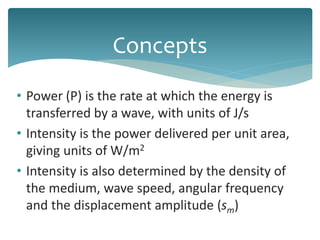
• Power (P) is the rate at which the energy is
transferred by a wave, with units of J/s
• Intensity is the power delivered per unit area,
giving units of W/m2
• Intensity is also determined by the density of
the medium, wave speed, angular frequency
and the displacement amplitude (sm)
Concepts
• When we double the power produced
by a source, by what factor does the
displacement amplitude of the resultant
wave change?
Problem 1
cr: desmos.com
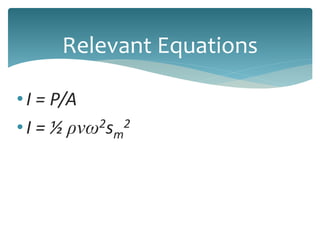
•I = P/A
•I = ½ ρvω2sm
2
Relevant Equations
• Can you find the relationship
between sm and P?
Hint
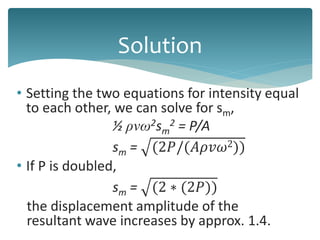
• Setting the two equations for intensity equal
to each other, we can solve for sm,
½ ρvω2sm
2 = P/A
sm = (2𝑃/(𝐴𝜌𝑣𝜔2))
• If P is doubled,
sm = (2 ∗ (2𝑃))
the displacement amplitude of the
resultant wave increases by approx. 1.4.
Solution
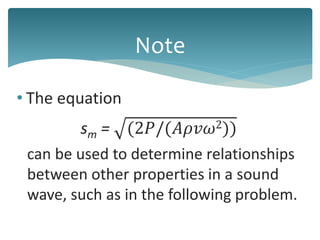
• The equation
sm = (2𝑃/(𝐴𝜌𝑣𝜔2))
can be used to determine relationships
between other properties in a sound
wave, such as in the following problem.
Note
• A person is standing beside a speaker
as it plays a 10,000 Hz tone. The sound
waves travel away from the speaker
uniformly in all directions. If the
distance from the speaker doubles,
then the amplitude of the waves that
the person observes:
Problem 2
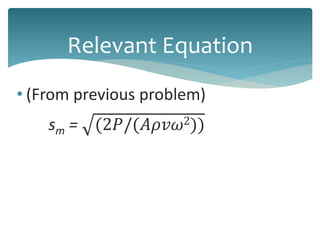
• (From previous problem)
sm = (2𝑃/(𝐴𝜌𝑣𝜔2))
Relevant Equation
•What area does power
radiating isotropically cover?
Hint
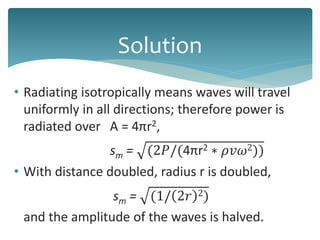
• Radiating isotropically means waves will travel
uniformly in all directions; therefore power is
radiated over A = 4πr2,
sm = (2𝑃/(4πr2 ∗ 𝜌𝑣𝜔2))
• With distance doubled, radius r is doubled,
sm = (1/ 2𝑟 2)
and the amplitude of the waves is halved.
Solution

Sound Waves: Relating Amplitude, Power and Intensity

  • 1.
    Sound waves: Relating displacement amplitude,power and intensity Alyssa Hui Phys 101 201 LO4
  • 2.
    • Power (P)is the rate at which the energy is transferred by a wave, with units of J/s • Intensity is the power delivered per unit area, giving units of W/m2 • Intensity is also determined by the density of the medium, wave speed, angular frequency and the displacement amplitude (sm) Concepts
  • 3.
    • When wedouble the power produced by a source, by what factor does the displacement amplitude of the resultant wave change? Problem 1 cr: desmos.com
  • 4.
    •I = P/A •I= ½ ρvω2sm 2 Relevant Equations
  • 5.
    • Can youfind the relationship between sm and P? Hint
  • 6.
    • Setting thetwo equations for intensity equal to each other, we can solve for sm, ½ ρvω2sm 2 = P/A sm = (2𝑃/(𝐴𝜌𝑣𝜔2)) • If P is doubled, sm = (2 ∗ (2𝑃)) the displacement amplitude of the resultant wave increases by approx. 1.4. Solution
  • 7.
    • The equation sm= (2𝑃/(𝐴𝜌𝑣𝜔2)) can be used to determine relationships between other properties in a sound wave, such as in the following problem. Note
  • 8.
    • A personis standing beside a speaker as it plays a 10,000 Hz tone. The sound waves travel away from the speaker uniformly in all directions. If the distance from the speaker doubles, then the amplitude of the waves that the person observes: Problem 2
  • 9.
    • (From previousproblem) sm = (2𝑃/(𝐴𝜌𝑣𝜔2)) Relevant Equation
  • 10.
    •What area doespower radiating isotropically cover? Hint
  • 11.
    • Radiating isotropicallymeans waves will travel uniformly in all directions; therefore power is radiated over A = 4πr2, sm = (2𝑃/(4πr2 ∗ 𝜌𝑣𝜔2)) • With distance doubled, radius r is doubled, sm = (1/ 2𝑟 2) and the amplitude of the waves is halved. Solution