PHYSICS – Reflection and Refraction
LEARNING
OBJECTIVES
Core
•Describe the formation of an optical image by
a plane mirror, and give its characteristics
• Recall and use the law angle of incidence =
angle of reflection
Describe an experimental demonstration of
the refraction of light
• Use the terminology for the angle of
incidence i and angle of refraction r and
describe the passage of light through parallel-
sided transparent material
• Give the meaning of critical angle
• Describe internal and total internal
reflection
Describe the action of a thin converging lens
on a beam of light
• Use the terms principal focus and focal
length
• Draw ray diagrams for the formation of a
real image by a single lens
• Describe the nature of an image using the
terms enlarged/same size/diminished and
upright/inverted
Supplement
Describe the formation of an optical image by a
plane mirror, and give its characteristics
• Recall and use the law angle of incidence =
angle of reflection
Recall and use the definition of refractive
index n in terms of speed
• Recall and use the equation sin I / sin r=n
• Recall and use n = n = 1 / sin c
• Describe and explain the action of optical
fibres particularly in medicine and
communications technology
Draw and use ray diagrams for the formation of
a virtual image by a single lens • Use and
describe the use of a single lens as a
magnifying glass • Show understanding of the
terms real image and virtual image
Reflection in a Plane Mirror
Plane mirror
Reflection in a Plane Mirror
Plane mirror
Normal
Reflection in a Plane Mirror
Plane mirror
Normal
Incident ray
Reflection in a Plane Mirror
Plane mirror
Normal
Incident ray Reflected ray
Reflection in a Plane Mirror
Plane mirror
Normal
Incident ray Reflected ray
Angle of
incidence
Angle of
reflection
Reflection in a Plane Mirror
Plane mirror
Normal
Incident ray Reflected ray
Angle of
incidence
Angle of
reflection
REMINDER: always use a
ruler to draw light rays
(light travels in straight
lines) and don’t forget to
include arrows showing
direction of light.
Reflection in a Plane Mirror
Plane mirror
Normal
Incident ray Reflected ray
Angle of
incidence
Angle of
reflection
Laws of reflection:
Reflection in a Plane Mirror
Plane mirror
Normal
Incident ray Reflected ray
Angle of
incidence
Angle of
reflection
Laws of reflection:
1. The angle of incidence is equal to the angle of reflection.
Reflection in a Plane Mirror
Plane mirror
Normal
Incident ray Reflected ray
Angle of
incidence
Angle of
reflection
Laws of reflection:
1. The angle of incidence is equal to the angle of reflection.
2. The incident ray, the reflected ray and the normal all lie in
the same plane (i.e. the two rays and the normal can all be
drawn on a single sheet of flat paper).
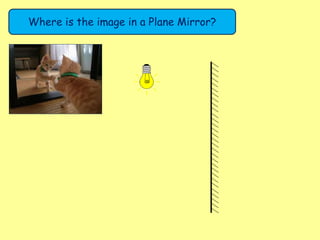
Where is the image in a Plane Mirror?
The image in the mirror
looks the same as the
object, but it is laterally
inverted (back to front).
Where is the image in a Plane Mirror?
The image in the mirror
looks the same as the
object, but it is laterally
inverted (back to front).
The image formed is
upright, but it is a
virtual image
(doesn’t really exist).
Where is the image in a Plane Mirror?
The image in the mirror
looks the same as the
object, but it is laterally
inverted (back to front).
The image formed is
upright, but it is a
virtual image
(doesn’t really exist).
Dotted lines show the
construction of the
virtual image)
Where is the image in a Plane Mirror?
Normal view from the
front.
Where is the image in a Plane Mirror?
Normal view from the
front.
Same view as seen in the
rear view mirror of a car.
Where is the image in a Plane Mirror?
Normal view from the
front.
Same view as seen in the
rear view mirror of a car.
The word AMBULANCE is laterally inverted so that
it reads correctly when seen in a driving mirror.
Where is the image in a Plane Mirror?
Finding this image by experiment.
Put a mirror
upright on a piece
of paper. Put a
pin in front of the
mirror – mark the
position of the pin
and mirror.
Where is the image in a Plane Mirror?
Finding this image by experiment.
Line up one edge
of the ruler with
the image of the
pin. Draw a line to
mark the position.
Where is the image in a Plane Mirror?
Finding this image by experiment.
Repeat with the
ruler in a
different position.
Where is the image in a Plane Mirror?
Finding this image by experiment.
Take away the
ruler and mirror –
where the two
lines meet is the
position of the
image.
Where is the image in a Plane Mirror?
Finding this image by experiment.
Test the position
by putting a
second pin exactly
where the image
was marked. The
second pin should
stay in line with
the mirror image
where-ever you
view it from = no
parallax.
Where is the image in a Plane Mirror?
Finding this image by experiment.
X X
Rules for mirror
images:
1. Image is the
same size as
the object.
2. Image is as far
behind the
mirror as the
object is in
front.
Refraction
• Refraction is the
bending of light
when it travels from
one medium to
another.
Refraction
• Refraction is the
bending of light
when it travels from
one medium to
another.
• A ‘medium’ is glass,
or air, or water
Refraction
Glass
block
Air
Refraction
Glass
block
Air
Light passing through a
glass block at right angles
to the surface will not be
refracted. The rays will
pass straight through.
Refraction
Glass
block
Normal
line
Air
Refraction
Glass
block
Normal
line
Incident
light ray
Air
Angle of
incidence
Refraction
Glass
block
Normal
line
Incident
light ray
Air
Angle of
incidence
Angle of
refraction
Refracted
light ray
Refraction
Glass
block
Normal
line
Incident
light ray
Air
Angle of
incidence
Angle of
refraction
Refracted
light ray
When passing from
a less dense medium
(air) to a more
dense medium
(glass) light bends
towards the normal.
Refraction
Glass
block
Normal
line
Incident
light ray
Air
Angle of
incidence
Angle of
refraction
Refracted
light ray
Refraction
Glass
block
Normal
line
Incident
light ray
Air
Angle of
incidence
Angle of
refraction
Refracted
light ray
The ray emerges from
the block parallel to
its original direction.
Refraction
Glass
block
Normal
line
Air
So why is
light
refracted?
Refraction
Glass
block
Normal
line
Air
So why is
light
refracted?
Light is
made up of
many tiny
waves
Refraction
Glass
block
Air
So why is
light
refracted?
Light is
made up of
many tiny
waves
When light beams pass
from air into glass one
side is slowed before the
other. This causes the
light beam to ‘bend’
Connecting the learning.
What happens as a ray of light enters a glass
block?
It bends towards the normal.
Why?
Because the speed of light changes
Real and Apparent Depth
What is the
‘refractive index’?
What is the
‘refractive index’?
The refractive index
of a medium (glass,
water) is defined as
the speed of light in
a vacuum divided by
the speed of light in
the medium.
What is the
‘refractive index’?
The refractive index
of a medium (glass,
water) is defined as
the speed of light in
a vacuum divided by
the speed of light in
the medium.
Refractive index = Speed of light in a vacuum
Speed of light in medium
Medium
Refractive
index
Vacuum 1.0000
Air 1.0003
Water 1.3333
Glass 1.5200
Diamond 2.4170
Perspex 1.4900
Refraction of light by a
prism.
White light
Refraction of light by a
prism.
Refraction
Refraction of light by a
prism.
Refraction of light by a
prism.
This effect is called dispersion
Refraction of light by a
prism.
This effect is called dispersion
Refraction of light by a
prism.
This effect is called dispersion
It happens because white is a mixture
of all the colours in the rainbow
LEARNING
OBJECTIVES
Core
•Describe the formation of an optical image by
a plane mirror, and give its characteristics
• Recall and use the law angle of incidence =
angle of reflection
Describe an experimental demonstration of
the refraction of light
• Use the terminology for the angle of
incidence i and angle of refraction r and
describe the passage of light through parallel-
sided transparent material
• Give the meaning of critical angle
• Describe internal and total internal
reflection
Describe the action of a thin converging lens
on a beam of light
• Use the terms principal focus and focal
length
• Draw ray diagrams for the formation of a
real image by a single lens
• Describe the nature of an image using the
terms enlarged/same size/diminished and
upright/inverted
Supplement
Describe the formation of an optical image by a
plane mirror, and give its characteristics
• Recall and use the law angle of incidence =
angle of reflection
Recall and use the definition of refractive
index n in terms of speed
• Recall and use the equation sin I / sin r=n
• Recall and use n = n = 1 / sin c
• Describe and explain the action of optical
fibres particularly in medicine and
communications technology
Draw and use ray diagrams for the formation of
a virtual image by a single lens • Use and
describe the use of a single lens as a
magnifying glass • Show understanding of the
terms real image and virtual image
PHYSICS – Reflection and Refraction
Physics 18 - Reflection and Refraction.pptx

Physics 18 - Reflection and Refraction.pptx

  • 1.
    PHYSICS – Reflectionand Refraction
  • 2.
    LEARNING OBJECTIVES Core •Describe the formationof an optical image by a plane mirror, and give its characteristics • Recall and use the law angle of incidence = angle of reflection Describe an experimental demonstration of the refraction of light • Use the terminology for the angle of incidence i and angle of refraction r and describe the passage of light through parallel- sided transparent material • Give the meaning of critical angle • Describe internal and total internal reflection Describe the action of a thin converging lens on a beam of light • Use the terms principal focus and focal length • Draw ray diagrams for the formation of a real image by a single lens • Describe the nature of an image using the terms enlarged/same size/diminished and upright/inverted Supplement Describe the formation of an optical image by a plane mirror, and give its characteristics • Recall and use the law angle of incidence = angle of reflection Recall and use the definition of refractive index n in terms of speed • Recall and use the equation sin I / sin r=n • Recall and use n = n = 1 / sin c • Describe and explain the action of optical fibres particularly in medicine and communications technology Draw and use ray diagrams for the formation of a virtual image by a single lens • Use and describe the use of a single lens as a magnifying glass • Show understanding of the terms real image and virtual image
  • 3.
    Reflection in aPlane Mirror Plane mirror
  • 4.
    Reflection in aPlane Mirror Plane mirror Normal
  • 5.
    Reflection in aPlane Mirror Plane mirror Normal Incident ray
  • 6.
    Reflection in aPlane Mirror Plane mirror Normal Incident ray Reflected ray
  • 7.
    Reflection in aPlane Mirror Plane mirror Normal Incident ray Reflected ray Angle of incidence Angle of reflection
  • 8.
    Reflection in aPlane Mirror Plane mirror Normal Incident ray Reflected ray Angle of incidence Angle of reflection REMINDER: always use a ruler to draw light rays (light travels in straight lines) and don’t forget to include arrows showing direction of light.
  • 9.
    Reflection in aPlane Mirror Plane mirror Normal Incident ray Reflected ray Angle of incidence Angle of reflection Laws of reflection:
  • 10.
    Reflection in aPlane Mirror Plane mirror Normal Incident ray Reflected ray Angle of incidence Angle of reflection Laws of reflection: 1. The angle of incidence is equal to the angle of reflection.
  • 11.
    Reflection in aPlane Mirror Plane mirror Normal Incident ray Reflected ray Angle of incidence Angle of reflection Laws of reflection: 1. The angle of incidence is equal to the angle of reflection. 2. The incident ray, the reflected ray and the normal all lie in the same plane (i.e. the two rays and the normal can all be drawn on a single sheet of flat paper).
  • 12.
    Where is theimage in a Plane Mirror?
  • 13.
    Where is theimage in a Plane Mirror?
  • 14.
    Where is theimage in a Plane Mirror?
  • 15.
    Where is theimage in a Plane Mirror? The image in the mirror looks the same as the object, but it is laterally inverted (back to front).
  • 16.
    Where is theimage in a Plane Mirror? The image in the mirror looks the same as the object, but it is laterally inverted (back to front). The image formed is upright, but it is a virtual image (doesn’t really exist).
  • 17.
    Where is theimage in a Plane Mirror? The image in the mirror looks the same as the object, but it is laterally inverted (back to front). The image formed is upright, but it is a virtual image (doesn’t really exist). Dotted lines show the construction of the virtual image)
  • 18.
    Where is theimage in a Plane Mirror? Normal view from the front.
  • 19.
    Where is theimage in a Plane Mirror? Normal view from the front. Same view as seen in the rear view mirror of a car.
  • 20.
    Where is theimage in a Plane Mirror? Normal view from the front. Same view as seen in the rear view mirror of a car. The word AMBULANCE is laterally inverted so that it reads correctly when seen in a driving mirror.
  • 21.
    Where is theimage in a Plane Mirror? Finding this image by experiment. Put a mirror upright on a piece of paper. Put a pin in front of the mirror – mark the position of the pin and mirror.
  • 22.
    Where is theimage in a Plane Mirror? Finding this image by experiment. Line up one edge of the ruler with the image of the pin. Draw a line to mark the position.
  • 23.
    Where is theimage in a Plane Mirror? Finding this image by experiment. Repeat with the ruler in a different position.
  • 24.
    Where is theimage in a Plane Mirror? Finding this image by experiment. Take away the ruler and mirror – where the two lines meet is the position of the image.
  • 25.
    Where is theimage in a Plane Mirror? Finding this image by experiment. Test the position by putting a second pin exactly where the image was marked. The second pin should stay in line with the mirror image where-ever you view it from = no parallax.
  • 26.
    Where is theimage in a Plane Mirror? Finding this image by experiment. X X Rules for mirror images: 1. Image is the same size as the object. 2. Image is as far behind the mirror as the object is in front.
  • 27.
    Refraction • Refraction isthe bending of light when it travels from one medium to another.
  • 28.
    Refraction • Refraction isthe bending of light when it travels from one medium to another. • A ‘medium’ is glass, or air, or water
  • 29.
  • 30.
    Refraction Glass block Air Light passing througha glass block at right angles to the surface will not be refracted. The rays will pass straight through.
  • 31.
  • 32.
  • 33.
  • 34.
    Refraction Glass block Normal line Incident light ray Air Angle of incidence Angleof refraction Refracted light ray When passing from a less dense medium (air) to a more dense medium (glass) light bends towards the normal.
  • 35.
  • 36.
    Refraction Glass block Normal line Incident light ray Air Angle of incidence Angleof refraction Refracted light ray The ray emerges from the block parallel to its original direction.
  • 37.
  • 38.
  • 39.
    Refraction Glass block Air So why is light refracted? Lightis made up of many tiny waves When light beams pass from air into glass one side is slowed before the other. This causes the light beam to ‘bend’
  • 40.
    Connecting the learning. Whathappens as a ray of light enters a glass block? It bends towards the normal. Why? Because the speed of light changes
  • 41.
  • 42.
  • 43.
    What is the ‘refractiveindex’? The refractive index of a medium (glass, water) is defined as the speed of light in a vacuum divided by the speed of light in the medium.
  • 44.
    What is the ‘refractiveindex’? The refractive index of a medium (glass, water) is defined as the speed of light in a vacuum divided by the speed of light in the medium. Refractive index = Speed of light in a vacuum Speed of light in medium Medium Refractive index Vacuum 1.0000 Air 1.0003 Water 1.3333 Glass 1.5200 Diamond 2.4170 Perspex 1.4900
  • 45.
    Refraction of lightby a prism. White light
  • 46.
    Refraction of lightby a prism. Refraction
  • 47.
  • 48.
    Refraction of lightby a prism. This effect is called dispersion
  • 49.
    Refraction of lightby a prism. This effect is called dispersion
  • 50.
    Refraction of lightby a prism. This effect is called dispersion It happens because white is a mixture of all the colours in the rainbow
  • 51.
    LEARNING OBJECTIVES Core •Describe the formationof an optical image by a plane mirror, and give its characteristics • Recall and use the law angle of incidence = angle of reflection Describe an experimental demonstration of the refraction of light • Use the terminology for the angle of incidence i and angle of refraction r and describe the passage of light through parallel- sided transparent material • Give the meaning of critical angle • Describe internal and total internal reflection Describe the action of a thin converging lens on a beam of light • Use the terms principal focus and focal length • Draw ray diagrams for the formation of a real image by a single lens • Describe the nature of an image using the terms enlarged/same size/diminished and upright/inverted Supplement Describe the formation of an optical image by a plane mirror, and give its characteristics • Recall and use the law angle of incidence = angle of reflection Recall and use the definition of refractive index n in terms of speed • Recall and use the equation sin I / sin r=n • Recall and use n = n = 1 / sin c • Describe and explain the action of optical fibres particularly in medicine and communications technology Draw and use ray diagrams for the formation of a virtual image by a single lens • Use and describe the use of a single lens as a magnifying glass • Show understanding of the terms real image and virtual image
  • 52.
    PHYSICS – Reflectionand Refraction