The Propagation of Light
The Ray Model of Light
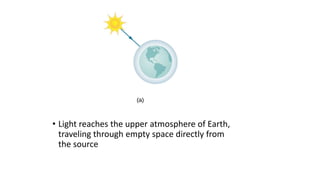
• Light reaches the upper atmosphere of Earth,
traveling through empty space directly from
the source
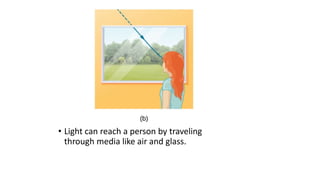
• Light can reach a person by traveling
through media like air and glass.
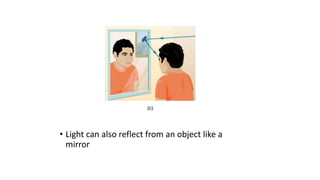
• Light can also reflect from an object like a
mirror
Experiments show that when light interacts with an object several times
larger than its wavelength, it travels in straight lines and acts like a ray. Its
wave characteristics are not pronounced in such situations. Since the
wavelength of visible light is less than a micron (a thousandth of a
millimeter), it acts like a ray in the many common situations in which it
encounters objects larger than a micron. For example, when visible light
encounters anything large enough that we can observe it with unaided eyes,
such as a coin, it acts like a ray, with generally negligible wave
characteristics
In all of these cases, we can model the path of light as
straight lines. Light may change direction when it
encounters objects (such as a mirror) or in passing from
one material to another (such as in passing from air to
glass), but it then continues in a straight line or as a ray.
The word “ray” comes from mathematics and here means
a straight line that originates at some point. It is
acceptable to visualize light rays as laser rays. The ray
model of light describes the path of light as straight lines.
Since light moves in straight lines,
changing directions when it interacts
with materials, its path is described by
geometry and simple trigonometry. This
part of optics, where the ray aspect of
light dominates, is therefore called
geometric optics.
Two laws govern how light changes direction when it
interacts with matter.
• law of reflection
• law of refraction
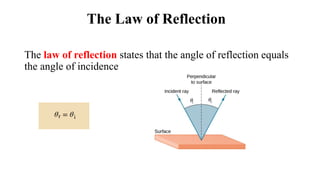
The Law of Reflection
The law of reflection states that the angle of reflection equals
the angle of incidence
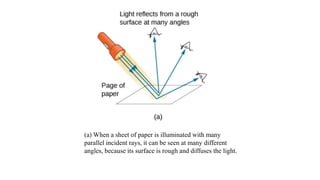
(a) When a sheet of paper is illuminated with many
parallel incident rays, it can be seen at many different
angles, because its surface is rough and diffuses the light.
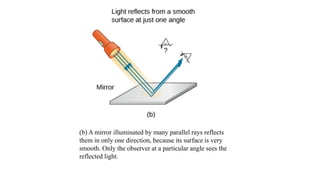
(b) A mirror illuminated by many parallel rays reflects
them in only one direction, because its surface is very
smooth. Only the observer at a particular angle sees the
reflected light.
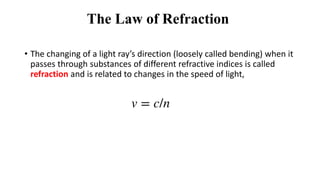
The Law of Refraction
• The changing of a light ray’s direction (loosely called bending) when it
passes through substances of different refractive indices is called
refraction and is related to changes in the speed of light,
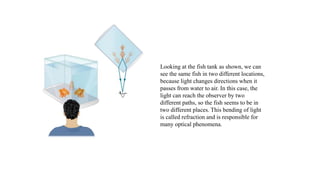
Looking at the fish tank as shown, we can
see the same fish in two different locations,
because light changes directions when it
passes from water to air. In this case, the
light can reach the observer by two
different paths, so the fish seems to be in
two different places. This bending of light
is called refraction and is responsible for
many optical phenomena.
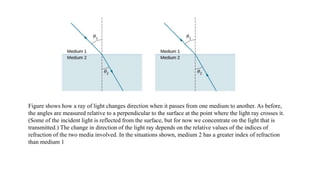
Figure shows how a ray of light changes direction when it passes from one medium to another. As before,
the angles are measured relative to a perpendicular to the surface at the point where the light ray crosses it.
(Some of the incident light is reflected from the surface, but for now we concentrate on the light that is
transmitted.) The change in direction of the light ray depends on the relative values of the indices of
refraction of the two media involved. In the situations shown, medium 2 has a greater index of refraction
than medium 1
The direction of the ray moves closer to the perpendicular when it progresses from a medium with a lower index of
refraction to one with a higher index of refraction. Conversely, as shown in ,the direction of the ray moves away
from the perpendicular when it progresses from a medium with a higher index of refraction to one with a lower index
of refraction. The path is exactly reversible.
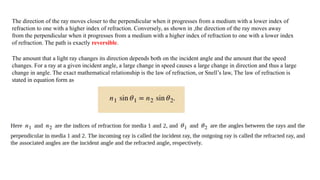
The amount that a light ray changes its direction depends both on the incident angle and the amount that the speed
changes. For a ray at a given incident angle, a large change in speed causes a large change in direction and thus a large
change in angle. The exact mathematical relationship is the law of refraction, or Snell’s law, The law of refraction is
stated in equation form as
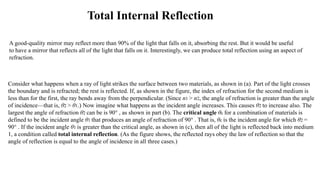
Total Internal Reflection
A good-quality mirror may reflect more than 90% of the light that falls on it, absorbing the rest. But it would be useful
to have a mirror that reflects all of the light that falls on it. Interestingly, we can produce total reflection using an aspect of
refraction.
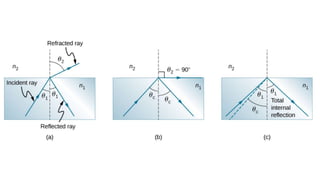
Consider what happens when a ray of light strikes the surface between two materials, as shown in (a). Part of the light crosses
the boundary and is refracted; the rest is reflected. If, as shown in the figure, the index of refraction for the second medium is
less than for the first, the ray bends away from the perpendicular. (Since n1 > n2, the angle of refraction is greater than the angle
of incidence—that is, θ2 > θ1.) Now imagine what happens as the incident angle increases. This causes θ2 to increase also. The
largest the angle of refraction θ2 can be is 90° , as shown in part (b). The critical angle θc for a combination of materials is
defined to be the incident angle θ1 that produces an angle of refraction of 90° . That is, θc is the incident angle for which θ2 =
90° . If the incident angle θ1 is greater than the critical angle, as shown in (c), then all of the light is reflected back into medium
1, a condition called total internal reflection. (As the figure shows, the reflected rays obey the law of reflection so that the
angle of reflection is equal to the angle of incidence in all three cases.)
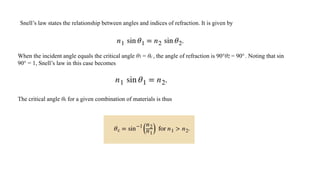
Snell’s law states the relationship between angles and indices of refraction. It is given by
When the incident angle equals the critical angle θ1 = θc, the angle of refraction is 90°θ2 = 90°. Noting that sin
90° = 1, Snell’s law in this case becomes
The critical angle θc for a given combination of materials is thus
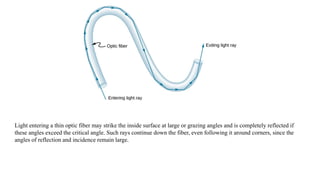
Light entering a thin optic fiber may strike the inside surface at large or grazing angles and is completely reflected if
these angles exceed the critical angle. Such rays continue down the fiber, even following it around corners, since the
angles of reflection and incidence remain large.
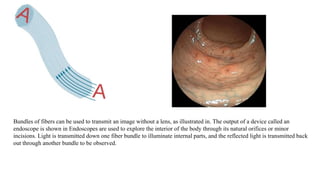
Bundles of fibers can be used to transmit an image without a lens, as illustrated in. The output of a device called an
endoscope is shown in Endoscopes are used to explore the interior of the body through its natural orifices or minor
incisions. Light is transmitted down one fiber bundle to illuminate internal parts, and the reflected light is transmitted back
out through another bundle to be observed.

Basic optics

  • 1.
  • 2.
    The Ray Modelof Light
  • 3.
    • Light reachesthe upper atmosphere of Earth, traveling through empty space directly from the source
  • 4.
    • Light canreach a person by traveling through media like air and glass.
  • 5.
    • Light canalso reflect from an object like a mirror
  • 6.
    Experiments show thatwhen light interacts with an object several times larger than its wavelength, it travels in straight lines and acts like a ray. Its wave characteristics are not pronounced in such situations. Since the wavelength of visible light is less than a micron (a thousandth of a millimeter), it acts like a ray in the many common situations in which it encounters objects larger than a micron. For example, when visible light encounters anything large enough that we can observe it with unaided eyes, such as a coin, it acts like a ray, with generally negligible wave characteristics
  • 7.
    In all ofthese cases, we can model the path of light as straight lines. Light may change direction when it encounters objects (such as a mirror) or in passing from one material to another (such as in passing from air to glass), but it then continues in a straight line or as a ray. The word “ray” comes from mathematics and here means a straight line that originates at some point. It is acceptable to visualize light rays as laser rays. The ray model of light describes the path of light as straight lines.
  • 8.
    Since light movesin straight lines, changing directions when it interacts with materials, its path is described by geometry and simple trigonometry. This part of optics, where the ray aspect of light dominates, is therefore called geometric optics.
  • 9.
    Two laws governhow light changes direction when it interacts with matter. • law of reflection • law of refraction
  • 10.
    The Law ofReflection The law of reflection states that the angle of reflection equals the angle of incidence
  • 11.
    (a) When asheet of paper is illuminated with many parallel incident rays, it can be seen at many different angles, because its surface is rough and diffuses the light.
  • 12.
    (b) A mirrorilluminated by many parallel rays reflects them in only one direction, because its surface is very smooth. Only the observer at a particular angle sees the reflected light.
  • 13.
    The Law ofRefraction • The changing of a light ray’s direction (loosely called bending) when it passes through substances of different refractive indices is called refraction and is related to changes in the speed of light,
  • 14.
    Looking at thefish tank as shown, we can see the same fish in two different locations, because light changes directions when it passes from water to air. In this case, the light can reach the observer by two different paths, so the fish seems to be in two different places. This bending of light is called refraction and is responsible for many optical phenomena.
  • 15.
    Figure shows howa ray of light changes direction when it passes from one medium to another. As before, the angles are measured relative to a perpendicular to the surface at the point where the light ray crosses it. (Some of the incident light is reflected from the surface, but for now we concentrate on the light that is transmitted.) The change in direction of the light ray depends on the relative values of the indices of refraction of the two media involved. In the situations shown, medium 2 has a greater index of refraction than medium 1
  • 16.
    The direction ofthe ray moves closer to the perpendicular when it progresses from a medium with a lower index of refraction to one with a higher index of refraction. Conversely, as shown in ,the direction of the ray moves away from the perpendicular when it progresses from a medium with a higher index of refraction to one with a lower index of refraction. The path is exactly reversible. The amount that a light ray changes its direction depends both on the incident angle and the amount that the speed changes. For a ray at a given incident angle, a large change in speed causes a large change in direction and thus a large change in angle. The exact mathematical relationship is the law of refraction, or Snell’s law, The law of refraction is stated in equation form as
  • 17.
    Total Internal Reflection Agood-quality mirror may reflect more than 90% of the light that falls on it, absorbing the rest. But it would be useful to have a mirror that reflects all of the light that falls on it. Interestingly, we can produce total reflection using an aspect of refraction. Consider what happens when a ray of light strikes the surface between two materials, as shown in (a). Part of the light crosses the boundary and is refracted; the rest is reflected. If, as shown in the figure, the index of refraction for the second medium is less than for the first, the ray bends away from the perpendicular. (Since n1 > n2, the angle of refraction is greater than the angle of incidence—that is, θ2 > θ1.) Now imagine what happens as the incident angle increases. This causes θ2 to increase also. The largest the angle of refraction θ2 can be is 90° , as shown in part (b). The critical angle θc for a combination of materials is defined to be the incident angle θ1 that produces an angle of refraction of 90° . That is, θc is the incident angle for which θ2 = 90° . If the incident angle θ1 is greater than the critical angle, as shown in (c), then all of the light is reflected back into medium 1, a condition called total internal reflection. (As the figure shows, the reflected rays obey the law of reflection so that the angle of reflection is equal to the angle of incidence in all three cases.)
  • 19.
    Snell’s law statesthe relationship between angles and indices of refraction. It is given by When the incident angle equals the critical angle θ1 = θc, the angle of refraction is 90°θ2 = 90°. Noting that sin 90° = 1, Snell’s law in this case becomes The critical angle θc for a given combination of materials is thus
  • 20.
    Light entering athin optic fiber may strike the inside surface at large or grazing angles and is completely reflected if these angles exceed the critical angle. Such rays continue down the fiber, even following it around corners, since the angles of reflection and incidence remain large.
  • 21.
    Bundles of fiberscan be used to transmit an image without a lens, as illustrated in. The output of a device called an endoscope is shown in Endoscopes are used to explore the interior of the body through its natural orifices or minor incisions. Light is transmitted down one fiber bundle to illuminate internal parts, and the reflected light is transmitted back out through another bundle to be observed.