Advanced Instrumentation
• Course contents
• Sensors and types
• Introduction to MEMS
• Transducers
• Signal conditioning circuits
• Data acquisition and transmission
• Biomedical instrumentation
• Integrated, Intelligent and smart sensors
• Electronic nose
• Real world interfacing
Sensors and Transducers
• Sensor
• Device that detects a change in a physical stimulus
and turns it into a (electrical) signal which can be
measured or recorded. Eg Bimetallic strip, Light
Dependent Resistors, Hg in glass thermometer etc
• Actuator
• Converts electrical or pneumatic signal to some
kind of motion. Eg, solenoid actuator
• Transducer
• Device that transfers power from one system to
another in the same or in the different form. Eg.
Weighing machine, electric motor
Classification of the sensors
• Active and Passive
Active: Input excitation is required (Electrical,
Pneumatic, Hydraulic etc)
Example : potentiometer as displacement sensor
Passive: Input excitation is not required
Example : Mercury Thermometer
• Null and Deflection Type
Null : Balancing a bridge to find resistance
Passive: Finding the defection due to resistance
change in bridge circuit
Classification of the sensors
• Monitoring and Transmitting Type
Monitoring: eg; Mercury thermometer
Transmitting: eg; Thermocouple
Current (4 mA to 20 mA) should be transmitted
but not voltage. A transmitter is used to convert
any signal into current signal.
• Analog and Digital Type
Analog: Output varies continuously, infinite
position for the pointer
Digital: Output varies in discrete form. Finite
number of positions
Static Characteristics of Instruments
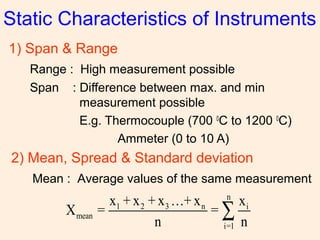
1) Span & Range
Range : High measurement possible
Span : Difference between max. and min
measurement possible
E.g. Thermocouple (700 0
C to 1200 0
C)
Ammeter (0 to 10 A)
2) Mean, Spread & Standard deviation
Mean : Average values of the same measurement
n
1 2 3 n i
mean
i=1
x + x + x …+ x x
X = =
n n
∑
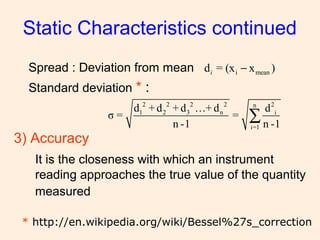
Spread : Deviation from mean
Standard deviation * :
Static Characteristics continued
i meand = (x x )i −
2 2 2 2 2n
1 2 3 n i
i=1
d + d + d …+ d d
σ = =
n -1 n -1
∑
* http://en.wikipedia.org/wiki/Bessel%27s_correction
3) Accuracy
It is the closeness with which an instrument
reading approaches the true value of the quantity
measured
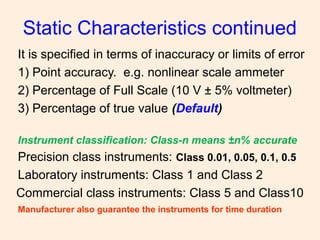
It is specified in terms of inaccuracy or limits of error
1) Point accuracy. e.g. nonlinear scale ammeter
2) Percentage of Full Scale (10 V ± 5% voltmeter)
3) Percentage of true value (Default)
Instrument classification: Class-n means ±n% accurate
Precision class instruments: Class 0.01, 0.05, 0.1, 0.5
Laboratory instruments: Class 1 and Class 2
Commercial class instruments: Class 5 and Class10
Manufacturer also guarantee the instruments for time duration
Static Characteristics continued
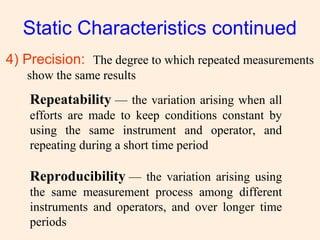
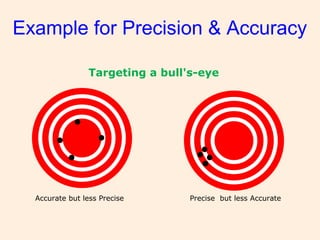
4) Precision: The degree to which repeated measurements
show the same results
Repeatability — the variation arising when all
efforts are made to keep conditions constant by
using the same instrument and operator, and
repeating during a short time period
Reproducibility — the variation arising using
the same measurement process among different
instruments and operators, and over longer time
periods
Example for Precision & Accuracy
Accurate but less Precise Precise but less Accurate
Targeting a bull's-eye
10
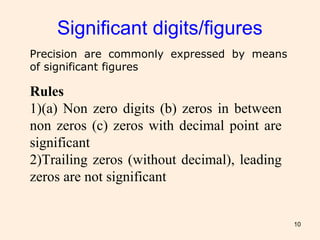
Significant digits/figures
Precision are commonly expressed by means
of significant figures
Rules
1)(a) Non zero digits (b) zeros in between
non zeros (c) zeros with decimal point are
significant
2)Trailing zeros (without decimal), leading
zeros are not significant
11
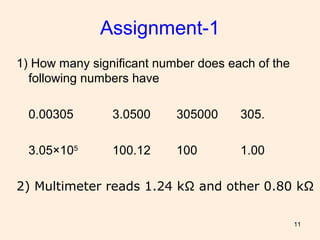
Assignment-1
1) How many significant number does each of the
following numbers have
0.00305 3.0500 305000 305.
3.05×10⁵
100.12 100 1.00
2) Multimeter reads 1.24 kΩ and other 0.80 kΩ
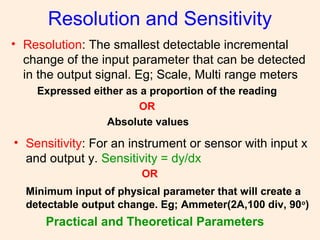
Resolution and Sensitivity
• Resolution: The smallest detectable incremental
change of the input parameter that can be detected
in the output signal. Eg; Scale, Multi range meters
Expressed either as a proportion of the reading
OR
Absolute values
• Sensitivity: For an instrument or sensor with input x
and output y. Sensitivity = dy/dx
OR
Minimum input of physical parameter that will create a
detectable output change. Eg; Ammeter(2A,100 div, 90o
)
Practical and Theoretical Parameters
13
Mistakes and Errors
No mistake in direct measurement. Data processing
causes mistakes
E.g. 1) Measuring resistance passing 3 A current
and voltmeter reads 1 V
2) Adding three reading of ammeter with
different significant figures after decimal
• Static Sensitivity: The slope of static calibration curve
evaluated at the input value
14
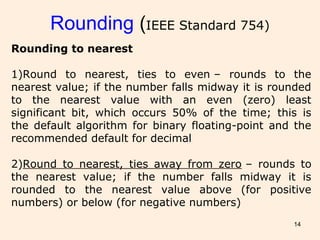
Rounding (IEEE Standard 754)
Rounding to nearest
1)Round to nearest, ties to even – rounds to the
nearest value; if the number falls midway it is rounded
to the nearest value with an even (zero) least
significant bit, which occurs 50% of the time; this is
the default algorithm for binary floating-point and the
recommended default for decimal
2)Round to nearest, ties away from zero – rounds to
the nearest value; if the number falls midway it is
rounded to the nearest value above (for positive
numbers) or below (for negative numbers)
15
Assignment-2
1) Round off 0.25 to one significant digit using the two
methods suggested in IEEE Standards. Compute
the result obtained by dividing by 2. Compare the
computational errors
16
Calibration
It is a procedure that involve a comparison of the
particular instrument with either
1) a primary standard
2) a secondary standard (higher accuracy than the
instrument to be calibrated)
3) known output
17
Dead zone/space and Dead time
Dead space: The largest of a measured variable
for which the instrument does not respond
Cause: friction in mechanical measurement
system
Dead time: The time before the instrument
begins to respond after the measured
quantity has been changed.
E.g: Camera, Data acquisition card, Ammeter
18
Hysteresis
It refers to the difference
between upscale sequence
of calibration and downscale
sequence of calibration
he=({y}upscale-{y}downscale)x=x1
Hysteresis error = [he(max)/FSOR] ×100
FSOR : Full Scale Output Reading
Fig. Internal force verses extension
of a rubber band follows
hysteresis. External force is in
opposition to internal force
E.g. Potentiometer used as
displacement sensor with
significant losses
19
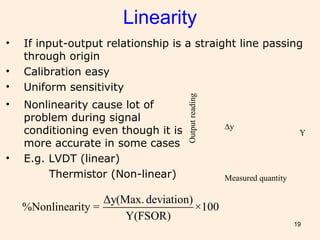
Linearity
• If input-output relationship is a straight line passing
through origin
• Calibration easy
• Uniform sensitivity
Y
∆y
Measured quantity
Outputreading
• Nonlinearity cause lot of
problem during signal
conditioning even though it is
more accurate in some cases
• E.g. LVDT (linear)
Thermistor (Non-linear)
Δy(Max. deviation)
%Nonlinearity = ×100
Y(FSOR)
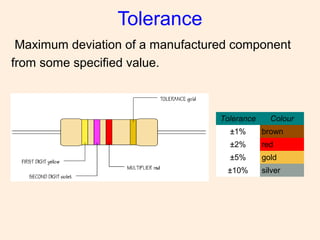
Tolerance
Maximum deviation of a manufactured component
from some specified value.
Tolerance Colour
±1% brown
±2% red
±5% gold
±10% silver
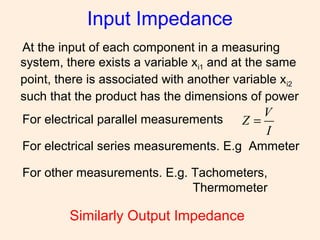
Input Impedance
At the input of each component in a measuring
system, there exists a variable xi1 and at the same
point, there is associated with another variable xi2
such that the product has the dimensions of power
V
Z
I
=For electrical parallel measurements
For electrical series measurements. E.g Ammeter
For other measurements. E.g. Tachometers,
Thermometer
Similarly Output Impedance
Bias
A constant error exists over the full range of
measurement of an instrument.
This can removed easily E.g. Zero Error
Drift
Change of some static characteristics of a measuring
system due to variations in ambient temperature,
pressure etc.
Instruments are calibrated under controlled conditions
E.g. Sensitivity drift, Zero drift.
Zero drift of voltmeter due to temperature change can
be expressed in volts/0
C

Introduction to sensors

  • 1.
    Advanced Instrumentation • Coursecontents • Sensors and types • Introduction to MEMS • Transducers • Signal conditioning circuits • Data acquisition and transmission • Biomedical instrumentation • Integrated, Intelligent and smart sensors • Electronic nose • Real world interfacing
  • 2.
    Sensors and Transducers •Sensor • Device that detects a change in a physical stimulus and turns it into a (electrical) signal which can be measured or recorded. Eg Bimetallic strip, Light Dependent Resistors, Hg in glass thermometer etc • Actuator • Converts electrical or pneumatic signal to some kind of motion. Eg, solenoid actuator • Transducer • Device that transfers power from one system to another in the same or in the different form. Eg. Weighing machine, electric motor
  • 3.
    Classification of thesensors • Active and Passive Active: Input excitation is required (Electrical, Pneumatic, Hydraulic etc) Example : potentiometer as displacement sensor Passive: Input excitation is not required Example : Mercury Thermometer • Null and Deflection Type Null : Balancing a bridge to find resistance Passive: Finding the defection due to resistance change in bridge circuit
  • 4.
    Classification of thesensors • Monitoring and Transmitting Type Monitoring: eg; Mercury thermometer Transmitting: eg; Thermocouple Current (4 mA to 20 mA) should be transmitted but not voltage. A transmitter is used to convert any signal into current signal. • Analog and Digital Type Analog: Output varies continuously, infinite position for the pointer Digital: Output varies in discrete form. Finite number of positions
  • 5.
    Static Characteristics ofInstruments 1) Span & Range Range : High measurement possible Span : Difference between max. and min measurement possible E.g. Thermocouple (700 0 C to 1200 0 C) Ammeter (0 to 10 A) 2) Mean, Spread & Standard deviation Mean : Average values of the same measurement n 1 2 3 n i mean i=1 x + x + x …+ x x X = = n n ∑
  • 6.
    Spread : Deviationfrom mean Standard deviation * : Static Characteristics continued i meand = (x x )i − 2 2 2 2 2n 1 2 3 n i i=1 d + d + d …+ d d σ = = n -1 n -1 ∑ * http://en.wikipedia.org/wiki/Bessel%27s_correction 3) Accuracy It is the closeness with which an instrument reading approaches the true value of the quantity measured
  • 7.
    It is specifiedin terms of inaccuracy or limits of error 1) Point accuracy. e.g. nonlinear scale ammeter 2) Percentage of Full Scale (10 V ± 5% voltmeter) 3) Percentage of true value (Default) Instrument classification: Class-n means ±n% accurate Precision class instruments: Class 0.01, 0.05, 0.1, 0.5 Laboratory instruments: Class 1 and Class 2 Commercial class instruments: Class 5 and Class10 Manufacturer also guarantee the instruments for time duration Static Characteristics continued
  • 8.
    Static Characteristics continued 4)Precision: The degree to which repeated measurements show the same results Repeatability — the variation arising when all efforts are made to keep conditions constant by using the same instrument and operator, and repeating during a short time period Reproducibility — the variation arising using the same measurement process among different instruments and operators, and over longer time periods
  • 9.
    Example for Precision& Accuracy Accurate but less Precise Precise but less Accurate Targeting a bull's-eye
  • 10.
    10 Significant digits/figures Precision arecommonly expressed by means of significant figures Rules 1)(a) Non zero digits (b) zeros in between non zeros (c) zeros with decimal point are significant 2)Trailing zeros (without decimal), leading zeros are not significant
  • 11.
    11 Assignment-1 1) How manysignificant number does each of the following numbers have 0.00305 3.0500 305000 305. 3.05×10⁵ 100.12 100 1.00 2) Multimeter reads 1.24 kΩ and other 0.80 kΩ
  • 12.
    Resolution and Sensitivity •Resolution: The smallest detectable incremental change of the input parameter that can be detected in the output signal. Eg; Scale, Multi range meters Expressed either as a proportion of the reading OR Absolute values • Sensitivity: For an instrument or sensor with input x and output y. Sensitivity = dy/dx OR Minimum input of physical parameter that will create a detectable output change. Eg; Ammeter(2A,100 div, 90o ) Practical and Theoretical Parameters
  • 13.
    13 Mistakes and Errors Nomistake in direct measurement. Data processing causes mistakes E.g. 1) Measuring resistance passing 3 A current and voltmeter reads 1 V 2) Adding three reading of ammeter with different significant figures after decimal • Static Sensitivity: The slope of static calibration curve evaluated at the input value
  • 14.
    14 Rounding (IEEE Standard754) Rounding to nearest 1)Round to nearest, ties to even – rounds to the nearest value; if the number falls midway it is rounded to the nearest value with an even (zero) least significant bit, which occurs 50% of the time; this is the default algorithm for binary floating-point and the recommended default for decimal 2)Round to nearest, ties away from zero – rounds to the nearest value; if the number falls midway it is rounded to the nearest value above (for positive numbers) or below (for negative numbers)
  • 15.
    15 Assignment-2 1) Round off0.25 to one significant digit using the two methods suggested in IEEE Standards. Compute the result obtained by dividing by 2. Compare the computational errors
  • 16.
    16 Calibration It is aprocedure that involve a comparison of the particular instrument with either 1) a primary standard 2) a secondary standard (higher accuracy than the instrument to be calibrated) 3) known output
  • 17.
    17 Dead zone/space andDead time Dead space: The largest of a measured variable for which the instrument does not respond Cause: friction in mechanical measurement system Dead time: The time before the instrument begins to respond after the measured quantity has been changed. E.g: Camera, Data acquisition card, Ammeter
  • 18.
    18 Hysteresis It refers tothe difference between upscale sequence of calibration and downscale sequence of calibration he=({y}upscale-{y}downscale)x=x1 Hysteresis error = [he(max)/FSOR] ×100 FSOR : Full Scale Output Reading Fig. Internal force verses extension of a rubber band follows hysteresis. External force is in opposition to internal force E.g. Potentiometer used as displacement sensor with significant losses
  • 19.
    19 Linearity • If input-outputrelationship is a straight line passing through origin • Calibration easy • Uniform sensitivity Y ∆y Measured quantity Outputreading • Nonlinearity cause lot of problem during signal conditioning even though it is more accurate in some cases • E.g. LVDT (linear) Thermistor (Non-linear) Δy(Max. deviation) %Nonlinearity = ×100 Y(FSOR)
  • 20.
    Tolerance Maximum deviation ofa manufactured component from some specified value. Tolerance Colour ±1% brown ±2% red ±5% gold ±10% silver
  • 21.
    Input Impedance At theinput of each component in a measuring system, there exists a variable xi1 and at the same point, there is associated with another variable xi2 such that the product has the dimensions of power V Z I =For electrical parallel measurements For electrical series measurements. E.g Ammeter For other measurements. E.g. Tachometers, Thermometer Similarly Output Impedance
  • 22.
    Bias A constant errorexists over the full range of measurement of an instrument. This can removed easily E.g. Zero Error Drift Change of some static characteristics of a measuring system due to variations in ambient temperature, pressure etc. Instruments are calibrated under controlled conditions E.g. Sensitivity drift, Zero drift. Zero drift of voltmeter due to temperature change can be expressed in volts/0 C