EE 202 : DIGITAL ELECTRONICS

CHAPTER 2 : BOOLEAN
OPERATIONS

by : Siti Sabariah Salihin
Electrical Engineering Department
sabariah@psa.edu.my
CHAPTER 2 : BOOLEAN OPERATIONS
EE 202 : DIGITAL ELECTRONICS

Programme Learning Outcomes, PLO
Upon completion of the programme, graduates should be able to:
•

PLO 1 : Apply knowledge of mathematics, scince and engineering
fundamentals to well defined electrical and electronic engineering
procedures and practices

Course Learning Outcomes, CLO
• CLO 1 : Illustrate the knowledge of digital number systems,codes
and ligic operations correctly
• CLO 2 : Simplify and design combinational and sequential logic
circuits by using the Boolean Algebra and the Karnaugh Maps.

EE 202 : DIGITAL ELECTRONICS
Upon completion of this Topic 2
student should be able to:
2.1 Know the symbols,operations and functions of logic gates.
2.1.1 Draw the symbols, operations and
functions of logic gates.
2.1.2 Explain the Function of Logic gates using Truth
Table.
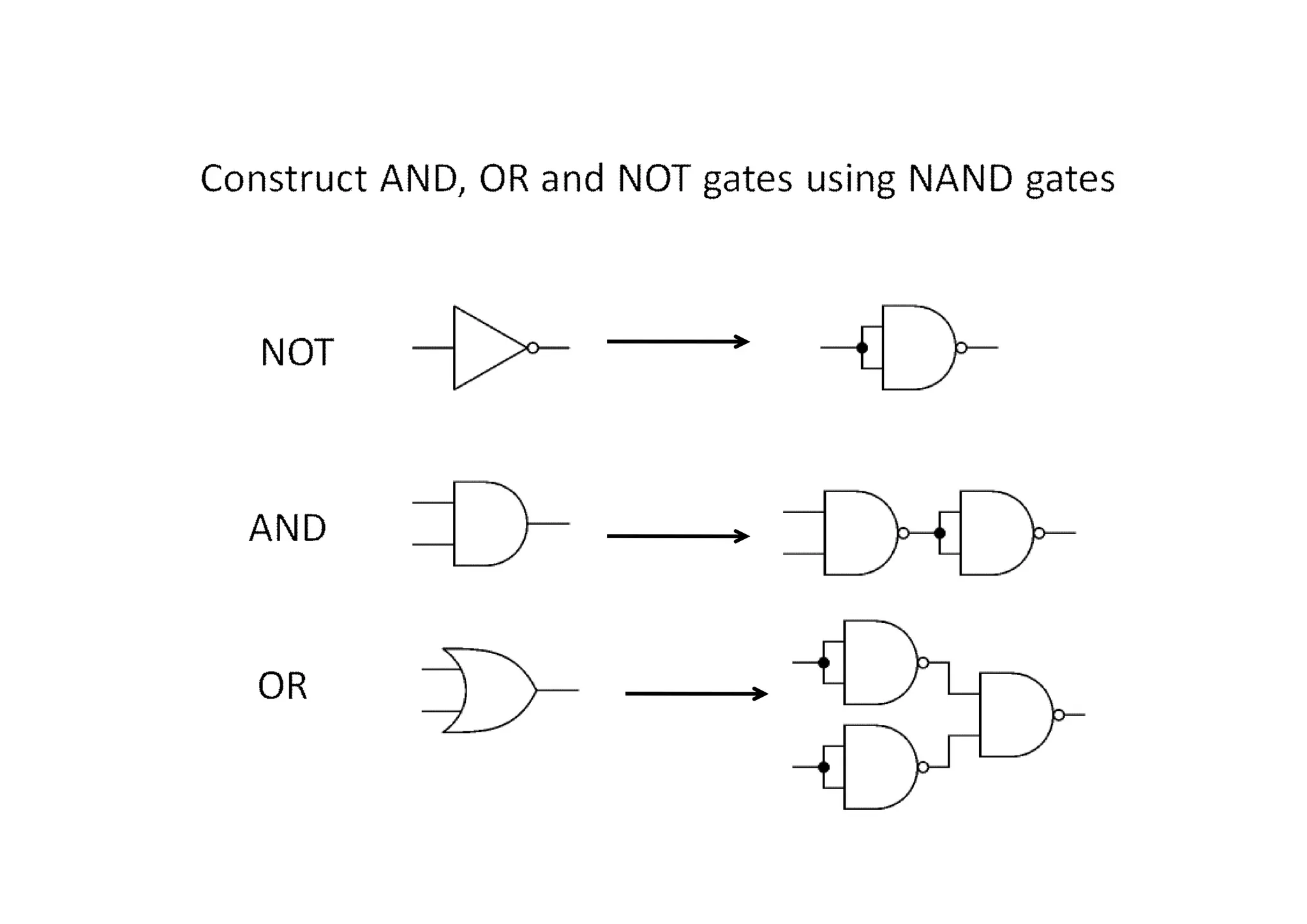
2.1.3 Construct AND, OR and NOT gates using only
NAND gates.

2.2
2.2.1
2.2.2
2.2.3
2.2.4

Know the basic concepts of Boolean Algebra and use them in
Logic circuits analysis and design.
Construct the basic concepts of Boolean Algebra
and use them in logic circuits analysis and design.
State the Boolean Laws.
Develop logic expressions from the truth table from
the form of SOP and POS
Simplify combinatinal Logic circuits using Boolean
Laws and Karnaugh Map
EE 202 : DIGITAL ELECTRONICS
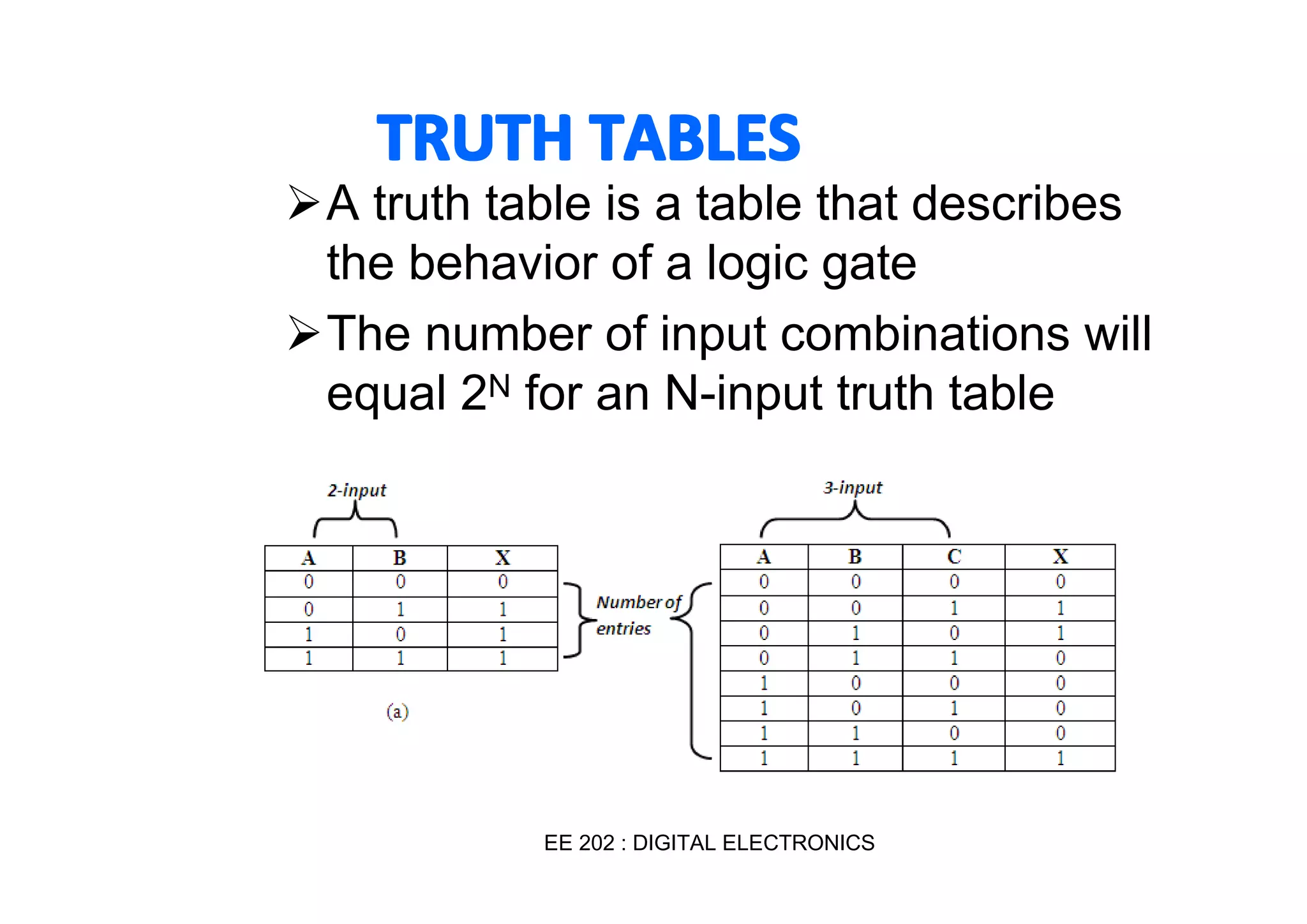
TRUTH TABLES
�A truth table is a table that describes
the behavior of a logic gate
�The number of input combinations will
equal 2N for an N-input truth table

EE 202 : DIGITAL ELECTRONICS

4
LOGIC GATES
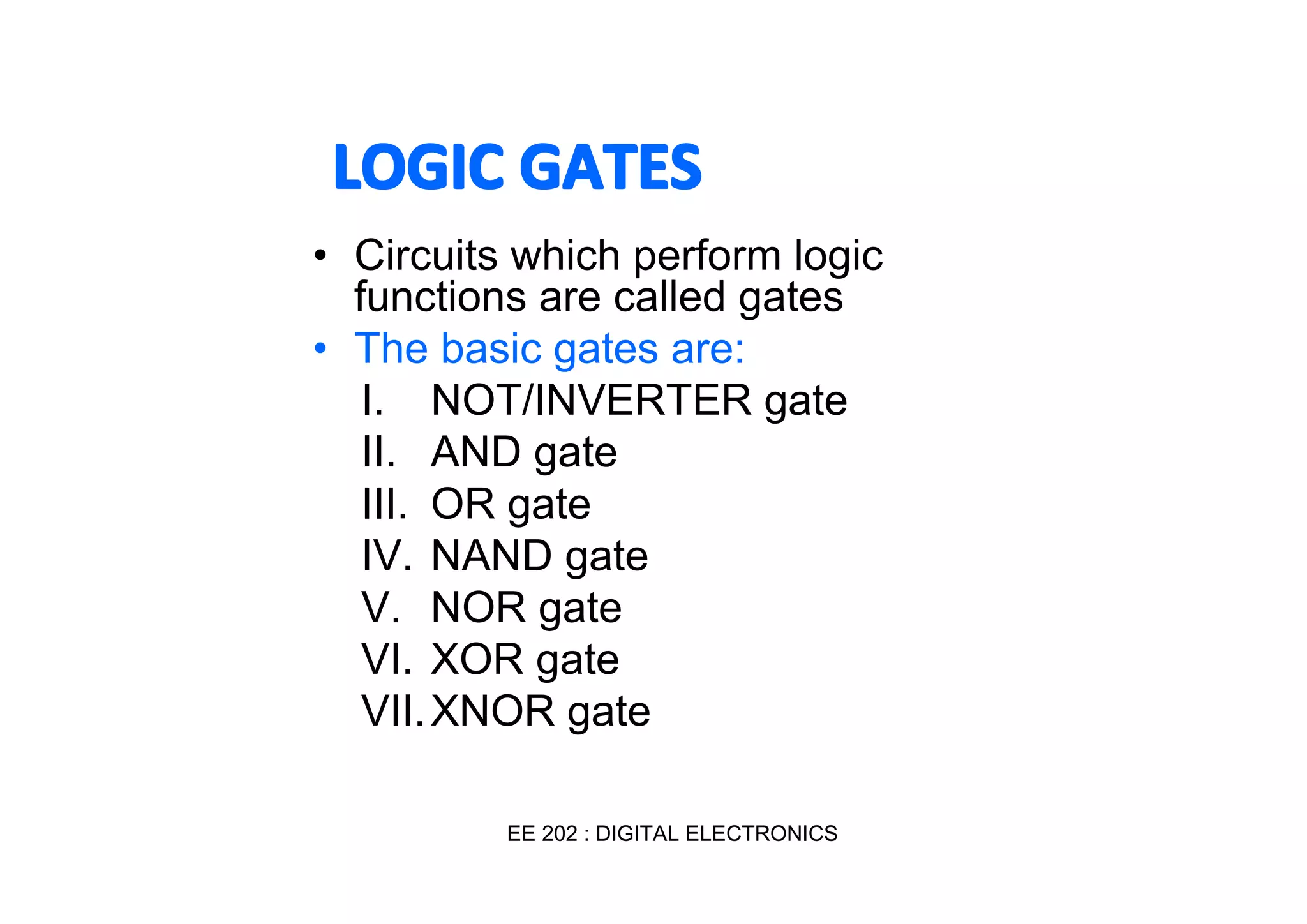
• Circuits which perform logic
functions are called gates
• The basic gates are:
I. NOT/INVERTER gate
II. AND gate
III. OR gate
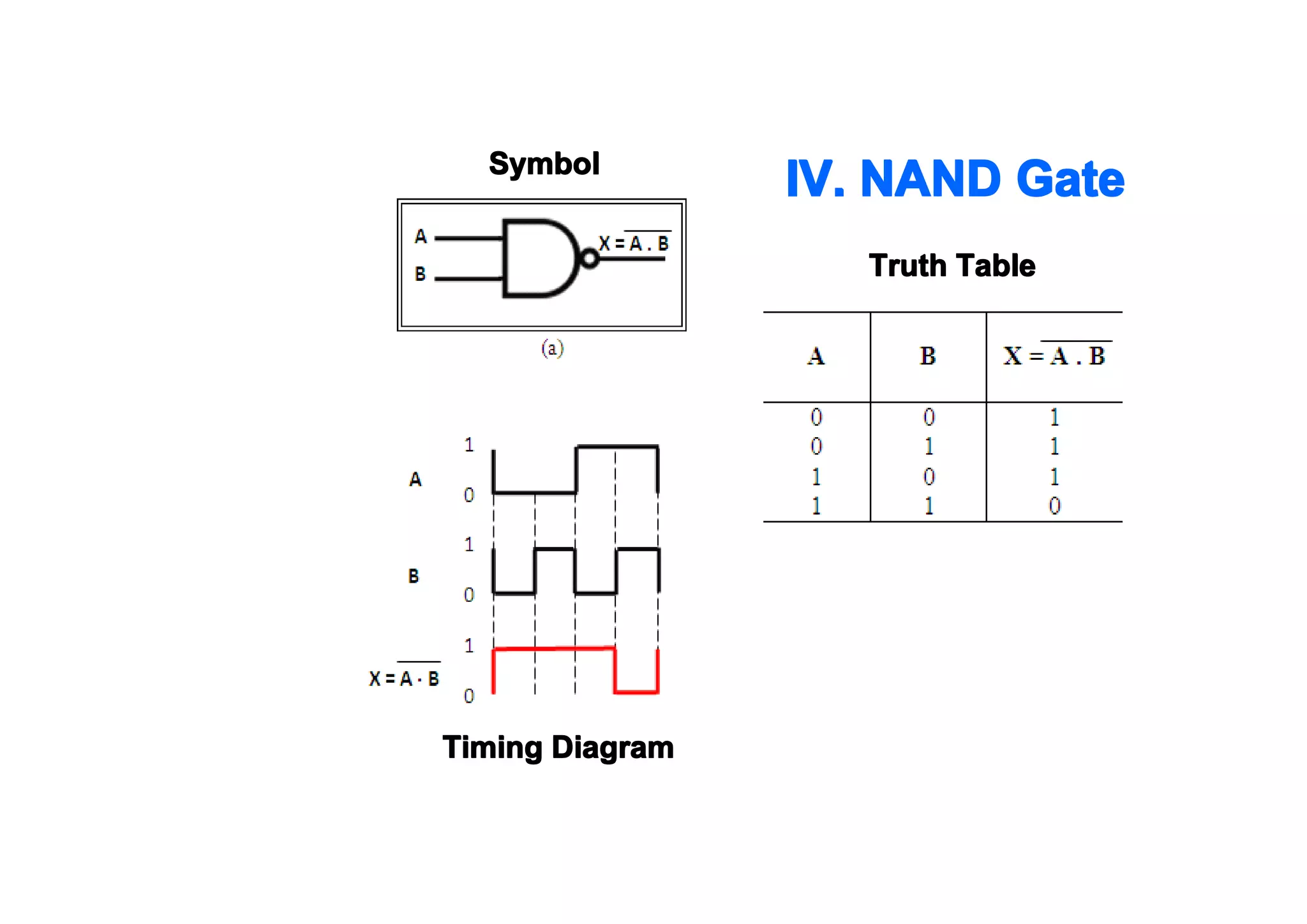
IV. NAND gate
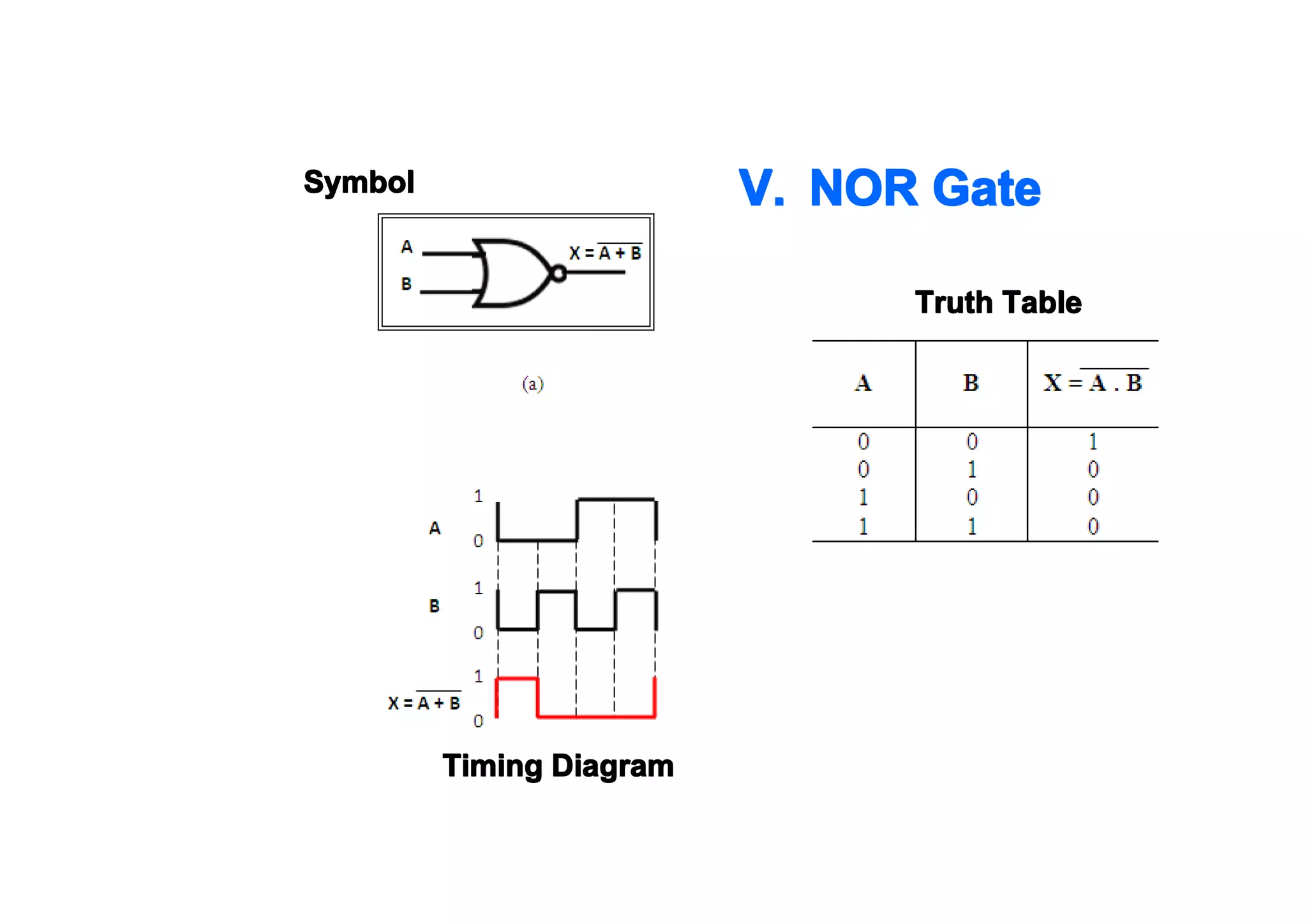
V. NOR gate
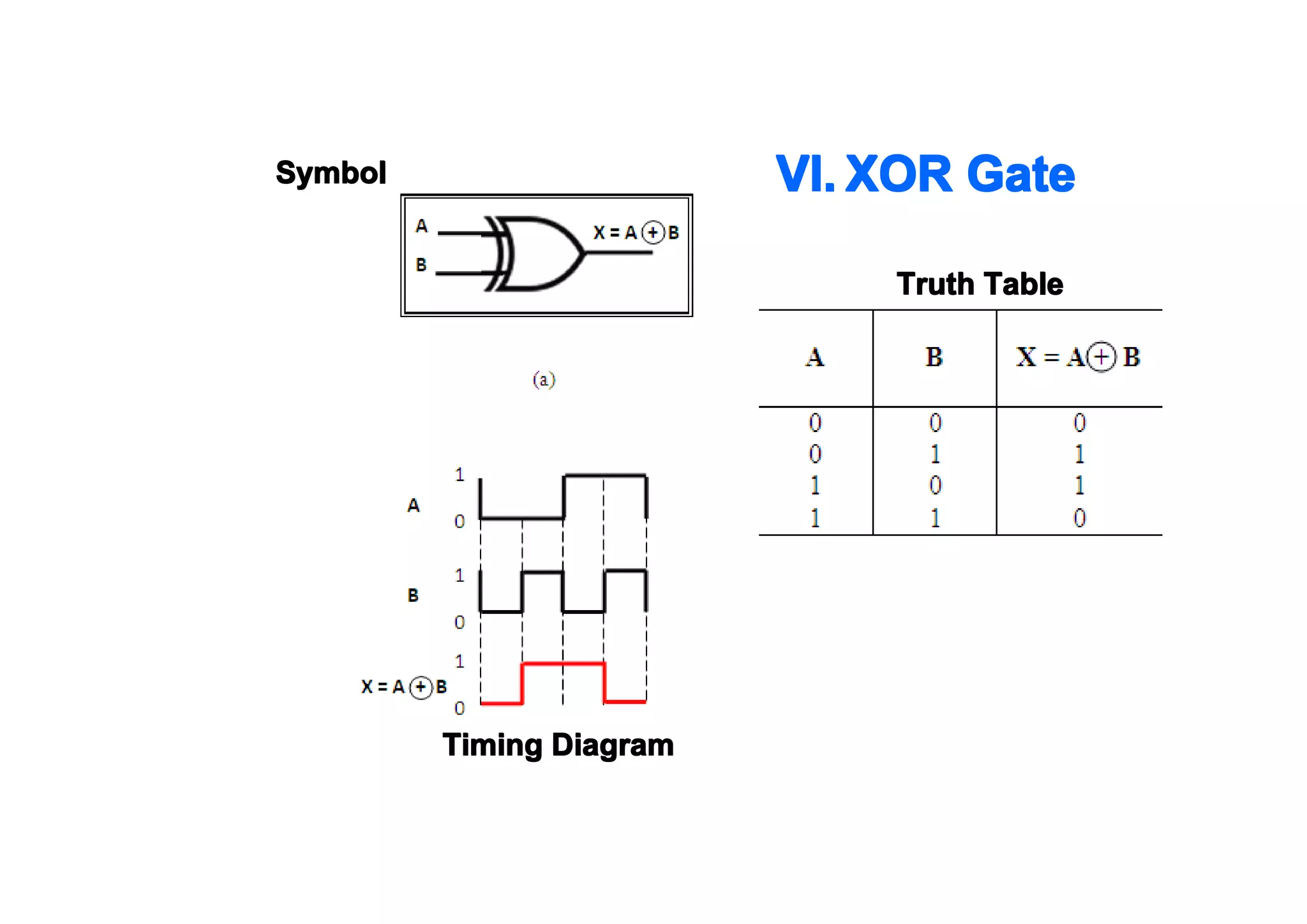
VI. XOR gate
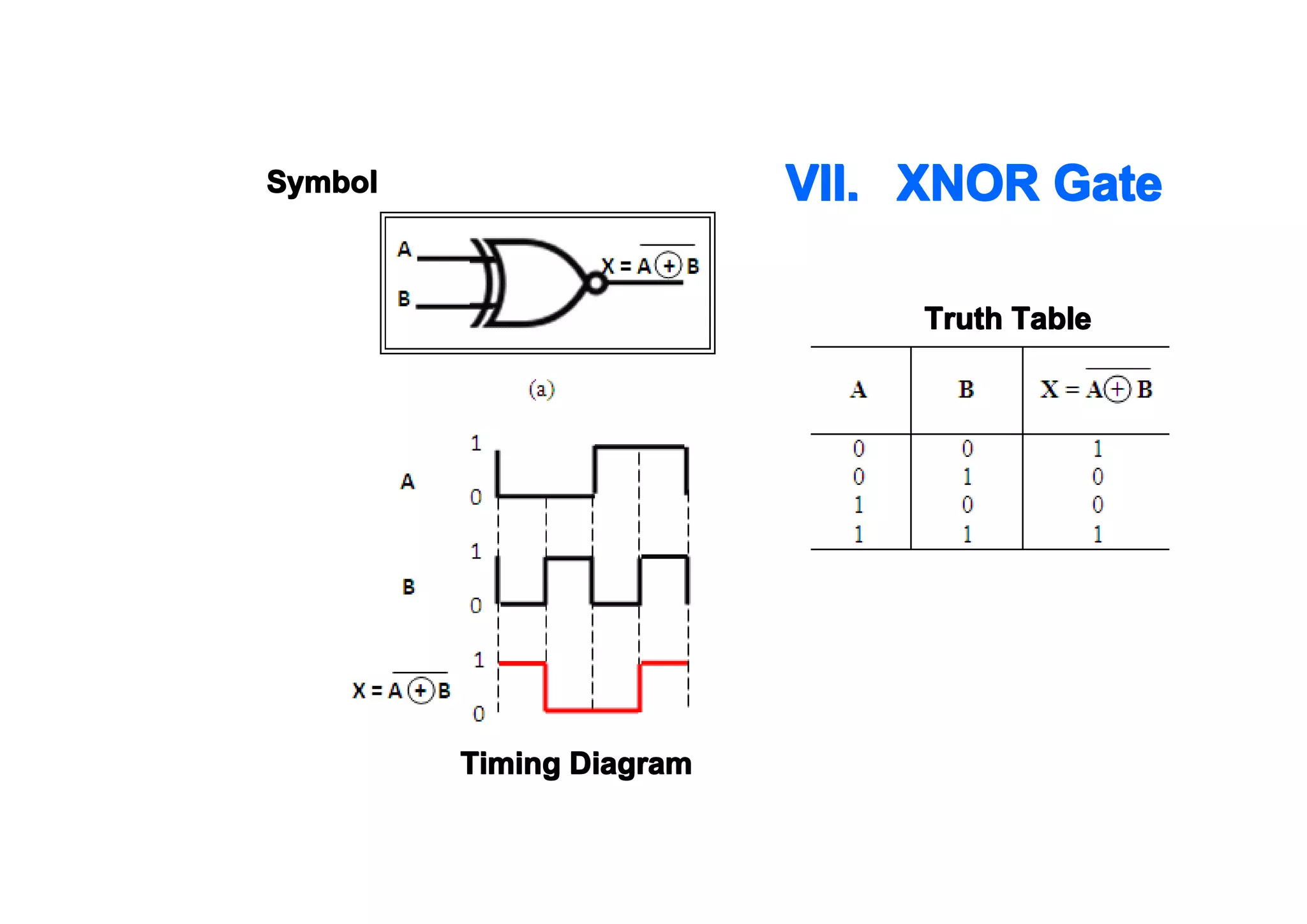
VII. XNOR gate
EE 202 : DIGITAL ELECTRONICS
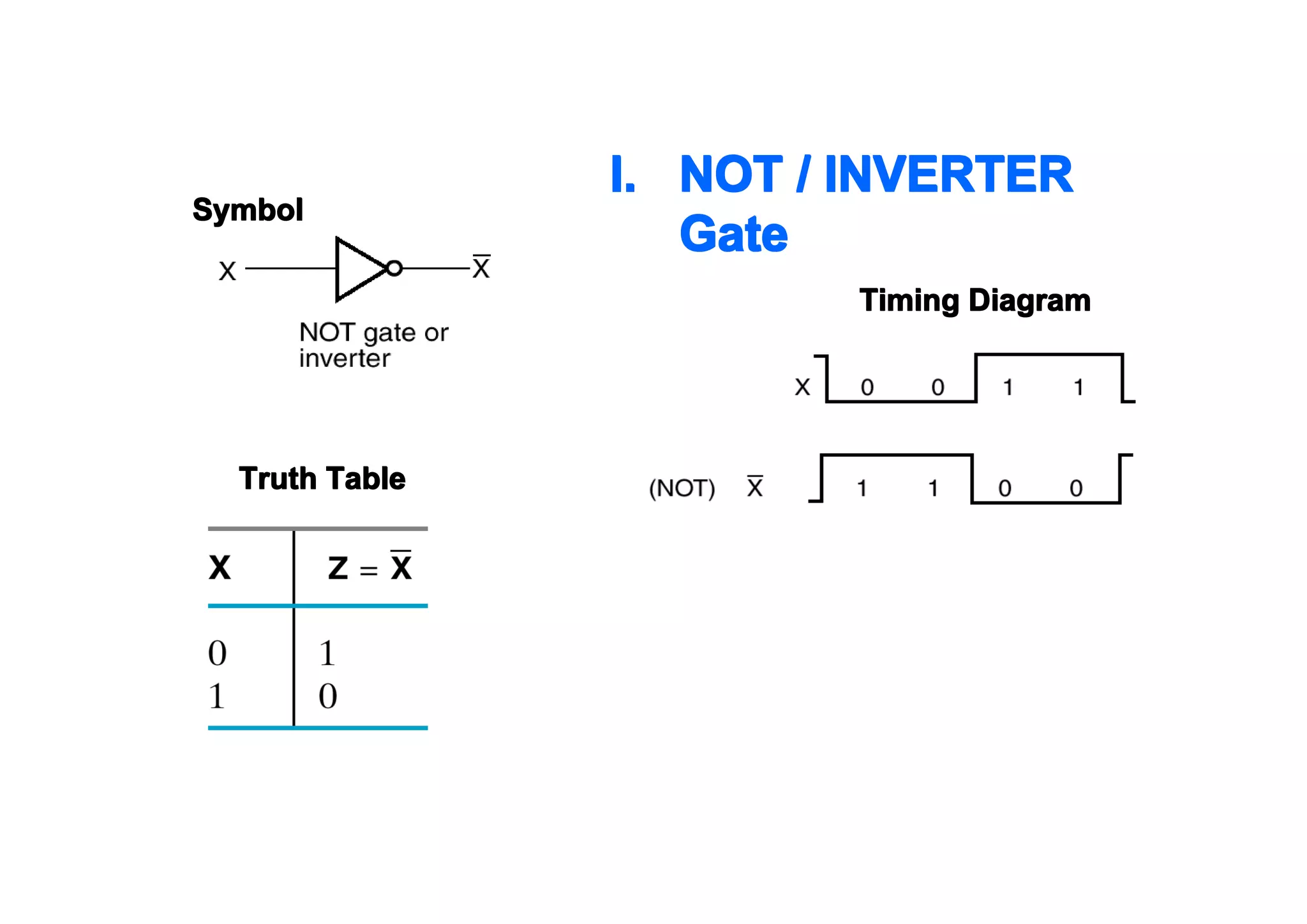
Symbol

I. NOT / INVERTER
Gate
Timing Diagram

Truth Table
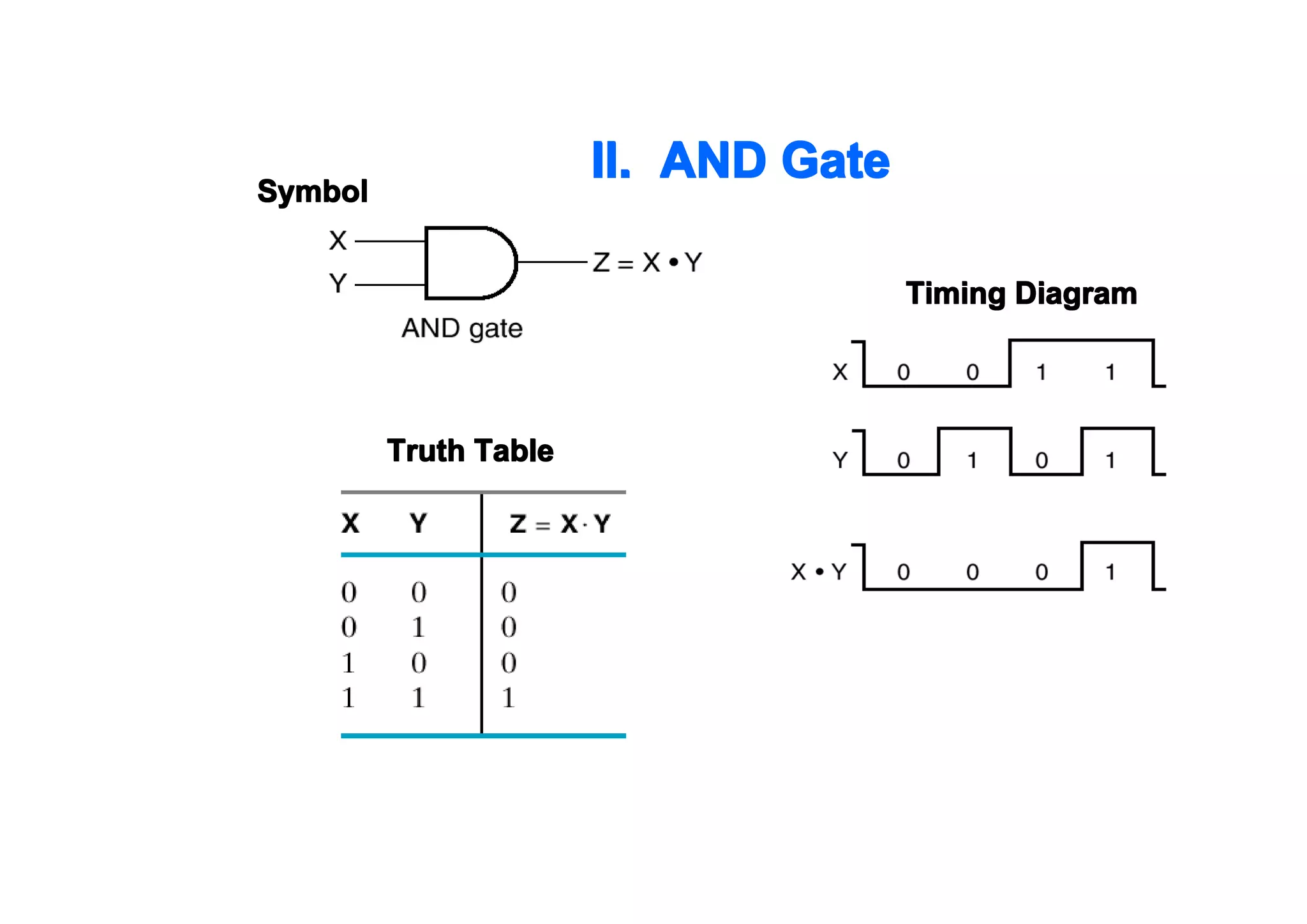
II. AND Gate

Symbol

Timing Diagram

Truth Table
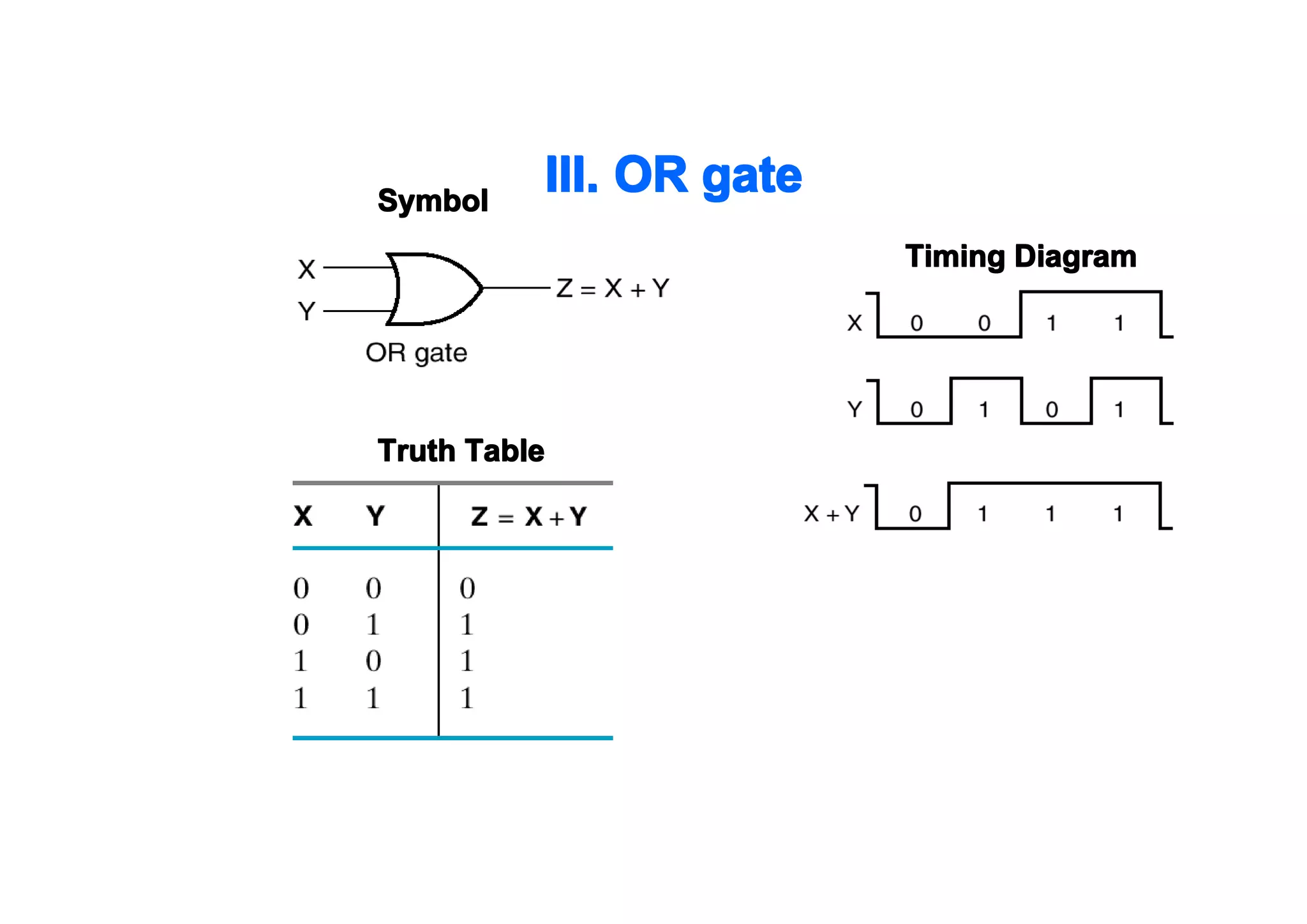
Symbol

III. OR gate
Timing Diagram

Truth Table
Symbol

IV. NAND Gate
Truth Table

Timing Diagram
V. NOR Gate

Symbol

Truth Table

Timing Diagram
VI. XOR Gate

Symbol

Truth Table

Timing Diagram
VII. XNOR Gate

Symbol

Truth Table

Timing Diagram
BOOLEAN ALGEBRA
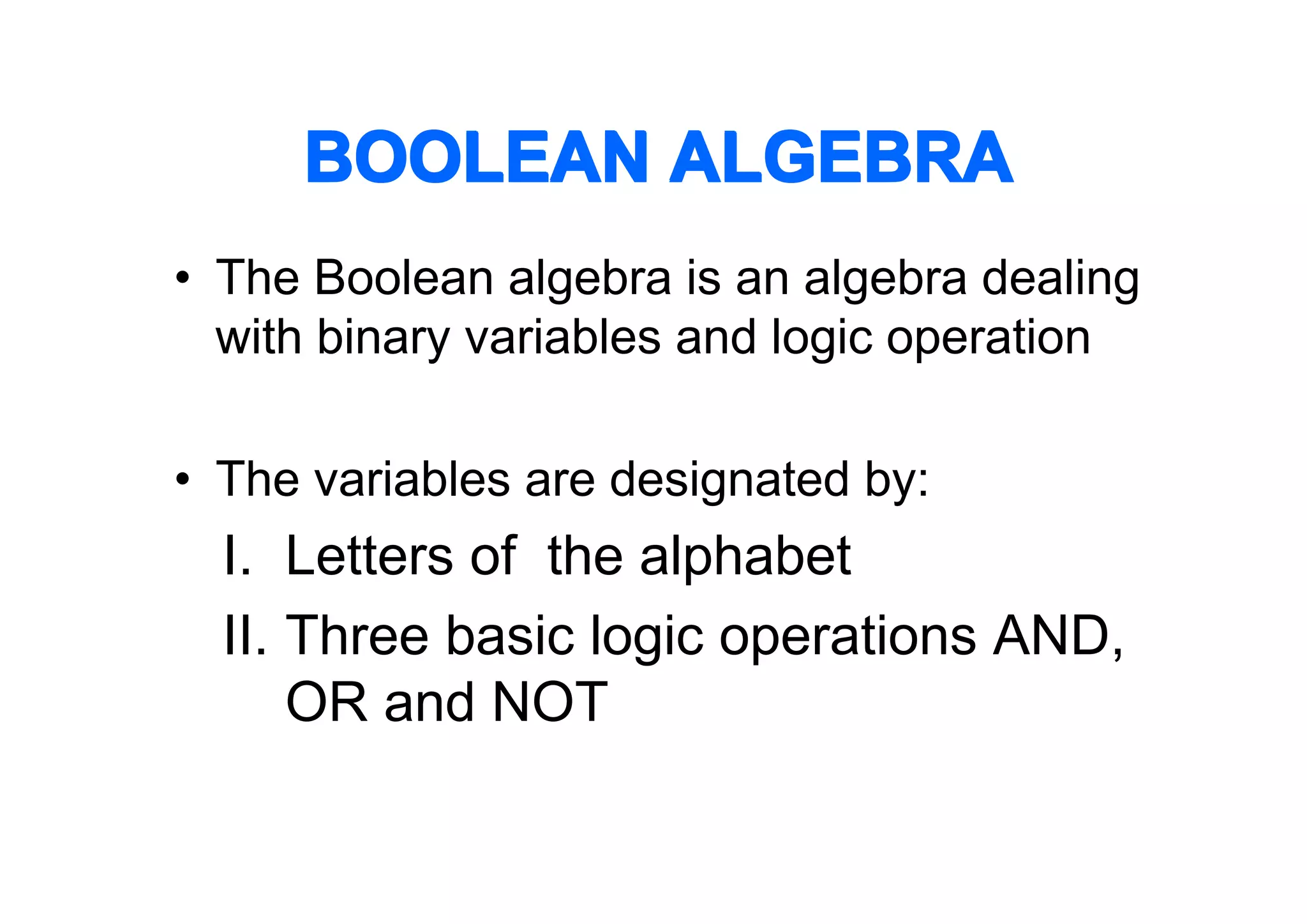
• The Boolean algebra is an algebra dealing
with binary variables and logic operation
• The variables are designated by:

I. Letters of the alphabet
II. Three basic logic operations AND,
OR and NOT
BOOLEAN ALGEBRA
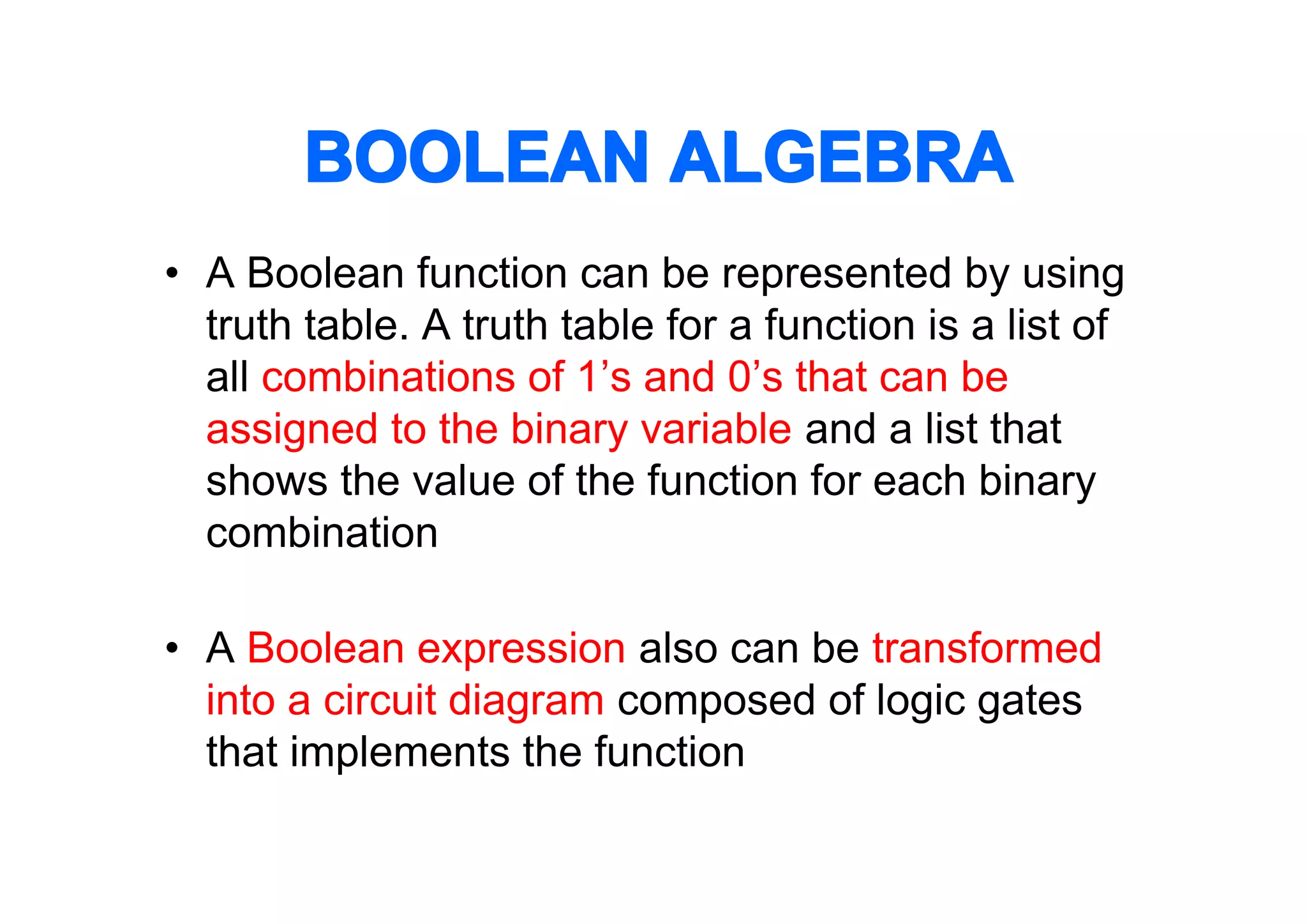
• A Boolean function can be represented by using
truth table. A truth table for a function is a list of
all combinations of 1’s and 0’s that can be
assigned to the binary variable and a list that
shows the value of the function for each binary
combination
• A Boolean expression also can be transformed
into a circuit diagram composed of logic gates
that implements the function
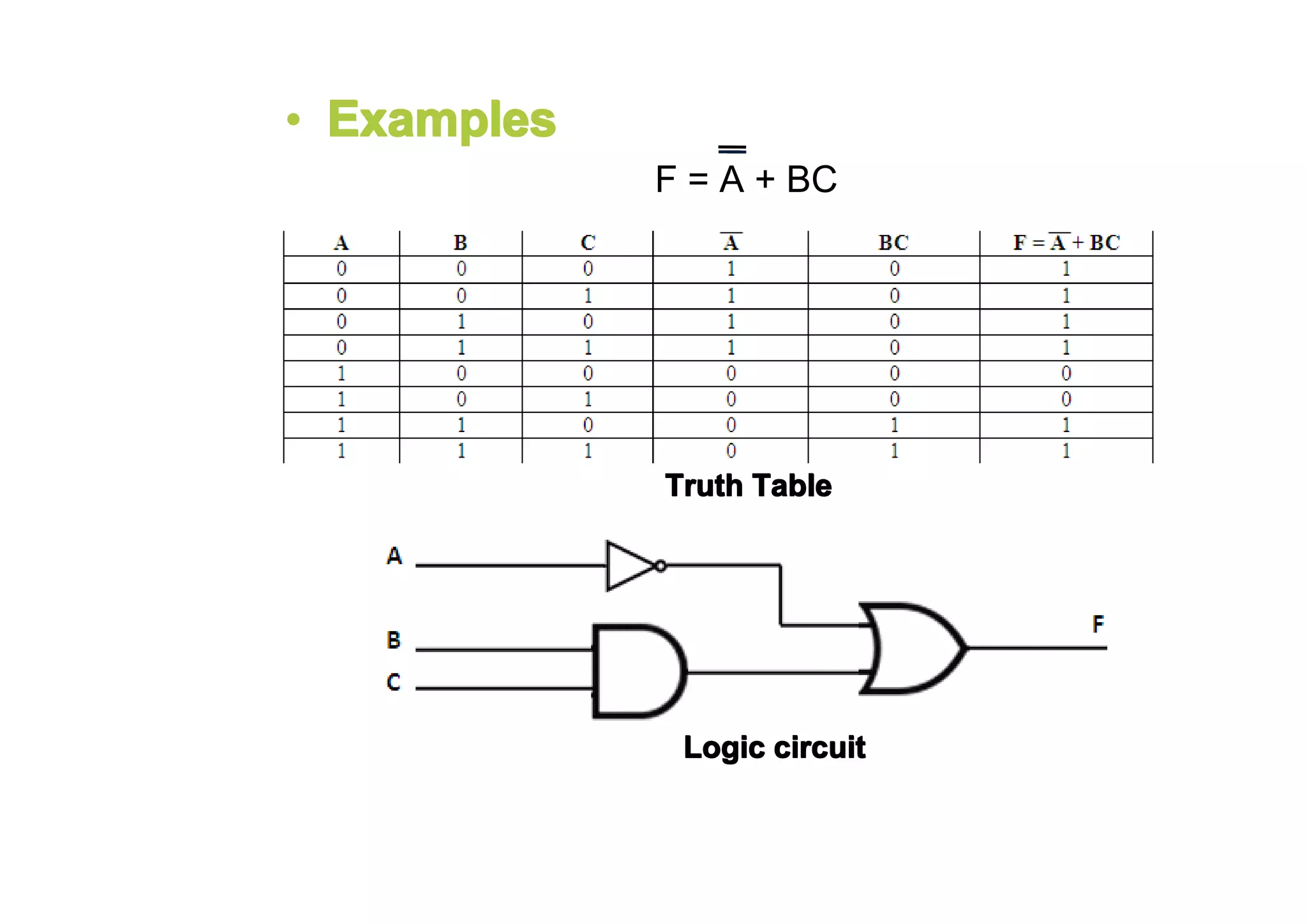
• Examples
F = A + BC

Truth Table

Logic circuit
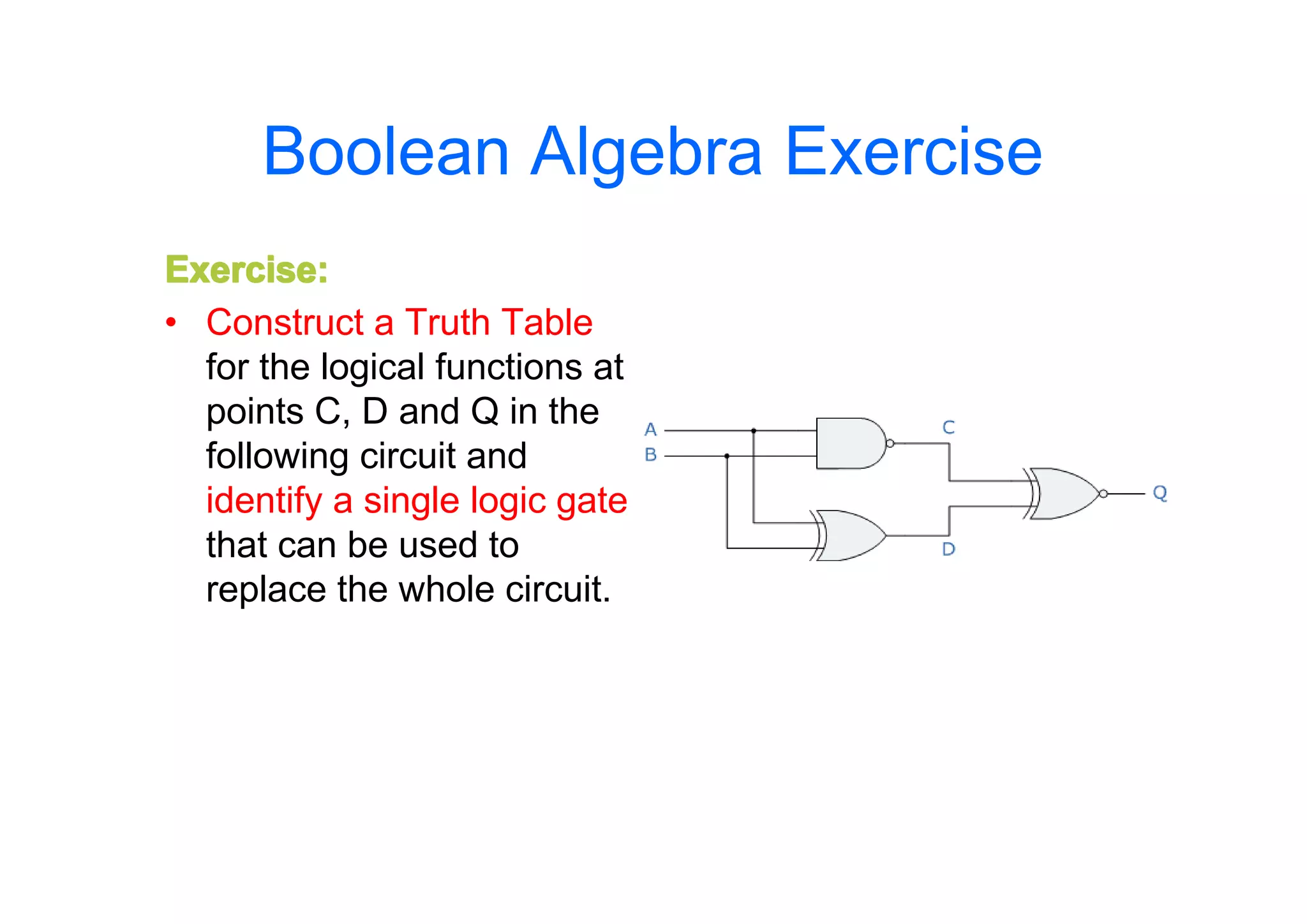
Boolean Algebra Exercise
Exercise:
• Construct a Truth Table
for the logical functions at
points C, D and Q in the
following circuit and
identify a single logic gate
that can be used to
replace the whole circuit.
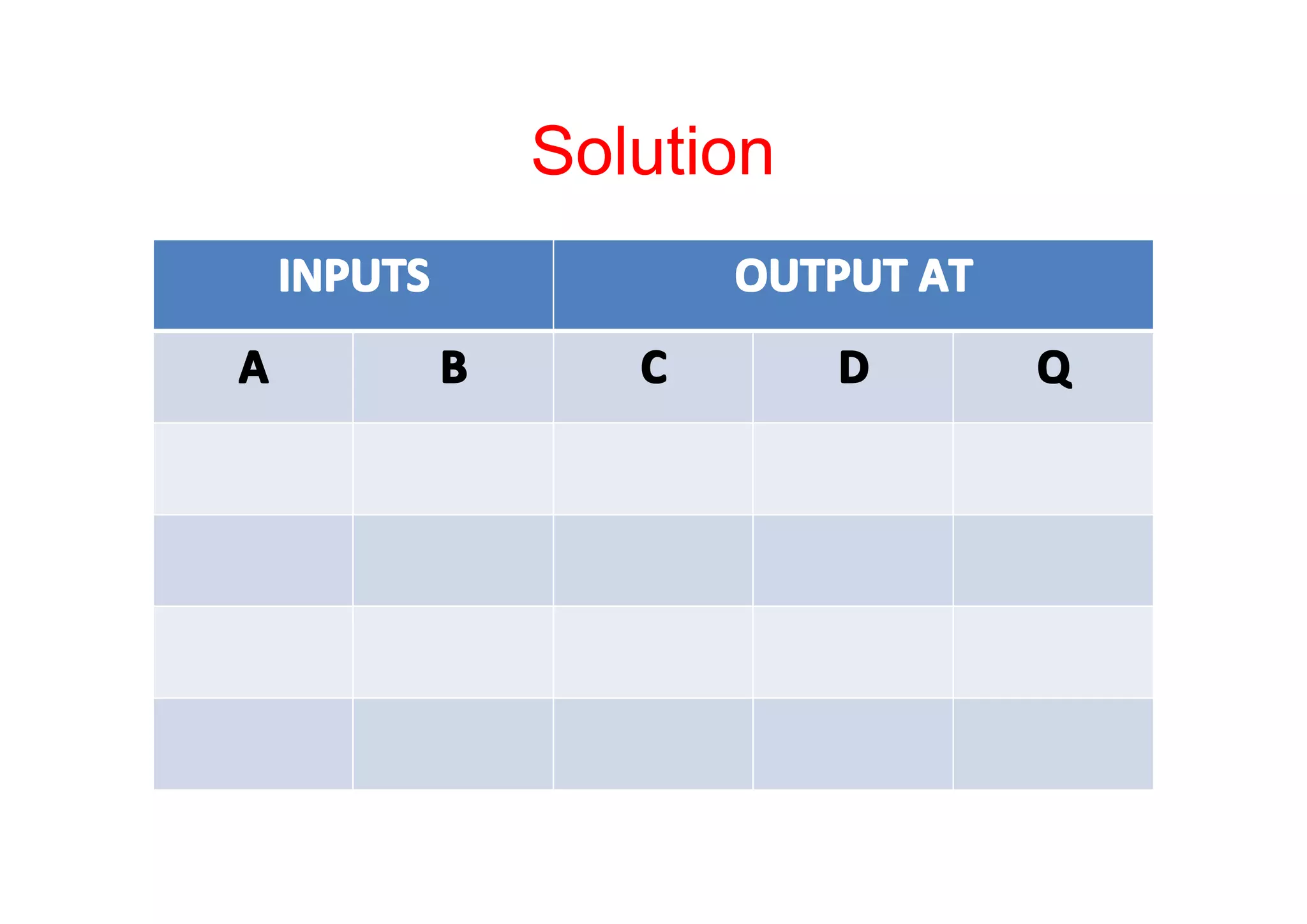
Solution
INPUTS
A

OUTPUT AT
B

C

D

Q
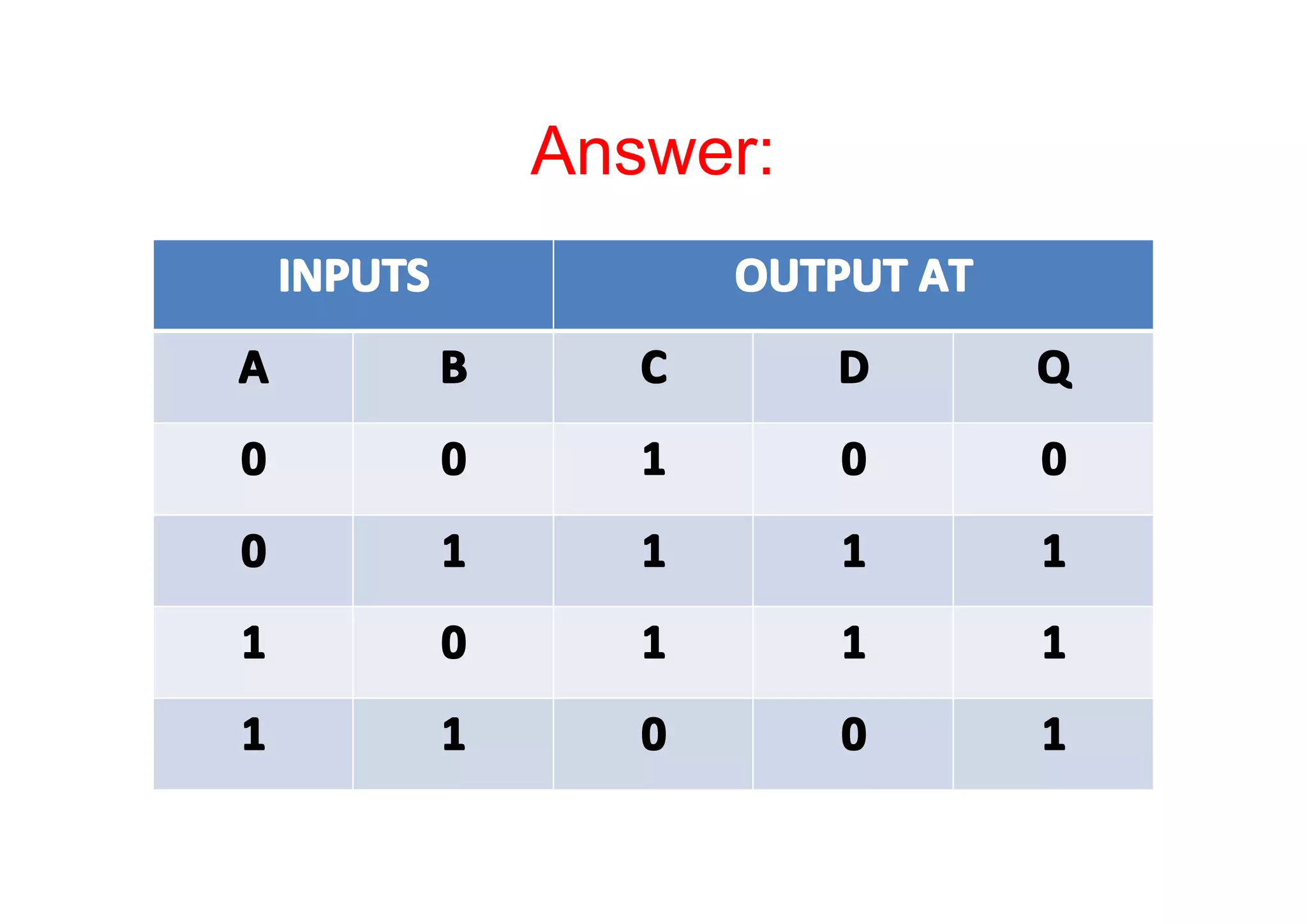
Answer:
INPUTS

OUTPUT AT

A

B

C

D

Q

0

0

1

0

0

0

1

1

1

1

1

0

1

1

1

1

1

0

0

1
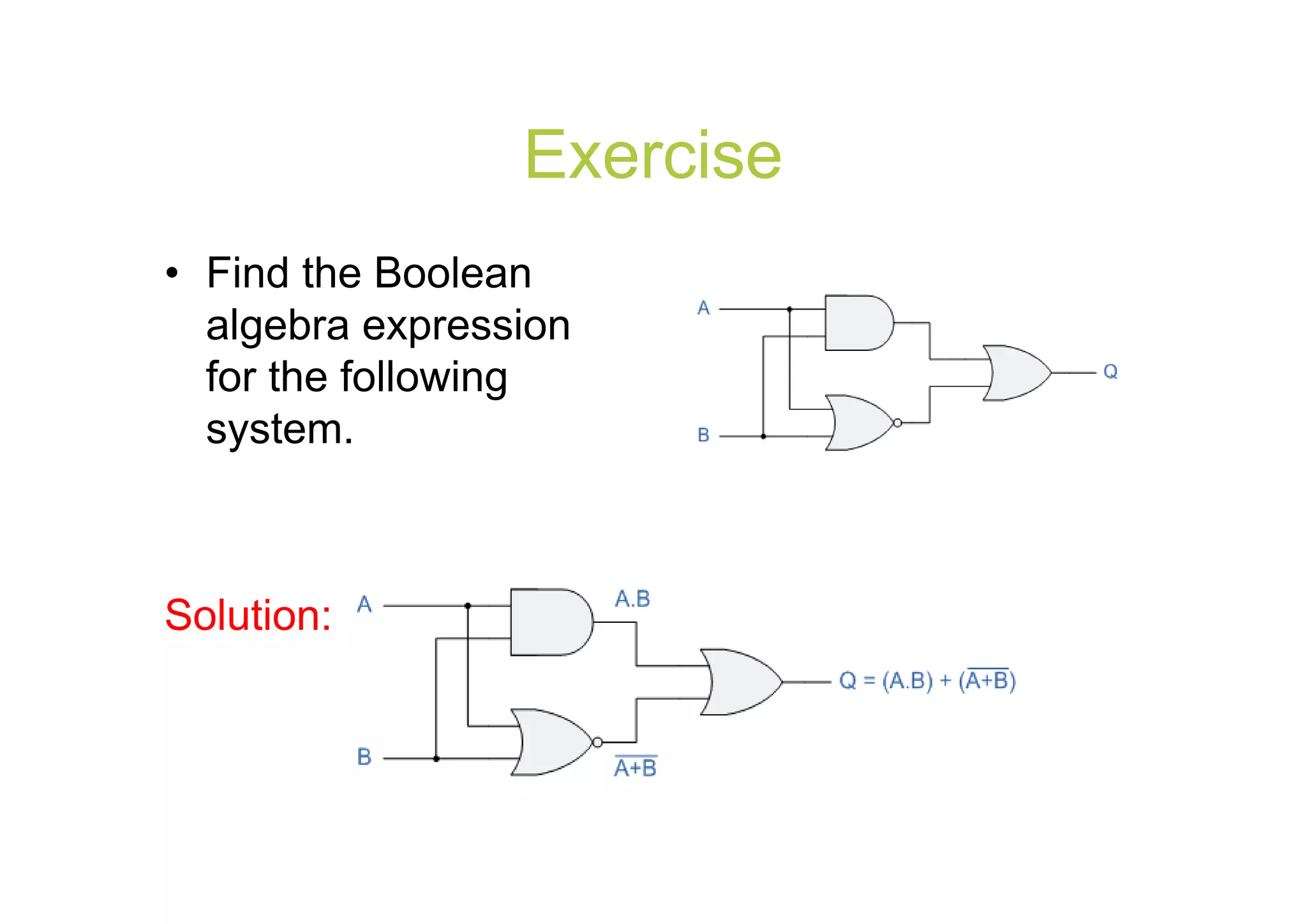
Exercise
• Find the Boolean
algebra expression
for the following
system.

Solution:
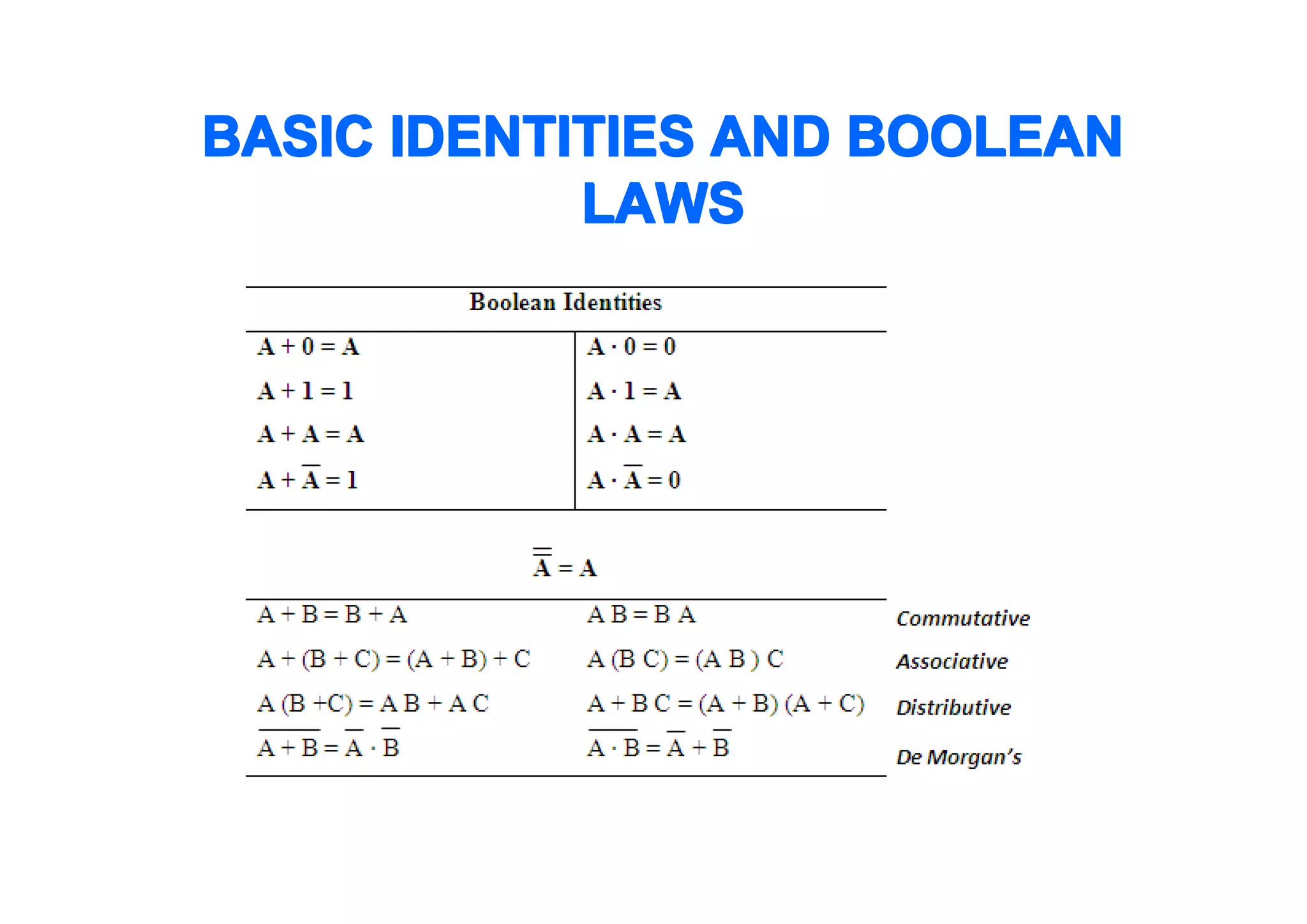
BASIC IDENTITIES AND BOOLEAN
LAWS
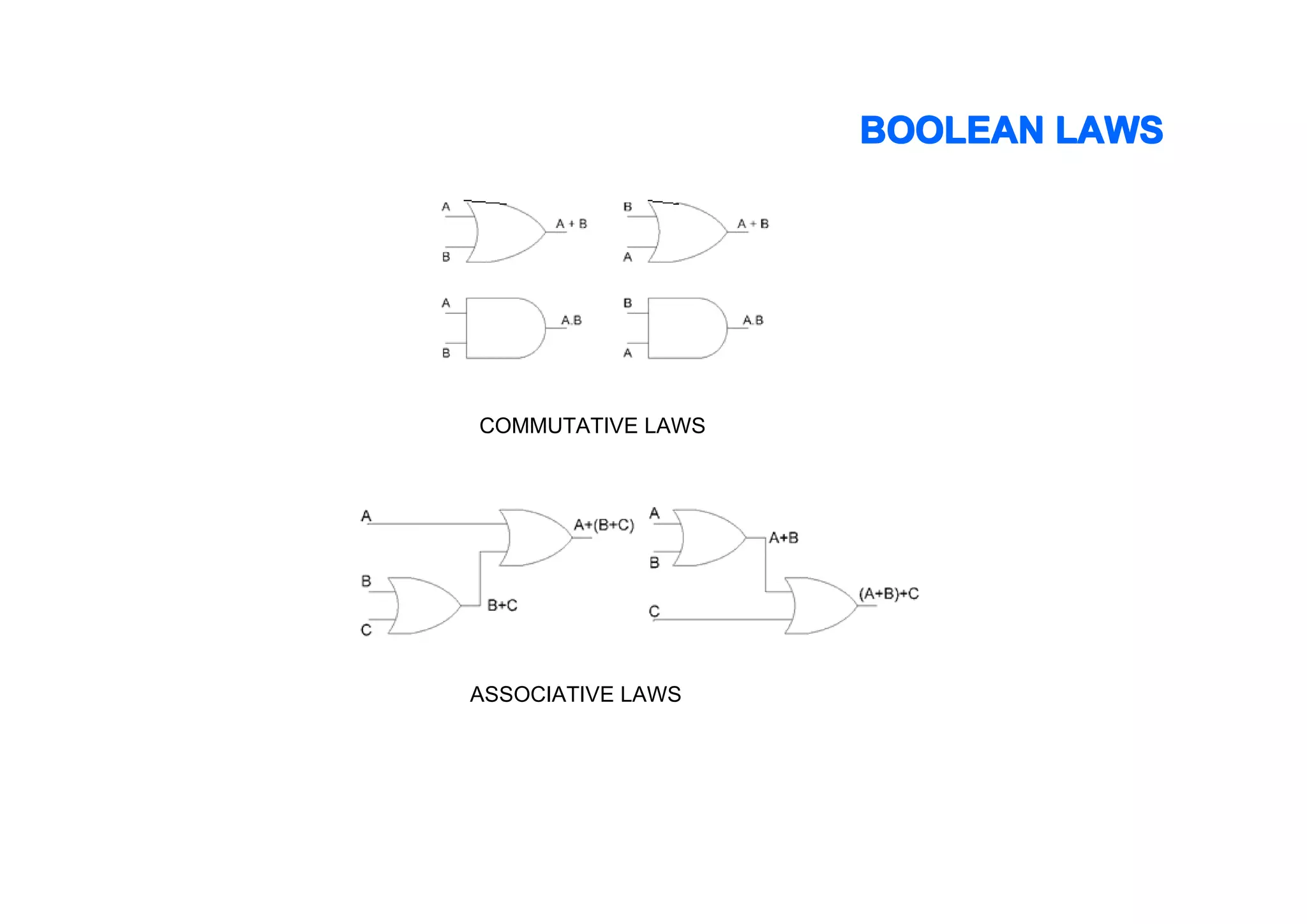
BOOLEAN LAWS

COMMUTATIVE LAWS

ASSOCIATIVE LAWS
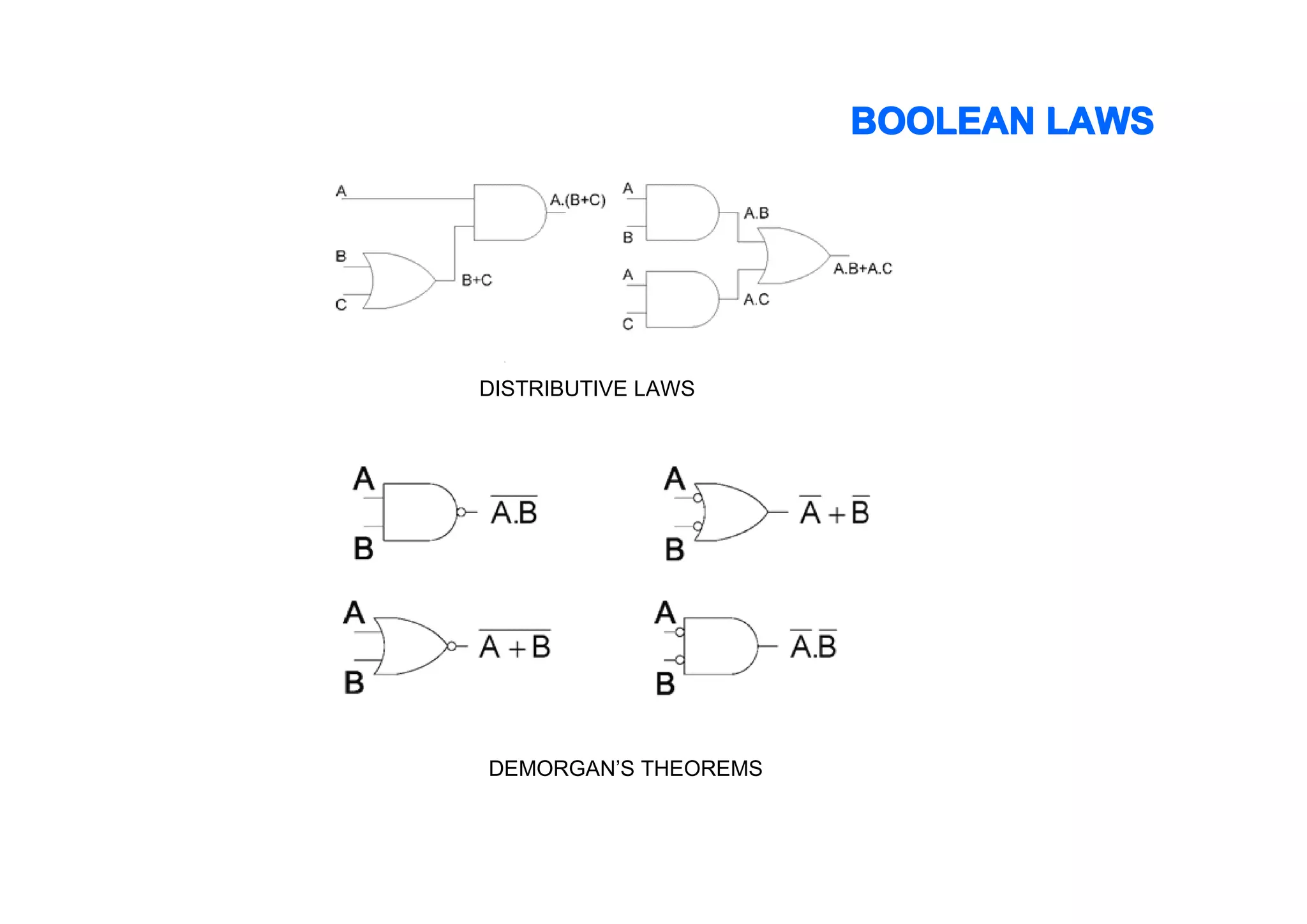
BOOLEAN LAWS

DISTRIBUTIVE LAWS

DEMORGAN’S THEOREMS
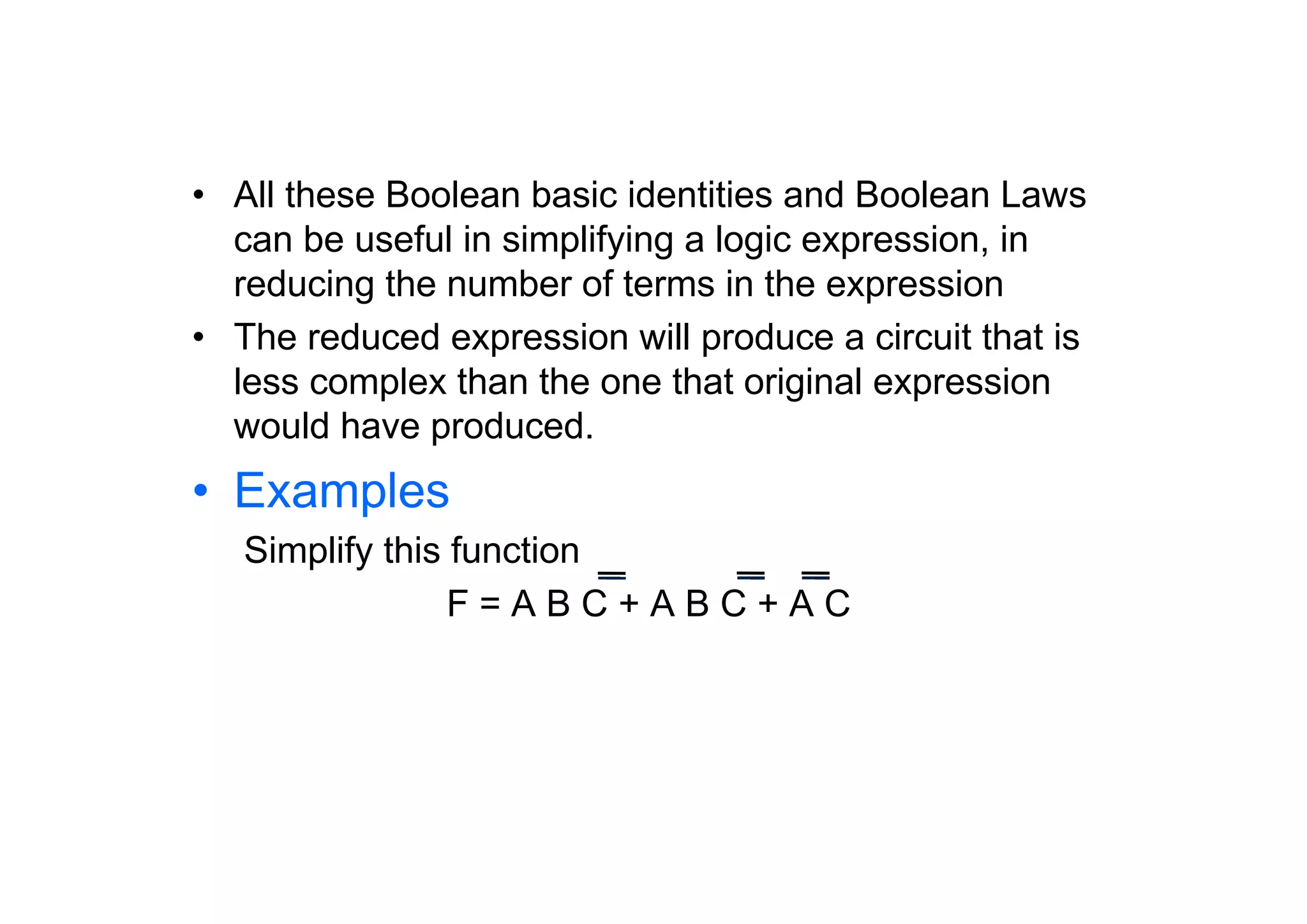
• All these Boolean basic identities and Boolean Laws
can be useful in simplifying a logic expression, in
reducing the number of terms in the expression
• The reduced expression will produce a circuit that is
less complex than the one that original expression
would have produced.

• Examples
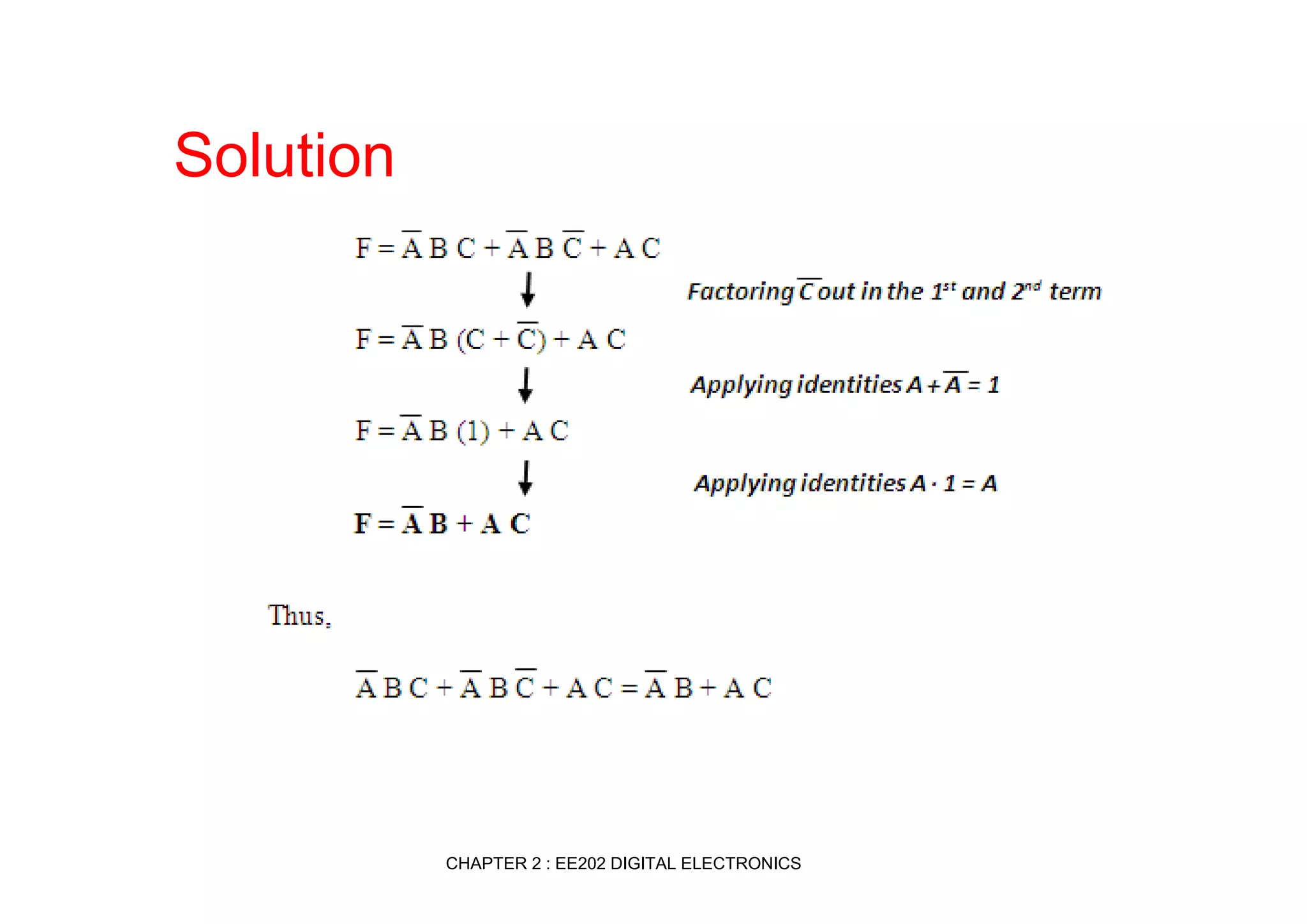
Simplify this function
F=ABC+ABC+AC
Solution

CHAPTER 2 : EE202 DIGITAL ELECTRONICS
Exercise:
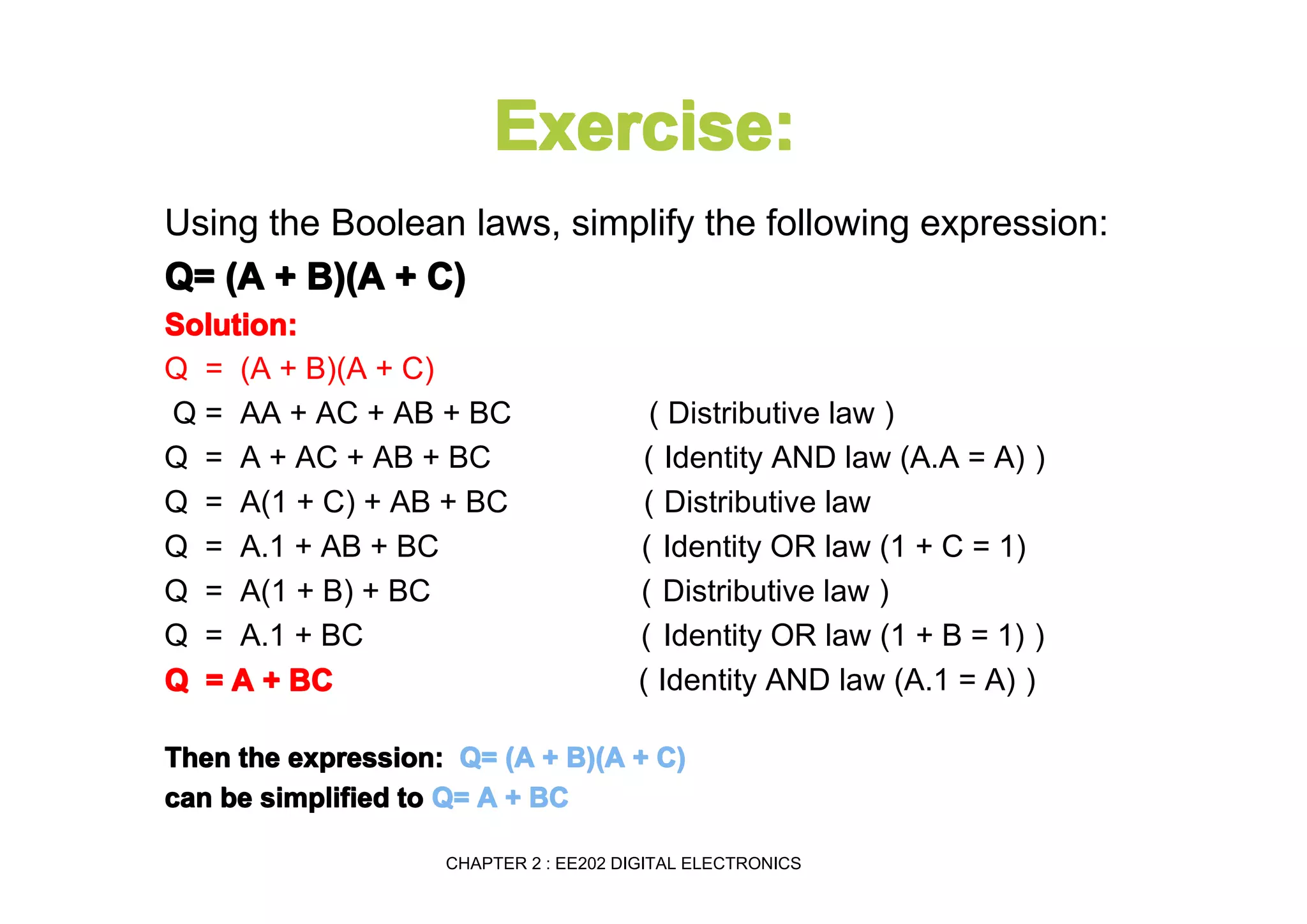
Using the Boolean laws, simplify the following expression:
Q= (A + B)(A + C)
Solution:
Q = (A + B)(A + C)
Q = AA + AC + AB + BC
Q = A + AC + AB + BC
Q = A(1 + C) + AB + BC
Q = A.1 + AB + BC
Q = A(1 + B) + BC
Q = A.1 + BC
Q = A + BC

( Distributive law )
( Identity AND law (A.A = A) )
( Distributive law
( Identity OR law (1 + C = 1)
( Distributive law )
( Identity OR law (1 + B = 1) )
( Identity AND law (A.1 = A) )

Then the expression: Q= (A + B)(A + C)
can be simplified to Q= A + BC
CHAPTER 2 : EE202 DIGITAL ELECTRONICS
continue chapter 2 Part B
REFERENCES:
1. "Digital Systems Principles And Application"
Sixth Editon, Ronald J. Tocci.
2. "Digital Systems Fundamentals"
P.W Chandana Prasad, Lau Siong Hoe,
Dr. Ashutosh Kumar Singh, Muhammad Suryanata.

Download Tutorials Chapter 2: Boolean Operations
@ CIDOS
http://www.cidos.edu.my

Chapter 2 ee202 boolean part a

  • 1.
    EE 202 :DIGITAL ELECTRONICS CHAPTER 2 : BOOLEAN OPERATIONS by : Siti Sabariah Salihin Electrical Engineering Department sabariah@psa.edu.my
  • 2.
    CHAPTER 2 :BOOLEAN OPERATIONS EE 202 : DIGITAL ELECTRONICS Programme Learning Outcomes, PLO Upon completion of the programme, graduates should be able to: • PLO 1 : Apply knowledge of mathematics, scince and engineering fundamentals to well defined electrical and electronic engineering procedures and practices Course Learning Outcomes, CLO • CLO 1 : Illustrate the knowledge of digital number systems,codes and ligic operations correctly • CLO 2 : Simplify and design combinational and sequential logic circuits by using the Boolean Algebra and the Karnaugh Maps. EE 202 : DIGITAL ELECTRONICS
  • 3.
    Upon completion ofthis Topic 2 student should be able to: 2.1 Know the symbols,operations and functions of logic gates. 2.1.1 Draw the symbols, operations and functions of logic gates. 2.1.2 Explain the Function of Logic gates using Truth Table. 2.1.3 Construct AND, OR and NOT gates using only NAND gates. 2.2 2.2.1 2.2.2 2.2.3 2.2.4 Know the basic concepts of Boolean Algebra and use them in Logic circuits analysis and design. Construct the basic concepts of Boolean Algebra and use them in logic circuits analysis and design. State the Boolean Laws. Develop logic expressions from the truth table from the form of SOP and POS Simplify combinatinal Logic circuits using Boolean Laws and Karnaugh Map EE 202 : DIGITAL ELECTRONICS
  • 4.
    TRUTH TABLES �A truthtable is a table that describes the behavior of a logic gate �The number of input combinations will equal 2N for an N-input truth table EE 202 : DIGITAL ELECTRONICS 4
  • 5.
    LOGIC GATES • Circuitswhich perform logic functions are called gates • The basic gates are: I. NOT/INVERTER gate II. AND gate III. OR gate IV. NAND gate V. NOR gate VI. XOR gate VII. XNOR gate EE 202 : DIGITAL ELECTRONICS
  • 6.
    Symbol I. NOT /INVERTER Gate Timing Diagram Truth Table
  • 7.
    II. AND Gate Symbol TimingDiagram Truth Table
  • 8.
    Symbol III. OR gate TimingDiagram Truth Table
  • 9.
    Symbol IV. NAND Gate TruthTable Timing Diagram
  • 10.
    V. NOR Gate Symbol TruthTable Timing Diagram
  • 11.
    VI. XOR Gate Symbol TruthTable Timing Diagram
  • 12.
    VII. XNOR Gate Symbol TruthTable Timing Diagram
  • 14.
    BOOLEAN ALGEBRA • TheBoolean algebra is an algebra dealing with binary variables and logic operation • The variables are designated by: I. Letters of the alphabet II. Three basic logic operations AND, OR and NOT
  • 15.
    BOOLEAN ALGEBRA • ABoolean function can be represented by using truth table. A truth table for a function is a list of all combinations of 1’s and 0’s that can be assigned to the binary variable and a list that shows the value of the function for each binary combination • A Boolean expression also can be transformed into a circuit diagram composed of logic gates that implements the function
  • 16.
    • Examples F =A + BC Truth Table Logic circuit
  • 17.
    Boolean Algebra Exercise Exercise: •Construct a Truth Table for the logical functions at points C, D and Q in the following circuit and identify a single logic gate that can be used to replace the whole circuit.
  • 18.
  • 19.
  • 20.
    Exercise • Find theBoolean algebra expression for the following system. Solution:
  • 21.
  • 22.
  • 23.
  • 24.
    • All theseBoolean basic identities and Boolean Laws can be useful in simplifying a logic expression, in reducing the number of terms in the expression • The reduced expression will produce a circuit that is less complex than the one that original expression would have produced. • Examples Simplify this function F=ABC+ABC+AC
  • 25.
    Solution CHAPTER 2 :EE202 DIGITAL ELECTRONICS
  • 26.
    Exercise: Using the Booleanlaws, simplify the following expression: Q= (A + B)(A + C) Solution: Q = (A + B)(A + C) Q = AA + AC + AB + BC Q = A + AC + AB + BC Q = A(1 + C) + AB + BC Q = A.1 + AB + BC Q = A(1 + B) + BC Q = A.1 + BC Q = A + BC ( Distributive law ) ( Identity AND law (A.A = A) ) ( Distributive law ( Identity OR law (1 + C = 1) ( Distributive law ) ( Identity OR law (1 + B = 1) ) ( Identity AND law (A.1 = A) ) Then the expression: Q= (A + B)(A + C) can be simplified to Q= A + BC CHAPTER 2 : EE202 DIGITAL ELECTRONICS
  • 27.
    continue chapter 2Part B REFERENCES: 1. "Digital Systems Principles And Application" Sixth Editon, Ronald J. Tocci. 2. "Digital Systems Fundamentals" P.W Chandana Prasad, Lau Siong Hoe, Dr. Ashutosh Kumar Singh, Muhammad Suryanata. Download Tutorials Chapter 2: Boolean Operations @ CIDOS http://www.cidos.edu.my