
Main topics
1. Introduction

2. Platform

3. Software development

4. Versions Of Android.

4. Overall evaluation

5. Conclusion
Introduction
•   What is Android?

    • A software platform and operating system for mobile devices

    • Based on the Linux kernel

    • Developed by Google and later the Open Handset Alliance (OHA)

    • Allows writing managed code in the Java language

    • Possibility to write applications in other languages.

    • Unveiling of the Android platform was announced on 5 November
      2007 with the founding of OHA

    • Android is under version 2 of the Apache Software License
      (ASL)
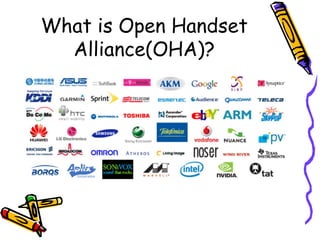
What is Open Handset
  Alliance(OHA)?
Features:
• Provide us SDK for developing
  application
• Runs on Dalvik virtual machine
• Audio and video codecs
• Media support for common
  audio,video and still image formats
  such as mp3,JPG ets
• 2.1 Hardware

• Android is a complete, end-to-end
  software.
• 2.2 Operating System(s)

  – Android uses Linux for its device drivers, memory
    management, process management, and networking.

  – Android native libraries. They are all written in C/C++

  – Dalvik Virtual Machine. Dalvik runs dex files, which are
    coverted at compile time from standard class and jar
    files.
• 2.3 Network Connectivity 

  – It supports wireless communications using:

     • GSM mobile-phone technology

     • 3G

     • 802.11 Wi-Fi networks
• 2.4 Security 
• Standard linux facilities, such as
  user and group IDs that are assigned
  to applications.

• Additional finer-grained security
  features
3.Software development
• 3.1 Development requirements

  – Java

  – Android SDK

  – Eclipse IDE (optional)
• 3.2 IDE and Tools

• Eclipse IDE + ADT (Android Development Tools)
•
   – Reduces Development and Testing Time

  – Makes User Interface-Creation easier

  – Makes Application Description Easier
• 3.3 Programming Language(s)

  – Java – officially supported

  – C/C++ – also possible but not supported
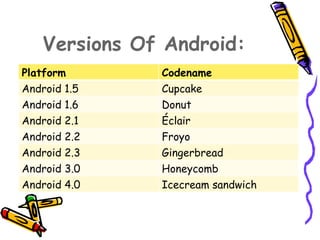
Versions Of Android:
Platform      Codename
Android 1.5   Cupcake
Android 1.6   Donut
Android 2.1   Éclair
Android 2.2   Froyo
Android 2.3   Gingerbread
Android 3.0   Honeycomb
Android 4.0   Icecream sandwich
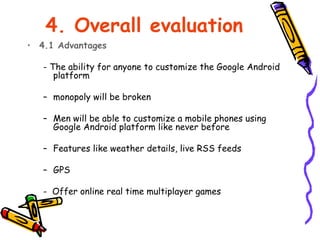
4. Overall evaluation
• 4.1 Advantages

   - The ability for anyone to customize the Google Android
      platform

   – monopoly will be broken

   – Men will be able to customize a mobile phones using
     Google Android platform like never before

   – Features like weather details, live RSS feeds

   – GPS

   - Offer online real time multiplayer games
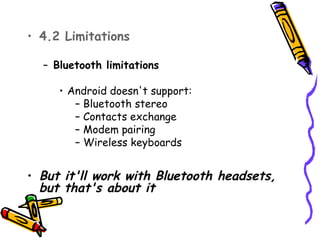
• 4.2 Limitations

  – Bluetooth limitations

     • Android doesn't support:
        – Bluetooth stereo
        – Contacts exchange
        – Modem pairing
        – Wireless keyboards


• But it'll work with Bluetooth headsets,
  but that's about it
Conclusion:

• We can only hope that the next
  versions of Android have overcome
  the actual limitations and that the
  future possibilities became a reality
• Thank you for your time &
         attention

Android

  • 2.
    Main topics 1. Introduction 2.Platform 3. Software development 4. Versions Of Android. 4. Overall evaluation 5. Conclusion
  • 3.
    Introduction • What is Android? • A software platform and operating system for mobile devices • Based on the Linux kernel • Developed by Google and later the Open Handset Alliance (OHA) • Allows writing managed code in the Java language • Possibility to write applications in other languages. • Unveiling of the Android platform was announced on 5 November 2007 with the founding of OHA • Android is under version 2 of the Apache Software License (ASL)
  • 4.
    What is OpenHandset Alliance(OHA)?
  • 5.
    Features: • Provide usSDK for developing application • Runs on Dalvik virtual machine • Audio and video codecs • Media support for common audio,video and still image formats such as mp3,JPG ets
  • 6.
    • 2.1 Hardware •Android is a complete, end-to-end software.
  • 7.
    • 2.2 OperatingSystem(s) – Android uses Linux for its device drivers, memory management, process management, and networking. – Android native libraries. They are all written in C/C++ – Dalvik Virtual Machine. Dalvik runs dex files, which are coverted at compile time from standard class and jar files.
  • 8.
    • 2.3 NetworkConnectivity  – It supports wireless communications using: • GSM mobile-phone technology • 3G • 802.11 Wi-Fi networks
  • 9.
    • 2.4 Security  •Standard linux facilities, such as user and group IDs that are assigned to applications. • Additional finer-grained security features
  • 10.
    3.Software development • 3.1Development requirements – Java – Android SDK – Eclipse IDE (optional)
  • 11.
    • 3.2 IDEand Tools • Eclipse IDE + ADT (Android Development Tools) • – Reduces Development and Testing Time – Makes User Interface-Creation easier – Makes Application Description Easier
  • 12.
    • 3.3 ProgrammingLanguage(s) – Java – officially supported – C/C++ – also possible but not supported
  • 13.
    Versions Of Android: Platform Codename Android 1.5 Cupcake Android 1.6 Donut Android 2.1 Éclair Android 2.2 Froyo Android 2.3 Gingerbread Android 3.0 Honeycomb Android 4.0 Icecream sandwich
  • 14.
    4. Overall evaluation •4.1 Advantages - The ability for anyone to customize the Google Android platform – monopoly will be broken – Men will be able to customize a mobile phones using Google Android platform like never before – Features like weather details, live RSS feeds – GPS - Offer online real time multiplayer games
  • 15.
    • 4.2 Limitations – Bluetooth limitations • Android doesn't support: – Bluetooth stereo – Contacts exchange – Modem pairing – Wireless keyboards • But it'll work with Bluetooth headsets, but that's about it
  • 16.
    Conclusion: • We canonly hope that the next versions of Android have overcome the actual limitations and that the future possibilities became a reality
  • 17.
    • Thank youfor your time & attention