GAS POWER
CYCLES
The devices or systems used to produce a
net power output are often called
engines, and the thermodynamic cycles
they operate on are called power cycles.
TYPES OF POWER CYCLES
GAS CYCLES:-
• In gas cycles, the working fluid remains in the gaseous
phase throughout the entire cycle.
VAPOUR CYCLES:-
• In vapour cycles, the working fluid exists in the vapour
phase during one part of the cycle and in the liquid
phase during another part.
AIR STANDARD ASSUMPTIONS
 The cycle is considered closed with the same ‘air’ always remaining in the
cylinder to repeat the cycle.
 In the cycle, all the processes are reversible.
 Mass of working fluid remains constant through entire cycle.
 The working fluid is homogenous throughout the cycle and no chemical
reaction takes place.
 The air behaves as an ideal gas and its specific heat is constant at all
temperatures.
 The working fluid is air.
TYPES OF GAS CYCLES
 Carnot cycle
 Otto cycle
 Diesel cycle
 Dual cycle
 Brayton cycle
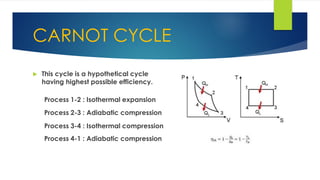
CARNOT CYCLE
 This cycle is a hypothetical cycle
having highest possible efficiency.
Process 1-2 : Isothermal expansion
Process 2-3 : Adiabatic compression
Process 3-4 : Isothermal compression
Process 4-1 : Adiabatic compression
APPLICATIONS
 Carnot cycle is an idealization, since no
real engine processes are reversible.
 All real processes involves some increase
in entropy.
 Heat transfer into the engine in isothermal
process is too slow to be of practical value.
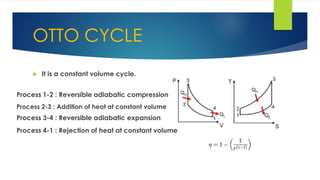
OTTO CYCLE
 It is a constant volume cycle.
Process 1-2 : Reversible adiabatic compression
Process 2-3 : Addition of heat at constant volume
Process 3-4 : Reversible adiabatic expansion
Process 4-1 : Rejection of heat at constant volume
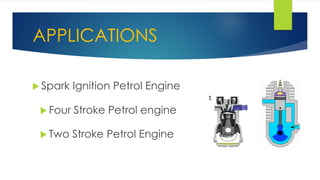
APPLICATIONS
 Two Stroke Petrol Engine
 Spark Ignition Petrol Engine
 Four Stroke Petrol engine
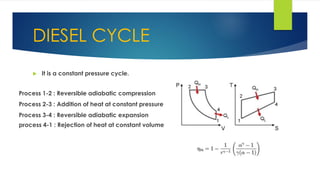
DIESEL CYCLE
 It is a constant pressure cycle.
Process 1-2 : Reversible adiabatic compression
Process 2-3 : Addition of heat at constant pressure
Process 3-4 : Reversible adiabatic expansion
process 4-1 : Rejection of heat at constant volume
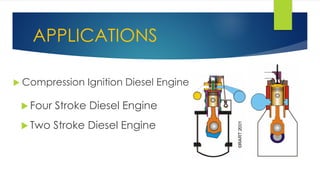
APPLICATIONS
 Compression Ignition Diesel Engine
 Two Stroke Diesel Engine
 Four Stroke Diesel Engine
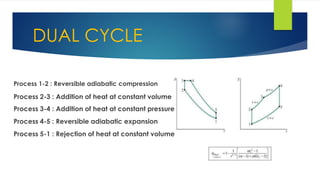
DUAL CYCLE
Process 1-2 : Reversible adiabatic compression
Process 4-5 : Reversible adiabatic expansion
Process 3-4 : Addition of heat at constant pressure
Process 5-1 : Rejection of heat at constant volume
Process 2-3 : Addition of heat at constant volume
APPLICATIONS
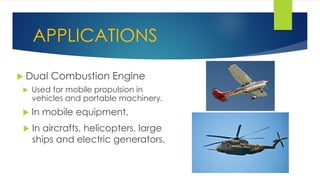
 Dual Combustion Engine
 Used for mobile propulsion in
vehicles and portable machinery.
 In mobile equipment.
 In aircrafts, helicopters, large
ships and electric generators.
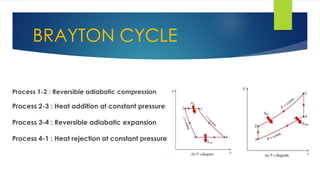
BRAYTON CYCLE
Process 2-3 : Heat addition at constant pressure
Process 1-2 : Reversible adiabatic compression
Process 4-1 : Heat rejection at constant pressure
Process 3-4 : Reversible adiabatic expansion
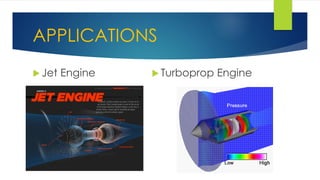
APPLICATIONS
 Jet Engine  Turboprop Engine
THE
END

Gas power cycles

  • 1.
    GAS POWER CYCLES The devicesor systems used to produce a net power output are often called engines, and the thermodynamic cycles they operate on are called power cycles.
  • 2.
    TYPES OF POWERCYCLES GAS CYCLES:- • In gas cycles, the working fluid remains in the gaseous phase throughout the entire cycle. VAPOUR CYCLES:- • In vapour cycles, the working fluid exists in the vapour phase during one part of the cycle and in the liquid phase during another part.
  • 3.
    AIR STANDARD ASSUMPTIONS The cycle is considered closed with the same ‘air’ always remaining in the cylinder to repeat the cycle.  In the cycle, all the processes are reversible.  Mass of working fluid remains constant through entire cycle.  The working fluid is homogenous throughout the cycle and no chemical reaction takes place.  The air behaves as an ideal gas and its specific heat is constant at all temperatures.  The working fluid is air.
  • 4.
    TYPES OF GASCYCLES  Carnot cycle  Otto cycle  Diesel cycle  Dual cycle  Brayton cycle
  • 5.
    CARNOT CYCLE  Thiscycle is a hypothetical cycle having highest possible efficiency. Process 1-2 : Isothermal expansion Process 2-3 : Adiabatic compression Process 3-4 : Isothermal compression Process 4-1 : Adiabatic compression
  • 6.
    APPLICATIONS  Carnot cycleis an idealization, since no real engine processes are reversible.  All real processes involves some increase in entropy.  Heat transfer into the engine in isothermal process is too slow to be of practical value.
  • 7.
    OTTO CYCLE  Itis a constant volume cycle. Process 1-2 : Reversible adiabatic compression Process 2-3 : Addition of heat at constant volume Process 3-4 : Reversible adiabatic expansion Process 4-1 : Rejection of heat at constant volume
  • 8.
    APPLICATIONS  Two StrokePetrol Engine  Spark Ignition Petrol Engine  Four Stroke Petrol engine
  • 9.
    DIESEL CYCLE  Itis a constant pressure cycle. Process 1-2 : Reversible adiabatic compression Process 2-3 : Addition of heat at constant pressure Process 3-4 : Reversible adiabatic expansion process 4-1 : Rejection of heat at constant volume
  • 10.
    APPLICATIONS  Compression IgnitionDiesel Engine  Two Stroke Diesel Engine  Four Stroke Diesel Engine
  • 11.
    DUAL CYCLE Process 1-2: Reversible adiabatic compression Process 4-5 : Reversible adiabatic expansion Process 3-4 : Addition of heat at constant pressure Process 5-1 : Rejection of heat at constant volume Process 2-3 : Addition of heat at constant volume
  • 12.
    APPLICATIONS  Dual CombustionEngine  Used for mobile propulsion in vehicles and portable machinery.  In mobile equipment.  In aircrafts, helicopters, large ships and electric generators.
  • 13.
    BRAYTON CYCLE Process 2-3: Heat addition at constant pressure Process 1-2 : Reversible adiabatic compression Process 4-1 : Heat rejection at constant pressure Process 3-4 : Reversible adiabatic expansion
  • 14.
    APPLICATIONS  Jet Engine Turboprop Engine
  • 15.