Ch. 2 - Classification of Matter I. Describing Matter ( p.34 - 53) Physical Property Physical Change Chemical Change Chemical Property MATTER
What is Matter? Anything that has mass and volume
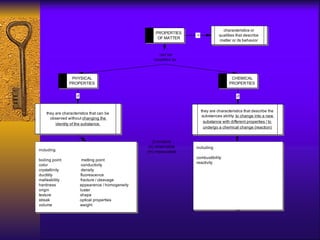
Characteristic properties  physical and chemical properties that help to define and identify a given substance.  Density, freezing point and boiling point are characteristic physical properties.  Reactivity is a characteristic chemical property.
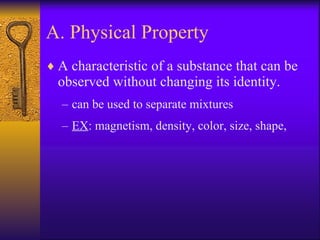
A. Physical Property A characteristic of a substance that can be observed without changing its identity. can be used to separate mixtures EX : magnetism, density, color, size, shape,
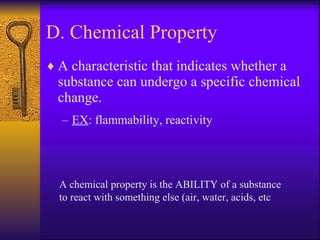
D. Chemical Property A characteristic that indicates whether a substance can undergo a specific chemical change. EX : flammability, reactivity A chemical property is the ABILITY of a substance to react with something else (air, water, acids, etc
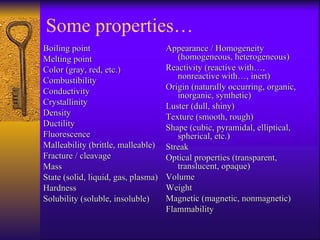
Boiling point Melting point Color (gray, red, etc.) Combustibility Conductivity Crystallinity Density Ductility Fluorescence Malleability (brittle, malleable) Fracture / cleavage Mass State (solid, liquid, gas, plasma) Hardness Solubility (soluble, insoluble) Appearance / Homogeneity (homogeneous, heterogeneous) Reactivity (reactive with…, nonreactive with…, inert) Origin (naturally occurring, organic, inorganic, synthetic) Luster (dull, shiny) Texture (smooth, rough) Shape (cubic, pyramidal, elliptical, spherical, etc.) Streak Optical properties (transparent, translucent, opaque) Volume Weight Magnetic (magnetic, nonmagnetic) Flammability Some properties…
 
 
B. Physical Change A change in the form of a substance without changing its identity. properties remain the same reversible can be used to separate mixtures EX : dissolving, grinding
C. Chemical Change A change in the identity of a substance. properties change irreversible Signs : color change, formation of a gas/solid, release of light/heat EX : burning, rusting
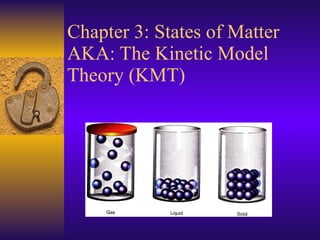
Chapter 3: States of Matter AKA: The Kinetic Model Theory (KMT)
4 States of Matter Matter: is anything that has mass and volume 4 States of Matter: solid, liquid, gas, plasma
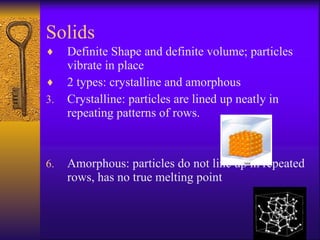
Solids Definite Shape and definite volume; particles vibrate in place 2 types: crystalline and amorphous Crystalline: particles are lined up neatly in repeating patterns of rows.  Amorphous: particles do not line up in repeated rows, has no true melting point
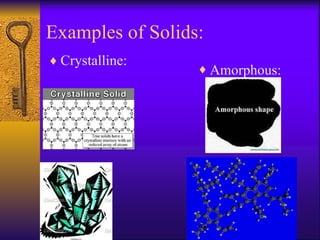
Examples of Solids: Crystalline: Amorphous:
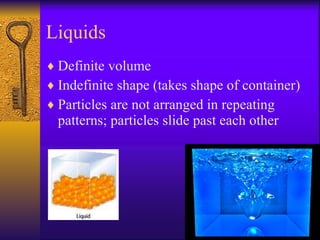
Liquids Definite volume Indefinite shape (takes shape of container) Particles are not arranged in repeating patterns; particles slide past each other
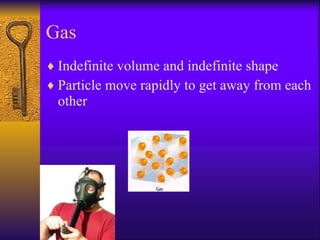
Gas Indefinite volume and indefinite shape Particle move rapidly to get away from each other
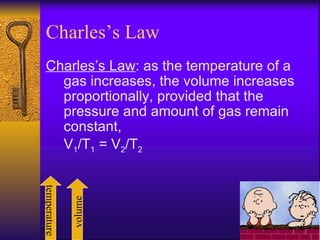
Charles’s Law Charles’s Law : as the temperature of a gas increases, the volume increases proportionally, provided that the pressure and amount of gas remain constant, V 1 /T 1  = V 2 /T 2 temperature volume
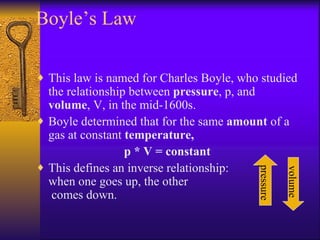
Boyle’s Law This law is named for Charles Boyle, who studied the relationship between  pressure , p, and  volume , V, in the mid-1600s. Boyle determined that for the same  amount  of a gas at constant  temperature, p * V = constant This defines an inverse relationship: when one goes up, the other  comes down. pressure volume
Boyle’s Law Boyle’s Law is one of the laws in physics that concern the behaviour of gases When a gas is under pressure it takes up less space: The higher the pressure, the smaller the volume Boyles Law tells us about the relationship between the volume of a gas and its pressure at a constant temperature The law states that  pressure is inversely proportional to the volume
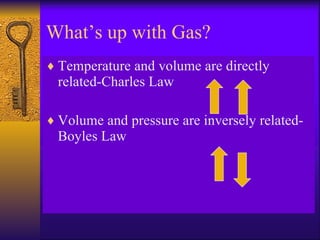
What’s up with Gas? Temperature and volume are directly related-Charles Law Volume and pressure are inversely related-Boyles Law
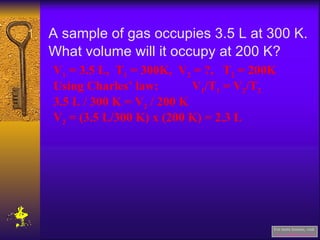
A sample of gas occupies 3.5 L at 300 K.  What volume will it occupy at 200 K? V 1  = 3.5 L,  T 1  = 300K,  V 2  = ?,  T 2  = 200K Using Charles’ law:  V 1 /T 1  = V 2 /T 2 3.5 L / 300 K = V 2  / 200 K V 2  = (3.5 L/300 K) x (200 K) = 2.3 L For more lessons, visit  www.chalkbored.com
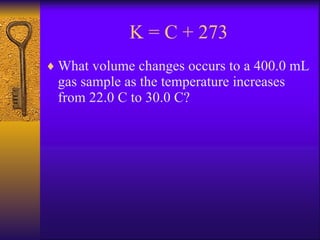
K = C + 273 What volume changes occurs to a 400.0 mL gas sample as the temperature increases from 22.0 C to 30.0 C?
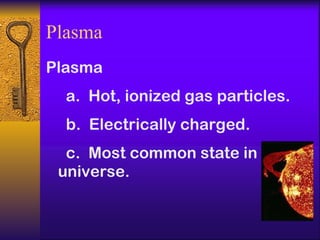
Plasma Plasma a.  Hot, ionized gas particles. b.  Electrically charged. c.  Most common state in universe.
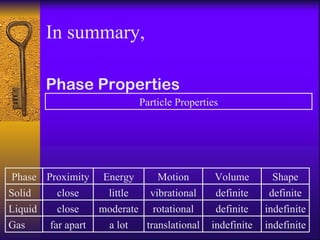
In summary,  Phase Properties  Phase Particle Properties Proximity Energy Motion Volume Shape Solid Liquid Gas close little vibrational definite definite close moderate rotational definite indefinite far apart a lot translational indefinite indefinite
ONE state of matter they didn’t teach you about in school… Until Now!
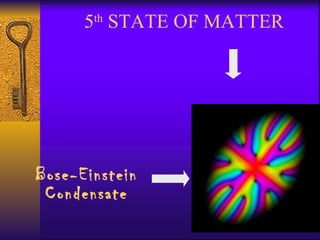
5 th  STATE OF MATTER Bose-Einstein Condensate
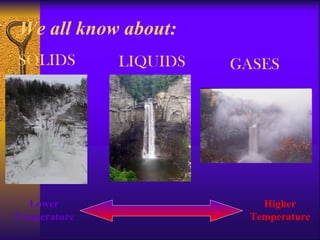
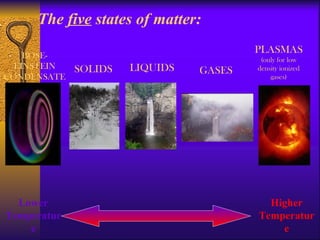
We all know about: LIQUIDS SOLIDS GASES Higher Temperature Lower Temperature
What happens if you raise the temperature to super-high levels… between  1000 °C and 1,000,000,000°C ? Will everything just be a gas?
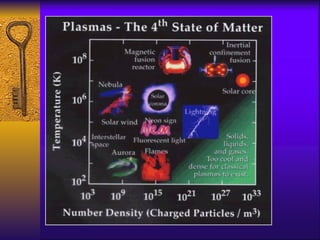
NO! If the gas is made up of particles which carry an electric charge (“ionized particles”), but the entire gas as a whole has no electric charge, and if the density is not too high, then we can get The 4 th  state of matter: PLASMA
 
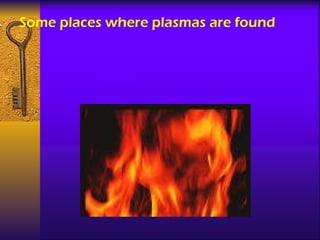
Some places where plasmas are found … 1.   Flames
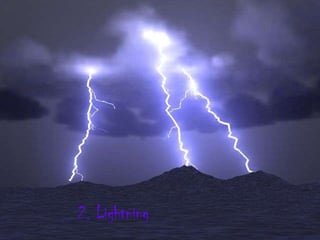
2. Lightning
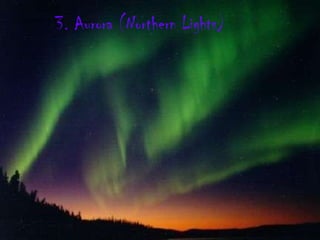
3. Aurora (Northern Lights)
4. Neon lights
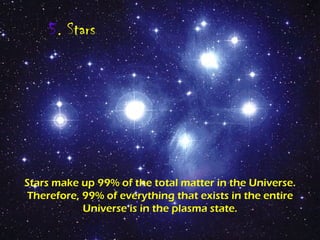
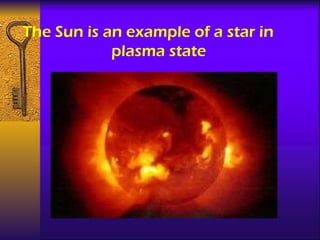
5 . Stars Stars make up 99% of the total matter in the Universe. Therefore, 99% of everything that exists in the entire Universe is in the plasma state.
The Sun is an example of a star in  its  plasma state
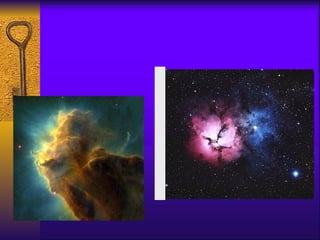
6 6. Clouds of gas and dust around stars
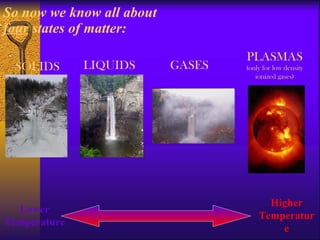
So now we know all about  four  states of matter: LIQUIDS SOLIDS GASES Higher Temperature Lower Temperature PLASMAS (only for low density ionized gases)
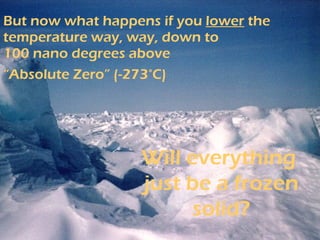
But now what happens if you  lower  the temperature way, way, down to 100 nano degrees above  “Absolute Zero” (-273°C)   Will everything  just be a frozen solid?
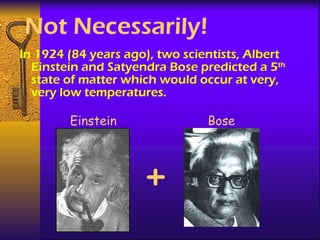
Not Necessarily! In 1924 (84 years ago), two scientists, Albert Einstein and Satyendra Bose predicted a 5 th  state of matter which would occur at very, very low temperatures. Einstein Bose +
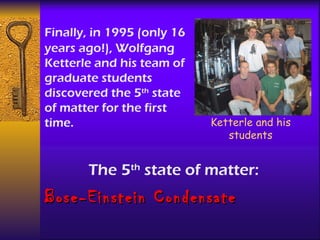
The 5 th  state of matter: Bose-Einstein Condensate Finally, in 1995 (only 16 years ago!), Wolfgang Ketterle and his team of graduate students  discovered the 5 th  state of matter for the first time. Ketterle and his students
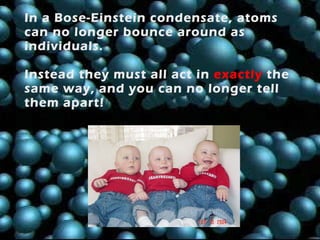
In a Bose-Einstein condensate, atoms can no longer bounce around as individuals.  Instead they must all act in   exactly   the same way, and you can no longer tell them apart!
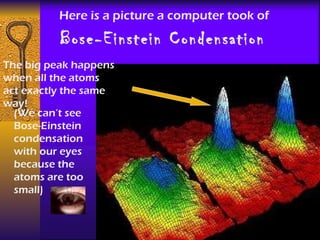
Here is a picture a computer took of Bose-Einstein Condensation   The big peak happens when all the atoms act exactly the same way! (We can’t see Bose-Einstein condensation with our eyes because the atoms are too small)
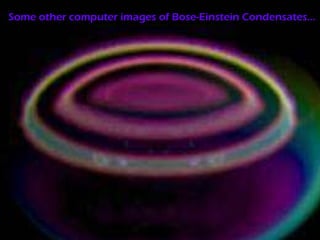
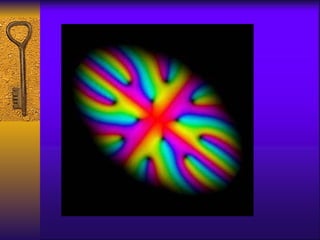
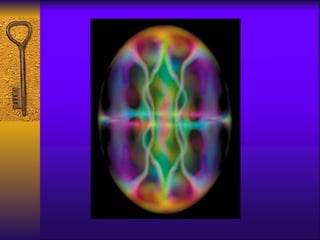
Some other computer images of Bose-Einstein Condensates…
 
 
To really understand Bose-Einstein condensate you need to know Quantum Physics
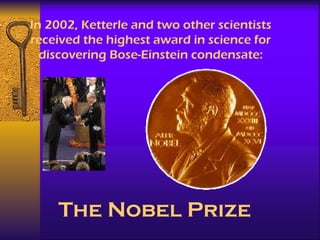
In 2002, Ketterle and two other scientists received the highest award in science for discovering Bose-Einstein condensate: The Nobel Prize
The  five  states of matter: LIQUIDS SOLIDS GASES Higher Temperature Lower Temperature PLASMAS (only for low density ionized gases) BOSE-EINSTEIN CONDENSATE
Ch. 8 - Solids, Liquids, & Gases II. Changes in State  (p.224-227) Phase Changes Heating Curves MATTER
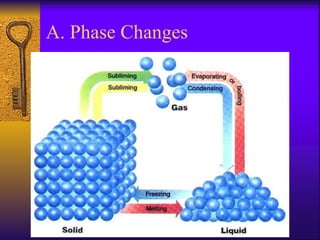
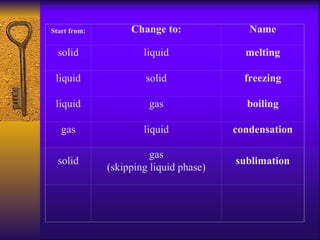
A. Phase Changes Melting solid to liquid Freezing liquid to solid melting point  =  freezing point
A. Phase Changes Vaporization (boiling) liquid to gas at the boiling point Evaporation liquid to gas below the boiling point Condensation gas to liquid
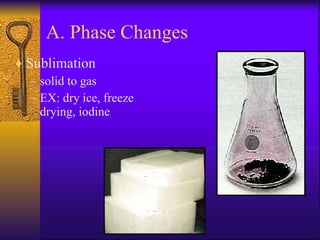
A. Phase Changes Sublimation solid to gas EX: dry ice, freeze drying, iodine
A. Phase Changes
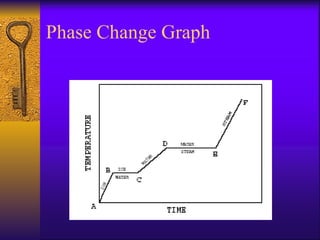
B. Heating Curves Kinetic Energy motion of particles related to temperature Potential Energy space between particles related to phase changes
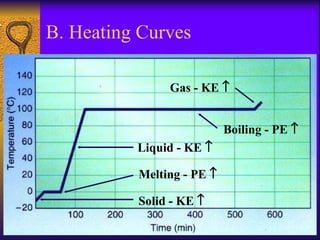
B. Heating Curves Solid - KE   Melting - PE   Liquid - KE   Boiling - PE   Gas - KE  
B. Heating Curves Heat of Fusion energy required to change from solid to liquid some attractive forces are broken
B. Heating Curves Heat of Vaporization energy required to change from liquid to gas all attractive forces are broken EX : steam burns, sweating, and… the drinking bird HEATING CURVE
Phase Change Graph
Start from: Change to: Name solid liquid melting liquid solid freezing liquid gas boiling gas liquid condensation solid gas (skipping liquid phase) sublimation
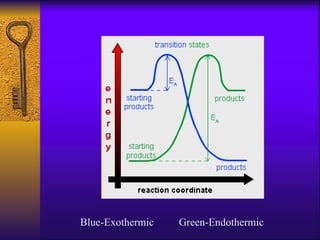
Ch. 16 - Chemical Reactions IV. Energy & Chemical Reactions Energy Changes Exothermic Reactions Endothermic Reactions
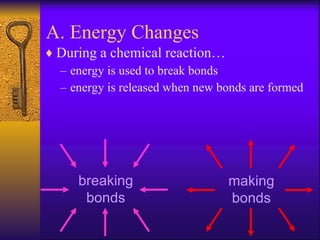
A. Energy Changes During a chemical reaction… energy is used to break bonds energy is released when new bonds are formed breaking bonds making bonds
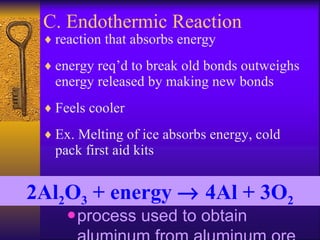
C. Endothermic Reaction reaction that absorbs energy energy req’d to break old bonds outweighs energy released by making new bonds  Feels cooler Ex. Melting of ice absorbs energy, cold pack first aid kits process used to obtain aluminum from aluminum ore 2Al 2 O 3  + energy    4Al + 3O 2
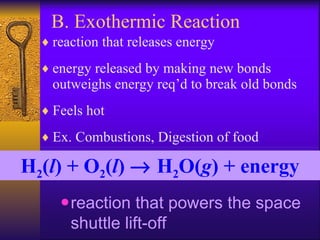
B. Exothermic Reaction reaction that releases energy energy released by making new bonds outweighs energy req’d to break old bonds Feels hot Ex. Combustions, Digestion of food H 2 ( l ) + O 2 ( l )    H 2 O( g ) + energy reaction that powers the space shuttle lift-off
Blue-Exothermic  Green-Endothermic

Chapter 2 and 3 notes

  • 1.
    Ch. 2 -Classification of Matter I. Describing Matter ( p.34 - 53) Physical Property Physical Change Chemical Change Chemical Property MATTER
  • 2.
    What is Matter?Anything that has mass and volume
  • 3.
    Characteristic properties physical and chemical properties that help to define and identify a given substance. Density, freezing point and boiling point are characteristic physical properties. Reactivity is a characteristic chemical property.
  • 4.
    A. Physical PropertyA characteristic of a substance that can be observed without changing its identity. can be used to separate mixtures EX : magnetism, density, color, size, shape,
  • 5.
    D. Chemical PropertyA characteristic that indicates whether a substance can undergo a specific chemical change. EX : flammability, reactivity A chemical property is the ABILITY of a substance to react with something else (air, water, acids, etc
  • 6.
    Boiling point Meltingpoint Color (gray, red, etc.) Combustibility Conductivity Crystallinity Density Ductility Fluorescence Malleability (brittle, malleable) Fracture / cleavage Mass State (solid, liquid, gas, plasma) Hardness Solubility (soluble, insoluble) Appearance / Homogeneity (homogeneous, heterogeneous) Reactivity (reactive with…, nonreactive with…, inert) Origin (naturally occurring, organic, inorganic, synthetic) Luster (dull, shiny) Texture (smooth, rough) Shape (cubic, pyramidal, elliptical, spherical, etc.) Streak Optical properties (transparent, translucent, opaque) Volume Weight Magnetic (magnetic, nonmagnetic) Flammability Some properties…
  • 7.
  • 8.
  • 9.
    B. Physical ChangeA change in the form of a substance without changing its identity. properties remain the same reversible can be used to separate mixtures EX : dissolving, grinding
  • 10.
    C. Chemical ChangeA change in the identity of a substance. properties change irreversible Signs : color change, formation of a gas/solid, release of light/heat EX : burning, rusting
  • 11.
    Chapter 3: Statesof Matter AKA: The Kinetic Model Theory (KMT)
  • 12.
    4 States ofMatter Matter: is anything that has mass and volume 4 States of Matter: solid, liquid, gas, plasma
  • 13.
    Solids Definite Shapeand definite volume; particles vibrate in place 2 types: crystalline and amorphous Crystalline: particles are lined up neatly in repeating patterns of rows. Amorphous: particles do not line up in repeated rows, has no true melting point
  • 14.
    Examples of Solids:Crystalline: Amorphous:
  • 15.
    Liquids Definite volumeIndefinite shape (takes shape of container) Particles are not arranged in repeating patterns; particles slide past each other
  • 16.
    Gas Indefinite volumeand indefinite shape Particle move rapidly to get away from each other
  • 17.
    Charles’s Law Charles’sLaw : as the temperature of a gas increases, the volume increases proportionally, provided that the pressure and amount of gas remain constant, V 1 /T 1 = V 2 /T 2 temperature volume
  • 18.
    Boyle’s Law Thislaw is named for Charles Boyle, who studied the relationship between pressure , p, and volume , V, in the mid-1600s. Boyle determined that for the same amount of a gas at constant temperature, p * V = constant This defines an inverse relationship: when one goes up, the other comes down. pressure volume
  • 19.
    Boyle’s Law Boyle’sLaw is one of the laws in physics that concern the behaviour of gases When a gas is under pressure it takes up less space: The higher the pressure, the smaller the volume Boyles Law tells us about the relationship between the volume of a gas and its pressure at a constant temperature The law states that pressure is inversely proportional to the volume
  • 20.
    What’s up withGas? Temperature and volume are directly related-Charles Law Volume and pressure are inversely related-Boyles Law
  • 21.
    A sample ofgas occupies 3.5 L at 300 K. What volume will it occupy at 200 K? V 1 = 3.5 L, T 1 = 300K, V 2 = ?, T 2 = 200K Using Charles’ law: V 1 /T 1 = V 2 /T 2 3.5 L / 300 K = V 2 / 200 K V 2 = (3.5 L/300 K) x (200 K) = 2.3 L For more lessons, visit www.chalkbored.com
  • 22.
    K = C+ 273 What volume changes occurs to a 400.0 mL gas sample as the temperature increases from 22.0 C to 30.0 C?
  • 23.
    Plasma Plasma a. Hot, ionized gas particles. b. Electrically charged. c. Most common state in universe.
  • 24.
    In summary, Phase Properties Phase Particle Properties Proximity Energy Motion Volume Shape Solid Liquid Gas close little vibrational definite definite close moderate rotational definite indefinite far apart a lot translational indefinite indefinite
  • 25.
    ONE state ofmatter they didn’t teach you about in school… Until Now!
  • 26.
    5 th STATE OF MATTER Bose-Einstein Condensate
  • 27.
    We all knowabout: LIQUIDS SOLIDS GASES Higher Temperature Lower Temperature
  • 28.
    What happens ifyou raise the temperature to super-high levels… between 1000 °C and 1,000,000,000°C ? Will everything just be a gas?
  • 29.
    NO! If thegas is made up of particles which carry an electric charge (“ionized particles”), but the entire gas as a whole has no electric charge, and if the density is not too high, then we can get The 4 th state of matter: PLASMA
  • 30.
  • 31.
    Some places whereplasmas are found … 1. Flames
  • 32.
  • 33.
  • 34.
  • 35.
    5 . StarsStars make up 99% of the total matter in the Universe. Therefore, 99% of everything that exists in the entire Universe is in the plasma state.
  • 36.
    The Sun isan example of a star in its plasma state
  • 37.
    6 6. Cloudsof gas and dust around stars
  • 38.
    So now weknow all about four states of matter: LIQUIDS SOLIDS GASES Higher Temperature Lower Temperature PLASMAS (only for low density ionized gases)
  • 39.
    But now whathappens if you lower the temperature way, way, down to 100 nano degrees above “Absolute Zero” (-273°C) Will everything just be a frozen solid?
  • 40.
    Not Necessarily! In1924 (84 years ago), two scientists, Albert Einstein and Satyendra Bose predicted a 5 th state of matter which would occur at very, very low temperatures. Einstein Bose +
  • 41.
    The 5 th state of matter: Bose-Einstein Condensate Finally, in 1995 (only 16 years ago!), Wolfgang Ketterle and his team of graduate students discovered the 5 th state of matter for the first time. Ketterle and his students
  • 42.
    In a Bose-Einsteincondensate, atoms can no longer bounce around as individuals. Instead they must all act in exactly the same way, and you can no longer tell them apart!
  • 43.
    Here is apicture a computer took of Bose-Einstein Condensation The big peak happens when all the atoms act exactly the same way! (We can’t see Bose-Einstein condensation with our eyes because the atoms are too small)
  • 44.
    Some other computerimages of Bose-Einstein Condensates…
  • 45.
  • 46.
  • 47.
    To really understandBose-Einstein condensate you need to know Quantum Physics
  • 48.
    In 2002, Ketterleand two other scientists received the highest award in science for discovering Bose-Einstein condensate: The Nobel Prize
  • 49.
    The five states of matter: LIQUIDS SOLIDS GASES Higher Temperature Lower Temperature PLASMAS (only for low density ionized gases) BOSE-EINSTEIN CONDENSATE
  • 50.
    Ch. 8 -Solids, Liquids, & Gases II. Changes in State (p.224-227) Phase Changes Heating Curves MATTER
  • 51.
    A. Phase ChangesMelting solid to liquid Freezing liquid to solid melting point = freezing point
  • 52.
    A. Phase ChangesVaporization (boiling) liquid to gas at the boiling point Evaporation liquid to gas below the boiling point Condensation gas to liquid
  • 53.
    A. Phase ChangesSublimation solid to gas EX: dry ice, freeze drying, iodine
  • 54.
  • 55.
    B. Heating CurvesKinetic Energy motion of particles related to temperature Potential Energy space between particles related to phase changes
  • 56.
    B. Heating CurvesSolid - KE  Melting - PE  Liquid - KE  Boiling - PE  Gas - KE 
  • 57.
    B. Heating CurvesHeat of Fusion energy required to change from solid to liquid some attractive forces are broken
  • 58.
    B. Heating CurvesHeat of Vaporization energy required to change from liquid to gas all attractive forces are broken EX : steam burns, sweating, and… the drinking bird HEATING CURVE
  • 59.
  • 60.
    Start from: Changeto: Name solid liquid melting liquid solid freezing liquid gas boiling gas liquid condensation solid gas (skipping liquid phase) sublimation
  • 61.
    Ch. 16 -Chemical Reactions IV. Energy & Chemical Reactions Energy Changes Exothermic Reactions Endothermic Reactions
  • 62.
    A. Energy ChangesDuring a chemical reaction… energy is used to break bonds energy is released when new bonds are formed breaking bonds making bonds
  • 63.
    C. Endothermic Reactionreaction that absorbs energy energy req’d to break old bonds outweighs energy released by making new bonds Feels cooler Ex. Melting of ice absorbs energy, cold pack first aid kits process used to obtain aluminum from aluminum ore 2Al 2 O 3 + energy  4Al + 3O 2
  • 64.
    B. Exothermic Reactionreaction that releases energy energy released by making new bonds outweighs energy req’d to break old bonds Feels hot Ex. Combustions, Digestion of food H 2 ( l ) + O 2 ( l )  H 2 O( g ) + energy reaction that powers the space shuttle lift-off
  • 65.