Radioactivity
Radiation
Radiation: The process of emitting
energy in the form of waves or
particles.

Where does radiation come from?
Radiation is generally produced
when particles interact or decay.

A large contribution of the radiation
on earth is from the sun (solar) or
from radioactive isotopes of the
elements (terrestrial).

Radiation is going through you at
this very moment!
                                        http://www.atral.com/U238.html
A. Definitions
• Radioactivity
  – emission of high-energy radiation from the
    nucleus of an atom
• Nuclide
  – nucleus of an isotope

• Transmutation
  – process of changing one element into another
    via nuclear decay
Isotopes
What’s an isotope?
Two or more varieties of an element
having the same number of protons but
different number of neutrons. Certain
isotopes are “unstable” and decay to
lighter isotopes or elements.

Deuterium and tritium are isotopes of
hydrogen. In addition to the 1 proton,
they have 1 and 2 additional neutrons in
the nucleus respectively*.
Another prime example is Uranium
238, or just 238U.
Radioactivity
By the end of the 1800s, it was known that certain
isotopes emit penetrating rays. Three types of radiation
were known:


   •   Alpha particles (α)

   •   Beta particles   (β)

   •   Gamma-rays       (γ)
B. Types of Radiation
• Alpha (α)
                     4
  – helium nucleus
                     2   He   2+     paper


 Beta-minus (β-)
                   0          1-
                  -1 e
                                     lead
   electron

 Gamma (γ)
   high-energy photon        0    concrete
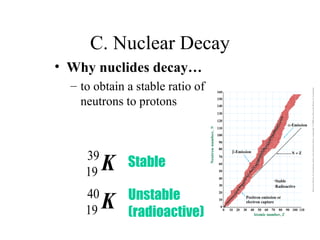
C. Nuclear Decay
• Why nuclides decay…
  – to obtain a stable ratio of
    neutrons to protons


     39
     19   K   Stable

     40       Unstable
     19   K   (radioactive)
C. Nuclear Decay
            TRANSMUTATION
• Alpha Emission
 238
  92   U→      Th + He
             234
              90
                       4
                       2


 Beta Emission
  131
   53   I→   131
              54   Xe + e
                        0
                       -1
Where do these particles come
               from ?

These particles generally come
from the nuclei of atomic isotopes
which are not stable.

 The decay chain of Uranium
produces all three of these forms
of radiation.

 Let’s look at them in more detail…
Note: This is the
atomic weight, which
is the number of
                          Alpha Particles (α)
protons plus neutrons


   Radium                         Radon
                                             +        n p
                                                       p n
     R226                         Rn222
                                                     α (4He)
 88 protons                  86 protons             2 protons
 138 neutrons                136 neutrons           2 neutrons


      The alpha-particle (α) is a Helium nucleus.

      It’s the same as the element Helium, with the
      electrons stripped off !
Beta Particles (β)
  Carbon                       Nitrogen     +        e-
    C14                           N14

 6 protons                    7 protons            electron
 8 neutrons                   7 neutrons        (beta-particle)


We see that one of the neutrons from the C14 nucleus
“converted” into a proton, and an electron was ejected.
The remaining nucleus contains 7p and 7n, which is a nitrogen
nucleus. In symbolic notation, the following process occurred:
                                                 Yes, the same
            np+e (+ν)
                                                neutrino we saw
                                                  previously
Gamma particles (γ)
In much the same way that electrons in atoms can be in an
excited state, so can a nucleus.

     Neon                         Neon
     Ne20                         Ne20       +


    10 protons                 10 protons         gamma
   10 neutrons                10 neutrons
(in excited state)        (lowest energy state)


  A gamma is a high energy light particle.

  It is NOT visible by your naked eye because it is not in
  the visible part of the EM spectrum.
Gamma Rays

   Neon
   Ne20


           Neon
           Ne20    +


The gamma from nuclear decay
 is in the X-ray/ Gamma ray
   part of the EM spectrum
        (very energetic!)
How do these particles differ ?
              Change in    Change in
   Particle     Mass        atomic
               number       number

  Gamma (γ)   No change   No change

                          Increased by
   Beta (β)   No change
                                1
              Decreased    Decreased
  Alpha (α)
                by 4         by 2
Rate of Decay
Beyond knowing the types of particles which are emitted
when an isotope decays, we also are interested in how frequently
one of the atoms emits this radiation.

 A very important point here is that we cannot predict when a
particular entity will decay.

 We do know though, that if we had a large sample of a radioactive
substance, some number will decay after a given amount of time.

 Some radioactive substances have a very high “rate of decay”,
while others have a very low decay rate.

 To differentiate different radioactive substances, we look to
quantify this idea of “decay rate”
Half-Life
 The “half-life” (h) is the time it takes for half the atoms of a
radioactive substance to decay.

 For example, suppose we had 20,000 atoms of a radioactive
substance. If the half-life is 1 hour, how many atoms of that
substance would be left after:

                                       #atoms       % of atoms
                Time
                                     remaining      remaining

       1 hour (one lifetime) ?         10,000          (50%)

       2 hours (two lifetimes) ?        5,000           (25%)

       3 hours (three lifetimes) ?      2,500          (12.5%)
D. Half-life
• Half-life (t½)
  – time it takes for half of the nuclides in a
    sample to decay
                                                                          Nuclear Decay
                                                                 20

 Example Half-lives                                              18

                                                                 16

 polonium-194         0.7 seconds


                                          Mass of Isotopes (g)
                                                                 14

                                                                 12


 lead-212             10.6 hours                                 10

                                                                 8


 iodine-131           8.04 days                                  6

                                                                 4


 carbon-14            5,370 years
                                                                 2

                                                                 0
                                                                      0    2       4     6       8   10

 uranium-238          4.5 billion years                                        # of Half-Lives
Half-life
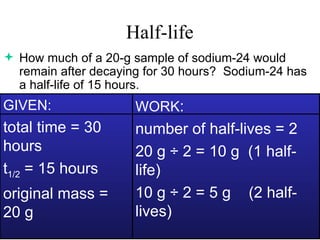
 How much of a 20-g sample of sodium-24 would
  remain after decaying for 30 hours? Sodium-24 has
  a half-life of 15 hours.
GIVEN:                WORK:
total time = 30       number of half-lives = 2
hours                 20 g ÷ 2 = 10 g (1 half-
t1/2 = 15 hours       life)
original mass =       10 g ÷ 2 = 5 g (2 half-
20 g                  lives)
Writing Nuclear
  Equations
Atomic number (Z) = number of protons in nucleus
     Mass number (A) = number of protons + number of neutrons
                       = atomic number (Z) + number of neutrons
               Mass Number      A
                                ZX
                                            Element Symbol
              Atomic Number


         proton                 electron                      α particle
       1
       1
         p or 1H
              1                0
                              -1 e or -1β
                                       0                     4
                                                             2 He or 2α
                                                                      4


A         1                       0                              4

Z         1                       -1                             2
Po decays by alpha emission. Write the balanced nuclear
212

equation for the decay of 212Po.

           alpha particle -             4
                                        2 He or 2α
                                                4


                 84Po           2 He        + ZX
              212               4             A


        212 = 4 + A                         A = 208

         84 = 2 + Z                         Z = 82


            84
                 212
                       Po   2
                                    4
                                        He + 208Pb
                                           82


                                                       23.1
Write Nuclear Equations!

Write the nuclear equation for the beta
emitter Co-60.
60                  0        60
 Co                 e   +     Ni
27             -1       28
Write Nuclear Equations!

Write an equation to describe the beta decay of a lead-214
nucleus to form a bismuth-214 nucleus.

 214
       Pb              0
                           e     +      214
                                              Bi
  82                   -1                83


Write an equation to describe the alpha decay of a
radium-226 nucleus to form a radon nucleus.
Summary
 Certain particles are radioactive and undergo decay.

 Radiation in nuclear decay consists of α, β, and γ particles

 The rate of decay is give by the radioactive decay law:


 After 5 lifetimes more than 99% of the initial particles
have decayed away.



 Subatomic particles usually have lifetimes which are
 fractions of a second…
A. F ission
• splitting a nucleus into two
  or more smaller nuclei
• some mass is converted to
  large amounts of energy


     1
     0   n+   235
               92   U→   141
                          56   Ba + Kr + 3 n
                                   92
                                   36
                                          1
                                          0
A. F ission
• chain reaction - self-feeding reaction
B. Fusion
• combining of two nuclei to form one
  nucleus of larger mass
• produces even more
  energy than fission
• occurs naturally in
  stars
A. Nuclear Power
• Fission Reactors           Cooling
                             Tower
A. Nuclear Power
• Fission Reactors
A. Nuclear Power
• Fusion Reactors (not yet sustainable)
A. Nuclear Power
 • Fusion Reactors (not yet sustainable)

                              National Spherical
                              Torus Experiment


Tokamak Fusion Test Reactor

    Princeton University
A. Nuclear Power
        F                             F
        I                             U
        s                             S
        s                             I
                       vs.
        i                             O
        o                             N
        n

• 235U is limited        • Hydrogen is abundant
• danger of meltdown     • no danger of
                           meltdown
• toxic waste
                         • no toxic waste
• thermal pollution
                         • not yet sustainable
• Choose one of the following to investigate:
  – Irradiated Food
  – Radioactive Dating
  – Nuclear Medicine
  – Weapons of mass destruction
  – Chernobyl
  – Nuclear power future
  – Meltdowns/ leaks


• Make a mini-poster to display what you have

Radioactivity

  • 1.
  • 2.
    Radiation Radiation: The processof emitting energy in the form of waves or particles. Where does radiation come from? Radiation is generally produced when particles interact or decay. A large contribution of the radiation on earth is from the sun (solar) or from radioactive isotopes of the elements (terrestrial). Radiation is going through you at this very moment! http://www.atral.com/U238.html
  • 3.
    A. Definitions • Radioactivity – emission of high-energy radiation from the nucleus of an atom • Nuclide – nucleus of an isotope • Transmutation – process of changing one element into another via nuclear decay
  • 4.
    Isotopes What’s an isotope? Twoor more varieties of an element having the same number of protons but different number of neutrons. Certain isotopes are “unstable” and decay to lighter isotopes or elements. Deuterium and tritium are isotopes of hydrogen. In addition to the 1 proton, they have 1 and 2 additional neutrons in the nucleus respectively*. Another prime example is Uranium 238, or just 238U.
  • 5.
    Radioactivity By the endof the 1800s, it was known that certain isotopes emit penetrating rays. Three types of radiation were known: • Alpha particles (α) • Beta particles (β) • Gamma-rays (γ)
  • 6.
    B. Types ofRadiation • Alpha (α) 4 – helium nucleus 2 He 2+ paper  Beta-minus (β-) 0 1- -1 e lead  electron  Gamma (γ)  high-energy photon 0 concrete
  • 7.
    C. Nuclear Decay •Why nuclides decay… – to obtain a stable ratio of neutrons to protons 39 19 K Stable 40 Unstable 19 K (radioactive)
  • 8.
    C. Nuclear Decay TRANSMUTATION • Alpha Emission 238 92 U→ Th + He 234 90 4 2  Beta Emission 131 53 I→ 131 54 Xe + e 0 -1
  • 9.
    Where do theseparticles come from ? These particles generally come from the nuclei of atomic isotopes which are not stable.  The decay chain of Uranium produces all three of these forms of radiation.  Let’s look at them in more detail…
  • 10.
    Note: This isthe atomic weight, which is the number of Alpha Particles (α) protons plus neutrons Radium Radon + n p p n R226 Rn222 α (4He) 88 protons 86 protons 2 protons 138 neutrons 136 neutrons 2 neutrons The alpha-particle (α) is a Helium nucleus. It’s the same as the element Helium, with the electrons stripped off !
  • 11.
    Beta Particles (β) Carbon Nitrogen + e- C14 N14 6 protons 7 protons electron 8 neutrons 7 neutrons (beta-particle) We see that one of the neutrons from the C14 nucleus “converted” into a proton, and an electron was ejected. The remaining nucleus contains 7p and 7n, which is a nitrogen nucleus. In symbolic notation, the following process occurred: Yes, the same np+e (+ν) neutrino we saw previously
  • 12.
    Gamma particles (γ) Inmuch the same way that electrons in atoms can be in an excited state, so can a nucleus. Neon Neon Ne20 Ne20 + 10 protons 10 protons gamma 10 neutrons 10 neutrons (in excited state) (lowest energy state) A gamma is a high energy light particle. It is NOT visible by your naked eye because it is not in the visible part of the EM spectrum.
  • 13.
    Gamma Rays Neon Ne20 Neon Ne20 + The gamma from nuclear decay is in the X-ray/ Gamma ray part of the EM spectrum (very energetic!)
  • 14.
    How do theseparticles differ ? Change in Change in Particle Mass atomic number number Gamma (γ) No change No change Increased by Beta (β) No change 1 Decreased Decreased Alpha (α) by 4 by 2
  • 15.
    Rate of Decay Beyondknowing the types of particles which are emitted when an isotope decays, we also are interested in how frequently one of the atoms emits this radiation.  A very important point here is that we cannot predict when a particular entity will decay.  We do know though, that if we had a large sample of a radioactive substance, some number will decay after a given amount of time.  Some radioactive substances have a very high “rate of decay”, while others have a very low decay rate.  To differentiate different radioactive substances, we look to quantify this idea of “decay rate”
  • 16.
    Half-Life  The “half-life”(h) is the time it takes for half the atoms of a radioactive substance to decay.  For example, suppose we had 20,000 atoms of a radioactive substance. If the half-life is 1 hour, how many atoms of that substance would be left after: #atoms % of atoms Time remaining remaining 1 hour (one lifetime) ? 10,000 (50%) 2 hours (two lifetimes) ? 5,000 (25%) 3 hours (three lifetimes) ? 2,500 (12.5%)
  • 17.
    D. Half-life • Half-life(t½) – time it takes for half of the nuclides in a sample to decay Nuclear Decay 20 Example Half-lives 18 16 polonium-194 0.7 seconds Mass of Isotopes (g) 14 12 lead-212 10.6 hours 10 8 iodine-131 8.04 days 6 4 carbon-14 5,370 years 2 0 0 2 4 6 8 10 uranium-238 4.5 billion years # of Half-Lives
  • 18.
    Half-life  How muchof a 20-g sample of sodium-24 would remain after decaying for 30 hours? Sodium-24 has a half-life of 15 hours. GIVEN: WORK: total time = 30 number of half-lives = 2 hours 20 g ÷ 2 = 10 g (1 half- t1/2 = 15 hours life) original mass = 10 g ÷ 2 = 5 g (2 half- 20 g lives)
  • 19.
  • 20.
    Atomic number (Z)= number of protons in nucleus Mass number (A) = number of protons + number of neutrons = atomic number (Z) + number of neutrons Mass Number A ZX Element Symbol Atomic Number proton electron α particle 1 1 p or 1H 1 0 -1 e or -1β 0 4 2 He or 2α 4 A 1 0 4 Z 1 -1 2
  • 21.
    Po decays byalpha emission. Write the balanced nuclear 212 equation for the decay of 212Po. alpha particle - 4 2 He or 2α 4 84Po 2 He + ZX 212 4 A 212 = 4 + A A = 208 84 = 2 + Z Z = 82 84 212 Po 2 4 He + 208Pb 82 23.1
  • 22.
    Write Nuclear Equations! Writethe nuclear equation for the beta emitter Co-60. 60 0 60 Co e + Ni 27 -1 28
  • 23.
    Write Nuclear Equations! Writean equation to describe the beta decay of a lead-214 nucleus to form a bismuth-214 nucleus. 214 Pb 0 e + 214 Bi 82 -1 83 Write an equation to describe the alpha decay of a radium-226 nucleus to form a radon nucleus.
  • 24.
    Summary  Certain particlesare radioactive and undergo decay.  Radiation in nuclear decay consists of α, β, and γ particles  The rate of decay is give by the radioactive decay law:  After 5 lifetimes more than 99% of the initial particles have decayed away.   Subatomic particles usually have lifetimes which are fractions of a second…
  • 25.
    A. F ission •splitting a nucleus into two or more smaller nuclei • some mass is converted to large amounts of energy 1 0 n+ 235 92 U→ 141 56 Ba + Kr + 3 n 92 36 1 0
  • 26.
    A. F ission •chain reaction - self-feeding reaction
  • 27.
    B. Fusion • combiningof two nuclei to form one nucleus of larger mass • produces even more energy than fission • occurs naturally in stars
  • 28.
    A. Nuclear Power •Fission Reactors Cooling Tower
  • 29.
    A. Nuclear Power •Fission Reactors
  • 30.
    A. Nuclear Power •Fusion Reactors (not yet sustainable)
  • 31.
    A. Nuclear Power • Fusion Reactors (not yet sustainable) National Spherical Torus Experiment Tokamak Fusion Test Reactor Princeton University
  • 32.
    A. Nuclear Power F F I U s S s I vs. i O o N n • 235U is limited • Hydrogen is abundant • danger of meltdown • no danger of meltdown • toxic waste • no toxic waste • thermal pollution • not yet sustainable
  • 33.
    • Choose oneof the following to investigate: – Irradiated Food – Radioactive Dating – Nuclear Medicine – Weapons of mass destruction – Chernobyl – Nuclear power future – Meltdowns/ leaks • Make a mini-poster to display what you have

Editor's Notes

  • #5 To be more clear, deuterium contains 1 proton and 1 neutron in the nucleus, and tritium contains 1 proton and 2 neutrons in its nucleus. Both isotopes behave similarly to ordinary hydrogen, as this chemical behavior is mostly driven by the atomic electrons.
  • #11 Note: The 226 refers to the atomic weight, which is the equal to the number of protons plus neutrons
  • #12 Note that in beta decay, the atomic mass not change, since the neutron and proton have nearly the same mass…