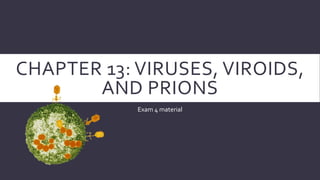
CHAPTER 13: VIRUSES, VIROIDS,
AND PRIONS
Exam 4 material
GENERAL CHARACTERISTICS OF VIRUSES
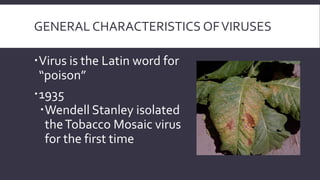
Virus is the Latin word for
“poison”
1935
Wendell Stanley isolated
the Tobacco Mosaic virus
for the first time
DEFINITION OF LIFE
 A complex set of processes resulting from the actions of proteins
specified by nucleic acids

 “Viruses are not living things. Viruses are complicated assemblies of
molecules, including proteins, nucleic acids, lipids, and
carbohydrates, but on their own they can do nothing until they enter
a living cell. Without cells, viruses would not be able to multiply.
Therefore, viruses are not living things.”
Viruses are “alive” (able to multiply) when they
enter a host organism

We will say that viruses are living, but they are not.
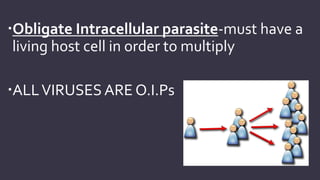
Obligate Intracellular parasite-must have a
living host cell in order to multiply

ALL VIRUSES ARE O.I.Ps
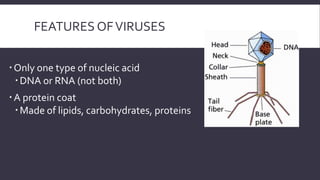
FEATURES OF VIRUSES
 Only one type of nucleic acid
 DNA or RNA (not both)
 A protein coat
 Made of lipids, carbohydrates, proteins
• Must have a host cell
• Uses the cells machinery to copy itself
• Makes specialized structures that can
transfer the viral information to other cells
• Lack personal enzymes
• http://www.youtube.com/watch?v=sHThHRV4uo
COMPARING PROKARYOTES & VIRUSES (P 387)
Prokaryotes

Viruses
HOST RANGE
Viruses can have a host range
A spectrum of host cells the virus can infect
Viruses that infect bacteria are bacteriophages
(phages)
Outer surface of virus must chemically interact with
specific receptor site on host cell
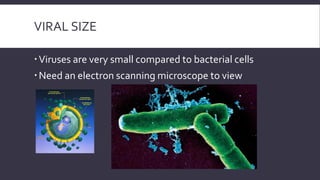
VIRAL SIZE
 Viruses are very small compared to bacterial cells

 Need an electron scanning microscope to view
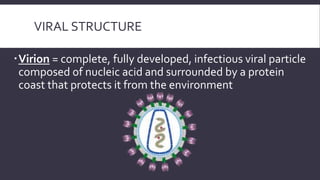
VIRAL STRUCTURE
Virion = complete, fully developed, infectious viral particle
composed of nucleic acid and surrounded by a protein
coast that protects it from the environment
NUCLEIC ACID
Prokaryotes and Eukaryotes use RNA and DNA as
genetic information
Viruses use RNA or DNA-not both
It is single or double stranded
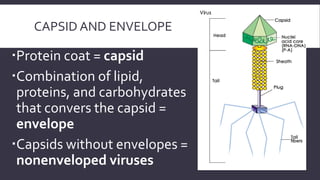
CAPSID AND ENVELOPE

Protein coat = capsid
Combination of lipid,
proteins, and carbohydrates
that convers the capsid =
envelope
Capsids without envelopes =
nonenveloped viruses
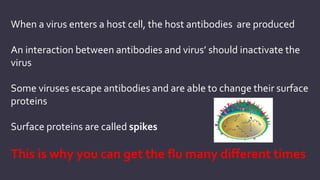
When a virus enters a host cell, the host antibodies are produced
An interaction between antibodies and virus’ should inactivate the
virus

Some viruses escape antibodies and are able to change their surface
proteins
Surface proteins are called spikes

This is why you can get the flu many different times
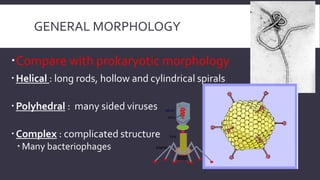
GENERAL MORPHOLOGY
Compare with prokaryotic morphology
 Helical : long rods, hollow and cylindrical spirals
 Polyhedral : many sided viruses
 Complex : complicated structure
 Many bacteriophages
TAXONOMY OF VIRUSES

A viral species is a
group of viruses sharing
the same genetic
information and
ecological niche.
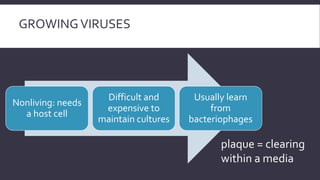
GROWING VIRUSES

Nonliving: needs
a host cell

Difficult and
expensive to
maintain cultures

Usually learn
from
bacteriophages

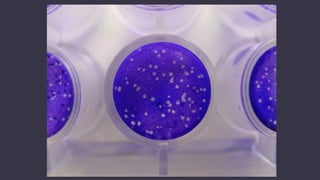
plaque = clearing
within a media
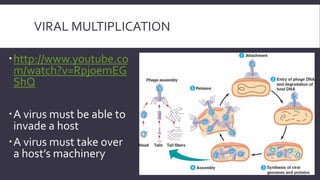
VIRAL MULTIPLICATION
http://www.youtube.co
m/watch?v=Rpj0emEG
ShQ

A virus must be able to
invade a host
A virus must take over
a host’s machinery
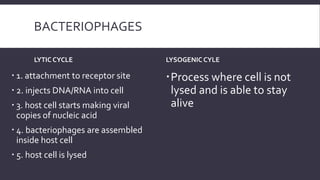
BACTERIOPHAGES
LYTIC CYCLE

 1. attachment to receptor site
 2. injects DNA/RNA into cell
 3. host cell starts making viral
copies of nucleic acid
 4. bacteriophages are assembled
inside host cell

 5. host cell is lysed

LYSOGENIC CYLE

Process where cell is not
lysed and is able to stay
alive
FAMILIES OF VIRUSES
 Paroviridae

 Adenoviridae
 Papovaviridae

 Poxviridae
 Herpesviridae

 Hepadnaviridae
 Picornaviridae

•
•
•
•
•
•
•
•

Rhabdoviridae
Filoviridae
Paramyxoviridae
Deltaviridae
Caliciviridae
Togaviridae
Flaviviridae
Coronaviridiae

PAGE 392-3
Orthomyxoviridae
Bunyaviridae
Arenaviridae
Retroviridae
Reoviridae
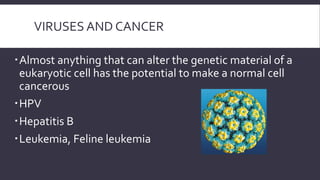
VIRUSES AND CANCER
Almost anything that can alter the genetic material of a
eukaryotic cell has the potential to make a normal cell
cancerous
HPV
Hepatitis B
Leukemia, Feline leukemia
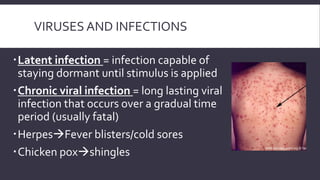
VIRUSES AND INFECTIONS
Latent infection = infection capable of
staying dormant until stimulus is applied
Chronic viral infection = long lasting viral
infection that occurs over a gradual time
period (usually fatal)
HerpesFever blisters/cold sores
Chicken poxshingles
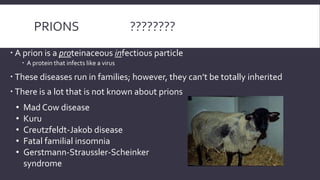
PRIONS

????????

 A prion is a proteinaceous infectious particle
 A protein that infects like a virus

 These diseases run in families; however, they can’t be totally inherited
 There is a lot that is not known about prions
•
•
•
•
•

Mad Cow disease
Kuru
Creutzfeldt-Jakob disease
Fatal familial insomnia
Gerstmann-Straussler-Scheinker
syndrome
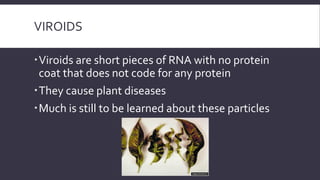
VIROIDS
Viroids are short pieces of RNA with no protein
coat that does not code for any protein
They cause plant diseases
Much is still to be learned about these particles
Chapter 13 Viruses, Viroids, and Prions

Chapter 13 Viruses, Viroids, and Prions

  • 1.
    CHAPTER 13: VIRUSES,VIROIDS, AND PRIONS Exam 4 material
  • 2.
    GENERAL CHARACTERISTICS OFVIRUSES Virus is the Latin word for “poison” 1935 Wendell Stanley isolated the Tobacco Mosaic virus for the first time
  • 3.
    DEFINITION OF LIFE A complex set of processes resulting from the actions of proteins specified by nucleic acids  “Viruses are not living things. Viruses are complicated assemblies of molecules, including proteins, nucleic acids, lipids, and carbohydrates, but on their own they can do nothing until they enter a living cell. Without cells, viruses would not be able to multiply. Therefore, viruses are not living things.”

  • 4.
    Viruses are “alive”(able to multiply) when they enter a host organism We will say that viruses are living, but they are not.
  • 5.
    Obligate Intracellular parasite-musthave a living host cell in order to multiply ALL VIRUSES ARE O.I.Ps
  • 6.
    FEATURES OF VIRUSES Only one type of nucleic acid  DNA or RNA (not both)  A protein coat  Made of lipids, carbohydrates, proteins
  • 7.
    • Must havea host cell • Uses the cells machinery to copy itself • Makes specialized structures that can transfer the viral information to other cells • Lack personal enzymes • http://www.youtube.com/watch?v=sHThHRV4uo
  • 8.
    COMPARING PROKARYOTES &VIRUSES (P 387) Prokaryotes Viruses
  • 9.
    HOST RANGE Viruses canhave a host range A spectrum of host cells the virus can infect Viruses that infect bacteria are bacteriophages (phages) Outer surface of virus must chemically interact with specific receptor site on host cell
  • 10.
    VIRAL SIZE  Virusesare very small compared to bacterial cells  Need an electron scanning microscope to view
  • 11.
    VIRAL STRUCTURE Virion =complete, fully developed, infectious viral particle composed of nucleic acid and surrounded by a protein coast that protects it from the environment
  • 12.
    NUCLEIC ACID Prokaryotes andEukaryotes use RNA and DNA as genetic information Viruses use RNA or DNA-not both It is single or double stranded
  • 13.
    CAPSID AND ENVELOPE Proteincoat = capsid Combination of lipid, proteins, and carbohydrates that convers the capsid = envelope Capsids without envelopes = nonenveloped viruses
  • 14.
    When a virusenters a host cell, the host antibodies are produced An interaction between antibodies and virus’ should inactivate the virus Some viruses escape antibodies and are able to change their surface proteins Surface proteins are called spikes This is why you can get the flu many different times
  • 15.
    GENERAL MORPHOLOGY Compare withprokaryotic morphology  Helical : long rods, hollow and cylindrical spirals  Polyhedral : many sided viruses  Complex : complicated structure  Many bacteriophages
  • 16.
    TAXONOMY OF VIRUSES Aviral species is a group of viruses sharing the same genetic information and ecological niche.
  • 17.
    GROWING VIRUSES Nonliving: needs ahost cell Difficult and expensive to maintain cultures Usually learn from bacteriophages plaque = clearing within a media
  • 19.
    VIRAL MULTIPLICATION http://www.youtube.co m/watch?v=Rpj0emEG ShQ A virusmust be able to invade a host A virus must take over a host’s machinery
  • 20.
    BACTERIOPHAGES LYTIC CYCLE  1.attachment to receptor site  2. injects DNA/RNA into cell  3. host cell starts making viral copies of nucleic acid  4. bacteriophages are assembled inside host cell  5. host cell is lysed LYSOGENIC CYLE Process where cell is not lysed and is able to stay alive
  • 21.
    FAMILIES OF VIRUSES Paroviridae  Adenoviridae  Papovaviridae  Poxviridae  Herpesviridae  Hepadnaviridae  Picornaviridae • • • • • • • • Rhabdoviridae Filoviridae Paramyxoviridae Deltaviridae Caliciviridae Togaviridae Flaviviridae Coronaviridiae PAGE 392-3 Orthomyxoviridae Bunyaviridae Arenaviridae Retroviridae Reoviridae
  • 22.
    VIRUSES AND CANCER Almostanything that can alter the genetic material of a eukaryotic cell has the potential to make a normal cell cancerous HPV Hepatitis B Leukemia, Feline leukemia
  • 23.
    VIRUSES AND INFECTIONS Latentinfection = infection capable of staying dormant until stimulus is applied Chronic viral infection = long lasting viral infection that occurs over a gradual time period (usually fatal) HerpesFever blisters/cold sores Chicken poxshingles
  • 24.
    PRIONS ????????  A prionis a proteinaceous infectious particle  A protein that infects like a virus  These diseases run in families; however, they can’t be totally inherited  There is a lot that is not known about prions • • • • • Mad Cow disease Kuru Creutzfeldt-Jakob disease Fatal familial insomnia Gerstmann-Straussler-Scheinker syndrome
  • 25.
    VIROIDS Viroids are shortpieces of RNA with no protein coat that does not code for any protein They cause plant diseases Much is still to be learned about these particles