GENERAL
CHARACTERISTICS OF
VIRUS & BACTERIA
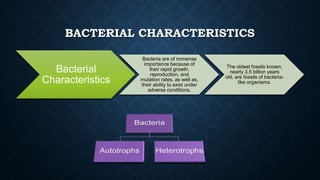
BACTERIAL CHARACTERISTICS
Bacterial
Characteristics

Bacteria are of immense
importance because of
their rapid growth,
reproduction, and
mutation rates, as well as,
their ability to exist under
adverse conditions.

The oldest fossils known,
nearly 3.5 billion years
old, are fossils of bacterialike organisms.
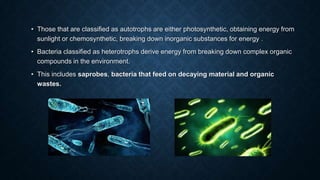
• Those that are classified as autotrophs are either photosynthetic, obtaining energy from
sunlight or chemosynthetic, breaking down inorganic substances for energy .
• Bacteria classified as heterotrophs derive energy from breaking down complex organic
compounds in the environment.

• This includes saprobes, bacteria that feed on decaying material and organic
wastes.
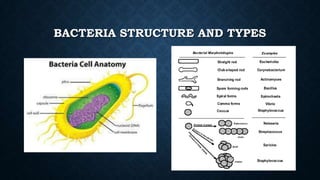
BACTERIA STRUCTURE AND TYPES
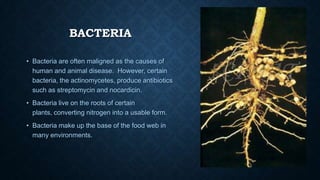
BACTERIA
• Bacteria are often maligned as the causes of
human and animal disease. However, certain
bacteria, the actinomycetes, produce antibiotics
such as streptomycin and nocardicin.
• Bacteria live on the roots of certain
plants, converting nitrogen into a usable form.
• Bacteria make up the base of the food web in
many environments.
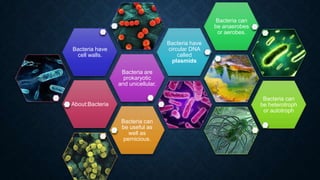
Bacteria can
be anaerobes
or aerobes.
Bacteria have
circular DNA
called
plasmids

Bacteria have
cell walls.
Bacteria are
prokaryotic
and unicellular.

Bacteria can
be heterotroph
or autotroph

About:Bacteria
Bacteria can
be useful as
well as
pernicious.
GENERAL CHARACTERISTICS OF VIRUS
 Viruses are infectious agents with both living and nonliving characteristics.

1. Living characteristics of viruses
 a. They reproduce at a fantastic rate, but only in living host cells.
b. They can mutate.
2. Nonliving characteristics of viruses
• They are a cellular, that is, they contain no cytoplasm or cellular organelles.
• They carry out no metabolism on their own and must replicate using the host cell's metabolic
machinery.
GENERAL STRUCTURE OF VIRUS
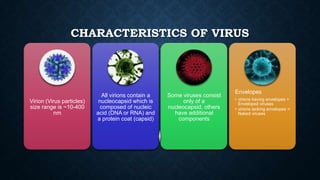
CHARACTERISTICS OF VIRUS

Virion (Virus particles)
size range is ~10-400
nm

All virions contain a
nucleocapsid which is
composed of nucleic
acid (DNA or RNA) and
a protein coat (capsid)

Some viruses consist
only of a
nucleocapsid, others
have additional
components

Envelopes
• virions having envelopes =
Enveloped viruses
• virions lacking envelopes =
Naked viruses
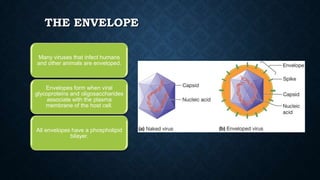
THE ENVELOPE
Many viruses that infect humans
and other animals are enveloped.

Envelopes form when viral
glycoproteins and oligosaccharides
associate with the plasma
membrane of the host cell.

All envelopes have a phospholipid
bilayer.
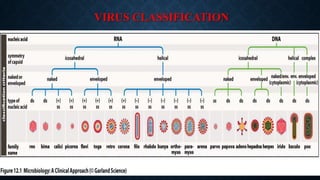
VIRUS CLASSIFICATION

Bacteria & Virus

  • 1.
  • 2.
    BACTERIAL CHARACTERISTICS Bacterial Characteristics Bacteria areof immense importance because of their rapid growth, reproduction, and mutation rates, as well as, their ability to exist under adverse conditions. The oldest fossils known, nearly 3.5 billion years old, are fossils of bacterialike organisms.
  • 3.
    • Those thatare classified as autotrophs are either photosynthetic, obtaining energy from sunlight or chemosynthetic, breaking down inorganic substances for energy . • Bacteria classified as heterotrophs derive energy from breaking down complex organic compounds in the environment. • This includes saprobes, bacteria that feed on decaying material and organic wastes.
  • 4.
  • 5.
    BACTERIA • Bacteria areoften maligned as the causes of human and animal disease. However, certain bacteria, the actinomycetes, produce antibiotics such as streptomycin and nocardicin. • Bacteria live on the roots of certain plants, converting nitrogen into a usable form. • Bacteria make up the base of the food web in many environments.
  • 6.
    Bacteria can be anaerobes oraerobes. Bacteria have circular DNA called plasmids Bacteria have cell walls. Bacteria are prokaryotic and unicellular. Bacteria can be heterotroph or autotroph About:Bacteria Bacteria can be useful as well as pernicious.
  • 7.
    GENERAL CHARACTERISTICS OFVIRUS  Viruses are infectious agents with both living and nonliving characteristics. 1. Living characteristics of viruses  a. They reproduce at a fantastic rate, but only in living host cells. b. They can mutate. 2. Nonliving characteristics of viruses • They are a cellular, that is, they contain no cytoplasm or cellular organelles. • They carry out no metabolism on their own and must replicate using the host cell's metabolic machinery.
  • 8.
  • 9.
    CHARACTERISTICS OF VIRUS Virion(Virus particles) size range is ~10-400 nm All virions contain a nucleocapsid which is composed of nucleic acid (DNA or RNA) and a protein coat (capsid) Some viruses consist only of a nucleocapsid, others have additional components Envelopes • virions having envelopes = Enveloped viruses • virions lacking envelopes = Naked viruses
  • 10.
    THE ENVELOPE Many virusesthat infect humans and other animals are enveloped. Envelopes form when viral glycoproteins and oligosaccharides associate with the plasma membrane of the host cell. All envelopes have a phospholipid bilayer.
  • 11.