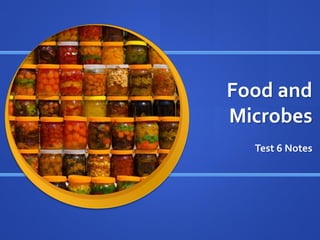
Food and
Microbes
Test 6 Notes
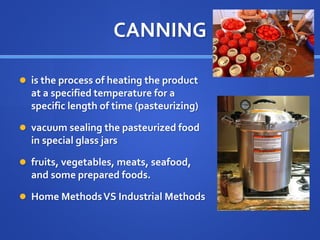
CANNING
 is the process of heating the product

at a specified temperature for a
specific length of time (pasteurizing)
 vacuum sealing the pasteurized food

in special glass jars
 fruits, vegetables, meats, seafood,

and some prepared foods.
 Home Methods VS Industrial Methods
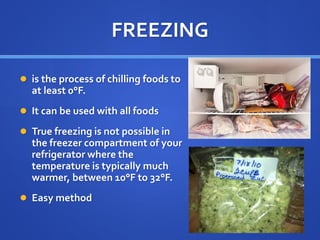
FREEZING
 is the process of chilling foods to

at least 0°F.
 It can be used with all foods
 True freezing is not possible in

the freezer compartment of your
refrigerator where the
temperature is typically much
warmer, between 10°F to 32°F.
 Easy method
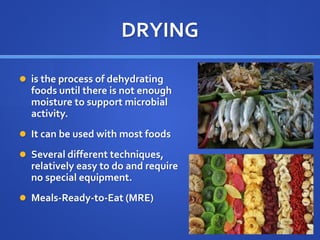
DRYING
 is the process of dehydrating

foods until there is not enough
moisture to support microbial
activity.
 It can be used with most foods
 Several different techniques,

relatively easy to do and require
no special equipment.
 Meals-Ready-to-Eat (MRE)
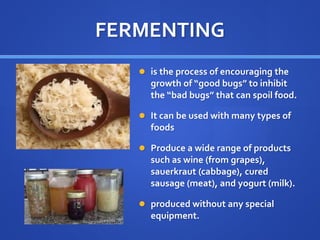
FERMENTING
 is the process of encouraging the

growth of “good bugs” to inhibit
the “bad bugs” that can spoil food.
 It can be used with many types of

foods
 Produce a wide range of products

such as wine (from grapes),
sauerkraut (cabbage), cured
sausage (meat), and yogurt (milk).
 produced without any special

equipment.
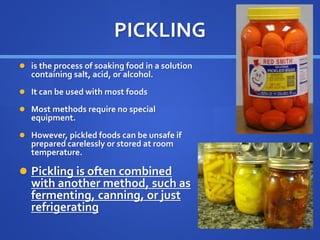
PICKLING
 is the process of soaking food in a solution

containing salt, acid, or alcohol.

 It can be used with most foods
 Most methods require no special

equipment.

 However, pickled foods can be unsafe if

prepared carelessly or stored at room
temperature.

 Pickling is often combined

with another method, such as
fermenting, canning, or just
refrigerating
CURING
 is similar to pickling, and uses salt,

acid, and/or nitrites.
 It is used for meat and fish.
 Simple, modern curing methods often

reduce the amount of salt and
nitrites, which may require that you
refrigerate or freeze the final product.

 Some curing methods also

employ a secondary process
such as fermenting,
smoking, or sealing.
SMOKING
 is a complementary process to

curing that improves flavor and
appearance, and can also act as
a drying agent.
 Smoked meats are less likely

to turn rancid or grow mold
than unsmoked meats.
SEALING
 is a process of covering food to

keep out air, which delays (but
does not stop) the activity of
spoilage organisms.
 It is used primarily as a

complementary process to other
methods such as drying or
freezing.
 Both fat sealing and vacuum

sealing methods are relatively
easy.
Importance of Bacteria
 It would be impossible to make cheese without a starter

culture. As the culture grows in the milk, it converts the
sugar lactose into lactic acid, which ensures the correct
level of acidity and gives the cheese it
 In yogurt and other fermented milk products, the culture is

responsible for the taste and texture of the final product.
 Probiotic cultures have become popular in dairy products

because of their health benefits
 Meat starter cultures are used to make dried, fermented

products such as salami, pepperoni, chorizo and dried ham
 Yeasts are responsible for the fermentation process

which produces alcohol in wine.
Animal Slaughter
 Many countries have poor

sanitation and animal
processing methods
 What do we know about the

growth of bacteria?
 How would the “normal

microbiota” help in the
breakdown of tissue? How
would the “normal
microbiota” influence the
growth of “bad bacteria.”
How do these processes
compare? Sanitary wise?
Microbial growth?
African Cow
Australian Sheep
What’s
Next?

Tuesday: Local Culture
Wednesday: Brief Review of
Methods and Articles
Thursday: In Computer Lab
Friday: Quiz/Mini Test over Methods &
Computer lab if needed
Monday: Start Microbial diseases of Skin
and Eyes

Food Preservation Methods and Food Processing

  • 1.
  • 2.
    CANNING  is theprocess of heating the product at a specified temperature for a specific length of time (pasteurizing)  vacuum sealing the pasteurized food in special glass jars  fruits, vegetables, meats, seafood, and some prepared foods.  Home Methods VS Industrial Methods
  • 3.
    FREEZING  is theprocess of chilling foods to at least 0°F.  It can be used with all foods  True freezing is not possible in the freezer compartment of your refrigerator where the temperature is typically much warmer, between 10°F to 32°F.  Easy method
  • 4.
    DRYING  is theprocess of dehydrating foods until there is not enough moisture to support microbial activity.  It can be used with most foods  Several different techniques, relatively easy to do and require no special equipment.  Meals-Ready-to-Eat (MRE)
  • 5.
    FERMENTING  is theprocess of encouraging the growth of “good bugs” to inhibit the “bad bugs” that can spoil food.  It can be used with many types of foods  Produce a wide range of products such as wine (from grapes), sauerkraut (cabbage), cured sausage (meat), and yogurt (milk).  produced without any special equipment.
  • 6.
    PICKLING  is theprocess of soaking food in a solution containing salt, acid, or alcohol.  It can be used with most foods  Most methods require no special equipment.  However, pickled foods can be unsafe if prepared carelessly or stored at room temperature.  Pickling is often combined with another method, such as fermenting, canning, or just refrigerating
  • 7.
    CURING  is similarto pickling, and uses salt, acid, and/or nitrites.  It is used for meat and fish.  Simple, modern curing methods often reduce the amount of salt and nitrites, which may require that you refrigerate or freeze the final product.  Some curing methods also employ a secondary process such as fermenting, smoking, or sealing.
  • 8.
    SMOKING  is acomplementary process to curing that improves flavor and appearance, and can also act as a drying agent.  Smoked meats are less likely to turn rancid or grow mold than unsmoked meats.
  • 9.
    SEALING  is aprocess of covering food to keep out air, which delays (but does not stop) the activity of spoilage organisms.  It is used primarily as a complementary process to other methods such as drying or freezing.  Both fat sealing and vacuum sealing methods are relatively easy.
  • 10.
    Importance of Bacteria It would be impossible to make cheese without a starter culture. As the culture grows in the milk, it converts the sugar lactose into lactic acid, which ensures the correct level of acidity and gives the cheese it  In yogurt and other fermented milk products, the culture is responsible for the taste and texture of the final product.  Probiotic cultures have become popular in dairy products because of their health benefits  Meat starter cultures are used to make dried, fermented products such as salami, pepperoni, chorizo and dried ham  Yeasts are responsible for the fermentation process which produces alcohol in wine.
  • 11.
    Animal Slaughter  Manycountries have poor sanitation and animal processing methods  What do we know about the growth of bacteria?  How would the “normal microbiota” help in the breakdown of tissue? How would the “normal microbiota” influence the growth of “bad bacteria.”
  • 12.
    How do theseprocesses compare? Sanitary wise? Microbial growth? African Cow Australian Sheep
  • 13.
    What’s Next? Tuesday: Local Culture Wednesday:Brief Review of Methods and Articles Thursday: In Computer Lab Friday: Quiz/Mini Test over Methods & Computer lab if needed Monday: Start Microbial diseases of Skin and Eyes