Dept. Microbiology, Medical Faculty Padjadjaran University VIROLOGY SUNARYATI SUDIGDOADI
a set of genes composed of either DNA or RNA packages in a protein containing coat The resulting particle     Virion Virus reproduction : virus particle infect a cell & program the cellular machinery to synthesize the constituents required for the assembly of new virions    considered an  intracellular parasite Introduction Virus :
Different viruses can have very different  genetics structures    reflected in their  replicative strategies Because of their small size, viruses have  achieved a very high degree of genetic  economy Viruses depend to great extent on host cell  functions    difficult to combat medically They do exhibit unique steps in their  replicative cycles that are potential targets  for antiviral therapy
CHARACTERISTICS   Small , ranging from about 20 – 300 nm diameter Totally   depend upon a living cell , either eukaryotic or prokaryotic, for replication and existence Some viruses possess complex enzyme of their own : RNA or DNA polymerases but they cannot amplify & reproduce the information in their own genomes without assistance Have a component a   receptor-binding protein   for attaching to cells
Viral Size Length 20 - 14,000 nm  Much smaller than  bacteria -  therefore  filterable (infectious agent that could pass through porcelain filter; many originated in animals )
CHARACTERISTICS   To see the virus electron microscope Growth  need living cells/ tissues Can not growth saprophytic Only have certain enzyme for metabolism and energy  Easy mutated    changes antigenic property Multiplication different from bacteria
 
Virus structure & Morphology The basic design of all viruses places the nucleic  acid genome on the inside of a protein shell    capsid  Two basic types of virions : 1. Enveloped viruses        have a nucleocapsid of nucleic acid   complexed to protein   2. Naked capsid viruses      have a nucleic acid genome within a   protein shell
Virus structure & Morphology Schematic drawing of two basic type of virions
Two basic shapes of virions : 1. Cylindrical 2. Spherical Some bacteriophages combine those 2 basic shapes Functions of capsid or envelope of viruses : 1. To protect the NA genome from damage during  extra-celullar passage of the virus from  one cell to another 2. To aid in the process of entry into the cell 3. To package enzymes essential for the early steps  of the infection process
Basic viral forms
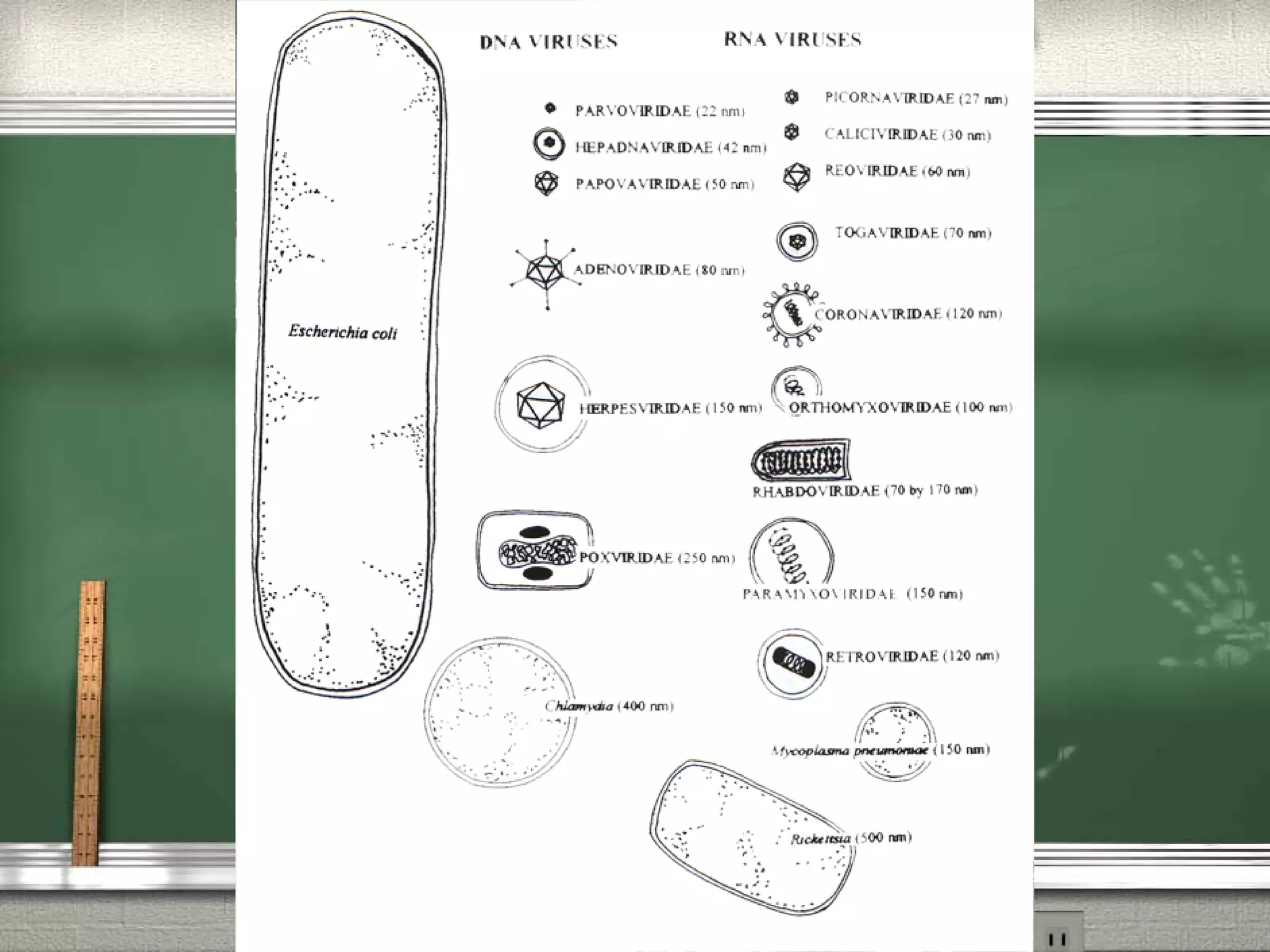
The structure and relative sizes of a number of DNA
The structure and relative sizes of a number of RNA
ENVELOPED   NAKED Double – stranded   Double – stranded  Single – stranded Icosahedral  Complex  Icosahedral  Icosahedral HERPES POX PAPOVA  PARVO HEPADNA ADENO DNA VIRUSES
RNA VIRUSES Single – stranded Double – stranded Positive – stranded (+)   Negative – stranded (-)  Naked Enveloped   Enveloped  Naked *PICORNA  *TOGA   BUNYA *REO *CALICI   *FLAVI   ORTHOMYXO   CORONA  PARAMYXO   RETRO   RHABDO   ARENA   FILO * Icosahedral; all of the rest have helical symmetry
 
 
The main groups of human viruses
VIRAL REPLICATION Virus multiplication cycle consist of  6 phases : 1. Attachment/ adsorption to the host cell 2. Penetration or entry 3. Uncoating to release the genome 4. Virion component production/ synthesis 5. Assembly/ maturation 6. Release from the cells Viral infections maybe productive/lytic response or nonproductive response (lysogeny)  Lysogeny may be associated with oncogenic  transformation by animal viruses
The outcome of the infection depend on : the particular virus-host combination other factors : - the extracelullar environment - multiplicity of the infection - physiology & developmental state of the cell
ADSORPTION Adsorption is the first step in every viral infection. Adsorption involves : - virion attachment proteins - cell surface receptor proteins Examples of viral receptors
For some viruses co-receptors are  involved in adsorption       HIV-1 : CD4 & chemokine receptors Viral spikes & phage tails carry attachment proteins  In some case, a region of the capsid protein serve the function of attachment  Adsorption is enhanced by presence of multiple  attachment & receptor proteins. A particular kind of virus is capable to infecting only a limited spectrum of cell types     its host range Differences in host range & tissue tropism due to presence or absence of the receptors
Entry & Uncoating Enveloped Animal Viruses Some enveloped viruses enter cells by  direct fusion of plasma membrane & envelope, release the  nucleocapsid directly into the cytoplasm.      Paramyxoviruses (eg. measles) retroviruses   (eg. HIV-1) & herpesviruses Other enveloped & naked viruses are taken in by receptor-mediated endocytosis  (viropexis).      orthomycovirus (eg. influenza viruses),   togaviruses (eg. rubella viruses), rhabdoviruses   (eg. rabies) & coronaviruses
The two basic modes of entry of an enveloped animal virus  into the host cell
Entry by  direct fusion
Viropexis
Naked Capsid Animal Viruses Naked capsid viruses (eg. poliovirus, reovirus, adenovirus) also appear to enter by viropexis, but in this case, virus can’t escape the endosomal vesicle by membrane fusion  For poliovirus : acidified endosome expose hydrophobic domains    result in the binding of the virions to membrane & releases nucleocapsid to cytoplasm  For reovirus : the content of the endosome are transferred to a lysosome    the lysosomal  proteases strip away part of the capsid protein &  active virions
Schematic of receptor-mediated endocytosis  ulitilized by poliovirus for entry into host cell
Insertion of  glycoprotein  into the cell’s  membrane structures  and formation of  the viral envelope
Viral release by Budding
VIRAL LIFE CYCLE ATTACHMENT PENETRATION HOST FUNCTIONS ASSEMBLY (MATURATION) Transcription REPLICATION RELEASE UNCOATING Translation MULTIPLICATION Click after each step to view process
Mutation Many DNA viruses use the host DNA synthesis machinery for replicating their genomes  However the largest animal viruses code for their own  DNA polymerases, & these enzymes are not as  effective at proofreading as the cellular polymerases  The resulting higher error rates in DNA replication  endow  the viruses with the potential for a high rate  of evolution, but they are partially responsible for  the high frequency of defective viral particles  High mutation rates permit adaptation to changed    conditions Mechanisms of genetic change
Recombination Homologous recombination is common in DNA viruses   There are 2 mechanisms : 1. Which is unique to the viruses with segmented genomes, involves reassortment of the segments during a mixed infections involving 2 different viral strains. 2. Exemplified by the genetic recombination between  different forms of poliovirus Recombination occurs during replication by a “copy choice” type of mechanism Poliovirus replicase switches templates to generate recombinants
COMMON METHODS OF INACTIVATING VIRUSES FOR VARIOUS PURPOSE Virus may be inactivated for : Sterilize laboratory supplies Sterilization : steam, dry heat, ethylene oxide,   -irradiation Disinfect surfaces or skin  Surface disinfection : sodium hypochlorite,  glutaraldehyde. formaldehyde, peracetic acid Skin disinfection : chlorhexidine, 70% ethanol,  iodophores Vaccine production  : formaldehyde,   -propiolactone, psoralen + uv  irradiation, detergents (subunit vaccines)
 
Cultivation in embryonated egg Virus injected into appropriate region  Method widely used for production of vaccines
 
Cultivation in cell cultures
Cultivation in cell culture Cytopathic effect - normal monolayer  structure is disrupted by viral  infection  Cell lines developed from embryonic  tissue  Continuous cell lines (immortal) - HeLa  Maintenance of cell culture lines is  technically difficult; must be kept free  of microbial contamination.
TRANSMISSION OF VIRAL INFECTION DIRECT CONTACT droplet/aerosol influenza virus morbilli virus smallpox virus GASTROINTESTINAL TRACT (ORALLY) enterovirus Hepatitis A, E virus poliomyelitis virus ANIMAL BITE   :  rabies virus VECTOR   :  dengue virus PARENTERAL   :  Hepatitis B, C virus, HIV
PATHOGENESIS OF VIRAL DISEASES Viral pathogenesis : interaction of viral and host factors leads to disease production Virus  pathogenic  if : can infect and cause signs of  disease of the host Virus  virulent   : produce more severe disease  Steps in viral pathogenesis : Viral entry & primary replication Viral spread and cell tropism Cell injury & clinical illness Recovery from infection Virus shedding
DIAGNOSTIC METHODS OF VIRAL INFECTION Clinical symptoms Laboratory diagnosis Typical clinical symptoms Polyomyelitis Chicken Pox Measles Mumps
Laboratory diagnosis 1. Electron microscope morphology 2. Light microscope special staining    ~ type of virus Variola virus inclusion bodies Gispen staining :  PASCHEN BODIES Rabies virus specimen  : brain Sellers staining : inclusion bodies in nerve cells NEGRI BODIES Molluscum contagiosum virus   skin nodule Lugol staining : inclusion bodies in cytoplasm  of epithel cell MOLLUSCUM BODIES
Laboratory diagnosis   3. Culture  specimen : depend on the disease in vitro, in ovo, or in vivo 4. Serology Raise of antibody titer Antigen detection from the specimen Viral type identification : agglutination, precipitation, complement  fixation test, neutralization, inhibition  haemagglutination, FAT, ELISA, RIA,  LIA
PREVENTION AND TREATMENT OF VIRAL INFECTIONS VIRAL VACCINES Killed-virus vaccines Attenuated live-virus vaccines Future prospect :    - attenuation of viruses by genetic  mapping   - avirulent viral vectors   - purified proteins produced using  cloned genes   - synthetic peptides     - subunit vaccines - DNA vaccines
2. INTERFERONS IFNs :  host-coded proteins of large cytokine  family inhibit viral replication produced by intact animal or cell culture in response to viral infection or other inducers first line of defense against viral infection
3. ANTIVIRAL CHEMOTHERAPY Nucleoside analogs Acyclovir &  valacyclovir Didanosine Gancyclovir Idoxuridine Lamivudin (3TC) Ribavirin Stavudine (d4T) Trifluridine Vidarabine Zalzitabine (ddC) Zidovudine (AZT)
B. Nucleotide analogs Cidofovir  : active against CMV & HSV   inhibit s viral DNA polymerase C. Nonnucleoside reverse transcriptase inhibitor Nevirapine : inhibit reverse transcriptase of HIV  D. Protease inhibitors Ritonavir, Saquinavir HIV E. Other types  Amantadine & rimantadine Foscarnet Methiasone
 
 
Questions ?

Virology Dr.Titi

  • 1.
    Dept. Microbiology, MedicalFaculty Padjadjaran University VIROLOGY SUNARYATI SUDIGDOADI
  • 2.
    a set ofgenes composed of either DNA or RNA packages in a protein containing coat The resulting particle  Virion Virus reproduction : virus particle infect a cell & program the cellular machinery to synthesize the constituents required for the assembly of new virions  considered an intracellular parasite Introduction Virus :
  • 3.
    Different viruses canhave very different genetics structures  reflected in their replicative strategies Because of their small size, viruses have achieved a very high degree of genetic economy Viruses depend to great extent on host cell functions  difficult to combat medically They do exhibit unique steps in their replicative cycles that are potential targets for antiviral therapy
  • 4.
    CHARACTERISTICS Small , ranging from about 20 – 300 nm diameter Totally depend upon a living cell , either eukaryotic or prokaryotic, for replication and existence Some viruses possess complex enzyme of their own : RNA or DNA polymerases but they cannot amplify & reproduce the information in their own genomes without assistance Have a component a receptor-binding protein for attaching to cells
  • 5.
    Viral Size Length20 - 14,000 nm Much smaller than bacteria - therefore filterable (infectious agent that could pass through porcelain filter; many originated in animals )
  • 6.
    CHARACTERISTICS To see the virus electron microscope Growth need living cells/ tissues Can not growth saprophytic Only have certain enzyme for metabolism and energy Easy mutated changes antigenic property Multiplication different from bacteria
  • 7.
  • 8.
    Virus structure &Morphology The basic design of all viruses places the nucleic acid genome on the inside of a protein shell  capsid Two basic types of virions : 1. Enveloped viruses  have a nucleocapsid of nucleic acid complexed to protein 2. Naked capsid viruses  have a nucleic acid genome within a protein shell
  • 9.
    Virus structure &Morphology Schematic drawing of two basic type of virions
  • 10.
    Two basic shapesof virions : 1. Cylindrical 2. Spherical Some bacteriophages combine those 2 basic shapes Functions of capsid or envelope of viruses : 1. To protect the NA genome from damage during extra-celullar passage of the virus from one cell to another 2. To aid in the process of entry into the cell 3. To package enzymes essential for the early steps of the infection process
  • 11.
  • 12.
    The structure andrelative sizes of a number of DNA
  • 13.
    The structure andrelative sizes of a number of RNA
  • 14.
    ENVELOPED NAKED Double – stranded Double – stranded Single – stranded Icosahedral Complex Icosahedral Icosahedral HERPES POX PAPOVA PARVO HEPADNA ADENO DNA VIRUSES
  • 15.
    RNA VIRUSES Single– stranded Double – stranded Positive – stranded (+) Negative – stranded (-) Naked Enveloped Enveloped Naked *PICORNA *TOGA BUNYA *REO *CALICI *FLAVI ORTHOMYXO CORONA PARAMYXO RETRO RHABDO ARENA FILO * Icosahedral; all of the rest have helical symmetry
  • 16.
  • 17.
  • 18.
    The main groupsof human viruses
  • 19.
    VIRAL REPLICATION Virusmultiplication cycle consist of 6 phases : 1. Attachment/ adsorption to the host cell 2. Penetration or entry 3. Uncoating to release the genome 4. Virion component production/ synthesis 5. Assembly/ maturation 6. Release from the cells Viral infections maybe productive/lytic response or nonproductive response (lysogeny) Lysogeny may be associated with oncogenic transformation by animal viruses
  • 20.
    The outcome ofthe infection depend on : the particular virus-host combination other factors : - the extracelullar environment - multiplicity of the infection - physiology & developmental state of the cell
  • 21.
    ADSORPTION Adsorption isthe first step in every viral infection. Adsorption involves : - virion attachment proteins - cell surface receptor proteins Examples of viral receptors
  • 22.
    For some virusesco-receptors are involved in adsorption  HIV-1 : CD4 & chemokine receptors Viral spikes & phage tails carry attachment proteins In some case, a region of the capsid protein serve the function of attachment Adsorption is enhanced by presence of multiple attachment & receptor proteins. A particular kind of virus is capable to infecting only a limited spectrum of cell types  its host range Differences in host range & tissue tropism due to presence or absence of the receptors
  • 23.
    Entry & UncoatingEnveloped Animal Viruses Some enveloped viruses enter cells by direct fusion of plasma membrane & envelope, release the nucleocapsid directly into the cytoplasm.  Paramyxoviruses (eg. measles) retroviruses (eg. HIV-1) & herpesviruses Other enveloped & naked viruses are taken in by receptor-mediated endocytosis (viropexis).  orthomycovirus (eg. influenza viruses), togaviruses (eg. rubella viruses), rhabdoviruses (eg. rabies) & coronaviruses
  • 24.
    The two basicmodes of entry of an enveloped animal virus into the host cell
  • 25.
    Entry by direct fusion
  • 26.
  • 27.
    Naked Capsid AnimalViruses Naked capsid viruses (eg. poliovirus, reovirus, adenovirus) also appear to enter by viropexis, but in this case, virus can’t escape the endosomal vesicle by membrane fusion For poliovirus : acidified endosome expose hydrophobic domains  result in the binding of the virions to membrane & releases nucleocapsid to cytoplasm For reovirus : the content of the endosome are transferred to a lysosome  the lysosomal proteases strip away part of the capsid protein & active virions
  • 28.
    Schematic of receptor-mediatedendocytosis ulitilized by poliovirus for entry into host cell
  • 29.
    Insertion of glycoprotein into the cell’s membrane structures and formation of the viral envelope
  • 30.
  • 31.
    VIRAL LIFE CYCLEATTACHMENT PENETRATION HOST FUNCTIONS ASSEMBLY (MATURATION) Transcription REPLICATION RELEASE UNCOATING Translation MULTIPLICATION Click after each step to view process
  • 32.
    Mutation Many DNAviruses use the host DNA synthesis machinery for replicating their genomes However the largest animal viruses code for their own DNA polymerases, & these enzymes are not as effective at proofreading as the cellular polymerases The resulting higher error rates in DNA replication endow the viruses with the potential for a high rate of evolution, but they are partially responsible for the high frequency of defective viral particles High mutation rates permit adaptation to changed conditions Mechanisms of genetic change
  • 33.
    Recombination Homologous recombinationis common in DNA viruses There are 2 mechanisms : 1. Which is unique to the viruses with segmented genomes, involves reassortment of the segments during a mixed infections involving 2 different viral strains. 2. Exemplified by the genetic recombination between different forms of poliovirus Recombination occurs during replication by a “copy choice” type of mechanism Poliovirus replicase switches templates to generate recombinants
  • 34.
    COMMON METHODS OFINACTIVATING VIRUSES FOR VARIOUS PURPOSE Virus may be inactivated for : Sterilize laboratory supplies Sterilization : steam, dry heat, ethylene oxide,  -irradiation Disinfect surfaces or skin Surface disinfection : sodium hypochlorite, glutaraldehyde. formaldehyde, peracetic acid Skin disinfection : chlorhexidine, 70% ethanol, iodophores Vaccine production : formaldehyde,  -propiolactone, psoralen + uv irradiation, detergents (subunit vaccines)
  • 35.
  • 36.
    Cultivation in embryonatedegg Virus injected into appropriate region Method widely used for production of vaccines
  • 37.
  • 38.
  • 39.
    Cultivation in cellculture Cytopathic effect - normal monolayer structure is disrupted by viral infection Cell lines developed from embryonic tissue Continuous cell lines (immortal) - HeLa Maintenance of cell culture lines is technically difficult; must be kept free of microbial contamination.
  • 40.
    TRANSMISSION OF VIRALINFECTION DIRECT CONTACT droplet/aerosol influenza virus morbilli virus smallpox virus GASTROINTESTINAL TRACT (ORALLY) enterovirus Hepatitis A, E virus poliomyelitis virus ANIMAL BITE : rabies virus VECTOR : dengue virus PARENTERAL : Hepatitis B, C virus, HIV
  • 41.
    PATHOGENESIS OF VIRALDISEASES Viral pathogenesis : interaction of viral and host factors leads to disease production Virus pathogenic if : can infect and cause signs of disease of the host Virus virulent : produce more severe disease Steps in viral pathogenesis : Viral entry & primary replication Viral spread and cell tropism Cell injury & clinical illness Recovery from infection Virus shedding
  • 42.
    DIAGNOSTIC METHODS OFVIRAL INFECTION Clinical symptoms Laboratory diagnosis Typical clinical symptoms Polyomyelitis Chicken Pox Measles Mumps
  • 43.
    Laboratory diagnosis 1.Electron microscope morphology 2. Light microscope special staining ~ type of virus Variola virus inclusion bodies Gispen staining : PASCHEN BODIES Rabies virus specimen : brain Sellers staining : inclusion bodies in nerve cells NEGRI BODIES Molluscum contagiosum virus skin nodule Lugol staining : inclusion bodies in cytoplasm of epithel cell MOLLUSCUM BODIES
  • 44.
    Laboratory diagnosis 3. Culture specimen : depend on the disease in vitro, in ovo, or in vivo 4. Serology Raise of antibody titer Antigen detection from the specimen Viral type identification : agglutination, precipitation, complement fixation test, neutralization, inhibition haemagglutination, FAT, ELISA, RIA, LIA
  • 45.
    PREVENTION AND TREATMENTOF VIRAL INFECTIONS VIRAL VACCINES Killed-virus vaccines Attenuated live-virus vaccines Future prospect : - attenuation of viruses by genetic mapping - avirulent viral vectors - purified proteins produced using cloned genes - synthetic peptides - subunit vaccines - DNA vaccines
  • 46.
    2. INTERFERONS IFNs: host-coded proteins of large cytokine family inhibit viral replication produced by intact animal or cell culture in response to viral infection or other inducers first line of defense against viral infection
  • 47.
    3. ANTIVIRAL CHEMOTHERAPYNucleoside analogs Acyclovir & valacyclovir Didanosine Gancyclovir Idoxuridine Lamivudin (3TC) Ribavirin Stavudine (d4T) Trifluridine Vidarabine Zalzitabine (ddC) Zidovudine (AZT)
  • 48.
    B. Nucleotide analogsCidofovir : active against CMV & HSV inhibit s viral DNA polymerase C. Nonnucleoside reverse transcriptase inhibitor Nevirapine : inhibit reverse transcriptase of HIV D. Protease inhibitors Ritonavir, Saquinavir HIV E. Other types Amantadine & rimantadine Foscarnet Methiasone
  • 49.
  • 50.
  • 51.