Submitted To : Dr. Sunita Devi
Presented By: Rajnish Kumar
Viruses can be defined as non
cellular, sub microscopic,
obligatory intracellular
parasite composed of a
proteinaceous covering
around central nucleic acid
(either DNA or RNA) and
capable of self replication
within the living host cells.
History
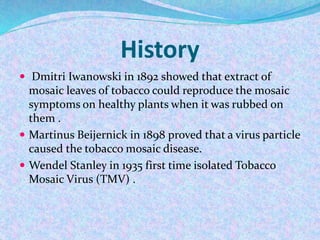
 Dmitri Iwanowski in 1892 showed that extract of
mosaic leaves of tobacco could reproduce the mosaic
symptoms on healthy plants when it was rubbed on
them .
 Martinus Beijernick in 1898 proved that a virus particle
caused the tobacco mosaic disease.
 Wendel Stanley in 1935 first time isolated Tobacco
Mosaic Virus (TMV) .
Isolation By Dmitri Iwanowski
Dmitri Iwanowsky extracted the extract of mosaic leaves of
tobacco that could reproduce the mosaic symptoms.
He filtered the extract by using Chamberland filter .
Then he treated healthy plants with filterate .
Then he observed the same mosaic symptoms on the healthy
leaves . And hence showed that extract of mosaic leaves of
tobacco could reproduce the mosaic symptoms on the
healthy plants when rubbed.
GENERAL FEATURES
 Obligate parasites.
 Multiply only within living host and metabolically inert
outside the host cell.
 Ultramicroscope and can only be viewed with electron
microscope .
 They are nucleoproteins (proteinaceous coat surrounds
the nucleic acid , which forms the central core of virus
particles.
 Contain either DNA or RNA.
 They have no metabolic activities of their own and utilize
the metabolism of host cells.
 Antibiotics have no effect on them.
Differences Between Living cells and
VIRUSES
Living cells Viruses
1. Cells contain definite protoplasm
surrounded by plasma membrane.
2 . Structure is complex.
3. Reproduction is independent of other
cells.
4. Multiplication occurs by cell division.
5. Cells cannot be crystallized .
6. Cells are almost free living.
7. Cells have all metabolic activities to lead
life
8. Protein synthesis is independent.
1. Viruses contain a nucleic acid and a protein
coat.
2. Structure is simple.
3. Reproduction occurs inside the host cell.
4. Multiplication occurs by replication.
5. Viruses can be crystallized. (a virus
“crystal” consists of several thousand
viruses and ,because of its purity,
it is well suited for chemical studies.) .
6. Viruses are obligate intracellular parasites .
7. Viruses have no metabolic activity.
8. Protein synthesis relies on the host’s
protein synthetic machinery.
Comparison between Rickettsiae(bacteria) and
Viruses
Rickettsiae Viruses
 Binary fission occurs.
 Contain both DNA and RNA.
 Ribosomes present.
 Sensitive to antibiotics.
 Resistant against interferons.
 They are bacteria .
 Binary fission do not occur.
 Contain DNA or RNA.
 Ribosomes absent.
 Resistant against antibiotics.
 Sensitive to interferon.
 They are viruses .
Difference between Interferons
and Antibodies
INTERFERONS ANTIBODIES
 Interferons are group of
proteins that are formed by
host cell in response to the
presence of viruses .
 Virus infected cells releases
interferons to protect to
protect the nearby cells from
viral infection.
 Antibodies are group of
proteins produced by plasma
cells to protect the host from
the attack of bacteria .
SIZES OF VIRUSES
•Smallest virus
Parvovirus(15nm)
Largest virus-
Poxvirus(300nm)
 Virion (a single particle of fully developed
virus)
 Complete
 Fully developed
 Infectious
 Viral particle
• Composed of nucleic acid
• Surrounded by protein coat ( capsid )
Virus Structure
Capsid
1. Protein coat
surrounding nucleic acid.
2. Most of mass of virus.
3. Composed of
capsomeres.
Structure of Virus
 Envelope
• Covers capsid in
some viruses.
• Combination of
lipids ,proteins ,
carbohydrates .
• Can be derived
from host cells
plasma
membrane.
STRUCTURE OF VIRUS
CONT…
Spikes
• Carbohydrate- protein complexes.
• Project from envelope.
• Attachment mechanism.
• Haemagglutination (clumping of RBC’s).
 Non-enveloped viruses
• Capsid:
 Protects nucleic acid from nuclease
enzymes.
 Promotes virus attachment.
Comparison between naked (non-
enveloped ) and enveloped viruses
Example : Ebola virus , Hepatitis A Virus
(HAV) , Polio virus , etc .
Example: Measles virus ,Rotavirus, Hepatitis C
Virus (HCV),Rabies virus ,etc.
Morphological Types of Capsids
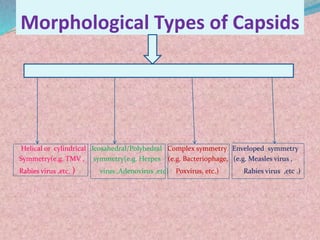
Helical or cylindrical Icosahedral/Polyhedral Complex symmetry Enveloped symmetry
Symmetry(e.g. TMV , symmetry(e.g. Herpes (e.g. Bacteriophage, (e.g. Measles virus ,
Rabies virus ,etc. ) virus ,Adenovirus ,etc) Poxvirus, etc.) Rabies virus ,etc .)
Morphology of viruses
Helical viruses
• Rigid or flexible
• Nucleic acid within hollow cylinderical , helical
Rabies
Ebola
Morphology of viruses
Polyhedral viruses
• Icosahedron (20 triangular faces,12 corners)
• E.g. polio virus
Morphology of viruses
Complex viruses
• Bacterial viruses
• Additional structures attached
• Capsid (polyhedral)
• Sheath(helical)
Morphology of viruses
Enveloped viruses;
o Many animal viruses and some plant viruses have an
extra covering around the capsid . This covering is
called envelope .
o 10-15 nm in thickness.
o Chemically , envelope is made up of lipoproteins and
glycoproteins.
o Example- Measles virus
CLASSIFICATION OF VIRUSES
• Virus classification is arrangement of viruses into
groups or taxa based on mutual similarity .
 Two schemes used for classification of viruses:
The International Committee on Taxonomy of
Viruses(ICTV)system.
The Baltimore classification.
ICTV CLASSIFICATION
 The International Committee on Taxonomy of viruses began to
devise and implement rules for the naming and classification of
viruses early in the 1970s.
 Currently viruses are classified with a taxonomic system placing
primary emphasis on the type and strandedness of viral nucleic
acids, and on the presence or absence of an envelope .
 Viruses grouped into families according to:
o Nucleic acid type
o Strategy for replication
o Morphology
 Suffixes
o Order – Virales
o Family – Viridae
o Subfamily – Virinae
o Genus - Virus
ORDER:
 An order is a group of families sharing certain
common characters.
 An order name must be single word ending in the
suffix- virales .
 Examle : Caudovirales are tailed dsDNA
(bacteriophages.)
: Herpesvirales contain large eukaryotic dsDNA
viruses.
FAMILY:
• A family is a group of genera, whether or not these are organised into
subfamilies, sharing certain common characters.
• A family name must be a single word ending in the suffix- viridae.
• Examples : Picorvaviridae
: Herpesviridae
: Flaviviridae
• Origin of family names :
• Symptoms or disease caused by viruses( Herpes : produce scaly lesion,
Pox: infections produce pox lesions).
• Sites of infection( Adeno : infections of respiratory tract )
• Physical characteristics of the viruses( Picorna : Pico small + RNA , Filo
: look fibrous )
• Combination( Hepadna : Hepatitis +DNA)
SUBFAMILY:
 A subfamily is a group of genera sharing certain
common characters.
 The taxon shall be used only when it is needed to solve
a complex hierarchical problem.
 A subfamily name must be a single word ending in the
suffix – virinae .
 Examples: Alphaherpesvirinae
: Betaherpesvirinae
: Gammaherpesvirinae
GENUS:
 A virus genus is a group of related species that share
significant properties and often only differ in host
range and virulence.
 A genus name must be a single word ending in the
suffix-virus .
 Example : Flavivirus - yellow fever virus
: Pestivirus - Bovine Diarrhea virus 1
: Hepacivirus - Hepatitis virus C (HCV)
SPECIES:
 A species name shall consist of as few words as
practicable but must not consist only of a host name
and a word virus.
 Examples: Poliovirus
: Human Immunodefficiency virus
Taxonomy : Examples
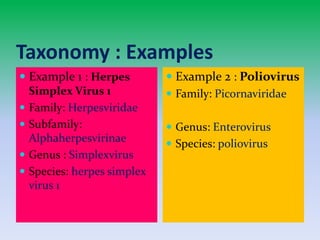
 Example 1 : Herpes
Simplex Virus 1
 Family: Herpesviridae
 Subfamily:
Alphaherpesvirinae
 Genus : Simplexvirus
 Species: herpes simplex
virus 1
 Example 2 : Poliovirus
 Family: Picornaviridae
 Genus: Enterovirus
 Species: poliovirus
BALTIMORE
CLASSIFICATION
 Baltimore classification was first defined in 1971 by David Baltimore .
 The Baltimore classification of virus is based on the method of viral
mRNA synthesis.
 It is the classification system that places viruses into seven groups:
1. dsDNA virus (e.g. Adenoviruses , Poxviruses)
2. ssDNA viruses (+ strand or “sense”)DNA(e.g. Parvoviruses)
3. dsRNA viruses(e.g. Reoviruses)
4. (+) ssRNA viruses(+strand or sense)RNA(e.g. Picornaviruses)
5. (-) ssRNA viruses(-strand or antisense) RNA(e.g. Rhabdoviruses)
6. ssRNA-RT viruses(+strand or sense) RNA with DNA intermediate in
life cycle(Retroviruses)
7. dsDNA-RT viruses(e.g. Hepadnaviruses)
Baltimore Classification
Based on the method of viral
mRNA synthesis.
Negative single stranded RNA
is a virus whose genetic
information consists of a single
strand of RNA that is negative
or antisense strand (3’to5’)
which does not encode mRNA.
Positive single strand of RNA
is a virus whose genetic
information consists of a single
strand of RNA that is
positive(5’to3’)which encodes
mRNA and proteins.
TYPES OF VIRUSES
 Animal viruses : Rabies , Polio , Mumps , Chickenpox ,
Influenza.
 Plant viruses : Tobacoo Mosaic Virus(TMV),Potato
virus-X(PVX),Carrot thin leaf virus.
 Bacterial virus : Bacteriophages (T1,T2,T3 and T4)
VIRUS REPLICATION
 Multiplication of viruses by the way of viral DNA or RNA
followed by encapsulation is called replication of viruses.
 This is called so because virus replication is the major event
in the reproduction and virus capsid itself is synthesized
by the host’s protein synthetic machinery and not by virus.
 Since viruses are the obligate intracellular parasites , they
reproduce only within a host cell .
 Viruses are host specific and hence infect the cells of
suitable hosts.
 Certain groups of viruses infect cells of specific animals.
Several stages in the replication
of viruses:
 Adsorption of viruses.
 Penetration and uncoating .
 Replication of nucleic acid .
 Synthesis of viral capsids.
 Assembly of virus particles.
 Release of mature virions.
Replication of virus
Adsorption (attachment)
 This is the first step in the multiplication process.
 It occurs when virus adheres on the surface of the cell with the help of receptor.
 This viral adherence is important for the virulence of the virus.
 In non-enveloped viruses , the adhesion is facilitated by capsid protein (e.g. Parvovirus)
and spike protein(e.g. Adenovirus).
 As far as enveloped viruses are concerned , spike protein play a key role in the adhesion of
the virus on the host cell.
 The susceptibility of host cells is necessary for proper adhesion of virus on the cell.
 A receptor is usually a glycoprotein on the cell surface.
 Host’s specificity to a particular virus is determined by the type of receptor present on
the cell surface.
 There are several types of receptor on different host cells.
 Examples-
 Influenza A virus binds with sialic acid receptor of respiratory track cells.
 Rabies virus adsorb on Acetyl choline receptor of neurons .
 HIV virus binds with CD4 receptor.
Penetration and
Uncoating:
 The adsorbed viruses penetrate the plasma membrane
and enter the host cell for multiplication .
 The mechanisms of penetration and uncoating vary
with different virus.
 Penetration of viruses may occur in anyone of the
following three ways :
Direct penetration .
Fusion.
Endocytosis .
Direct penetration
 Naked virus (e.g. Poliovirus)undergoes conformational
changes after adherence on plasma membrane and
releases its nucleic acid into the host cell .This process
is also called translocation .
Fusion
 Enveloped virus fused with plasma membrane with the
help of fusion protein or F protein .
 It results in the entry of capsid protein into the
cytoplasm .
Endocytosis
 Most enveloped virus enters inside of host cells through receptor
mediated endocytosis and form coated vesicles .
 Immediately after the entry, uncoating takes place by making use
of lysozyme or acidity formation within the endocytic vessles.
 Plant viruses and bacteriophages have to overcome an extra
obstacle of the cell wall to penetrate their host cells.The plant
viruses may penetrate through breaches on the cell wall formed
by physical or mechanical means or may directly be introduced
into the host cell by vectors .
 In case of bacteriophages ,the virus nucleic acid alone penetrates
the host cell wall and capsid remains outside .Here the phage
dissolve the bacterial cell wall using lysozyme and its tail injects
the nucleic acid by contraction of tail sheath .
Replication of Nucleic acid
DNA Viruses RNA Viruses
 In most of the DNA viruses , genome replicates
within the host cell’s nucleus , but in some cases
it occurs in cytoplasm (e.g. Small pox virus ).
 As soon as the double stranded viral DNA enters
the nucleus , it undergoes transcription using the
host’s RNA polymerase enzyme.
 One of the strands of the duplex DNA acts as a
template for transcription and replication .
 Consequently, mRNAs of early and late genes are
formed , which are transformed to the cytoplasm
for the subsequent translation process.
 The mRNAs of early genes are translated into
early or non-structural proteins (enzymes) .
 These proteins initiate and maintain the
synthesis of viral components and switch off the
host’s proteins and nucleic acids synthesis.
 DNA is replicated using the enzyme DNA
polymerase .
 It follows the usual semiconservative method
proposed by Watson and Crick .
 Because of this replication , multiple copies of
viral DNA are formed within the host cell.
 RNA viruses adopt four strategies
for the replication depending
upon the nature of RNA.
 Some RNA viruses uses their RNA
genome as a mRNA . They are
considered as +sense ssRNA
viruses(e.g. Polio virus).
 In case of negative sense ssRNA
viruses, viral replicase converts the
ssRNA in to a double stranded
RNA called the replicative form.
 The +strand directs the synthesis
of viral proteins necessary for
RNA replication and capsid .
 On the other hand ,the –strand is
packed in the virus capsid during
virus assembly(e.g. Influenza
virus).
Synthesis of Viral Capsid
 Various components of viral capsid are all the products
of the late genes of the viral genome .
 The late genes code for capsomers and spikes.
 They are assembled together in a characteristic way to
form a virus capsid .
 Viruses are assembled after the complete synthesis of
nucleic acid and structural proteins.
Assembly of Virus particles
 The daughter virions are assembled from the capsid
protein and viral nucleic acid .
 It may take place either in the nucleus or in cytoplasm of
the host cell.
 At the time of virion assembly , the capsid remains
incomplete , leaving a pore at one end.
 Through this pore , the viral nucleic acid enter the central
cavity of the capsid .
 Then the pore is closed with enough number of
capsomeres.
 Thus a mature virion is formed . Hence, this step , is often
called maturation.
Virion Release
 This is the last step in the virus multiplication.
 The mature viruses found inside the host cell escape from it as complete virion
.
 There are three mechanisms for the releasing progeny viruses from the host
cell.
 They are cell lysis or cytopathic effect , budding and cell degeneration.
 Several bacteriophages and some animal viruses are released out after the lysis
of the host cell.
 Since the host cell die off during the release of virus, it is said to be cytopathic
effect.
 Many of the animal viruses escape from the host cell without cell lysis .
 They are released by budding off of cell membrane simultaneously over a
period of time.
 Viruses such as Parvoviruses accumulate within the host cell and are released
only after the death of the host cell which results in the degeneration of host
cell.
Effect of Viruses on Host
cell
 Virus inhibits host’s DNA,RNA and protein synthesis.
 Lysosomes may be damaged resulting in cell lysis.
 Intracellular structures called inclusion bodies are
formed.
 Viruses cause chromosomal disruptions.
 Infection with oncovirus may lead to transformation of
cells (cancer cells).
Two Pathway For Replication
Examples
Lytic cycle
replication
Lysogenic cycle
replication
 T4 phage in Escherichia.coli
 Influenza virus
 Rabies virus
 TMV(Tobacco Mosaic Virus)
 Common cold , etc.
 Herpes Simplex Virus
 Hepatitis B Virus
 VaricellaZosterVirus(chicken
pox), etc.
Virus Related Agents
 The subcellular entities which are more like viruses but
not true viruses are called virus related agents.
 None them has the complete nucleocapsid.
 They are divided into four groups:
1. Viroids (viral nucleic acid is present ,but no capsid).
2. Satellites ( viral nucleic acid present , but
replication relies on a helper virus).
3. Prions ( capsid is present but nucleic acid is
absent).
Viroids
 Viroids are naked circular single stranded RNAs that are
not at all associated with a capsid or helper virus.
 They infect host cells and cause diseases in them as viruses
do. They are also called virusoids.
 The RNA of viroids contains 246 to 250 nucleotides.
 They lack protein components .
 They are thermodynamically stable so that they can survive
for 10 minutes at 90 C temperature .
 More than 16 plant viral diseases are reported to be caused
by viroids.
 It cause infections by inhibiting mRNA synthesis of the
cell.
Replication of Viroids
Satellites
 Satellites are subcellular entities composed of nucleic acid
molecules that replicate only in the presence of a helper
virus(a virus used when producing copies of a helper dependent viral
vector which does not have the ability to replicate on its own) .
 The nucleic acid may be RNA or DNA ; it may be single
stranded or double stranded ; and it may be circular or
linear .
 They are plant pathogens.
 Multiplication of nucleic acid occurs only within the host
cell .
 The nucleic acid sequence of satellites is distinct from the
host’s genome as well as the helper virus .
Replication of Satellites
Prions
 Prions are proteinaceous infectious viral particle
without nucleic acids .
 Prions usually infect mammals and a few fungi .
 They are resistant to heat at 80 C and to UV rays .
 Prions infect spleen and multiply in the
reticuloendothelial system and later spread to brain.
 They contain 250 amino acids.
Replication of Prions
Diseases caused by viroids ,
satellites and prions
Viroids
Leaf distortion ,
Necrosis ,
Stunting ,
Mottling , etc .
Satellites
Black ring in tomato ,
Leaf curl in tomato ,
Mosaic disease in
maize, tobacco , etc .
Prions
In Animals (scrapie in
sheep and goats,
Bovine Songiform
Encephalopathy in
cattle)
In Humans ( Kuru ,
Fatal Fimilial
Insomania ,
Creutzfeldt- Jacob
Disease)
PRESENTATION ON VIRUS.pptx

PRESENTATION ON VIRUS.pptx

  • 1.
    Submitted To :Dr. Sunita Devi Presented By: Rajnish Kumar
  • 2.
    Viruses can bedefined as non cellular, sub microscopic, obligatory intracellular parasite composed of a proteinaceous covering around central nucleic acid (either DNA or RNA) and capable of self replication within the living host cells.
  • 3.
    History  Dmitri Iwanowskiin 1892 showed that extract of mosaic leaves of tobacco could reproduce the mosaic symptoms on healthy plants when it was rubbed on them .  Martinus Beijernick in 1898 proved that a virus particle caused the tobacco mosaic disease.  Wendel Stanley in 1935 first time isolated Tobacco Mosaic Virus (TMV) .
  • 4.
    Isolation By DmitriIwanowski Dmitri Iwanowsky extracted the extract of mosaic leaves of tobacco that could reproduce the mosaic symptoms. He filtered the extract by using Chamberland filter . Then he treated healthy plants with filterate . Then he observed the same mosaic symptoms on the healthy leaves . And hence showed that extract of mosaic leaves of tobacco could reproduce the mosaic symptoms on the healthy plants when rubbed.
  • 5.
    GENERAL FEATURES  Obligateparasites.  Multiply only within living host and metabolically inert outside the host cell.  Ultramicroscope and can only be viewed with electron microscope .  They are nucleoproteins (proteinaceous coat surrounds the nucleic acid , which forms the central core of virus particles.  Contain either DNA or RNA.  They have no metabolic activities of their own and utilize the metabolism of host cells.  Antibiotics have no effect on them.
  • 6.
    Differences Between Livingcells and VIRUSES Living cells Viruses 1. Cells contain definite protoplasm surrounded by plasma membrane. 2 . Structure is complex. 3. Reproduction is independent of other cells. 4. Multiplication occurs by cell division. 5. Cells cannot be crystallized . 6. Cells are almost free living. 7. Cells have all metabolic activities to lead life 8. Protein synthesis is independent. 1. Viruses contain a nucleic acid and a protein coat. 2. Structure is simple. 3. Reproduction occurs inside the host cell. 4. Multiplication occurs by replication. 5. Viruses can be crystallized. (a virus “crystal” consists of several thousand viruses and ,because of its purity, it is well suited for chemical studies.) . 6. Viruses are obligate intracellular parasites . 7. Viruses have no metabolic activity. 8. Protein synthesis relies on the host’s protein synthetic machinery.
  • 7.
    Comparison between Rickettsiae(bacteria)and Viruses Rickettsiae Viruses  Binary fission occurs.  Contain both DNA and RNA.  Ribosomes present.  Sensitive to antibiotics.  Resistant against interferons.  They are bacteria .  Binary fission do not occur.  Contain DNA or RNA.  Ribosomes absent.  Resistant against antibiotics.  Sensitive to interferon.  They are viruses .
  • 8.
    Difference between Interferons andAntibodies INTERFERONS ANTIBODIES  Interferons are group of proteins that are formed by host cell in response to the presence of viruses .  Virus infected cells releases interferons to protect to protect the nearby cells from viral infection.  Antibodies are group of proteins produced by plasma cells to protect the host from the attack of bacteria .
  • 9.
    SIZES OF VIRUSES •Smallestvirus Parvovirus(15nm) Largest virus- Poxvirus(300nm)
  • 10.
     Virion (asingle particle of fully developed virus)  Complete  Fully developed  Infectious  Viral particle • Composed of nucleic acid • Surrounded by protein coat ( capsid )
  • 11.
    Virus Structure Capsid 1. Proteincoat surrounding nucleic acid. 2. Most of mass of virus. 3. Composed of capsomeres.
  • 12.
    Structure of Virus Envelope • Covers capsid in some viruses. • Combination of lipids ,proteins , carbohydrates . • Can be derived from host cells plasma membrane.
  • 13.
    STRUCTURE OF VIRUS CONT… Spikes •Carbohydrate- protein complexes. • Project from envelope. • Attachment mechanism. • Haemagglutination (clumping of RBC’s).
  • 14.
     Non-enveloped viruses •Capsid:  Protects nucleic acid from nuclease enzymes.  Promotes virus attachment.
  • 15.
    Comparison between naked(non- enveloped ) and enveloped viruses Example : Ebola virus , Hepatitis A Virus (HAV) , Polio virus , etc . Example: Measles virus ,Rotavirus, Hepatitis C Virus (HCV),Rabies virus ,etc.
  • 16.
    Morphological Types ofCapsids Helical or cylindrical Icosahedral/Polyhedral Complex symmetry Enveloped symmetry Symmetry(e.g. TMV , symmetry(e.g. Herpes (e.g. Bacteriophage, (e.g. Measles virus , Rabies virus ,etc. ) virus ,Adenovirus ,etc) Poxvirus, etc.) Rabies virus ,etc .)
  • 17.
    Morphology of viruses Helicalviruses • Rigid or flexible • Nucleic acid within hollow cylinderical , helical Rabies Ebola
  • 18.
    Morphology of viruses Polyhedralviruses • Icosahedron (20 triangular faces,12 corners) • E.g. polio virus
  • 19.
    Morphology of viruses Complexviruses • Bacterial viruses • Additional structures attached • Capsid (polyhedral) • Sheath(helical)
  • 20.
    Morphology of viruses Envelopedviruses; o Many animal viruses and some plant viruses have an extra covering around the capsid . This covering is called envelope . o 10-15 nm in thickness. o Chemically , envelope is made up of lipoproteins and glycoproteins. o Example- Measles virus
  • 21.
    CLASSIFICATION OF VIRUSES •Virus classification is arrangement of viruses into groups or taxa based on mutual similarity .  Two schemes used for classification of viruses: The International Committee on Taxonomy of Viruses(ICTV)system. The Baltimore classification.
  • 22.
    ICTV CLASSIFICATION  TheInternational Committee on Taxonomy of viruses began to devise and implement rules for the naming and classification of viruses early in the 1970s.  Currently viruses are classified with a taxonomic system placing primary emphasis on the type and strandedness of viral nucleic acids, and on the presence or absence of an envelope .  Viruses grouped into families according to: o Nucleic acid type o Strategy for replication o Morphology  Suffixes o Order – Virales o Family – Viridae o Subfamily – Virinae o Genus - Virus
  • 23.
    ORDER:  An orderis a group of families sharing certain common characters.  An order name must be single word ending in the suffix- virales .  Examle : Caudovirales are tailed dsDNA (bacteriophages.) : Herpesvirales contain large eukaryotic dsDNA viruses.
  • 24.
    FAMILY: • A familyis a group of genera, whether or not these are organised into subfamilies, sharing certain common characters. • A family name must be a single word ending in the suffix- viridae. • Examples : Picorvaviridae : Herpesviridae : Flaviviridae • Origin of family names : • Symptoms or disease caused by viruses( Herpes : produce scaly lesion, Pox: infections produce pox lesions). • Sites of infection( Adeno : infections of respiratory tract ) • Physical characteristics of the viruses( Picorna : Pico small + RNA , Filo : look fibrous ) • Combination( Hepadna : Hepatitis +DNA)
  • 25.
    SUBFAMILY:  A subfamilyis a group of genera sharing certain common characters.  The taxon shall be used only when it is needed to solve a complex hierarchical problem.  A subfamily name must be a single word ending in the suffix – virinae .  Examples: Alphaherpesvirinae : Betaherpesvirinae : Gammaherpesvirinae
  • 26.
    GENUS:  A virusgenus is a group of related species that share significant properties and often only differ in host range and virulence.  A genus name must be a single word ending in the suffix-virus .  Example : Flavivirus - yellow fever virus : Pestivirus - Bovine Diarrhea virus 1 : Hepacivirus - Hepatitis virus C (HCV)
  • 27.
    SPECIES:  A speciesname shall consist of as few words as practicable but must not consist only of a host name and a word virus.  Examples: Poliovirus : Human Immunodefficiency virus
  • 28.
    Taxonomy : Examples Example 1 : Herpes Simplex Virus 1  Family: Herpesviridae  Subfamily: Alphaherpesvirinae  Genus : Simplexvirus  Species: herpes simplex virus 1  Example 2 : Poliovirus  Family: Picornaviridae  Genus: Enterovirus  Species: poliovirus
  • 29.
    BALTIMORE CLASSIFICATION  Baltimore classificationwas first defined in 1971 by David Baltimore .  The Baltimore classification of virus is based on the method of viral mRNA synthesis.  It is the classification system that places viruses into seven groups: 1. dsDNA virus (e.g. Adenoviruses , Poxviruses) 2. ssDNA viruses (+ strand or “sense”)DNA(e.g. Parvoviruses) 3. dsRNA viruses(e.g. Reoviruses) 4. (+) ssRNA viruses(+strand or sense)RNA(e.g. Picornaviruses) 5. (-) ssRNA viruses(-strand or antisense) RNA(e.g. Rhabdoviruses) 6. ssRNA-RT viruses(+strand or sense) RNA with DNA intermediate in life cycle(Retroviruses) 7. dsDNA-RT viruses(e.g. Hepadnaviruses)
  • 30.
    Baltimore Classification Based onthe method of viral mRNA synthesis. Negative single stranded RNA is a virus whose genetic information consists of a single strand of RNA that is negative or antisense strand (3’to5’) which does not encode mRNA. Positive single strand of RNA is a virus whose genetic information consists of a single strand of RNA that is positive(5’to3’)which encodes mRNA and proteins.
  • 31.
    TYPES OF VIRUSES Animal viruses : Rabies , Polio , Mumps , Chickenpox , Influenza.  Plant viruses : Tobacoo Mosaic Virus(TMV),Potato virus-X(PVX),Carrot thin leaf virus.  Bacterial virus : Bacteriophages (T1,T2,T3 and T4)
  • 32.
    VIRUS REPLICATION  Multiplicationof viruses by the way of viral DNA or RNA followed by encapsulation is called replication of viruses.  This is called so because virus replication is the major event in the reproduction and virus capsid itself is synthesized by the host’s protein synthetic machinery and not by virus.  Since viruses are the obligate intracellular parasites , they reproduce only within a host cell .  Viruses are host specific and hence infect the cells of suitable hosts.  Certain groups of viruses infect cells of specific animals.
  • 33.
    Several stages inthe replication of viruses:  Adsorption of viruses.  Penetration and uncoating .  Replication of nucleic acid .  Synthesis of viral capsids.  Assembly of virus particles.  Release of mature virions.
  • 34.
  • 36.
    Adsorption (attachment)  Thisis the first step in the multiplication process.  It occurs when virus adheres on the surface of the cell with the help of receptor.  This viral adherence is important for the virulence of the virus.  In non-enveloped viruses , the adhesion is facilitated by capsid protein (e.g. Parvovirus) and spike protein(e.g. Adenovirus).  As far as enveloped viruses are concerned , spike protein play a key role in the adhesion of the virus on the host cell.  The susceptibility of host cells is necessary for proper adhesion of virus on the cell.  A receptor is usually a glycoprotein on the cell surface.  Host’s specificity to a particular virus is determined by the type of receptor present on the cell surface.  There are several types of receptor on different host cells.  Examples-  Influenza A virus binds with sialic acid receptor of respiratory track cells.  Rabies virus adsorb on Acetyl choline receptor of neurons .  HIV virus binds with CD4 receptor.
  • 37.
    Penetration and Uncoating:  Theadsorbed viruses penetrate the plasma membrane and enter the host cell for multiplication .  The mechanisms of penetration and uncoating vary with different virus.  Penetration of viruses may occur in anyone of the following three ways : Direct penetration . Fusion. Endocytosis .
  • 38.
    Direct penetration  Nakedvirus (e.g. Poliovirus)undergoes conformational changes after adherence on plasma membrane and releases its nucleic acid into the host cell .This process is also called translocation .
  • 39.
    Fusion  Enveloped virusfused with plasma membrane with the help of fusion protein or F protein .  It results in the entry of capsid protein into the cytoplasm .
  • 40.
    Endocytosis  Most envelopedvirus enters inside of host cells through receptor mediated endocytosis and form coated vesicles .  Immediately after the entry, uncoating takes place by making use of lysozyme or acidity formation within the endocytic vessles.  Plant viruses and bacteriophages have to overcome an extra obstacle of the cell wall to penetrate their host cells.The plant viruses may penetrate through breaches on the cell wall formed by physical or mechanical means or may directly be introduced into the host cell by vectors .  In case of bacteriophages ,the virus nucleic acid alone penetrates the host cell wall and capsid remains outside .Here the phage dissolve the bacterial cell wall using lysozyme and its tail injects the nucleic acid by contraction of tail sheath .
  • 41.
    Replication of Nucleicacid DNA Viruses RNA Viruses  In most of the DNA viruses , genome replicates within the host cell’s nucleus , but in some cases it occurs in cytoplasm (e.g. Small pox virus ).  As soon as the double stranded viral DNA enters the nucleus , it undergoes transcription using the host’s RNA polymerase enzyme.  One of the strands of the duplex DNA acts as a template for transcription and replication .  Consequently, mRNAs of early and late genes are formed , which are transformed to the cytoplasm for the subsequent translation process.  The mRNAs of early genes are translated into early or non-structural proteins (enzymes) .  These proteins initiate and maintain the synthesis of viral components and switch off the host’s proteins and nucleic acids synthesis.  DNA is replicated using the enzyme DNA polymerase .  It follows the usual semiconservative method proposed by Watson and Crick .  Because of this replication , multiple copies of viral DNA are formed within the host cell.  RNA viruses adopt four strategies for the replication depending upon the nature of RNA.  Some RNA viruses uses their RNA genome as a mRNA . They are considered as +sense ssRNA viruses(e.g. Polio virus).  In case of negative sense ssRNA viruses, viral replicase converts the ssRNA in to a double stranded RNA called the replicative form.  The +strand directs the synthesis of viral proteins necessary for RNA replication and capsid .  On the other hand ,the –strand is packed in the virus capsid during virus assembly(e.g. Influenza virus).
  • 42.
    Synthesis of ViralCapsid  Various components of viral capsid are all the products of the late genes of the viral genome .  The late genes code for capsomers and spikes.  They are assembled together in a characteristic way to form a virus capsid .  Viruses are assembled after the complete synthesis of nucleic acid and structural proteins.
  • 43.
    Assembly of Virusparticles  The daughter virions are assembled from the capsid protein and viral nucleic acid .  It may take place either in the nucleus or in cytoplasm of the host cell.  At the time of virion assembly , the capsid remains incomplete , leaving a pore at one end.  Through this pore , the viral nucleic acid enter the central cavity of the capsid .  Then the pore is closed with enough number of capsomeres.  Thus a mature virion is formed . Hence, this step , is often called maturation.
  • 44.
    Virion Release  Thisis the last step in the virus multiplication.  The mature viruses found inside the host cell escape from it as complete virion .  There are three mechanisms for the releasing progeny viruses from the host cell.  They are cell lysis or cytopathic effect , budding and cell degeneration.  Several bacteriophages and some animal viruses are released out after the lysis of the host cell.  Since the host cell die off during the release of virus, it is said to be cytopathic effect.  Many of the animal viruses escape from the host cell without cell lysis .  They are released by budding off of cell membrane simultaneously over a period of time.  Viruses such as Parvoviruses accumulate within the host cell and are released only after the death of the host cell which results in the degeneration of host cell.
  • 45.
    Effect of Viruseson Host cell  Virus inhibits host’s DNA,RNA and protein synthesis.  Lysosomes may be damaged resulting in cell lysis.  Intracellular structures called inclusion bodies are formed.  Viruses cause chromosomal disruptions.  Infection with oncovirus may lead to transformation of cells (cancer cells).
  • 46.
    Two Pathway ForReplication
  • 47.
    Examples Lytic cycle replication Lysogenic cycle replication T4 phage in Escherichia.coli  Influenza virus  Rabies virus  TMV(Tobacco Mosaic Virus)  Common cold , etc.  Herpes Simplex Virus  Hepatitis B Virus  VaricellaZosterVirus(chicken pox), etc.
  • 48.
    Virus Related Agents The subcellular entities which are more like viruses but not true viruses are called virus related agents.  None them has the complete nucleocapsid.  They are divided into four groups: 1. Viroids (viral nucleic acid is present ,but no capsid). 2. Satellites ( viral nucleic acid present , but replication relies on a helper virus). 3. Prions ( capsid is present but nucleic acid is absent).
  • 49.
    Viroids  Viroids arenaked circular single stranded RNAs that are not at all associated with a capsid or helper virus.  They infect host cells and cause diseases in them as viruses do. They are also called virusoids.  The RNA of viroids contains 246 to 250 nucleotides.  They lack protein components .  They are thermodynamically stable so that they can survive for 10 minutes at 90 C temperature .  More than 16 plant viral diseases are reported to be caused by viroids.  It cause infections by inhibiting mRNA synthesis of the cell.
  • 50.
  • 51.
    Satellites  Satellites aresubcellular entities composed of nucleic acid molecules that replicate only in the presence of a helper virus(a virus used when producing copies of a helper dependent viral vector which does not have the ability to replicate on its own) .  The nucleic acid may be RNA or DNA ; it may be single stranded or double stranded ; and it may be circular or linear .  They are plant pathogens.  Multiplication of nucleic acid occurs only within the host cell .  The nucleic acid sequence of satellites is distinct from the host’s genome as well as the helper virus .
  • 52.
  • 53.
    Prions  Prions areproteinaceous infectious viral particle without nucleic acids .  Prions usually infect mammals and a few fungi .  They are resistant to heat at 80 C and to UV rays .  Prions infect spleen and multiply in the reticuloendothelial system and later spread to brain.  They contain 250 amino acids.
  • 54.
  • 55.
    Diseases caused byviroids , satellites and prions Viroids Leaf distortion , Necrosis , Stunting , Mottling , etc . Satellites Black ring in tomato , Leaf curl in tomato , Mosaic disease in maize, tobacco , etc . Prions In Animals (scrapie in sheep and goats, Bovine Songiform Encephalopathy in cattle) In Humans ( Kuru , Fatal Fimilial Insomania , Creutzfeldt- Jacob Disease)