Chapter 6: Microbial Growth
August 15, 2013
Requirements for Growth
• There are two ways to microbial growth can be
divided

• Physical
• Chemical
Physical Requirements
• Temperature
• Hyperthermophiles –some members of Archaea,
“extreme thermophiles”

• Psychrophile-cold loving microbes
• Mesophile-moderate temperatures (most
common)

• Thermophile-heat loving microbes
• Psychrotrophs-capable of growing between 0
and 30 degrees Celsius (refrigerator
temperatures)
• pH – the acidity or basicity of a solution
• Most bacteria growth best at a pH between 6.5-7.5
• Neutral

• Osmotic pressure
• Microbes are 80-90% water
• Adding solutes to solutions can reduce the presence
of microbes (i.e. salt)
Chemical Requirements
• Carbon
•
•

Carbon is the structural backbone of all living matter
Organic compounds

• Nitrogen, Sulfur, Phosphorus
•
•

N2 and P required for synthesis of DNA and ATP
N2 required for protein synthesis

• Trace Elements
•
•
•

Needed for enzymatic functions
Can be added to media to culture microbes
Fe, Cu, Zn
• Oxygen
• Obligate Aerobes- require O2 to live
• Facultative Anaerobes – can use O2 to live if present,
but doesn’t require it for growth

• Obligate Anaerobes – do NOT require O2 to live,
harmed by it

• Aerotolerant Aerobes- can not use O2 for growth,
but they can handle it. Not necessarily harmed by the
presence of O2
Chapter 6 Continued
Microbial Growth
Page 166 in your Textbook
CULTURE MEDIA
• There are many different mediums that microbes
can grow in

• Some require specific requirements, whereas others
are more universal

• Culture Medium: a nutrient material prepared for
the growth of microorganisms in a laboratory
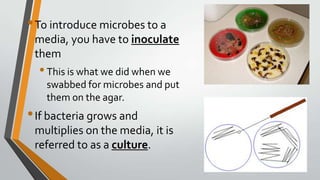
• To introduce microbes to a
media, you have to inoculate
them

• This is what we did when we
swabbed for microbes and put
them on the agar.

• If bacteria grows and
multiplies on the media, it is
referred to as a culture.
• A complex polysaccharide derived from a
marine algae is called agar.
Types of Media
• Chemically defined medium = the exact chemical
composition is known

• Complex media = a media that is made of
nutrients, chemical composition varies from plate to
plate; includes yeast, plant and meat extracts

• Nutrient broth or nutrient agar

• Reducing Media = anaerobic conditions and stored in
anaerobic jars to remove any oxygen
• Selective Media = Media used to
encourage growth of some organisms
while suppressing the growth of others

• Differential Media = Media used to
distinguish colonies of specific bacteria
from other organisms

• Enrichment Culture = media that mimics
environmental conditions that favor the
growth of a particular microbe but not
another
Obtaining Pure Cultures
• The most commonly used
method to get pure
cultures is the streak plate
method
Growth of Bacterial Cultures
• Bacterial cells divide by binary
fission, some by budding

• The time for a cell to divide is
called generation time

• 1-3 hours is typical for most
bacteria

• E.coli reproduces every 20
minutes!
Calculating Generation Time
(Initial # of cells )X (2 number of generations )= # of cells

• Example: A Taco Bell manager accidentally

inoculated 5 cells of E. coli into the burrito meat. How
many cells would there be after 4 hours if E.coli has a
generation time of 20 minutes.
Phases of Growth

• A bacterial growth
curve shows the
growth of cells over
time

• LAG PHASE
• EXPONENTIAL
PHASE

• STATIONARY PHASE
• DEATH PHASE
REVIEW CHAPTER 6 and
• Describe physical

• PAGE 185-186

• Review #’s: 2, 4, 10, 12
• Multiple Choice #’s: 8, 9

chemical requirements
for growth

• Label these test tubes
with the type of
oxygen-organism
GROUP TEACH
• Page 178-read first 2
paragraphs

• PLATE COUNTS-dilutions
• FILTRATION
• MPN
• DIRECT MICROSCOPE
COUNT

Each group tell me:

• Tell the method of measuring
cell growth

• Advantages/Disadvantages
• When is it used
• What is the process
• Picture or Diagram

Microbial Growth

  • 1.
    Chapter 6: MicrobialGrowth August 15, 2013
  • 2.
    Requirements for Growth •There are two ways to microbial growth can be divided • Physical • Chemical
  • 3.
    Physical Requirements • Temperature •Hyperthermophiles –some members of Archaea, “extreme thermophiles” • Psychrophile-cold loving microbes • Mesophile-moderate temperatures (most common) • Thermophile-heat loving microbes • Psychrotrophs-capable of growing between 0 and 30 degrees Celsius (refrigerator temperatures)
  • 4.
    • pH –the acidity or basicity of a solution • Most bacteria growth best at a pH between 6.5-7.5 • Neutral • Osmotic pressure • Microbes are 80-90% water • Adding solutes to solutions can reduce the presence of microbes (i.e. salt)
  • 5.
    Chemical Requirements • Carbon • • Carbonis the structural backbone of all living matter Organic compounds • Nitrogen, Sulfur, Phosphorus • • N2 and P required for synthesis of DNA and ATP N2 required for protein synthesis • Trace Elements • • • Needed for enzymatic functions Can be added to media to culture microbes Fe, Cu, Zn
  • 6.
    • Oxygen • ObligateAerobes- require O2 to live • Facultative Anaerobes – can use O2 to live if present, but doesn’t require it for growth • Obligate Anaerobes – do NOT require O2 to live, harmed by it • Aerotolerant Aerobes- can not use O2 for growth, but they can handle it. Not necessarily harmed by the presence of O2
  • 7.
  • 8.
    Page 166 inyour Textbook
  • 9.
    CULTURE MEDIA • Thereare many different mediums that microbes can grow in • Some require specific requirements, whereas others are more universal • Culture Medium: a nutrient material prepared for the growth of microorganisms in a laboratory
  • 10.
    • To introducemicrobes to a media, you have to inoculate them • This is what we did when we swabbed for microbes and put them on the agar. • If bacteria grows and multiplies on the media, it is referred to as a culture.
  • 11.
    • A complexpolysaccharide derived from a marine algae is called agar.
  • 12.
    Types of Media •Chemically defined medium = the exact chemical composition is known • Complex media = a media that is made of nutrients, chemical composition varies from plate to plate; includes yeast, plant and meat extracts • Nutrient broth or nutrient agar • Reducing Media = anaerobic conditions and stored in anaerobic jars to remove any oxygen
  • 13.
    • Selective Media= Media used to encourage growth of some organisms while suppressing the growth of others • Differential Media = Media used to distinguish colonies of specific bacteria from other organisms • Enrichment Culture = media that mimics environmental conditions that favor the growth of a particular microbe but not another
  • 14.
    Obtaining Pure Cultures •The most commonly used method to get pure cultures is the streak plate method
  • 15.
    Growth of BacterialCultures • Bacterial cells divide by binary fission, some by budding • The time for a cell to divide is called generation time • 1-3 hours is typical for most bacteria • E.coli reproduces every 20 minutes!
  • 16.
    Calculating Generation Time (Initial# of cells )X (2 number of generations )= # of cells • Example: A Taco Bell manager accidentally inoculated 5 cells of E. coli into the burrito meat. How many cells would there be after 4 hours if E.coli has a generation time of 20 minutes.
  • 17.
    Phases of Growth •A bacterial growth curve shows the growth of cells over time • LAG PHASE • EXPONENTIAL PHASE • STATIONARY PHASE • DEATH PHASE
  • 18.
    REVIEW CHAPTER 6and • Describe physical • PAGE 185-186 • Review #’s: 2, 4, 10, 12 • Multiple Choice #’s: 8, 9 chemical requirements for growth • Label these test tubes with the type of oxygen-organism
  • 19.
    GROUP TEACH • Page178-read first 2 paragraphs • PLATE COUNTS-dilutions • FILTRATION • MPN • DIRECT MICROSCOPE COUNT Each group tell me: • Tell the method of measuring cell growth • Advantages/Disadvantages • When is it used • What is the process • Picture or Diagram