ANIMAL VIRUSES
Animal viruses are self replicating,
intracellular parasites that completely
rely on host animal cell for
reproduction. They use the host's
cellular components to replicate, then
leaves the host cell to infect other
cells.
THE BALTIMORE CLASSIFICATION OF VIRUSES
Animal viruses are classified in the following 7 groups
according to relationship between virion, nucleic acid
& mRNA transcription :
Group1. ds DNA viruses
Group2. ss DNA viruses
Group3. ds RNA viruses
Group4. (+) sense ss RNA viruses
Group5. (-) sense ss RNA viruses
Group6. ss RNA reverse transcribing viruses
Group7. ds DNA reverse transcribing viruses
Group1. ds DNA viruses:the mRNA
is synthesized on a ds DNA genome
template.following are eg. Of some
viruses 1. adenoviruses
2.herpes virus
3. papovavirus
4. poxvirus
1. Adenoviruses
• virions are naked ,
non enveloped. 90-100
nm diameter & have
icosahedral symmetry.
•The penton fibers with
a globular head are
involved in the process
of attachment of the
virus to the host cell.
•Hexons consists of
protein II with a central
core, invoved in the
stabilization & assembly
of particles.
Diseases caused by adenoviruses are :
1. respiratory disease
2.conjunctival pneumonia
3.acute hemorrhagic cyctitis
4.acute gastroenteritis
2.Herpes virus
•The nucleocapsid is spherical
icosahedral &100 nm in
diameter , enclosed in
glycoprotein lipid envelop.
•Glycoprotein are visible as
“spikes” that are projected from
the surface.
•The nucleic acid is linear ds
DNA which is converted into a
circular DNA molecule upon
slight digestion .
•Disease caused by herpes virus
: herpes simplex I ( cold sores),
herpes simplex II (genital sores)
& varicellovirus (chicken pox.
Shingles) .
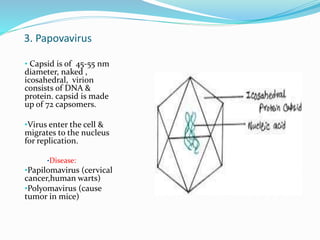
3. Papovavirus
• Capsid is of 45-55 nm
diameter, naked ,
icosahedral, virion
consists of DNA &
protein. capsid is made
up of 72 capsomers.
•Virus enter the cell &
migrates to the nucleus
for replication.
•Disease:
•Papilomavirus (cervical
cancer,human warts)
•Polyomavirus (cause
tumor in mice)
4. poxvirus
•Poxvirus are brick
shaped (240-
300nm),dsDNA genome
(130-260kb) & naturally
associated with enzyme
•Virions are enveloped .
Viral multiplication is
started by viral
transcriptase, the viral
components are
synthesized & assemble
in the cytoplasm of the
host cell.
•Pathogenesis:
•Human monkey pox
•Smallpox (variola virus)
Grpoup 2. ssDNA
virus: parvovirus
•Parvovirus are linear,
average genome size of
5000 nucleotide,
smallest virus with 18-
28 nm diameter.
•Viral capsid s made up
of 2-4 protein form
naked icosahedral
structure.
•Diseases:
•Human parvovirus B19
•Erythema infectiosum
•Joint disease syndrome
Group3. (+) ss RNA
virus:1. corona virus
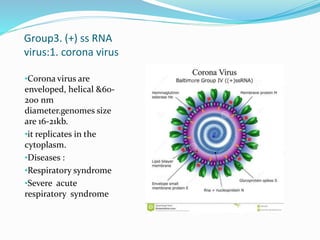
•Corona virus are
enveloped, helical &60-
200 nm
diameter.genomes size
are 16-21kb.
•it replicates in the
cytoplasm.
•Diseases :
•Respiratory syndrome
•Severe acute
respiratory syndrome
2.Picorna virus
Virions naked
,icosahedral. Capsid is
composed of 60 copies of
4 structiural protein .
Viral genome are linear
7.1-8.9 kb size
Diseases:
poliovirus (polio)
Rihinovirus( common
cold)
Hepatitis A virus
(hepatitis A)
3.Togavirus
•Envelop consists of 80
trimer spikes . The
spikes consists of
glycoprotein that help
in attachment protein
to receptor of host cell
membrane.
•Eg. Alpha virus
•Eastern equine
encephalitis virus
•Yellow fever virus
•Rubella virus
Group 4. (-) ssRNA
viruses
1.Rhabdovirus
Envelop with spikes
made up of gly coprotein
linked matrix protein
contain nucleocapsid
Eg. Mumps virus , rabies
virus
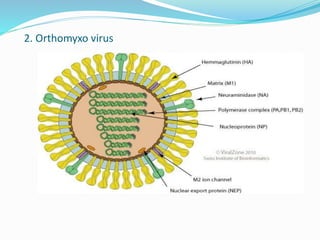
2. Orthomyxo virus
Group 5. ds RNA virus :eg. reovirus
Group6. ss RNA RT virus : eg.reterovirus
Group 7. ds DNA RT virus: eg Hepadna
virus.
Animal viruses

Animal viruses

  • 2.
    ANIMAL VIRUSES Animal virusesare self replicating, intracellular parasites that completely rely on host animal cell for reproduction. They use the host's cellular components to replicate, then leaves the host cell to infect other cells.
  • 3.
    THE BALTIMORE CLASSIFICATIONOF VIRUSES Animal viruses are classified in the following 7 groups according to relationship between virion, nucleic acid & mRNA transcription : Group1. ds DNA viruses Group2. ss DNA viruses Group3. ds RNA viruses Group4. (+) sense ss RNA viruses Group5. (-) sense ss RNA viruses Group6. ss RNA reverse transcribing viruses Group7. ds DNA reverse transcribing viruses
  • 4.
    Group1. ds DNAviruses:the mRNA is synthesized on a ds DNA genome template.following are eg. Of some viruses 1. adenoviruses 2.herpes virus 3. papovavirus 4. poxvirus
  • 5.
    1. Adenoviruses • virionsare naked , non enveloped. 90-100 nm diameter & have icosahedral symmetry. •The penton fibers with a globular head are involved in the process of attachment of the virus to the host cell. •Hexons consists of protein II with a central core, invoved in the stabilization & assembly of particles.
  • 6.
    Diseases caused byadenoviruses are : 1. respiratory disease 2.conjunctival pneumonia 3.acute hemorrhagic cyctitis 4.acute gastroenteritis
  • 7.
    2.Herpes virus •The nucleocapsidis spherical icosahedral &100 nm in diameter , enclosed in glycoprotein lipid envelop. •Glycoprotein are visible as “spikes” that are projected from the surface. •The nucleic acid is linear ds DNA which is converted into a circular DNA molecule upon slight digestion . •Disease caused by herpes virus : herpes simplex I ( cold sores), herpes simplex II (genital sores) & varicellovirus (chicken pox. Shingles) .
  • 8.
    3. Papovavirus • Capsidis of 45-55 nm diameter, naked , icosahedral, virion consists of DNA & protein. capsid is made up of 72 capsomers. •Virus enter the cell & migrates to the nucleus for replication. •Disease: •Papilomavirus (cervical cancer,human warts) •Polyomavirus (cause tumor in mice)
  • 9.
    4. poxvirus •Poxvirus arebrick shaped (240- 300nm),dsDNA genome (130-260kb) & naturally associated with enzyme •Virions are enveloped . Viral multiplication is started by viral transcriptase, the viral components are synthesized & assemble in the cytoplasm of the host cell. •Pathogenesis: •Human monkey pox •Smallpox (variola virus)
  • 10.
    Grpoup 2. ssDNA virus:parvovirus •Parvovirus are linear, average genome size of 5000 nucleotide, smallest virus with 18- 28 nm diameter. •Viral capsid s made up of 2-4 protein form naked icosahedral structure. •Diseases: •Human parvovirus B19 •Erythema infectiosum •Joint disease syndrome
  • 11.
    Group3. (+) ssRNA virus:1. corona virus •Corona virus are enveloped, helical &60- 200 nm diameter.genomes size are 16-21kb. •it replicates in the cytoplasm. •Diseases : •Respiratory syndrome •Severe acute respiratory syndrome
  • 12.
    2.Picorna virus Virions naked ,icosahedral.Capsid is composed of 60 copies of 4 structiural protein . Viral genome are linear 7.1-8.9 kb size Diseases: poliovirus (polio) Rihinovirus( common cold) Hepatitis A virus (hepatitis A)
  • 13.
    3.Togavirus •Envelop consists of80 trimer spikes . The spikes consists of glycoprotein that help in attachment protein to receptor of host cell membrane. •Eg. Alpha virus •Eastern equine encephalitis virus •Yellow fever virus •Rubella virus
  • 14.
    Group 4. (-)ssRNA viruses 1.Rhabdovirus Envelop with spikes made up of gly coprotein linked matrix protein contain nucleocapsid Eg. Mumps virus , rabies virus
  • 15.
  • 16.
    Group 5. dsRNA virus :eg. reovirus Group6. ss RNA RT virus : eg.reterovirus Group 7. ds DNA RT virus: eg Hepadna virus.