Chapter 13
                                             Viruses, Viroids,
                                                and Prions


Copyright © 2010 Pearson Education, Inc.
                                           Lectures prepared by Christine L. Case
Q&A

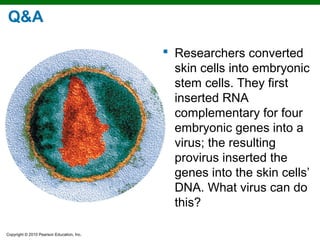
                                            Researchers converted
                                             skin cells into embryonic
                                             stem cells. They first
                                             inserted RNA
                                             complementary for four
                                             embryonic genes into a
                                             virus; the resulting
                                             provirus inserted the
                                             genes into the skin cells’
                                             DNA. What virus can do
                                             this?

Copyright © 2010 Pearson Education, Inc.
General Characteristics of Viruses

Learning Objective
13-1 Differentiate a virus from a bacterium.


Copyright © 2010 Pearson Education, Inc.
General Characteristics of Viruses

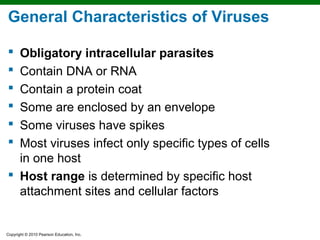
 Obligatory intracellular parasites
 Contain DNA or RNA
 Contain a protein coat
 Some are enclosed by an envelope
 Some viruses have spikes
 Most viruses infect only specific types of cells
  in one host
 Host range is determined by specific host
  attachment sites and cellular factors


Copyright © 2010 Pearson Education, Inc.
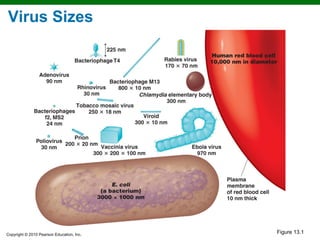
Virus Sizes


Copyright © 2010 Pearson Education, Inc.
                                           Figure 13.1
Check Your Understanding
 How could the small size of viruses have helped
  researchers detect viruses before the invention of
  the electron microscope? 13-1


Copyright © 2010 Pearson Education, Inc.
Viral Structure

Learning Objective
13-2 Describe the chemical and physical structure of
     both an enveloped and a nonenveloped virus.


Copyright © 2010 Pearson Education, Inc.
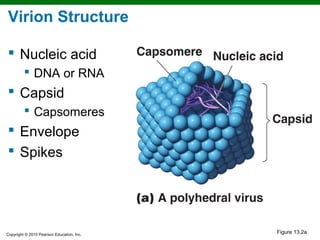
Virion Structure

 Nucleic acid
          DNA or RNA
 Capsid
          Capsomeres
 Envelope
 Spikes


Copyright © 2010 Pearson Education, Inc.
                                           Figure 13.2a
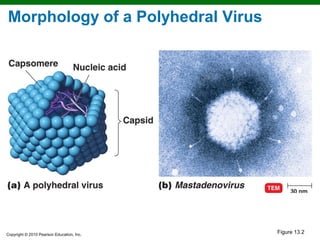
Morphology of a Polyhedral Virus


Copyright © 2010 Pearson Education, Inc.
                                           Figure 13.2
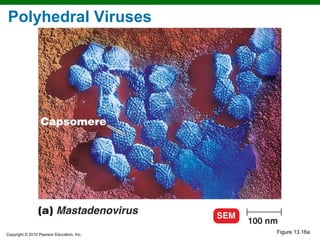
Polyhedral Viruses


Copyright © 2010 Pearson Education, Inc.
                                           Figure 13.16a
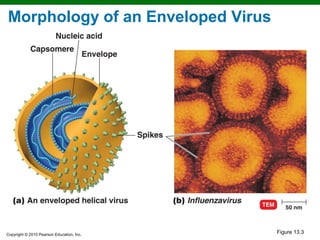
Morphology of an Enveloped Virus


Copyright © 2010 Pearson Education, Inc.
                                           Figure 13.3
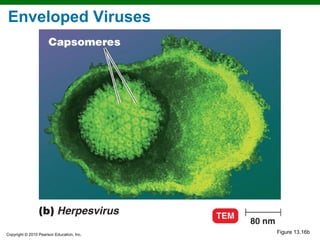
Enveloped Viruses


Copyright © 2010 Pearson Education, Inc.
                                           Figure 13.16b
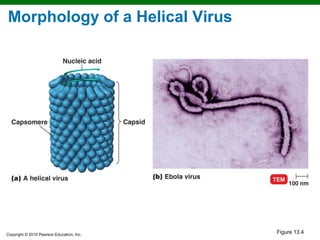
Morphology of a Helical Virus


Copyright © 2010 Pearson Education, Inc.
                                           Figure 13.4
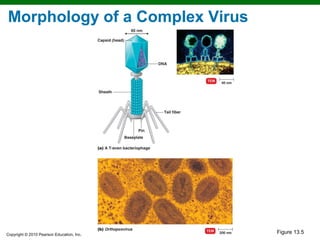
Morphology of a Complex Virus


Copyright © 2010 Pearson Education, Inc.
                                           Figure 13.5
Check Your Understanding
 Diagram a nonenveloped polyhedral virus that has
  spikes. 13-2


Copyright © 2010 Pearson Education, Inc.
Taxonomy of Viruses

Learning Objectives
13-3 Define viral species.
13-4 Give an example of a family, genus, and
     common name for a virus.


Copyright © 2010 Pearson Education, Inc.
Taxonomy of Viruses

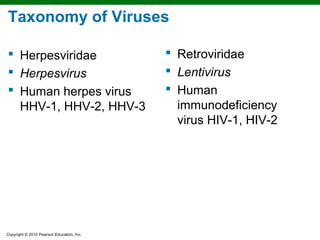
 Family names end in -viridae.

 Genus names end in -virus.
 Viral species: A group of viruses sharing the same
  genetic information and ecological niche (host).
  Common names are used for species.
 Subspecies are designated by a number.


Copyright © 2010 Pearson Education, Inc.
Taxonomy of Viruses

 Herpesviridae                             Retroviridae
 Herpesvirus                               Lentivirus
 Human herpes virus                        Human
  HHV-1, HHV-2, HHV-3                        immunodeficiency
                                             virus HIV-1, HIV-2


Copyright © 2010 Pearson Education, Inc.
Check Your Understanding
 How does a virus species differ from a bacterial
  species? 13-3
 Attach the proper endings to Papilloma- to show the
  family and genus that includes HPV, the cause of
  cervical cancer. 13-4


Copyright © 2010 Pearson Education, Inc.
Isolation, Cultivation, and Identification

Learning Objectives
13-5 Describe how bacteriophages are cultured.
13-6 Describe how animal viruses are cultured.
13-7 List three techniques used to identify viruses.


Copyright © 2010 Pearson Education, Inc.
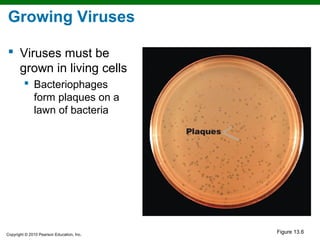
Growing Viruses

 Viruses must be
  grown in living cells
          Bacteriophages
           form plaques on a
           lawn of bacteria


Copyright © 2010 Pearson Education, Inc.
                                           Figure 13.6
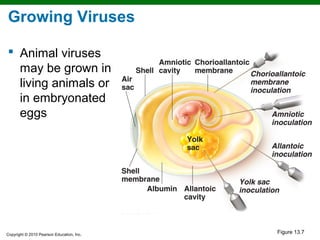
Growing Viruses

 Animal viruses
  may be grown in
  living animals or
  in embryonated
  eggs


Copyright © 2010 Pearson Education, Inc.
                                           Figure 13.7
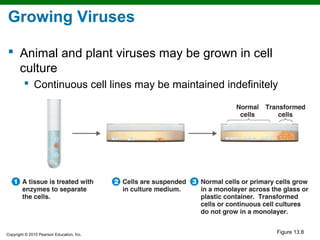
Growing Viruses

 Animal and plant viruses may be grown in cell
  culture
          Continuous cell lines may be maintained indefinitely


Copyright © 2010 Pearson Education, Inc.
                                                              Figure 13.8
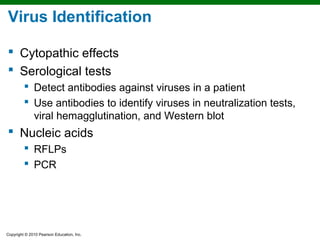
Virus Identification

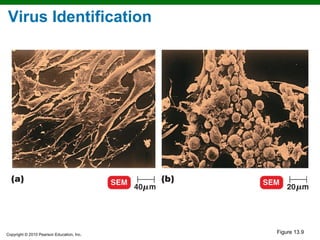
 Cytopathic effects
 Serological tests
          Detect antibodies against viruses in a patient
          Use antibodies to identify viruses in neutralization tests,
           viral hemagglutination, and Western blot
 Nucleic acids
          RFLPs
          PCR


Copyright © 2010 Pearson Education, Inc.
Virus Identification


Copyright © 2010 Pearson Education, Inc.
                                           Figure 13.9
Check Your Understanding
 What is the plaque method? 13-5
 Why are continuous cell lines of more practical use than
  primary cell lines for culturing viruses? 13-6
 What tests could you use to identify influenza virus in a
  patient? 13-7


Copyright © 2010 Pearson Education, Inc.
Viral Multiplication

Learning Objectives
13-8 Describe the lytic cycle of T-even
     bacteriophages.
13-9 Describe the lysogenic cycle of
     bacteriophage lambda.


Copyright © 2010 Pearson Education, Inc.
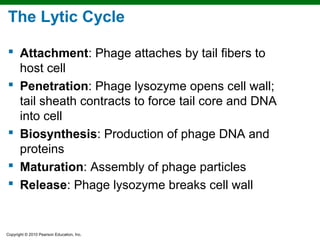
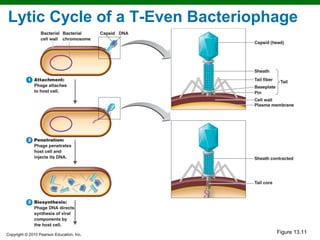
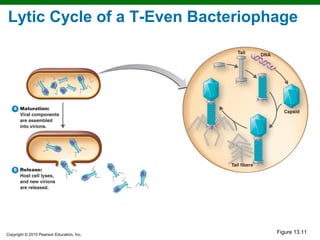
The Lytic Cycle

 Attachment: Phage attaches by tail fibers to
  host cell
 Penetration: Phage lysozyme opens cell wall;
  tail sheath contracts to force tail core and DNA
  into cell
 Biosynthesis: Production of phage DNA and
  proteins
 Maturation: Assembly of phage particles
 Release: Phage lysozyme breaks cell wall


Copyright © 2010 Pearson Education, Inc.
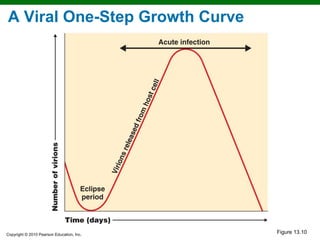
A Viral One-Step Growth Curve


Copyright © 2010 Pearson Education, Inc.
                                           Figure 13.10
Lytic Cycle of a T-Even Bacteriophage


  1


   2


   3


Copyright © 2010 Pearson Education, Inc.
                                           Figure 13.11
Lytic Cycle of a T-Even Bacteriophage


 4


Copyright © 2010 Pearson Education, Inc.
                                           Figure 13.11
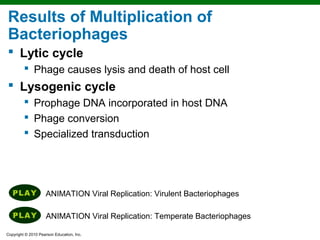
Results of Multiplication of
Bacteriophages
 Lytic cycle
          Phage causes lysis and death of host cell
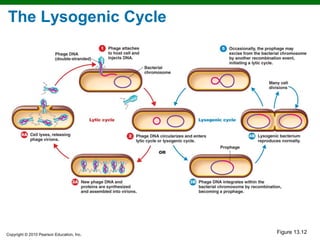
 Lysogenic cycle
          Prophage DNA incorporated in host DNA
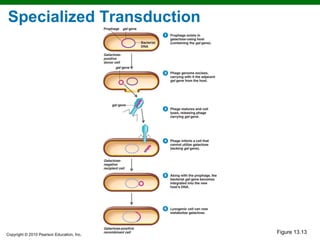
          Phage conversion
          Specialized transduction


                    ANIMATION Viral Replication: Virulent Bacteriophages

                     ANIMATION Viral Replication: Temperate Bacteriophages

Copyright © 2010 Pearson Education, Inc.
The Lysogenic Cycle


Copyright © 2010 Pearson Education, Inc.
                                           Figure 13.12
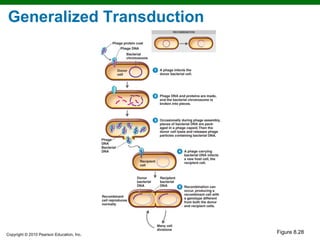
Generalized Transduction


                                           2


                                           3


                                           4


                                           5


                                           6


Copyright © 2010 Pearson Education, Inc.
                                               Figure 8.28
Specialized Transduction


Copyright © 2010 Pearson Education, Inc.
                                           Figure 13.13
Specialized Transduction


                                                 2


                                                 3


                                                 4


                                                 5

                    ANIMATION Transduction: Generalized Transduction

                                                 6
                     ANIMATION Transduction: Specialized Transduction

Copyright © 2010 Pearson Education, Inc.
Check Your Understanding
 How do bacteriophages get nucleotides and
  amino acids if they don’t have any metabolic
  enzymes? 13-8
 Vibrio cholerae produces toxin and is capable of
  causing cholera only when it is lysogenic. What
  does this mean? 13-9


Copyright © 2010 Pearson Education, Inc.
Viral Multiplication

Learning Objective
13-10 Compare and contrast the multiplication cycle
      of DNA- and RNA-containing animal viruses.


Copyright © 2010 Pearson Education, Inc.
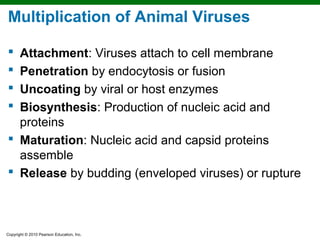
Multiplication of Animal Viruses

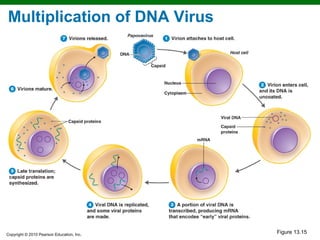
 Attachment: Viruses attach to cell membrane
 Penetration by endocytosis or fusion
 Uncoating by viral or host enzymes
 Biosynthesis: Production of nucleic acid and
  proteins
 Maturation: Nucleic acid and capsid proteins
  assemble
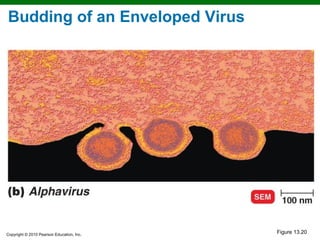
 Release by budding (enveloped viruses) or rupture


Copyright © 2010 Pearson Education, Inc.
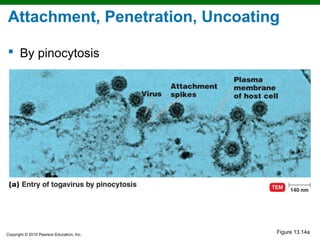
Attachment, Penetration, Uncoating

 By pinocytosis


Copyright © 2010 Pearson Education, Inc.
                                           Figure 13.14a
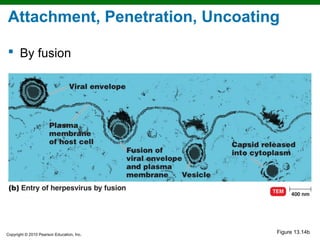
Attachment, Penetration, Uncoating

 By fusion


Copyright © 2010 Pearson Education, Inc.
                                           Figure 13.14b
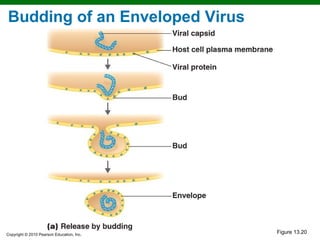
Budding of an Enveloped Virus


Copyright © 2010 Pearson Education, Inc.
                                           Figure 13.20
Budding of an Enveloped Virus


Copyright © 2010 Pearson Education, Inc.
                                           Figure 13.20
Multiplication of DNA Virus


Copyright © 2010 Pearson Education, Inc.
                                           Figure 13.15
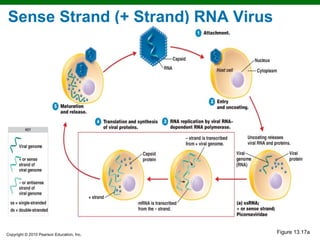
Sense Strand (+ Strand) RNA Virus


Copyright © 2010 Pearson Education, Inc.
                                           Figure 13.17a
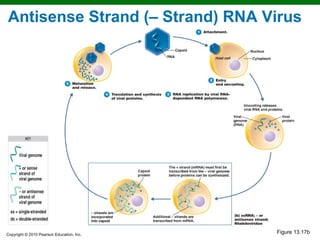
Antisense Strand (– Strand) RNA Virus


Copyright © 2010 Pearson Education, Inc.
                                           Figure 13.17b
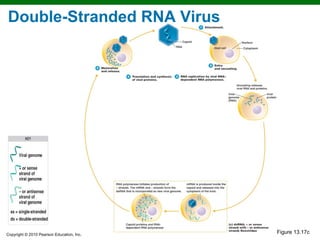
Double-Stranded RNA Virus


Copyright © 2010 Pearson Education, Inc.
                                           Figure 13.17c
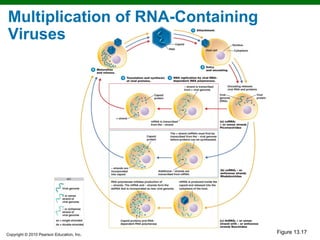
Multiplication of RNA-Containing
Viruses


Copyright © 2010 Pearson Education, Inc.
                                           Figure 13.17
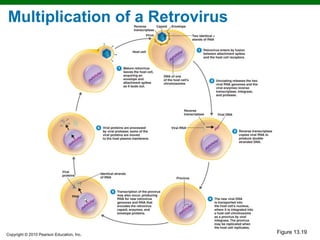
Multiplication of a Retrovirus


Copyright © 2010 Pearson Education, Inc.
                                           Figure 13.19
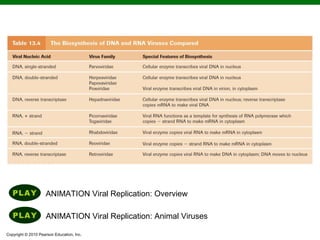
ANIMATION Viral Replication: Overview

                     ANIMATION Viral Replication: Animal Viruses

Copyright © 2010 Pearson Education, Inc.
Check Your Understanding
 Describe the principal events of attachment, entry,
  uncoating, biosynthesis, maturation, and release of
  an enveloped DNA-containing virus. 13-10


Copyright © 2010 Pearson Education, Inc.
Viruses and Cancer

Learning Objectives
13-11 Define oncogene and transformed cell.
13-12 Discuss the relationship between DNA- and
      RNA-containing viruses and cancer.


Copyright © 2010 Pearson Education, Inc.
Cancer

 Activated oncogenes transform normal cells into
  cancerous cells
 Transformed cells have increased growth, loss of
  contact inhibition, tumor-specific transplant
  antigens, and T antigens
 The genetic material of oncogenic viruses becomes
  integrated into the host cell's DNA


Copyright © 2010 Pearson Education, Inc.
Oncogenic Viruses

 Oncogenic DNA                             Oncogenic RNA
  viruses                                    viruses
    Adenoviridae                              Retroviridae
    Herpesviridae                             Viral RNA is
    Poxviridae                                 transcribed to DNA,
    Papovaviridae                              which can integrate
                                                into host DNA
    Hepadnaviridae
                                               HTLV-1
                                               HTLV-2


Copyright © 2010 Pearson Education, Inc.
Check Your Understanding
 What is a provirus? 13-11
 How can an RNA virus cause cancer if it doesn’t
  have DNA to insert into a cell’s genome? 13-12


Copyright © 2010 Pearson Education, Inc.
Latent and Persistent Viral Infections

Learning Objectives
13-13 Provide an example of a latent viral infection.
13-14 Differentiate persistent viral infections from
      latent viral infections.


Copyright © 2010 Pearson Education, Inc.
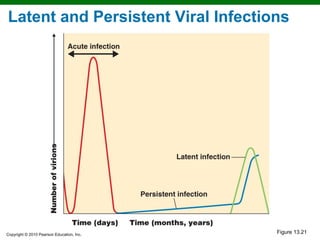
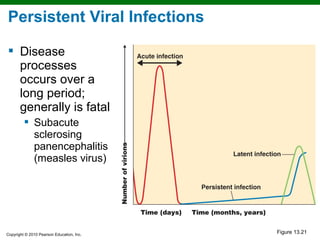
Latent and Persistent Viral Infections


Copyright © 2010 Pearson Education, Inc.
                                           Figure 13.21
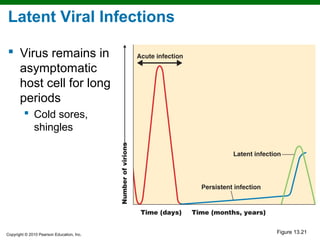
Latent Viral Infections

 Virus remains in
  asymptomatic
  host cell for long
  periods
          Cold sores,
           shingles


Copyright © 2010 Pearson Education, Inc.
                                           Figure 13.21
Persistent Viral Infections

 Disease
  processes
  occurs over a
  long period;
  generally is fatal
          Subacute
           sclerosing
           panencephalitis
           (measles virus)


Copyright © 2010 Pearson Education, Inc.
                                           Figure 13.21
Check Your Understanding
 Is shingles a persistent or latent infection?
  13-13, 13-14


Copyright © 2010 Pearson Education, Inc.
Prions, Viroids, and Plant Viruses

Learning Objectives
13-15 Discuss how a protein can be infectious.
13-16 Differentiate virus, viroid, and prion.
13-17 Describe the lytic cycle for a plant virus.


Copyright © 2010 Pearson Education, Inc.
Prions

 Proteinaceous Infectious particle
 Inherited and transmissible by ingestion, transplant,
  and surgical instruments
          Spongiform encephalopathies: Sheep scrapie, Creutzfeldt-
           Jakob disease, Gerstmann-Sträussler-Scheinker
           syndrome, fatal familial insomnia, mad cow disease


Copyright © 2010 Pearson Education, Inc.
Prions

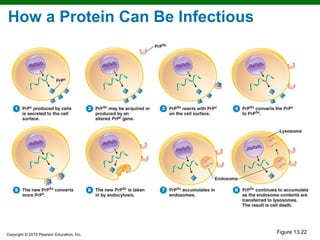
 PrPC: Normal cellular prion protein, on cell surface
 PrPSc: Scrapie protein; accumulates in brain cells,
  forming plaques


                    ANIMATION Prion: Overview

                    ANIMATION Prion: Characteristics

                     ANIMATION Prion: Diseases

Copyright © 2010 Pearson Education, Inc.
How a Protein Can Be Infectious


Copyright © 2010 Pearson Education, Inc.
                                           Figure 13.22
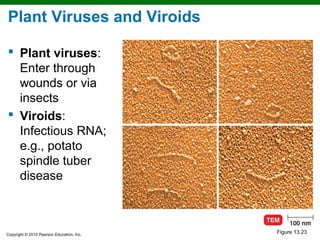
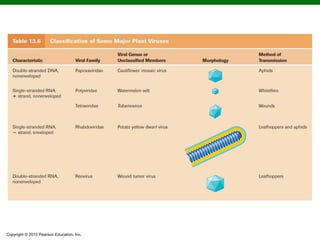
Plant Viruses and Viroids

 Plant viruses:
  Enter through
  wounds or via
  insects
 Viroids:
  Infectious RNA;
  e.g., potato
  spindle tuber
  disease


Copyright © 2010 Pearson Education, Inc.
                                           Figure 13.23
Copyright © 2010 Pearson Education, Inc.
Check Your Understanding
 Contrast viroids and prions, and for each name a
  disease it causes. 13-15, 13-16
 How do plant viruses enter host cells? 13-17


Copyright © 2010 Pearson Education, Inc.
Virus Families That Affect Humans

Learning Objective
13-10 Compare and contrast the multiplication cycle of
      DNA and RNA containing animal viruses.


Copyright © 2010 Pearson Education, Inc.
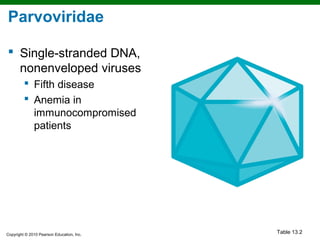
Parvoviridae

 Single-stranded DNA,
  nonenveloped viruses
          Fifth disease
          Anemia in
           immunocompromised
           patients


Copyright © 2010 Pearson Education, Inc.
                                           Table 13.2
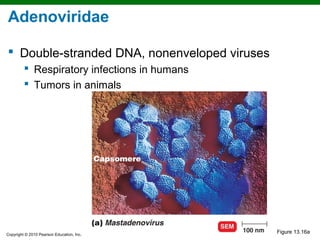
Adenoviridae

 Double-stranded DNA, nonenveloped viruses
          Respiratory infections in humans
          Tumors in animals


Copyright © 2010 Pearson Education, Inc.
                                              Figure 13.16a
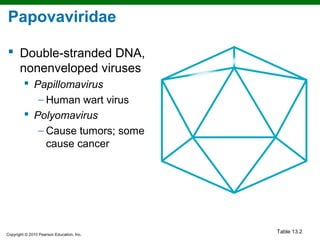
Papovaviridae

 Double-stranded DNA,
  nonenveloped viruses
          Papillomavirus
            − Human wart virus
          Polyomavirus
            − Cause tumors; some
              cause cancer


Copyright © 2010 Pearson Education, Inc.
                                           Table 13.2
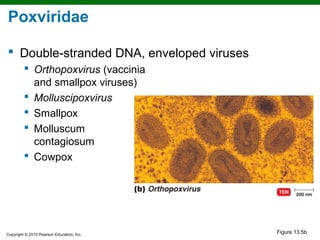
Poxviridae

 Double-stranded DNA, enveloped viruses
          Orthopoxvirus (vaccinia
           and smallpox viruses)
          Molluscipoxvirus
          Smallpox
          Molluscum
           contagiosum
          Cowpox


Copyright © 2010 Pearson Education, Inc.
                                           Figure 13.5b
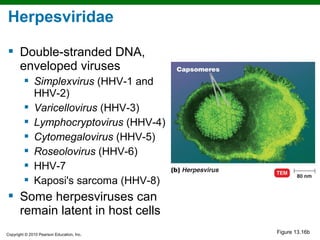
Herpesviridae

 Double-stranded DNA,
  enveloped viruses
          Simplexvirus (HHV-1 and
           HHV-2)
          Varicellovirus (HHV-3)
          Lymphocryptovirus (HHV-4)
          Cytomegalovirus (HHV-5)
          Roseolovirus (HHV-6)
          HHV-7
          Kaposi's sarcoma (HHV-8)
 Some herpesviruses can
  remain latent in host cells
Copyright © 2010 Pearson Education, Inc.
                                           Figure 13.16b
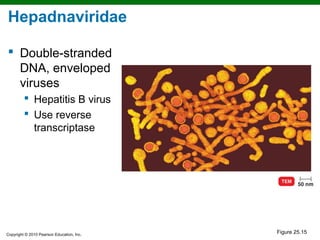
Hepadnaviridae

 Double-stranded
  DNA, enveloped
  viruses
          Hepatitis B virus
          Use reverse
           transcriptase


Copyright © 2010 Pearson Education, Inc.
                                           Figure 25.15
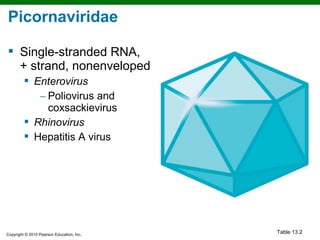
Picornaviridae

 Single-stranded RNA,
  + strand, nonenveloped
          Enterovirus
            − Poliovirus and
              coxsackievirus
          Rhinovirus
          Hepatitis A virus


Copyright © 2010 Pearson Education, Inc.
                                           Table 13.2
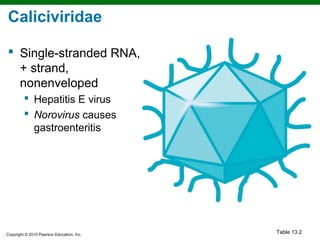
Caliciviridae

 Single-stranded RNA,
  + strand,
  nonenveloped
          Hepatitis E virus
          Norovirus causes
           gastroenteritis


Copyright © 2010 Pearson Education, Inc.
                                           Table 13.2
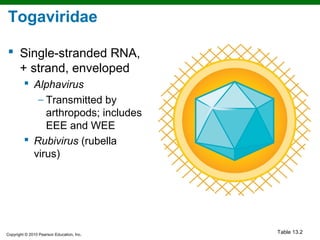
Togaviridae

 Single-stranded RNA,
  + strand, enveloped
          Alphavirus
            − Transmitted by
              arthropods; includes
              EEE and WEE
          Rubivirus (rubella
           virus)


Copyright © 2010 Pearson Education, Inc.
                                           Table 13.2
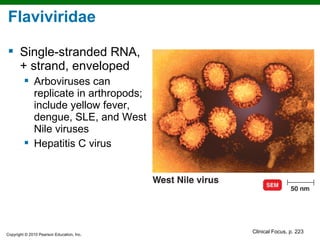
Flaviviridae

 Single-stranded RNA,
  + strand, enveloped
          Arboviruses can
           replicate in arthropods;
           include yellow fever,
           dengue, SLE, and West
           Nile viruses
          Hepatitis C virus


Copyright © 2010 Pearson Education, Inc.
                                           Clinical Focus, p. 223
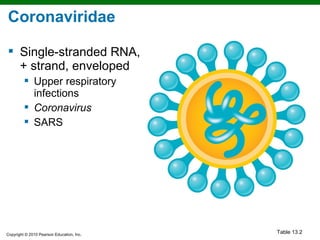
Coronaviridae

 Single-stranded RNA,
  + strand, enveloped
          Upper respiratory
           infections
          Coronavirus
          SARS


Copyright © 2010 Pearson Education, Inc.
                                           Table 13.2
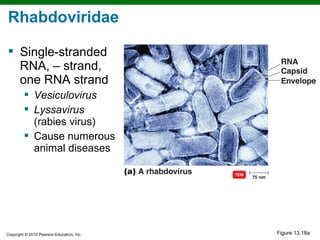
Rhabdoviridae

 Single-stranded
  RNA, – strand,
  one RNA strand
          Vesiculovirus
          Lyssavirus
           (rabies virus)
          Cause numerous
           animal diseases


Copyright © 2010 Pearson Education, Inc.   Figure 13.18a
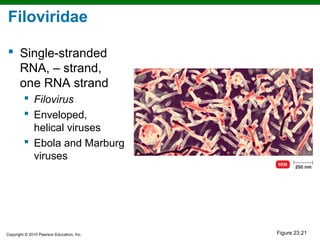
Filoviridae

 Single-stranded
  RNA, – strand,
  one RNA strand
          Filovirus
          Enveloped,
           helical viruses
          Ebola and Marburg
           viruses


Copyright © 2010 Pearson Education, Inc.   Figure 23.21
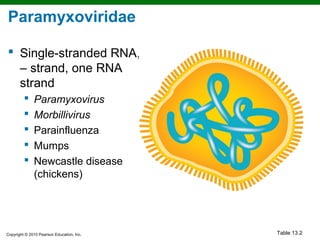
Paramyxoviridae

 Single-stranded RNA,
  – strand, one RNA
  strand
             Paramyxovirus
             Morbillivirus
             Parainfluenza
             Mumps
             Newcastle disease
              (chickens)


Copyright © 2010 Pearson Education, Inc.   Table 13.2
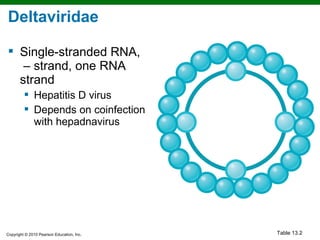
Deltaviridae

 Single-stranded RNA,
   – strand, one RNA
  strand
          Hepatitis D virus
          Depends on coinfection
           with hepadnavirus


Copyright © 2010 Pearson Education, Inc.   Table 13.2
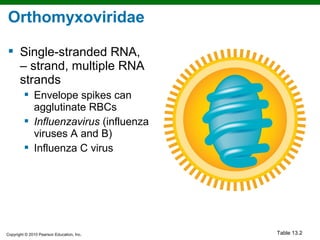
Orthomyxoviridae

 Single-stranded RNA,
  – strand, multiple RNA
  strands
          Envelope spikes can
           agglutinate RBCs
          Influenzavirus (influenza
           viruses A and B)
          Influenza C virus


Copyright © 2010 Pearson Education, Inc.   Table 13.2
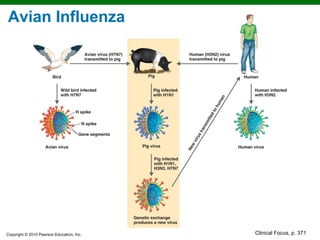
Avian Influenza


Copyright © 2010 Pearson Education, Inc.   Clinical Focus, p. 371
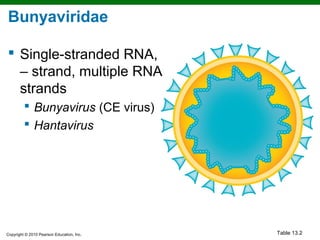
Bunyaviridae

 Single-stranded RNA,
  – strand, multiple RNA
  strands
          Bunyavirus (CE virus)
          Hantavirus


Copyright © 2010 Pearson Education, Inc.   Table 13.2
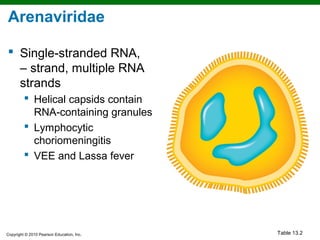
Arenaviridae

 Single-stranded RNA,
  – strand, multiple RNA
  strands
          Helical capsids contain
           RNA-containing granules
          Lymphocytic
           choriomeningitis
          VEE and Lassa fever


Copyright © 2010 Pearson Education, Inc.   Table 13.2
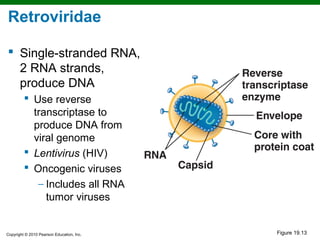
Retroviridae

 Single-stranded RNA,
  2 RNA strands,
  produce DNA
          Use reverse
           transcriptase to
           produce DNA from
           viral genome
          Lentivirus (HIV)
          Oncogenic viruses
            − Includes all RNA
              tumor viruses


Copyright © 2010 Pearson Education, Inc.   Figure 19.13
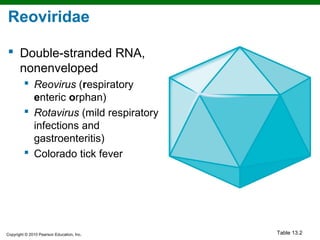
Reoviridae

 Double-stranded RNA,
  nonenveloped
          Reovirus (respiratory
           enteric orphan)
          Rotavirus (mild respiratory
           infections and
           gastroenteritis)
          Colorado tick fever


Copyright © 2010 Pearson Education, Inc.   Table 13.2
Q&A

                                            Researchers converted
                                             skin cells into
                                             embryonic stem cells.
                                             They first inserted RNA
                                             complementary for four
                                             embryonic genes into a
                                             virus; the resulting
                                             provirus inserted the
                                             genes into the skin
                                             cells’ DNA. What virus
                                             can do this?


Copyright © 2010 Pearson Education, Inc.

Viruses, Viroids, and Prions

  • 1.
    Chapter 13 Viruses, Viroids, and Prions Copyright © 2010 Pearson Education, Inc. Lectures prepared by Christine L. Case
  • 2.
    Q&A  Researchers converted skin cells into embryonic stem cells. They first inserted RNA complementary for four embryonic genes into a virus; the resulting provirus inserted the genes into the skin cells’ DNA. What virus can do this? Copyright © 2010 Pearson Education, Inc.
  • 3.
    General Characteristics ofViruses Learning Objective 13-1 Differentiate a virus from a bacterium. Copyright © 2010 Pearson Education, Inc.
  • 4.
    General Characteristics ofViruses  Obligatory intracellular parasites  Contain DNA or RNA  Contain a protein coat  Some are enclosed by an envelope  Some viruses have spikes  Most viruses infect only specific types of cells in one host  Host range is determined by specific host attachment sites and cellular factors Copyright © 2010 Pearson Education, Inc.
  • 5.
    Virus Sizes Copyright ©2010 Pearson Education, Inc. Figure 13.1
  • 6.
    Check Your Understanding How could the small size of viruses have helped researchers detect viruses before the invention of the electron microscope? 13-1 Copyright © 2010 Pearson Education, Inc.
  • 7.
    Viral Structure Learning Objective 13-2Describe the chemical and physical structure of both an enveloped and a nonenveloped virus. Copyright © 2010 Pearson Education, Inc.
  • 8.
    Virion Structure  Nucleicacid  DNA or RNA  Capsid  Capsomeres  Envelope  Spikes Copyright © 2010 Pearson Education, Inc. Figure 13.2a
  • 9.
    Morphology of aPolyhedral Virus Copyright © 2010 Pearson Education, Inc. Figure 13.2
  • 10.
    Polyhedral Viruses Copyright ©2010 Pearson Education, Inc. Figure 13.16a
  • 11.
    Morphology of anEnveloped Virus Copyright © 2010 Pearson Education, Inc. Figure 13.3
  • 12.
    Enveloped Viruses Copyright ©2010 Pearson Education, Inc. Figure 13.16b
  • 13.
    Morphology of aHelical Virus Copyright © 2010 Pearson Education, Inc. Figure 13.4
  • 14.
    Morphology of aComplex Virus Copyright © 2010 Pearson Education, Inc. Figure 13.5
  • 15.
    Check Your Understanding Diagram a nonenveloped polyhedral virus that has spikes. 13-2 Copyright © 2010 Pearson Education, Inc.
  • 16.
    Taxonomy of Viruses LearningObjectives 13-3 Define viral species. 13-4 Give an example of a family, genus, and common name for a virus. Copyright © 2010 Pearson Education, Inc.
  • 17.
    Taxonomy of Viruses Family names end in -viridae.  Genus names end in -virus.  Viral species: A group of viruses sharing the same genetic information and ecological niche (host). Common names are used for species.  Subspecies are designated by a number. Copyright © 2010 Pearson Education, Inc.
  • 18.
    Taxonomy of Viruses Herpesviridae  Retroviridae  Herpesvirus  Lentivirus  Human herpes virus  Human HHV-1, HHV-2, HHV-3 immunodeficiency virus HIV-1, HIV-2 Copyright © 2010 Pearson Education, Inc.
  • 19.
    Check Your Understanding How does a virus species differ from a bacterial species? 13-3  Attach the proper endings to Papilloma- to show the family and genus that includes HPV, the cause of cervical cancer. 13-4 Copyright © 2010 Pearson Education, Inc.
  • 20.
    Isolation, Cultivation, andIdentification Learning Objectives 13-5 Describe how bacteriophages are cultured. 13-6 Describe how animal viruses are cultured. 13-7 List three techniques used to identify viruses. Copyright © 2010 Pearson Education, Inc.
  • 21.
    Growing Viruses  Virusesmust be grown in living cells  Bacteriophages form plaques on a lawn of bacteria Copyright © 2010 Pearson Education, Inc. Figure 13.6
  • 22.
    Growing Viruses  Animalviruses may be grown in living animals or in embryonated eggs Copyright © 2010 Pearson Education, Inc. Figure 13.7
  • 23.
    Growing Viruses  Animaland plant viruses may be grown in cell culture  Continuous cell lines may be maintained indefinitely Copyright © 2010 Pearson Education, Inc. Figure 13.8
  • 24.
    Virus Identification  Cytopathiceffects  Serological tests  Detect antibodies against viruses in a patient  Use antibodies to identify viruses in neutralization tests, viral hemagglutination, and Western blot  Nucleic acids  RFLPs  PCR Copyright © 2010 Pearson Education, Inc.
  • 25.
    Virus Identification Copyright ©2010 Pearson Education, Inc. Figure 13.9
  • 26.
    Check Your Understanding What is the plaque method? 13-5  Why are continuous cell lines of more practical use than primary cell lines for culturing viruses? 13-6  What tests could you use to identify influenza virus in a patient? 13-7 Copyright © 2010 Pearson Education, Inc.
  • 27.
    Viral Multiplication Learning Objectives 13-8Describe the lytic cycle of T-even bacteriophages. 13-9 Describe the lysogenic cycle of bacteriophage lambda. Copyright © 2010 Pearson Education, Inc.
  • 28.
    The Lytic Cycle Attachment: Phage attaches by tail fibers to host cell  Penetration: Phage lysozyme opens cell wall; tail sheath contracts to force tail core and DNA into cell  Biosynthesis: Production of phage DNA and proteins  Maturation: Assembly of phage particles  Release: Phage lysozyme breaks cell wall Copyright © 2010 Pearson Education, Inc.
  • 29.
    A Viral One-StepGrowth Curve Copyright © 2010 Pearson Education, Inc. Figure 13.10
  • 30.
    Lytic Cycle ofa T-Even Bacteriophage 1 2 3 Copyright © 2010 Pearson Education, Inc. Figure 13.11
  • 31.
    Lytic Cycle ofa T-Even Bacteriophage 4 Copyright © 2010 Pearson Education, Inc. Figure 13.11
  • 32.
    Results of Multiplicationof Bacteriophages  Lytic cycle  Phage causes lysis and death of host cell  Lysogenic cycle  Prophage DNA incorporated in host DNA  Phage conversion  Specialized transduction ANIMATION Viral Replication: Virulent Bacteriophages ANIMATION Viral Replication: Temperate Bacteriophages Copyright © 2010 Pearson Education, Inc.
  • 33.
    The Lysogenic Cycle Copyright© 2010 Pearson Education, Inc. Figure 13.12
  • 34.
    Generalized Transduction 2 3 4 5 6 Copyright © 2010 Pearson Education, Inc. Figure 8.28
  • 35.
    Specialized Transduction Copyright ©2010 Pearson Education, Inc. Figure 13.13
  • 36.
    Specialized Transduction 2 3 4 5 ANIMATION Transduction: Generalized Transduction 6 ANIMATION Transduction: Specialized Transduction Copyright © 2010 Pearson Education, Inc.
  • 37.
    Check Your Understanding How do bacteriophages get nucleotides and amino acids if they don’t have any metabolic enzymes? 13-8  Vibrio cholerae produces toxin and is capable of causing cholera only when it is lysogenic. What does this mean? 13-9 Copyright © 2010 Pearson Education, Inc.
  • 38.
    Viral Multiplication Learning Objective 13-10Compare and contrast the multiplication cycle of DNA- and RNA-containing animal viruses. Copyright © 2010 Pearson Education, Inc.
  • 39.
    Multiplication of AnimalViruses  Attachment: Viruses attach to cell membrane  Penetration by endocytosis or fusion  Uncoating by viral or host enzymes  Biosynthesis: Production of nucleic acid and proteins  Maturation: Nucleic acid and capsid proteins assemble  Release by budding (enveloped viruses) or rupture Copyright © 2010 Pearson Education, Inc.
  • 40.
    Attachment, Penetration, Uncoating By pinocytosis Copyright © 2010 Pearson Education, Inc. Figure 13.14a
  • 41.
    Attachment, Penetration, Uncoating By fusion Copyright © 2010 Pearson Education, Inc. Figure 13.14b
  • 42.
    Budding of anEnveloped Virus Copyright © 2010 Pearson Education, Inc. Figure 13.20
  • 43.
    Budding of anEnveloped Virus Copyright © 2010 Pearson Education, Inc. Figure 13.20
  • 44.
    Multiplication of DNAVirus Copyright © 2010 Pearson Education, Inc. Figure 13.15
  • 45.
    Sense Strand (+Strand) RNA Virus Copyright © 2010 Pearson Education, Inc. Figure 13.17a
  • 46.
    Antisense Strand (–Strand) RNA Virus Copyright © 2010 Pearson Education, Inc. Figure 13.17b
  • 47.
    Double-Stranded RNA Virus Copyright© 2010 Pearson Education, Inc. Figure 13.17c
  • 48.
    Multiplication of RNA-Containing Viruses Copyright© 2010 Pearson Education, Inc. Figure 13.17
  • 49.
    Multiplication of aRetrovirus Copyright © 2010 Pearson Education, Inc. Figure 13.19
  • 50.
    ANIMATION Viral Replication:Overview ANIMATION Viral Replication: Animal Viruses Copyright © 2010 Pearson Education, Inc.
  • 51.
    Check Your Understanding Describe the principal events of attachment, entry, uncoating, biosynthesis, maturation, and release of an enveloped DNA-containing virus. 13-10 Copyright © 2010 Pearson Education, Inc.
  • 52.
    Viruses and Cancer LearningObjectives 13-11 Define oncogene and transformed cell. 13-12 Discuss the relationship between DNA- and RNA-containing viruses and cancer. Copyright © 2010 Pearson Education, Inc.
  • 53.
    Cancer  Activated oncogenestransform normal cells into cancerous cells  Transformed cells have increased growth, loss of contact inhibition, tumor-specific transplant antigens, and T antigens  The genetic material of oncogenic viruses becomes integrated into the host cell's DNA Copyright © 2010 Pearson Education, Inc.
  • 54.
    Oncogenic Viruses  OncogenicDNA  Oncogenic RNA viruses viruses  Adenoviridae  Retroviridae  Herpesviridae  Viral RNA is  Poxviridae transcribed to DNA,  Papovaviridae which can integrate into host DNA  Hepadnaviridae  HTLV-1  HTLV-2 Copyright © 2010 Pearson Education, Inc.
  • 55.
    Check Your Understanding What is a provirus? 13-11  How can an RNA virus cause cancer if it doesn’t have DNA to insert into a cell’s genome? 13-12 Copyright © 2010 Pearson Education, Inc.
  • 56.
    Latent and PersistentViral Infections Learning Objectives 13-13 Provide an example of a latent viral infection. 13-14 Differentiate persistent viral infections from latent viral infections. Copyright © 2010 Pearson Education, Inc.
  • 57.
    Latent and PersistentViral Infections Copyright © 2010 Pearson Education, Inc. Figure 13.21
  • 58.
    Latent Viral Infections Virus remains in asymptomatic host cell for long periods  Cold sores, shingles Copyright © 2010 Pearson Education, Inc. Figure 13.21
  • 59.
    Persistent Viral Infections Disease processes occurs over a long period; generally is fatal  Subacute sclerosing panencephalitis (measles virus) Copyright © 2010 Pearson Education, Inc. Figure 13.21
  • 60.
    Check Your Understanding Is shingles a persistent or latent infection? 13-13, 13-14 Copyright © 2010 Pearson Education, Inc.
  • 61.
    Prions, Viroids, andPlant Viruses Learning Objectives 13-15 Discuss how a protein can be infectious. 13-16 Differentiate virus, viroid, and prion. 13-17 Describe the lytic cycle for a plant virus. Copyright © 2010 Pearson Education, Inc.
  • 62.
    Prions  Proteinaceous Infectiousparticle  Inherited and transmissible by ingestion, transplant, and surgical instruments  Spongiform encephalopathies: Sheep scrapie, Creutzfeldt- Jakob disease, Gerstmann-Sträussler-Scheinker syndrome, fatal familial insomnia, mad cow disease Copyright © 2010 Pearson Education, Inc.
  • 63.
    Prions  PrPC: Normalcellular prion protein, on cell surface  PrPSc: Scrapie protein; accumulates in brain cells, forming plaques ANIMATION Prion: Overview ANIMATION Prion: Characteristics ANIMATION Prion: Diseases Copyright © 2010 Pearson Education, Inc.
  • 64.
    How a ProteinCan Be Infectious Copyright © 2010 Pearson Education, Inc. Figure 13.22
  • 65.
    Plant Viruses andViroids  Plant viruses: Enter through wounds or via insects  Viroids: Infectious RNA; e.g., potato spindle tuber disease Copyright © 2010 Pearson Education, Inc. Figure 13.23
  • 66.
    Copyright © 2010Pearson Education, Inc.
  • 67.
    Check Your Understanding Contrast viroids and prions, and for each name a disease it causes. 13-15, 13-16  How do plant viruses enter host cells? 13-17 Copyright © 2010 Pearson Education, Inc.
  • 68.
    Virus Families ThatAffect Humans Learning Objective 13-10 Compare and contrast the multiplication cycle of DNA and RNA containing animal viruses. Copyright © 2010 Pearson Education, Inc.
  • 69.
    Parvoviridae  Single-stranded DNA, nonenveloped viruses  Fifth disease  Anemia in immunocompromised patients Copyright © 2010 Pearson Education, Inc. Table 13.2
  • 70.
    Adenoviridae  Double-stranded DNA,nonenveloped viruses  Respiratory infections in humans  Tumors in animals Copyright © 2010 Pearson Education, Inc. Figure 13.16a
  • 71.
    Papovaviridae  Double-stranded DNA, nonenveloped viruses  Papillomavirus − Human wart virus  Polyomavirus − Cause tumors; some cause cancer Copyright © 2010 Pearson Education, Inc. Table 13.2
  • 72.
    Poxviridae  Double-stranded DNA,enveloped viruses  Orthopoxvirus (vaccinia and smallpox viruses)  Molluscipoxvirus  Smallpox  Molluscum contagiosum  Cowpox Copyright © 2010 Pearson Education, Inc. Figure 13.5b
  • 73.
    Herpesviridae  Double-stranded DNA, enveloped viruses  Simplexvirus (HHV-1 and HHV-2)  Varicellovirus (HHV-3)  Lymphocryptovirus (HHV-4)  Cytomegalovirus (HHV-5)  Roseolovirus (HHV-6)  HHV-7  Kaposi's sarcoma (HHV-8)  Some herpesviruses can remain latent in host cells Copyright © 2010 Pearson Education, Inc. Figure 13.16b
  • 74.
    Hepadnaviridae  Double-stranded DNA, enveloped viruses  Hepatitis B virus  Use reverse transcriptase Copyright © 2010 Pearson Education, Inc. Figure 25.15
  • 75.
    Picornaviridae  Single-stranded RNA, + strand, nonenveloped  Enterovirus − Poliovirus and coxsackievirus  Rhinovirus  Hepatitis A virus Copyright © 2010 Pearson Education, Inc. Table 13.2
  • 76.
    Caliciviridae  Single-stranded RNA, + strand, nonenveloped  Hepatitis E virus  Norovirus causes gastroenteritis Copyright © 2010 Pearson Education, Inc. Table 13.2
  • 77.
    Togaviridae  Single-stranded RNA, + strand, enveloped  Alphavirus − Transmitted by arthropods; includes EEE and WEE  Rubivirus (rubella virus) Copyright © 2010 Pearson Education, Inc. Table 13.2
  • 78.
    Flaviviridae  Single-stranded RNA, + strand, enveloped  Arboviruses can replicate in arthropods; include yellow fever, dengue, SLE, and West Nile viruses  Hepatitis C virus Copyright © 2010 Pearson Education, Inc. Clinical Focus, p. 223
  • 79.
    Coronaviridae  Single-stranded RNA, + strand, enveloped  Upper respiratory infections  Coronavirus  SARS Copyright © 2010 Pearson Education, Inc. Table 13.2
  • 80.
    Rhabdoviridae  Single-stranded RNA, – strand, one RNA strand  Vesiculovirus  Lyssavirus (rabies virus)  Cause numerous animal diseases Copyright © 2010 Pearson Education, Inc. Figure 13.18a
  • 81.
    Filoviridae  Single-stranded RNA, – strand, one RNA strand  Filovirus  Enveloped, helical viruses  Ebola and Marburg viruses Copyright © 2010 Pearson Education, Inc. Figure 23.21
  • 82.
    Paramyxoviridae  Single-stranded RNA, – strand, one RNA strand  Paramyxovirus  Morbillivirus  Parainfluenza  Mumps  Newcastle disease (chickens) Copyright © 2010 Pearson Education, Inc. Table 13.2
  • 83.
    Deltaviridae  Single-stranded RNA, – strand, one RNA strand  Hepatitis D virus  Depends on coinfection with hepadnavirus Copyright © 2010 Pearson Education, Inc. Table 13.2
  • 84.
    Orthomyxoviridae  Single-stranded RNA, – strand, multiple RNA strands  Envelope spikes can agglutinate RBCs  Influenzavirus (influenza viruses A and B)  Influenza C virus Copyright © 2010 Pearson Education, Inc. Table 13.2
  • 85.
    Avian Influenza Copyright ©2010 Pearson Education, Inc. Clinical Focus, p. 371
  • 86.
    Bunyaviridae  Single-stranded RNA, – strand, multiple RNA strands  Bunyavirus (CE virus)  Hantavirus Copyright © 2010 Pearson Education, Inc. Table 13.2
  • 87.
    Arenaviridae  Single-stranded RNA, – strand, multiple RNA strands  Helical capsids contain RNA-containing granules  Lymphocytic choriomeningitis  VEE and Lassa fever Copyright © 2010 Pearson Education, Inc. Table 13.2
  • 88.
    Retroviridae  Single-stranded RNA, 2 RNA strands, produce DNA  Use reverse transcriptase to produce DNA from viral genome  Lentivirus (HIV)  Oncogenic viruses − Includes all RNA tumor viruses Copyright © 2010 Pearson Education, Inc. Figure 19.13
  • 89.
    Reoviridae  Double-stranded RNA, nonenveloped  Reovirus (respiratory enteric orphan)  Rotavirus (mild respiratory infections and gastroenteritis)  Colorado tick fever Copyright © 2010 Pearson Education, Inc. Table 13.2
  • 90.
    Q&A  Researchers converted skin cells into embryonic stem cells. They first inserted RNA complementary for four embryonic genes into a virus; the resulting provirus inserted the genes into the skin cells’ DNA. What virus can do this? Copyright © 2010 Pearson Education, Inc.