Overview of
Business Continuity Planning
Chris Greenhill
Greenhill Consulting Limited
What is a Business Continuity Plan?
• A plan which provides for the continuation of
critical business processes in the event of significant
business interruption or disaster
– Identify key processes and assets
– Minimise impact of their loss
– Effective back up and recovery strategies to mitigate the
impact of disruptive events
– A formal process to be followed if disaster occurs
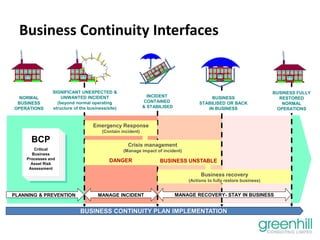
BUSINESS
STABILISED OR BACK
IN BUSINESS
NORMAL
BUSINESS
OPERATIONS
SIGNIFICANT UNEXPECTED &
UNWANTED INCIDENT
(beyond normal operating
structure of the business/site)
BUSINESS CONTINUITY PLAN IMPLEMENTATION
MANAGE INCIDENT MANAGE RECOVERY- STAY IN BUSINESSPLANNING & PREVENTION
Business Continuity Interfaces
BUSINESS FULLY
RESTORED
NORMAL
OPERATIONS
INCIDENT
CONTAINED
& STABILISED
Crisis management
(Manage impact of incident)
Emergency Response
(Contain incident)
Business recovery
(Actions to fully restore business)
DANGER BUSINESS UNSTABLEBCPBCPBCP
BCP
Critical
Business
Processes and
Asset Risk
Assessment
What is a business process?
• Any set of activities performed by a business that is
initiated by an event, transforms information,
materials or business commitments, and produces
an output
• A series of interrelated activities which convert
inputs into results (outputs)
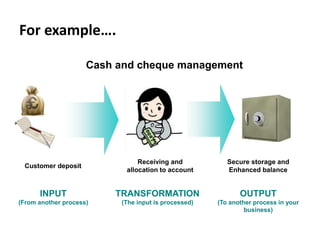
For example….
Receiving and
allocation to account
Cash and cheque management
Customer deposit
TRANSFORMATION
(The input is processed)
OUTPUT
(To another process in your
business)
INPUT
(From another process)
Secure storage and
Enhanced balance
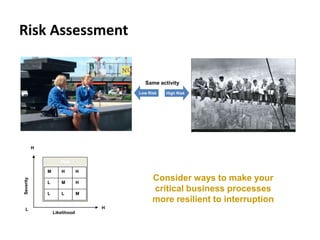
Risk Assessment
Consider ways to make your
critical business processes
more resilient to interruption
Risk
M H H
L M H
L L M
Severity
Likelihood
H
HL
Same activity
High RiskLow Risk
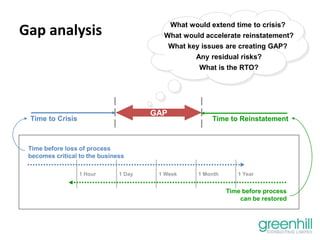
1 Hour 1 Day 1 Month 1 Year1 Week
Gap analysis What would extend time to crisis?
What would accelerate reinstatement?
What key issues are creating GAP?
Any residual risks?
What is the RTO?
Time before loss of process
becomes critical to the business
Time before process
can be restored
GAP
Time to Crisis Time to Reinstatement
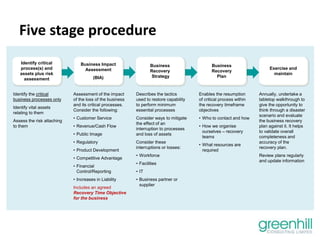
Identify critical
process(s) and
assets plus risk
assessment
Business Impact
Assessment
(BIA)
Business
Recovery
Strategy
Business
Recovery
Plan
Exercise and
maintain
Five stage procedure
Enables the resumption
of critical process within
the recovery timeframe
objectives
• Who to contact and how
• How we organise
ourselves – recovery
teams
• What resources are
required
Describes the tactics
used to restore capability
to perform minimum
essential processes
Consider ways to mitigate
the effect of an
interruption to processes
and loss of assets
Consider these
interruptions or losses:
• Workforce
• Facilities
• IT
• Business partner or
supplier
Assessment of the impact
of the loss of the business
and its critical processes.
Consider the following:
• Customer Service
• Revenue/Cash Flow
• Public Image
• Regulatory
• Product Development
• Competitive Advantage
• Financial
Control/Reporting
• Increases in Liability
Includes an agreed
Recovery Time Objective
for the business
Identify the critical
business processes only
Identify vital assets
relating to them
Assess the risk attaching
to them
Annually, undertake a
tabletop walkthrough to
give the opportunity to
think through a disaster
scenario and evaluate
the business recovery
plan against it. It helps
to validate overall
completeness and
accuracy of the
recovery plan.
Review plans regularly
and update information
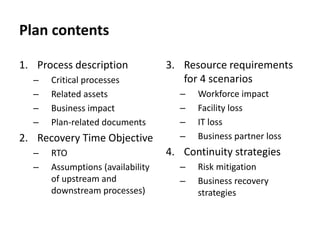
Plan contents
1. Process description
– Critical processes
– Related assets
– Business impact
– Plan-related documents
2. Recovery Time Objective
– RTO
– Assumptions (availability
of upstream and
downstream processes)
3. Resource requirements
for 4 scenarios
– Workforce impact
– Facility loss
– IT loss
– Business partner loss
4. Continuity strategies
– Risk mitigation
– Business recovery
strategies
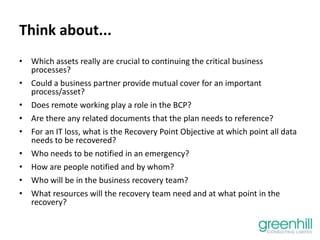
Think about...
• Which assets really are crucial to continuing the critical business
processes?
• Could a business partner provide mutual cover for an important
process/asset?
• Does remote working play a role in the BCP?
• Are there any related documents that the plan needs to reference?
• For an IT loss, what is the Recovery Point Objective at which point all data
needs to be recovered?
• Who needs to be notified in an emergency?
• How are people notified and by whom?
• Who will be in the business recovery team?
• What resources will the recovery team need and at what point in the
recovery?

Business continuity overview slideshare

  • 1.
    Overview of Business ContinuityPlanning Chris Greenhill Greenhill Consulting Limited
  • 2.
    What is aBusiness Continuity Plan? • A plan which provides for the continuation of critical business processes in the event of significant business interruption or disaster – Identify key processes and assets – Minimise impact of their loss – Effective back up and recovery strategies to mitigate the impact of disruptive events – A formal process to be followed if disaster occurs
  • 3.
    BUSINESS STABILISED OR BACK INBUSINESS NORMAL BUSINESS OPERATIONS SIGNIFICANT UNEXPECTED & UNWANTED INCIDENT (beyond normal operating structure of the business/site) BUSINESS CONTINUITY PLAN IMPLEMENTATION MANAGE INCIDENT MANAGE RECOVERY- STAY IN BUSINESSPLANNING & PREVENTION Business Continuity Interfaces BUSINESS FULLY RESTORED NORMAL OPERATIONS INCIDENT CONTAINED & STABILISED Crisis management (Manage impact of incident) Emergency Response (Contain incident) Business recovery (Actions to fully restore business) DANGER BUSINESS UNSTABLEBCPBCPBCP BCP Critical Business Processes and Asset Risk Assessment
  • 4.
    What is abusiness process? • Any set of activities performed by a business that is initiated by an event, transforms information, materials or business commitments, and produces an output • A series of interrelated activities which convert inputs into results (outputs)
  • 5.
    For example…. Receiving and allocationto account Cash and cheque management Customer deposit TRANSFORMATION (The input is processed) OUTPUT (To another process in your business) INPUT (From another process) Secure storage and Enhanced balance
  • 6.
    Risk Assessment Consider waysto make your critical business processes more resilient to interruption Risk M H H L M H L L M Severity Likelihood H HL Same activity High RiskLow Risk
  • 7.
    1 Hour 1Day 1 Month 1 Year1 Week Gap analysis What would extend time to crisis? What would accelerate reinstatement? What key issues are creating GAP? Any residual risks? What is the RTO? Time before loss of process becomes critical to the business Time before process can be restored GAP Time to Crisis Time to Reinstatement
  • 8.
    Identify critical process(s) and assetsplus risk assessment Business Impact Assessment (BIA) Business Recovery Strategy Business Recovery Plan Exercise and maintain Five stage procedure Enables the resumption of critical process within the recovery timeframe objectives • Who to contact and how • How we organise ourselves – recovery teams • What resources are required Describes the tactics used to restore capability to perform minimum essential processes Consider ways to mitigate the effect of an interruption to processes and loss of assets Consider these interruptions or losses: • Workforce • Facilities • IT • Business partner or supplier Assessment of the impact of the loss of the business and its critical processes. Consider the following: • Customer Service • Revenue/Cash Flow • Public Image • Regulatory • Product Development • Competitive Advantage • Financial Control/Reporting • Increases in Liability Includes an agreed Recovery Time Objective for the business Identify the critical business processes only Identify vital assets relating to them Assess the risk attaching to them Annually, undertake a tabletop walkthrough to give the opportunity to think through a disaster scenario and evaluate the business recovery plan against it. It helps to validate overall completeness and accuracy of the recovery plan. Review plans regularly and update information
  • 9.
    Plan contents 1. Processdescription – Critical processes – Related assets – Business impact – Plan-related documents 2. Recovery Time Objective – RTO – Assumptions (availability of upstream and downstream processes) 3. Resource requirements for 4 scenarios – Workforce impact – Facility loss – IT loss – Business partner loss 4. Continuity strategies – Risk mitigation – Business recovery strategies
  • 10.
    Think about... • Whichassets really are crucial to continuing the critical business processes? • Could a business partner provide mutual cover for an important process/asset? • Does remote working play a role in the BCP? • Are there any related documents that the plan needs to reference? • For an IT loss, what is the Recovery Point Objective at which point all data needs to be recovered? • Who needs to be notified in an emergency? • How are people notified and by whom? • Who will be in the business recovery team? • What resources will the recovery team need and at what point in the recovery?