E-commerce
2013
Kenneth C. Laudon
Carol Guercio Traver
business. technology. society.
ninth edition
Copyright © 2013 Pearson Education, Inc.
Copyright © 2013 Pearson
Education, Inc.
Chapter 11
Social Networks, Auctions, and Portals
Copyright © 2013 Pearson Education, Inc.
Class Discussion
Social Network Fever
Spreads to the Professions
●How has the growth of social networks enabled the
creation of more specific niche sites?
●What are some examples of social network sites with
a financial or business focus?
●Describe some common features and activities on
these social network sites.
●What features of social networks best explain their
popularity?
Copyright © 2013 Pearson Education, Inc. Slide 11-*
Copyright © 2013 Pearson
Education, Inc.
Social Networks and Online
Communities
●Internet began as communications medium for
scientists
●Early communities were bulletin boards,
newsgroups; e.g., the Well
●Today social networks, photo/video sharing,
blogs have created new era of online socializing
●Social networks now one of most common
Internet activities
Copyright © 2013 Pearson Education, Inc. Slide 11-*
Copyright © 2013 Pearson
Education, Inc.
What Is an Online Social Network?
●Working definition
●Group of people
●Shared social interaction
●Common ties
●Sharing an area for period of time
●Portals and social networks:
●Moving closer together
●Community sites adding portal-like services
●Searching, news, e-commerce services
Copyright © 2013 Pearson Education, Inc. Slide 11-*
Copyright © 2013 Pearson
Education, Inc.
The Growth of Social Networks and
Online Communities
●Top 10 social networks account for over 90% social
networking activity
●Facebook users: Over 50% are 35+
●Unique audience size:
●Top four U.S. social networks: Over 260 million
●Top four portal/search engines: Over 630 million
●Annual advertising revenue
●U.S. social network sites: $3.1 billion
●Top four portal/search engines: $17.5 billion
Copyright © 2013 Pearson Education, Inc. Slide 11-*
Copyright © 2013 Pearson
Education, Inc.
Top 10 Social Network Sites 2012
Figure 11.1, Page 7
Copyright © 2013 Pearson Education, Inc. Slide 11-*
SOURCES: Based on data comScore, 2012a; Gaudin, 2012; McGee, 2012.
Copyright © 2013 Pearson
Education, Inc.
Turning Social Networks
into Businesses
●Social networks monetizing audiences through
advertising
●Business use of social networks
●Marketing and branding tool
●Facebook pages, “fans”
●Twitter feeds
●Listening tool
●Monitoring online reputation
●Extension of CRMS
Copyright © 2013 Pearson Education, Inc. Slide 11-*
Copyright © 2013 Pearson
Education, Inc.
Insight on Society: Class Discussion
The Dark Side of Social Networks
●How can businesses accurately judge whether
negative comments are trolling or have merit
and should be responded to?
●Have you ever left a negative comment about
a product or business? Have others’ negative
comments influenced a purchase?
●Should a business have any say in how an
employee uses social networks outside of the
office?
Copyright © 2013 Pearson Education, Inc. Slide 11-*
Copyright © 2013 Pearson
Education, Inc.
Types of Social Networks
and their Business Models
●General communities:
●Offer opportunities to interact with general audience
organized into general topics
●Advertising supported by selling ad space on pages and
videos
●Practice networks:
●Offer focused discussion groups, help, and knowledge
related to area of shared practice
●May be profit or nonprofit; rely on advertising or user
donations
Copyright © 2013 Pearson Education, Inc. Slide 11-*
Copyright © 2013 Pearson
Education, Inc.
Types of Social Networks
and Their Business Models (cont.)
●Interest-based social networks:
●Offer focused discussion groups based on shared interest in some
specific subject
●Usually advertising supported
●Affinity communities:
●Offer focused discussion and interaction with other people who share
same affinity (self or group identification)
●Advertising and revenues from sales of products
●Sponsored communities:
●Created by government, nonprofit, or for-profit organizations for
purpose of pursuing organizational goals
Copyright © 2013 Pearson Education, Inc. Slide 11-*
Copyright © 2013 Pearson
Education, Inc.
Social Network Features
and Technologies
●Profiles
●Friends network
●Network discovery
●Favorites
●Games, widgets, apps
●E-mail
●Storage
Copyright © 2013 Pearson Education, Inc.
●Instant messaging
●Message boards
●Online polling
●Chat
●Discussion groups
●Experts online
●Membership
management tools
Slide 11-*
Copyright © 2013 Pearson
Education, Inc.
The Future of Social Networks
●Facebook’s growth has slowed
●Growth of social networks focused on
specific shared interests
●Network fatigue
●Reuter study shows Facebook users spending
less time on the site
●Financial future
●Relationship between sales and Likes unclear
Copyright © 2013 Pearson Education, Inc. Slide 11-*
Copyright © 2013 Pearson
Education, Inc.
Insight on Technology: Class Discussion
Facebook Has Friends
●What does Mark Zuckerberg, Facebook’s CEO, mean
by the “social graph?”
●Why have Facebook applications become so popular?
Do they have any limitations?
●What are the core differences between Google+ and
Facebook? Does Google+ offer significant advantages?
●How has Microsoft responded?
●Is Tumblr a significant competitor? Why or why not?
Copyright © 2013 Pearson Education, Inc. Slide 11-*
Copyright © 2013 Pearson
Education, Inc.
Online Auctions
●Online auction sites are among the most
popular C2C sites on the Internet
●eBay: Market leader
●Several hundred different auction sites in
United States alone
●Established portals and online retail sites
increasingly are adding auctions to their sites
Copyright © 2013 Pearson Education, Inc. Slide 11-*
Copyright © 2013 Pearson
Education, Inc.
Defining and Measuring the Growth
of Auctions and Dynamic Pricing
●Dynamic pricing
●Airline tickets, coupons, college scholarships
●Prices based on demand characteristics of customer and
supply situation of seller
●Many types of dynamic pricing
●Bundling
●Trigger pricing
●Utilization pricing
●Personalization pricing
Copyright © 2013 Pearson Education, Inc. Slide 11-*
Copyright © 2013 Pearson
Education, Inc.
Defining and Measuring the Growth
of Auctions and Dynamic Pricing (cont.)
●Auctions: Type of dynamic pricing
●C2C auctions
●Auction house an intermediary
●B2C auctions
●Business owns assets; often used for excess goods
●Can be used to
●Sell goods and services
●Allocate resources
●Allocate and bundle resources
Copyright © 2013 Pearson Education, Inc. Slide 11-*
Copyright © 2013 Pearson
Education, Inc.
Benefits of Auctions
●Liquidity
●Price discovery
●Price transparency
●Market efficiency
●Lower transaction costs
●Consumer aggregation
●Network effects
Copyright © 2013 Pearson Education, Inc. Slide 11-*
Copyright © 2013 Pearson
Education, Inc.
Risks and Costs of Auctions for
Consumers and Businesses
●Delayed consumption costs
●Monitoring costs
●Possible solutions include:
●Fixed pricing
●Watch lists
●Proxy bidding
●Equipment costs
●Trust risks
●Possible solution—rating systems
●Fulfillment costs
Copyright © 2013 Pearson Education, Inc. Slide 11-*
Copyright © 2013 Pearson
Education, Inc.
Market-Maker Benefits
●No inventory
●No fulfillment activities
●No warehouses, shipping, or logistical facilities
●eBay makes money from every stage in
auction cycle
●Transaction fees
●Listing fees
●Financial services fees
●Advertising or placement fees
Copyright © 2013 Pearson Education, Inc. Slide 11-*
Copyright © 2013 Pearson
Education, Inc.
Internet Auction Basics
●Different from traditional auctions
●Last much longer (usually a week)
●Variable number of bidders who come and go from
auction arena
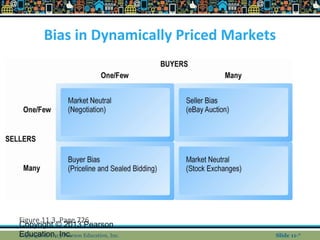
●Market power and bias in dynamically priced
markets
●Neutral: Number of buyers and sellers is few or equal
●Seller bias: Few sellers and many buyers
●Buyer bias: Many sellers and few buyers
●Fair market value
Copyright © 2013 Pearson Education, Inc. Slide 11-*
Copyright © 2013 Pearson
Education, Inc.
Internet Auction Basics (cont.)
●Price Allocation Rules
●Uniform pricing rule: Multiple winners who all
pay the same price
●Discriminatory pricing rule: Winners pay
different amount depending on what they bid
●Public vs. private information
●Prices bid may be kept secret
●Bid rigging
●Open markets
●Price matching
Copyright © 2013 Pearson Education, Inc. Slide 11-*
Copyright © 2013 Pearson
Education, Inc.
Bias in Dynamically Priced Markets
Figure 11.3, Page 726
Copyright © 2013 Pearson Education, Inc. Slide 11-*
Copyright © 2013 Pearson
Education, Inc.
Types of Auctions
●English auctions:
●Single item up for sale to single seller
●Highest bidder wins
●Traditional Dutch auction:
●Uses a clock that displays starting price
●Clock ticks down price until buyer stops it
●Dutch Internet auction:
●Public ascending price, multiple units
●Final price is lowest successful bid, which sets price for
all higher bidders
Copyright © 2013 Pearson Education, Inc. Slide 11-*
Copyright © 2013 Pearson
Education, Inc.
Types of Auctions (cont.)
●Name Your Own Price Auctions
●Users specify what they are willing to pay for
goods or services and multiple providers bid for
their business
●Prices do not descend and are fixed
●Consumer offer is commitment to buy at that price
●e.g., Priceline
●Enables sellers to unload unsold excess capacity
Copyright © 2013 Pearson Education, Inc. Slide 11-*
Copyright © 2013 Pearson
Education, Inc.
Types of Auctions (cont.)
●Group buying auctions (demand aggregators)
●Group buying of products at dynamically adjusted
discount prices based on high volume purchases
●Two principles
●Sellers more likely to offer discounts to buyers purchasing in
volume
●Buyers increase their purchases as prices fall
●Professional service auctions
●e.g., Elance.com
Copyright © 2013 Pearson Education, Inc. Slide 11-*
Copyright © 2013 Pearson
Education, Inc.
Factors to Consider When Choosing Auctions
Table 11.8, p 732
Copyright © 2013 Pearson Education, Inc. Slide 11-*
CONSIDERATIONS DESCRIPTION
Type of product Rare, unique, commodity, perishable
Stage of product life cycle Early, mature, late
Channel-management issues Conflict with retail distributors; differentiation
Type of auction Seller vs. buyer bias
Initial pricing Low vs. high
Bid increment amounts Low vs. high
Auction length Short vs. long
Number of items Single vs. multiple
Price-allocation rule Uniform vs. discriminatory
Information sharing Closed vs. open bidding
Copyright © 2013 Pearson
Education, Inc.
Seller and Consumer
Behavior at Auctions
●Seller profit: Arrival rate, auction length, and number
of units at auction
●Auction prices not necessarily the lowest
●Unintended results of participating in auctions:
●Winner’s regret
●Seller’s lament
●Loser’s lament
●Consumer trust an important motivating factor in
auctions
Copyright © 2013 Pearson Education, Inc. Slide 11-*
Copyright © 2013 Pearson
Education, Inc.
Auction Profits
Figure 11.4, Page 734
Copyright © 2013 Pearson Education, Inc. Slide 11-*
SOURCE: Based on data from Vakrat and Seidmann, 1998.
Copyright © 2013 Pearson
Education, Inc.
When Auction Markets Fail:
Fraud and Abuse in Auctions
●Markets fail to produce socially desirable
outcomes in four situations:
1. Information asymmetry
2. Monopoly power
3. Public goods
4. Externalities
●In 2011, Internet auto-auction fraud one
of top 10 types of fraud reported
Copyright © 2013 Pearson Education, Inc. Slide 11-*
Copyright © 2013 Pearson
Education, Inc.
E-commerce Portals
●Most frequently visited sites on Web
●Original portals were search engines
●As search sites, attracted huge audiences
●Today provide:
●Navigation of the Web
●Commerce
●Content (owned and others’)
●Compete on reach and unique visitors
●Enterprise portals
●Help employees find important organizational content
Copyright © 2013 Pearson Education, Inc. Slide 11-*
Copyright © 2013 Pearson
Education, Inc.
Top Five
Portal/Search
Engines in
United States
Figure 11.5, Page 739
Copyright © 2013 Pearson Education, Inc. Slide 11-*
SOURCE: Based on data
from comScore, 2011.
Copyright © 2013 Pearson
Education, Inc.
Insight on Business: Class Discussion
The Transformation of AOL
●What types of decisions have led to
AOL’s decline in popularity?
●What are AOL’s current strategies?
●Do you think its new strategies will
succeed?
●Is there a Patch site for your community?
What kind of coverage does it provide?
Copyright © 2013 Pearson Education, Inc. Slide 11-*
Copyright © 2013 Pearson
Education, Inc.
Types of Portals
●General purpose portals:
●Attempt to attract very large general audience
●Retain audience by providing in-depth vertical
content channels
●e.g., Yahoo, MSN
●Vertical market portals:
●Attempt to attract highly-focused, loyal
audiences with specific interest in:
●Community (affinity group); e.g., iVillage
●Focused content; e.g., ESPN.com
Copyright © 2013 Pearson Education, Inc. Slide 11-*
Copyright © 2013 Pearson
Education, Inc.
Two General Types of Portals:
General Purpose and Vertical Market
Portals
Figure 11.6, Page 744
Copyright © 2013 Pearson Education, Inc. Slide 11-*
Copyright © 2013 Pearson
Education, Inc.
Portal Business Models
●General advertising revenue
●Tenancy deals
●Fixed charge for number of impressions,
exclusive partnerships, “sole providers”
●Commissions on sales
●Subscription fees
●Charging for premium content
●Applications and games
Copyright © 2013 Pearson Education, Inc. Slide 11-*
Copyright © 2013 Pearson
Education, Inc.
Revenue per Customer and Market Focus
Figure 11.7, Page 745
Copyright © 2013 Pearson Education, Inc. Slide 11-*
Copyright © 2013 Pearson
Education, Inc.
Copyright © 2013 Pearson Education, Inc. Slide 11-*
Copyright © 2013 Pearson
Education, Inc.

Chapter 11

  • 1.
    E-commerce 2013 Kenneth C. Laudon CarolGuercio Traver business. technology. society. ninth edition Copyright © 2013 Pearson Education, Inc. Copyright © 2013 Pearson Education, Inc.
  • 2.
    Chapter 11 Social Networks,Auctions, and Portals Copyright © 2013 Pearson Education, Inc.
  • 3.
    Class Discussion Social NetworkFever Spreads to the Professions ●How has the growth of social networks enabled the creation of more specific niche sites? ●What are some examples of social network sites with a financial or business focus? ●Describe some common features and activities on these social network sites. ●What features of social networks best explain their popularity? Copyright © 2013 Pearson Education, Inc. Slide 11-* Copyright © 2013 Pearson Education, Inc.
  • 4.
    Social Networks andOnline Communities ●Internet began as communications medium for scientists ●Early communities were bulletin boards, newsgroups; e.g., the Well ●Today social networks, photo/video sharing, blogs have created new era of online socializing ●Social networks now one of most common Internet activities Copyright © 2013 Pearson Education, Inc. Slide 11-* Copyright © 2013 Pearson Education, Inc.
  • 5.
    What Is anOnline Social Network? ●Working definition ●Group of people ●Shared social interaction ●Common ties ●Sharing an area for period of time ●Portals and social networks: ●Moving closer together ●Community sites adding portal-like services ●Searching, news, e-commerce services Copyright © 2013 Pearson Education, Inc. Slide 11-* Copyright © 2013 Pearson Education, Inc.
  • 6.
    The Growth ofSocial Networks and Online Communities ●Top 10 social networks account for over 90% social networking activity ●Facebook users: Over 50% are 35+ ●Unique audience size: ●Top four U.S. social networks: Over 260 million ●Top four portal/search engines: Over 630 million ●Annual advertising revenue ●U.S. social network sites: $3.1 billion ●Top four portal/search engines: $17.5 billion Copyright © 2013 Pearson Education, Inc. Slide 11-* Copyright © 2013 Pearson Education, Inc.
  • 7.
    Top 10 SocialNetwork Sites 2012 Figure 11.1, Page 7 Copyright © 2013 Pearson Education, Inc. Slide 11-* SOURCES: Based on data comScore, 2012a; Gaudin, 2012; McGee, 2012. Copyright © 2013 Pearson Education, Inc.
  • 8.
    Turning Social Networks intoBusinesses ●Social networks monetizing audiences through advertising ●Business use of social networks ●Marketing and branding tool ●Facebook pages, “fans” ●Twitter feeds ●Listening tool ●Monitoring online reputation ●Extension of CRMS Copyright © 2013 Pearson Education, Inc. Slide 11-* Copyright © 2013 Pearson Education, Inc.
  • 9.
    Insight on Society:Class Discussion The Dark Side of Social Networks ●How can businesses accurately judge whether negative comments are trolling or have merit and should be responded to? ●Have you ever left a negative comment about a product or business? Have others’ negative comments influenced a purchase? ●Should a business have any say in how an employee uses social networks outside of the office? Copyright © 2013 Pearson Education, Inc. Slide 11-* Copyright © 2013 Pearson Education, Inc.
  • 10.
    Types of SocialNetworks and their Business Models ●General communities: ●Offer opportunities to interact with general audience organized into general topics ●Advertising supported by selling ad space on pages and videos ●Practice networks: ●Offer focused discussion groups, help, and knowledge related to area of shared practice ●May be profit or nonprofit; rely on advertising or user donations Copyright © 2013 Pearson Education, Inc. Slide 11-* Copyright © 2013 Pearson Education, Inc.
  • 11.
    Types of SocialNetworks and Their Business Models (cont.) ●Interest-based social networks: ●Offer focused discussion groups based on shared interest in some specific subject ●Usually advertising supported ●Affinity communities: ●Offer focused discussion and interaction with other people who share same affinity (self or group identification) ●Advertising and revenues from sales of products ●Sponsored communities: ●Created by government, nonprofit, or for-profit organizations for purpose of pursuing organizational goals Copyright © 2013 Pearson Education, Inc. Slide 11-* Copyright © 2013 Pearson Education, Inc.
  • 12.
    Social Network Features andTechnologies ●Profiles ●Friends network ●Network discovery ●Favorites ●Games, widgets, apps ●E-mail ●Storage Copyright © 2013 Pearson Education, Inc. ●Instant messaging ●Message boards ●Online polling ●Chat ●Discussion groups ●Experts online ●Membership management tools Slide 11-* Copyright © 2013 Pearson Education, Inc.
  • 13.
    The Future ofSocial Networks ●Facebook’s growth has slowed ●Growth of social networks focused on specific shared interests ●Network fatigue ●Reuter study shows Facebook users spending less time on the site ●Financial future ●Relationship between sales and Likes unclear Copyright © 2013 Pearson Education, Inc. Slide 11-* Copyright © 2013 Pearson Education, Inc.
  • 14.
    Insight on Technology:Class Discussion Facebook Has Friends ●What does Mark Zuckerberg, Facebook’s CEO, mean by the “social graph?” ●Why have Facebook applications become so popular? Do they have any limitations? ●What are the core differences between Google+ and Facebook? Does Google+ offer significant advantages? ●How has Microsoft responded? ●Is Tumblr a significant competitor? Why or why not? Copyright © 2013 Pearson Education, Inc. Slide 11-* Copyright © 2013 Pearson Education, Inc.
  • 15.
    Online Auctions ●Online auctionsites are among the most popular C2C sites on the Internet ●eBay: Market leader ●Several hundred different auction sites in United States alone ●Established portals and online retail sites increasingly are adding auctions to their sites Copyright © 2013 Pearson Education, Inc. Slide 11-* Copyright © 2013 Pearson Education, Inc.
  • 16.
    Defining and Measuringthe Growth of Auctions and Dynamic Pricing ●Dynamic pricing ●Airline tickets, coupons, college scholarships ●Prices based on demand characteristics of customer and supply situation of seller ●Many types of dynamic pricing ●Bundling ●Trigger pricing ●Utilization pricing ●Personalization pricing Copyright © 2013 Pearson Education, Inc. Slide 11-* Copyright © 2013 Pearson Education, Inc.
  • 17.
    Defining and Measuringthe Growth of Auctions and Dynamic Pricing (cont.) ●Auctions: Type of dynamic pricing ●C2C auctions ●Auction house an intermediary ●B2C auctions ●Business owns assets; often used for excess goods ●Can be used to ●Sell goods and services ●Allocate resources ●Allocate and bundle resources Copyright © 2013 Pearson Education, Inc. Slide 11-* Copyright © 2013 Pearson Education, Inc.
  • 18.
    Benefits of Auctions ●Liquidity ●Pricediscovery ●Price transparency ●Market efficiency ●Lower transaction costs ●Consumer aggregation ●Network effects Copyright © 2013 Pearson Education, Inc. Slide 11-* Copyright © 2013 Pearson Education, Inc.
  • 19.
    Risks and Costsof Auctions for Consumers and Businesses ●Delayed consumption costs ●Monitoring costs ●Possible solutions include: ●Fixed pricing ●Watch lists ●Proxy bidding ●Equipment costs ●Trust risks ●Possible solution—rating systems ●Fulfillment costs Copyright © 2013 Pearson Education, Inc. Slide 11-* Copyright © 2013 Pearson Education, Inc.
  • 20.
    Market-Maker Benefits ●No inventory ●Nofulfillment activities ●No warehouses, shipping, or logistical facilities ●eBay makes money from every stage in auction cycle ●Transaction fees ●Listing fees ●Financial services fees ●Advertising or placement fees Copyright © 2013 Pearson Education, Inc. Slide 11-* Copyright © 2013 Pearson Education, Inc.
  • 21.
    Internet Auction Basics ●Differentfrom traditional auctions ●Last much longer (usually a week) ●Variable number of bidders who come and go from auction arena ●Market power and bias in dynamically priced markets ●Neutral: Number of buyers and sellers is few or equal ●Seller bias: Few sellers and many buyers ●Buyer bias: Many sellers and few buyers ●Fair market value Copyright © 2013 Pearson Education, Inc. Slide 11-* Copyright © 2013 Pearson Education, Inc.
  • 22.
    Internet Auction Basics(cont.) ●Price Allocation Rules ●Uniform pricing rule: Multiple winners who all pay the same price ●Discriminatory pricing rule: Winners pay different amount depending on what they bid ●Public vs. private information ●Prices bid may be kept secret ●Bid rigging ●Open markets ●Price matching Copyright © 2013 Pearson Education, Inc. Slide 11-* Copyright © 2013 Pearson Education, Inc.
  • 23.
    Bias in DynamicallyPriced Markets Figure 11.3, Page 726 Copyright © 2013 Pearson Education, Inc. Slide 11-* Copyright © 2013 Pearson Education, Inc.
  • 24.
    Types of Auctions ●Englishauctions: ●Single item up for sale to single seller ●Highest bidder wins ●Traditional Dutch auction: ●Uses a clock that displays starting price ●Clock ticks down price until buyer stops it ●Dutch Internet auction: ●Public ascending price, multiple units ●Final price is lowest successful bid, which sets price for all higher bidders Copyright © 2013 Pearson Education, Inc. Slide 11-* Copyright © 2013 Pearson Education, Inc.
  • 25.
    Types of Auctions(cont.) ●Name Your Own Price Auctions ●Users specify what they are willing to pay for goods or services and multiple providers bid for their business ●Prices do not descend and are fixed ●Consumer offer is commitment to buy at that price ●e.g., Priceline ●Enables sellers to unload unsold excess capacity Copyright © 2013 Pearson Education, Inc. Slide 11-* Copyright © 2013 Pearson Education, Inc.
  • 26.
    Types of Auctions(cont.) ●Group buying auctions (demand aggregators) ●Group buying of products at dynamically adjusted discount prices based on high volume purchases ●Two principles ●Sellers more likely to offer discounts to buyers purchasing in volume ●Buyers increase their purchases as prices fall ●Professional service auctions ●e.g., Elance.com Copyright © 2013 Pearson Education, Inc. Slide 11-* Copyright © 2013 Pearson Education, Inc.
  • 27.
    Factors to ConsiderWhen Choosing Auctions Table 11.8, p 732 Copyright © 2013 Pearson Education, Inc. Slide 11-* CONSIDERATIONS DESCRIPTION Type of product Rare, unique, commodity, perishable Stage of product life cycle Early, mature, late Channel-management issues Conflict with retail distributors; differentiation Type of auction Seller vs. buyer bias Initial pricing Low vs. high Bid increment amounts Low vs. high Auction length Short vs. long Number of items Single vs. multiple Price-allocation rule Uniform vs. discriminatory Information sharing Closed vs. open bidding Copyright © 2013 Pearson Education, Inc.
  • 28.
    Seller and Consumer Behaviorat Auctions ●Seller profit: Arrival rate, auction length, and number of units at auction ●Auction prices not necessarily the lowest ●Unintended results of participating in auctions: ●Winner’s regret ●Seller’s lament ●Loser’s lament ●Consumer trust an important motivating factor in auctions Copyright © 2013 Pearson Education, Inc. Slide 11-* Copyright © 2013 Pearson Education, Inc.
  • 29.
    Auction Profits Figure 11.4,Page 734 Copyright © 2013 Pearson Education, Inc. Slide 11-* SOURCE: Based on data from Vakrat and Seidmann, 1998. Copyright © 2013 Pearson Education, Inc.
  • 30.
    When Auction MarketsFail: Fraud and Abuse in Auctions ●Markets fail to produce socially desirable outcomes in four situations: 1. Information asymmetry 2. Monopoly power 3. Public goods 4. Externalities ●In 2011, Internet auto-auction fraud one of top 10 types of fraud reported Copyright © 2013 Pearson Education, Inc. Slide 11-* Copyright © 2013 Pearson Education, Inc.
  • 31.
    E-commerce Portals ●Most frequentlyvisited sites on Web ●Original portals were search engines ●As search sites, attracted huge audiences ●Today provide: ●Navigation of the Web ●Commerce ●Content (owned and others’) ●Compete on reach and unique visitors ●Enterprise portals ●Help employees find important organizational content Copyright © 2013 Pearson Education, Inc. Slide 11-* Copyright © 2013 Pearson Education, Inc.
  • 32.
    Top Five Portal/Search Engines in UnitedStates Figure 11.5, Page 739 Copyright © 2013 Pearson Education, Inc. Slide 11-* SOURCE: Based on data from comScore, 2011. Copyright © 2013 Pearson Education, Inc.
  • 33.
    Insight on Business:Class Discussion The Transformation of AOL ●What types of decisions have led to AOL’s decline in popularity? ●What are AOL’s current strategies? ●Do you think its new strategies will succeed? ●Is there a Patch site for your community? What kind of coverage does it provide? Copyright © 2013 Pearson Education, Inc. Slide 11-* Copyright © 2013 Pearson Education, Inc.
  • 34.
    Types of Portals ●Generalpurpose portals: ●Attempt to attract very large general audience ●Retain audience by providing in-depth vertical content channels ●e.g., Yahoo, MSN ●Vertical market portals: ●Attempt to attract highly-focused, loyal audiences with specific interest in: ●Community (affinity group); e.g., iVillage ●Focused content; e.g., ESPN.com Copyright © 2013 Pearson Education, Inc. Slide 11-* Copyright © 2013 Pearson Education, Inc.
  • 35.
    Two General Typesof Portals: General Purpose and Vertical Market Portals Figure 11.6, Page 744 Copyright © 2013 Pearson Education, Inc. Slide 11-* Copyright © 2013 Pearson Education, Inc.
  • 36.
    Portal Business Models ●Generaladvertising revenue ●Tenancy deals ●Fixed charge for number of impressions, exclusive partnerships, “sole providers” ●Commissions on sales ●Subscription fees ●Charging for premium content ●Applications and games Copyright © 2013 Pearson Education, Inc. Slide 11-* Copyright © 2013 Pearson Education, Inc.
  • 37.
    Revenue per Customerand Market Focus Figure 11.7, Page 745 Copyright © 2013 Pearson Education, Inc. Slide 11-* Copyright © 2013 Pearson Education, Inc.
  • 38.
    Copyright © 2013Pearson Education, Inc. Slide 11-* Copyright © 2013 Pearson Education, Inc.