Indradeva Mendis
1
INTRODUCTION
• Effective O&M is one of the most cost-effective methods for
ensuring reliability, safety, and energy efficiency
• To implement best maintenance approaches, it is important to;
– Applied technical systems along with the competent personnel
operating and maintaining them.
– Structured changes are required to reflect the business
environment
– Recognize the importance of the involvement of all personnel at
all levels for achieving business objectives
– Apply suitable tools to strive for continuously improved
equipment effectiveness
– Increase involvement and integration at all levels in order to
pursue cost effective maintenance within the framework of life-2
DEFINITIONS
• Maintenance-BS 3811:1984 defines maintenance as:
– A combination of any action carries out to retain an item in or
restore it to an acceptable condition.
• The physical execution of maintenance work, and its
initiation, financing and organizing
• The effective usage of the building and its parts, which in
turn compels broader consideration of building performance.
• Operations and Maintenance is the decisions and actions
regarding the control and upkeep of property and equipment.
• Actions focused on scheduling, procedures, and
work/systems control and optimization; and
• Performance of routine, preventive, predictive, scheduled
and unscheduled actions aimed at preventing equipment
failure or decline with the goal of increasing efficiency,
reliability, and safety.
3
DEFINITIONS
 Operational Efficiency
 Represents-Life-cycle, cost-effective mix of
preventive, predictive, and reliability-centered
maintenance technologies
 Coupled with Equipment calibration, tracking, and
computerized maintenance management
capabilities
 All targeting reliability, safety, occupant comfort,
and system efficiency
4
MAINTENANCE MANAGEMENT
• The overall program should contain five very
distinct functions making up the organization:
– Operations
• Administration
• Conduct of Operations
• Equipment Status Control
• Operator Knowledge and Performance
– Maintenance
• Administration
• Work Control System
• Conduct of Maintenance
• Preventive Maintenance
• Maintenance Procedures and Documentation
5
MAINTENANCE MANAGEMENT Cont..
– Engineering
• Engineering Support Organization and Administration
• Equipment Modifications
• Equipment Performance Monitoring
• Engineering Support Procedures and Documentation
– Training
• Administration
• General Employee Training
• Training Facilities and Equipment
• Operator Training
• Maintenance Training
– Administration
• Organization and Administration
• Management Objectives
• Management Assessment
• Personnel Planning and Qualification
• Industrial Safety
6
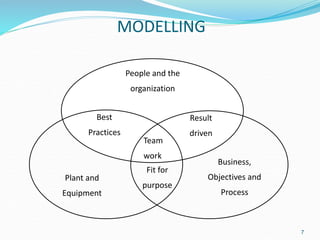
MODELLING
Team
work
Business,
Objectives and
Process
People and the
organization
Fit for
purpose
Plant and
Equipment
Best
Practices
Result
driven
7
O&M POTENTIAL ENERGY SAVINGS AND
OTHER POSITIVE IMPLICATIONS
 Energy Efficiency improvement -5 to 20 %
 Mitigates any potential hazard arising from deferred
maintenance.
 Improves Indoor Air Quality.
 Design life expectancy of equipment can be
achieved.
 Proactive in its response and corrects situations
before they become problems.
8
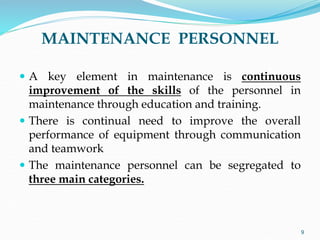
MAINTENANCE PERSONNEL
 A key element in maintenance is continuous
improvement of the skills of the personnel in
maintenance through education and training.
 There is continual need to improve the overall
performance of equipment through communication
and teamwork
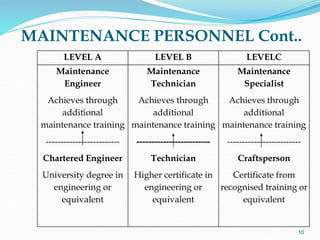
 The maintenance personnel can be segregated to
three main categories.
9
MAINTENANCE PERSONNEL Cont..
LEVEL A LEVEL B LEVELC
Maintenance
Engineer
Achieves through
additional
maintenance training
-------------------------
Chartered Engineer
University degree in
engineering or
equivalent
Maintenance
Technician
Achieves through
additional
maintenance training
-------------------------
Technician
Higher certificate in
engineering or
equivalent
Maintenance
Specialist
Achieves through
additional
maintenance training
-------------------------
Craftsperson
Certificate from
recognised training or
equivalent
10
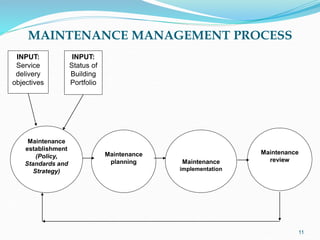
MAINTENANCE MANAGEMENT PROCESS
Maintenance
establishment
(Policy,
Standards and
Strategy)
Development
Maintenance
planning Maintenance
implementation
Maintenance
review
INPUT:
Service
delivery
objectives
priorities
INPUT:
Status of
Building
Portfolio
11
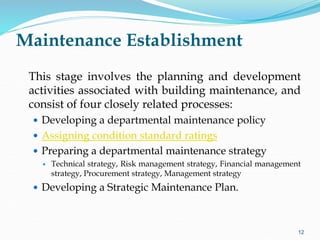
Maintenance Establishment
This stage involves the planning and development
activities associated with building maintenance, and
consist of four closely related processes:
 Developing a departmental maintenance policy
 Assigning condition standard ratings
 Preparing a departmental maintenance strategy
 Technical strategy, Risk management strategy, Financial management
strategy, Procurement strategy, Management strategy
 Developing a Strategic Maintenance Plan.
12
Maintenance planning
Maintenance planning is defined as those activities
involved in developing, recording and modifying
standard maintenance procedures.
Standard maintenance procedures are used for:
 Inspections
 Services
 Periodic component replacements
 Condition based investigations and component
replacements
 Predicting component failures
13
Maintenance implementation
 Step 1
 Define and agree on some fundamental principles
 Discover improvement potential
 Step-2
 Evaluation of how your present practices and
performance compares to Current Best Practices
 Structure them in nine key processes
 Step 3
 Identify the improvement opportunities.
 Step 4
 Root Cause Problem Elimination
14
MEASURING THE QUALITY OF THE O&M
PROGRAM
 O&M managers need to be responsible for improving
reliability, controlling costs, evaluating and
implementing new technologies, tracking and reporting
on health and safety issues, and expanding their
program.
 O&M manager must be aware of the various indicators
that can be used to measure the quality or effectiveness
of the O&M program
 They are useful in cost justification of equipment
purchases, program modifications, and staff hiring.
15
MEASURING THE QUALITY OF THE O&M PROGRAM
Cont..
 Capacity factor – Relates actual plant or equipment operation to the full-capacity
operation of the plant or equipment.
 Work orders generated/closed out – Tracking of work orders generated and
completed (closed out) over time .
 Backlog of corrective maintenance – An indicator of workload issues and
effectiveness of preventive/predictive maintenance programs.
 Safety record – Commonly tracked either by number of loss-of-time incidents or
total number of reportable incidents. It is useful in getting an overall safety
picture.
 Energy use – A key indicator of equipment performance, level of efficiency
achieved, and possible degradation.
 Inventory control – An accurate accounting of spare parts can be an important
element in controlling costs.
 Overtime worked – Weekly or monthly hours of overtime worked.
 Absentee rate – A high or varying absentee rate can be a signal of low worker
morale and should be tracked. In addition, a high absentee rate can have a
significant economic impact.
 Staff turnover – High turnover rates are also a sign of low worker morale.
Significant costs are incurred in the hiring and training of new staff. Other costs
include those associated with errors made by newly hired personnel that
normally would not have been made by experienced staff.
16
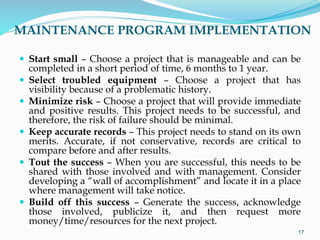
MAINTENANCE PROGRAM IMPLEMENTATION
 Start small – Choose a project that is manageable and can be
completed in a short period of time, 6 months to 1 year.
 Select troubled equipment – Choose a project that has
visibility because of a problematic history.
 Minimize risk – Choose a project that will provide immediate
and positive results. This project needs to be successful, and
therefore, the risk of failure should be minimal.
 Keep accurate records – This project needs to stand on its own
merits. Accurate, if not conservative, records are critical to
compare before and after results.
 Tout the success – When you are successful, this needs to be
shared with those involved and with management. Consider
developing a “wall of accomplishment” and locate it in a place
where management will take notice.
 Build off this success – Generate the success, acknowledge
those involved, publicize it, and then request more
money/time/resources for the next project.
17
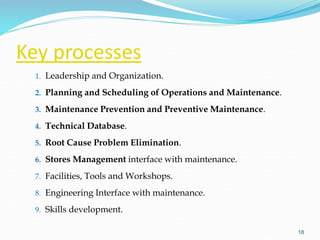
Key processes
1. Leadership and Organization.
2. Planning and Scheduling of Operations and Maintenance.
3. Maintenance Prevention and Preventive Maintenance.
4. Technical Database.
5. Root Cause Problem Elimination.
6. Stores Management interface with maintenance.
7. Facilities, Tools and Workshops.
8. Engineering Interface with maintenance.
9. Skills development.
18
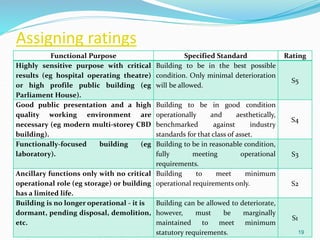
Assigning ratings
19
Functional Purpose Specified Standard Rating
Highly sensitive purpose with critical
results (eg hospital operating theatre)
or high profile public building (eg
Parliament House).
Building to be in the best possible
condition. Only minimal deterioration
will be allowed.
S5
Good public presentation and a high
quality working environment are
necessary (eg modern multi-storey CBD
building).
Building to be in good condition
operationally and aesthetically,
benchmarked against industry
standards for that class of asset.
S4
Functionally-focused building (eg
laboratory).
Building to be in reasonable condition,
fully meeting operational
requirements.
S3
Ancillary functions only with no critical
operational role (eg storage) or building
has a limited life.
Building to meet minimum
operational requirements only. S2
Building is no longer operational - it is
dormant, pending disposal, demolition,
etc.
Building can be allowed to deteriorate,
however, must be marginally
maintained to meet minimum
statutory requirements.
S1

Lecture-3-Introduction to Maintenance Management.ppt

  • 1.
  • 2.
    INTRODUCTION • Effective O&Mis one of the most cost-effective methods for ensuring reliability, safety, and energy efficiency • To implement best maintenance approaches, it is important to; – Applied technical systems along with the competent personnel operating and maintaining them. – Structured changes are required to reflect the business environment – Recognize the importance of the involvement of all personnel at all levels for achieving business objectives – Apply suitable tools to strive for continuously improved equipment effectiveness – Increase involvement and integration at all levels in order to pursue cost effective maintenance within the framework of life-2
  • 3.
    DEFINITIONS • Maintenance-BS 3811:1984defines maintenance as: – A combination of any action carries out to retain an item in or restore it to an acceptable condition. • The physical execution of maintenance work, and its initiation, financing and organizing • The effective usage of the building and its parts, which in turn compels broader consideration of building performance. • Operations and Maintenance is the decisions and actions regarding the control and upkeep of property and equipment. • Actions focused on scheduling, procedures, and work/systems control and optimization; and • Performance of routine, preventive, predictive, scheduled and unscheduled actions aimed at preventing equipment failure or decline with the goal of increasing efficiency, reliability, and safety. 3
  • 4.
    DEFINITIONS  Operational Efficiency Represents-Life-cycle, cost-effective mix of preventive, predictive, and reliability-centered maintenance technologies  Coupled with Equipment calibration, tracking, and computerized maintenance management capabilities  All targeting reliability, safety, occupant comfort, and system efficiency 4
  • 5.
    MAINTENANCE MANAGEMENT • Theoverall program should contain five very distinct functions making up the organization: – Operations • Administration • Conduct of Operations • Equipment Status Control • Operator Knowledge and Performance – Maintenance • Administration • Work Control System • Conduct of Maintenance • Preventive Maintenance • Maintenance Procedures and Documentation 5
  • 6.
    MAINTENANCE MANAGEMENT Cont.. –Engineering • Engineering Support Organization and Administration • Equipment Modifications • Equipment Performance Monitoring • Engineering Support Procedures and Documentation – Training • Administration • General Employee Training • Training Facilities and Equipment • Operator Training • Maintenance Training – Administration • Organization and Administration • Management Objectives • Management Assessment • Personnel Planning and Qualification • Industrial Safety 6
  • 7.
    MODELLING Team work Business, Objectives and Process People andthe organization Fit for purpose Plant and Equipment Best Practices Result driven 7
  • 8.
    O&M POTENTIAL ENERGYSAVINGS AND OTHER POSITIVE IMPLICATIONS  Energy Efficiency improvement -5 to 20 %  Mitigates any potential hazard arising from deferred maintenance.  Improves Indoor Air Quality.  Design life expectancy of equipment can be achieved.  Proactive in its response and corrects situations before they become problems. 8
  • 9.
    MAINTENANCE PERSONNEL  Akey element in maintenance is continuous improvement of the skills of the personnel in maintenance through education and training.  There is continual need to improve the overall performance of equipment through communication and teamwork  The maintenance personnel can be segregated to three main categories. 9
  • 10.
    MAINTENANCE PERSONNEL Cont.. LEVELA LEVEL B LEVELC Maintenance Engineer Achieves through additional maintenance training ------------------------- Chartered Engineer University degree in engineering or equivalent Maintenance Technician Achieves through additional maintenance training ------------------------- Technician Higher certificate in engineering or equivalent Maintenance Specialist Achieves through additional maintenance training ------------------------- Craftsperson Certificate from recognised training or equivalent 10
  • 11.
    MAINTENANCE MANAGEMENT PROCESS Maintenance establishment (Policy, Standardsand Strategy) Development Maintenance planning Maintenance implementation Maintenance review INPUT: Service delivery objectives priorities INPUT: Status of Building Portfolio 11
  • 12.
    Maintenance Establishment This stageinvolves the planning and development activities associated with building maintenance, and consist of four closely related processes:  Developing a departmental maintenance policy  Assigning condition standard ratings  Preparing a departmental maintenance strategy  Technical strategy, Risk management strategy, Financial management strategy, Procurement strategy, Management strategy  Developing a Strategic Maintenance Plan. 12
  • 13.
    Maintenance planning Maintenance planningis defined as those activities involved in developing, recording and modifying standard maintenance procedures. Standard maintenance procedures are used for:  Inspections  Services  Periodic component replacements  Condition based investigations and component replacements  Predicting component failures 13
  • 14.
    Maintenance implementation  Step1  Define and agree on some fundamental principles  Discover improvement potential  Step-2  Evaluation of how your present practices and performance compares to Current Best Practices  Structure them in nine key processes  Step 3  Identify the improvement opportunities.  Step 4  Root Cause Problem Elimination 14
  • 15.
    MEASURING THE QUALITYOF THE O&M PROGRAM  O&M managers need to be responsible for improving reliability, controlling costs, evaluating and implementing new technologies, tracking and reporting on health and safety issues, and expanding their program.  O&M manager must be aware of the various indicators that can be used to measure the quality or effectiveness of the O&M program  They are useful in cost justification of equipment purchases, program modifications, and staff hiring. 15
  • 16.
    MEASURING THE QUALITYOF THE O&M PROGRAM Cont..  Capacity factor – Relates actual plant or equipment operation to the full-capacity operation of the plant or equipment.  Work orders generated/closed out – Tracking of work orders generated and completed (closed out) over time .  Backlog of corrective maintenance – An indicator of workload issues and effectiveness of preventive/predictive maintenance programs.  Safety record – Commonly tracked either by number of loss-of-time incidents or total number of reportable incidents. It is useful in getting an overall safety picture.  Energy use – A key indicator of equipment performance, level of efficiency achieved, and possible degradation.  Inventory control – An accurate accounting of spare parts can be an important element in controlling costs.  Overtime worked – Weekly or monthly hours of overtime worked.  Absentee rate – A high or varying absentee rate can be a signal of low worker morale and should be tracked. In addition, a high absentee rate can have a significant economic impact.  Staff turnover – High turnover rates are also a sign of low worker morale. Significant costs are incurred in the hiring and training of new staff. Other costs include those associated with errors made by newly hired personnel that normally would not have been made by experienced staff. 16
  • 17.
    MAINTENANCE PROGRAM IMPLEMENTATION Start small – Choose a project that is manageable and can be completed in a short period of time, 6 months to 1 year.  Select troubled equipment – Choose a project that has visibility because of a problematic history.  Minimize risk – Choose a project that will provide immediate and positive results. This project needs to be successful, and therefore, the risk of failure should be minimal.  Keep accurate records – This project needs to stand on its own merits. Accurate, if not conservative, records are critical to compare before and after results.  Tout the success – When you are successful, this needs to be shared with those involved and with management. Consider developing a “wall of accomplishment” and locate it in a place where management will take notice.  Build off this success – Generate the success, acknowledge those involved, publicize it, and then request more money/time/resources for the next project. 17
  • 18.
    Key processes 1. Leadershipand Organization. 2. Planning and Scheduling of Operations and Maintenance. 3. Maintenance Prevention and Preventive Maintenance. 4. Technical Database. 5. Root Cause Problem Elimination. 6. Stores Management interface with maintenance. 7. Facilities, Tools and Workshops. 8. Engineering Interface with maintenance. 9. Skills development. 18
  • 19.
    Assigning ratings 19 Functional PurposeSpecified Standard Rating Highly sensitive purpose with critical results (eg hospital operating theatre) or high profile public building (eg Parliament House). Building to be in the best possible condition. Only minimal deterioration will be allowed. S5 Good public presentation and a high quality working environment are necessary (eg modern multi-storey CBD building). Building to be in good condition operationally and aesthetically, benchmarked against industry standards for that class of asset. S4 Functionally-focused building (eg laboratory). Building to be in reasonable condition, fully meeting operational requirements. S3 Ancillary functions only with no critical operational role (eg storage) or building has a limited life. Building to meet minimum operational requirements only. S2 Building is no longer operational - it is dormant, pending disposal, demolition, etc. Building can be allowed to deteriorate, however, must be marginally maintained to meet minimum statutory requirements. S1