Security Program and
Policies
Principles and Practices
by Sari Stern Greene
Chapter 1: Understanding Policy
Copyright 2014 Pearson Education, Inc. 2
Objectives
❑ Describe the significance of policies
❑ Evaluate the role policy plays in corporate culture
and civil society
❑ Discuss information security policy
❑ Identity the characteristics of a successful policy
❑ Discuss Information Security Policy lifecycle
Copyright 2014 Pearson Education, Inc. 3
Introduction
■ Policy: “A definite course of action or
procedure selected from among alternatives
and in light of given conditions to guide and
determine present and future decisions”**
(** per www.merriamwebster.com)
Copyright 2014 Pearson Education, Inc. 4
Looking at Policy Through the Ages
■ The role of the Torah and Bible as written
policy
■ 3000-year old documents include business rules still in
practice today
■ First documented attempt at creating a code to preserve
order
Copyright 2014 Pearson Education, Inc. 5
Looking at Policy Through the Ages
Cont.
❑ The U.S. Constitution as a Policy Revolution
■ A collection of articles and amendments that codify all
aspects of American government along with citizens’
rights and responsibilities
■ A rule set with a built-in mechanism for change
❑ Both the Constitution and the Torah have a similar
goal:
■ Serve as rules that guide behavior
Policy Today
■ Corporate culture
❑ Shared attitudes, values, goals, and practices
that characterize a company
❑ Three classifications
■ Negative
■ Neutral
■ Positive
■ Guiding principles
❑ Reflect the corporate culture
Copyright 2014 Pearson Education, Inc. 6
Copyright 2014 Pearson Education, Inc. 7
■ A document that states how an organization
plans to protect its information assets and
information systems and ensure compliance with
legal and regulatory requirements
❑ Asset
■ Resource with a value
❑ Information asset
■ Any information item, regardless of storage format, that
represents value to the organization
■ Customer data, employee records, IT information, reputation,
and brand
Information Security Policy
Successful Policy Characteristics
■ Endorsed
❑ Management supports the policy
■ Relevant
❑ The policy is applicable and supports the goals of the organization
■ Realistic
❑ The policy makes sense
■ Attainable
❑ The policy can be successfully implemented
■ Adaptable
❑ The policy can be changed
■ Enforceable
❑ Controls that can be used to support and enforce the policy exist
■ Inclusive
❑ The policy scope includes all relevant parties
Copyright 2014 Pearson Education, Inc. 8
Copyright 2014 Pearson Education, Inc. 9
Defining the Role of Policy in
Government
❑ Government regulation is required to protect its
critical infrastructure and citizens
❑ Two major information security-related legislations
were introduced in the 1990s
■ Gramm-Leach-Bliley Act (GLBA)
■ The Health Insurance Portability and Accountability Act
(HIPAA)
Copyright 2014 Pearson Education, Inc. 10
Defining the Role of Policy in
Government Cont.
❑ States as Leaders
■ California was the first state to enact consumer
information security notification
❑ SB1386: California Security Breach Information Act
❑ 46 states have passed similar legislation
■ Massachusetts was the first state to require the
protection of personally identifiable information on
Massachusetts residents
❑ 201 CMR 17: Standards for the Protection of Personal
Information of Residents of the Commonwealth
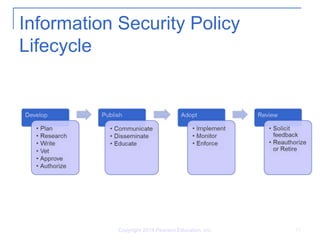
Information Security Policy
Lifecycle
Copyright 2014 Pearson Education, Inc. 11
Copyright 2014 Pearson Education, Inc. 12
Summary
Policies apply to governments as well as to business
organizations.
When people are grouped to achieve a common goal,
policies provide a framework that guides the company and
protects the assets of that company.
The policy lifecycle spans four phases: develop, publish,
adopt, and review.

Chapter 1: Understanding Policy

  • 1.
    Security Program and Policies Principlesand Practices by Sari Stern Greene Chapter 1: Understanding Policy
  • 2.
    Copyright 2014 PearsonEducation, Inc. 2 Objectives ❑ Describe the significance of policies ❑ Evaluate the role policy plays in corporate culture and civil society ❑ Discuss information security policy ❑ Identity the characteristics of a successful policy ❑ Discuss Information Security Policy lifecycle
  • 3.
    Copyright 2014 PearsonEducation, Inc. 3 Introduction ■ Policy: “A definite course of action or procedure selected from among alternatives and in light of given conditions to guide and determine present and future decisions”** (** per www.merriamwebster.com)
  • 4.
    Copyright 2014 PearsonEducation, Inc. 4 Looking at Policy Through the Ages ■ The role of the Torah and Bible as written policy ■ 3000-year old documents include business rules still in practice today ■ First documented attempt at creating a code to preserve order
  • 5.
    Copyright 2014 PearsonEducation, Inc. 5 Looking at Policy Through the Ages Cont. ❑ The U.S. Constitution as a Policy Revolution ■ A collection of articles and amendments that codify all aspects of American government along with citizens’ rights and responsibilities ■ A rule set with a built-in mechanism for change ❑ Both the Constitution and the Torah have a similar goal: ■ Serve as rules that guide behavior
  • 6.
    Policy Today ■ Corporateculture ❑ Shared attitudes, values, goals, and practices that characterize a company ❑ Three classifications ■ Negative ■ Neutral ■ Positive ■ Guiding principles ❑ Reflect the corporate culture Copyright 2014 Pearson Education, Inc. 6
  • 7.
    Copyright 2014 PearsonEducation, Inc. 7 ■ A document that states how an organization plans to protect its information assets and information systems and ensure compliance with legal and regulatory requirements ❑ Asset ■ Resource with a value ❑ Information asset ■ Any information item, regardless of storage format, that represents value to the organization ■ Customer data, employee records, IT information, reputation, and brand Information Security Policy
  • 8.
    Successful Policy Characteristics ■Endorsed ❑ Management supports the policy ■ Relevant ❑ The policy is applicable and supports the goals of the organization ■ Realistic ❑ The policy makes sense ■ Attainable ❑ The policy can be successfully implemented ■ Adaptable ❑ The policy can be changed ■ Enforceable ❑ Controls that can be used to support and enforce the policy exist ■ Inclusive ❑ The policy scope includes all relevant parties Copyright 2014 Pearson Education, Inc. 8
  • 9.
    Copyright 2014 PearsonEducation, Inc. 9 Defining the Role of Policy in Government ❑ Government regulation is required to protect its critical infrastructure and citizens ❑ Two major information security-related legislations were introduced in the 1990s ■ Gramm-Leach-Bliley Act (GLBA) ■ The Health Insurance Portability and Accountability Act (HIPAA)
  • 10.
    Copyright 2014 PearsonEducation, Inc. 10 Defining the Role of Policy in Government Cont. ❑ States as Leaders ■ California was the first state to enact consumer information security notification ❑ SB1386: California Security Breach Information Act ❑ 46 states have passed similar legislation ■ Massachusetts was the first state to require the protection of personally identifiable information on Massachusetts residents ❑ 201 CMR 17: Standards for the Protection of Personal Information of Residents of the Commonwealth
  • 11.
    Information Security Policy Lifecycle Copyright2014 Pearson Education, Inc. 11
  • 12.
    Copyright 2014 PearsonEducation, Inc. 12 Summary Policies apply to governments as well as to business organizations. When people are grouped to achieve a common goal, policies provide a framework that guides the company and protects the assets of that company. The policy lifecycle spans four phases: develop, publish, adopt, and review.