MENDELIAN GENETICS


   1.   Mendel’s work
   2.   Monohybrid inheritance and principal of segregation
   3.   Dihybrid inheritance and the principal of independent
        assortment
   4.   Test cross
INTRODUCTION
• Explaining the mechanism of inheritance
• The mechanism relates to the numbers of
  characteristic of inheritance
• The simple characteristic leads to the simpler
  crossing over mechanism and ration
• This is followed by excluding the mutation
  effects that will be discussed later (chapter 4)
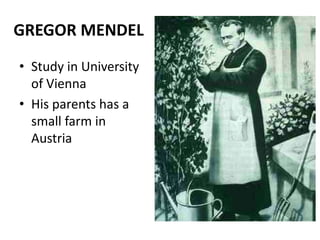
GREGOR MENDEL
• Study in University
  of Vienna
• His parents has a
  small farm in
  Austria
GREGOR MENDEL (cont)
• Austrian monk
• Studied the
  inheritance of traits in
  pea plants
• Developed the laws of
  inheritance
• Mendel's work was
  not recognized until
  the turn of the 20th
  century
GREGOR MENDEL (cont)
• Between 1856 and
  1863, Mendel
  cultivated and tested
  some 28,000 pea
  plants
• He found that the
  plants' offspring
  retained traits of the
  parents
• Called the “Father of
  Genetics"
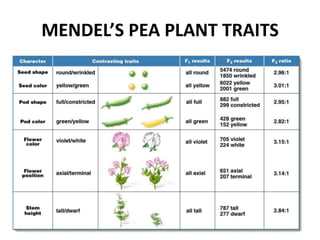
MENDEL’S PEA PLANT TRAITS
GREGOR MENDEL (cont)
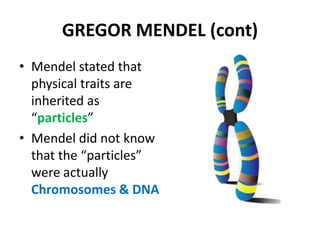
• Mendel stated that
  physical traits are
  inherited as
  “particles”
• Mendel did not know
  that the “particles”
  were actually
  Chromosomes & DNA
GENETIC TERMINOLOGIES
• Character – heritable feature that varies among
  individuals
• Trait – each variant for the character
• True-breeding – Plants homozygous for a
  characteristic are true-breeding (Self-pollinate)
• Hybridization – mating or crossing over of two
  true-breeding varieties
• P generation – parental generation/parent
• F1 generation – first filial generation (son)
• F2 generation – second filial generation
GENETIC TERMINOLOGIES (cont)
• Allele- alternate version of a gene
• Homozygote – pair of identical alleles for a character
• Heterozygote – two different alleles for a character
  (Bb)
• Dominate allele – expressed in the heterozygote
• Recessive allele – not expressed in the heterozygote
• Homozygous dominant- BB
• Homozygous recessive - bb
• Genotype – genetic makeup
• Phenotype – appearance of an organism
TYPES OF GENETIC CROSS
1. Monohybrid cross - cross involving a single
   trait
   e.g. flower colour


2. Dihybrid cross - cross involving two traits
   e.g. flower colour & plant height
PUNNET SQUARE
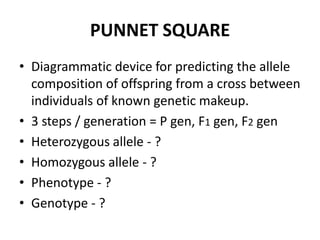
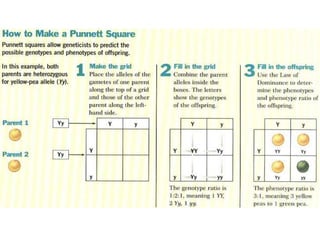
• Diagrammatic device for predicting the allele
  composition of offspring from a cross between
  individuals of known genetic makeup.
• 3 steps / generation = P gen, F1 gen, F2 gen
• Heterozygous allele - ?
• Homozygous allele - ?
• Phenotype - ?
• Genotype - ?
PUNNET SQUARE (cont)
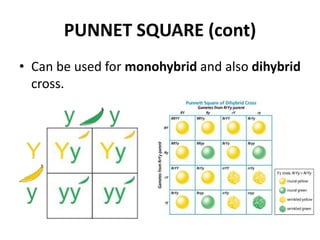
• Can be used for monohybrid and also dihybrid
  cross.
LAW OF INHERITANCE
Gregor Mendel introduce 2 laws
• Law of Segregation
• Law of Independent Assortment
LAW OF SEGREGATION
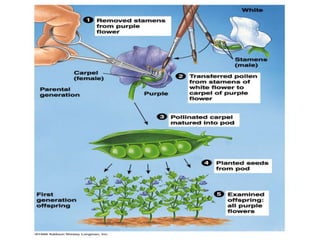
• Inherit only ONE characteristic @ Monohybrid
• Producing 3:1 of phenotypic inheritance
• Mendel use a large group of sample size to
  explain this law
• Leads to a development of a model known as
  Mendel’s Model
MENDEL MODEL
Four concepts in law of segregation
1. Alternative versions of genes account for variations in
   inherited characteristics
2. For each character, an organism inherit two alleles,
   one from each parent
3. If the two alleles at a locus differ, then one, the
   dominant allele, determines the organism’s
   appearance; the other, the recessive allele, has NO
   noticeable effect in the organism’s appearance
4. The two alleles for a heritable character segregate
   (separate) during gamete formation and end up in
   different gametes
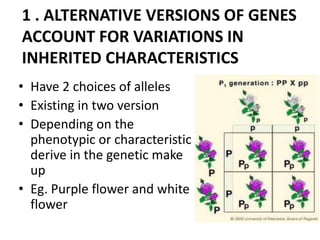
1 . ALTERNATIVE VERSIONS OF GENES
ACCOUNT FOR VARIATIONS IN
INHERITED CHARACTERISTICS
• Have 2 choices of alleles
• Existing in two version
• Depending on the
  phenotypic or characteristic
  derive in the genetic make
  up
• Eg. Purple flower and white
  flower
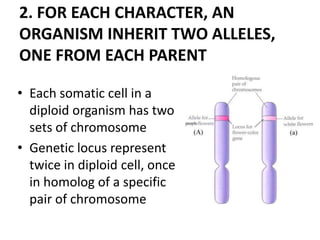
2. FOR EACH CHARACTER, AN
ORGANISM INHERIT TWO ALLELES,
ONE FROM EACH PARENT

• Each somatic cell in a
  diploid organism has two
  sets of chromosome
• Genetic locus represent
  twice in diploid cell, once
  in homolog of a specific
  pair of chromosome
3. IF THE TWO ALLELES AT A LOCUS
DIFFER, THEN ONE, THE DOMINANT
ALLELE, DETERMINES THE ORGANISM’S
APPEARANCE; THE OTHER, THE
RECESSIVE ALLELE, HAS NO NOTICEABLE
EFFECT IN THE ORGANISM’S
APPEARANCE
• The plant have more purple colour due to its
  dominant allele, vice versa
4. THE TWO ALLELES FOR A
   HERITABLE CHARACTER SEGREGATE
        (SEPARATE) DURING GAMETE
         FORMATION AND END UP IN
                DIFFERENT GAMETES
• An egg or sperm gets only one of the two
  alleles that are present in the somatic cell of
  the organism making the gamete
• The correspond depending on the types of
  reproduction between meiosis and mitosis
• Further discussion after test cross
Example of
MONOHYBRID CROSS
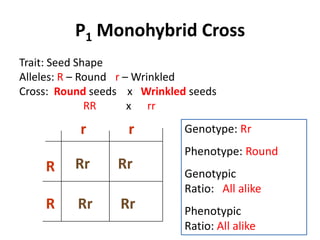
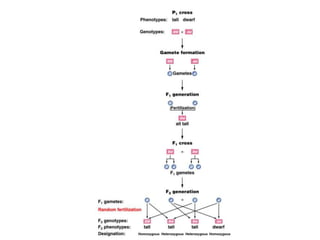
P1 Monohybrid Cross
Trait: Seed Shape
Alleles: R – Round r – Wrinkled
Cross: Round seeds x Wrinkled seeds
              RR      x rr

          r        r         Genotype: Rr
                             Phenotype: Round
    R    Rr      Rr
                             Genotypic
                             Ratio: All alike
    R     Rr     Rr          Phenotypic
                             Ratio: All alike
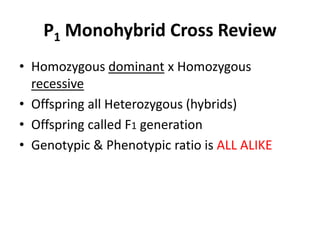
P1 Monohybrid Cross Review
• Homozygous dominant x Homozygous
  recessive
• Offspring all Heterozygous (hybrids)
• Offspring called F1 generation
• Genotypic & Phenotypic ratio is ALL ALIKE
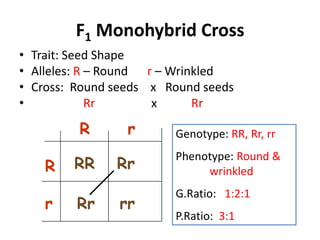
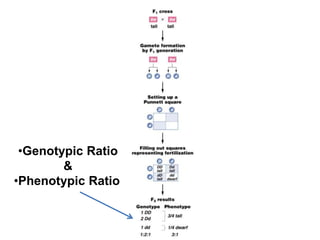
F1 Monohybrid Cross
• Trait: Seed Shape
• Alleles: R – Round r – Wrinkled
• Cross: Round seeds x Round seeds
•            Rr       x      Rr

         R       r      Genotype: RR, Rr, rr
                        Phenotype: Round &
    R   RR     Rr            wrinkled
                        G.Ratio: 1:2:1
    r    Rr    rr
                        P.Ratio: 3:1
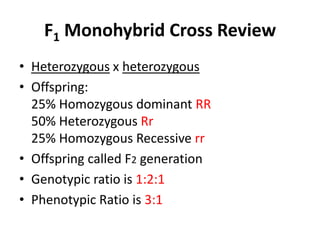
F1 Monohybrid Cross Review
• Heterozygous x heterozygous
• Offspring:
  25% Homozygous dominant RR
  50% Heterozygous Rr
  25% Homozygous Recessive rr
• Offspring called F2 generation
• Genotypic ratio is 1:2:1
• Phenotypic Ratio is 3:1
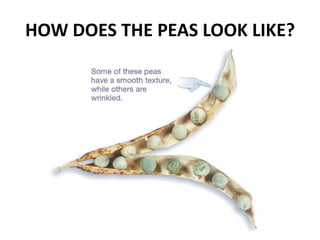
HOW DOES THE PEAS LOOK LIKE?
•Genotypic Ratio
        &
•Phenotypic Ratio
TEST YOURSELF!
1. Between blue flower, BB and yellow, yy
2. Between small leaf, ff and big leaf, Ff
LAW OF INDEPENDENT ASSORTMENT
• TWO characteristics at the same time @
  Dihybrid cross
• Eg. Leaf colour and leaf size
• Using both dominant and recessive alleles in
  each of the characteristics.
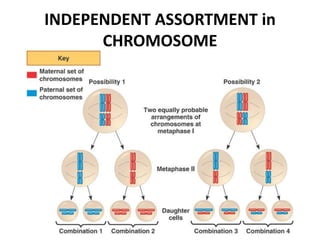
INDEPENDENT ASSORTMENT in
      CHROMOSOME
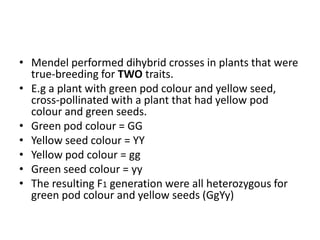
• Mendel performed dihybrid crosses in plants that were
  true-breeding for TWO traits.
• E.g a plant with green pod colour and yellow seed,
  cross-pollinated with a plant that had yellow pod
  colour and green seeds.
• Green pod colour = GG
• Yellow seed colour = YY
• Yellow pod colour = gg
• Green seed colour = yy
• The resulting F1 generation were all heterozygous for
  green pod colour and yellow seeds (GgYy)
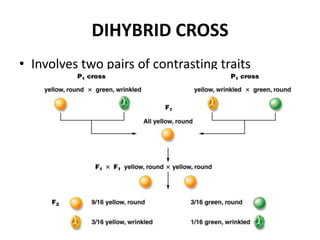
DIHYBRID CROSS
• Involves two pairs of contrasting traits
DIHYBRID CROSS


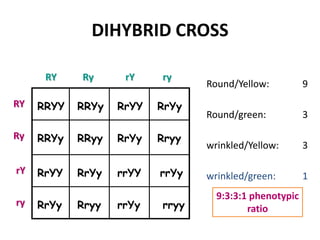
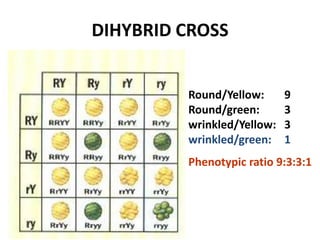
                         Round/Yellow:      9
                         Round/green:       3
                         wrinkled/Yellow:   3
                         wrinkled/green:    1
                         Phenotypic ratio 9:3:3:1


     copyright cmassengale                      36
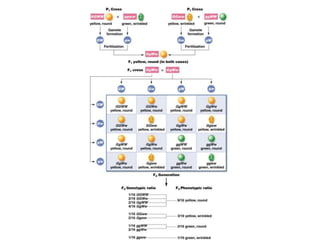
DIHYBRID CROSS
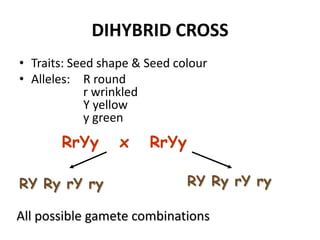
• Traits: Seed shape & Seed colour
• Alleles: R round
             r wrinkled
             Y yellow
             y green
       RrYy       x    RrYy

RY Ry rY ry                   RY Ry rY ry

All possible gamete combinations
DIHYBRID CROSS

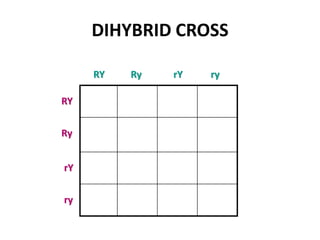
     RY   Ry   rY   ry

RY


Ry


rY


ry
DIHYBRID CROSS

      RY    Ry      rY    ry
                                 Round/Yellow:          9
RY   RRYY   RRYy   RrYY   RrYy
                                 Round/green:           3
Ry   RRYy   RRyy   RrYy   Rryy
                                 wrinkled/Yellow:       3

rY   RrYY   RrYy   rrYY   rrYy   wrinkled/green:        1
                                   9:3:3:1 phenotypic
ry   RrYy   Rryy   rrYy   rryy            ratio
HYPOTHESIS/CONCLUSION
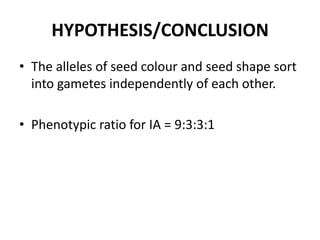
• The alleles of seed colour and seed shape sort
  into gametes independently of each other.

• Phenotypic ratio for IA = 9:3:3:1
TEST CROSS
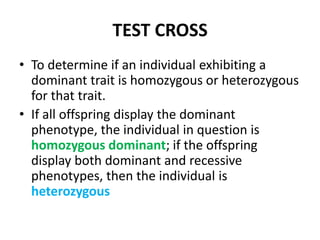
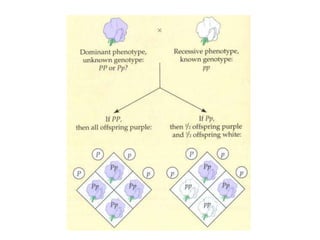
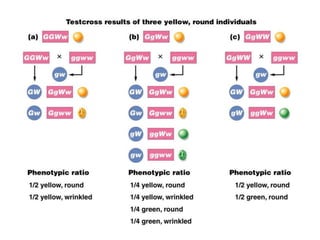
• To determine if an individual exhibiting a
  dominant trait is homozygous or heterozygous
  for that trait.
• If all offspring display the dominant
  phenotype, the individual in question is
  homozygous dominant; if the offspring
  display both dominant and recessive
  phenotypes, then the individual is
  heterozygous
TEST CROSS (cont)
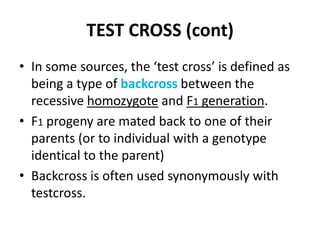
• In some sources, the ‘test cross’ is defined as
  being a type of backcross between the
  recessive homozygote and F1 generation.
• F1 progeny are mated back to one of their
  parents (or to individual with a genotype
  identical to the parent)
• Backcross is often used synonymously with
  testcross.
TEST CROSS
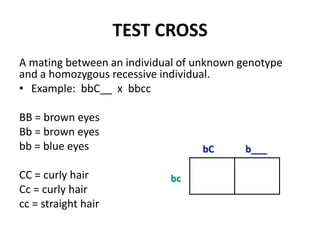
A mating between an individual of unknown genotype
and a homozygous recessive individual.
• Example: bbC__ x bbcc

BB = brown eyes
Bb = brown eyes
bb = blue eyes                    bC      b___

CC = curly hair             bc
Cc = curly hair
cc = straight hair
TEST CROSS
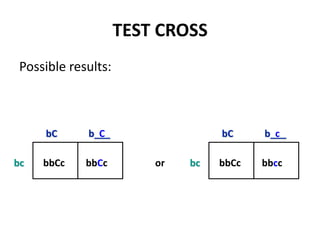
 Possible results:


     bC      b___
               C                                     bC     b___
                                                              c

bc   bbCc    bbCc          or                   bc   bbCc   bbcc


                        copyright cmassengale                      44
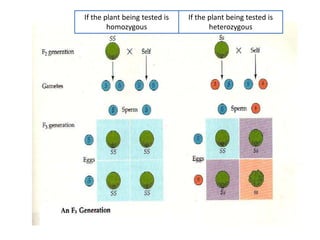
If the plant being tested is   If the plant being tested is
        homozygous                    heterozygous
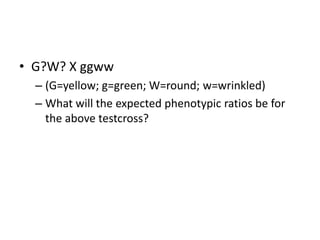
• G?W? X ggww
  – (G=yellow; g=green; W=round; w=wrinkled)
  – What will the expected phenotypic ratios be for
    the above testcross?
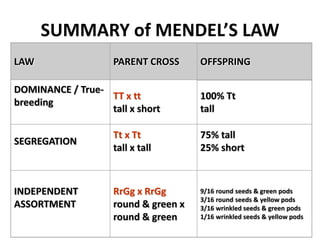
SUMMARY of MENDEL’S LAW
LAW                 PARENT CROSS      OFFSPRING

DOMINANCE / True-
                  TT x tt             100% Tt
breeding
                  tall x short        tall

                    Tt x Tt           75% tall
SEGREGATION
                    tall x tall       25% short


INDEPENDENT         RrGg x RrGg       9/16 round seeds & green pods
                                      3/16 round seeds & yellow pods
ASSORTMENT          round & green x   3/16 wrinkled seeds & green pods
                    round & green     1/16 wrinkled seeds & yellow pods

MIC150 - Chap 1 Mendelian Genetics

  • 1.
    MENDELIAN GENETICS 1. Mendel’s work 2. Monohybrid inheritance and principal of segregation 3. Dihybrid inheritance and the principal of independent assortment 4. Test cross
  • 2.
    INTRODUCTION • Explaining themechanism of inheritance • The mechanism relates to the numbers of characteristic of inheritance • The simple characteristic leads to the simpler crossing over mechanism and ration • This is followed by excluding the mutation effects that will be discussed later (chapter 4)
  • 3.
    GREGOR MENDEL • Studyin University of Vienna • His parents has a small farm in Austria
  • 4.
    GREGOR MENDEL (cont) •Austrian monk • Studied the inheritance of traits in pea plants • Developed the laws of inheritance • Mendel's work was not recognized until the turn of the 20th century
  • 5.
    GREGOR MENDEL (cont) •Between 1856 and 1863, Mendel cultivated and tested some 28,000 pea plants • He found that the plants' offspring retained traits of the parents • Called the “Father of Genetics"
  • 7.
  • 8.
    GREGOR MENDEL (cont) •Mendel stated that physical traits are inherited as “particles” • Mendel did not know that the “particles” were actually Chromosomes & DNA
  • 9.
    GENETIC TERMINOLOGIES • Character– heritable feature that varies among individuals • Trait – each variant for the character • True-breeding – Plants homozygous for a characteristic are true-breeding (Self-pollinate) • Hybridization – mating or crossing over of two true-breeding varieties • P generation – parental generation/parent • F1 generation – first filial generation (son) • F2 generation – second filial generation
  • 10.
    GENETIC TERMINOLOGIES (cont) •Allele- alternate version of a gene • Homozygote – pair of identical alleles for a character • Heterozygote – two different alleles for a character (Bb) • Dominate allele – expressed in the heterozygote • Recessive allele – not expressed in the heterozygote • Homozygous dominant- BB • Homozygous recessive - bb • Genotype – genetic makeup • Phenotype – appearance of an organism
  • 11.
    TYPES OF GENETICCROSS 1. Monohybrid cross - cross involving a single trait e.g. flower colour 2. Dihybrid cross - cross involving two traits e.g. flower colour & plant height
  • 12.
    PUNNET SQUARE • Diagrammaticdevice for predicting the allele composition of offspring from a cross between individuals of known genetic makeup. • 3 steps / generation = P gen, F1 gen, F2 gen • Heterozygous allele - ? • Homozygous allele - ? • Phenotype - ? • Genotype - ?
  • 13.
    PUNNET SQUARE (cont) •Can be used for monohybrid and also dihybrid cross.
  • 15.
    LAW OF INHERITANCE GregorMendel introduce 2 laws • Law of Segregation • Law of Independent Assortment
  • 16.
    LAW OF SEGREGATION •Inherit only ONE characteristic @ Monohybrid • Producing 3:1 of phenotypic inheritance • Mendel use a large group of sample size to explain this law • Leads to a development of a model known as Mendel’s Model
  • 17.
    MENDEL MODEL Four conceptsin law of segregation 1. Alternative versions of genes account for variations in inherited characteristics 2. For each character, an organism inherit two alleles, one from each parent 3. If the two alleles at a locus differ, then one, the dominant allele, determines the organism’s appearance; the other, the recessive allele, has NO noticeable effect in the organism’s appearance 4. The two alleles for a heritable character segregate (separate) during gamete formation and end up in different gametes
  • 18.
    1 . ALTERNATIVEVERSIONS OF GENES ACCOUNT FOR VARIATIONS IN INHERITED CHARACTERISTICS • Have 2 choices of alleles • Existing in two version • Depending on the phenotypic or characteristic derive in the genetic make up • Eg. Purple flower and white flower
  • 19.
    2. FOR EACHCHARACTER, AN ORGANISM INHERIT TWO ALLELES, ONE FROM EACH PARENT • Each somatic cell in a diploid organism has two sets of chromosome • Genetic locus represent twice in diploid cell, once in homolog of a specific pair of chromosome
  • 20.
    3. IF THETWO ALLELES AT A LOCUS DIFFER, THEN ONE, THE DOMINANT ALLELE, DETERMINES THE ORGANISM’S APPEARANCE; THE OTHER, THE RECESSIVE ALLELE, HAS NO NOTICEABLE EFFECT IN THE ORGANISM’S APPEARANCE • The plant have more purple colour due to its dominant allele, vice versa
  • 21.
    4. THE TWOALLELES FOR A HERITABLE CHARACTER SEGREGATE (SEPARATE) DURING GAMETE FORMATION AND END UP IN DIFFERENT GAMETES • An egg or sperm gets only one of the two alleles that are present in the somatic cell of the organism making the gamete • The correspond depending on the types of reproduction between meiosis and mitosis • Further discussion after test cross
  • 22.
  • 23.
    P1 Monohybrid Cross Trait:Seed Shape Alleles: R – Round r – Wrinkled Cross: Round seeds x Wrinkled seeds RR x rr r r Genotype: Rr Phenotype: Round R Rr Rr Genotypic Ratio: All alike R Rr Rr Phenotypic Ratio: All alike
  • 24.
    P1 Monohybrid CrossReview • Homozygous dominant x Homozygous recessive • Offspring all Heterozygous (hybrids) • Offspring called F1 generation • Genotypic & Phenotypic ratio is ALL ALIKE
  • 25.
    F1 Monohybrid Cross •Trait: Seed Shape • Alleles: R – Round r – Wrinkled • Cross: Round seeds x Round seeds • Rr x Rr R r Genotype: RR, Rr, rr Phenotype: Round & R RR Rr wrinkled G.Ratio: 1:2:1 r Rr rr P.Ratio: 3:1
  • 26.
    F1 Monohybrid CrossReview • Heterozygous x heterozygous • Offspring: 25% Homozygous dominant RR 50% Heterozygous Rr 25% Homozygous Recessive rr • Offspring called F2 generation • Genotypic ratio is 1:2:1 • Phenotypic Ratio is 3:1
  • 27.
    HOW DOES THEPEAS LOOK LIKE?
  • 29.
    •Genotypic Ratio & •Phenotypic Ratio
  • 30.
    TEST YOURSELF! 1. Betweenblue flower, BB and yellow, yy 2. Between small leaf, ff and big leaf, Ff
  • 31.
    LAW OF INDEPENDENTASSORTMENT • TWO characteristics at the same time @ Dihybrid cross • Eg. Leaf colour and leaf size • Using both dominant and recessive alleles in each of the characteristics.
  • 32.
  • 33.
    • Mendel performeddihybrid crosses in plants that were true-breeding for TWO traits. • E.g a plant with green pod colour and yellow seed, cross-pollinated with a plant that had yellow pod colour and green seeds. • Green pod colour = GG • Yellow seed colour = YY • Yellow pod colour = gg • Green seed colour = yy • The resulting F1 generation were all heterozygous for green pod colour and yellow seeds (GgYy)
  • 34.
    DIHYBRID CROSS • Involvestwo pairs of contrasting traits
  • 36.
    DIHYBRID CROSS Round/Yellow: 9 Round/green: 3 wrinkled/Yellow: 3 wrinkled/green: 1 Phenotypic ratio 9:3:3:1 copyright cmassengale 36
  • 37.
    DIHYBRID CROSS • Traits:Seed shape & Seed colour • Alleles: R round r wrinkled Y yellow y green RrYy x RrYy RY Ry rY ry RY Ry rY ry All possible gamete combinations
  • 38.
    DIHYBRID CROSS RY Ry rY ry RY Ry rY ry
  • 39.
    DIHYBRID CROSS RY Ry rY ry Round/Yellow: 9 RY RRYY RRYy RrYY RrYy Round/green: 3 Ry RRYy RRyy RrYy Rryy wrinkled/Yellow: 3 rY RrYY RrYy rrYY rrYy wrinkled/green: 1 9:3:3:1 phenotypic ry RrYy Rryy rrYy rryy ratio
  • 40.
    HYPOTHESIS/CONCLUSION • The allelesof seed colour and seed shape sort into gametes independently of each other. • Phenotypic ratio for IA = 9:3:3:1
  • 41.
    TEST CROSS • Todetermine if an individual exhibiting a dominant trait is homozygous or heterozygous for that trait. • If all offspring display the dominant phenotype, the individual in question is homozygous dominant; if the offspring display both dominant and recessive phenotypes, then the individual is heterozygous
  • 42.
    TEST CROSS (cont) •In some sources, the ‘test cross’ is defined as being a type of backcross between the recessive homozygote and F1 generation. • F1 progeny are mated back to one of their parents (or to individual with a genotype identical to the parent) • Backcross is often used synonymously with testcross.
  • 43.
    TEST CROSS A matingbetween an individual of unknown genotype and a homozygous recessive individual. • Example: bbC__ x bbcc BB = brown eyes Bb = brown eyes bb = blue eyes bC b___ CC = curly hair bc Cc = curly hair cc = straight hair
  • 44.
    TEST CROSS Possibleresults: bC b___ C bC b___ c bc bbCc bbCc or bc bbCc bbcc copyright cmassengale 44
  • 46.
    If the plantbeing tested is If the plant being tested is homozygous heterozygous
  • 47.
    • G?W? Xggww – (G=yellow; g=green; W=round; w=wrinkled) – What will the expected phenotypic ratios be for the above testcross?
  • 49.
    SUMMARY of MENDEL’SLAW LAW PARENT CROSS OFFSPRING DOMINANCE / True- TT x tt 100% Tt breeding tall x short tall Tt x Tt 75% tall SEGREGATION tall x tall 25% short INDEPENDENT RrGg x RrGg 9/16 round seeds & green pods 3/16 round seeds & yellow pods ASSORTMENT round & green x 3/16 wrinkled seeds & green pods round & green 1/16 wrinkled seeds & yellow pods

Editor's Notes

  • #33 ndependent Assortment: Mendelian theory that, as meiosis ends, genes on pairs of homologus chromosomes have been sorted out for distribution into one gamete or another, independently of gene pairs on other chromosomes.