Mendelelian Genetics copyright cmassengale
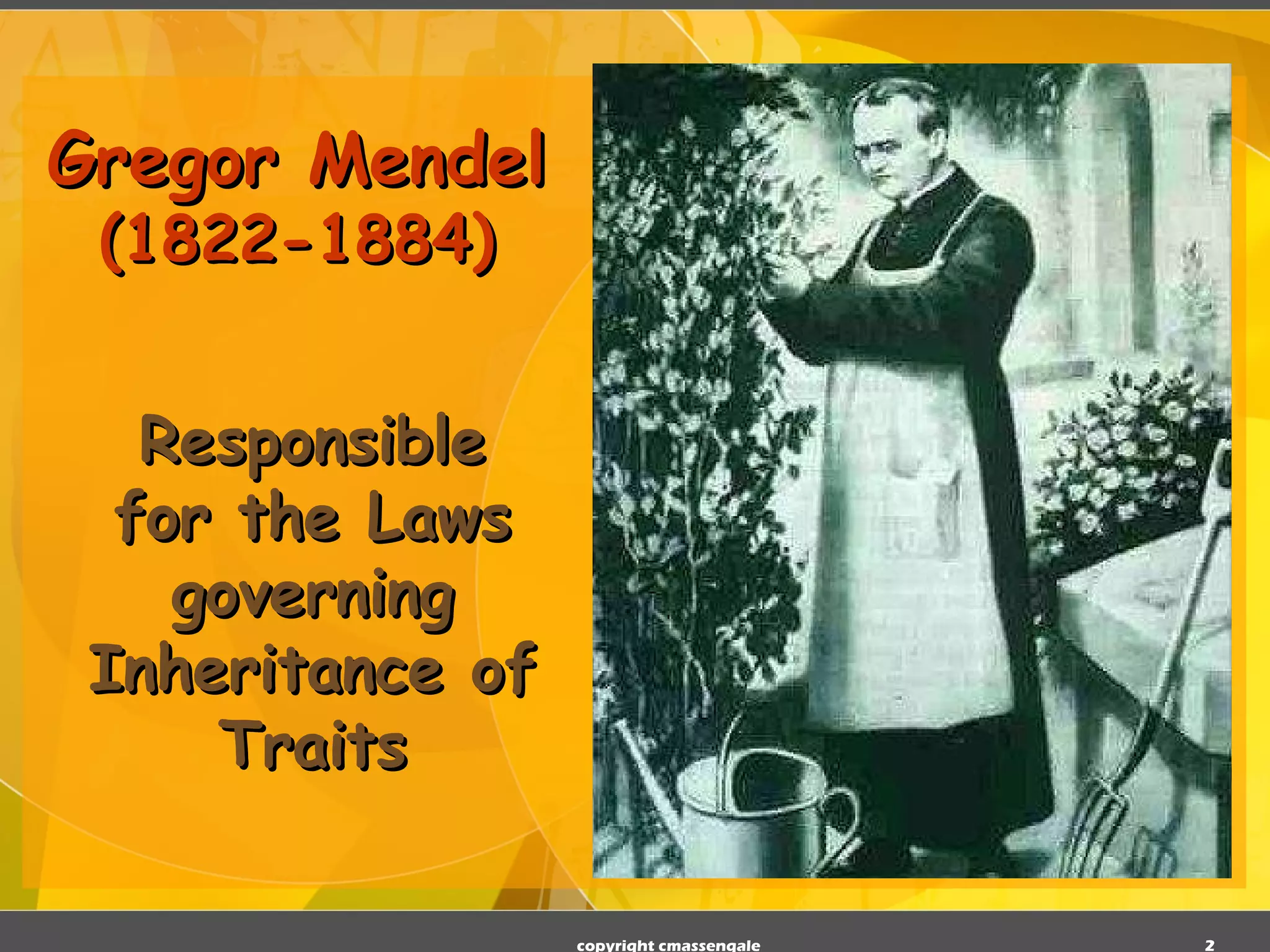
Gregor Mendel (1822-1884) Responsible for the Laws governing Inheritance of Traits copyright cmassengale
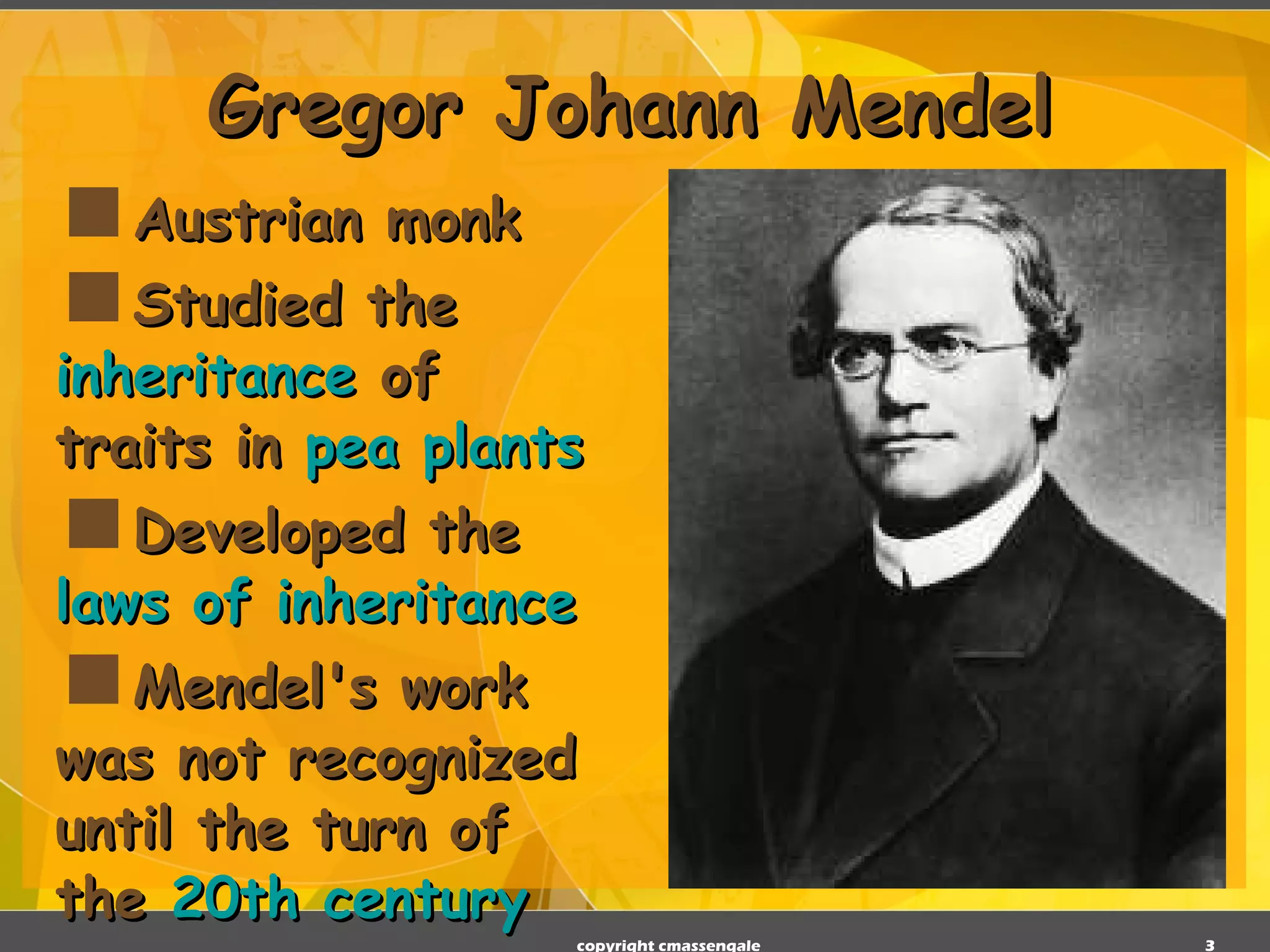
Gregor Johann Mendel Austrian monk Studied the  inheritance  of traits in  pea plants Developed the  laws of inheritance Mendel's work was not recognized until the turn of the  20th century copyright cmassengale
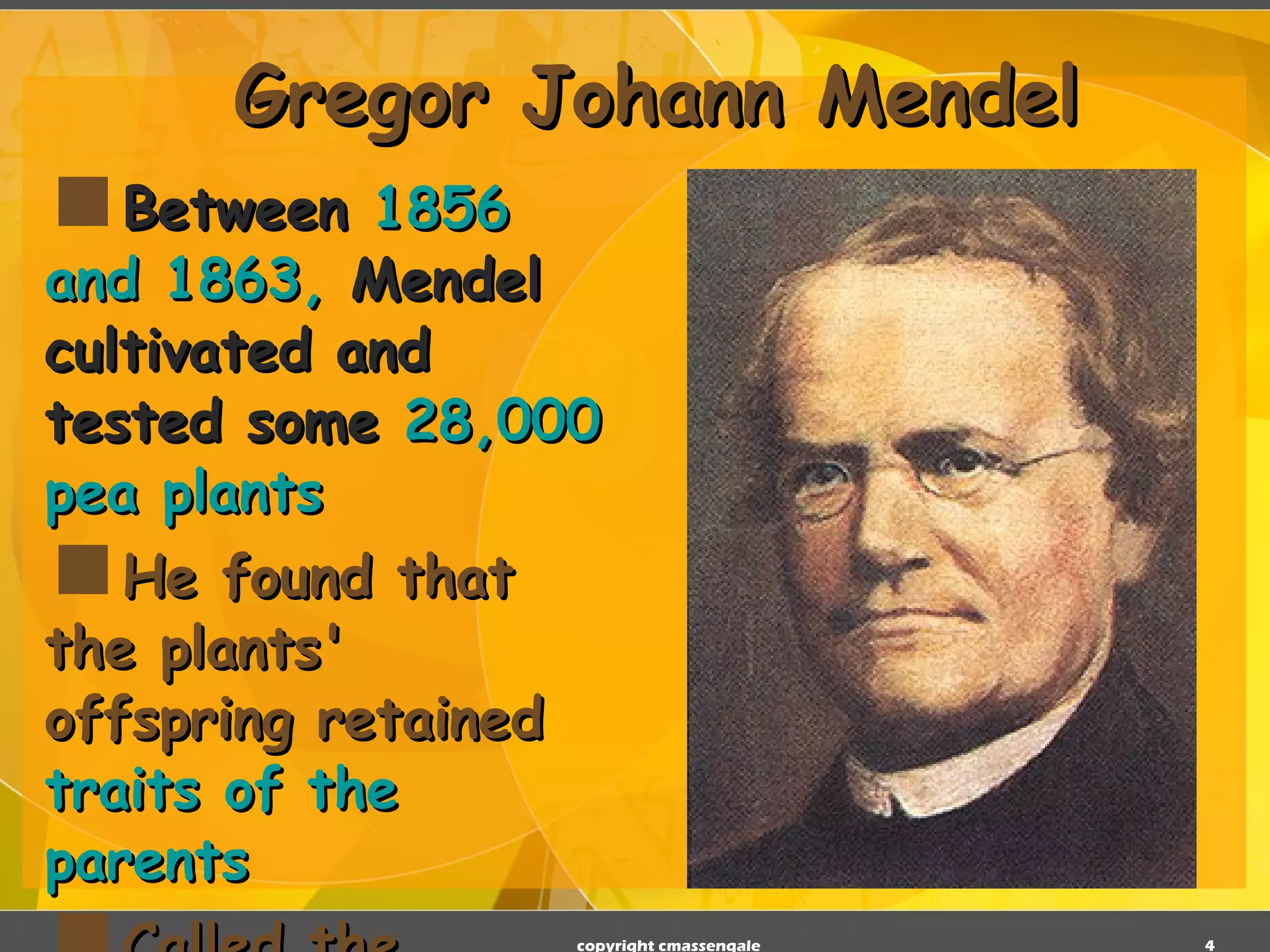
Gregor Johann Mendel Between  1856 and 1863,  Mendel cultivated and tested some  28,000 pea plants He found that the plants' offspring retained  traits of the parents Called the  “Father of Genetics" copyright cmassengale
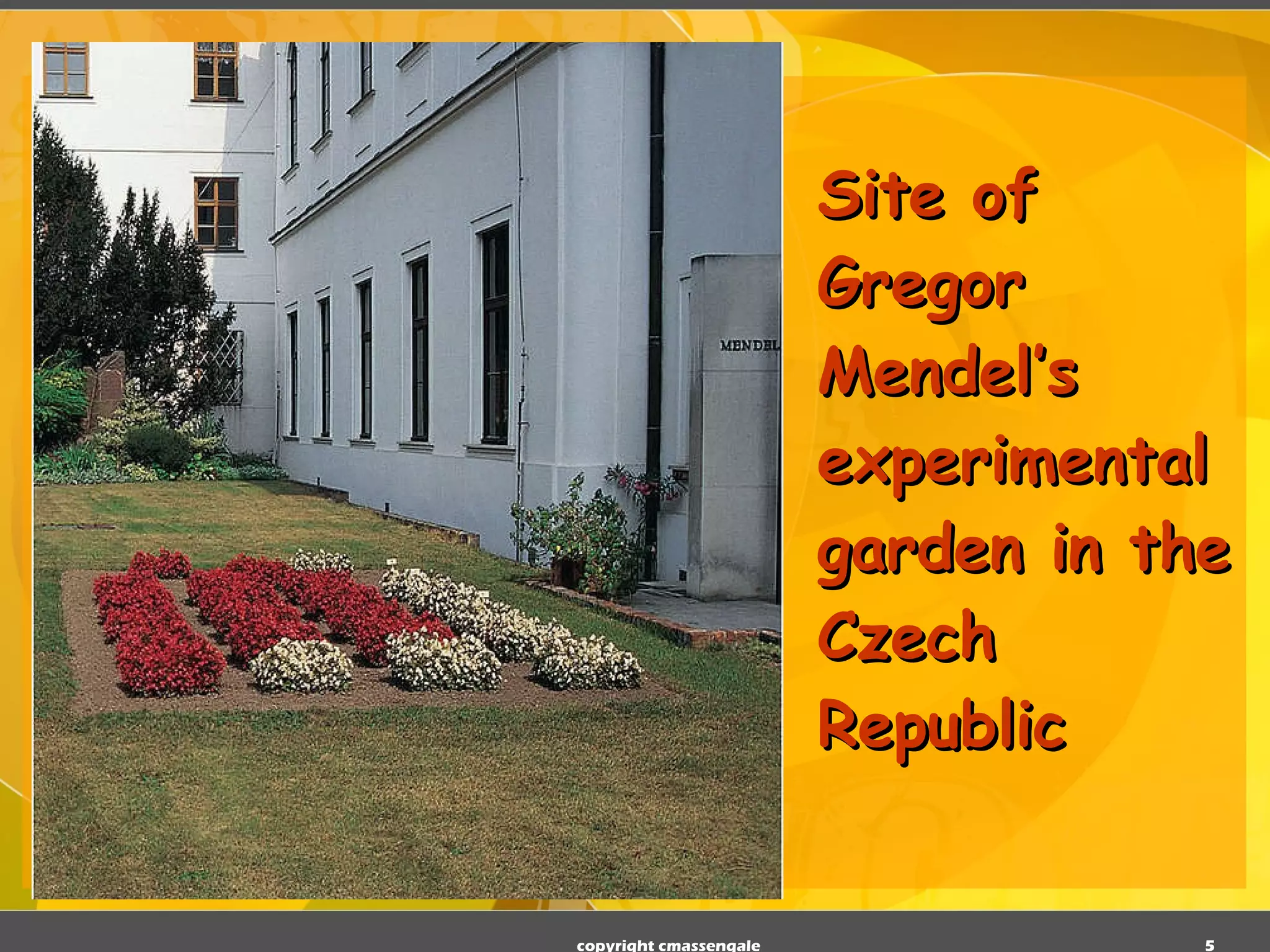
Site of Gregor Mendel’s experimental garden in the Czech Republic copyright cmassengale
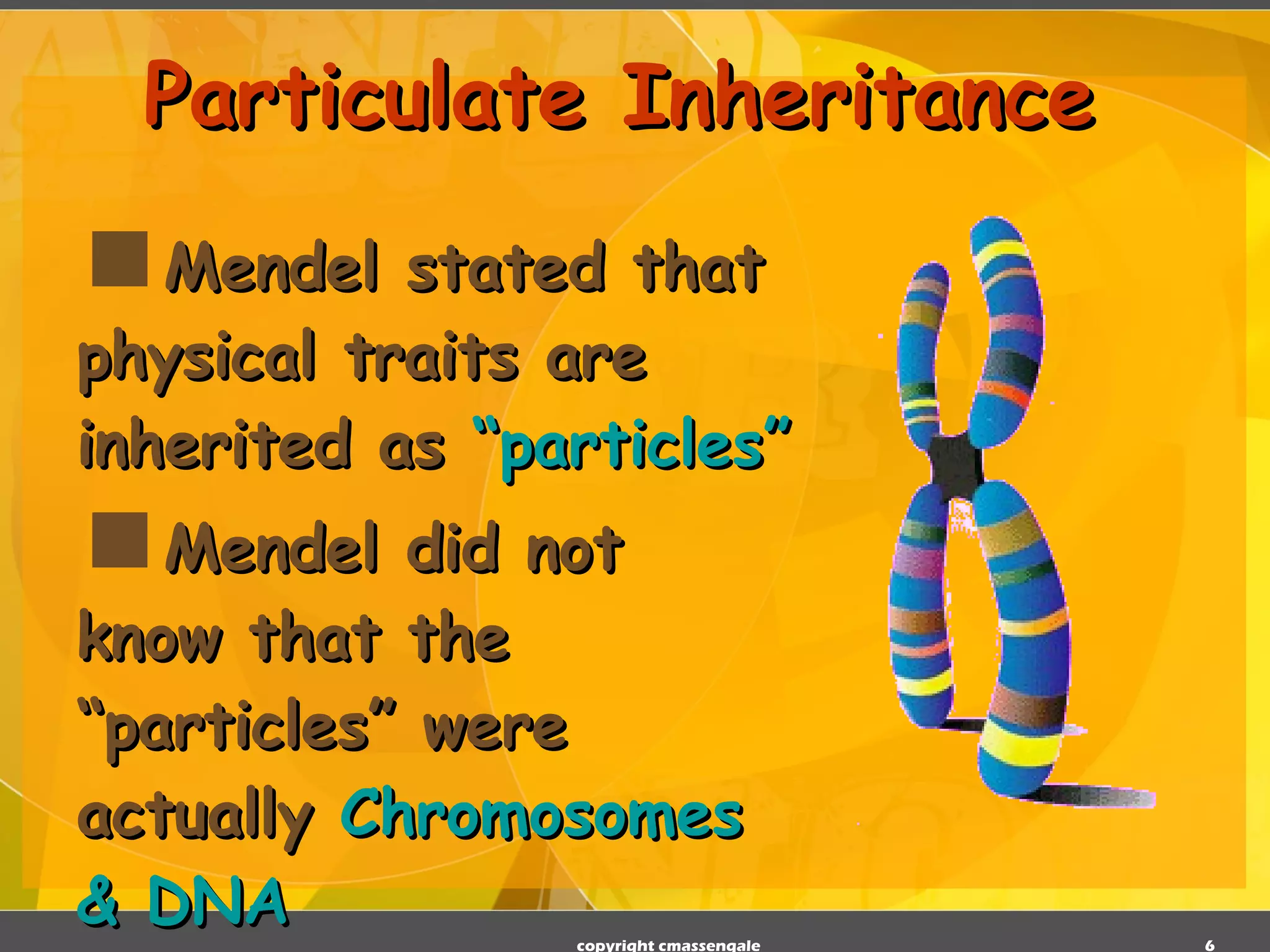
Mendel stated that physical traits are inherited as  “particles” Mendel did not know that the “particles” were actually  Chromosomes & DNA Particulate Inheritance copyright cmassengale
Genetic Terminology Trait  - any characteristic that can be passed from parent to offspring  Heredity  - passing of traits from parent to offspring  Genetics  - study of heredity  copyright cmassengale
Types of Genetic Crosses Monohybrid cross  -  cross involving a single trait e.g. flower color  Dihybrid cross  -  cross involving two traits  e.g. flower color & plant height copyright cmassengale
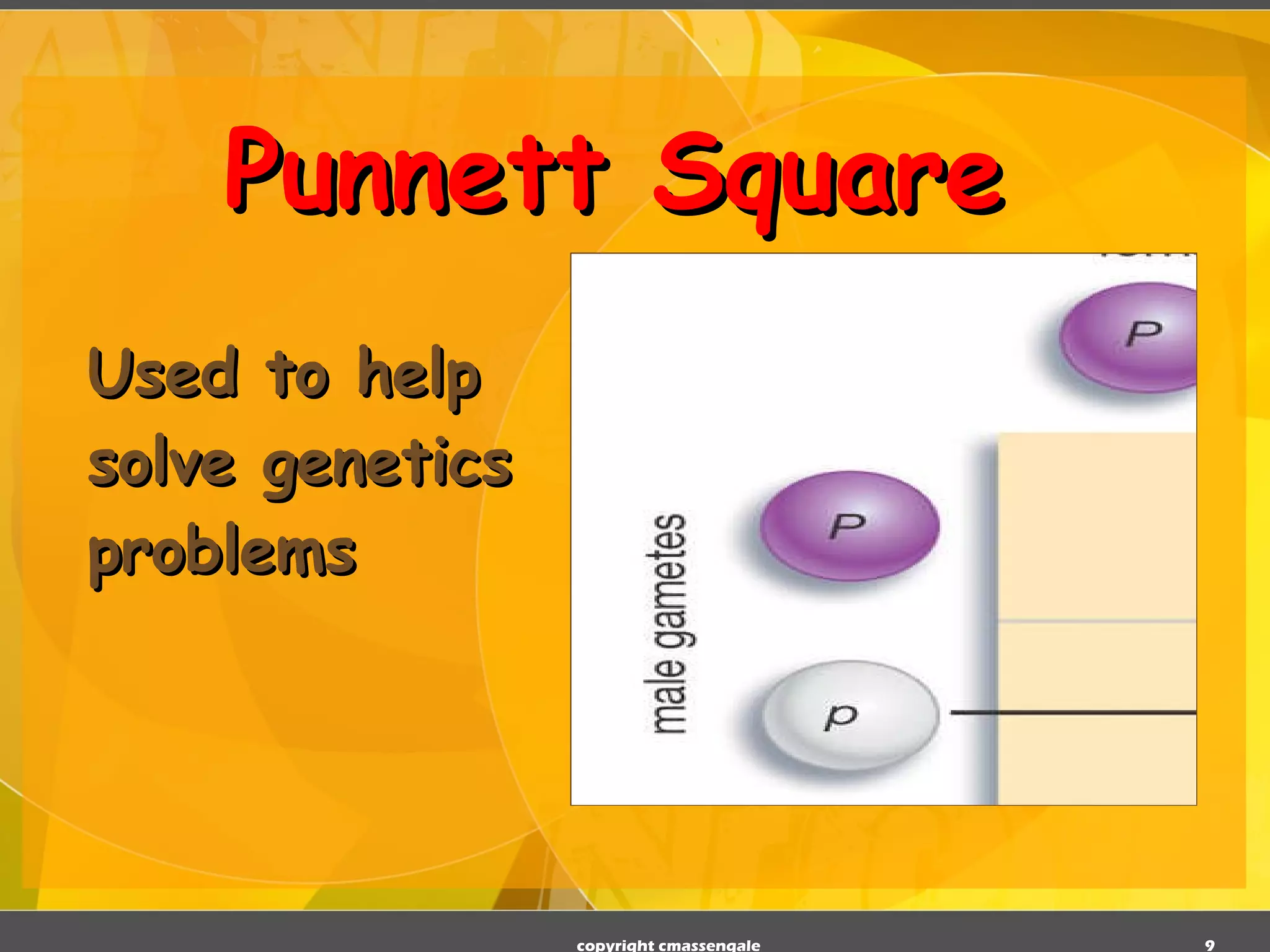
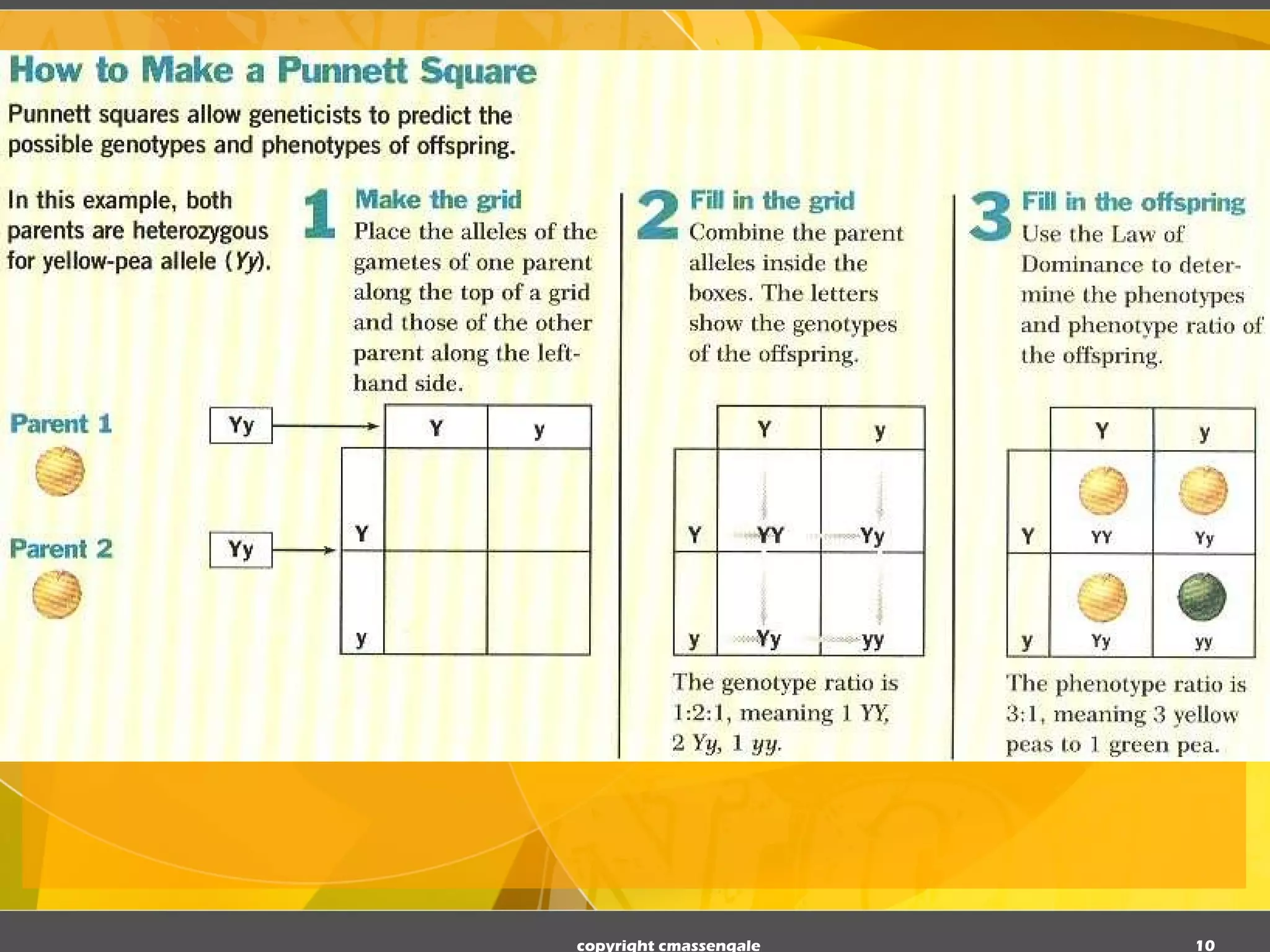
Punnett Square Used to help solve genetics problems copyright cmassengale
copyright cmassengale
Designer  “Genes” Alleles  -  two forms of a  gene  (dominant & recessive)   Dominant  -  stronger of two genes expressed in the hybrid; represented by   a   capital letter (R)   Recessive  -  gene that shows up less often in a cross; represented by a   lowercase letter (r)   copyright cmassengale
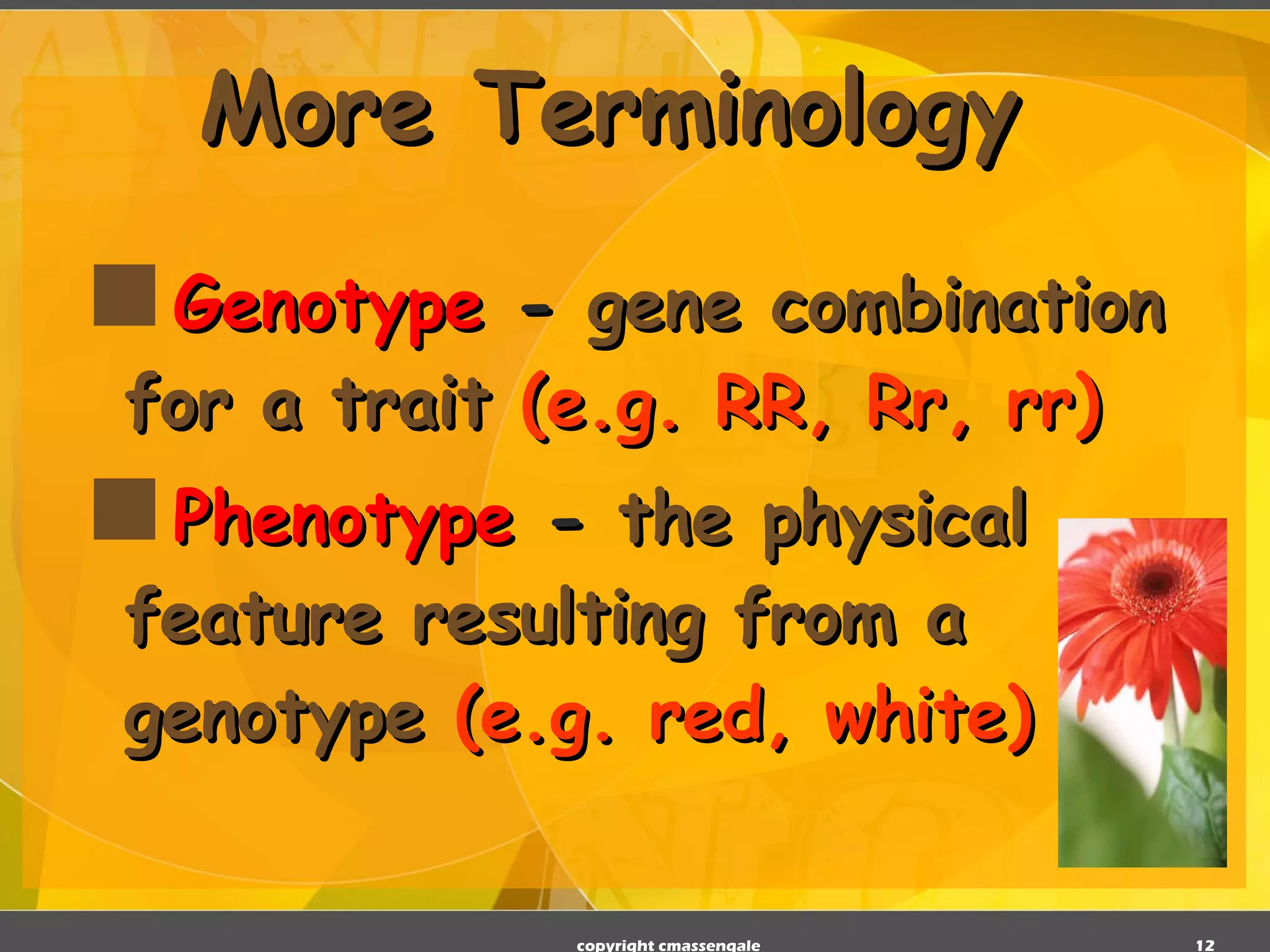
More Terminology Genotype  -  gene combination for a trait   (e.g. RR, Rr, rr)  Phenotype  -  the physical feature resulting from a genotype   (e.g. red, white)  copyright cmassengale
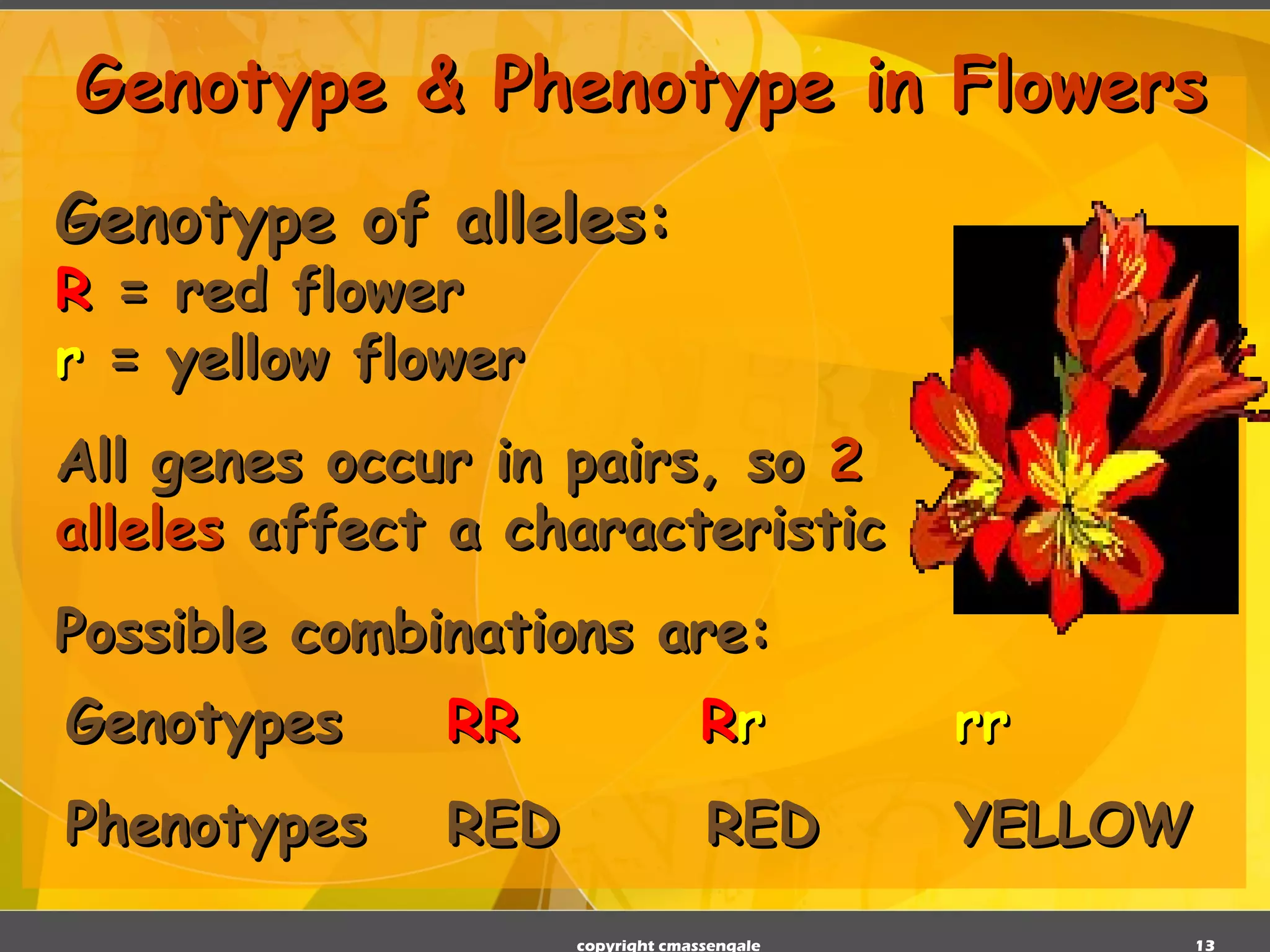
Genotype & Phenotype in Flowers Genotype of alleles: R   = red flower r   = yellow flower All genes occur in pairs, so  2   alleles  affect a characteristic Possible combinations are: Genotypes RR   R r rr Phenotypes RED  RED  YELLOW copyright cmassengale
Genotypes Homozygous   genotype - gene combination involving 2 dominant or 2 recessive genes  (e.g. RR or rr);  also called   pure    Heterozygous   genotype - gene combination of one dominant & one recessive allele    ( e.g. Rr);  also called   hybrid copyright cmassengale
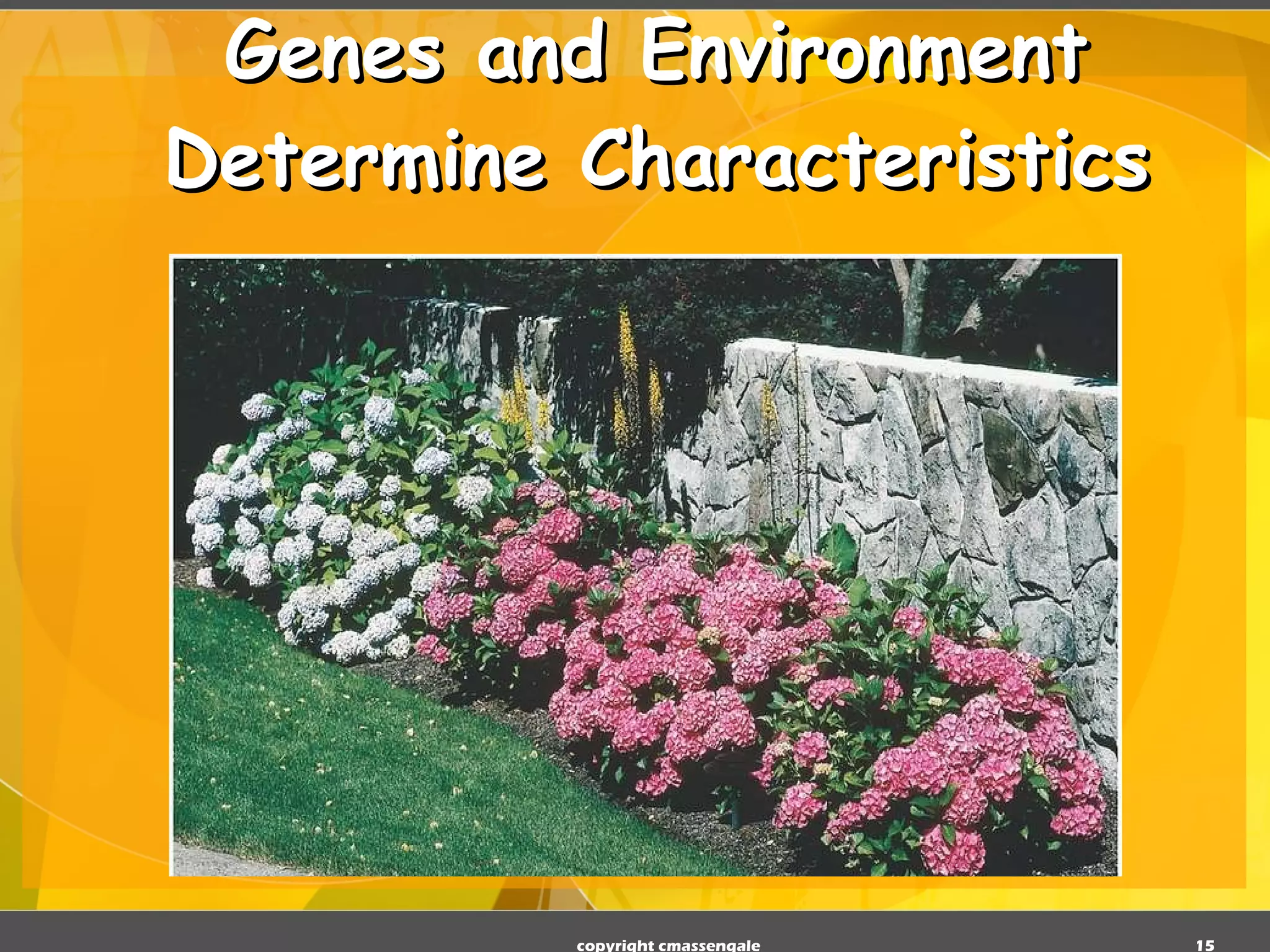
Genes and Environment Determine Characteristics copyright cmassengale
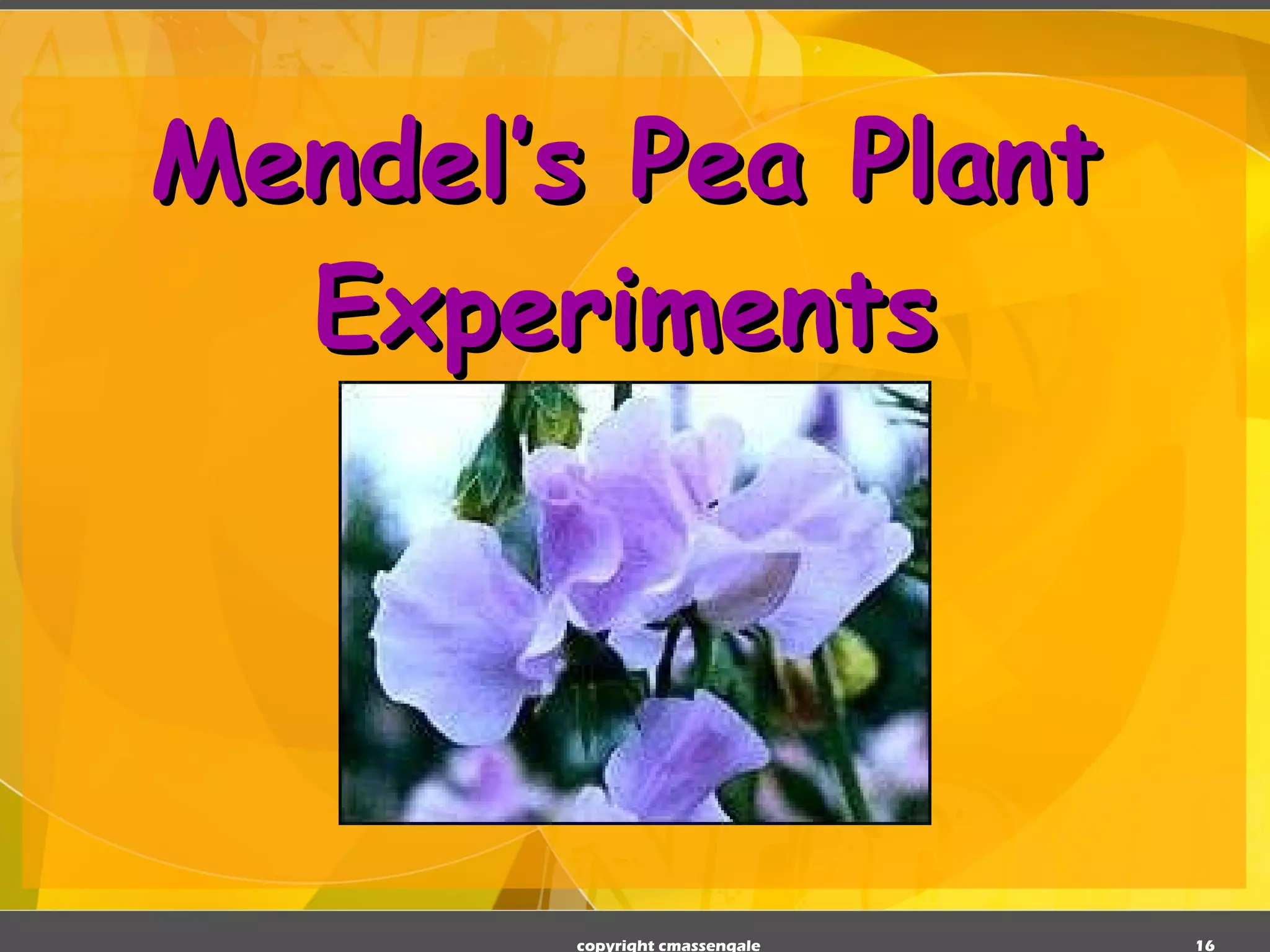
Mendel’s Pea Plant Experiments copyright cmassengale
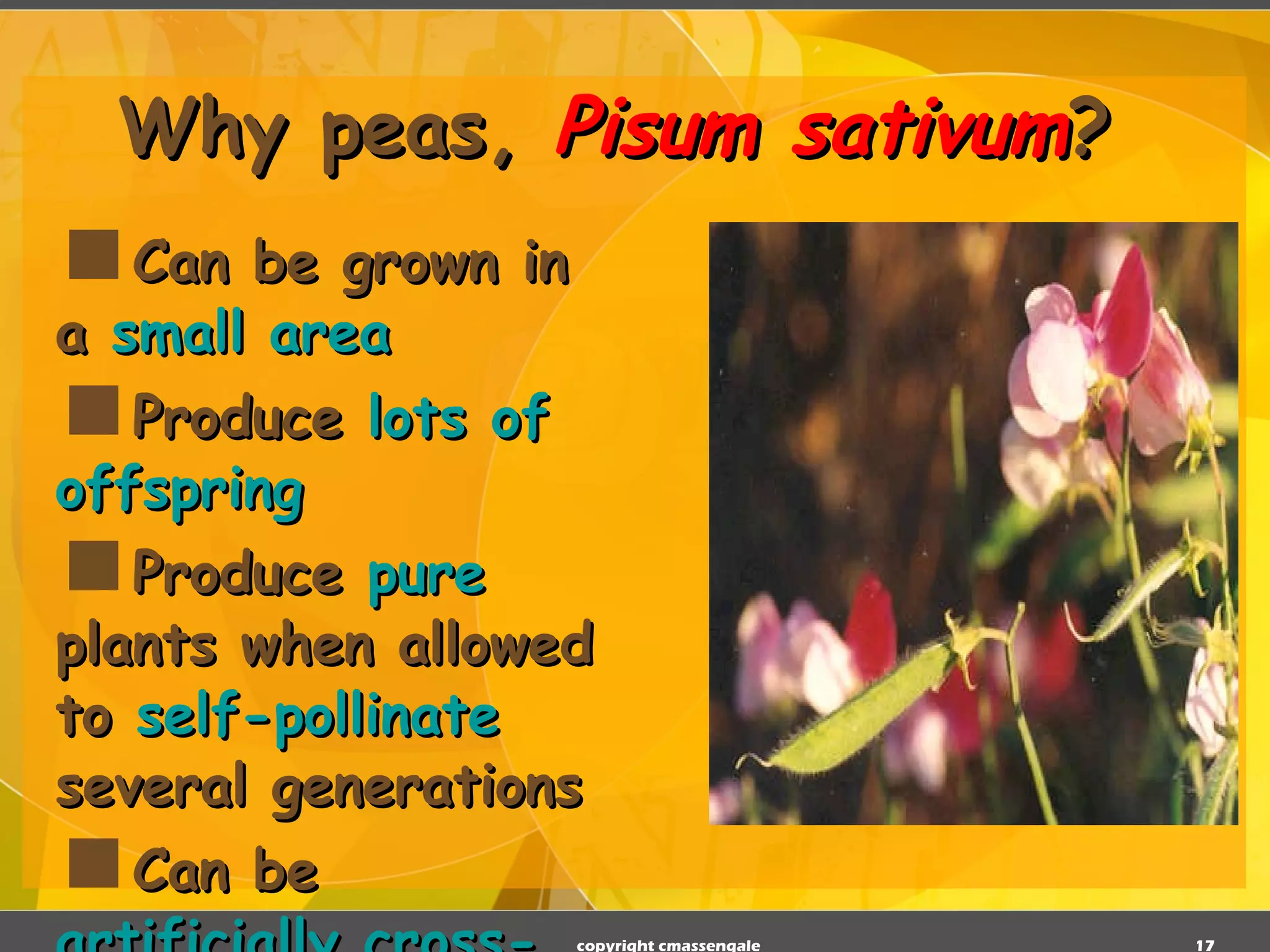
Why peas,   Pisum sativum ? Can be grown in a  small area   Produce  lots of offspring  Produce  pure  plants when allowed to  self-pollinate  several generations  Can be  artificially cross-pollinated   copyright cmassengale
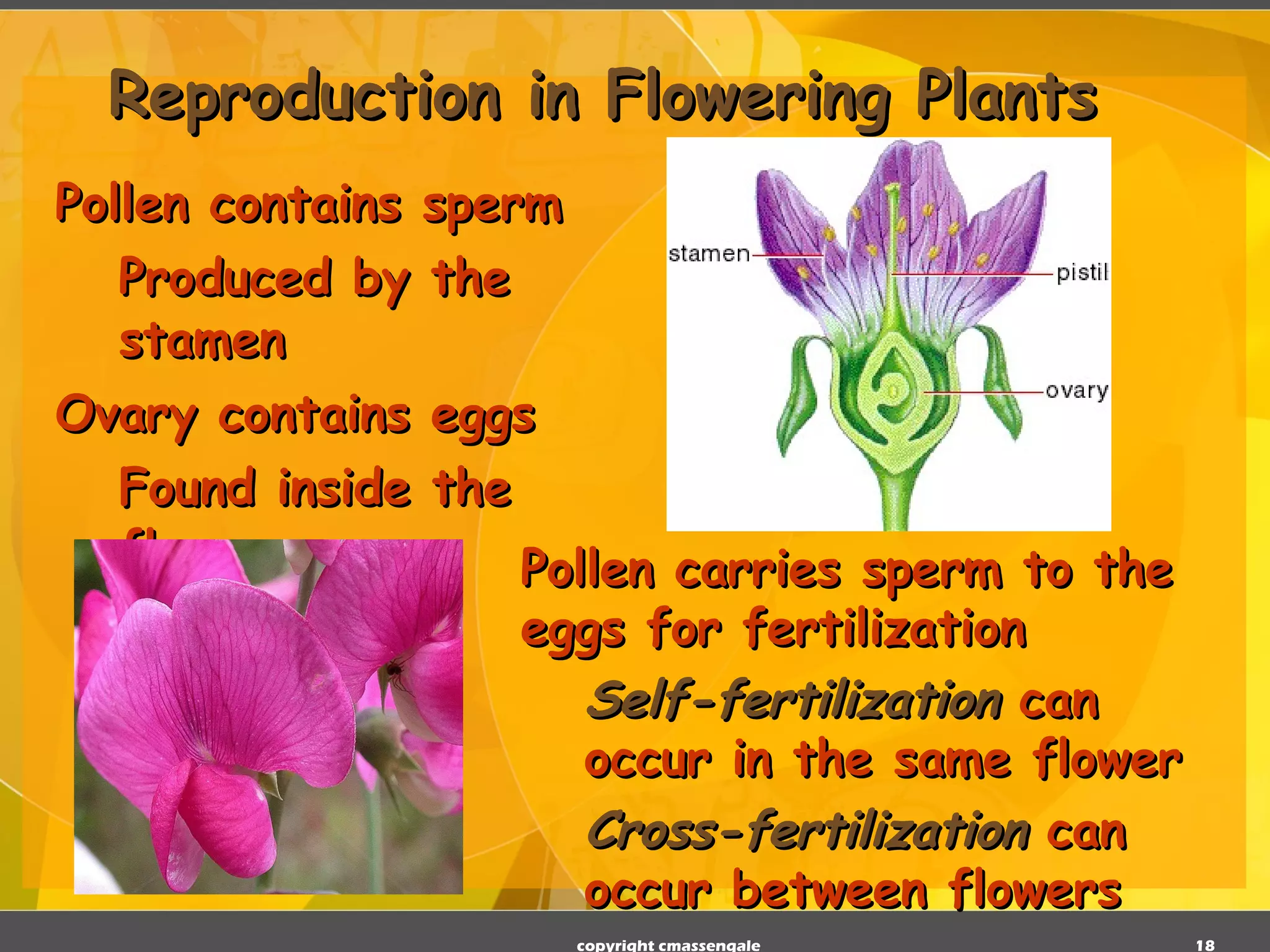
Reproduction in Flowering Plants Pollen contains sperm Produced by the stamen Ovary contains eggs Found inside the flower Pollen carries sperm to the eggs for fertilization Self-fertilization  can occur in the same flower Cross-fertilization  can occur between flowers copyright cmassengale
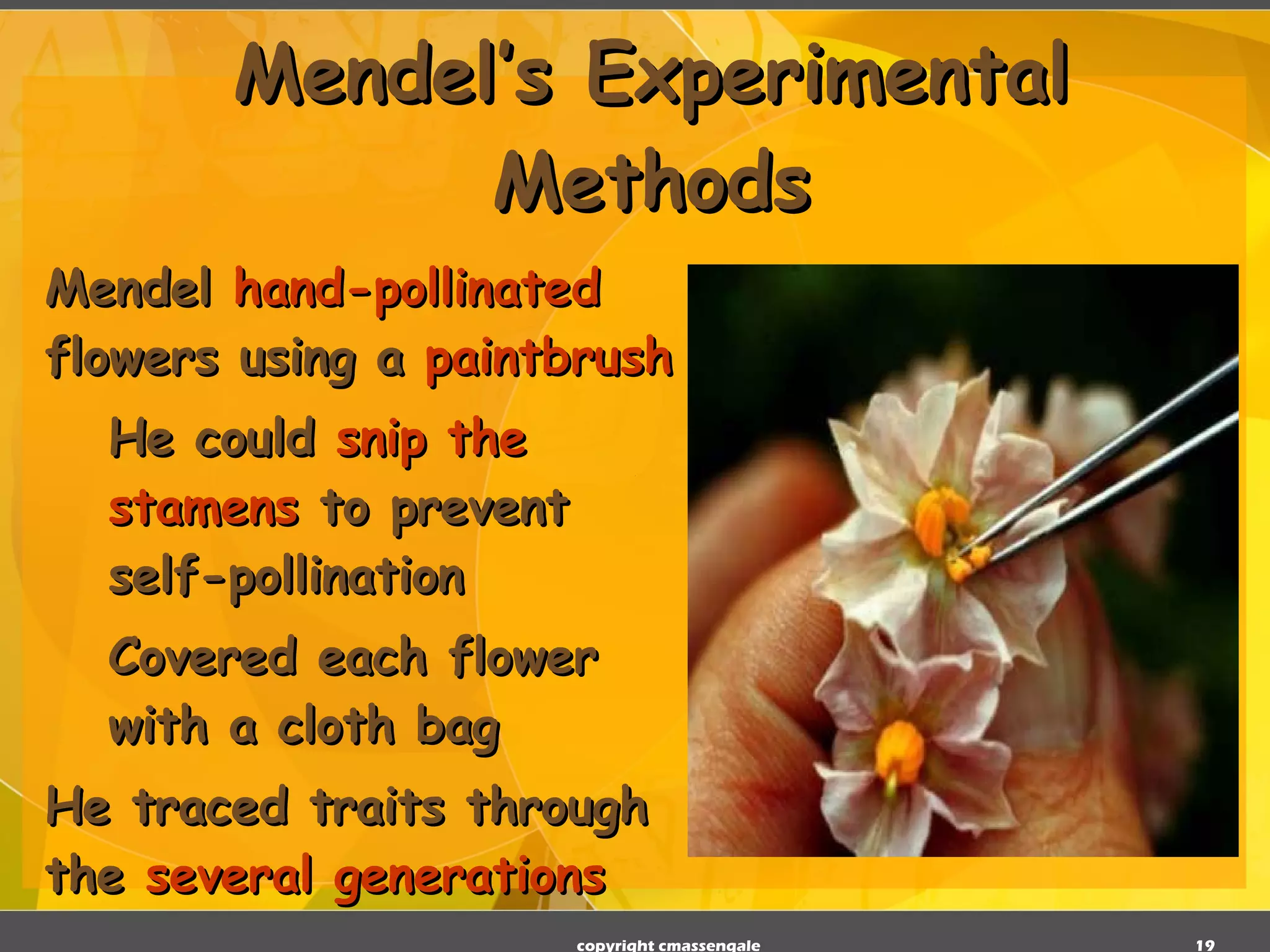
Mendel’s Experimental Methods Mendel  hand-pollinated  flowers using a  paintbrush He could  snip the stamens  to prevent self-pollination Covered each flower with a cloth bag He traced traits through the  several generations copyright cmassengale
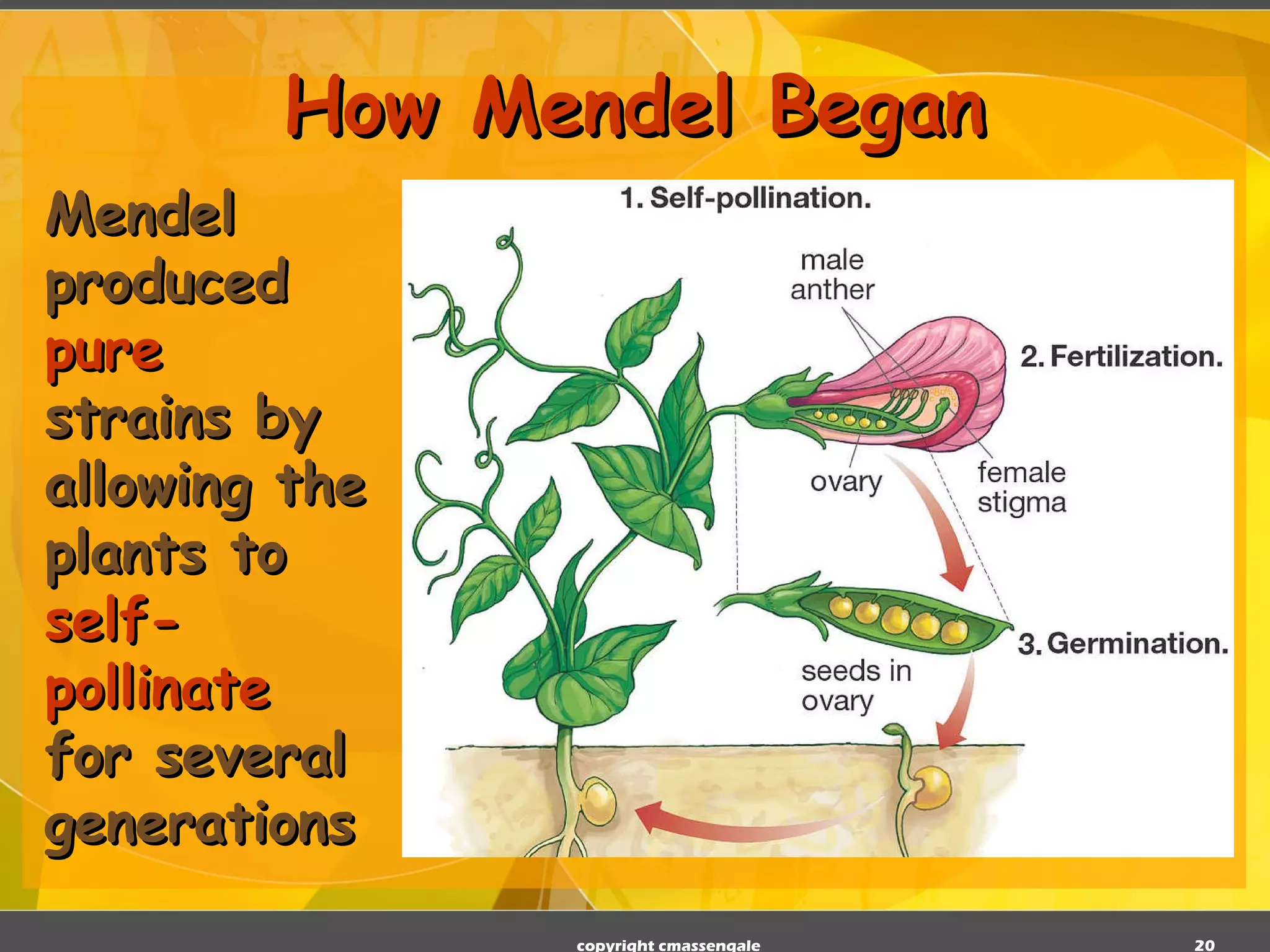
How Mendel Began Mendel produced  pure  strains by allowing the plants to  self-pollinate  for several generations copyright cmassengale
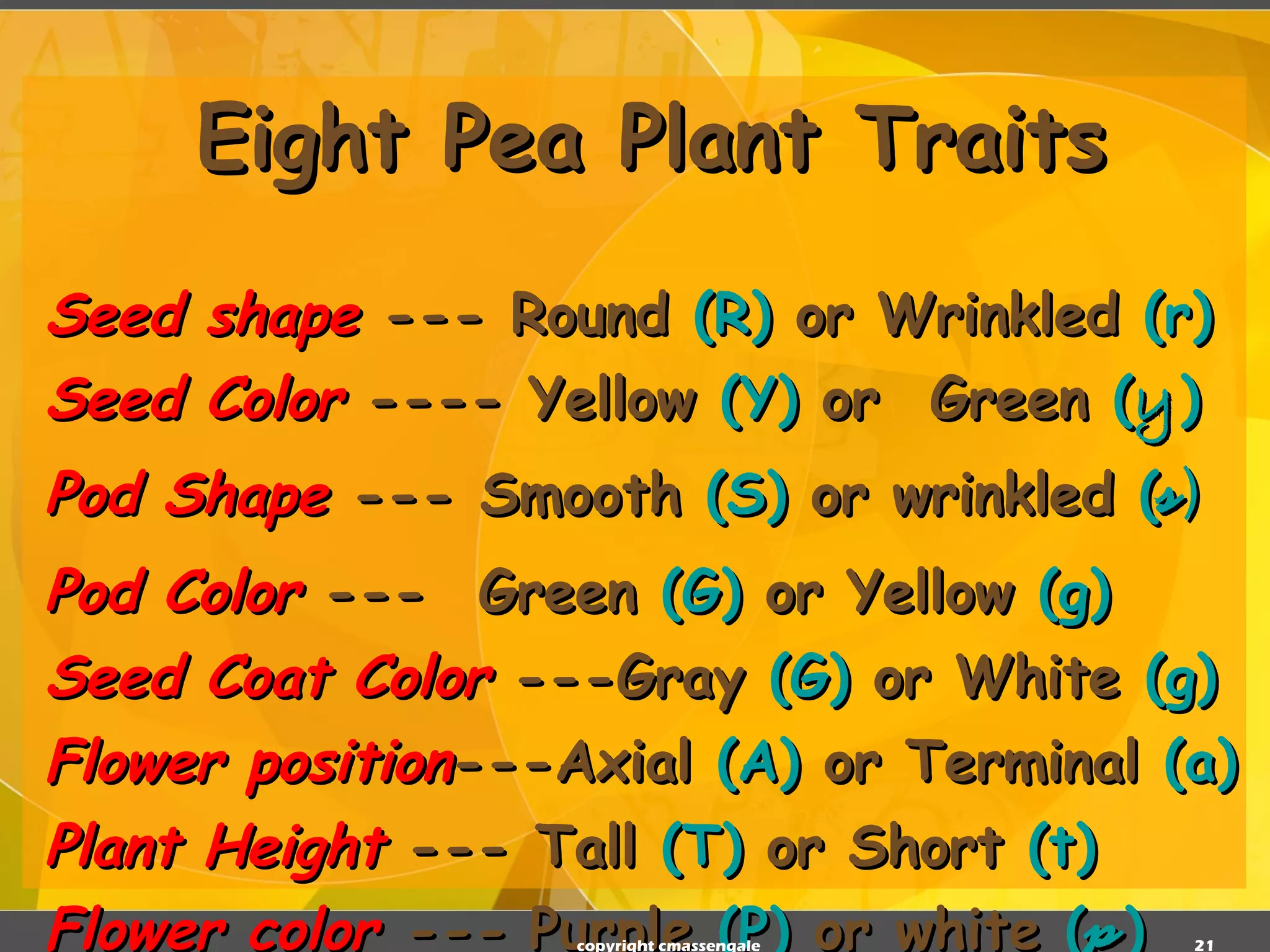
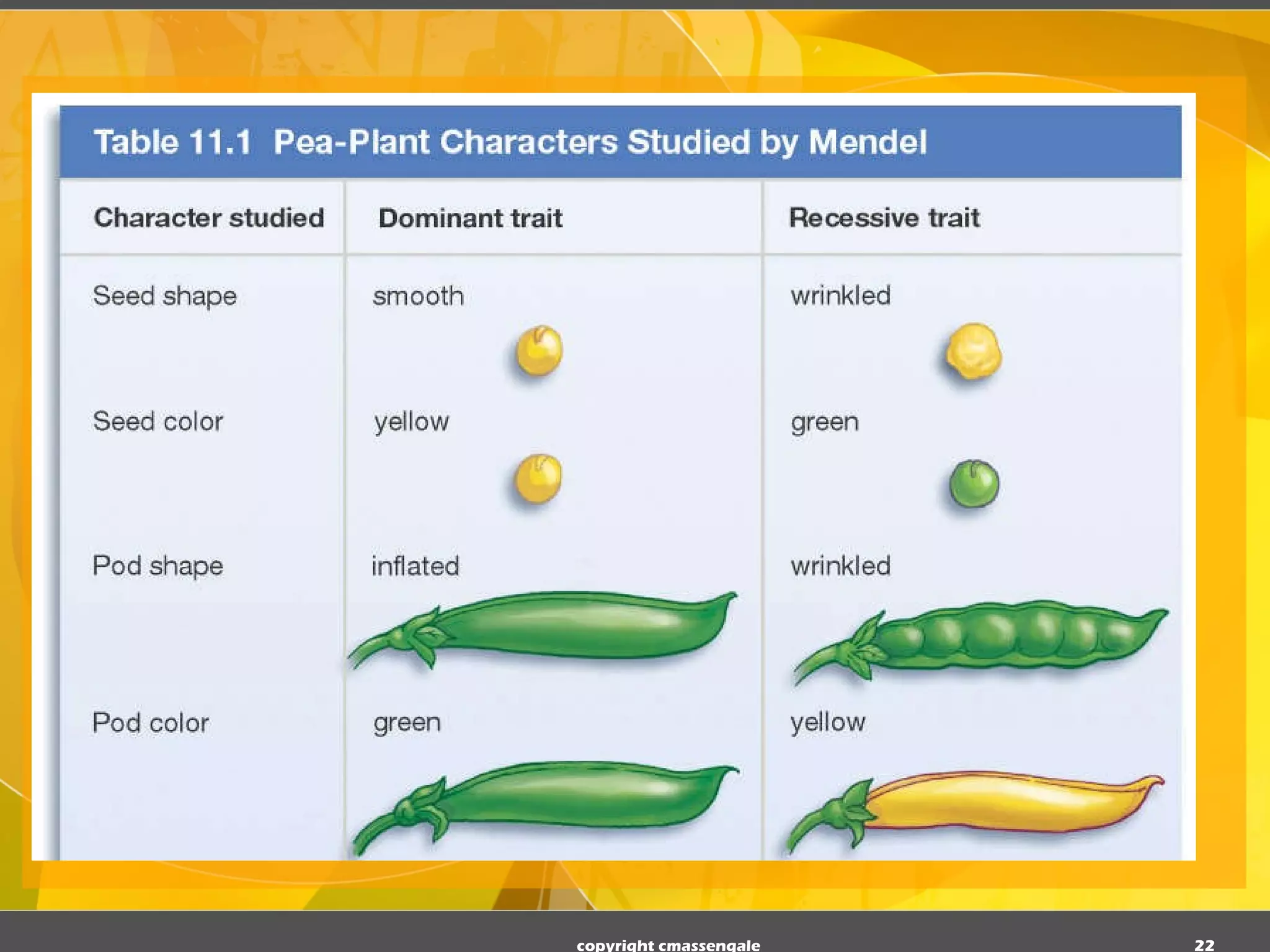
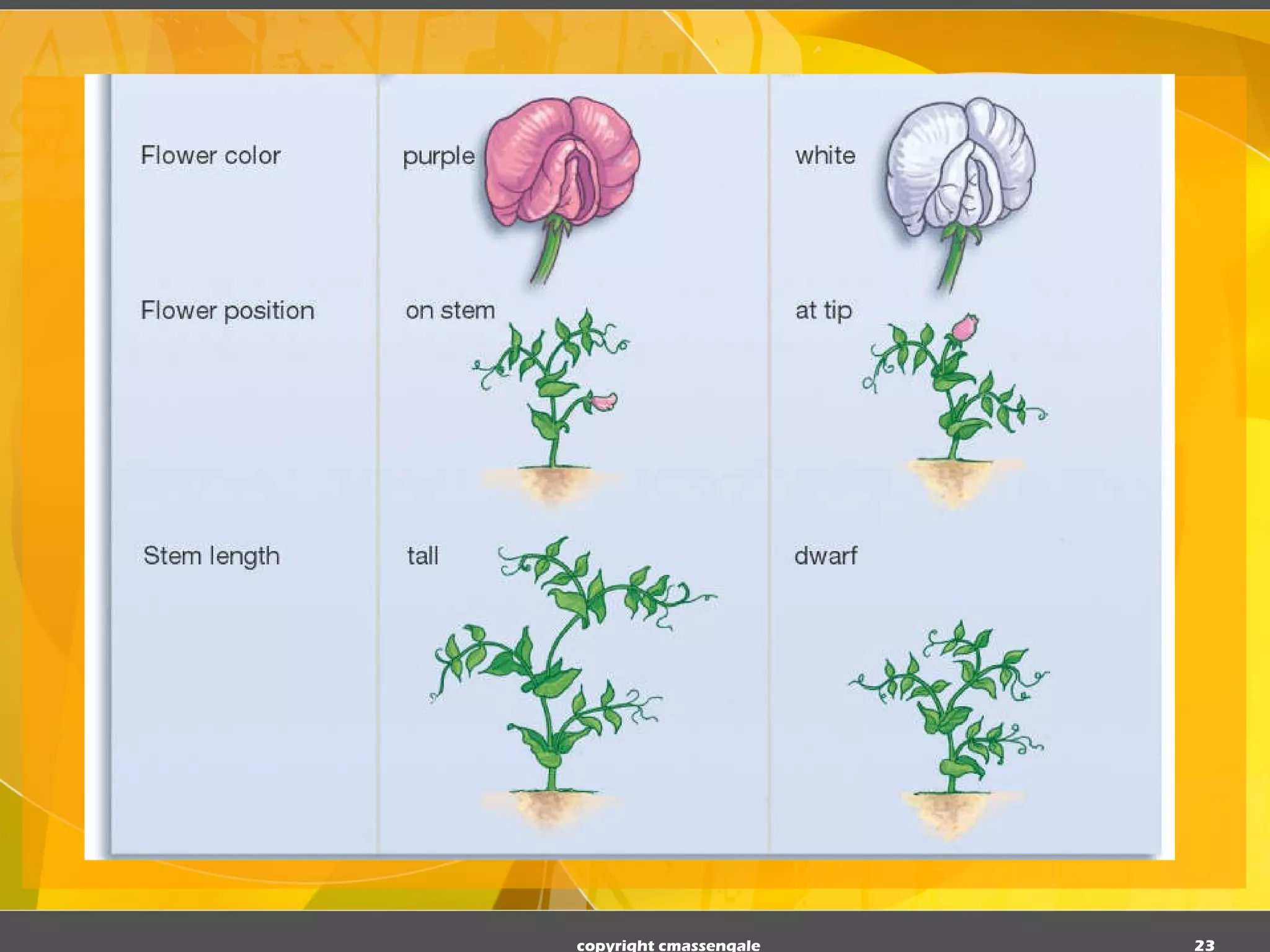
Eight Pea Plant Traits Seed shape   --- Round  (R)  or Wrinkled  (r) Seed Color   ---- Yellow  (Y)  or  Green  ( y ) Pod Shape   --- Smooth  (S)  or wrinkled  ( s ) Pod Color   ---  Green  (G)  or Yellow  (g) Seed Coat Color   ---Gray  (G)  or White  (g) Flower position ---Axial  (A)  or Terminal  (a) Plant Height   --- Tall  (T)  or Short  (t) Flower color  ---  Purple  (P)  or white  ( p ) copyright cmassengale
copyright cmassengale
Mendel’s Experimental Results copyright cmassengale
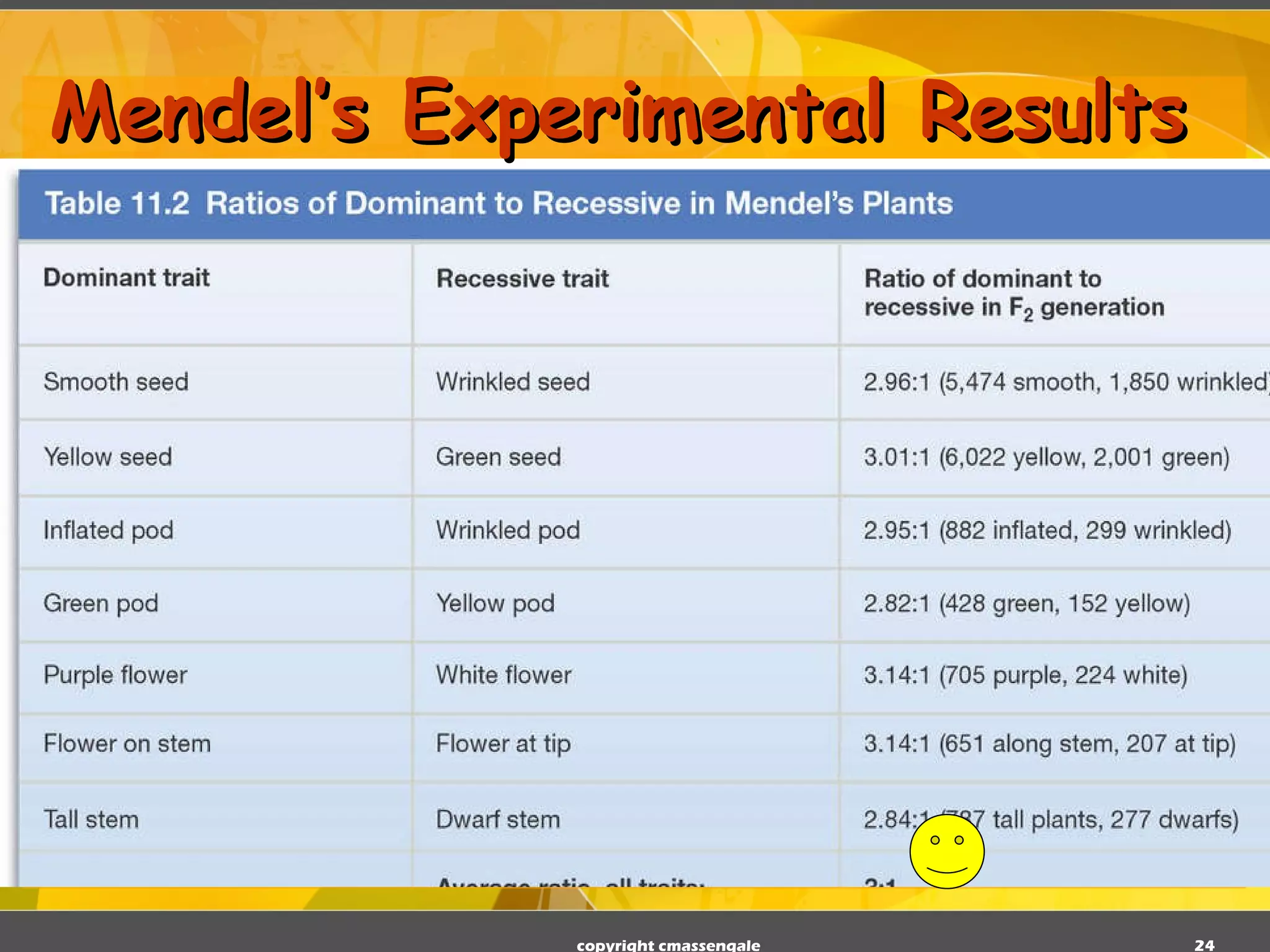
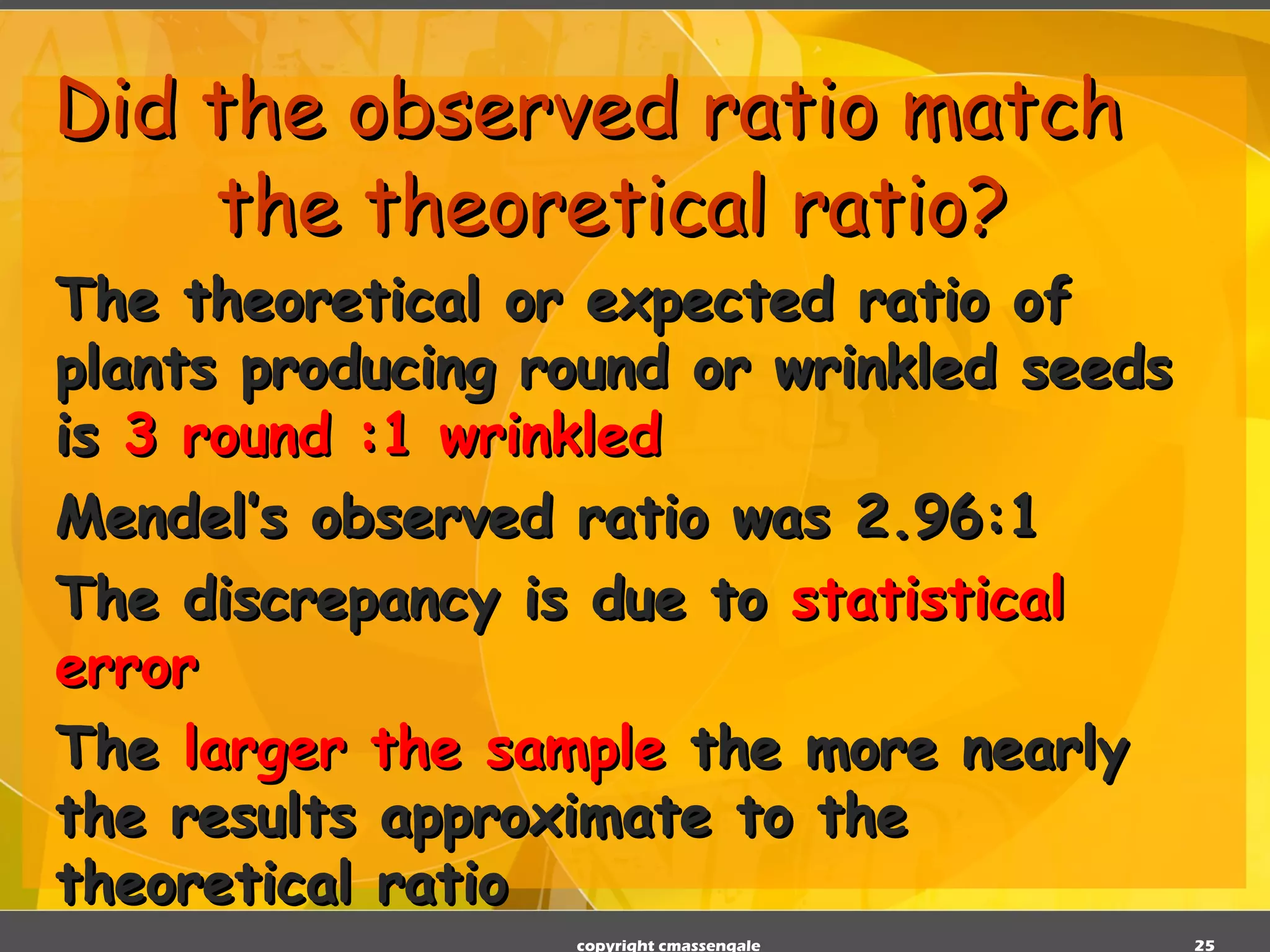
Did the observed ratio match the theoretical ratio? The theoretical or expected ratio of plants producing round or wrinkled seeds is  3 round :1 wrinkled Mendel’s observed ratio was 2.96:1 The discrepancy is due to  statistical error The  larger the sample  the more nearly the results approximate to the theoretical ratio copyright cmassengale
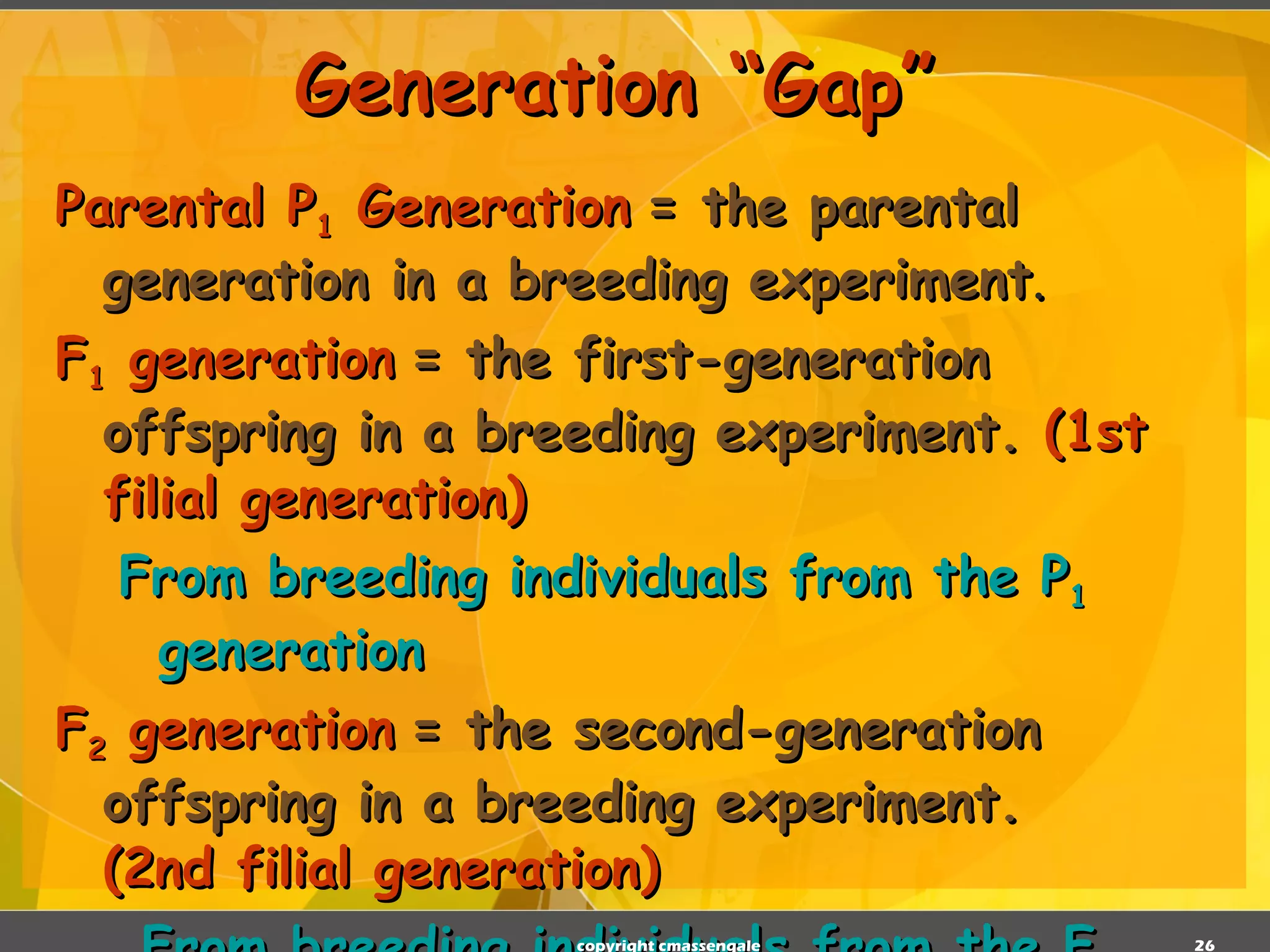
Generation “Gap” Parental P 1  Generation   = the parental generation in a breeding experiment . F 1  generation   = the first-generation offspring in a breeding experiment.  (1st filial generation) From breeding individuals from the P 1  generation F 2  generation   = the second-generation offspring in a breeding experiment.  (2nd filial generation) From breeding individuals from the F 1  generation copyright cmassengale
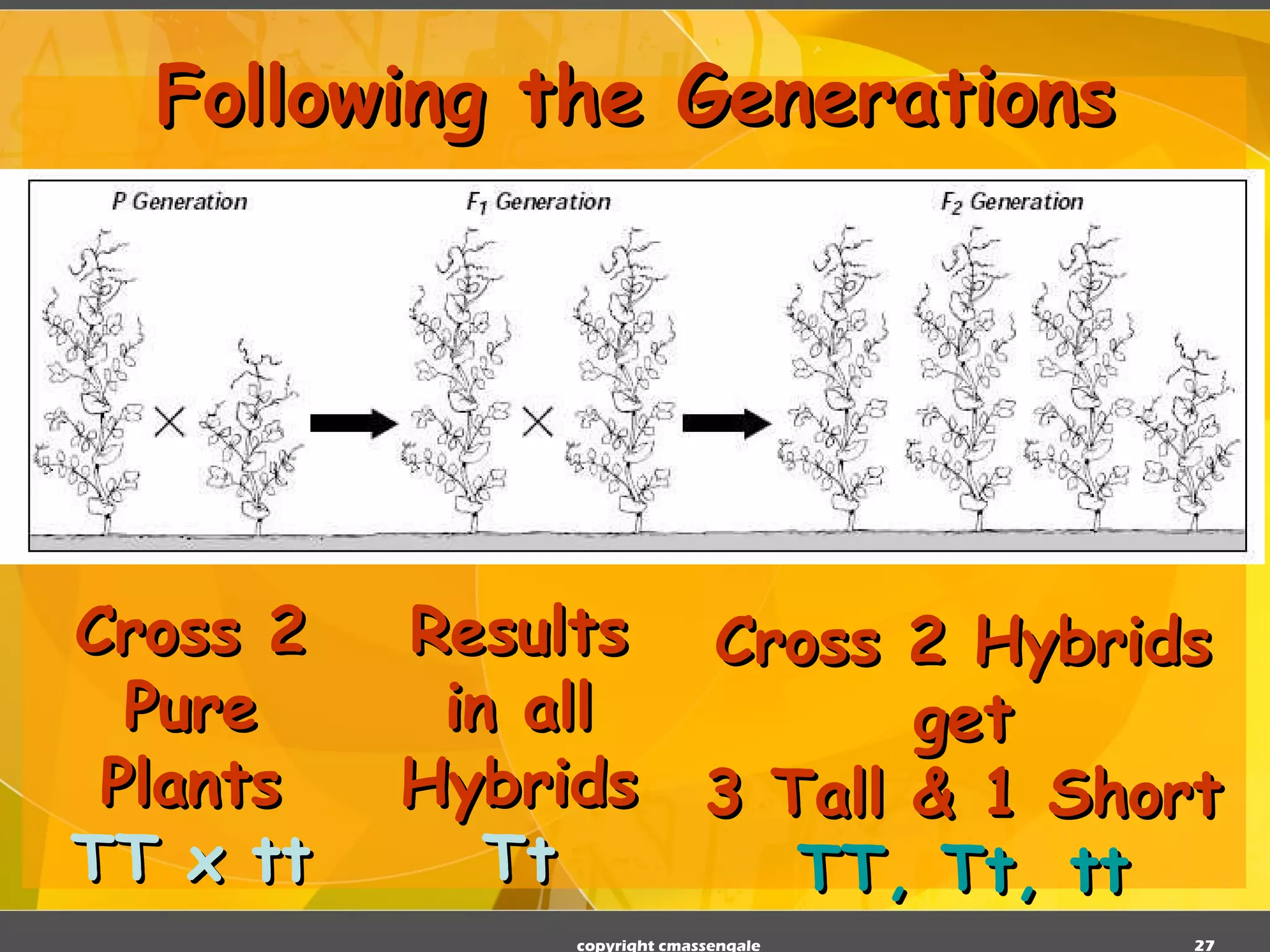
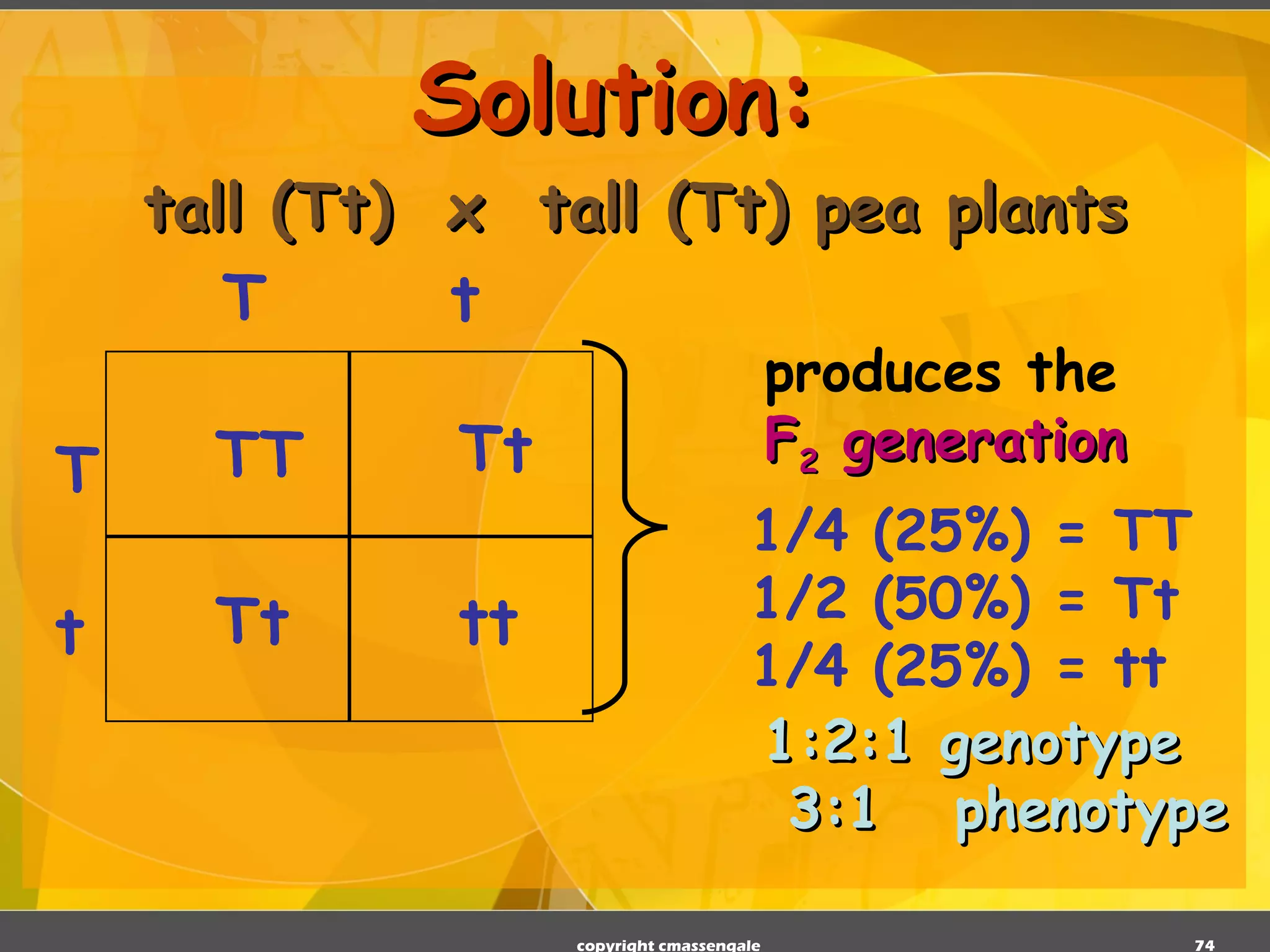
Following the Generations Cross 2 Pure Plants TT x tt Results in all Hybrids Tt Cross 2 Hybrids get 3 Tall & 1 Short TT, Tt, tt copyright cmassengale
Monohybrid Crosses copyright cmassengale
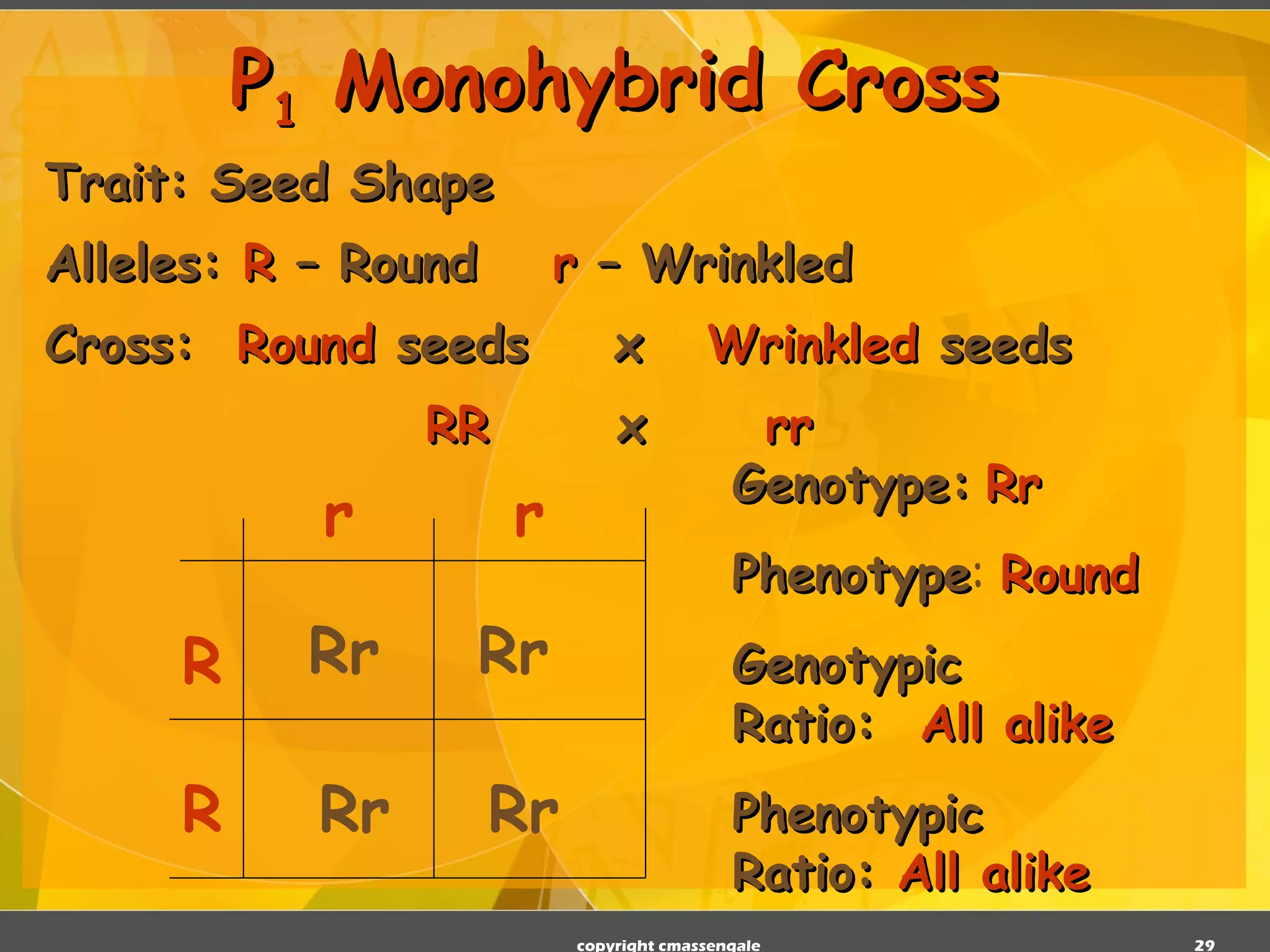
Trait: Seed Shape Alleles:  R  – Round r  – Wrinkled Cross:  Round   seeds   x   Wrinkled  seeds RR   x   rr P 1  Monohybrid Cross R R r r Rr Rr Rr Rr Genotype:   Rr Phenotype :   Round Genotypic Ratio:   All alike Phenotypic Ratio:  All alike copyright cmassengale
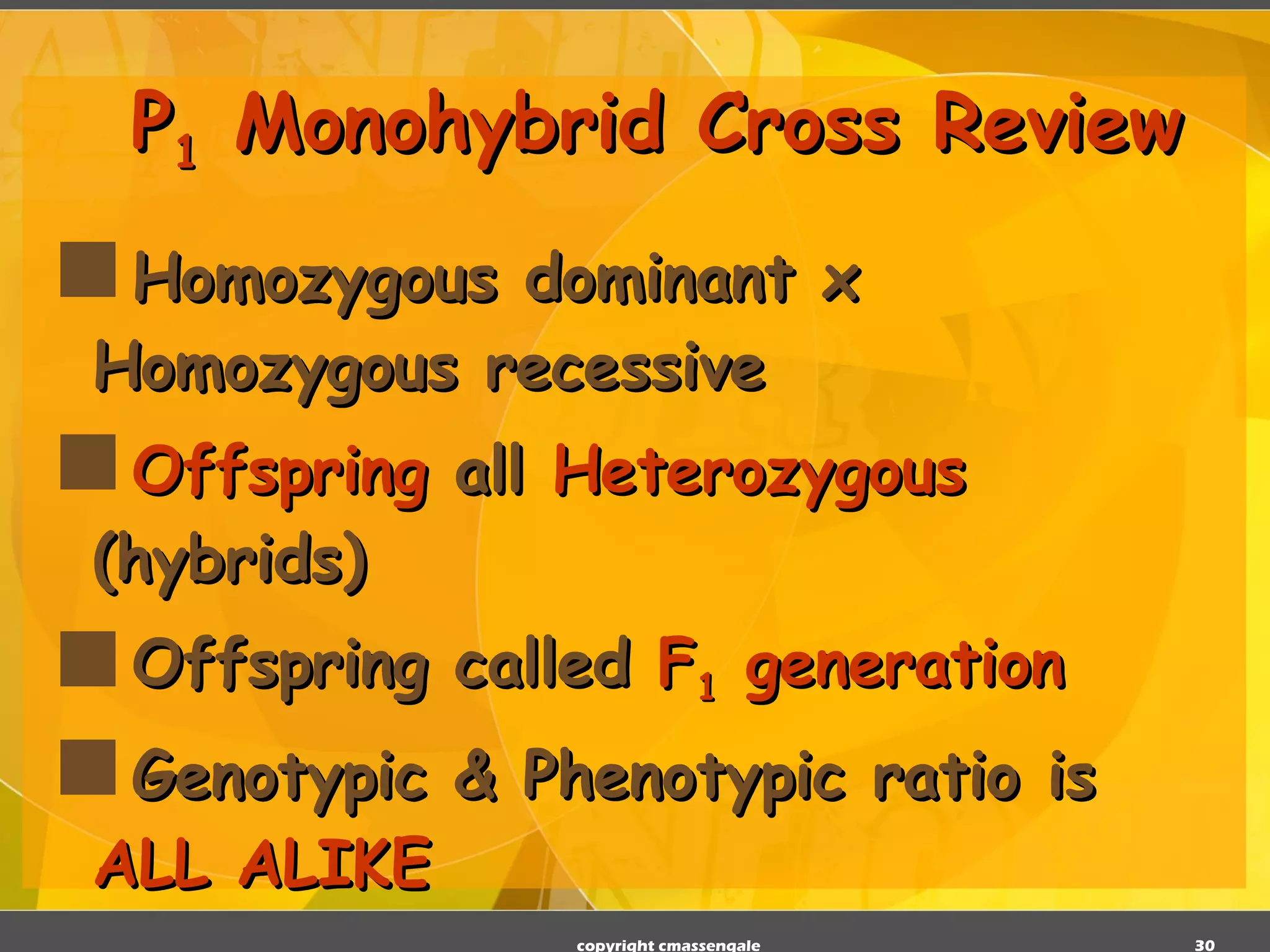
P 1  Monohybrid Cross Review Homozygous dominant x Homozygous recessive Offspring   all   Heterozygous   (hybrids) Offspring called   F 1  generation Genotypic & Phenotypic ratio is   ALL ALIKE copyright cmassengale
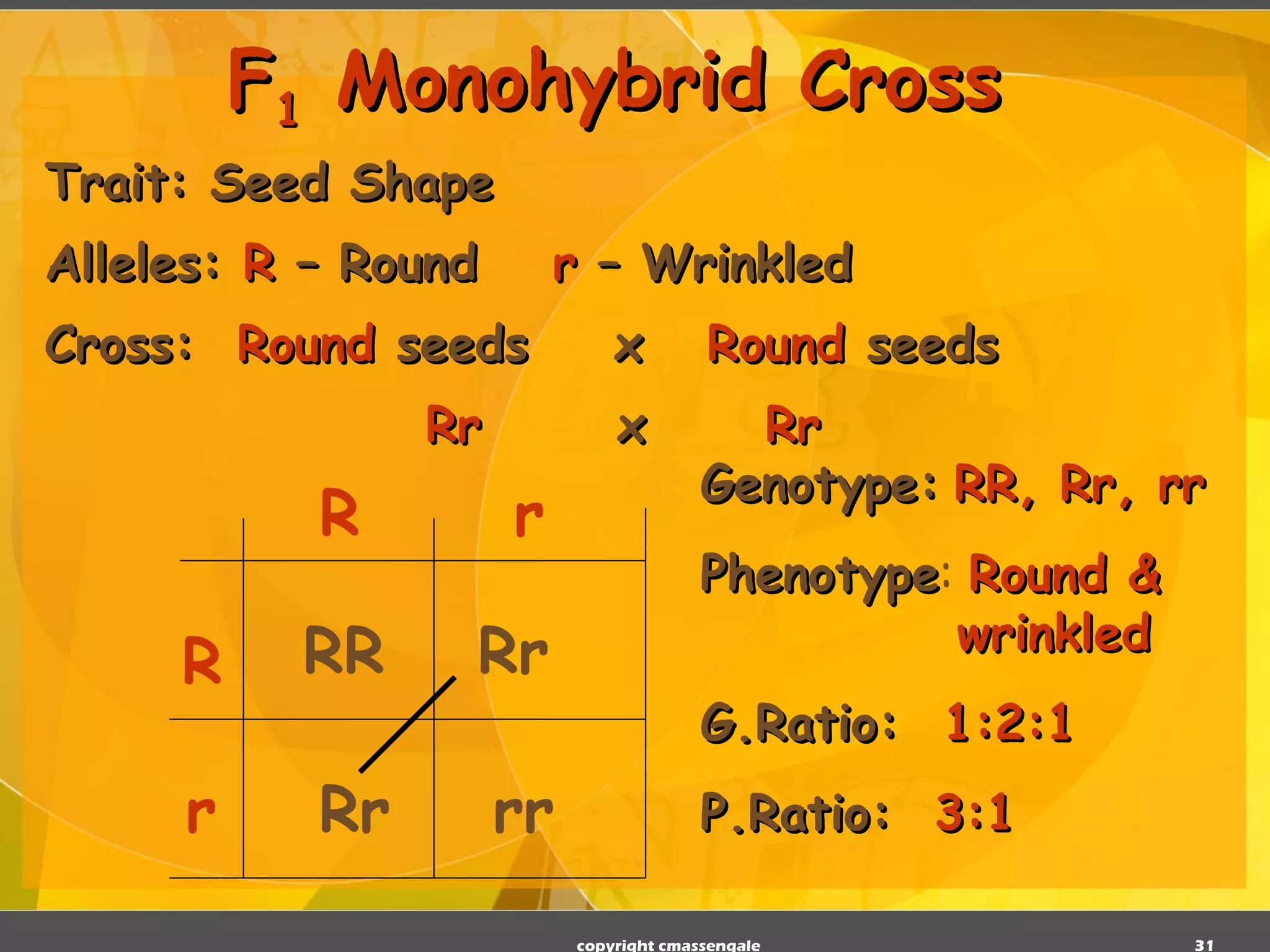
Trait: Seed Shape Alleles:  R  – Round r  – Wrinkled Cross:  Round   seeds  x   Round  seeds Rr   x   Rr F 1  Monohybrid Cross R r r R RR rr Rr Rr Genotype:   RR, Rr, rr Phenotype :   Round &   wrinkled G.Ratio:   1:2:1 P.Ratio:   3:1 copyright cmassengale
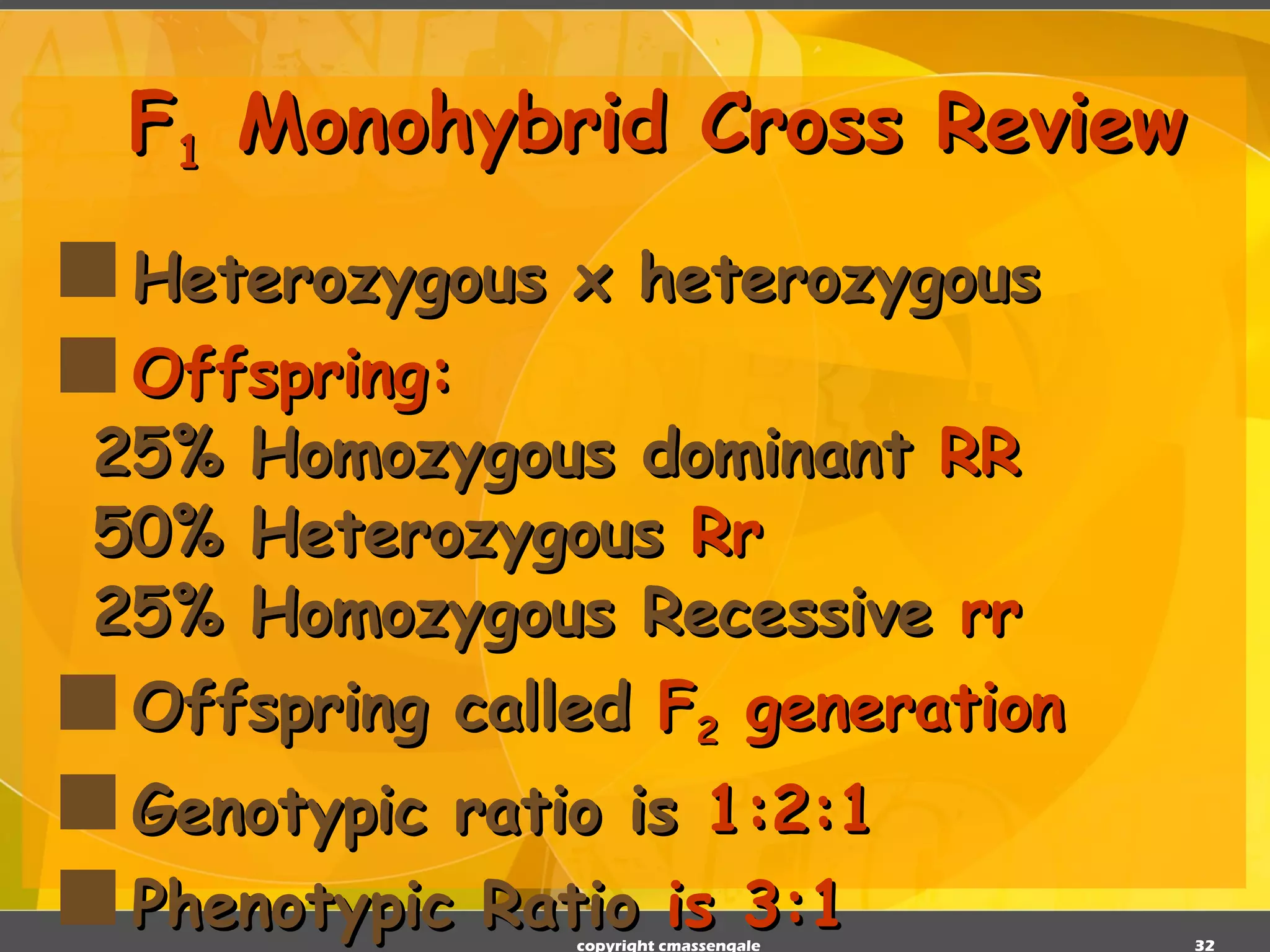
F 1  Monohybrid Cross Review Heterozygous x heterozygous Offspring: 25% Homozygous dominant   RR 50% Heterozygous   Rr 25% Homozygous Recessive   rr Offspring called   F 2  generation Genotypic ratio is   1:2:1 Phenotypic Ratio  is 3:1 copyright cmassengale
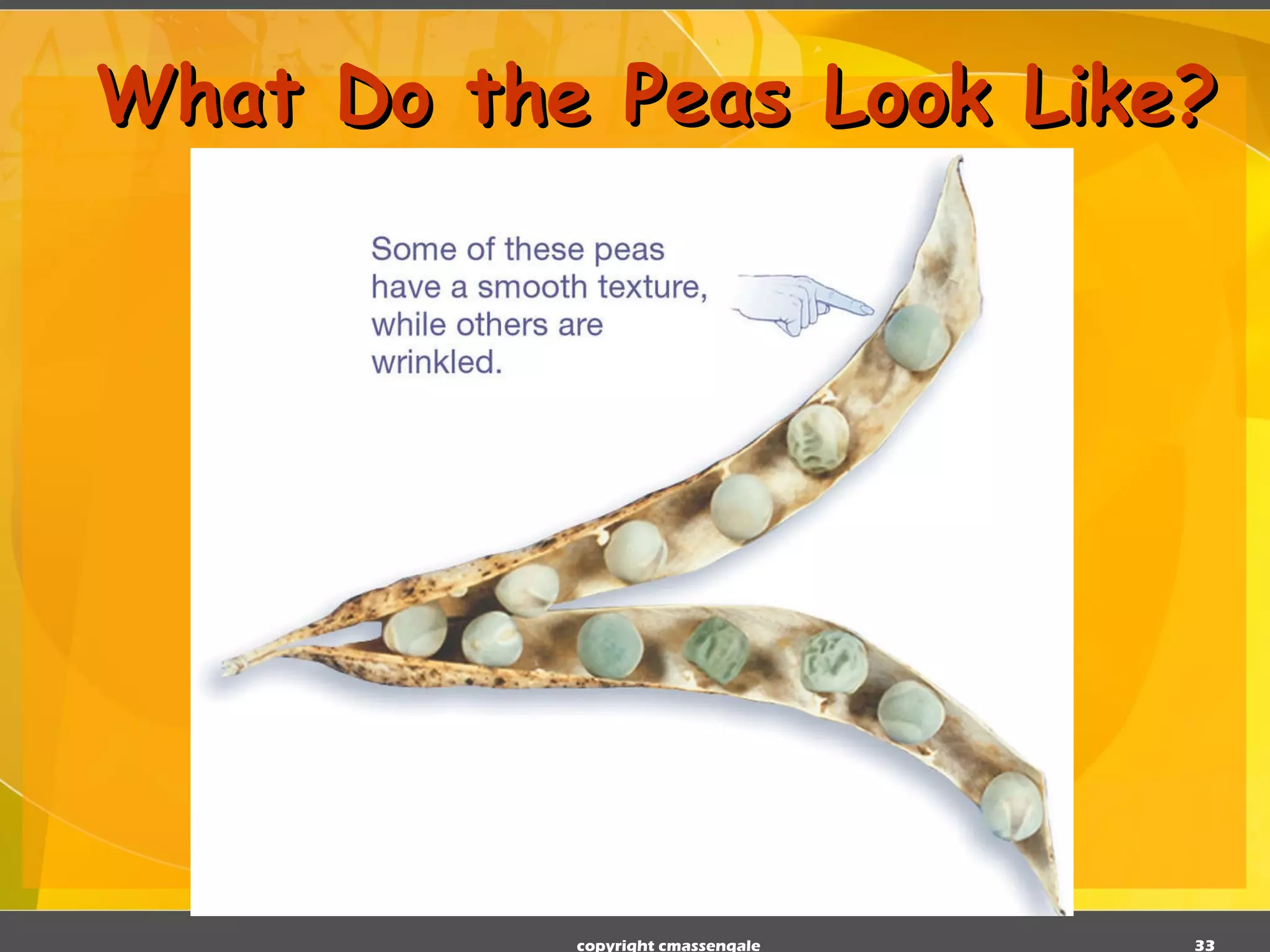
What Do the Peas Look Like? copyright cmassengale
… And Now the Test Cross Mendel then crossed a  pure  & a  hybrid  from his  F 2  generation This is known as an  F 2  or test cross There are  two  possible testcrosses: Homozygous dominant x Hybrid Homozygous recessive x Hybrid copyright cmassengale
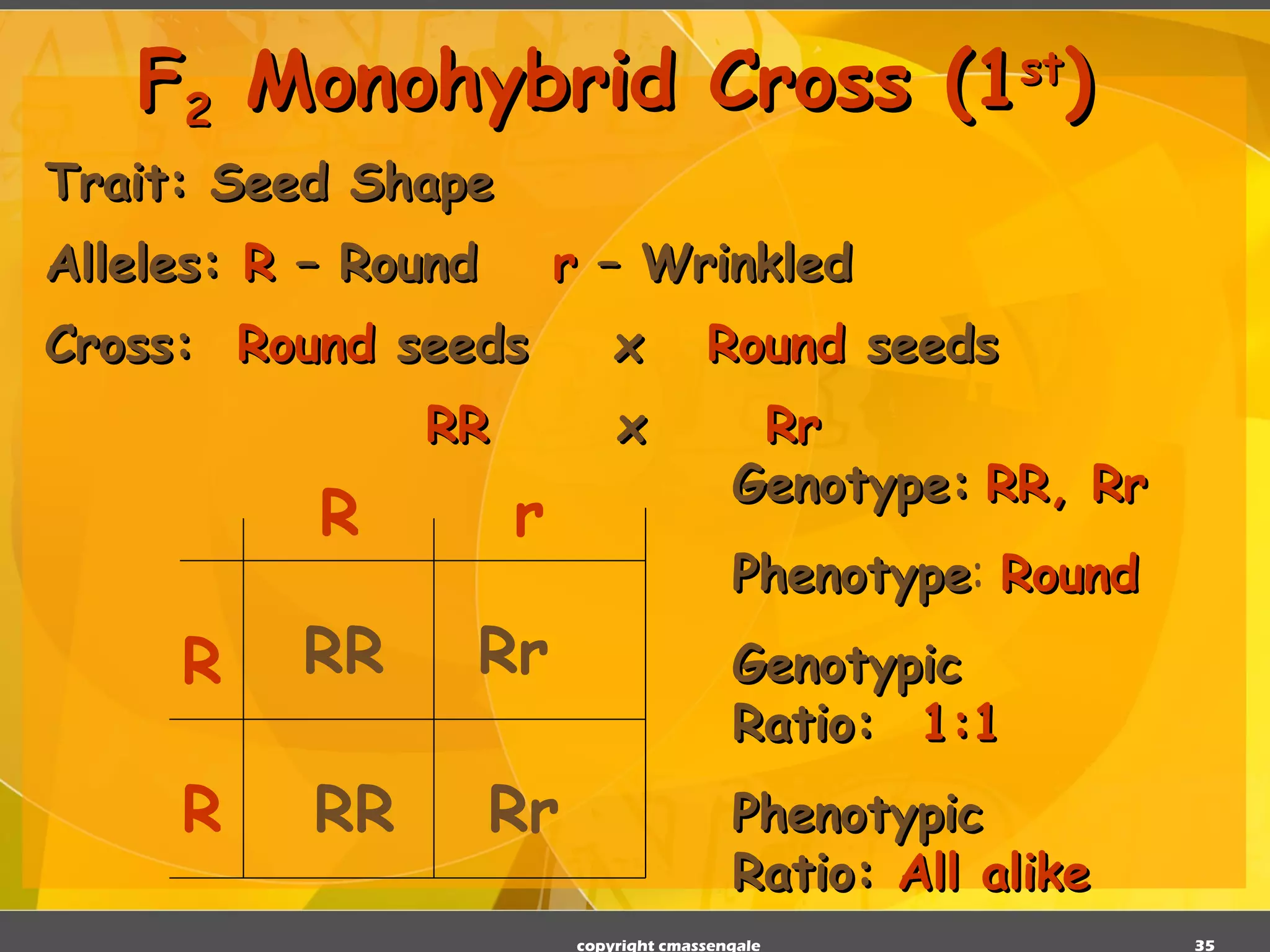
Trait: Seed Shape Alleles:  R  – Round r  – Wrinkled Cross:  Round   seeds   x   Round  seeds RR   x   Rr F 2  Monohybrid Cross (1 st ) R R r R RR Rr RR Rr Genotype:   RR, Rr Phenotype :   Round Genotypic Ratio:   1:1 Phenotypic Ratio:  All alike copyright cmassengale
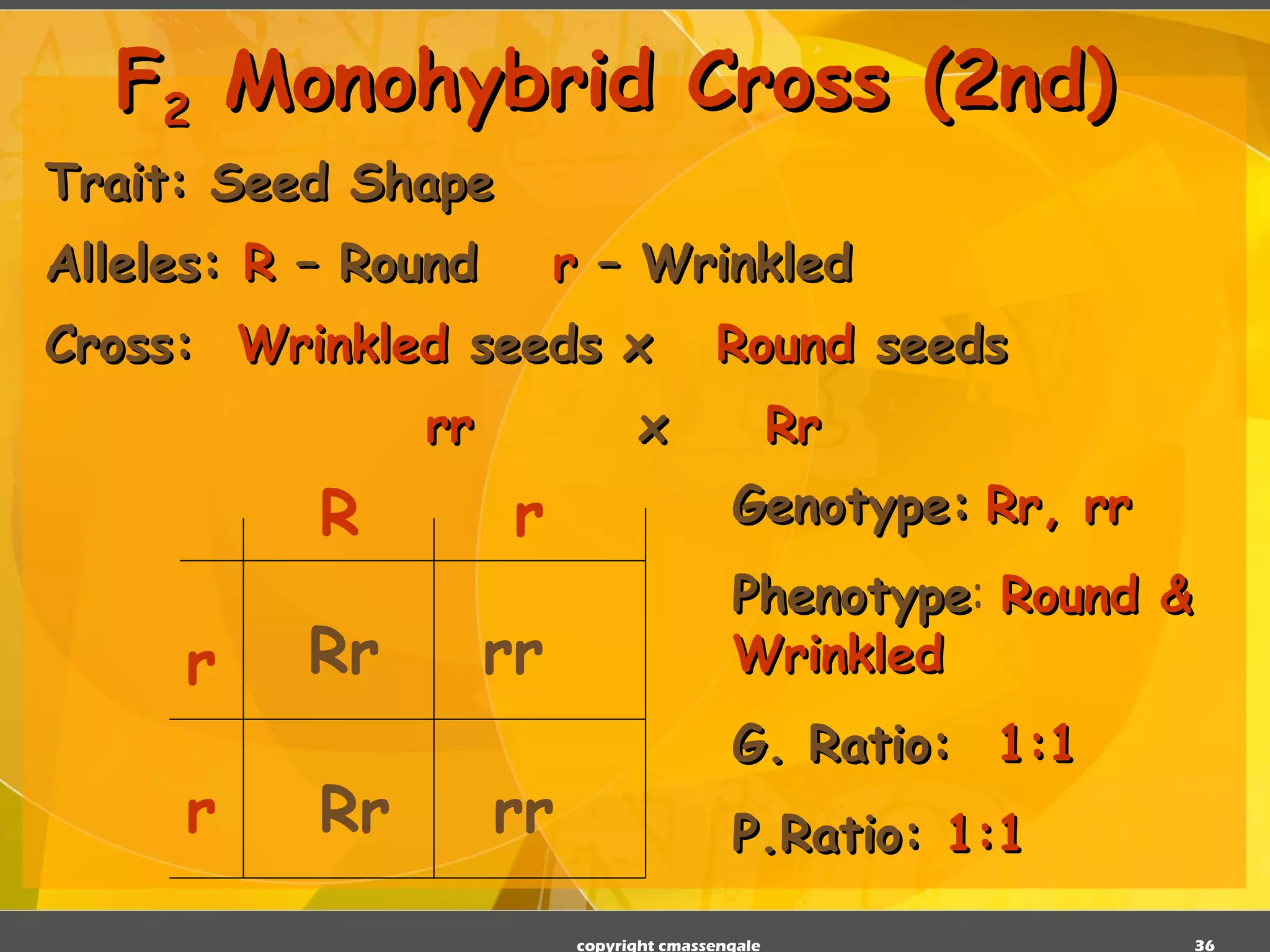
Trait: Seed Shape Alleles:  R  – Round r  – Wrinkled Cross:  Wrinkled   seeds   x   Round  seeds rr   x   Rr F 2  Monohybrid Cross (2nd) r r r R Rr rr Rr rr Genotype:   Rr, rr Phenotype :   Round & Wrinkled G. Ratio:   1:1 P.Ratio:  1:1 copyright cmassengale
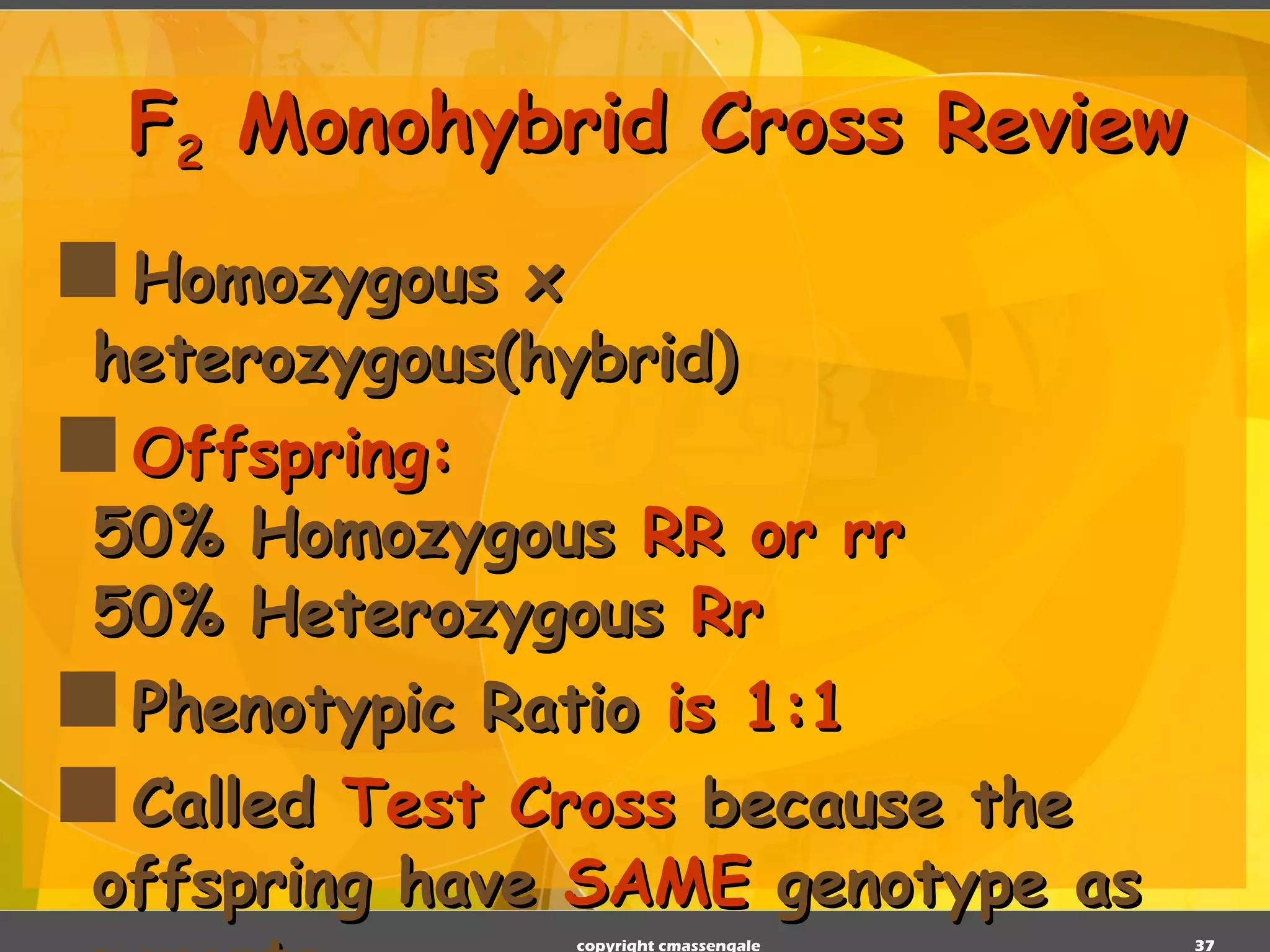
F 2  Monohybrid Cross Review Homozygous x heterozygous(hybrid) Offspring: 50% Homozygous  RR or rr 50% Heterozygous   Rr Phenotypic Ratio  is 1:1 Called  Test Cross  because the offspring have  SAME  genotype as parents copyright cmassengale
Practice Your Crosses Work the P 1 , F 1 , and both F 2  Crosses for each of the other Seven Pea Plant Traits copyright cmassengale
Mendel’s Laws copyright cmassengale
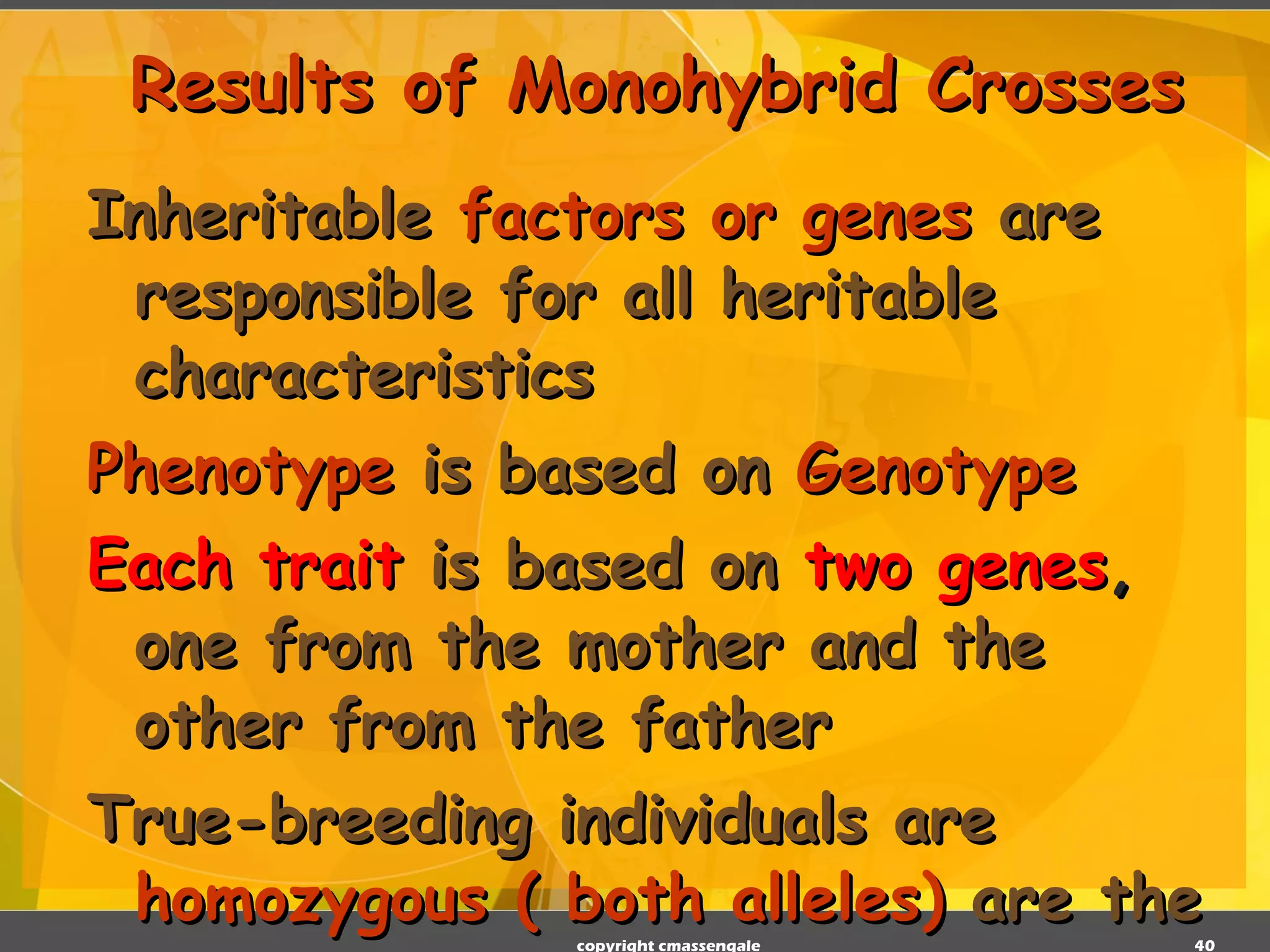
Results of Monohybrid Crosses Inheritable   factors or genes   are responsible for all heritable characteristics  Phenotype  is based on  Genotype   Each trait   is based on   two genes ,  one from the mother and the other from the father   True-breeding individuals are  homozygous ( both alleles)  are the same copyright cmassengale
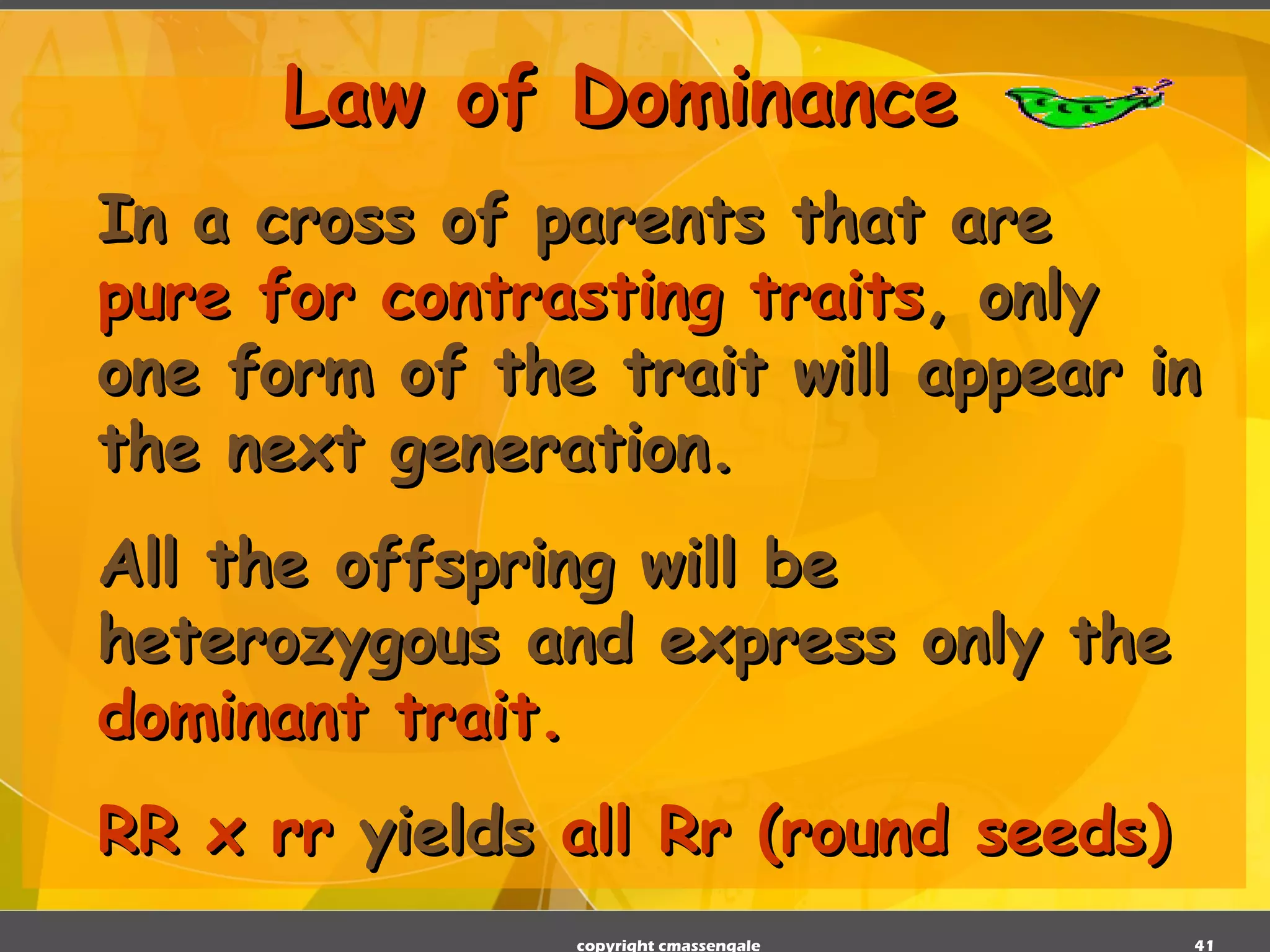
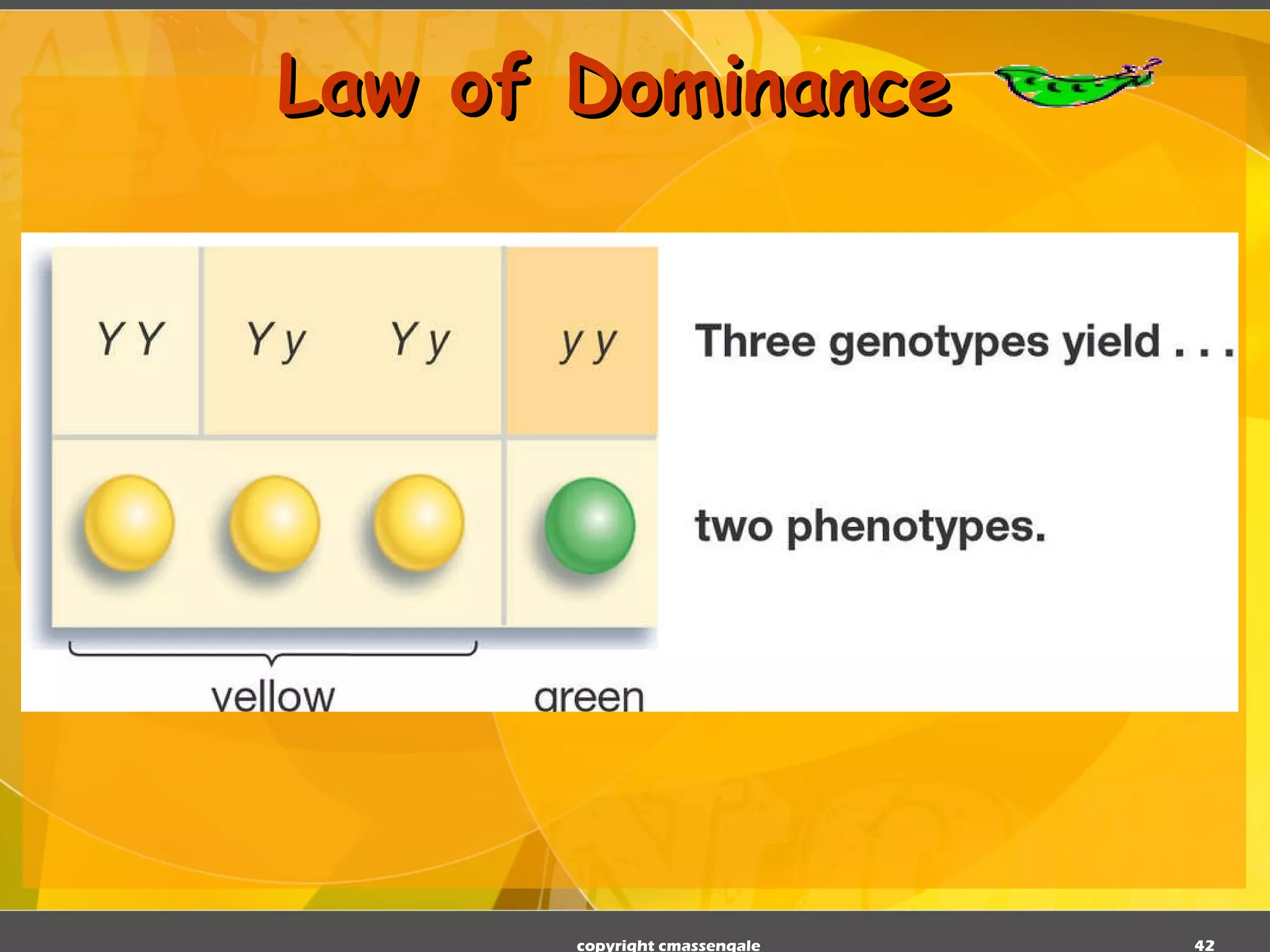
Law of Dominance   In a cross of parents that are  pure for contrasting traits , only one form of the trait will appear in the next generation. All the offspring will be heterozygous and express only the  dominant trait. RR x rr  yields  all Rr (round seeds) copyright cmassengale
Law of Dominance copyright cmassengale
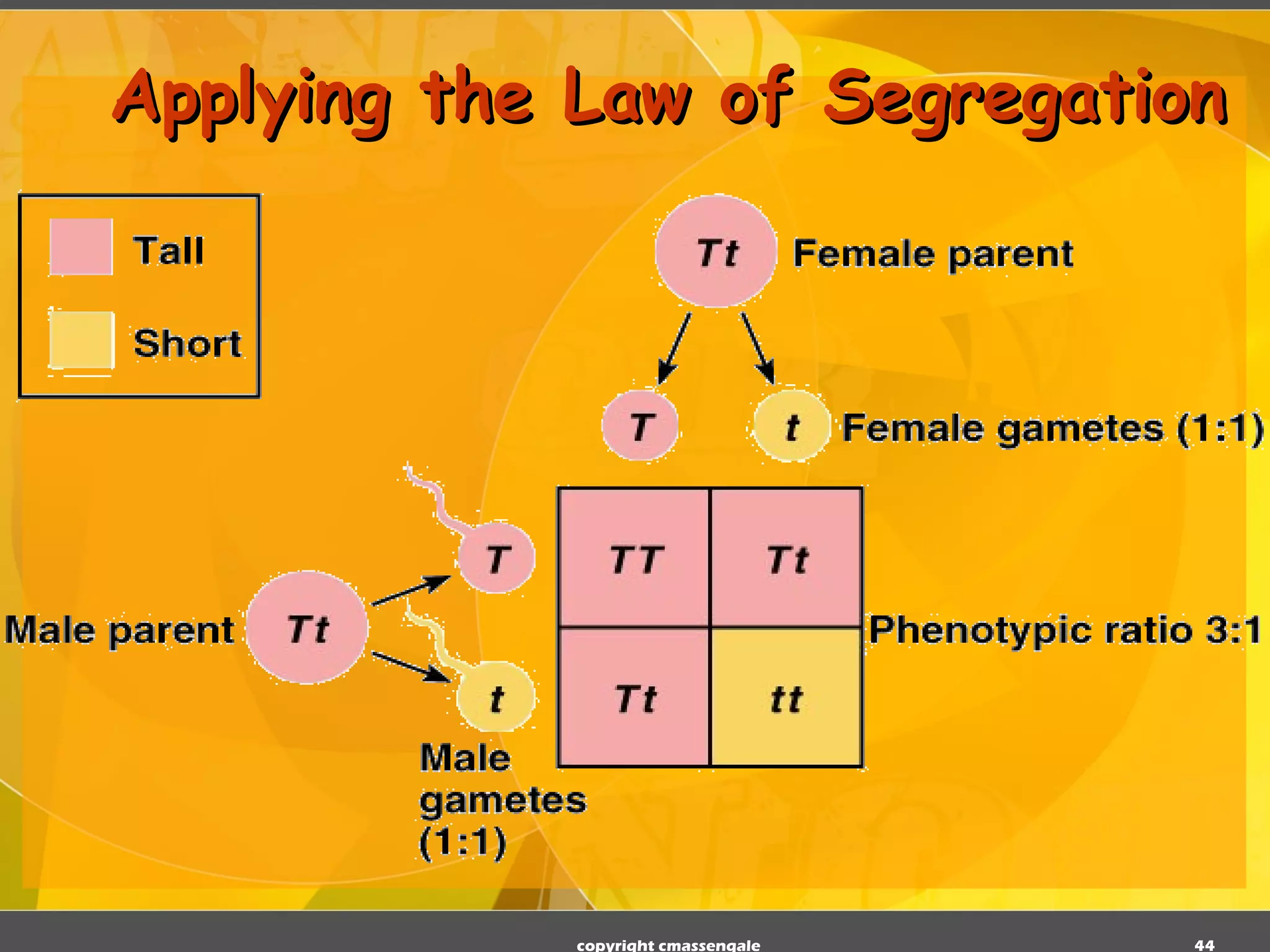
Law of Segregation During the  formation of gametes  (eggs or sperm), the  two alleles  responsible for a trait  separate  from each other. Alleles for a trait are then  "recombined" at fertilization , producing the genotype for the traits of the offspring .   copyright cmassengale
Applying the Law of Segregation copyright cmassengale
Law of Independent Assortment   Alleles for  different   traits are distributed to sex cells (& offspring) independently of one another.   This law can be illustrated using  dihybrid crosses . copyright cmassengale
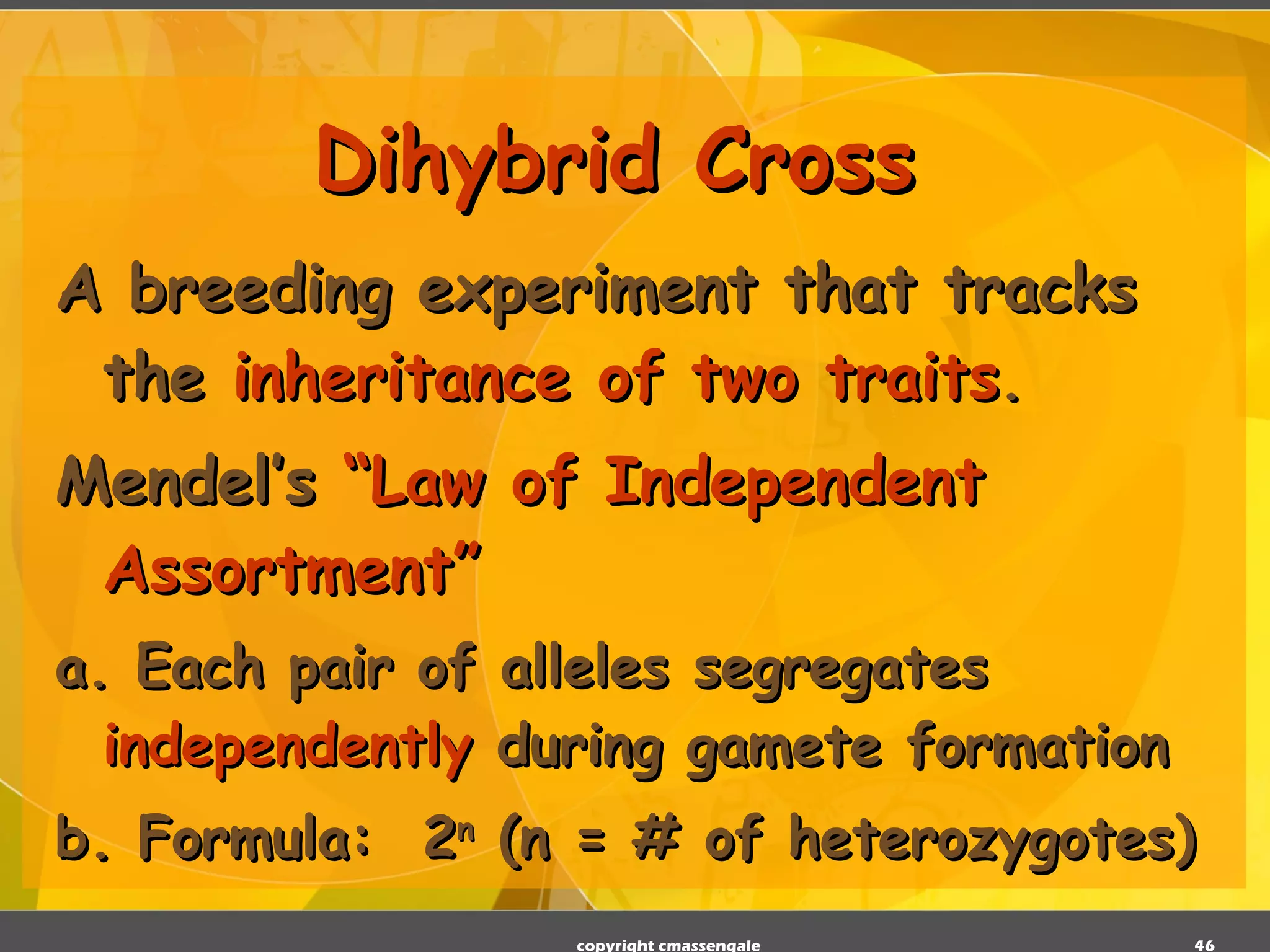
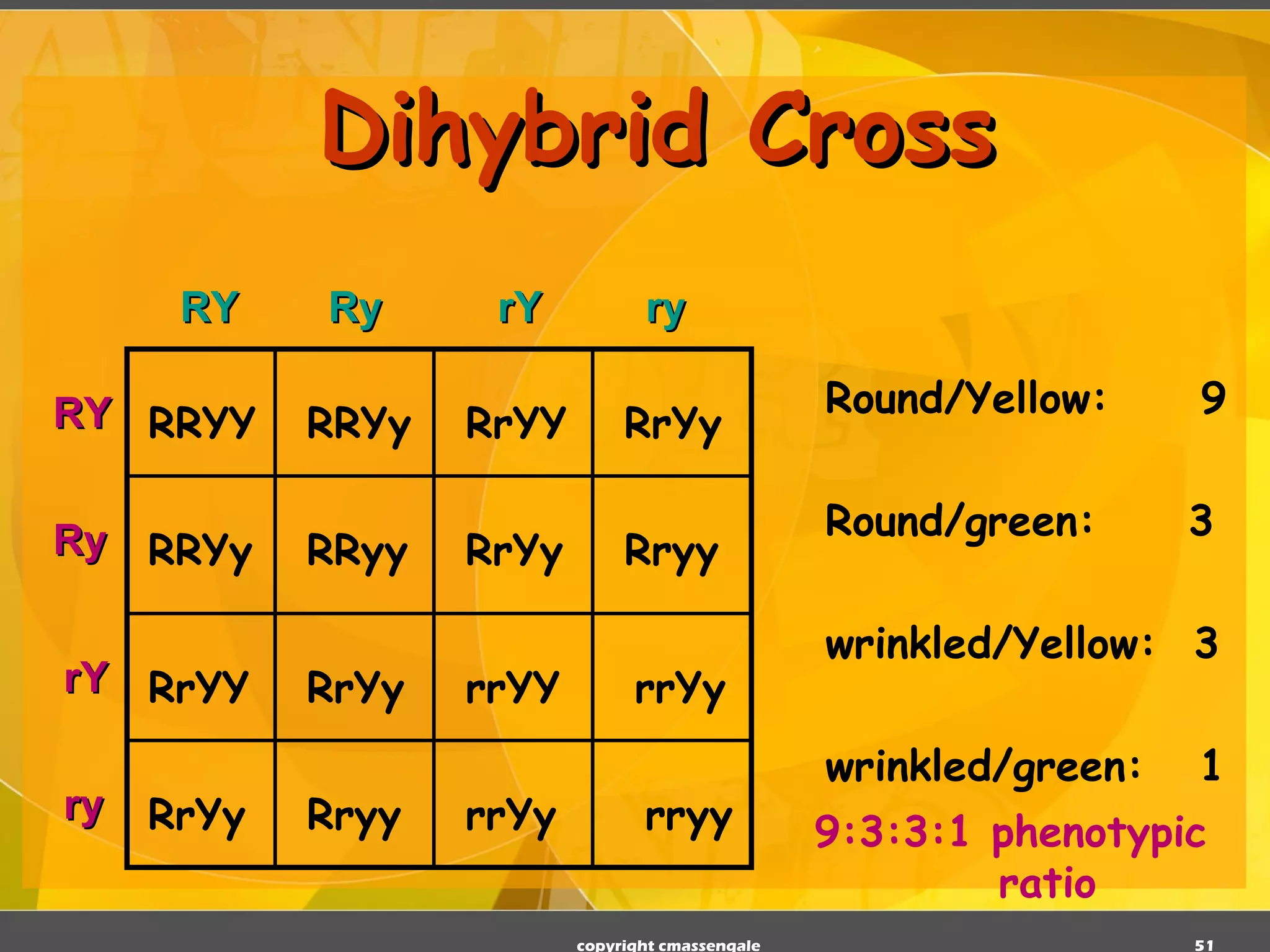
Dihybrid Cross A breeding experiment that tracks the  inheritance of two traits . Mendel’s  “Law of Independent Assortment” a. Each pair of alleles segregates  independently  during gamete formation b. Formula:  2 n  (n = # of heterozygotes) copyright cmassengale
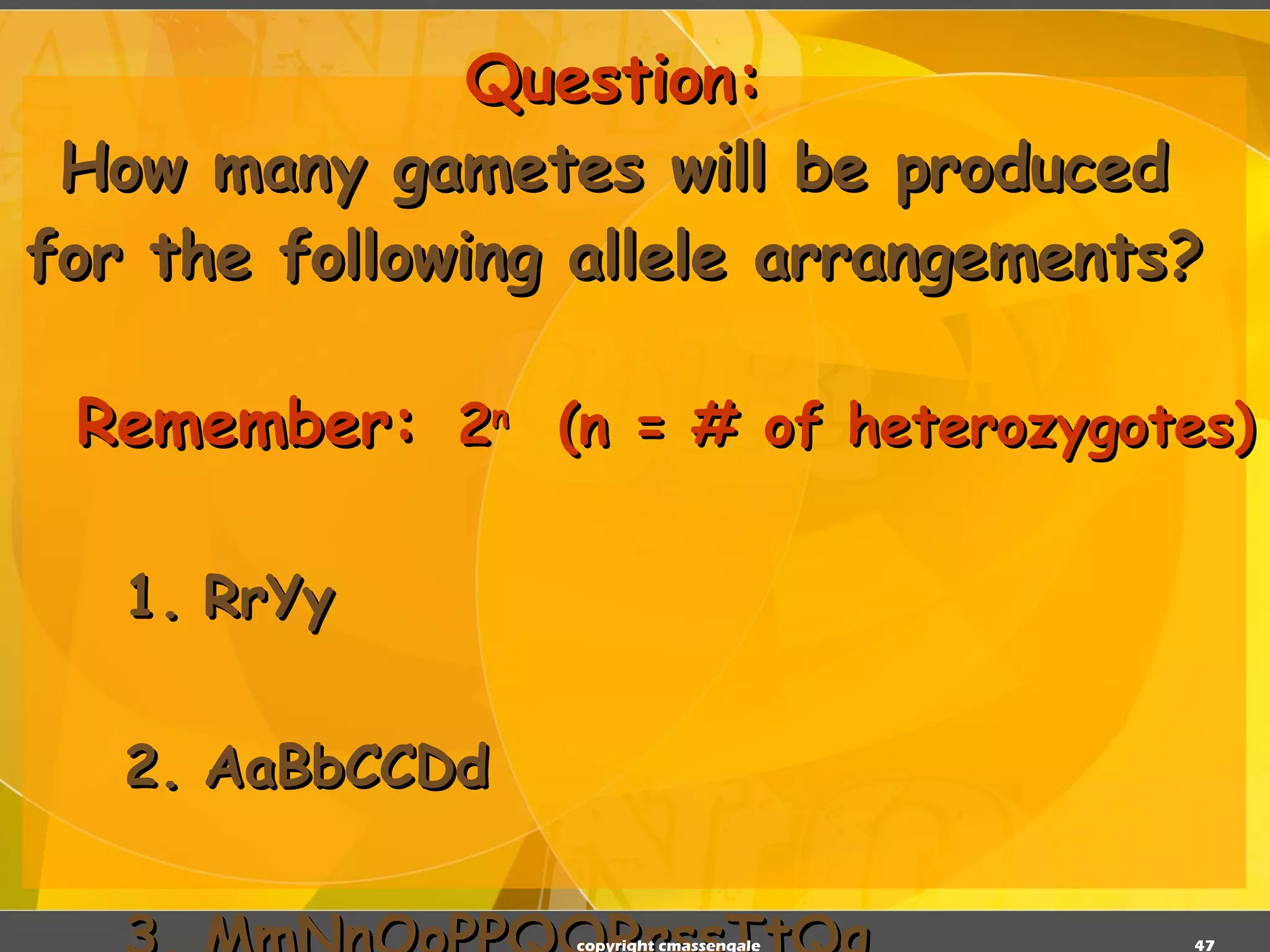
Question: How many gametes will be produced for the following allele arrangements? Remember:   2 n   (n = # of heterozygotes) 1. RrYy 2. AaBbCCDd 3. MmNnOoPPQQRrssTtQq copyright cmassengale
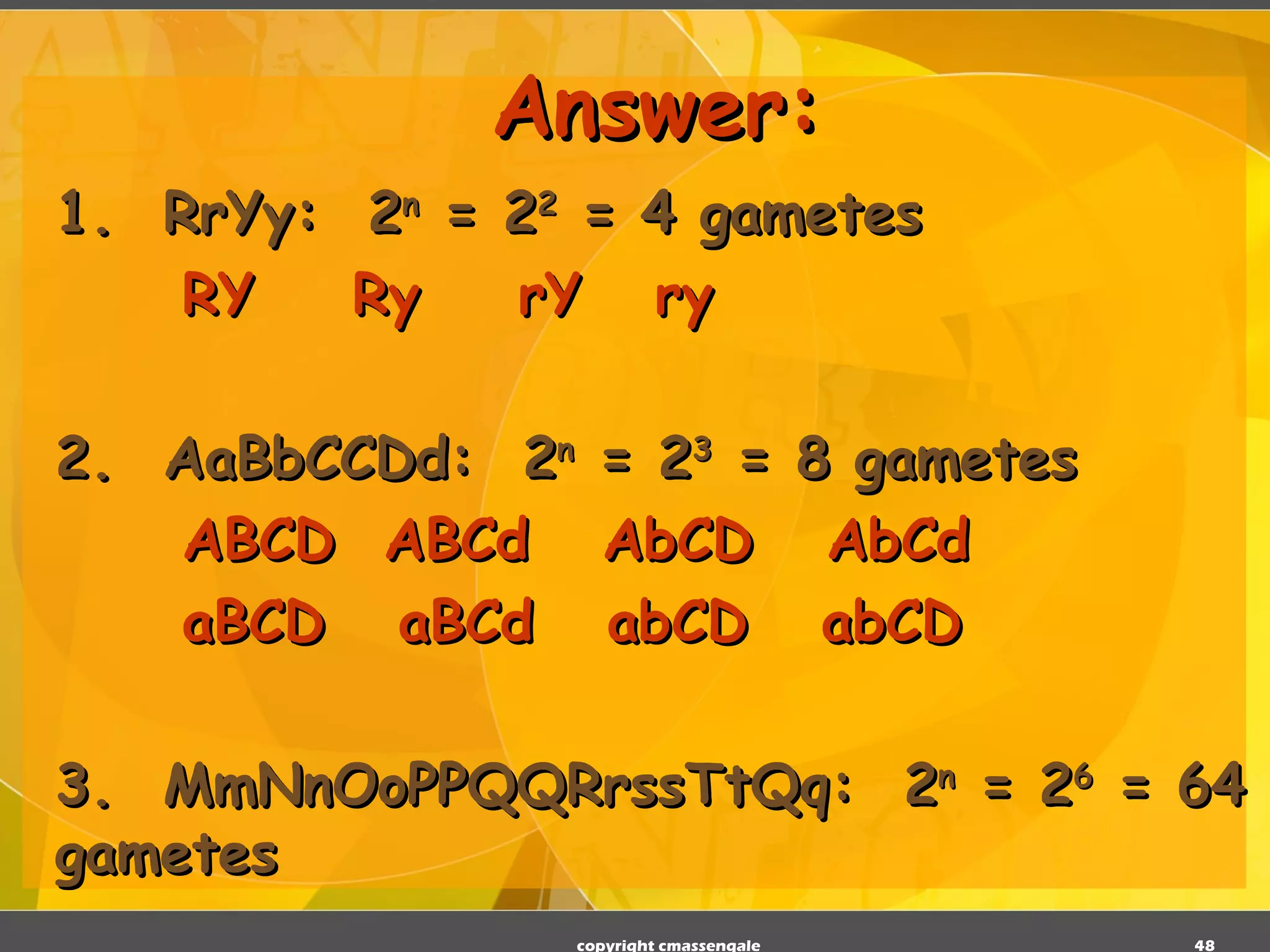
Answer: 1.  RrYy:  2 n  = 2 2  = 4 gametes RY  Ry  rY  ry 2.  AaBbCCDd:  2 n  = 2 3  = 8 gametes ABCD  ABCd  AbCD  AbCd aBCD  aBCd  abCD  abCD   3.  MmNnOoPPQQRrssTtQq:  2 n  = 2 6  = 64 gametes copyright cmassengale
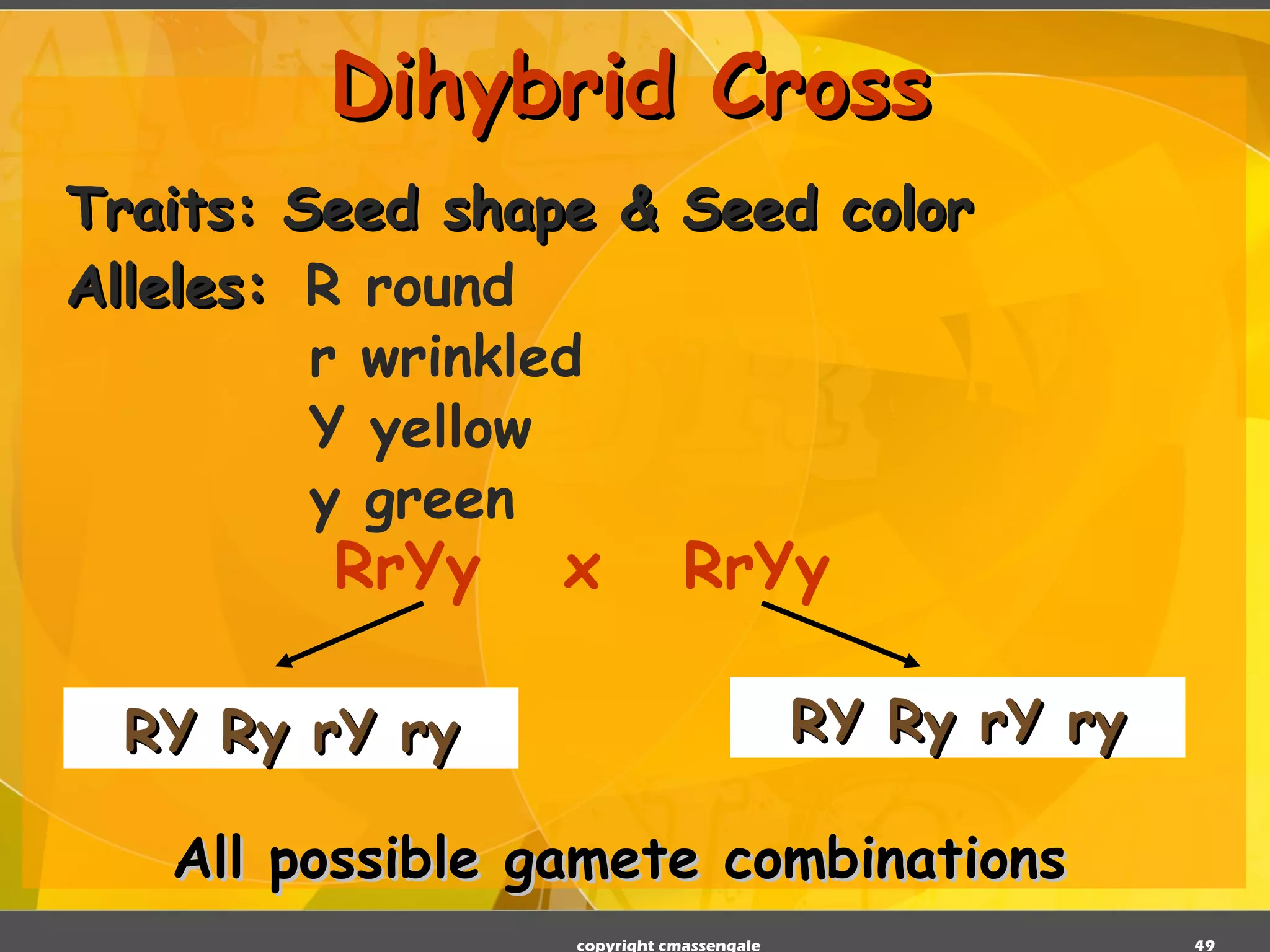
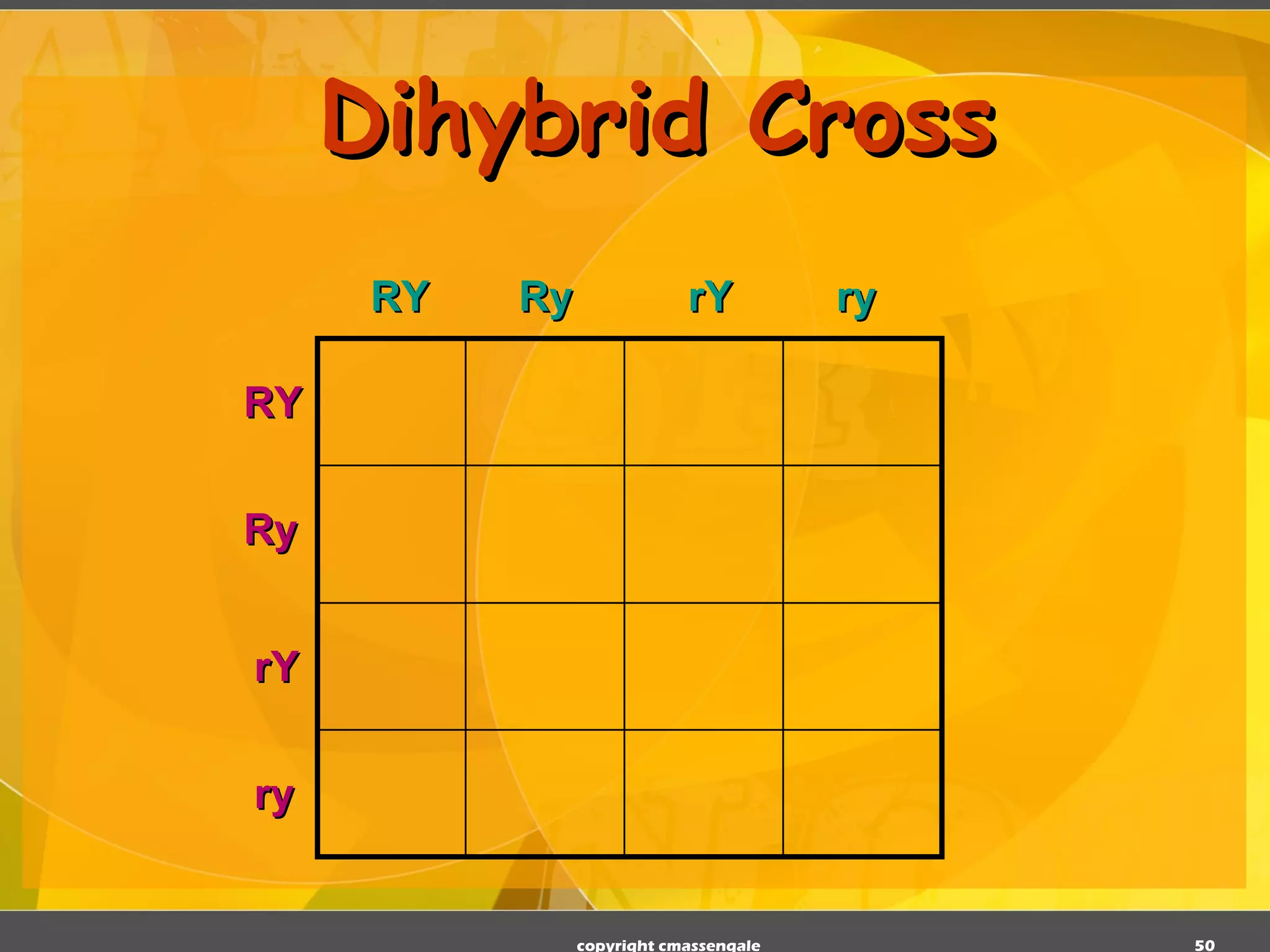
Dihybrid Cross Traits: Seed shape & Seed color Alleles:   R round   r wrinkled   Y yellow   y green   RrYy  x  RrYy RY Ry rY ry RY Ry rY ry All possible gamete combinations copyright cmassengale
Dihybrid Cross copyright cmassengale RY Ry rY ry RY Ry rY ry
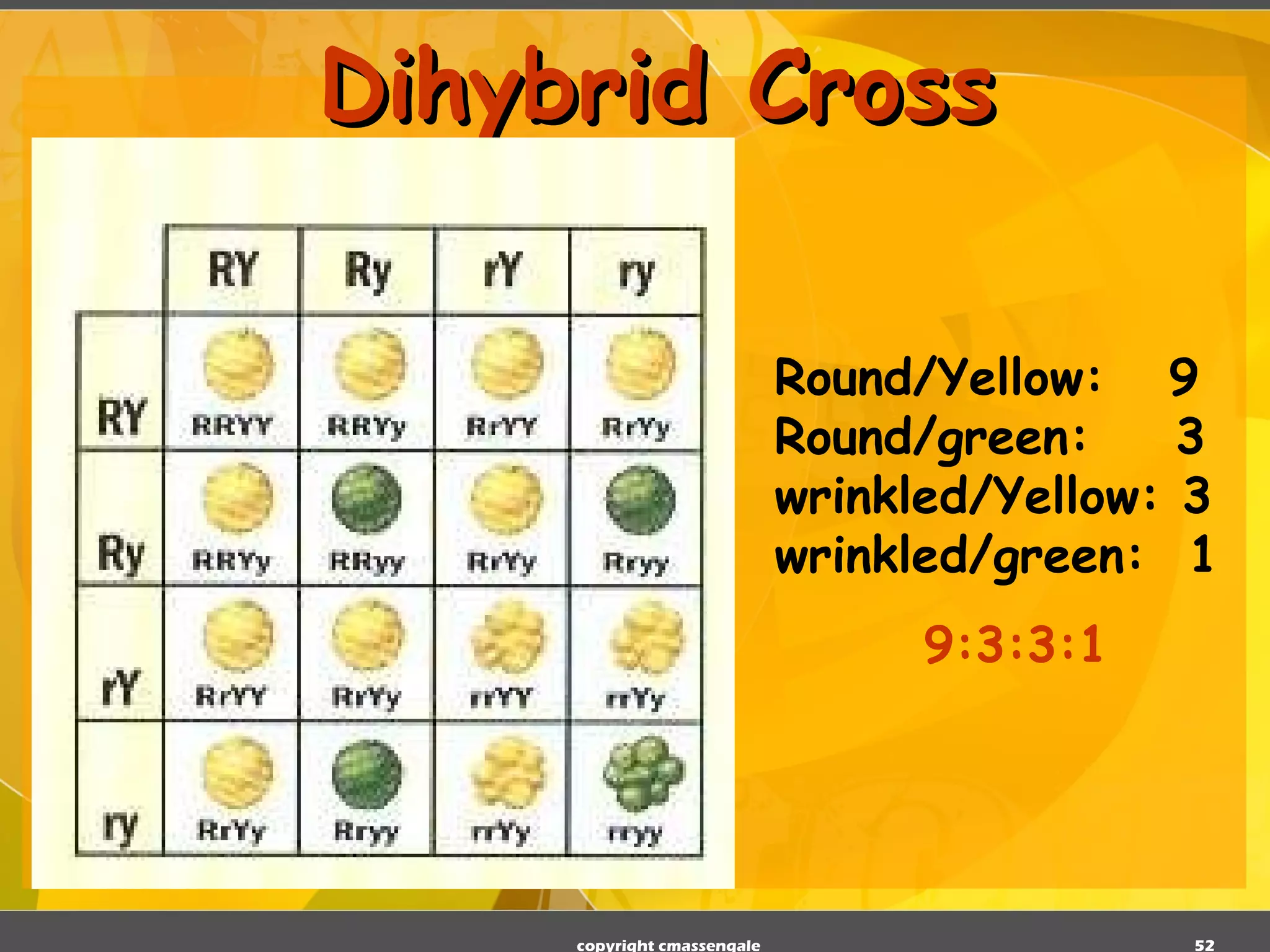
Dihybrid Cross copyright cmassengale RRYY RRYy RrYY RrYy RRYy RRyy RrYy Rryy RrYY RrYy rrYY rrYy RrYy Rryy rrYy rryy Round/Yellow:  9 Round/green:  3 wrinkled/Yellow:  3 wrinkled/green:  1 9:3:3:1 phenotypic   ratio RY Ry rY ry RY Ry rY ry
Dihybrid Cross Round/Yellow:  9 Round/green:  3 wrinkled/Yellow: 3 wrinkled/green:  1 9:3:3:1 copyright cmassengale
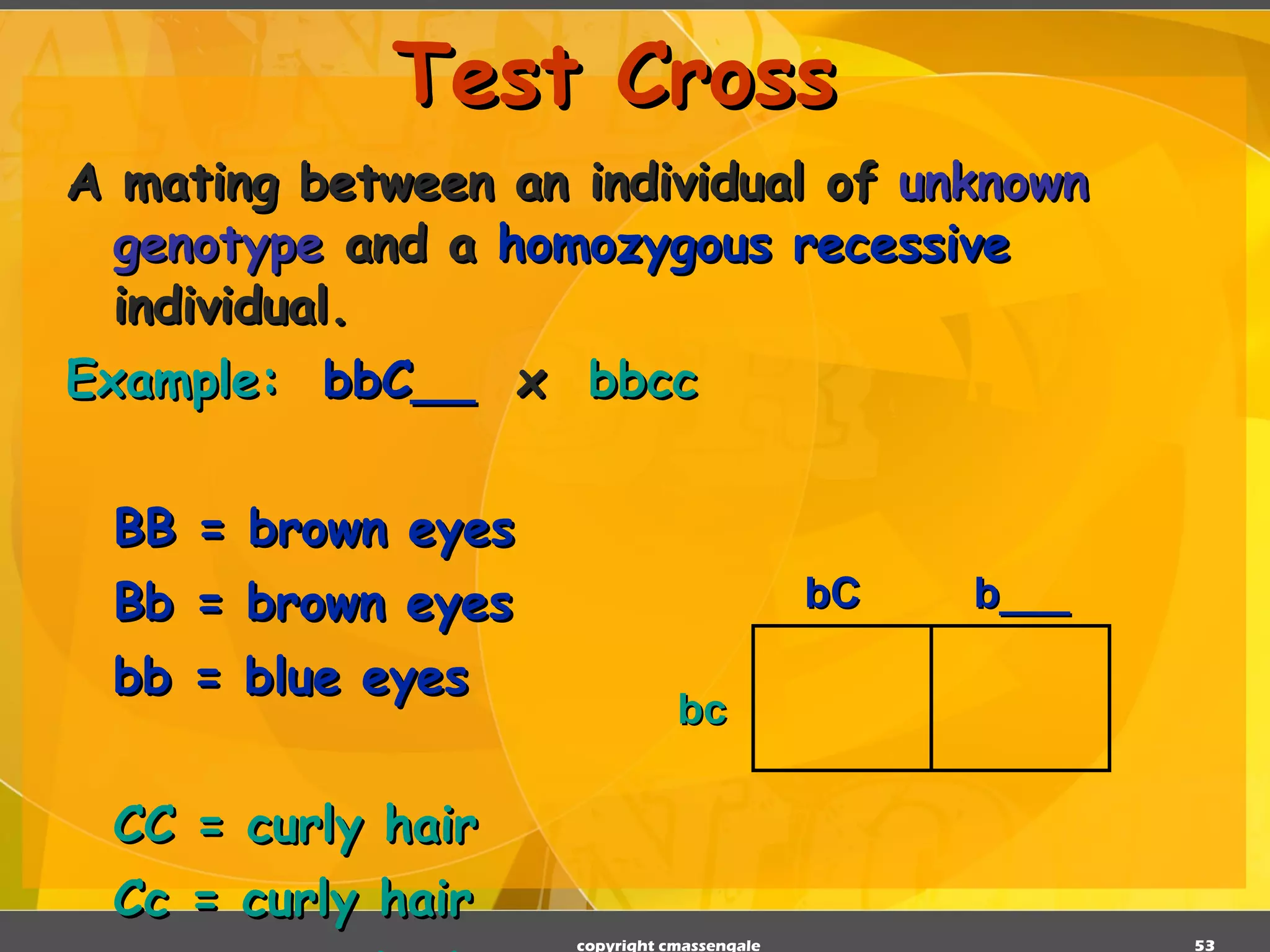
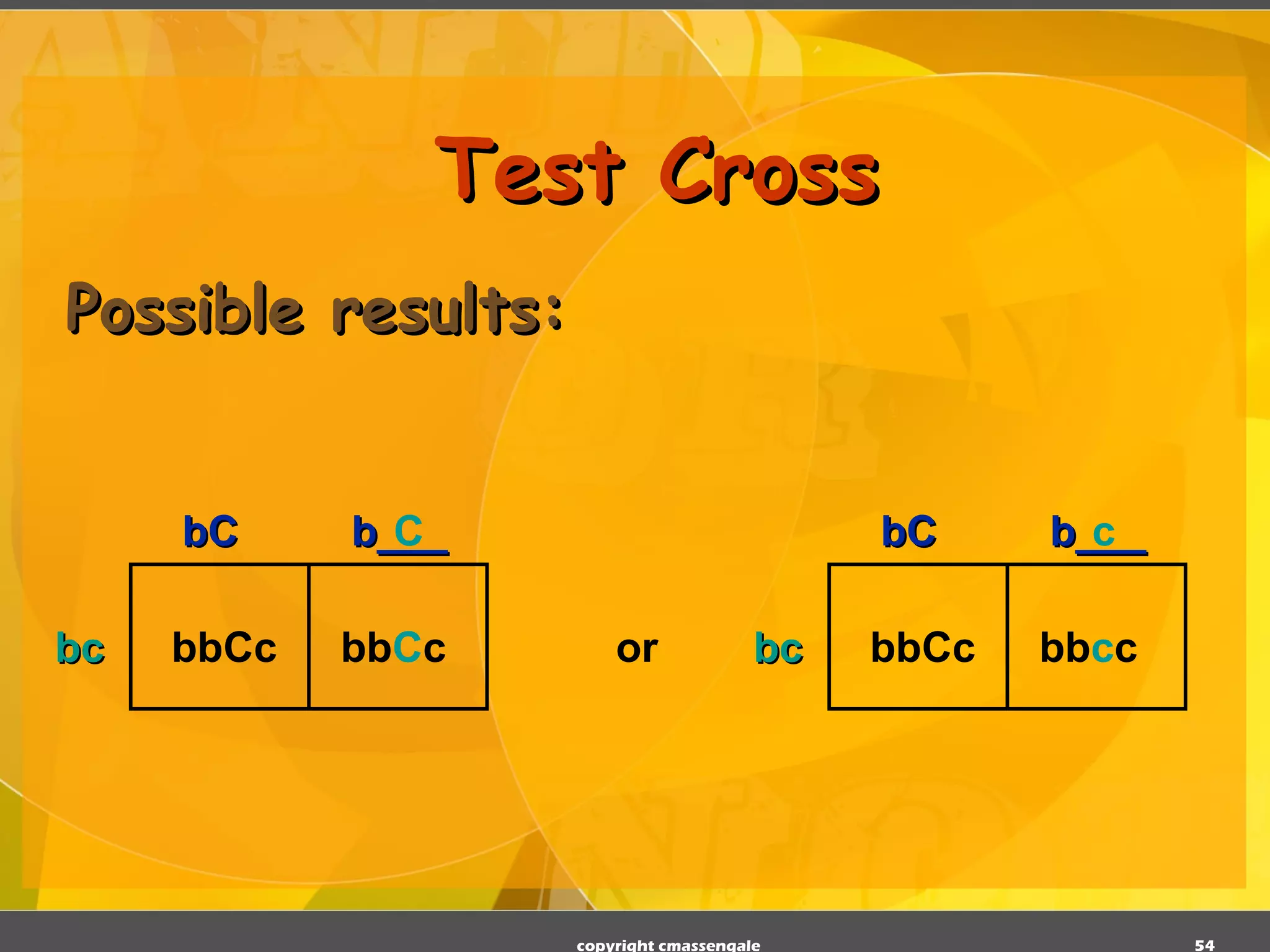
Test Cross A mating between an individual of  unknown genotype  and a  homozygous recessive  individual. Example:   bbC__  x  bbcc BB = brown eyes Bb = brown eyes bb = blue eyes CC = curly hair Cc = curly hair cc = straight hair copyright cmassengale bC b___ bc
Test Cross Possible results: copyright cmassengale bC b___ bc bbCc bb C c C bC b___ bc bbCc bb c c or c
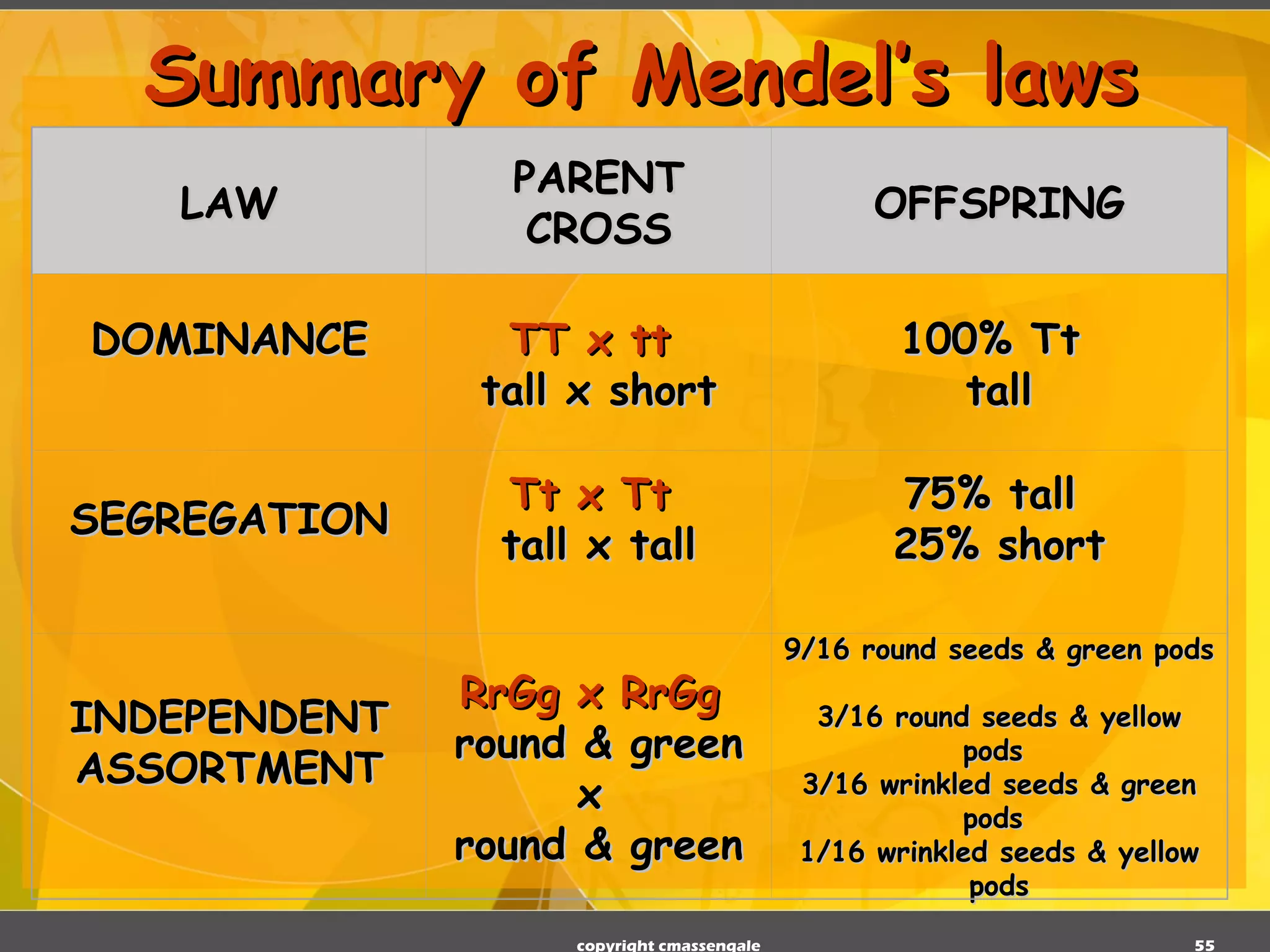
Summary of Mendel’s laws copyright cmassengale LAW PARENT CROSS OFFSPRING DOMINANCE TT x tt   tall x short 100% Tt  tall SEGREGATION Tt x Tt   tall x tall 75% tall  25% short INDEPENDENT ASSORTMENT RrGg x RrGg   round & green x  round & green 9/16 round seeds & green pods  3/16 round seeds & yellow pods  3/16 wrinkled seeds & green pods  1/16 wrinkled seeds & yellow pods
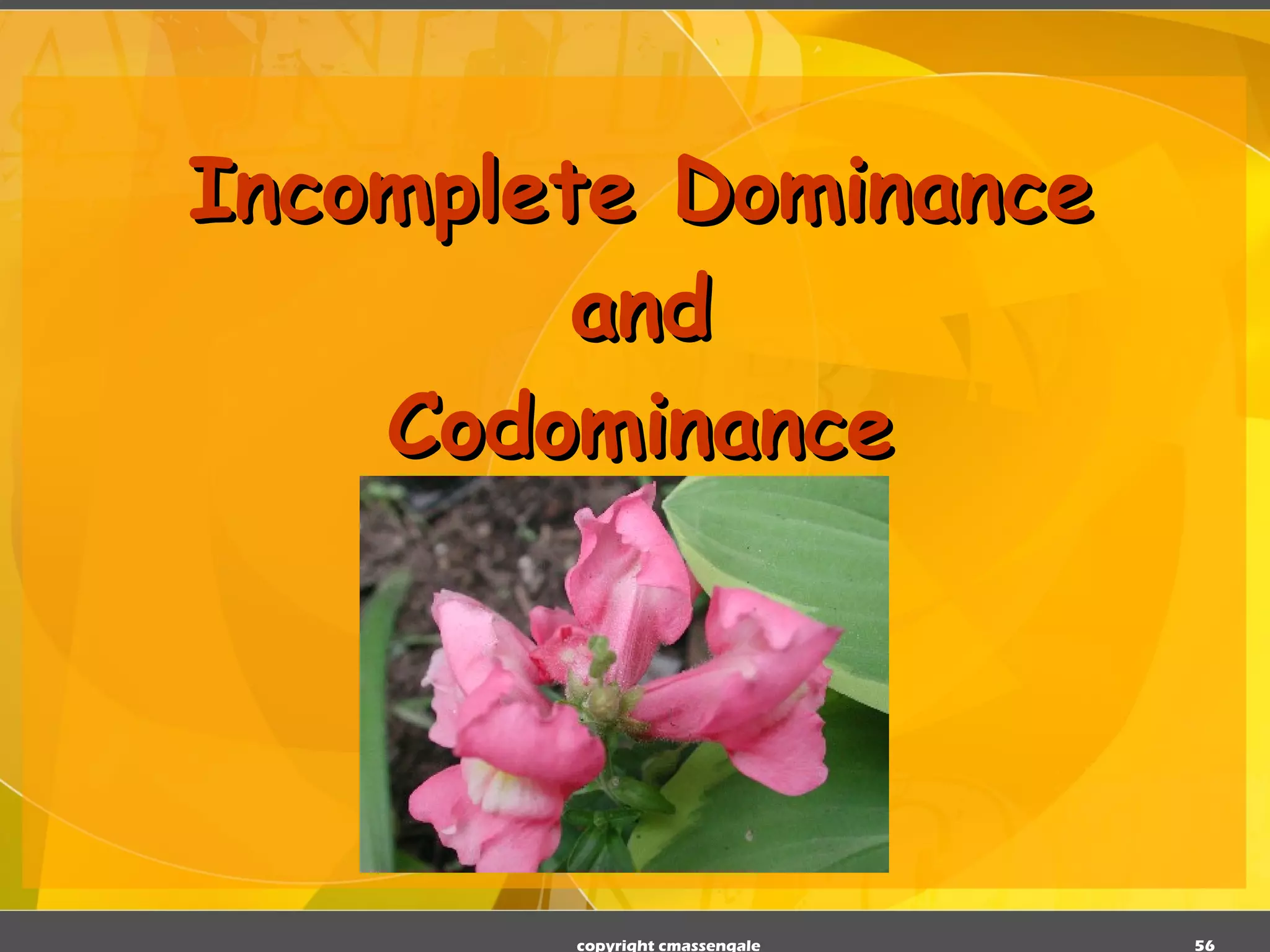
Incomplete Dominance and Codominance copyright cmassengale
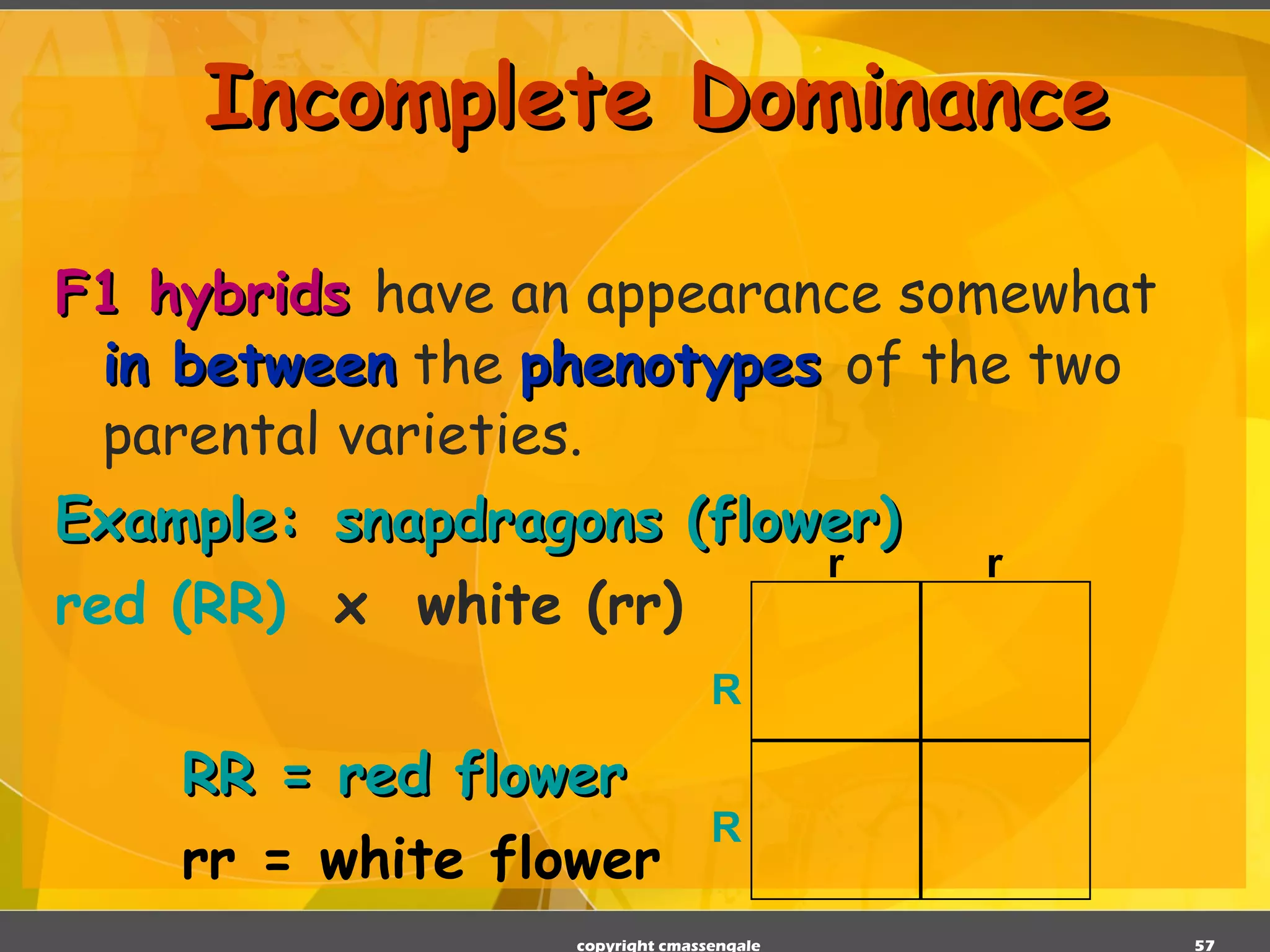
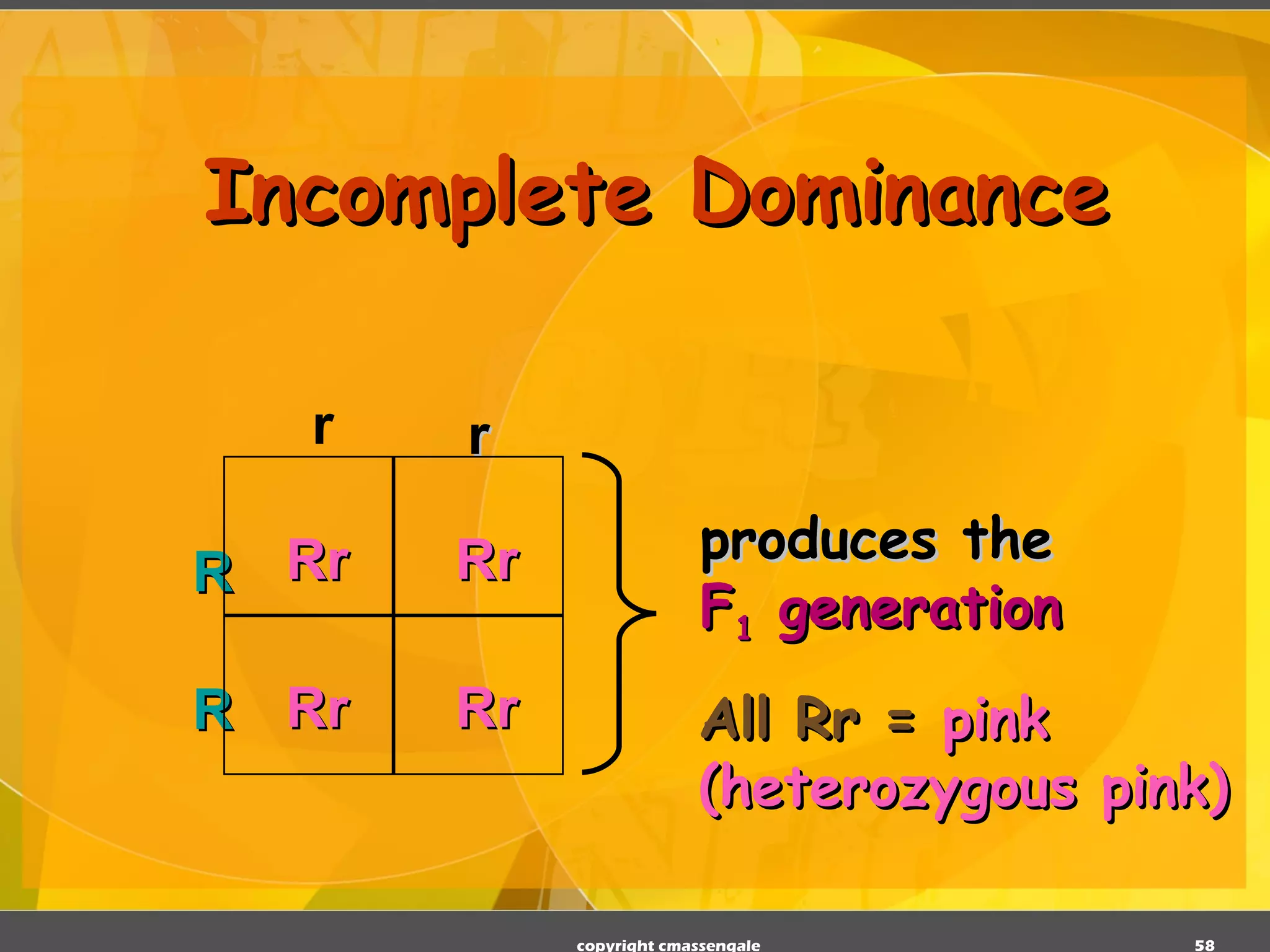
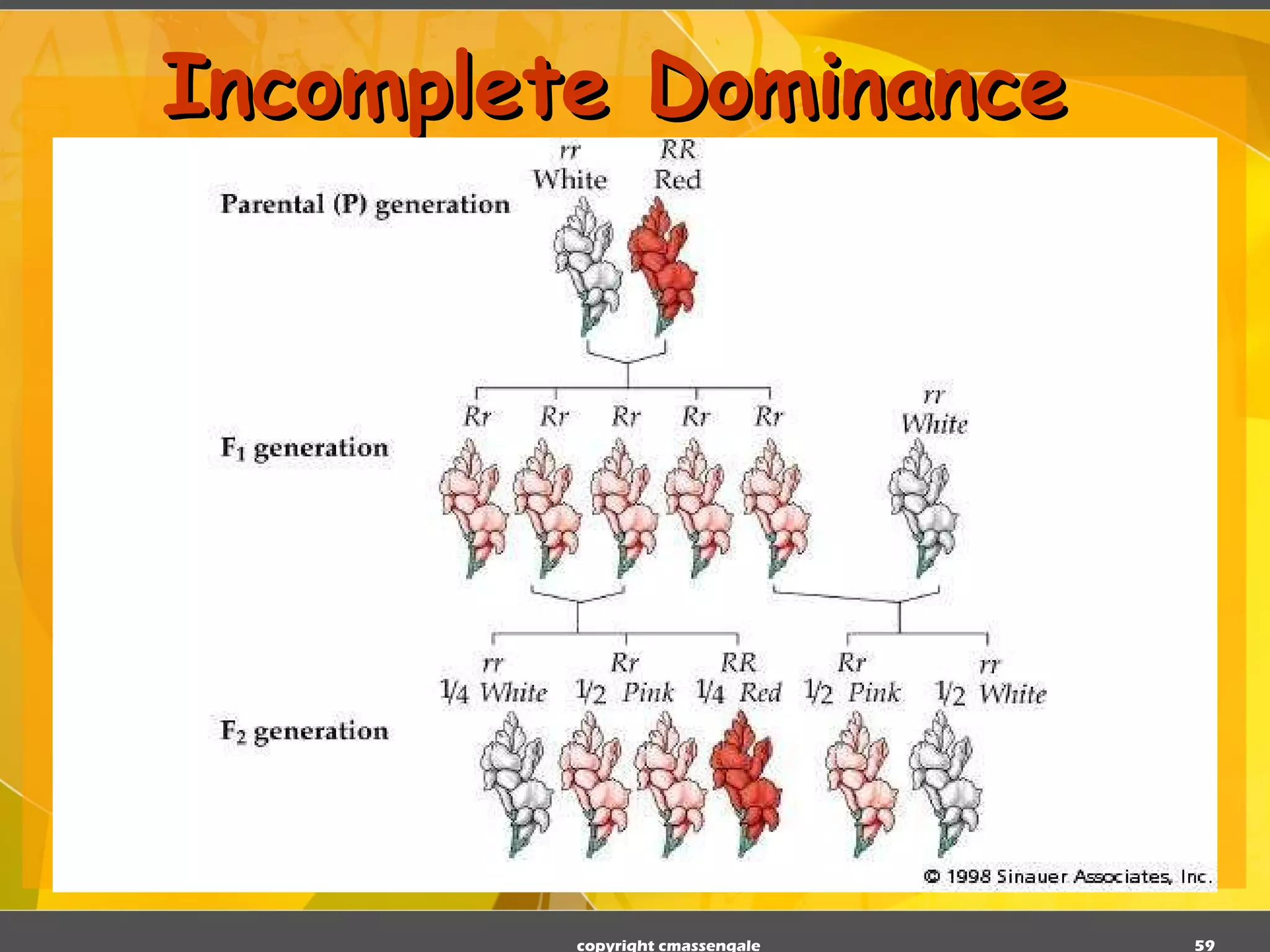
Incomplete Dominance F1 hybrids  have an appearance somewhat  in between  the  phenotypes  of the two parental varieties. Example:   snapdragons (flower) red (RR)  x  white (rr) RR = red flower rr = white flower copyright cmassengale R R r r
Incomplete Dominance r copyright cmassengale Rr Rr Rr Rr R R r All Rr =  pink (heterozygous pink) produces the F 1  generation
Incomplete Dominance copyright cmassengale
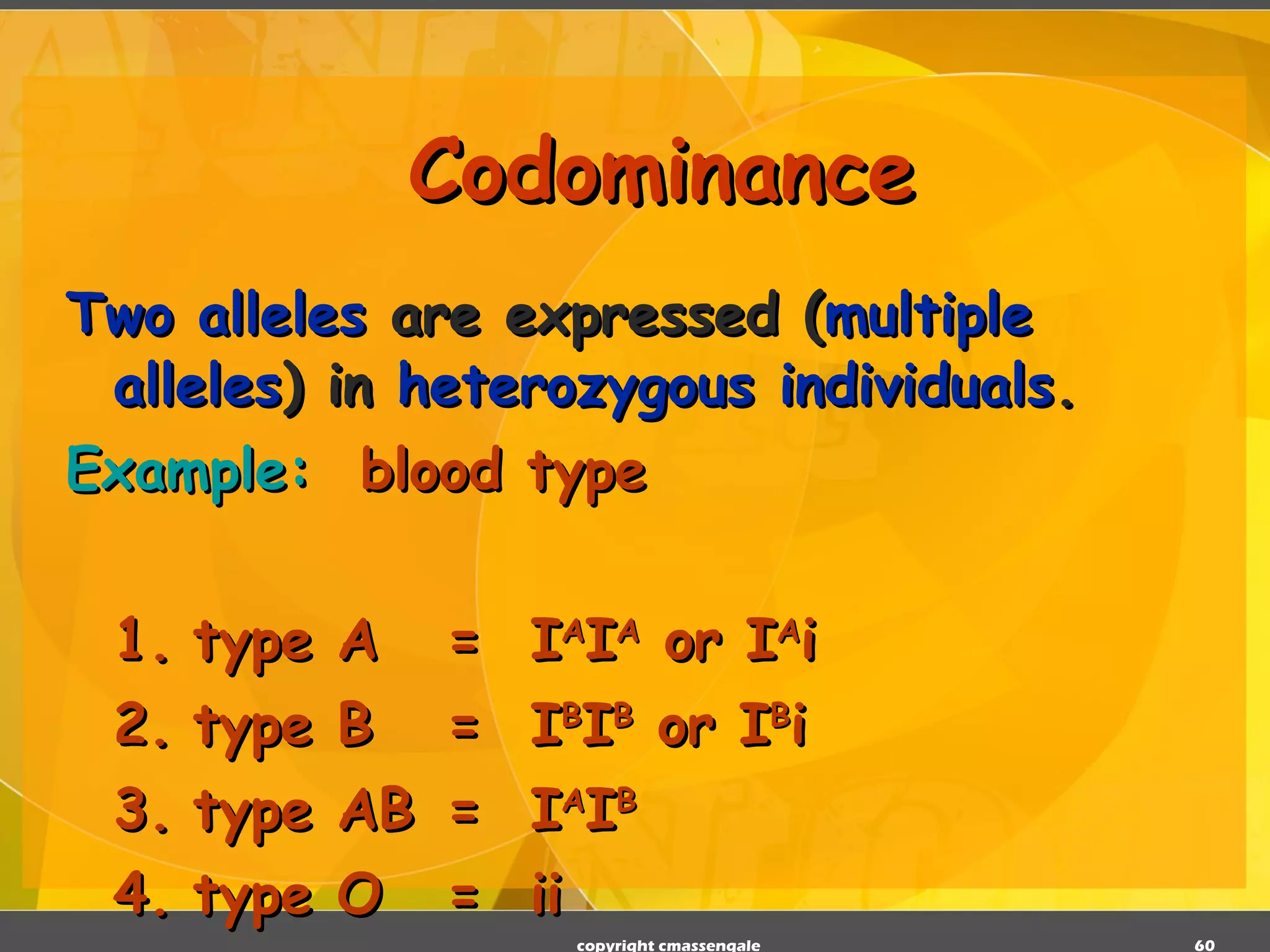
Codominance Two alleles  are expressed ( multiple alleles ) in  heterozygous individuals . Example:   blood type 1. type A =  I A I A  or I A i 2. type B =  I B I B  or I B i 3. type AB =  I A I B 4. type O =  ii copyright cmassengale
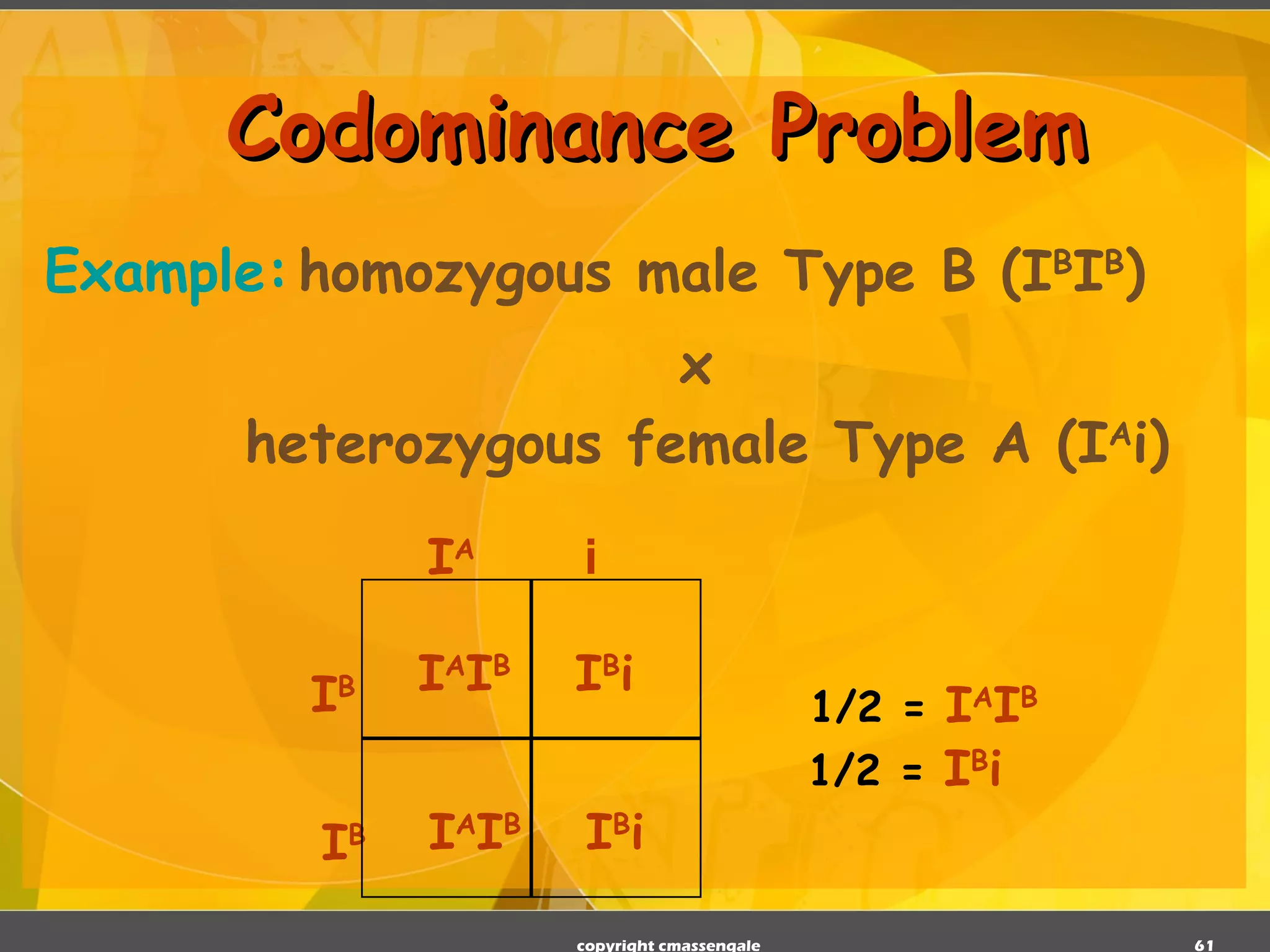
Codominance Problem Example: homozygous male Type B (I B I B ) x    heterozygous female Type A (I A i) copyright cmassengale I A I B I B i I A I B I B i 1/2 =  I A I B 1/2 =  I B i   I B I A i I B
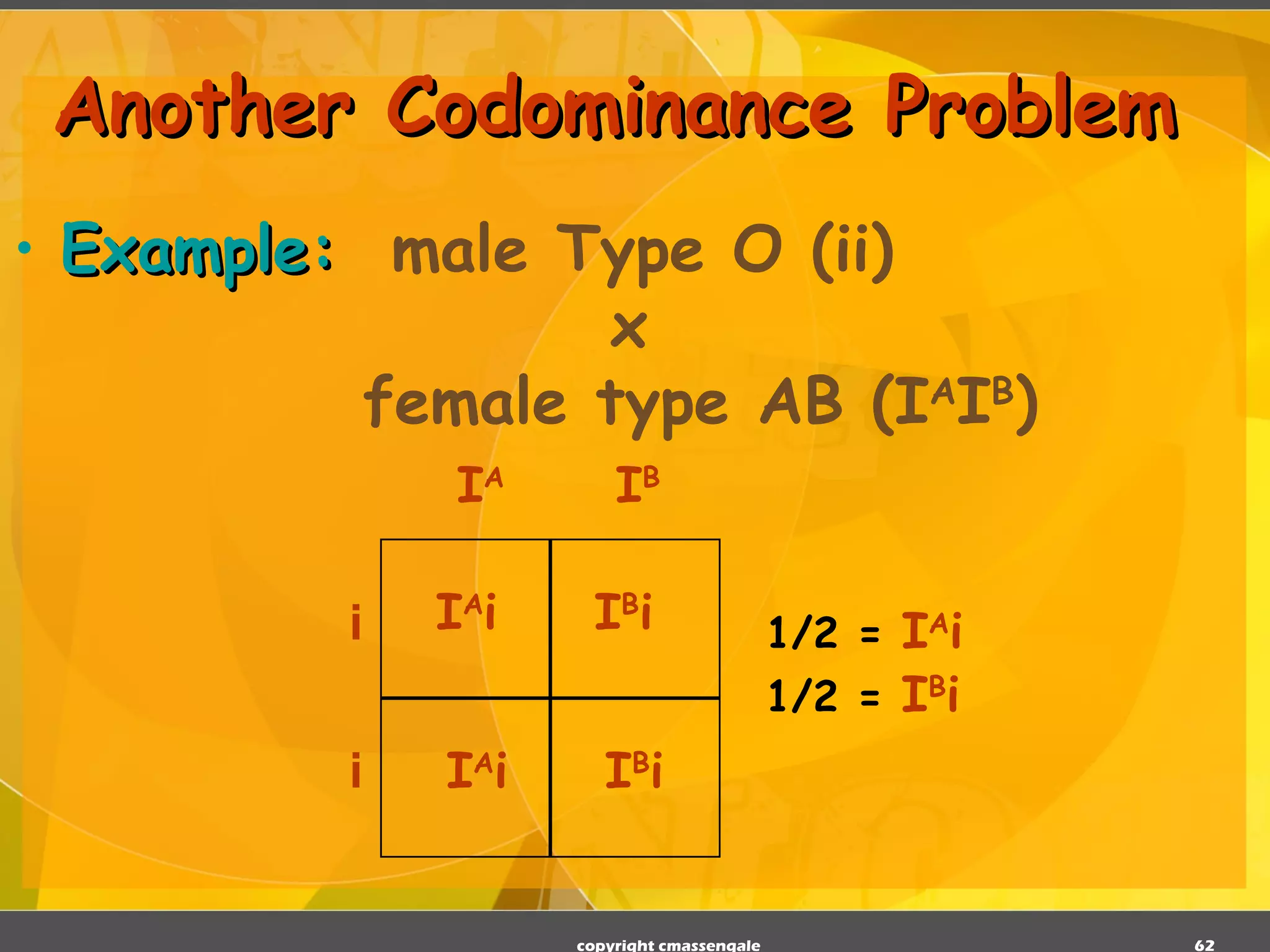
Another Codominance Problem Example:   male Type O (ii)   x    female type AB (I A I B ) copyright cmassengale I A i I B i I A i I B i 1/2 =  I A i 1/2 =  I B i   i I A I B i
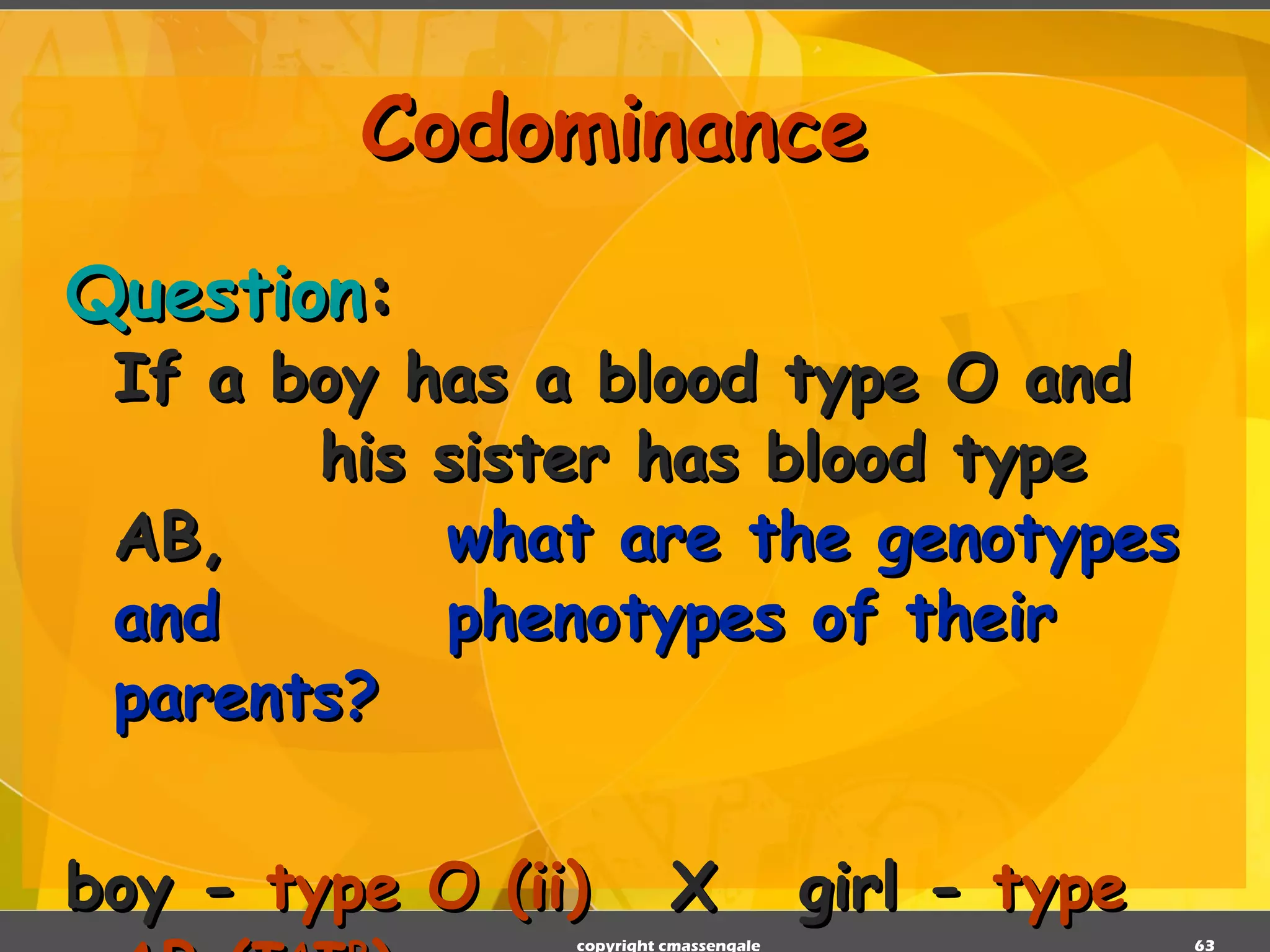
Codominance Question : If a boy has a blood type O and  his sister has blood type AB,  what are the genotypes and  phenotypes of their parents? boy -  type O (ii)  X  girl -  type AB (I A I B ) copyright cmassengale
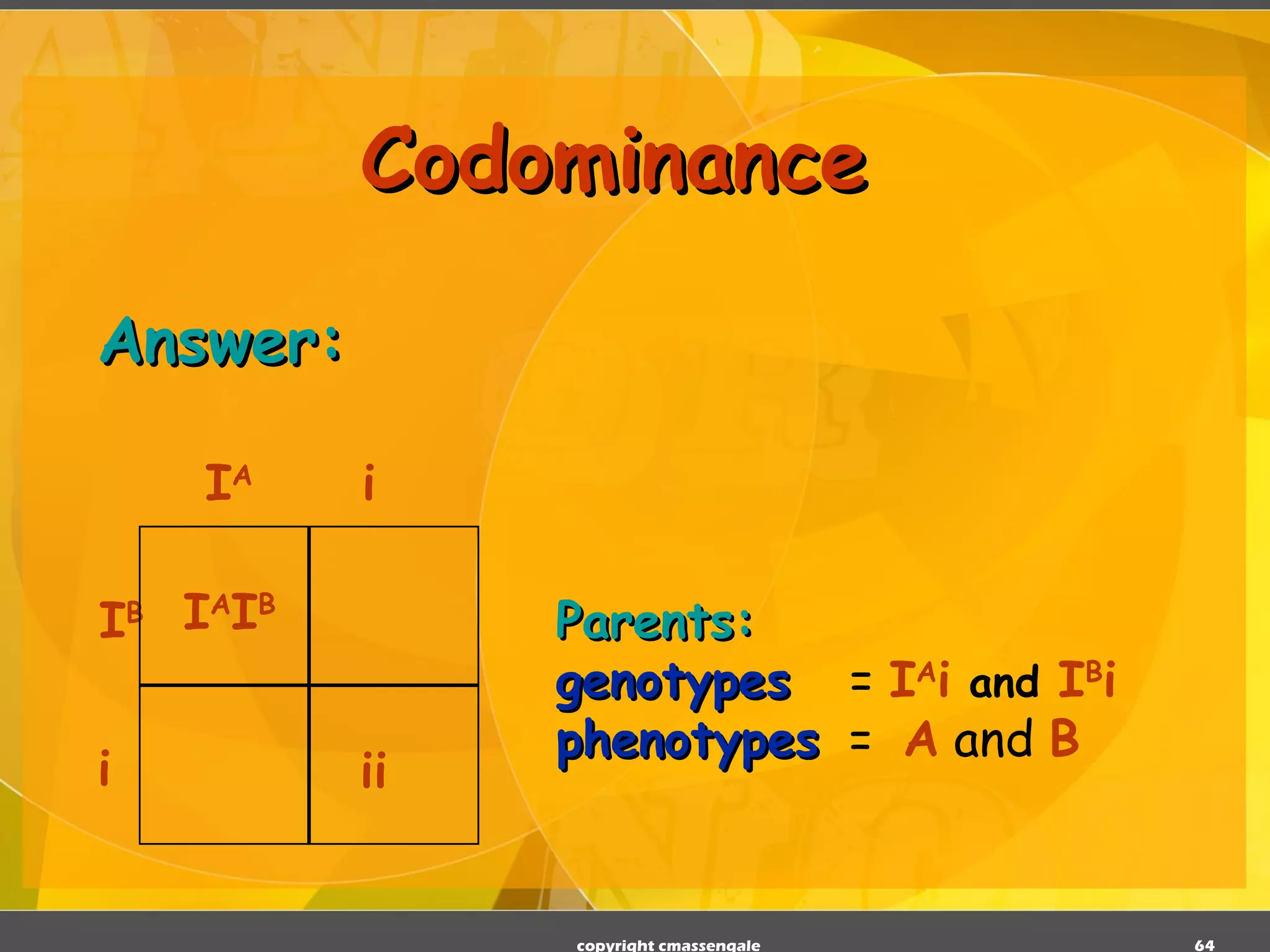
Codominance Answer: Parents: genotypes   =  I A i  and  I B i phenotypes   =  A  and  B copyright cmassengale I A I B ii I B I A i i
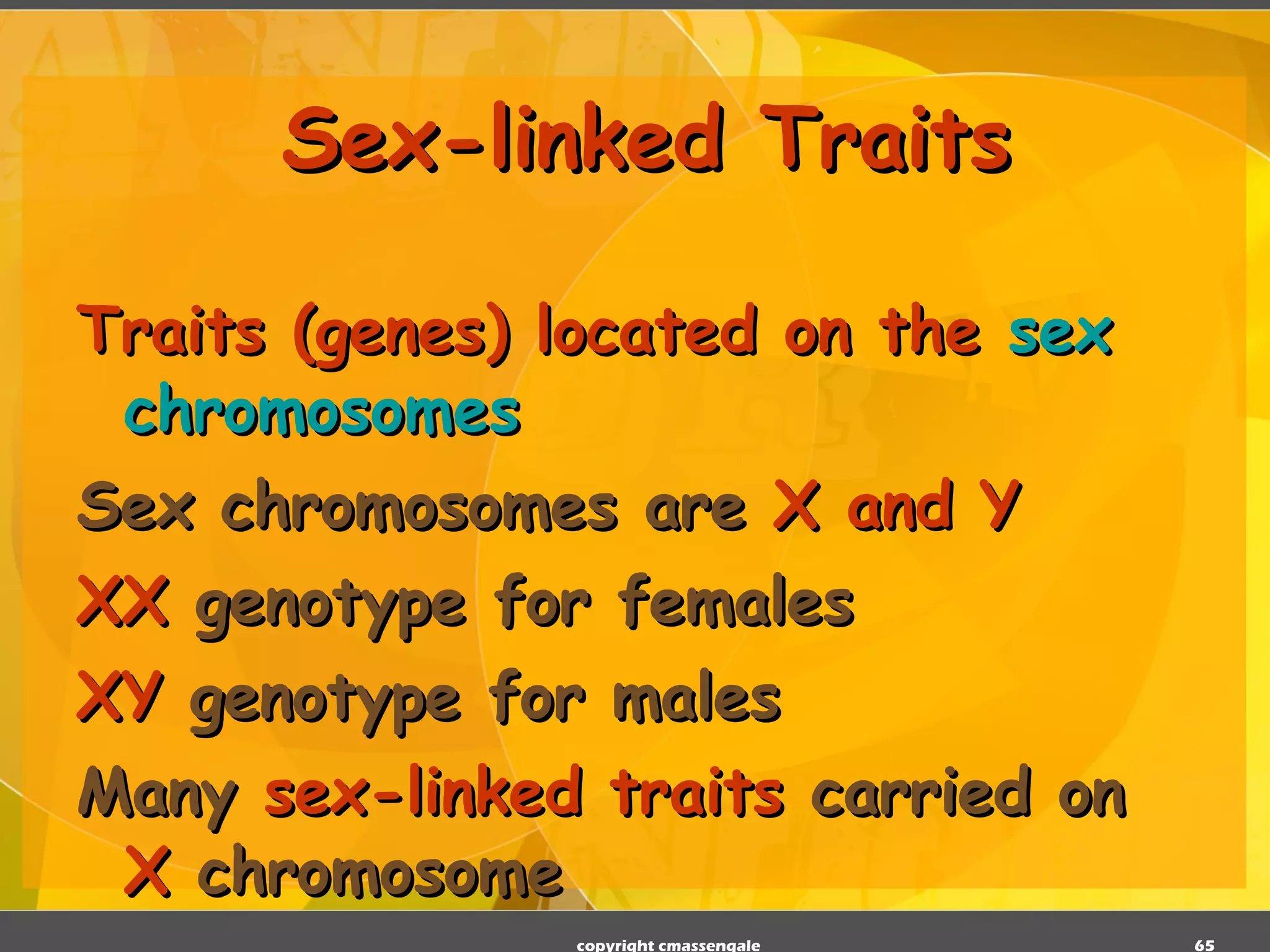
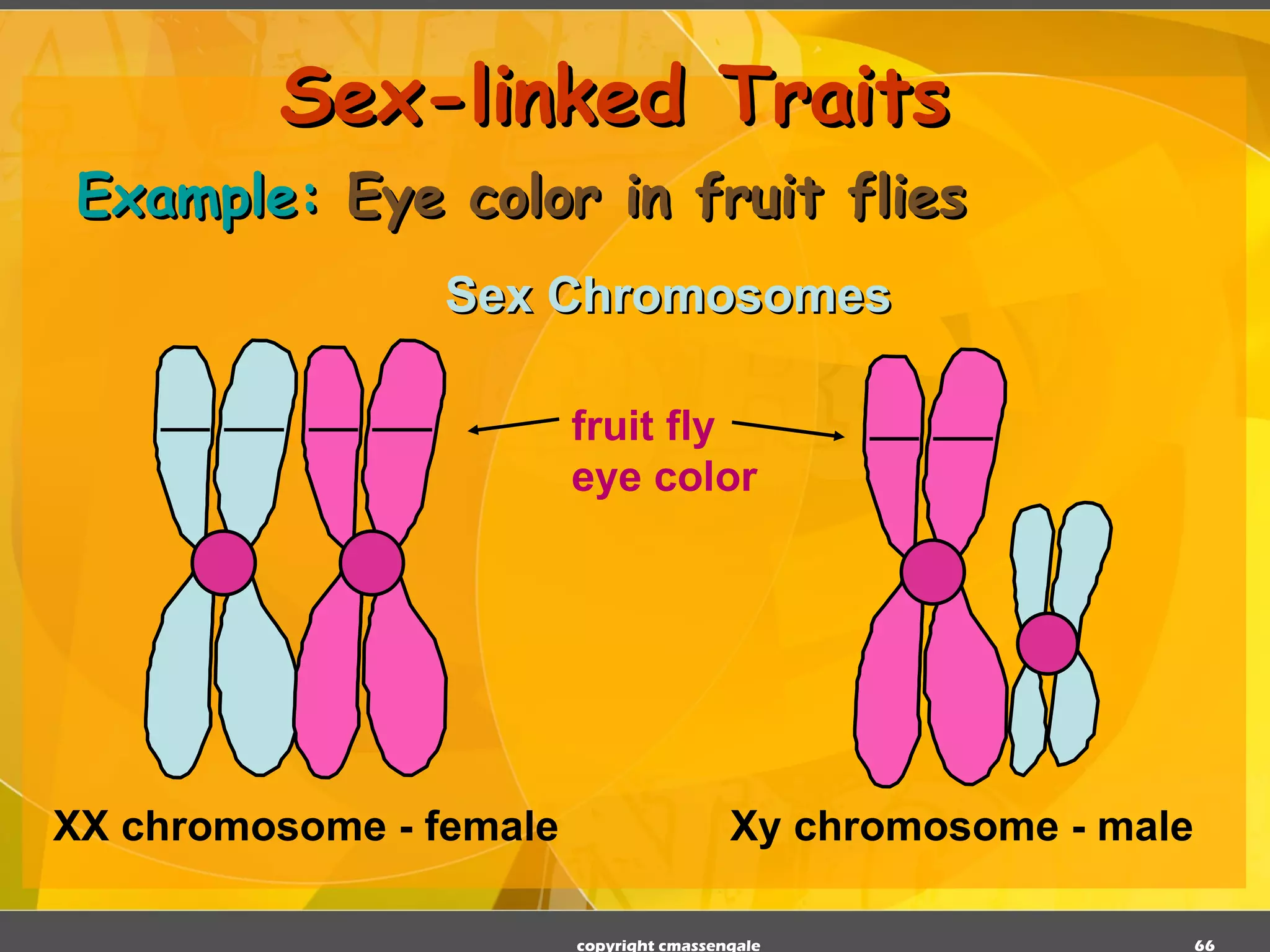
Sex-linked Traits Traits (genes) located on the  sex chromosomes Sex chromosomes are  X and Y XX  genotype for females XY  genotype for males Many  sex-linked traits  carried on  X  chromosome copyright cmassengale
Sex-linked Traits Sex Chromosomes Example:  Eye color in fruit flies copyright cmassengale XX chromosome - female Xy chromosome - male fruit fly eye color
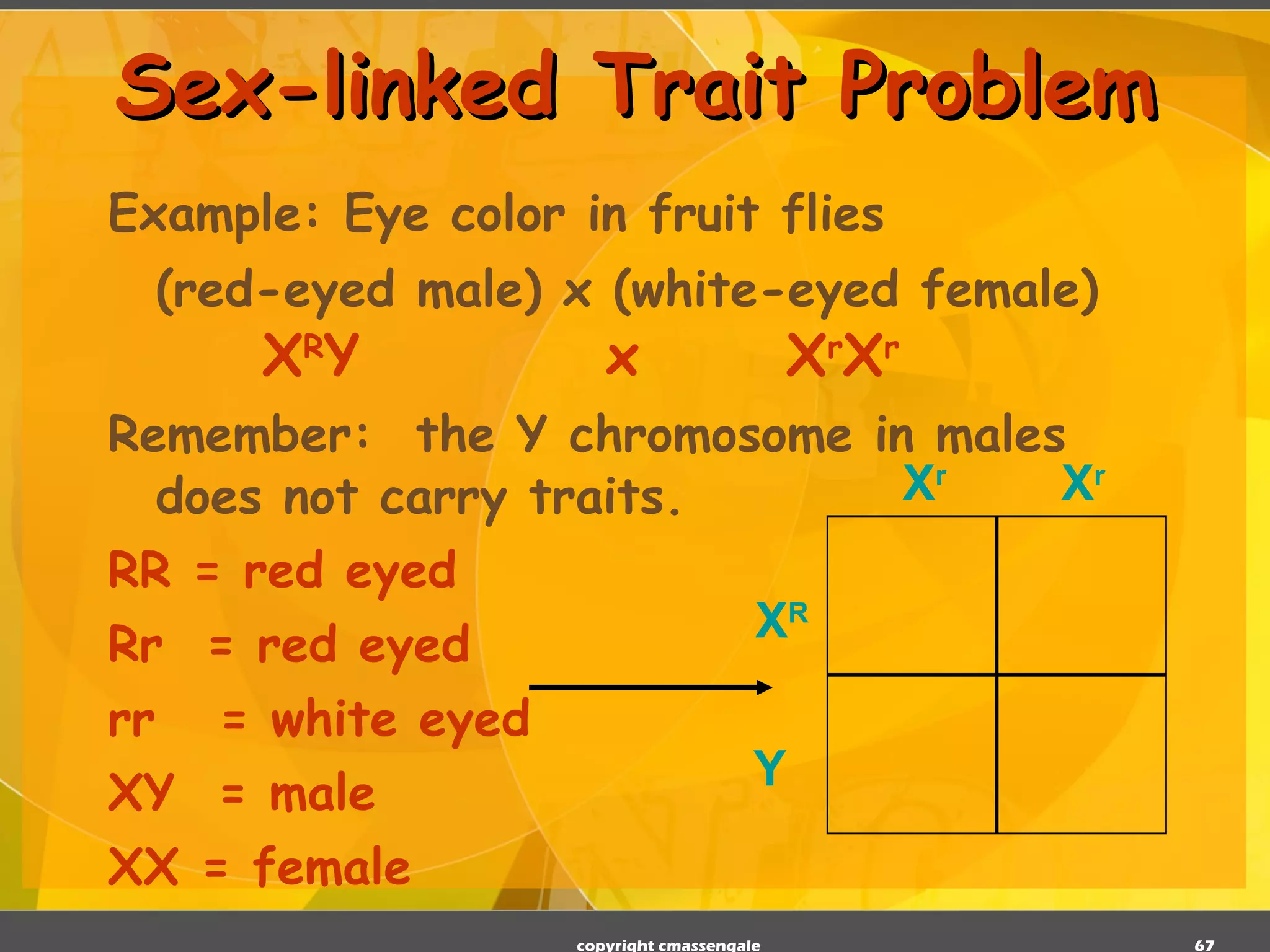
Sex-linked Trait Problem Example: Eye color in fruit flies (red-eyed male) x (white-eyed female)   X R Y  x  X r X r Remember:  the Y chromosome in males does not carry traits. RR = red eyed Rr  = red eyed rr  = white eyed XY  = male XX = female copyright cmassengale X R X r   X r Y
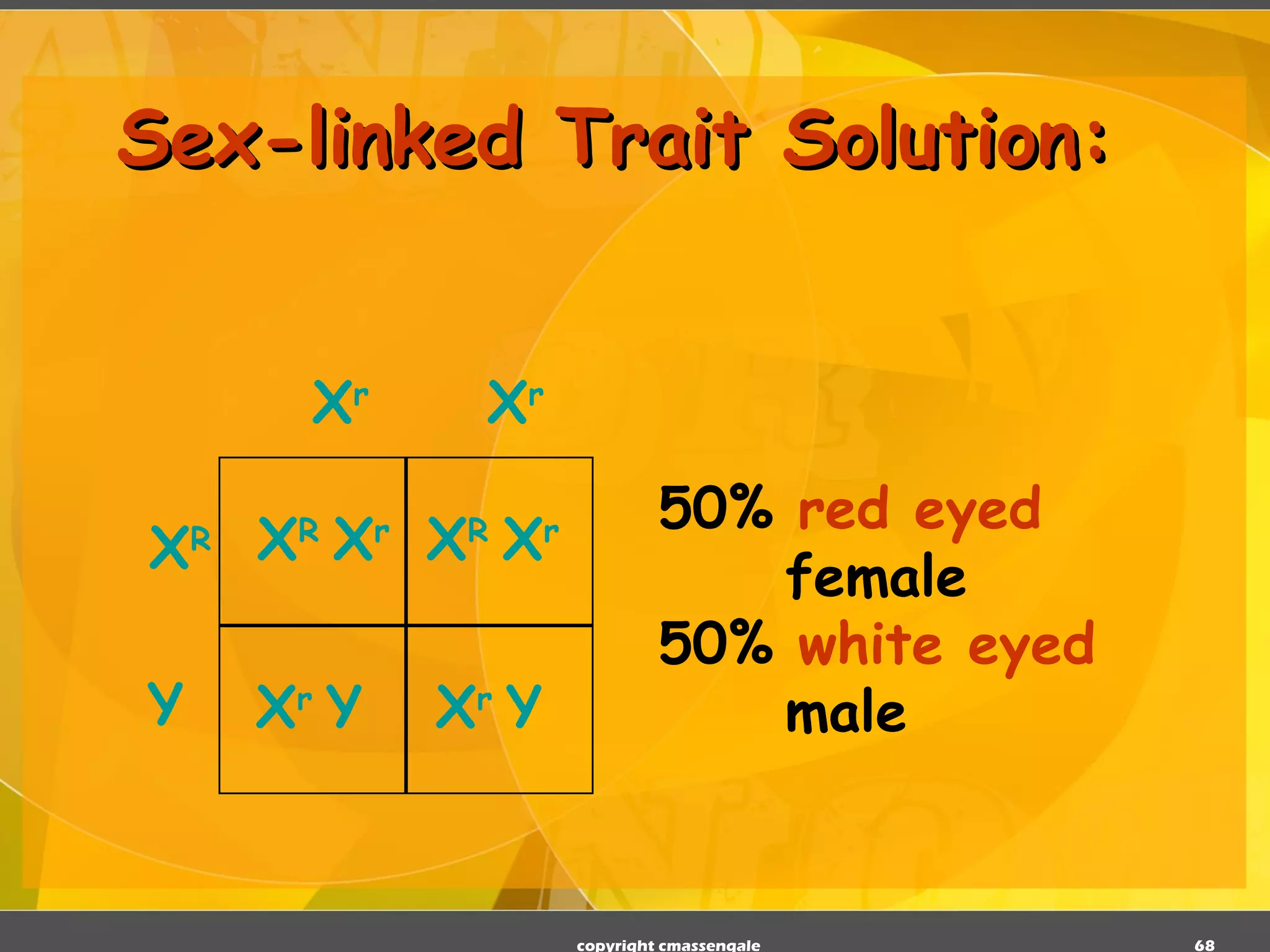
Sex-linked Trait Solution: 50%  red eyed   female 50%  white eyed   male copyright cmassengale X R  X r X r  Y X R  X r X r  Y X R X r   X r Y
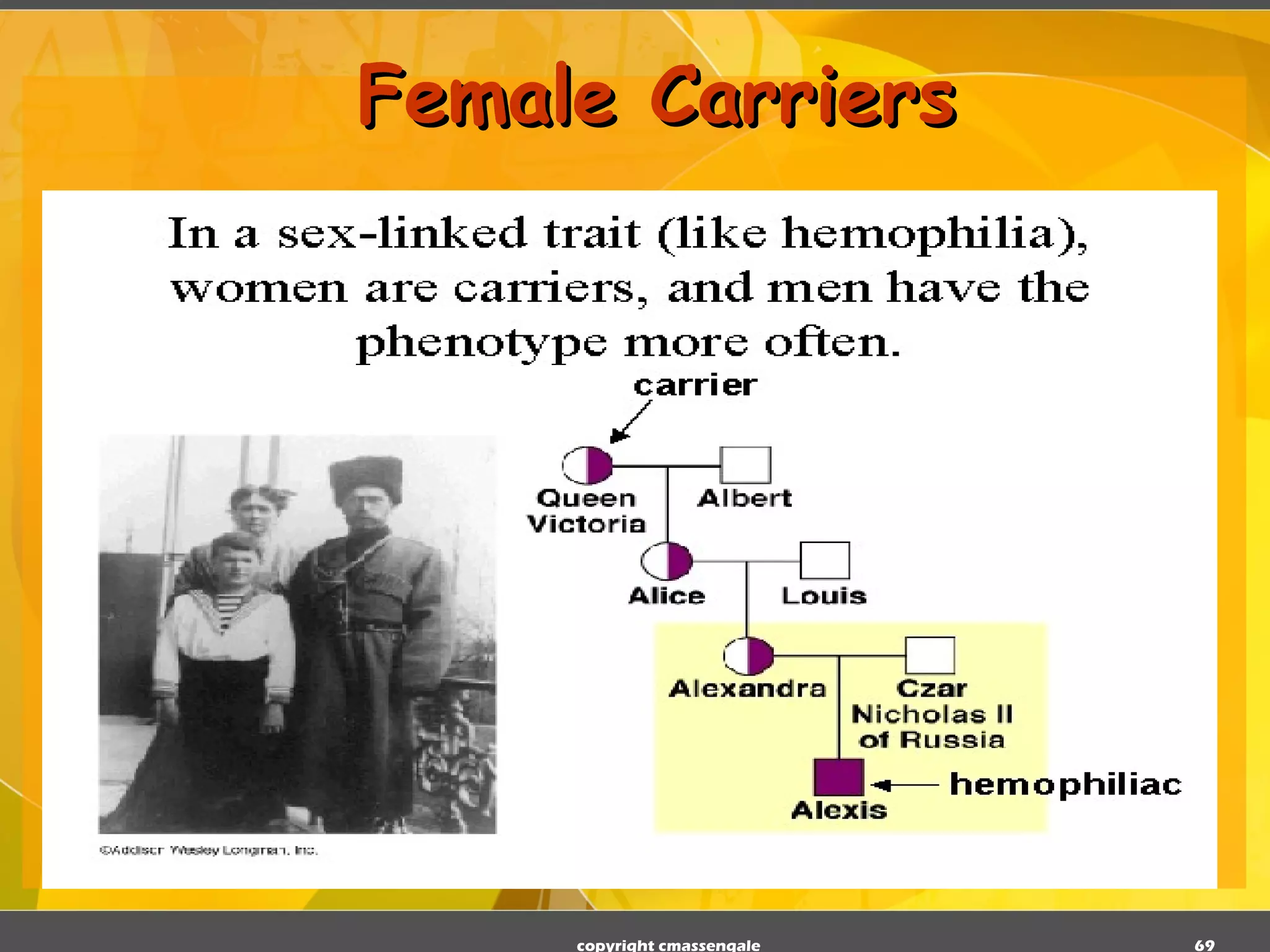
Female Carriers copyright cmassengale
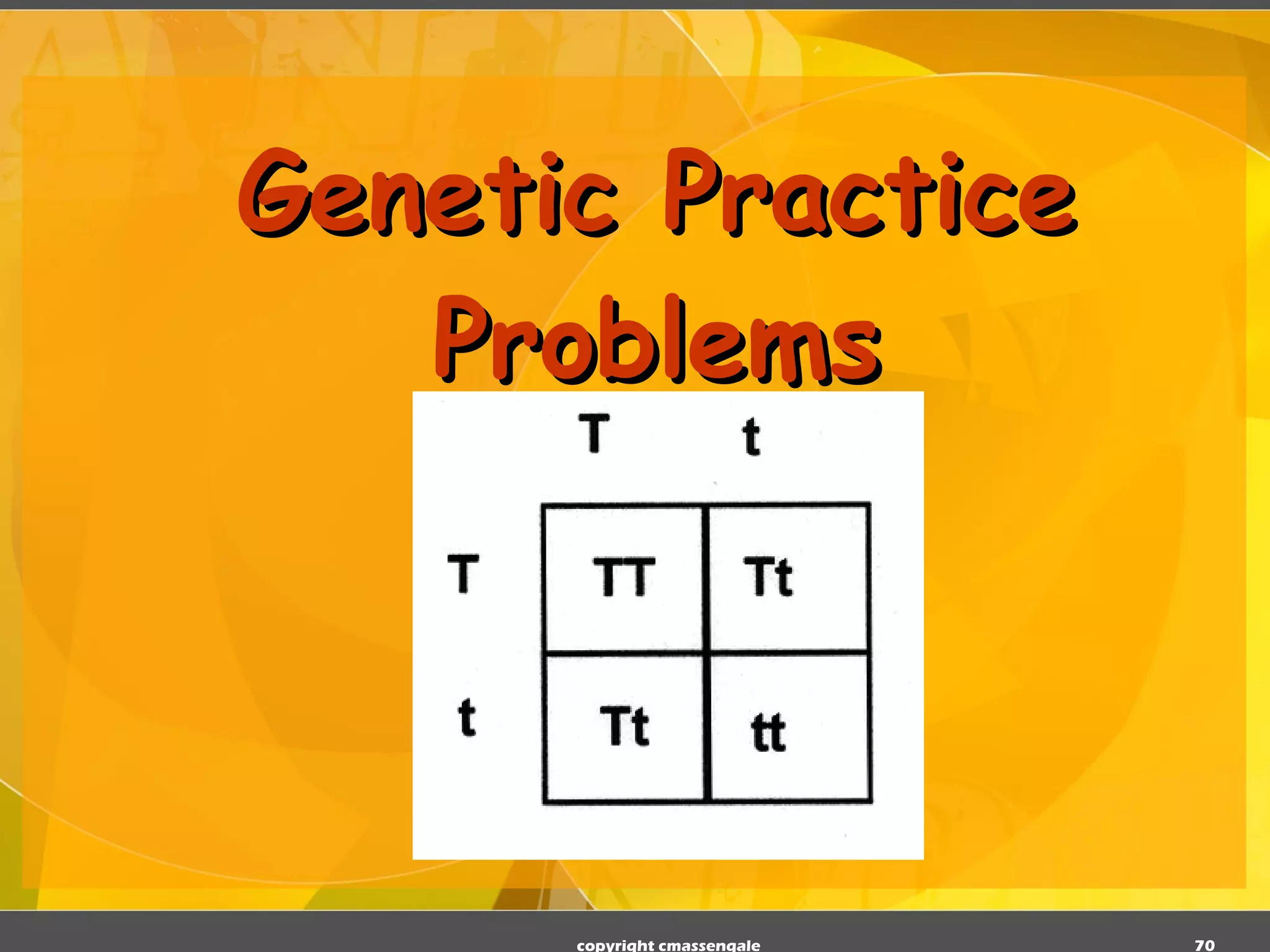
Genetic Practice Problems copyright cmassengale
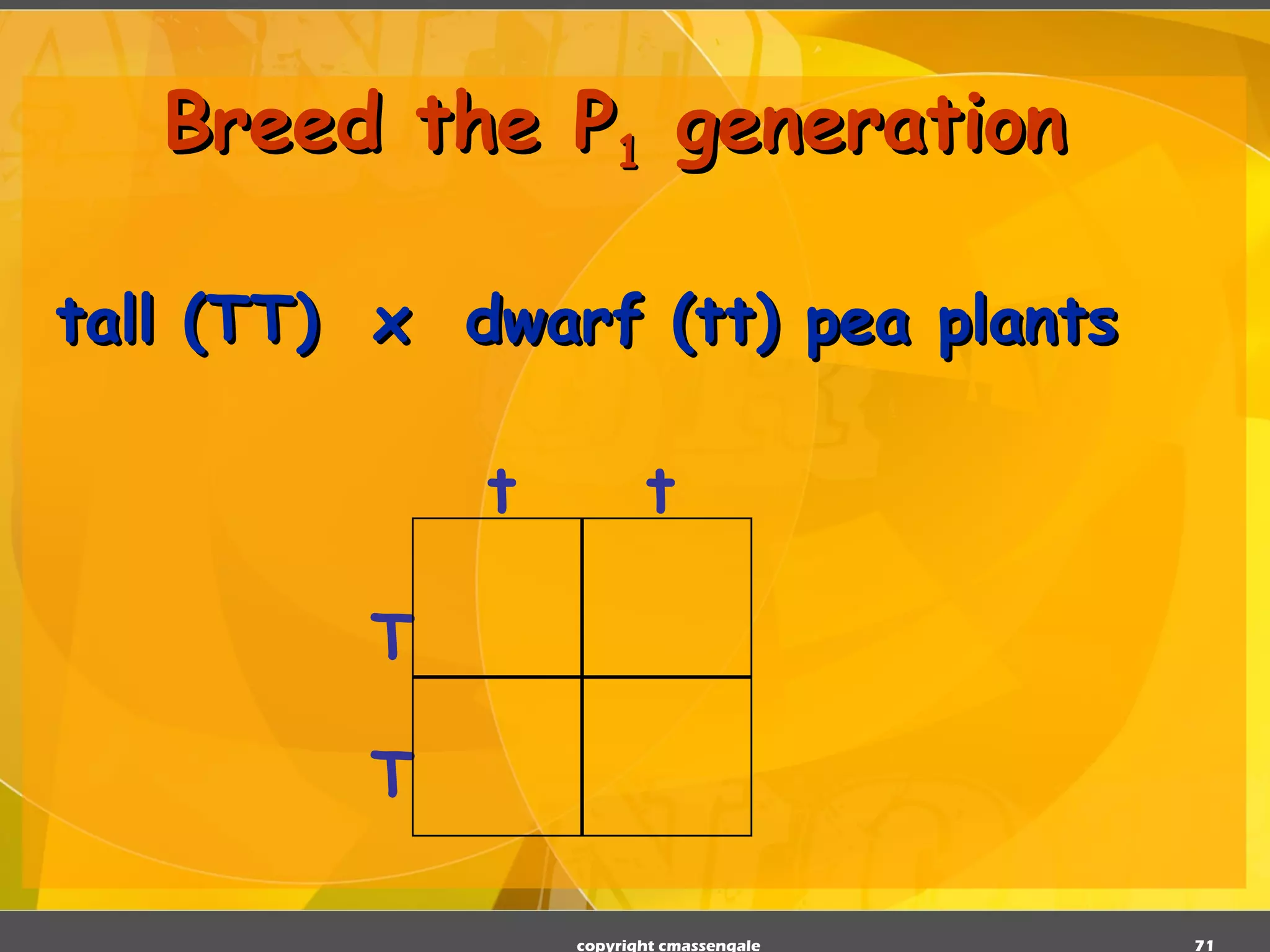
Breed the P 1  generation tall (TT)  x  dwarf (tt) pea plants copyright cmassengale T T t t
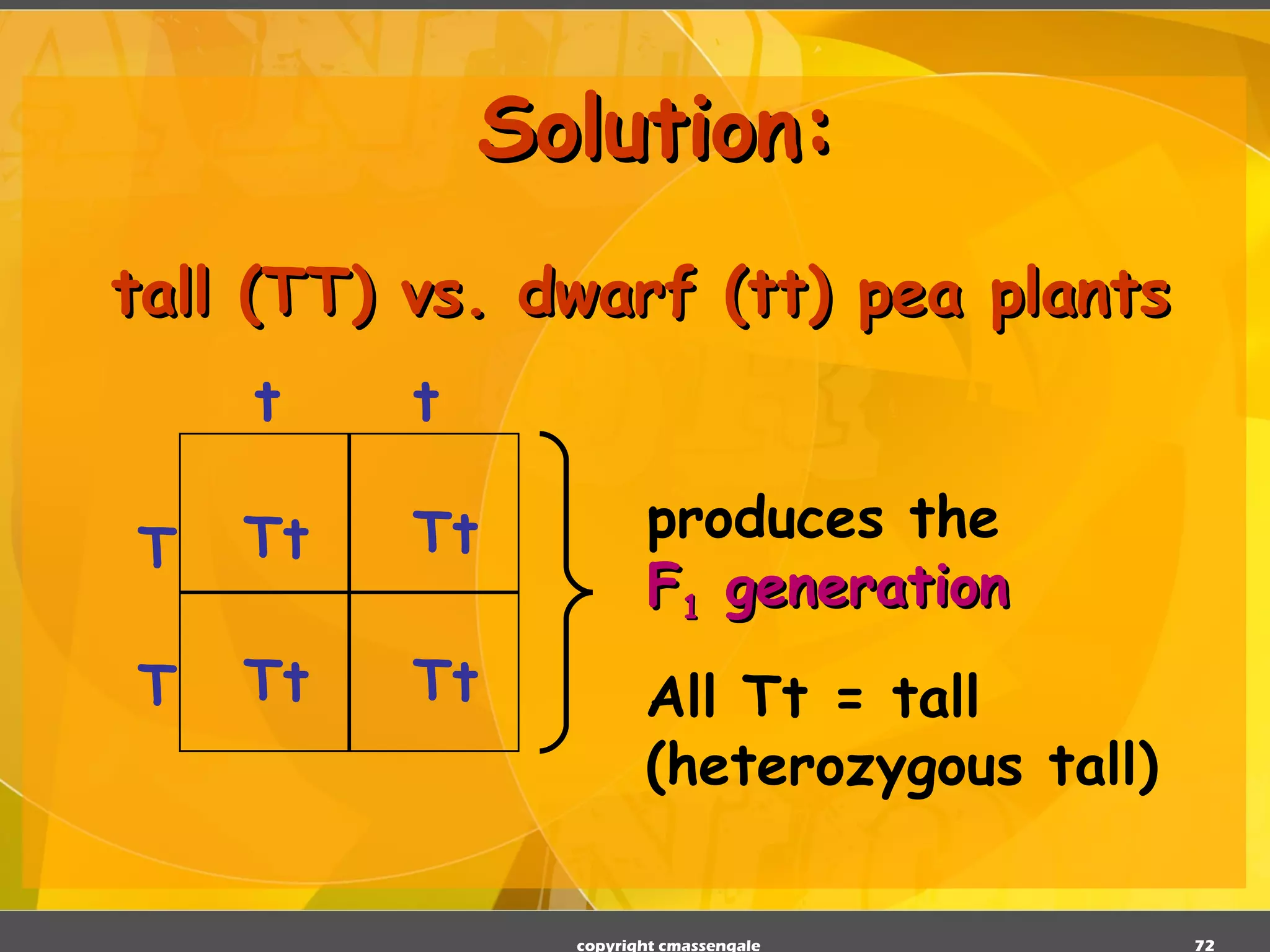
Solution: tall (TT) vs. dwarf (tt) pea plants copyright cmassengale T T t t Tt Tt Tt Tt All Tt = tall (heterozygous tall) produces the F 1  generation
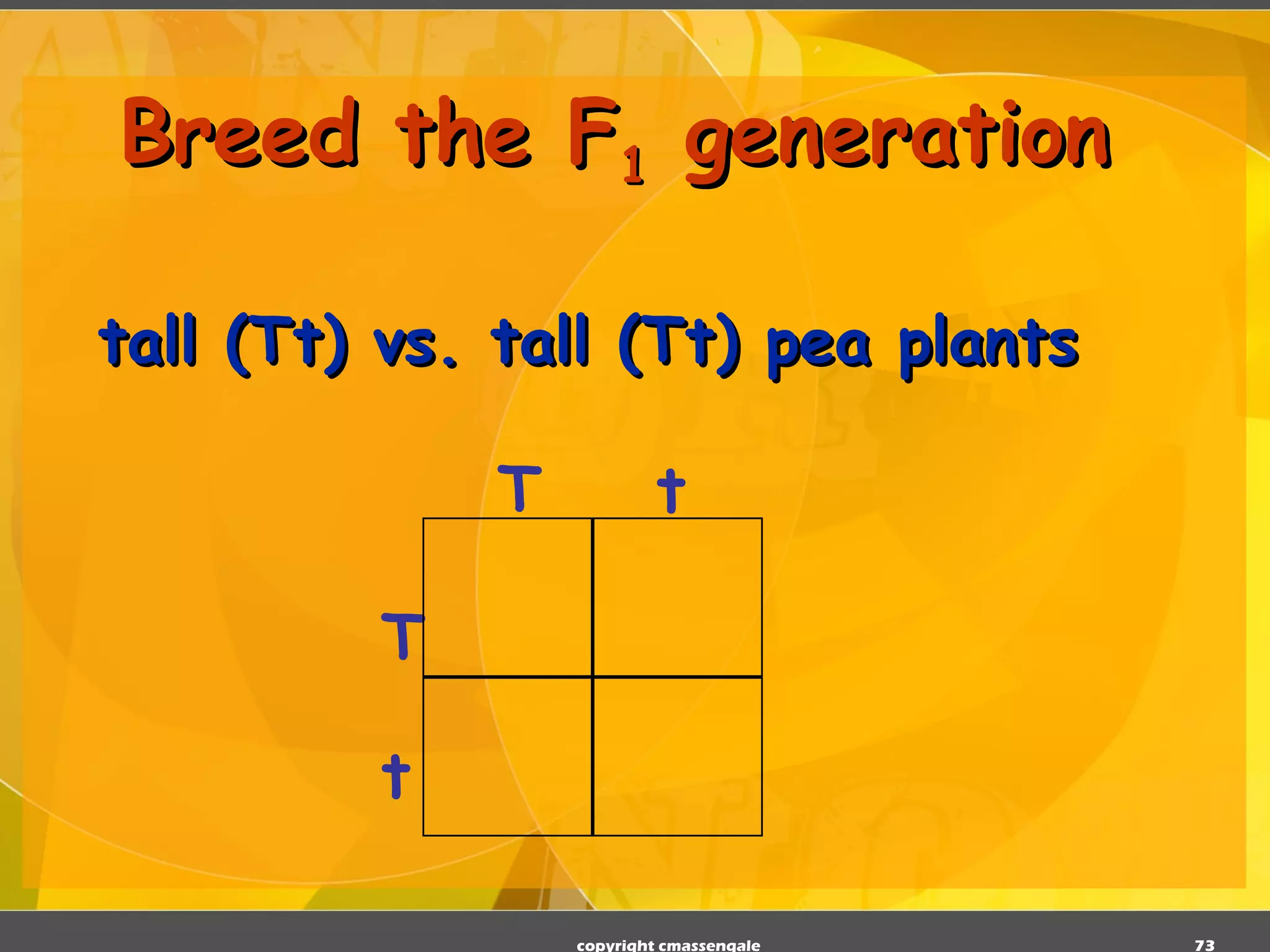
Breed the F 1  generation tall (Tt) vs. tall (Tt) pea plants copyright cmassengale T t T t
Solution: tall (Tt)  x  tall (Tt) pea plants copyright cmassengale TT Tt Tt tt T t T t produces the F 2  generation 1/4 (25%) = TT 1/2 (50%) = Tt 1/4 (25%) = tt 1:2:1 genotype 3:1  phenotype

Biology lecture 8

  • 1.
  • 2.
    Gregor Mendel (1822-1884)Responsible for the Laws governing Inheritance of Traits copyright cmassengale
  • 3.
    Gregor Johann MendelAustrian monk Studied the inheritance of traits in pea plants Developed the laws of inheritance Mendel's work was not recognized until the turn of the 20th century copyright cmassengale
  • 4.
    Gregor Johann MendelBetween 1856 and 1863, Mendel cultivated and tested some 28,000 pea plants He found that the plants' offspring retained traits of the parents Called the “Father of Genetics" copyright cmassengale
  • 5.
    Site of GregorMendel’s experimental garden in the Czech Republic copyright cmassengale
  • 6.
    Mendel stated thatphysical traits are inherited as “particles” Mendel did not know that the “particles” were actually Chromosomes & DNA Particulate Inheritance copyright cmassengale
  • 7.
    Genetic Terminology Trait - any characteristic that can be passed from parent to offspring Heredity - passing of traits from parent to offspring Genetics - study of heredity copyright cmassengale
  • 8.
    Types of GeneticCrosses Monohybrid cross - cross involving a single trait e.g. flower color Dihybrid cross - cross involving two traits e.g. flower color & plant height copyright cmassengale
  • 9.
    Punnett Square Usedto help solve genetics problems copyright cmassengale
  • 10.
  • 11.
    Designer “Genes”Alleles - two forms of a gene (dominant & recessive) Dominant - stronger of two genes expressed in the hybrid; represented by a capital letter (R) Recessive - gene that shows up less often in a cross; represented by a lowercase letter (r) copyright cmassengale
  • 12.
    More Terminology Genotype - gene combination for a trait (e.g. RR, Rr, rr) Phenotype - the physical feature resulting from a genotype (e.g. red, white) copyright cmassengale
  • 13.
    Genotype & Phenotypein Flowers Genotype of alleles: R = red flower r = yellow flower All genes occur in pairs, so 2 alleles affect a characteristic Possible combinations are: Genotypes RR R r rr Phenotypes RED RED YELLOW copyright cmassengale
  • 14.
    Genotypes Homozygous genotype - gene combination involving 2 dominant or 2 recessive genes (e.g. RR or rr); also called pure  Heterozygous genotype - gene combination of one dominant & one recessive allele    ( e.g. Rr); also called hybrid copyright cmassengale
  • 15.
    Genes and EnvironmentDetermine Characteristics copyright cmassengale
  • 16.
    Mendel’s Pea PlantExperiments copyright cmassengale
  • 17.
    Why peas, Pisum sativum ? Can be grown in a small area Produce lots of offspring Produce pure plants when allowed to self-pollinate several generations Can be artificially cross-pollinated copyright cmassengale
  • 18.
    Reproduction in FloweringPlants Pollen contains sperm Produced by the stamen Ovary contains eggs Found inside the flower Pollen carries sperm to the eggs for fertilization Self-fertilization can occur in the same flower Cross-fertilization can occur between flowers copyright cmassengale
  • 19.
    Mendel’s Experimental MethodsMendel hand-pollinated flowers using a paintbrush He could snip the stamens to prevent self-pollination Covered each flower with a cloth bag He traced traits through the several generations copyright cmassengale
  • 20.
    How Mendel BeganMendel produced pure strains by allowing the plants to self-pollinate for several generations copyright cmassengale
  • 21.
    Eight Pea PlantTraits Seed shape --- Round (R) or Wrinkled (r) Seed Color ---- Yellow (Y) or  Green ( y ) Pod Shape --- Smooth (S) or wrinkled ( s ) Pod Color ---  Green (G) or Yellow (g) Seed Coat Color ---Gray (G) or White (g) Flower position ---Axial (A) or Terminal (a) Plant Height --- Tall (T) or Short (t) Flower color --- Purple (P) or white ( p ) copyright cmassengale
  • 22.
  • 23.
  • 24.
    Mendel’s Experimental Resultscopyright cmassengale
  • 25.
    Did the observedratio match the theoretical ratio? The theoretical or expected ratio of plants producing round or wrinkled seeds is 3 round :1 wrinkled Mendel’s observed ratio was 2.96:1 The discrepancy is due to statistical error The larger the sample the more nearly the results approximate to the theoretical ratio copyright cmassengale
  • 26.
    Generation “Gap” ParentalP 1 Generation = the parental generation in a breeding experiment . F 1 generation = the first-generation offspring in a breeding experiment. (1st filial generation) From breeding individuals from the P 1 generation F 2 generation = the second-generation offspring in a breeding experiment. (2nd filial generation) From breeding individuals from the F 1 generation copyright cmassengale
  • 27.
    Following the GenerationsCross 2 Pure Plants TT x tt Results in all Hybrids Tt Cross 2 Hybrids get 3 Tall & 1 Short TT, Tt, tt copyright cmassengale
  • 28.
  • 29.
    Trait: Seed ShapeAlleles: R – Round r – Wrinkled Cross: Round seeds x Wrinkled seeds RR x rr P 1 Monohybrid Cross R R r r Rr Rr Rr Rr Genotype: Rr Phenotype : Round Genotypic Ratio: All alike Phenotypic Ratio: All alike copyright cmassengale
  • 30.
    P 1 Monohybrid Cross Review Homozygous dominant x Homozygous recessive Offspring all Heterozygous (hybrids) Offspring called F 1 generation Genotypic & Phenotypic ratio is ALL ALIKE copyright cmassengale
  • 31.
    Trait: Seed ShapeAlleles: R – Round r – Wrinkled Cross: Round seeds x Round seeds Rr x Rr F 1 Monohybrid Cross R r r R RR rr Rr Rr Genotype: RR, Rr, rr Phenotype : Round & wrinkled G.Ratio: 1:2:1 P.Ratio: 3:1 copyright cmassengale
  • 32.
    F 1 Monohybrid Cross Review Heterozygous x heterozygous Offspring: 25% Homozygous dominant RR 50% Heterozygous Rr 25% Homozygous Recessive rr Offspring called F 2 generation Genotypic ratio is 1:2:1 Phenotypic Ratio is 3:1 copyright cmassengale
  • 33.
    What Do thePeas Look Like? copyright cmassengale
  • 34.
    … And Nowthe Test Cross Mendel then crossed a pure & a hybrid from his F 2 generation This is known as an F 2 or test cross There are two possible testcrosses: Homozygous dominant x Hybrid Homozygous recessive x Hybrid copyright cmassengale
  • 35.
    Trait: Seed ShapeAlleles: R – Round r – Wrinkled Cross: Round seeds x Round seeds RR x Rr F 2 Monohybrid Cross (1 st ) R R r R RR Rr RR Rr Genotype: RR, Rr Phenotype : Round Genotypic Ratio: 1:1 Phenotypic Ratio: All alike copyright cmassengale
  • 36.
    Trait: Seed ShapeAlleles: R – Round r – Wrinkled Cross: Wrinkled seeds x Round seeds rr x Rr F 2 Monohybrid Cross (2nd) r r r R Rr rr Rr rr Genotype: Rr, rr Phenotype : Round & Wrinkled G. Ratio: 1:1 P.Ratio: 1:1 copyright cmassengale
  • 37.
    F 2 Monohybrid Cross Review Homozygous x heterozygous(hybrid) Offspring: 50% Homozygous RR or rr 50% Heterozygous Rr Phenotypic Ratio is 1:1 Called Test Cross because the offspring have SAME genotype as parents copyright cmassengale
  • 38.
    Practice Your CrossesWork the P 1 , F 1 , and both F 2 Crosses for each of the other Seven Pea Plant Traits copyright cmassengale
  • 39.
  • 40.
    Results of MonohybridCrosses Inheritable factors or genes are responsible for all heritable characteristics Phenotype is based on Genotype Each trait is based on two genes , one from the mother and the other from the father True-breeding individuals are homozygous ( both alleles) are the same copyright cmassengale
  • 41.
    Law of Dominance In a cross of parents that are pure for contrasting traits , only one form of the trait will appear in the next generation. All the offspring will be heterozygous and express only the dominant trait. RR x rr yields all Rr (round seeds) copyright cmassengale
  • 42.
    Law of Dominancecopyright cmassengale
  • 43.
    Law of SegregationDuring the formation of gametes (eggs or sperm), the two alleles responsible for a trait separate from each other. Alleles for a trait are then "recombined" at fertilization , producing the genotype for the traits of the offspring . copyright cmassengale
  • 44.
    Applying the Lawof Segregation copyright cmassengale
  • 45.
    Law of IndependentAssortment Alleles for different traits are distributed to sex cells (& offspring) independently of one another. This law can be illustrated using dihybrid crosses . copyright cmassengale
  • 46.
    Dihybrid Cross Abreeding experiment that tracks the inheritance of two traits . Mendel’s “Law of Independent Assortment” a. Each pair of alleles segregates independently during gamete formation b. Formula: 2 n (n = # of heterozygotes) copyright cmassengale
  • 47.
    Question: How manygametes will be produced for the following allele arrangements? Remember: 2 n (n = # of heterozygotes) 1. RrYy 2. AaBbCCDd 3. MmNnOoPPQQRrssTtQq copyright cmassengale
  • 48.
    Answer: 1. RrYy: 2 n = 2 2 = 4 gametes RY Ry rY ry 2. AaBbCCDd: 2 n = 2 3 = 8 gametes ABCD ABCd AbCD AbCd aBCD aBCd abCD abCD 3. MmNnOoPPQQRrssTtQq: 2 n = 2 6 = 64 gametes copyright cmassengale
  • 49.
    Dihybrid Cross Traits:Seed shape & Seed color Alleles: R round r wrinkled Y yellow y green RrYy x RrYy RY Ry rY ry RY Ry rY ry All possible gamete combinations copyright cmassengale
  • 50.
    Dihybrid Cross copyrightcmassengale RY Ry rY ry RY Ry rY ry
  • 51.
    Dihybrid Cross copyrightcmassengale RRYY RRYy RrYY RrYy RRYy RRyy RrYy Rryy RrYY RrYy rrYY rrYy RrYy Rryy rrYy rryy Round/Yellow: 9 Round/green: 3 wrinkled/Yellow: 3 wrinkled/green: 1 9:3:3:1 phenotypic ratio RY Ry rY ry RY Ry rY ry
  • 52.
    Dihybrid Cross Round/Yellow: 9 Round/green: 3 wrinkled/Yellow: 3 wrinkled/green: 1 9:3:3:1 copyright cmassengale
  • 53.
    Test Cross Amating between an individual of unknown genotype and a homozygous recessive individual. Example: bbC__ x bbcc BB = brown eyes Bb = brown eyes bb = blue eyes CC = curly hair Cc = curly hair cc = straight hair copyright cmassengale bC b___ bc
  • 54.
    Test Cross Possibleresults: copyright cmassengale bC b___ bc bbCc bb C c C bC b___ bc bbCc bb c c or c
  • 55.
    Summary of Mendel’slaws copyright cmassengale LAW PARENT CROSS OFFSPRING DOMINANCE TT x tt tall x short 100% Tt tall SEGREGATION Tt x Tt tall x tall 75% tall 25% short INDEPENDENT ASSORTMENT RrGg x RrGg round & green x round & green 9/16 round seeds & green pods 3/16 round seeds & yellow pods 3/16 wrinkled seeds & green pods 1/16 wrinkled seeds & yellow pods
  • 56.
    Incomplete Dominance andCodominance copyright cmassengale
  • 57.
    Incomplete Dominance F1hybrids have an appearance somewhat in between the phenotypes of the two parental varieties. Example: snapdragons (flower) red (RR) x white (rr) RR = red flower rr = white flower copyright cmassengale R R r r
  • 58.
    Incomplete Dominance rcopyright cmassengale Rr Rr Rr Rr R R r All Rr = pink (heterozygous pink) produces the F 1 generation
  • 59.
  • 60.
    Codominance Two alleles are expressed ( multiple alleles ) in heterozygous individuals . Example: blood type 1. type A = I A I A or I A i 2. type B = I B I B or I B i 3. type AB = I A I B 4. type O = ii copyright cmassengale
  • 61.
    Codominance Problem Example:homozygous male Type B (I B I B ) x heterozygous female Type A (I A i) copyright cmassengale I A I B I B i I A I B I B i 1/2 = I A I B 1/2 = I B i I B I A i I B
  • 62.
    Another Codominance ProblemExample: male Type O (ii) x female type AB (I A I B ) copyright cmassengale I A i I B i I A i I B i 1/2 = I A i 1/2 = I B i i I A I B i
  • 63.
    Codominance Question :If a boy has a blood type O and his sister has blood type AB, what are the genotypes and phenotypes of their parents? boy - type O (ii) X girl - type AB (I A I B ) copyright cmassengale
  • 64.
    Codominance Answer: Parents:genotypes = I A i and I B i phenotypes = A and B copyright cmassengale I A I B ii I B I A i i
  • 65.
    Sex-linked Traits Traits(genes) located on the sex chromosomes Sex chromosomes are X and Y XX genotype for females XY genotype for males Many sex-linked traits carried on X chromosome copyright cmassengale
  • 66.
    Sex-linked Traits SexChromosomes Example: Eye color in fruit flies copyright cmassengale XX chromosome - female Xy chromosome - male fruit fly eye color
  • 67.
    Sex-linked Trait ProblemExample: Eye color in fruit flies (red-eyed male) x (white-eyed female) X R Y x X r X r Remember: the Y chromosome in males does not carry traits. RR = red eyed Rr = red eyed rr = white eyed XY = male XX = female copyright cmassengale X R X r X r Y
  • 68.
    Sex-linked Trait Solution:50% red eyed female 50% white eyed male copyright cmassengale X R X r X r Y X R X r X r Y X R X r X r Y
  • 69.
  • 70.
    Genetic Practice Problemscopyright cmassengale
  • 71.
    Breed the P1 generation tall (TT) x dwarf (tt) pea plants copyright cmassengale T T t t
  • 72.
    Solution: tall (TT)vs. dwarf (tt) pea plants copyright cmassengale T T t t Tt Tt Tt Tt All Tt = tall (heterozygous tall) produces the F 1 generation
  • 73.
    Breed the F1 generation tall (Tt) vs. tall (Tt) pea plants copyright cmassengale T t T t
  • 74.
    Solution: tall (Tt) x tall (Tt) pea plants copyright cmassengale TT Tt Tt tt T t T t produces the F 2 generation 1/4 (25%) = TT 1/2 (50%) = Tt 1/4 (25%) = tt 1:2:1 genotype 3:1 phenotype

Editor's Notes

  • #2 Mendelian Genetics 12/07/11
  • #3 Mendelian Genetics 12/07/11
  • #4 Mendelian Genetics 12/07/11
  • #5 Mendelian Genetics 12/07/11
  • #6 Mendelian Genetics 12/07/11 Fig. 5.co
  • #7 Mendelian Genetics 12/07/11
  • #8 Mendelian Genetics 12/07/11
  • #9 Mendelian Genetics 12/07/11
  • #10 Mendelian Genetics 12/07/11
  • #11 Mendelian Genetics 12/07/11
  • #12 Mendelian Genetics 12/07/11
  • #13 Mendelian Genetics 12/07/11
  • #14 Mendelian Genetics 12/07/11
  • #15 Mendelian Genetics 12/07/11
  • #16 Mendelian Genetics 12/07/11
  • #17 Mendelian Genetics 12/07/11
  • #18 Mendelian Genetics 12/07/11
  • #19 Mendelian Genetics 12/07/11
  • #20 Mendelian Genetics 12/07/11
  • #21 Mendelian Genetics 12/07/11
  • #22 Mendelian Genetics 12/07/11
  • #23 Mendelian Genetics 12/07/11
  • #24 Mendelian Genetics 12/07/11
  • #25 Mendelian Genetics 12/07/11
  • #26 Mendelian Genetics 12/07/11
  • #27 Mendelian Genetics 12/07/11
  • #28 Mendelian Genetics 12/07/11
  • #29 Mendelian Genetics 12/07/11
  • #30 Mendelian Genetics 12/07/11
  • #31 Mendelian Genetics 12/07/11
  • #32 Mendelian Genetics 12/07/11
  • #33 Mendelian Genetics 12/07/11
  • #34 Mendelian Genetics 12/07/11
  • #35 Mendelian Genetics 12/07/11
  • #36 Mendelian Genetics 12/07/11
  • #37 Mendelian Genetics 12/07/11
  • #38 Mendelian Genetics 12/07/11
  • #39 Mendelian Genetics 12/07/11
  • #40 Mendelian Genetics 12/07/11
  • #41 Mendelian Genetics 12/07/11
  • #42 Mendelian Genetics 12/07/11
  • #43 Mendelian Genetics 12/07/11
  • #44 Mendelian Genetics 12/07/11
  • #45 Mendelian Genetics 12/07/11
  • #46 Mendelian Genetics 12/07/11
  • #47 Mendelian Genetics 12/07/11
  • #48 Mendelian Genetics 12/07/11
  • #49 Mendelian Genetics 12/07/11
  • #50 Mendelian Genetics 12/07/11
  • #51 Mendelian Genetics 12/07/11
  • #52 Mendelian Genetics 12/07/11
  • #53 Mendelian Genetics 12/07/11
  • #54 Mendelian Genetics 12/07/11
  • #55 Mendelian Genetics 12/07/11
  • #56 Mendelian Genetics 12/07/11
  • #57 Mendelian Genetics 12/07/11
  • #58 Mendelian Genetics 12/07/11
  • #59 Mendelian Genetics 12/07/11
  • #60 Mendelian Genetics 12/07/11
  • #61 Mendelian Genetics 12/07/11
  • #62 Mendelian Genetics 12/07/11
  • #63 Mendelian Genetics 12/07/11
  • #64 Mendelian Genetics 12/07/11
  • #65 Mendelian Genetics 12/07/11
  • #66 Mendelian Genetics 12/07/11
  • #67 Mendelian Genetics 12/07/11
  • #68 Mendelian Genetics 12/07/11
  • #69 Mendelian Genetics 12/07/11
  • #70 Mendelian Genetics 12/07/11
  • #71 Mendelian Genetics 12/07/11
  • #72 Mendelian Genetics 12/07/11
  • #73 Mendelian Genetics 12/07/11
  • #74 Mendelian Genetics 12/07/11
  • #75 Mendelian Genetics 12/07/11