MULTIPLE ALLELES   Genes which have more than two alleles © 2007 Paul Billiet  ODWS
Genes and their alleles About 30% of the genes in humans are  di-allelic , that is they exist in two forms, (they have two alleles) About 70% are  mono-allelic , they only exist in one form and they show no variation A very few are  poly-allelic  having more than two forms © 2007 Paul Billiet  ODWS
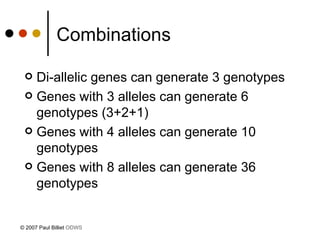
Combinations Di-allelic genes can generate 3 genotypes Genes with 3 alleles can generate 6 genotypes (3+2+1) Genes with 4 alleles can generate 10 genotypes  Genes with 8 alleles can generate 36 genotypes   © 2007 Paul Billiet  ODWS
Genes and the immune system Poly-allelic alleles are usually associated with tissue types These genes are so varied that they provide us with our genetic finger print   This is very important to our immune system which must tell the difference between our own cells ( self ) and invading disease causing microbes  ( non-self ) © 2007 Paul Billiet  ODWS
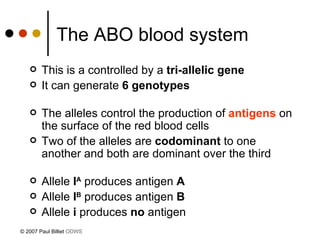
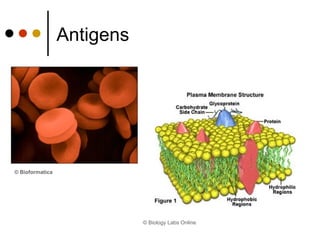
The ABO blood system   This is a controlled by a  tri-allelic gene It can generate  6 genotypes The alleles control the production of  antigens  on the surface of the red blood cells Two of the alleles are  codominant  to one another and both are dominant over the third Allele  I A  produces antigen  A Allele  I B  produces antigen  B Allele  i  produces  no  antigen   © 2007 Paul Billiet  ODWS
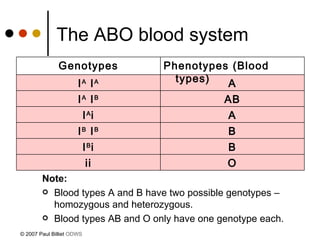
The ABO blood system Note:  Blood types A and B have two possible genotypes – homozygous and heterozygous. Blood types AB and O only have one genotype each.   © 2007 Paul Billiet  ODWS O ii B I B i B I B  I B A I A i AB I A  I B A I A  I A Phenotypes (Blood types) Genotypes
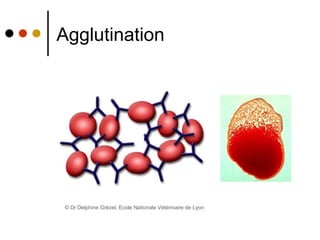
Blood types and transfusions Blood types vary and your immune system recognises your own blood type as being  self Other blood types are recognised as  non-self If a blood which is incompatible with your body is transfused it will result in the  agglutination  of the foreign red blood cells © 2007 Paul Billiet  ODWS
Antigens © Biology Labs Online © Bioformatica
Agglutination ©  Dr Delphine Grézel, Ecole Nationale Vétérinaire de Lyon
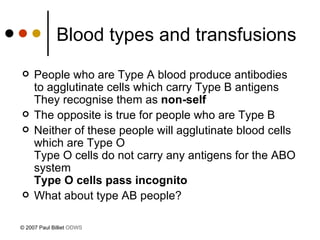
Blood types and transfusions People who are Type A blood produce antibodies to agglutinate cells which carry Type B antigens They recognise them as  non-self The opposite is true for people who are Type B Neither of these people will agglutinate blood cells which are Type O Type O cells do not carry any antigens for the ABO system Type O cells pass incognito What about type AB people? © 2007 Paul Billiet  ODWS
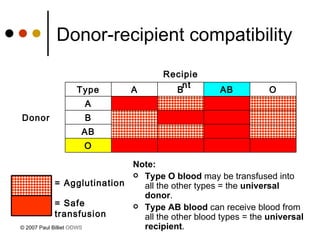
Donor-recipient compatibility Note: Type O blood  may be transfused into all the other types = the  universal donor . Type AB blood  can receive blood from all the other blood types = the  universal recipient . © 2007 Paul Billiet  ODWS O AB B Donor A O AB B A Type Recipient = Safe transfusion = Agglutination

Multiple Alleles

  • 1.
    MULTIPLE ALLELES Genes which have more than two alleles © 2007 Paul Billiet ODWS
  • 2.
    Genes and theiralleles About 30% of the genes in humans are di-allelic , that is they exist in two forms, (they have two alleles) About 70% are mono-allelic , they only exist in one form and they show no variation A very few are poly-allelic having more than two forms © 2007 Paul Billiet ODWS
  • 3.
    Combinations Di-allelic genescan generate 3 genotypes Genes with 3 alleles can generate 6 genotypes (3+2+1) Genes with 4 alleles can generate 10 genotypes Genes with 8 alleles can generate 36 genotypes © 2007 Paul Billiet ODWS
  • 4.
    Genes and theimmune system Poly-allelic alleles are usually associated with tissue types These genes are so varied that they provide us with our genetic finger print This is very important to our immune system which must tell the difference between our own cells ( self ) and invading disease causing microbes ( non-self ) © 2007 Paul Billiet ODWS
  • 5.
    The ABO bloodsystem This is a controlled by a tri-allelic gene It can generate 6 genotypes The alleles control the production of antigens on the surface of the red blood cells Two of the alleles are codominant to one another and both are dominant over the third Allele I A produces antigen A Allele I B produces antigen B Allele i produces no antigen © 2007 Paul Billiet ODWS
  • 6.
    The ABO bloodsystem Note: Blood types A and B have two possible genotypes – homozygous and heterozygous. Blood types AB and O only have one genotype each. © 2007 Paul Billiet ODWS O ii B I B i B I B I B A I A i AB I A I B A I A I A Phenotypes (Blood types) Genotypes
  • 7.
    Blood types andtransfusions Blood types vary and your immune system recognises your own blood type as being self Other blood types are recognised as non-self If a blood which is incompatible with your body is transfused it will result in the agglutination of the foreign red blood cells © 2007 Paul Billiet ODWS
  • 8.
    Antigens © BiologyLabs Online © Bioformatica
  • 9.
    Agglutination © Dr Delphine Grézel, Ecole Nationale Vétérinaire de Lyon
  • 10.
    Blood types andtransfusions People who are Type A blood produce antibodies to agglutinate cells which carry Type B antigens They recognise them as non-self The opposite is true for people who are Type B Neither of these people will agglutinate blood cells which are Type O Type O cells do not carry any antigens for the ABO system Type O cells pass incognito What about type AB people? © 2007 Paul Billiet ODWS
  • 11.
    Donor-recipient compatibility Note:Type O blood may be transfused into all the other types = the universal donor . Type AB blood can receive blood from all the other blood types = the universal recipient . © 2007 Paul Billiet ODWS O AB B Donor A O AB B A Type Recipient = Safe transfusion = Agglutination