Monohybrid and Dihybrid
                  Cross
         Submitted by:
     ARIOLA, Inah Abbygail T.
      VERA, Dianne Eliza G.
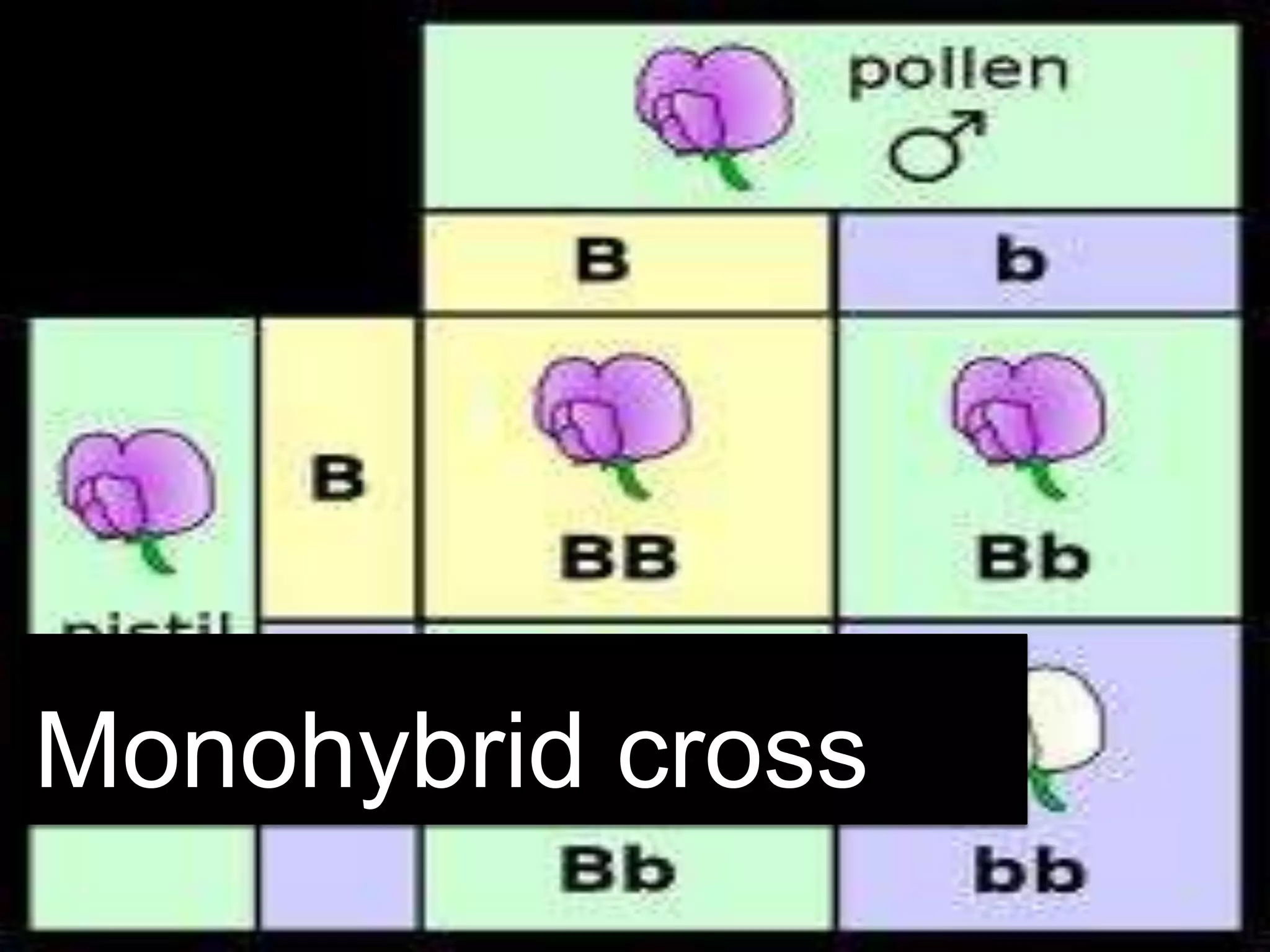
Monohybrid cross
Monohybrid Cross
 a method of determining the inheritance pattern
  of a trait between two single organisms.
 a cross between parents who are true-breeding
  for a trait; i.e., both are homozygous for one allele
  of the
  gene, for example AA x aa, in
  which A is the dominant allele
  for a trait and a is the recessive
  allele for that same trait.
Sample Problem
 In pea plants, spherical seeds (S) are
 dominant to dented seeds (s). In a
 genetic cross of two plants that are
 heterozygous for the seed shape trait,
 what fraction of the offspring should
 have spherical seeds?
Analysis
 The figure above represents a monohybrid
  cross of F1-hybrid plants.
 Both parent plants are heterozygous (Ss) for
  an allele that determines seed shape.
 Presence of the dominant allele (S) in
  homozygous (SS) or heterozygous (Ss) plants
  results in spherical seeds.
 Homozygous recessive (ss) plants have
  dented seeds.
Analysis
 To solve the sample problem, you'll
 need to set up a Punnett square.

 Punnett square - a diagram that is used
 to predict an outcome of a particular
 cross or breeding experiment
Steps to Solve the Sample
Problem
 Set up a 2 by 2
 Punnett square.
Steps to Solve the Sample
Problem
 Write the alleles for
 parent 1 on the left
 side of the Punnett
 square.
 Each gamete will have
 one of the two alleles of   S
 the parent. In this
 particular cross, half of
 the gametes will have
 the dominant (S) allele,    s
 and half will have the
 recessive (s) allele. We
 will use blue and brown
 to keep track of the
 alleles of each parent.
Steps to Solve the Sample
Problem
 Write the alleles
 from parent 2 above            S   s
 the Punnett square.
 For this heterozygous
 parent (Ss), half of the   S
 gametes will have the
 dominant (S) allele, and
 half will have the
 recessive (s) allele.      s
Steps to Solve the Sample
Problem
 Fill the squares for
 parent 1.                     S   s
   Fill each square with
   the allele from Parent
   1 that lines up with
   the row.
                            S SS S s
 Fill the squares for
 parent 2.
                            s Ss   ss
   Fill each square with
   the allele from Parent
   2 that lines up with
   the column.
Steps to Solve the Sample
Problem
 Interpreting the
 results of a Punnett      S   s
 square
   Genotypes that
   resulted from this
   monohybrid cross
                        S SS S s
   (Ss x Ss)
    25% homozygous
     dominant           s Ss   ss
    50% heterozygous
    25%
     homozygous
     recessive
Steps to Solve the Sample
Problem
 Interpreting the
 results of a Punnett      S   s
 square
   Phenotypes that
   resulted from this
   monohybrid cross
                        S SS S s
   (Ss x Ss)
    75% Spherical
    25% Dented         s Ss   ss
Dihybrid cross
Dihybrid Cross
 a cross between F1 offspring (first generation
  offspring) of two individuals that differ in two traits
  of particular interest.
 used to test for dominant and recessive genes in
  two separate characteristics
 The rules of meiosis, as they apply to the
  dihybrid, are codified in Mendel's First Law and
  Mendel's Second Law, which are also called the
  Law of Segregation and the Law of Independent
  Assortment, respectively
Example Problem
 In summer squash, white fruit color (W) is
 dominant over yellow fruit color (w) and disk-
 shaped fruit (D) is dominant over sphere-
 shaped fruit (d).. If a squash plant true-
 breeding for white, disk-shaped fruit is
 crossed with a plant true-breeding for yellow,
 sphere-shaped fruit, what will the phenotypic
 and genotypic ratios be for:
  a. the F1 generation?
  b. the F2 generation?
Steps to Solve the Sample
Problem
 Write down the cross in terms of the
 parental (P1) genotypes and
 phenotypes:

  WWDD (white, disk-shaped
  fruit) X wwdd (yellow, sphere-
  shaped fruit)
Steps to Solve the Sample
Problem
 Determine the P1 gametes, place
 them in a Punnett Square and fill in
 the resulting genotypes:
Steps to Solve the Sample
Problem
 Determine the genotypic and
 phenotypic ratios for the F1
 generation:

  All F1 progeny will be
  heterozygous for both characters
  (WwDd) and will have white, disk-
  shaped fruit .
Steps to Solve the Sample
Problem
 Write down the cross between
 F1 progeny:

 WwDd (white, disk-shaped
  fruit) X WwDd (white,
  disk-shaped fruit)
Steps to Solve the Sample
Problem
 Determine the
 F1 gametes,
 place them in a
 Punnett Square
 and fill in the
 resulting
 genotypes:
Steps to Solve the Sample
  Problem
 Determine the genotypic and phenotypic ratios
 for the F2 generation:
  Genotypic ratios:
   1/16 will be homozygous dominant for both traits
   (WWDD)
   2/16 will be homozygous dominant for color and
   heterozygous for shape (WWDd)
   2/16 will be heterozygous for color and homozygous
   dominant for shape (WwDD)
   1/16 will be homozygous dominant for color and
   homozygous recessive for shape (WWdd)
   4/16 will be heterozygous for both traits (WwDd)
Steps to Solve the Sample
Problem
 2/16 will be heteozygous for color and
   homozygous recessive for shape (Wwdd)
   1/16 will be homozygous recessive for color
   and homozygous dominant for shape
   (wwDD)
   2/16 will be homozygous recessive for color
   and heterozygous for shape (wwDd)
   1/16 will be homozygous recessive for both
   traits (wwdd)
  This is a 1:2:2:1:4:2:1:2:1 genotypic ratio
Steps to Solve the Sample
Problem
 Determine the genotypic and phenotypic
 ratios for the F2 generation:
  Phenotypic ratios:
   9/16 will have white, disk-shaped fruit
   3/16 will have white, sphere-shaped
   fruit
   3/16 will have yellow, disk-shaped fruit
   1/16 will have yellow, sphere-shaped
   fruit
  This is a 9:3:3:1 phenotypic ratio.

Monohybrid and dihybrid cross(1)

  • 1.
    Monohybrid and Dihybrid Cross Submitted by: ARIOLA, Inah Abbygail T. VERA, Dianne Eliza G.
  • 2.
  • 3.
    Monohybrid Cross  amethod of determining the inheritance pattern of a trait between two single organisms.  a cross between parents who are true-breeding for a trait; i.e., both are homozygous for one allele of the gene, for example AA x aa, in which A is the dominant allele for a trait and a is the recessive allele for that same trait.
  • 4.
    Sample Problem  Inpea plants, spherical seeds (S) are dominant to dented seeds (s). In a genetic cross of two plants that are heterozygous for the seed shape trait, what fraction of the offspring should have spherical seeds?
  • 5.
    Analysis  The figureabove represents a monohybrid cross of F1-hybrid plants.  Both parent plants are heterozygous (Ss) for an allele that determines seed shape.  Presence of the dominant allele (S) in homozygous (SS) or heterozygous (Ss) plants results in spherical seeds.  Homozygous recessive (ss) plants have dented seeds.
  • 6.
    Analysis  To solvethe sample problem, you'll need to set up a Punnett square.  Punnett square - a diagram that is used to predict an outcome of a particular cross or breeding experiment
  • 7.
    Steps to Solvethe Sample Problem  Set up a 2 by 2 Punnett square.
  • 8.
    Steps to Solvethe Sample Problem  Write the alleles for parent 1 on the left side of the Punnett square.  Each gamete will have one of the two alleles of S the parent. In this particular cross, half of the gametes will have the dominant (S) allele, s and half will have the recessive (s) allele. We will use blue and brown to keep track of the alleles of each parent.
  • 9.
    Steps to Solvethe Sample Problem  Write the alleles from parent 2 above S s the Punnett square.  For this heterozygous parent (Ss), half of the S gametes will have the dominant (S) allele, and half will have the recessive (s) allele. s
  • 10.
    Steps to Solvethe Sample Problem  Fill the squares for parent 1. S s  Fill each square with the allele from Parent 1 that lines up with the row. S SS S s  Fill the squares for parent 2. s Ss ss  Fill each square with the allele from Parent 2 that lines up with the column.
  • 11.
    Steps to Solvethe Sample Problem  Interpreting the results of a Punnett S s square  Genotypes that resulted from this monohybrid cross S SS S s (Ss x Ss)  25% homozygous dominant s Ss ss  50% heterozygous  25% homozygous recessive
  • 12.
    Steps to Solvethe Sample Problem  Interpreting the results of a Punnett S s square  Phenotypes that resulted from this monohybrid cross S SS S s (Ss x Ss)  75% Spherical  25% Dented s Ss ss
  • 13.
  • 14.
    Dihybrid Cross  across between F1 offspring (first generation offspring) of two individuals that differ in two traits of particular interest.  used to test for dominant and recessive genes in two separate characteristics  The rules of meiosis, as they apply to the dihybrid, are codified in Mendel's First Law and Mendel's Second Law, which are also called the Law of Segregation and the Law of Independent Assortment, respectively
  • 15.
    Example Problem  Insummer squash, white fruit color (W) is dominant over yellow fruit color (w) and disk- shaped fruit (D) is dominant over sphere- shaped fruit (d).. If a squash plant true- breeding for white, disk-shaped fruit is crossed with a plant true-breeding for yellow, sphere-shaped fruit, what will the phenotypic and genotypic ratios be for:  a. the F1 generation?  b. the F2 generation?
  • 16.
    Steps to Solvethe Sample Problem  Write down the cross in terms of the parental (P1) genotypes and phenotypes:  WWDD (white, disk-shaped fruit) X wwdd (yellow, sphere- shaped fruit)
  • 17.
    Steps to Solvethe Sample Problem  Determine the P1 gametes, place them in a Punnett Square and fill in the resulting genotypes:
  • 18.
    Steps to Solvethe Sample Problem  Determine the genotypic and phenotypic ratios for the F1 generation:  All F1 progeny will be heterozygous for both characters (WwDd) and will have white, disk- shaped fruit .
  • 19.
    Steps to Solvethe Sample Problem  Write down the cross between F1 progeny: WwDd (white, disk-shaped fruit) X WwDd (white, disk-shaped fruit)
  • 20.
    Steps to Solvethe Sample Problem  Determine the F1 gametes, place them in a Punnett Square and fill in the resulting genotypes:
  • 21.
    Steps to Solvethe Sample Problem  Determine the genotypic and phenotypic ratios for the F2 generation:  Genotypic ratios: 1/16 will be homozygous dominant for both traits (WWDD) 2/16 will be homozygous dominant for color and heterozygous for shape (WWDd) 2/16 will be heterozygous for color and homozygous dominant for shape (WwDD) 1/16 will be homozygous dominant for color and homozygous recessive for shape (WWdd) 4/16 will be heterozygous for both traits (WwDd)
  • 22.
    Steps to Solvethe Sample Problem 2/16 will be heteozygous for color and homozygous recessive for shape (Wwdd) 1/16 will be homozygous recessive for color and homozygous dominant for shape (wwDD) 2/16 will be homozygous recessive for color and heterozygous for shape (wwDd) 1/16 will be homozygous recessive for both traits (wwdd)  This is a 1:2:2:1:4:2:1:2:1 genotypic ratio
  • 23.
    Steps to Solvethe Sample Problem  Determine the genotypic and phenotypic ratios for the F2 generation:  Phenotypic ratios: 9/16 will have white, disk-shaped fruit 3/16 will have white, sphere-shaped fruit 3/16 will have yellow, disk-shaped fruit 1/16 will have yellow, sphere-shaped fruit  This is a 9:3:3:1 phenotypic ratio.