Ch6 
Interpersonal Communication 
MARIA SUBERT
Defining Interpersonal Communication 
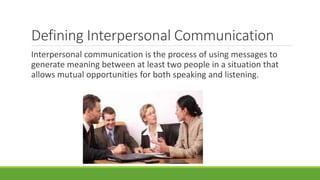
Interpersonal communication is the process of using messages to 
generate meaning between at least two people in a situation that 
allows mutual opportunities for both speaking and listening.
Interpersonal relationship 
•Interpersonal relationships are associations between 
at least two people who are interdependent, who use 
some consistent pattern of interaction, and who have 
interacted for a period of time. 
•Our interactions with strangers, salespeople, and waiters are 
NOT interpersonal relationships. 
•Interpersonal relationships are important because they 
allow us to fulfill our needs for inclusion, affection, and 
control.
Types of interpersonal relationships 
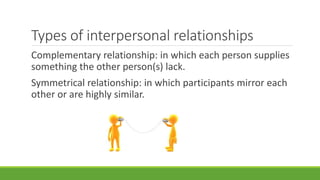
Complementary relationship: in which each person supplies 
something the other person(s) lack. 
Symmetrical relationship: in which participants mirror each 
other or are highly similar.
Conflict 
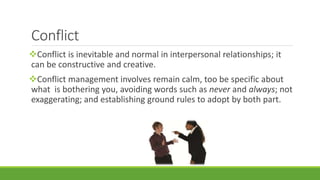
Conflict is inevitable and normal in interpersonal relationships; it 
can be constructive and creative. 
Conflict management involves remain calm, too be specific about 
what is bothering you, avoiding words such as never and always; not 
exaggerating; and establishing ground rules to adopt by both part.
Self-disclosure 
Self-disclosure: making intentional revelations about yourself the 
others would be unlikely to know and that constitute private, 
sensitive, or confidential information. 
It tends to be reciprocal. Though, reciprocal disclosure generally does not occur 
in families. 
Partners in romantic relationship report greater feeling of security after an 
honest and intentional self-disclosure. 
◦ Yet, at least one-fifth of sexually active college students purposefully misrepresent 
their sexual history to their sex partners. 
Disclosure varies across cultures.
Extreme Self-disclosure 
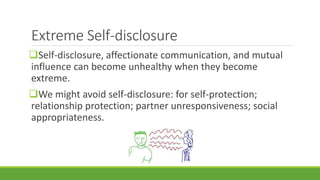
Self-disclosure, affectionate communication, and mutual 
influence can become unhealthy when they become 
extreme. 
We might avoid self-disclosure: for self-protection; 
relationship protection; partner unresponsiveness; social 
appropriateness.
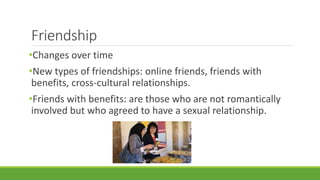
Friendship 
•Changes over time 
•New types of friendships: online friends, friends with 
benefits, cross-cultural relationships. 
•Friends with benefits: are those who are not romantically 
involved but who agreed to have a sexual relationship.
Stages of relations 
Relational development: the initial stage that moves a couple from meeting to 
mating. 
Relational maintenance: the second stage after the has bounded and in which 
they engage in the process of keeping the relationship together 
Relational deterioration: in which the prior bond disintegrates . It is marked by 
differentiating behaviors.
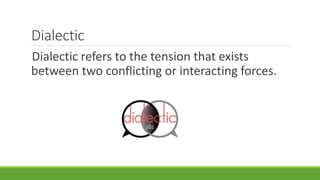
Dialectic 
Dialectic refers to the tension that exists 
between two conflicting or interacting forces.
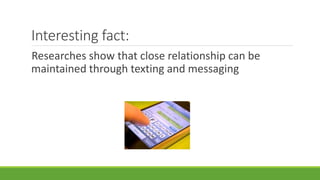
Interesting fact: 
Researches show that close relationship can be 
maintained through texting and messaging
Motivations 
 Motivations for initiating a relationship: proximity, attractiveness, 
responsiveness, similarity, complementarity. 
 Motivations for maintaining relationships: predictability and 
certainty; additional personal info; to be involved in empathic and 
caring relationship. 
Motivation for terminating relationships: messages that creat 
emotional pain (hurtful mess.) the practice of deliberately making 
somebody to believe things that are not true (deceptive comm) 
aggressiveness, argumentativeness and defensiveness.
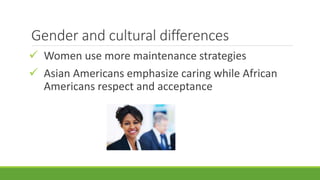
Gender and cultural differences 
 Women use more maintenance strategies 
 Asian Americans emphasize caring while African 
Americans respect and acceptance
Compliance gaining & Compliance resisting 
oCompliance gaining: a person’s attempt to influence a 
target to perform a desired behavior that the target 
otherwise would not perform. 
oCompliance resisting: The refusal of the targets of influence 
messages to comply with request.
Idioms and bargain 
Personal idioms help to develop a unique relationship. 
Bargain: in which two or more parties attempt to reach an 
agreement on what each should give and receive in a 
transaction between them.
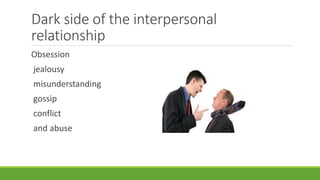
Dark side of the interpersonal 
relationship 
Obsession 
jealousy 
misunderstanding 
gossip 
conflict 
and abuse

Ch6 interpersonal communication power point

  • 1.
  • 2.
    Defining Interpersonal Communication Interpersonal communication is the process of using messages to generate meaning between at least two people in a situation that allows mutual opportunities for both speaking and listening.
  • 3.
    Interpersonal relationship •Interpersonalrelationships are associations between at least two people who are interdependent, who use some consistent pattern of interaction, and who have interacted for a period of time. •Our interactions with strangers, salespeople, and waiters are NOT interpersonal relationships. •Interpersonal relationships are important because they allow us to fulfill our needs for inclusion, affection, and control.
  • 4.
    Types of interpersonalrelationships Complementary relationship: in which each person supplies something the other person(s) lack. Symmetrical relationship: in which participants mirror each other or are highly similar.
  • 5.
    Conflict Conflict isinevitable and normal in interpersonal relationships; it can be constructive and creative. Conflict management involves remain calm, too be specific about what is bothering you, avoiding words such as never and always; not exaggerating; and establishing ground rules to adopt by both part.
  • 6.
    Self-disclosure Self-disclosure: makingintentional revelations about yourself the others would be unlikely to know and that constitute private, sensitive, or confidential information. It tends to be reciprocal. Though, reciprocal disclosure generally does not occur in families. Partners in romantic relationship report greater feeling of security after an honest and intentional self-disclosure. ◦ Yet, at least one-fifth of sexually active college students purposefully misrepresent their sexual history to their sex partners. Disclosure varies across cultures.
  • 7.
    Extreme Self-disclosure Self-disclosure,affectionate communication, and mutual influence can become unhealthy when they become extreme. We might avoid self-disclosure: for self-protection; relationship protection; partner unresponsiveness; social appropriateness.
  • 8.
    Friendship •Changes overtime •New types of friendships: online friends, friends with benefits, cross-cultural relationships. •Friends with benefits: are those who are not romantically involved but who agreed to have a sexual relationship.
  • 9.
    Stages of relations Relational development: the initial stage that moves a couple from meeting to mating. Relational maintenance: the second stage after the has bounded and in which they engage in the process of keeping the relationship together Relational deterioration: in which the prior bond disintegrates . It is marked by differentiating behaviors.
  • 10.
    Dialectic Dialectic refersto the tension that exists between two conflicting or interacting forces.
  • 11.
    Interesting fact: Researchesshow that close relationship can be maintained through texting and messaging
  • 12.
    Motivations  Motivationsfor initiating a relationship: proximity, attractiveness, responsiveness, similarity, complementarity.  Motivations for maintaining relationships: predictability and certainty; additional personal info; to be involved in empathic and caring relationship. Motivation for terminating relationships: messages that creat emotional pain (hurtful mess.) the practice of deliberately making somebody to believe things that are not true (deceptive comm) aggressiveness, argumentativeness and defensiveness.
  • 13.
    Gender and culturaldifferences  Women use more maintenance strategies  Asian Americans emphasize caring while African Americans respect and acceptance
  • 14.
    Compliance gaining &Compliance resisting oCompliance gaining: a person’s attempt to influence a target to perform a desired behavior that the target otherwise would not perform. oCompliance resisting: The refusal of the targets of influence messages to comply with request.
  • 15.
    Idioms and bargain Personal idioms help to develop a unique relationship. Bargain: in which two or more parties attempt to reach an agreement on what each should give and receive in a transaction between them.
  • 16.
    Dark side ofthe interpersonal relationship Obsession jealousy misunderstanding gossip conflict and abuse