Communication Skills
Introduction
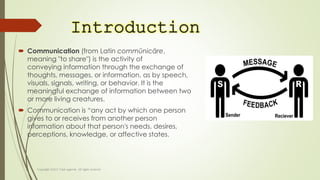
 Communication (from Latin commūnicāre,
meaning "to share") is the activity of
conveying information through the exchange of
thoughts, messages, or information, as by speech,
visuals, signals, writing, or behavior. It is the
meaningful exchange of information between two
or more living creatures.
 Communication is “any act by which one person
gives to or receives from another person
information about that person's needs, desires,
perceptions, knowledge, or affective states.
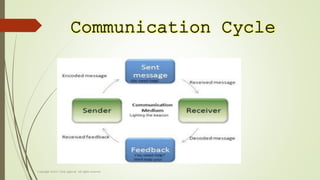
Communication Cycle
Essentials of effective
communication
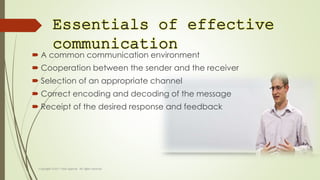
 A common communication environment
 Cooperation between the sender and the receiver
 Selection of an appropriate channel
 Correct encoding and decoding of the message
 Receipt of the desired response and feedback
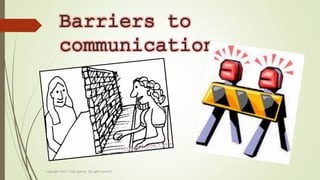
Barriers to
communication
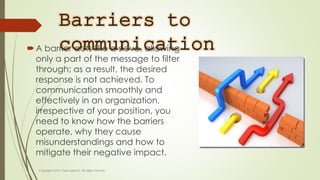
Barriers to
communicationA barrier acts like a sieve, allowing
only a part of the message to filter
through; as a result, the desired
response is not achieved. To
communication smoothly and
effectively in an organization,
irrespective of your position, you
need to know how the barriers
operate, why they cause
misunderstandings and how to
mitigate their negative impact.
Classification of
barriers
Even with the best intentions, communication
barriers crop up and our written and spoken messages
are misunderstood. These barriers are classified at three
levels according to the process of conversation:
Intrapersonal
Interpersonal
Organizational
INTRAPERSONAL BARRIERS
Each of us interpret the same information in different ways as
our thinking varies. Certain causes that are responsible for these
intrapersonal barriers are:
 Wrong assumptions
 Varied perceptions
 Differing background
 Wrong inferences
 Impervious categories
 Categorical thinking
Wrong assumptions
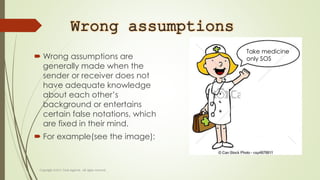
 Wrong assumptions are
generally made when the
sender or receiver does not
have adequate knowledge
about each other’s
background or entertains
certain false notations, which
are fixed in their mind.
 For example(see the image):
Take medicine
only SOS
Varied Perceptions
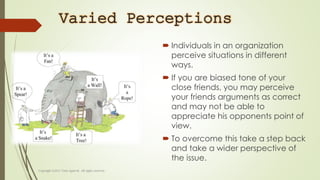
 Individuals in an organization
perceive situations in different
ways.
 If you are biased tone of your
close friends, you may perceive
your friends arguments as correct
and may not be able to
appreciate his opponents point of
view.
 To overcome this take a step back
and take a wider perspective of
the issue.
Differing backgrounds
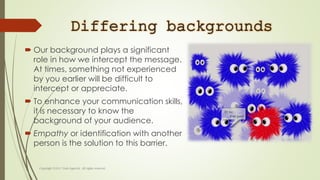
 Our background plays a significant
role in how we intercept the message.
At times, something not experienced
by you earlier will be difficult to
intercept or appreciate.
 To enhance your communication skills,
it is necessary to know the
background of your audience.
 Empathy or identification with another
person is the solution to this barrier.
To sum up, good
communicators should:
Be non-judgmental
Be empathetic
Not assume anything
Stick to the subject
Listen and above all paraphrase
INTRAPERSONAL BARRIERS
Interpersonal barriers occur due to the inappropriate transaction
of words between two or more people.
 The most common reasons for interpersonal barriers are:
 Limited vocabulary
 Incongruity of verbal and nonverbal messages
 Emotional outbursts
 Communication selectivity
 Cultural variations
 Poor listening skills
 Noise in the channel
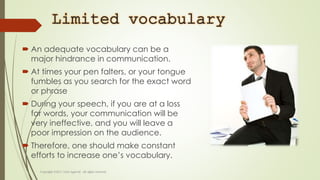
Limited vocabulary
 An adequate vocabulary can be a
major hindrance in communication.
 At times your pen falters, or your tongue
fumbles as you search for the exact word
or phrase
 During your speech, if you are at a loss
for words, your communication will be
very ineffective, and you will leave a
poor impression on the audience.
 Therefore, one should make constant
efforts to increase one’s vocabulary.
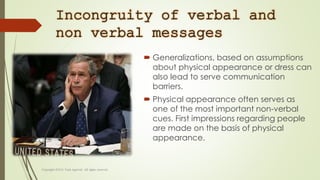
Incongruity of verbal and
non verbal messages
 Generalizations, based on assumptions
about physical appearance or dress can
also lead to serve communication
barriers.
 Physical appearance often serves as
one of the most important non-verbal
cues. First impressions regarding people
are made on the basis of physical
appearance.
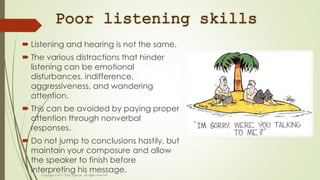
Poor listening skills
 Listening and hearing is not the same.
 The various distractions that hinder
listening can be emotional
disturbances, indifference,
aggressiveness, and wandering
attention.
 This can be avoided by paying proper
attention through nonverbal
responses.
 Do not jump to conclusions hastily, but
maintain your composure and allow
the speaker to finish before
interpreting his message.
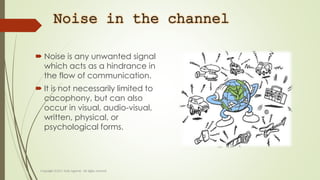
Noise in the channel
 Noise is any unwanted signal
which acts as a hindrance in
the flow of communication.
 It is not necessarily limited to
cacophony, but can also
occur in visual, audio-visual,
written, physical, or
psychological forms.
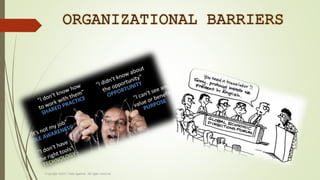
ORGANIZATIONAL BARRIERS
Organizational Barriers
 Irrespective of size, all organizations have communication policies which
describe the protocol that usually causes communication barriers.
 In organizations with many communication levels, messages have a
greater chance of being distorted. This occurs due to poor listening, lack
of concentration or a persons tendency to leave out part of the
message.
The main organizational barriers are enumerated below:
• Too many transfer stations
• Fear of the superiors
• Negative tendencies
• Use of inappropriate media
• Information overload
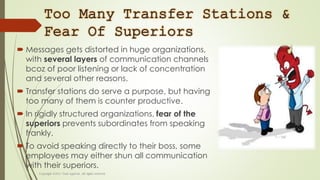
Too Many Transfer Stations &
Fear Of Superiors
 Messages gets distorted in huge organizations,
with several layers of communication channels
bcoz of poor listening or lack of concentration
and several other reasons.
 Transfer stations do serve a purpose, but having
too many of them is counter productive.
 In rigidly structured organizations, fear of the
superiors prevents subordinates from speaking
frankly.
 To avoid speaking directly to their boss, some
employees may either shun all communication
with their superiors.
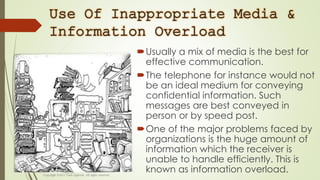
Use Of Inappropriate Media &
Information Overload
Usually a mix of media is the best for
effective communication.
The telephone for instance would not
be an ideal medium for conveying
confidential information. Such
messages are best conveyed in
person or by speed post.
One of the major problems faced by
organizations is the huge amount of
information which the receiver is
unable to handle efficiently. This is
known as information overload.
Tips for effective
communication
Create an open communication environment
Always keep the receiver in mind
Avoid having too many transfer stations
Do not communicate when you are emotionally
disturbed
Be aware of changes
Analyze the feedback
Communication skills (protected)

Communication skills (protected)

  • 1.
  • 2.
    Introduction  Communication (fromLatin commūnicāre, meaning "to share") is the activity of conveying information through the exchange of thoughts, messages, or information, as by speech, visuals, signals, writing, or behavior. It is the meaningful exchange of information between two or more living creatures.  Communication is “any act by which one person gives to or receives from another person information about that person's needs, desires, perceptions, knowledge, or affective states.
  • 3.
  • 4.
    Essentials of effective communication A common communication environment  Cooperation between the sender and the receiver  Selection of an appropriate channel  Correct encoding and decoding of the message  Receipt of the desired response and feedback
  • 5.
  • 6.
    Barriers to communicationA barrieracts like a sieve, allowing only a part of the message to filter through; as a result, the desired response is not achieved. To communication smoothly and effectively in an organization, irrespective of your position, you need to know how the barriers operate, why they cause misunderstandings and how to mitigate their negative impact.
  • 7.
    Classification of barriers Even withthe best intentions, communication barriers crop up and our written and spoken messages are misunderstood. These barriers are classified at three levels according to the process of conversation: Intrapersonal Interpersonal Organizational
  • 8.
    INTRAPERSONAL BARRIERS Each ofus interpret the same information in different ways as our thinking varies. Certain causes that are responsible for these intrapersonal barriers are:  Wrong assumptions  Varied perceptions  Differing background  Wrong inferences  Impervious categories  Categorical thinking
  • 9.
    Wrong assumptions  Wrongassumptions are generally made when the sender or receiver does not have adequate knowledge about each other’s background or entertains certain false notations, which are fixed in their mind.  For example(see the image): Take medicine only SOS
  • 10.
    Varied Perceptions  Individualsin an organization perceive situations in different ways.  If you are biased tone of your close friends, you may perceive your friends arguments as correct and may not be able to appreciate his opponents point of view.  To overcome this take a step back and take a wider perspective of the issue.
  • 11.
    Differing backgrounds  Ourbackground plays a significant role in how we intercept the message. At times, something not experienced by you earlier will be difficult to intercept or appreciate.  To enhance your communication skills, it is necessary to know the background of your audience.  Empathy or identification with another person is the solution to this barrier.
  • 12.
    To sum up,good communicators should: Be non-judgmental Be empathetic Not assume anything Stick to the subject Listen and above all paraphrase
  • 13.
    INTRAPERSONAL BARRIERS Interpersonal barriersoccur due to the inappropriate transaction of words between two or more people.  The most common reasons for interpersonal barriers are:  Limited vocabulary  Incongruity of verbal and nonverbal messages  Emotional outbursts  Communication selectivity  Cultural variations  Poor listening skills  Noise in the channel
  • 14.
    Limited vocabulary  Anadequate vocabulary can be a major hindrance in communication.  At times your pen falters, or your tongue fumbles as you search for the exact word or phrase  During your speech, if you are at a loss for words, your communication will be very ineffective, and you will leave a poor impression on the audience.  Therefore, one should make constant efforts to increase one’s vocabulary.
  • 15.
    Incongruity of verbaland non verbal messages  Generalizations, based on assumptions about physical appearance or dress can also lead to serve communication barriers.  Physical appearance often serves as one of the most important non-verbal cues. First impressions regarding people are made on the basis of physical appearance.
  • 16.
    Poor listening skills Listening and hearing is not the same.  The various distractions that hinder listening can be emotional disturbances, indifference, aggressiveness, and wandering attention.  This can be avoided by paying proper attention through nonverbal responses.  Do not jump to conclusions hastily, but maintain your composure and allow the speaker to finish before interpreting his message.
  • 17.
    Noise in thechannel  Noise is any unwanted signal which acts as a hindrance in the flow of communication.  It is not necessarily limited to cacophony, but can also occur in visual, audio-visual, written, physical, or psychological forms.
  • 18.
  • 19.
    Organizational Barriers  Irrespectiveof size, all organizations have communication policies which describe the protocol that usually causes communication barriers.  In organizations with many communication levels, messages have a greater chance of being distorted. This occurs due to poor listening, lack of concentration or a persons tendency to leave out part of the message. The main organizational barriers are enumerated below: • Too many transfer stations • Fear of the superiors • Negative tendencies • Use of inappropriate media • Information overload
  • 20.
    Too Many TransferStations & Fear Of Superiors  Messages gets distorted in huge organizations, with several layers of communication channels bcoz of poor listening or lack of concentration and several other reasons.  Transfer stations do serve a purpose, but having too many of them is counter productive.  In rigidly structured organizations, fear of the superiors prevents subordinates from speaking frankly.  To avoid speaking directly to their boss, some employees may either shun all communication with their superiors.
  • 21.
    Use Of InappropriateMedia & Information Overload Usually a mix of media is the best for effective communication. The telephone for instance would not be an ideal medium for conveying confidential information. Such messages are best conveyed in person or by speed post. One of the major problems faced by organizations is the huge amount of information which the receiver is unable to handle efficiently. This is known as information overload.
  • 22.
    Tips for effective communication Createan open communication environment Always keep the receiver in mind Avoid having too many transfer stations Do not communicate when you are emotionally disturbed Be aware of changes Analyze the feedback