Chapter 7
Developing and
Maintaining
Relationships
• Explain key aspects of interpersonal
relationships
• Describe how and why we form
relationships
• List the advantages and
disadvantages of relationships
Chapter Outcomes
• Describe the factors that influence
self-disclosure
• Outline the predictable stages of
most relationships
Chapter Outcomes
(cont.)
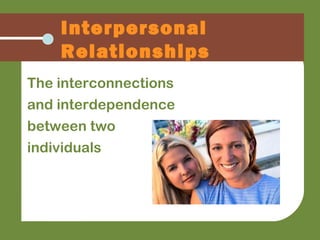
The interconnections
and interdependence
between two
individuals
Interpersonal
Relationships
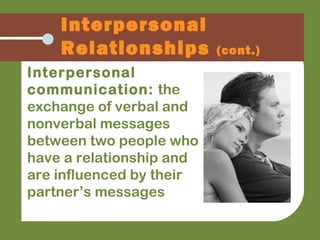
Interpersonal
communication: the
exchange of verbal and
nonverbal messages
between two people who
have a relationship and
are influenced by their
partner’s messages
Interpersonal
Relationships (cont.)
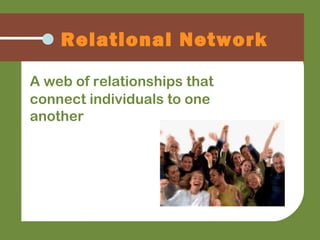
A web of relationships that
connect individuals to one
another
Relational Network
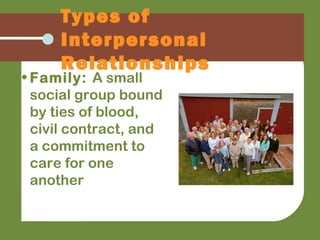
• Family: A small
social group bound
by ties of blood,
civil contract, and
a commitment to
care for one
another
Types of
Interpersonal
Relationships
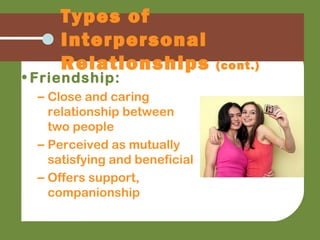
• Friendship:
– Close and caring
relationship between
two people
– Perceived as mutually
satisfying and beneficial
– Offers support,
companionship
Types of
Interpersonal
Relationships (cont.)
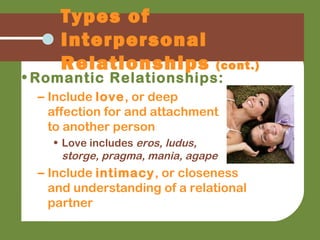
• Romantic Relationships:
– Include love, or deep
affection for and attachment
to another person
• Love includes eros, ludus,
storge, pragma, mania, agape
– Include intimacy, or closeness
and understanding of a relational
partner
Types of
Interpersonal
Relationships (cont.)
• Online Relationships
– Social Information Processing
Theory argues that virtual relationships
are as close as face-to-face relationships.
– Hyperpersonal communication:
online communication that is even more
intimate than face-to-face
– Include friendships, romances, business
relationships, group memberships
Types of
Interpersonal
Relationships (cont.)
• Functions of relationships
– Companionship (inclusion)
– Stimulation
– Goal achievement
• Interpersonal attraction
– Proximity (nearness)
– Physical attraction
– Similarity
Why We Form
Relationships
• Costs and rewards
– Social exchange theory balances
advantages and disadvantages
– Rewards
• Extrinsic (external advantages)
• Instrumental (shared resources)
• Intrinsic (personal satisfaction)
– Costs
• Cause stress or annoyance
Managing
Relationship
Dynamics
• Reducing uncertainty
– Uncertainty reduction theory:
People need information to become
closer or separate.
• Passive strategies include observing and
monitoring.
• Active strategies involve checking with a
third party.
• Interactive strategies involve asking the
person for information.
Managing
Relationship
Dynamics (cont.)
• Dialectical tensions:
contradictory feelings that tug at
every relationship
– Relational dialectics theory
• Autonomy vs. Connection
• Openness vs. Closedness
• Predictability vs. Novelty
Managing
Relationship
Dynamics (cont.)
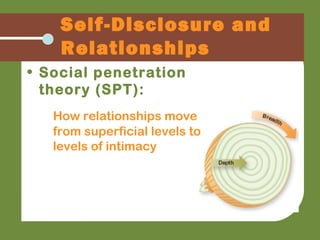
• Social penetration
theory (SPT):
How relationships move
from superficial levels to
levels of intimacy
Self-Disclosure and
Relationships
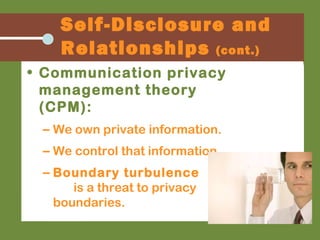
• Communication privacy
management theory
(CPM):
– We own private information.
– We control that information.
– Boundary turbulence
is a threat to privacy
boundaries.
Self-Disclosure and
Relationships (cont.)
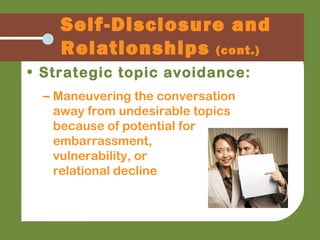
• Strategic topic avoidance:
– Maneuvering the conversation
away from undesirable topics
because of potential for
embarrassment,
vulnerability, or
relational decline
Self-Disclosure and
Relationships (cont.)
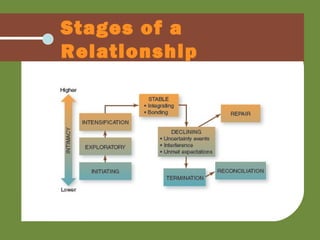
Stages of a
Relationship
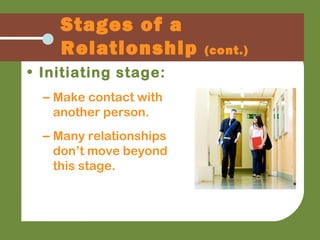
• Initiating stage:
– Make contact with
another person.
– Many relationships
don’t move beyond
this stage.
Stages of a
Relationship (cont.)
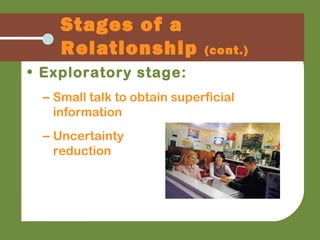
• Exploratory stage:
– Small talk to obtain superficial
information
– Uncertainty
reduction
Stages of a
Relationship (cont.)
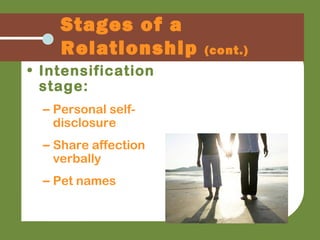
• Intensification
stage:
– Personal self-
disclosure
– Share affection
verbally
– Pet names
Stages of a
Relationship (cont.)
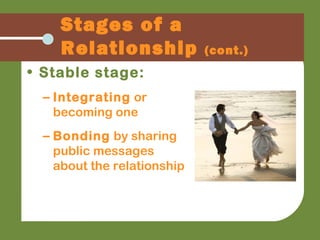
• Stable stage:
– Integrating or
becoming one
– Bonding by sharing
public messages
about the relationship
Stages of a
Relationship (cont.)
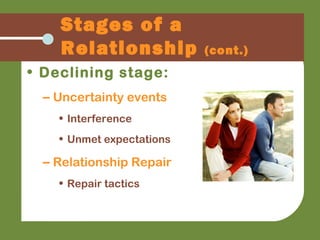
• Declining stage:
– Uncertainty events
• Interference
• Unmet expectations
– Relationship Repair
• Repair tactics
Stages of a
Relationship (cont.)
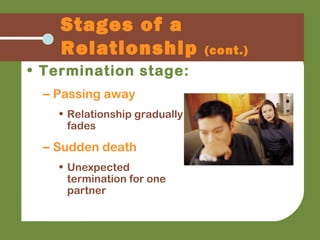
• Termination stage:
– Passing away
• Relationship gradually
fades
– Sudden death
• Unexpected
termination for one
partner
Stages of a
Relationship (cont.)
• Reconciliation:
– Spontaneous development
– Third-party mediation
– High affect
– Tacit persistence
– Mutual interaction
– Avoidance
Stages of a
Relationship (cont.)

Real comm2e ch7

  • 1.
  • 2.
    • Explain keyaspects of interpersonal relationships • Describe how and why we form relationships • List the advantages and disadvantages of relationships Chapter Outcomes
  • 3.
    • Describe thefactors that influence self-disclosure • Outline the predictable stages of most relationships Chapter Outcomes (cont.)
  • 4.
    The interconnections and interdependence betweentwo individuals Interpersonal Relationships
  • 5.
    Interpersonal communication: the exchange ofverbal and nonverbal messages between two people who have a relationship and are influenced by their partner’s messages Interpersonal Relationships (cont.)
  • 6.
    A web ofrelationships that connect individuals to one another Relational Network
  • 7.
    • Family: Asmall social group bound by ties of blood, civil contract, and a commitment to care for one another Types of Interpersonal Relationships
  • 8.
    • Friendship: – Closeand caring relationship between two people – Perceived as mutually satisfying and beneficial – Offers support, companionship Types of Interpersonal Relationships (cont.)
  • 9.
    • Romantic Relationships: –Include love, or deep affection for and attachment to another person • Love includes eros, ludus, storge, pragma, mania, agape – Include intimacy, or closeness and understanding of a relational partner Types of Interpersonal Relationships (cont.)
  • 10.
    • Online Relationships –Social Information Processing Theory argues that virtual relationships are as close as face-to-face relationships. – Hyperpersonal communication: online communication that is even more intimate than face-to-face – Include friendships, romances, business relationships, group memberships Types of Interpersonal Relationships (cont.)
  • 11.
    • Functions ofrelationships – Companionship (inclusion) – Stimulation – Goal achievement • Interpersonal attraction – Proximity (nearness) – Physical attraction – Similarity Why We Form Relationships
  • 12.
    • Costs andrewards – Social exchange theory balances advantages and disadvantages – Rewards • Extrinsic (external advantages) • Instrumental (shared resources) • Intrinsic (personal satisfaction) – Costs • Cause stress or annoyance Managing Relationship Dynamics
  • 13.
    • Reducing uncertainty –Uncertainty reduction theory: People need information to become closer or separate. • Passive strategies include observing and monitoring. • Active strategies involve checking with a third party. • Interactive strategies involve asking the person for information. Managing Relationship Dynamics (cont.)
  • 14.
    • Dialectical tensions: contradictoryfeelings that tug at every relationship – Relational dialectics theory • Autonomy vs. Connection • Openness vs. Closedness • Predictability vs. Novelty Managing Relationship Dynamics (cont.)
  • 15.
    • Social penetration theory(SPT): How relationships move from superficial levels to levels of intimacy Self-Disclosure and Relationships
  • 16.
    • Communication privacy managementtheory (CPM): – We own private information. – We control that information. – Boundary turbulence is a threat to privacy boundaries. Self-Disclosure and Relationships (cont.)
  • 17.
    • Strategic topicavoidance: – Maneuvering the conversation away from undesirable topics because of potential for embarrassment, vulnerability, or relational decline Self-Disclosure and Relationships (cont.)
  • 18.
  • 19.
    • Initiating stage: –Make contact with another person. – Many relationships don’t move beyond this stage. Stages of a Relationship (cont.)
  • 20.
    • Exploratory stage: –Small talk to obtain superficial information – Uncertainty reduction Stages of a Relationship (cont.)
  • 21.
    • Intensification stage: – Personalself- disclosure – Share affection verbally – Pet names Stages of a Relationship (cont.)
  • 22.
    • Stable stage: –Integrating or becoming one – Bonding by sharing public messages about the relationship Stages of a Relationship (cont.)
  • 23.
    • Declining stage: –Uncertainty events • Interference • Unmet expectations – Relationship Repair • Repair tactics Stages of a Relationship (cont.)
  • 24.
    • Termination stage: –Passing away • Relationship gradually fades – Sudden death • Unexpected termination for one partner Stages of a Relationship (cont.)
  • 25.
    • Reconciliation: – Spontaneousdevelopment – Third-party mediation – High affect – Tacit persistence – Mutual interaction – Avoidance Stages of a Relationship (cont.)