POWER and
CULTURE
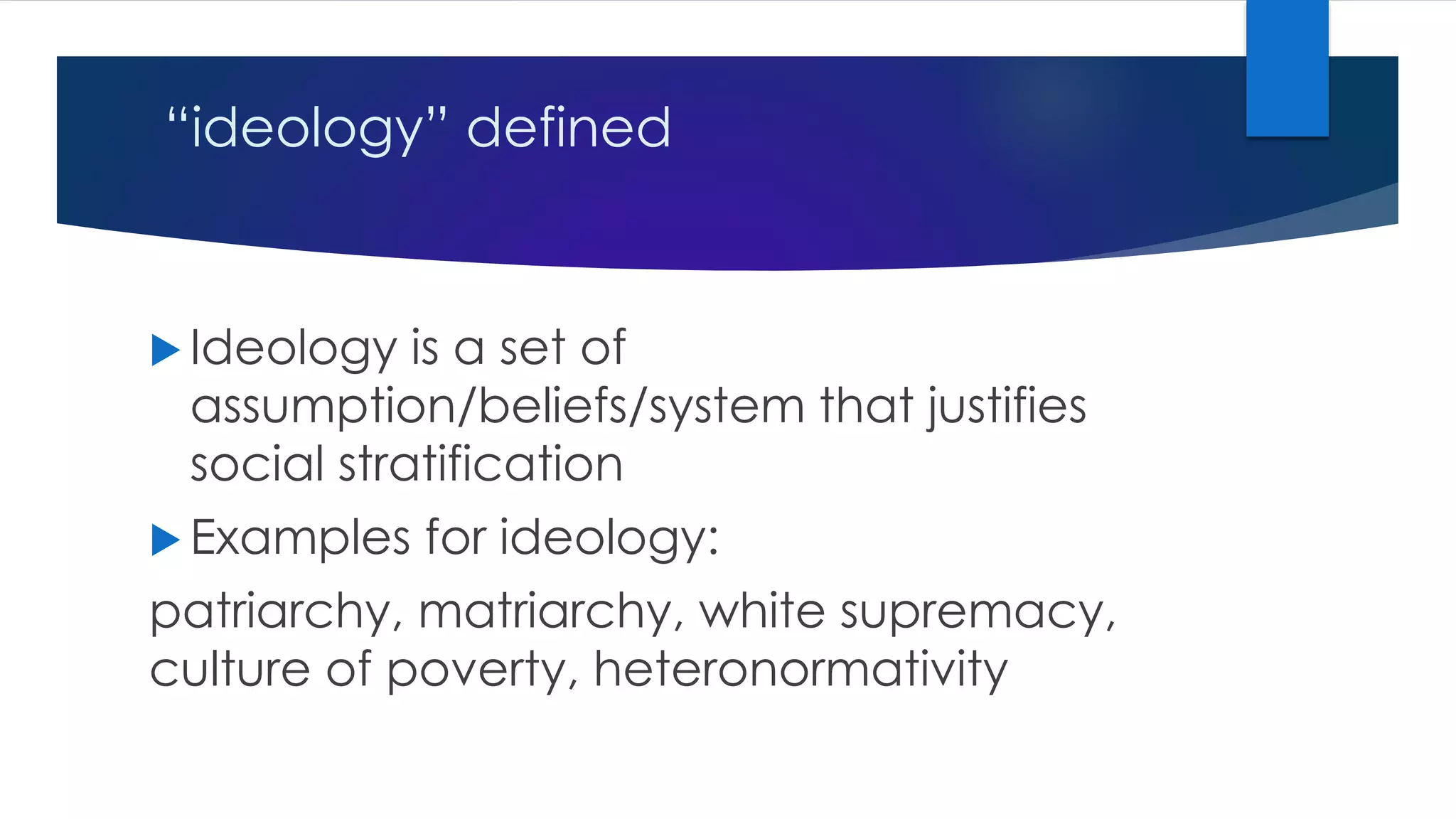
“ideology” defined
 Ideology is a set of
assumption/beliefs/system that justifies
social stratification
 Examples for ideology:
patriarchy, matriarchy, white supremacy,
culture of poverty, heteronormativity
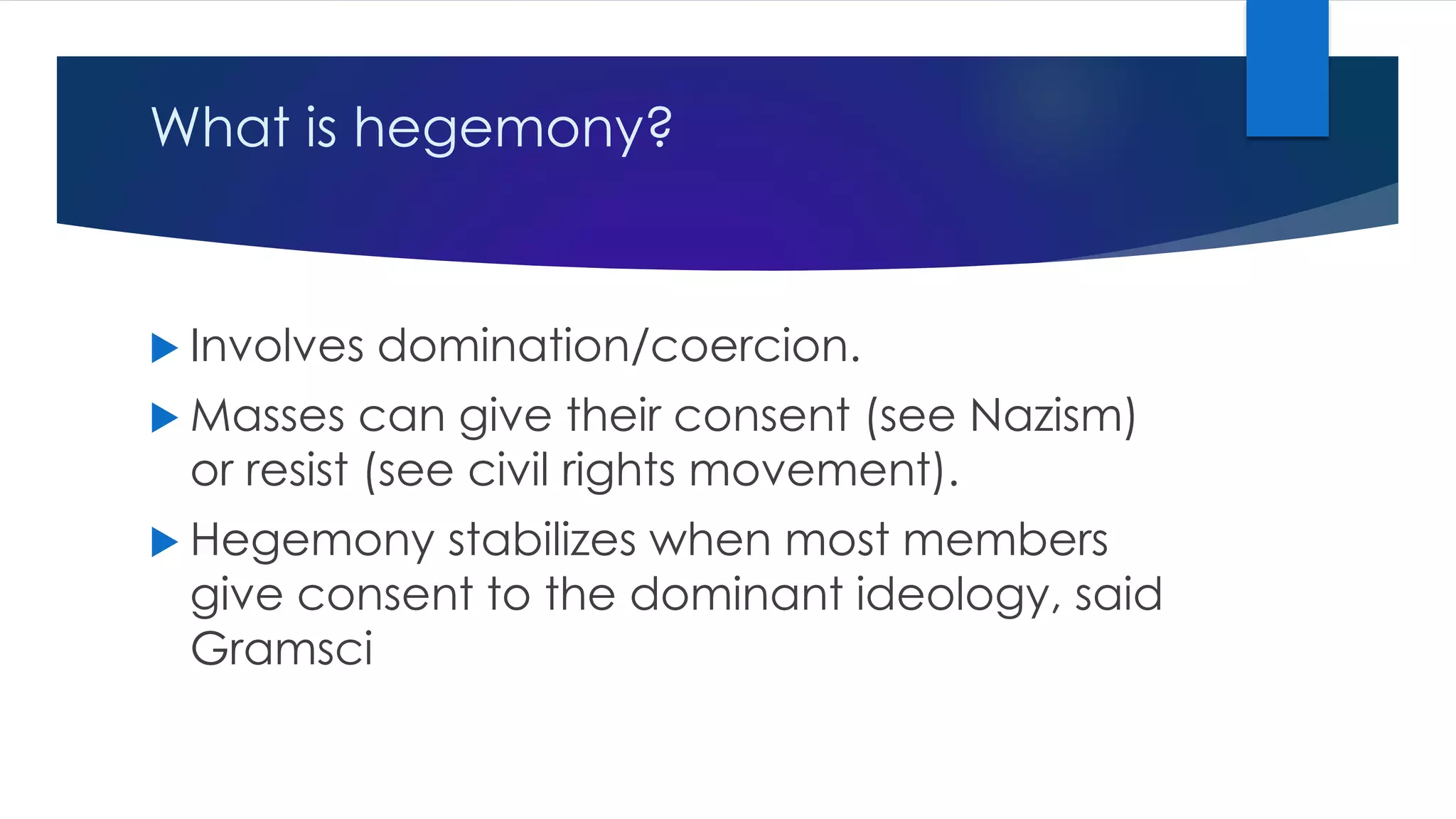
What is hegemony?
 Involves domination/coercion.
 Masses can give their consent (see Nazism)
or resist (see civil rights movement).
 Hegemony stabilizes when most members
give consent to the dominant ideology, said
Gramsci
illness and sexuality field of oppression
 According to Foucault, illness and
sexuality can become fields of
oppression:
By using the labels “abnormal” and
“immoral” that make people outcasts.
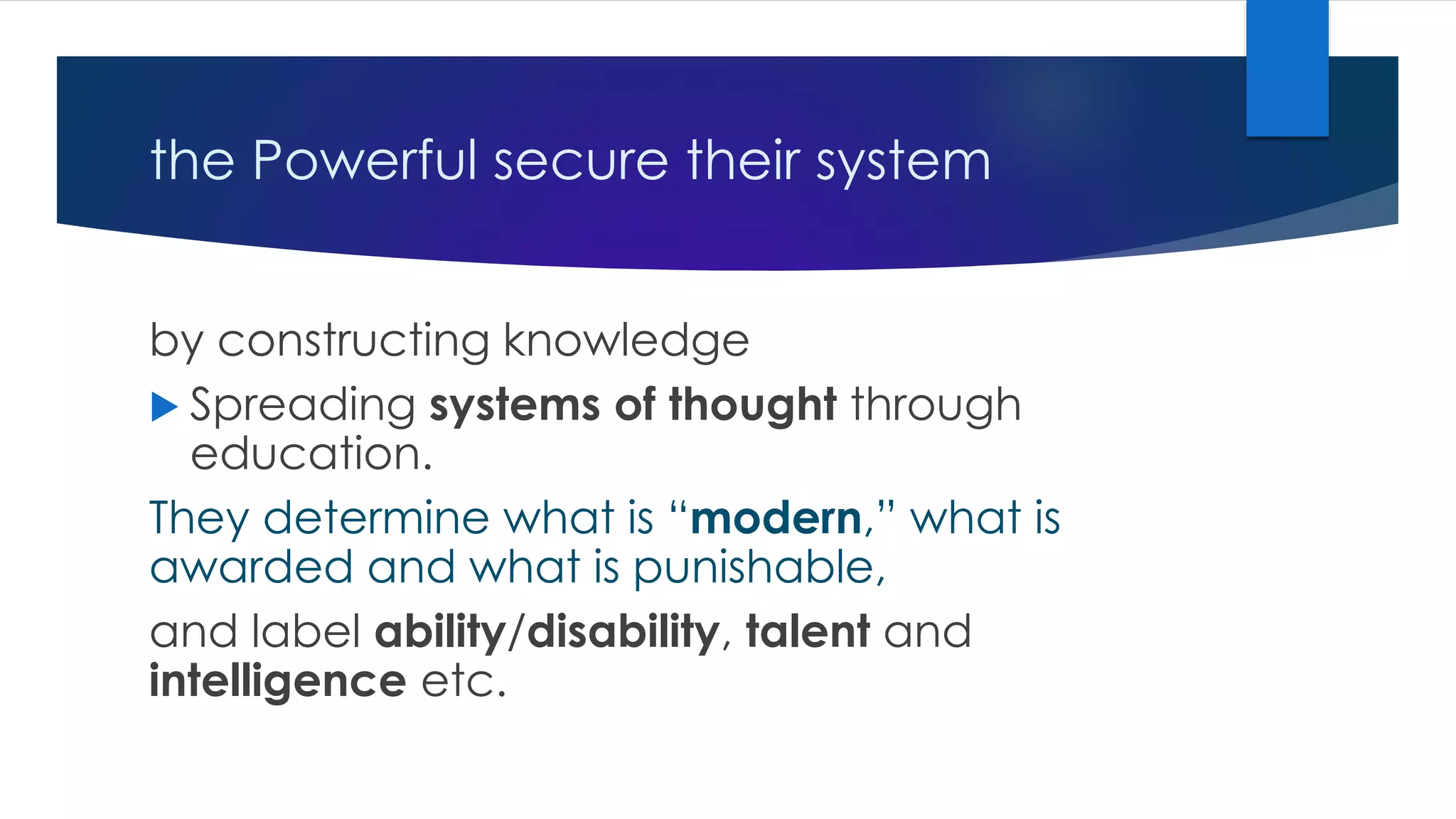
the Powerful secure their system
by constructing knowledge
 Spreading systems of thought through
education.
They determine what is “modern,” what is
awarded and what is punishable,
and label ability/disability, talent and
intelligence etc.
What kind of theory do we use for
analyzing how power operates?
 Critical Theory
Critical theory
 Critical theory provides
with frame of concepts
to analyze how power operates
Foucault: History of Madness in the
Classical Age(1961)
 Foucault questioned that the mad were merely sick
(“mentally” ill) and in need of medical treatment.
 He reasoned that the alleged scientific neutrality of
modern medical treatments of insanity are in fact
“covers” for controlling,
 and they oppress in the name of a conventional
bourgeois morality.
 The same is true for sexuality, and the concepts of
“man” (is it an object or subject?)
Foucault new idea about power
Foucault says, power has not only
negative but also positive impact
Power is also productive, helps
prevent chaos, and brings
discipline in social life

Power and culture ppt.

  • 1.
  • 2.
    “ideology” defined  Ideologyis a set of assumption/beliefs/system that justifies social stratification  Examples for ideology: patriarchy, matriarchy, white supremacy, culture of poverty, heteronormativity
  • 3.
    What is hegemony? Involves domination/coercion.  Masses can give their consent (see Nazism) or resist (see civil rights movement).  Hegemony stabilizes when most members give consent to the dominant ideology, said Gramsci
  • 4.
    illness and sexualityfield of oppression  According to Foucault, illness and sexuality can become fields of oppression: By using the labels “abnormal” and “immoral” that make people outcasts.
  • 5.
    the Powerful securetheir system by constructing knowledge  Spreading systems of thought through education. They determine what is “modern,” what is awarded and what is punishable, and label ability/disability, talent and intelligence etc.
  • 6.
    What kind oftheory do we use for analyzing how power operates?  Critical Theory
  • 7.
    Critical theory  Criticaltheory provides with frame of concepts to analyze how power operates
  • 8.
    Foucault: History ofMadness in the Classical Age(1961)  Foucault questioned that the mad were merely sick (“mentally” ill) and in need of medical treatment.  He reasoned that the alleged scientific neutrality of modern medical treatments of insanity are in fact “covers” for controlling,  and they oppress in the name of a conventional bourgeois morality.  The same is true for sexuality, and the concepts of “man” (is it an object or subject?)
  • 9.
    Foucault new ideaabout power Foucault says, power has not only negative but also positive impact Power is also productive, helps prevent chaos, and brings discipline in social life