CHAPTER 8
Relationship Dynamics
Copyright © 2022 W. W. Norton & Company
Relationship dynamics
2
8.1 Principles of relationships
While not all relationships are good for you—those that
are abusive, neglectful, or toxic—relationships that are
positive, loving, and supportive are essential to your
health and well-being.
3
Relationships vary in significance
• A strong tie is a relationship that is significant to
you. It has a strong influence on your thoughts,
feelings, and behaviors.
• A weak tie is a relationship that you do not take
extra time or effort to develop. Weak ties exist more
out of convenience or circumstance.
4
Relationships have upsides and downsides
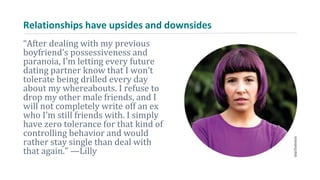
“After dealing with my previous
boyfriend’s possessiveness and
paranoia, I’m letting every future
dating partner know that I won’t
tolerate being drilled every day
about my whereabouts. I refuse to
drop my other male friends, and I
will not completely write off an ex
who I’m still friends with. I simply
have zero tolerance for that kind of
controlling behavior and would
rather stay single than deal with
that again.” —Lilly
Relationship dynamics
• Relationships are often random and situational.
• Relationships are voluntary and involuntary.
6
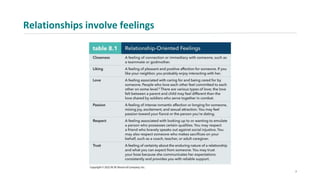
Relationships involve feelings
7
Relationships are governed by rules (1)
• Rules theory suggests that relationships are held together and
torn apart based on whether or not relational partners adhere to
certain rules.
• A relational rule governs what you can or cannot do within the
context of a specific relationship.
8
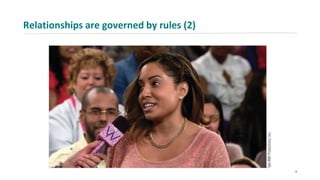
Relationships are governed by rules (2)
9
8.2 Relationship development and maintenance
• Attraction is the feeling of being drawn to someone; it happens
when you find a person appealing in some way.
• Short-term attraction is the initial feeling that motivates you
to begin and develop a relationship.
• Long-term attraction is the feeling that motivates you to
maintain an existing relationship, and when necessary, repair
or reconcile it.
10
Relational rewards versus costs (1)
• A relational reward is something you receive from a
relationship that you like and value.
• A relational cost is something you don’t like about or want in a
relationship.
• According to social exchange theory, your willingness to
develop and maintain a relationship is based on an analysis of its
rewards and costs.
11
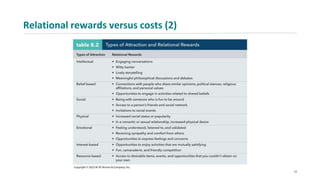
Relational rewards versus costs (2)
12
Relational rewards versus costs (3)
• Your perceptions may lead you to believe that an alternative
relationship has more to offer than your current relationship, a
cognitive assessment referred to as the comparison level of
alternatives.
• The equity theory suggests that your relationship satisfaction
is higher when you sense that there is a fair exchange of costs
and benefits between you and a relational partner.
13
Relational rewards versus costs (4)
14
Physical proximity versus self-disclosure
• Physical proximity is how near or accessible you are to
someone.
• Self-disclosure is the act of revealing personal information
about yourself—such as personal facts, opinions, feelings, and
needs—to others.
15
Self-disclosing and reducing uncertainty (1)
• Uncertainty reduction theory holds that we tend to seek out
information about relational partners or social situations to
reduce any discomfort associated with them.
• Social penetration theory suggests that the breadth and depth
of self-disclosure influences a relationship’s development.
• Predicting outcome value theory suggests that in your initial
interactions with others, you will use various communication
strategies.
16
Self-disclosure and reducing uncertainty (2)
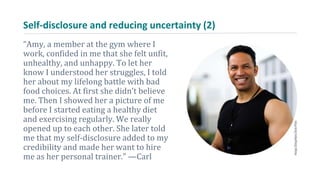
“Amy, a member at the gym where I
work, confided in me that she felt unfit,
unhealthy, and unhappy. To let her
know I understood her struggles, I told
her about my lifelong battle with bad
food choices. At first she didn’t believe
me. Then I showed her a picture of me
before I started eating a healthy diet
and exercising regularly. We really
opened up to each other. She later told
me that my self-disclosure added to my
credibility and made her want to hire
me as her personal trainer.” —Carl
Benefits and risks of self-disclosure
• To avoid the negative outcomes of self-disclosure, consider the
following questions before you share:
 Can I trust this person with this information?
 Did I clearly communicate that I want anything I share
to be kept private?
 How could this disclosure affect me in the future?
 Is this the right time and place to disclose?
 Is my disclosure honest and accurate?
 What are my motives for disclosing? Do they reflect the
ethics and morals I expect from others?
 Would it improve my relationship if I took more risks and
disclosed more?
18
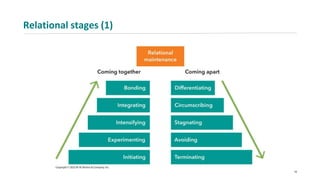
Relational stages (1)
19
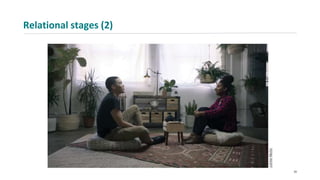
Relational stages (2)
20
Moving from stage to stage (1)
• A turning point is an event that causes or
signals a significant change in a relationship.
• A turning point can shift the direction of a
relationship dramatically.
21
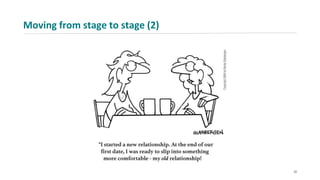
Moving from stage to stage (2)
22
8.3 Managing dialectical tensions
• A dialectical tension occurs when the needs
or motivations of relational partners clash.
23
Types of dialectical tensions (1)
• Connection vs. separateness
• Predictability vs. novelty
• Openness vs. privacy
• Dependence vs. autonomy
24
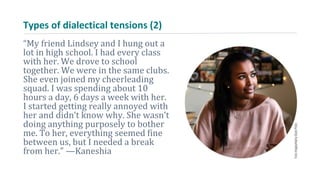
Types of dialectical tensions (2)
“My friend Lindsey and I hung out a
lot in high school. I had every class
with her. We drove to school
together. We were in the same clubs.
She even joined my cheerleading
squad. I was spending about 10
hours a day, 6 days a week with her.
I started getting really annoyed with
her and didn’t know why. She wasn’t
doing anything purposely to bother
me. To her, everything seemed fine
between us, but I needed a break
from her.” —Kaneshia
Managing dialectical tensions effectively (1)
• Identify the tension.
• Validate your relational partner’s needs, thoughts,
and feelings.
• Solution-based communication
26
Managing dialectical tensions effectively (2)
27
Credits
This concludes the Lecture PowerPoint presentation for Chapter 8.
For more resources, please visit It’s Interpersonal, An Introduction
to Relational Communication, at:
http://digital.wwnorton.com/interpersonal
Copyright © 2018 W. W. Norton & Company

It's Interpersonal Ch. 8

  • 1.
    CHAPTER 8 Relationship Dynamics Copyright© 2022 W. W. Norton & Company
  • 2.
  • 3.
    8.1 Principles ofrelationships While not all relationships are good for you—those that are abusive, neglectful, or toxic—relationships that are positive, loving, and supportive are essential to your health and well-being. 3
  • 4.
    Relationships vary insignificance • A strong tie is a relationship that is significant to you. It has a strong influence on your thoughts, feelings, and behaviors. • A weak tie is a relationship that you do not take extra time or effort to develop. Weak ties exist more out of convenience or circumstance. 4
  • 5.
    Relationships have upsidesand downsides “After dealing with my previous boyfriend’s possessiveness and paranoia, I’m letting every future dating partner know that I won’t tolerate being drilled every day about my whereabouts. I refuse to drop my other male friends, and I will not completely write off an ex who I’m still friends with. I simply have zero tolerance for that kind of controlling behavior and would rather stay single than deal with that again.” —Lilly
  • 6.
    Relationship dynamics • Relationshipsare often random and situational. • Relationships are voluntary and involuntary. 6
  • 7.
  • 8.
    Relationships are governedby rules (1) • Rules theory suggests that relationships are held together and torn apart based on whether or not relational partners adhere to certain rules. • A relational rule governs what you can or cannot do within the context of a specific relationship. 8
  • 9.
  • 10.
    8.2 Relationship developmentand maintenance • Attraction is the feeling of being drawn to someone; it happens when you find a person appealing in some way. • Short-term attraction is the initial feeling that motivates you to begin and develop a relationship. • Long-term attraction is the feeling that motivates you to maintain an existing relationship, and when necessary, repair or reconcile it. 10
  • 11.
    Relational rewards versuscosts (1) • A relational reward is something you receive from a relationship that you like and value. • A relational cost is something you don’t like about or want in a relationship. • According to social exchange theory, your willingness to develop and maintain a relationship is based on an analysis of its rewards and costs. 11
  • 12.
  • 13.
    Relational rewards versuscosts (3) • Your perceptions may lead you to believe that an alternative relationship has more to offer than your current relationship, a cognitive assessment referred to as the comparison level of alternatives. • The equity theory suggests that your relationship satisfaction is higher when you sense that there is a fair exchange of costs and benefits between you and a relational partner. 13
  • 14.
  • 15.
    Physical proximity versusself-disclosure • Physical proximity is how near or accessible you are to someone. • Self-disclosure is the act of revealing personal information about yourself—such as personal facts, opinions, feelings, and needs—to others. 15
  • 16.
    Self-disclosing and reducinguncertainty (1) • Uncertainty reduction theory holds that we tend to seek out information about relational partners or social situations to reduce any discomfort associated with them. • Social penetration theory suggests that the breadth and depth of self-disclosure influences a relationship’s development. • Predicting outcome value theory suggests that in your initial interactions with others, you will use various communication strategies. 16
  • 17.
    Self-disclosure and reducinguncertainty (2) “Amy, a member at the gym where I work, confided in me that she felt unfit, unhealthy, and unhappy. To let her know I understood her struggles, I told her about my lifelong battle with bad food choices. At first she didn’t believe me. Then I showed her a picture of me before I started eating a healthy diet and exercising regularly. We really opened up to each other. She later told me that my self-disclosure added to my credibility and made her want to hire me as her personal trainer.” —Carl
  • 18.
    Benefits and risksof self-disclosure • To avoid the negative outcomes of self-disclosure, consider the following questions before you share:  Can I trust this person with this information?  Did I clearly communicate that I want anything I share to be kept private?  How could this disclosure affect me in the future?  Is this the right time and place to disclose?  Is my disclosure honest and accurate?  What are my motives for disclosing? Do they reflect the ethics and morals I expect from others?  Would it improve my relationship if I took more risks and disclosed more? 18
  • 19.
  • 20.
  • 21.
    Moving from stageto stage (1) • A turning point is an event that causes or signals a significant change in a relationship. • A turning point can shift the direction of a relationship dramatically. 21
  • 22.
    Moving from stageto stage (2) 22
  • 23.
    8.3 Managing dialecticaltensions • A dialectical tension occurs when the needs or motivations of relational partners clash. 23
  • 24.
    Types of dialecticaltensions (1) • Connection vs. separateness • Predictability vs. novelty • Openness vs. privacy • Dependence vs. autonomy 24
  • 25.
    Types of dialecticaltensions (2) “My friend Lindsey and I hung out a lot in high school. I had every class with her. We drove to school together. We were in the same clubs. She even joined my cheerleading squad. I was spending about 10 hours a day, 6 days a week with her. I started getting really annoyed with her and didn’t know why. She wasn’t doing anything purposely to bother me. To her, everything seemed fine between us, but I needed a break from her.” —Kaneshia
  • 26.
    Managing dialectical tensionseffectively (1) • Identify the tension. • Validate your relational partner’s needs, thoughts, and feelings. • Solution-based communication 26
  • 27.
  • 28.
    Credits This concludes theLecture PowerPoint presentation for Chapter 8. For more resources, please visit It’s Interpersonal, An Introduction to Relational Communication, at: http://digital.wwnorton.com/interpersonal Copyright © 2018 W. W. Norton & Company

Editor's Notes

  • #3 Relationships start, stop, grow, endure, and end for many reasons. What do you see in this photo? Perhaps it’s a wedding reception or company social hour. With so many people in attendance, there are sure to be many relational dynamics at play. Photo credit: Rawpixel.com/Shutterstock
  • #6 Photo credit: Gelpi/Shutterstock
  • #8 Table 8.1 Relationship-Oriented Feelings Photo credit: W. W. Norton & Company, Inc.
  • #10 Is it a relational rule violation if you date a close friend’s ex? Some people may not have a problem with it. Others would have a serious problem with it—no matter what. Which factors would make it more or less acceptable to you if a friend wanted to date your ex? On the Wendy Williams Show, a member of the audience seeks advice. What advice would you give her? On YouTube search using the keywords: “Ask Wendy: Dating Your Friend’s Ex.” Photo credit: Talk WW Productions, Inc.
  • #13 Table 8.2 Types of Attraction and Relational Rewards Photo credit: W. W. Norton & Company, Inc.
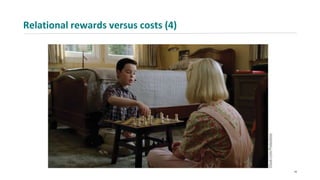
  • #15 Child genius Sheldon Cooper (Iain Armitage) meets fellow prodigy Paige (McKenna Grace) in an advanced college physics class. Compare this scene from the TV show Young Sheldon to what you’ve read about how similarities and differences can influence attraction. How might Sheldon and Paige’s similarities and differences make a friendship more or less likely? Compare your thoughts to the social exchange theory. On YouTube, search using the keywords: “Young Sheldon’s new smart rival scenes.” Photo credit: Chuck Lorre Productions
  • #18 Photo credit: Hongqi Zhang/Alamy Stock Photo
  • #20 Figure 8.1 Relational Stages Model
  • #21 Social psychologists Arthur Aron, Elaine Aron, and Edward Melinat believe that two complete strangers can fall in love in a single interaction. They ask subjects to sit across from each other and exchange answers to 36 predetermined questions. Two college students were asked to participate in this experiment. Using their recorded conversation, describe how this relationship might take off using the terms associated with the “coming together” stages of a relationship. Did the subjects fall in love? On YouTube, search using the keywords: “Can 2 Strangers Fall in Love with 36 Questions Russell Kera.” Photo credit: Jubilee Media
  • #23 Photo credit: Randy Glasbergen, 2004
  • #26 Photo credit: Folio Images/Alamy Stock Photo
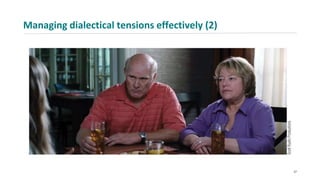
  • #28 In Failure to Launch, 35-year-old Tripp (Matthew McConaughey) enjoys the comforts of his parents’ home. Unbeknownst to him, his parents are exhausted by his level of dependence. They hire Paula (Sarah Jessica Parker) to lure him into independent adulthood. Relate this scene to the dependence vs. autonomy dialectical tension. On YouTube, search using the keywords: “Failure to Launch (1/10) Movie CLIP – Paula’s pitch (2006) HD.” Photo credit: Scott Rudin Productions