Interpersonal
Communication
Prepared by:
Karla Maolen Visbal
MA in Speech Communication
University of the Philippines
Diliman
What is Interpersonal
Communication?
 InterpersonalCommunication came from
  the Latin word “inter”, meaning between.

 Itpertains to relations between persons.
  [dictionary.com]

 “The dyad [or communication between
  two people] is the building block of human
  social interaction.” [Zimmerman, Owen and
  Seibert, 1986]
What is Interpersonal
Communication?
 “Interpersonal Communication is a
 selective, systemic, unique and on-going
 process of interaction between people,
 who reflect and build personal knowledge
 of one another and create shared
 meanings.”[Wood, 2002]
Why do we communicate
to form relationships?
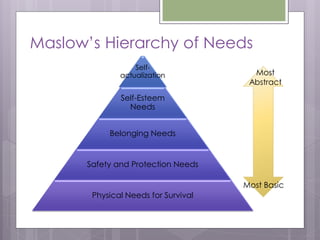
Maslow’s Hierarchy of Needs
 “There are many reasons why we seek
  interaction, and we meet many human
  needs by communicating.” [Maslow, 1968]
 “Communication is a primary means of
  meeting our needs at each level in the
  hierarchy.” [Wood, 2002]
Maslow’s Hierarchy of Needs
                  Self-
              actualization            Most
                                      Abstract
              Self-Esteem
                Needs


           Belonging Needs


      Safety and Protection Needs

                                     Most Basic
       Physical Needs for Survival
Maslow’s Hierarchy of Needs

               Physical Needs for Survival


 Atthe most basic level, human needs air, food
  and water in order to survive.
 We rely on communication to communicate
  what we need (e.g. a baby crying for milk) or if
  something is amiss (e.g. when we are in pain)
Maslow’s Hierarchy of Needs

             Safety and Protection Needs


 We  meet safety needs by communicating
  what we need (e.g. fix a leaking roof, report
  threats to police or authority, etc.)
 News announcements are also made if food
  threats or natural calamities are taking place.
Maslow’s Hierarchy of Needs

                   Belonging Needs


 Thismay also refer to social needs. We want
  other people’s acceptance and affirmation.
 We want to be included in groups.
 Our fear of rejection prevents us from disclosing
  information about ourselves [Powell, 1969]
Maslow’s Hierarchy of Needs

                  Self-Esteem
                    Needs


 Value that we give ourselves and value other
  people gives us.
 Derived from positive evaluation of other
  people.
Maslow’s Hierarchy of Needs


                            Self-
                        Actualization

 The   most abstract human need.
 “It is defined as the fully using and developing
  our unique talents, capacities and potentials.”
  [Maslow, 1970]
Adler and Towne, 1987
 We  like people who are similar to us.
 We like people who are different from us.
 We like people who like us.
 We are attracted to people who can help
  us.
 We like competent people.
 We like people who discloses themselves to
  us.
 We feel strongly towards people we
  encounter often.
A Communication
Continuum
Interpersonal vs. Impersonal
 Allcommunication happens between
  people yet many interactions don’t involve
  us personally [Wood, 2002]

 When   we talk about interpersonal
  communication, we are referring to the
  quality of interaction between individuals
  [Adler & Towne, 1987]
Interpersonal vs. Impersonal
 Inimpersonal interactions, we tend to
  classify the other person by using labels.
  [Adler & Towne, 1987]

 I-IT   relationship
      We do not acknowledge the humanity of
       other people, sometimes not even their
       existence. [Buber, 1970].
Interpersonal vs. Impersonal
    The degree to which the communicators
    rely socially constructed rules to interact
    with other people determine the degree of
    our relationship with other people. [Adler &
    Towne, 1987]

 I-You    relationships
       We don’t look at other people as objects, but
        we don’t see them as unique individuals
        either. [Buber, 1970].
Interpersonal vs. Impersonal
 The
    amount of information the
 communicators have about each other also
 determines the level of their relationship with
 one another. [Adler & Towne, 1987]

 I-Thou   relationships
     The rarest kind of relationship…the highest form
      of human dialogue because each person
      affirms the other as cherished and unique.
      [Buber, 1970]
Self-Disclosure in
Relationships
Self-Disclosure
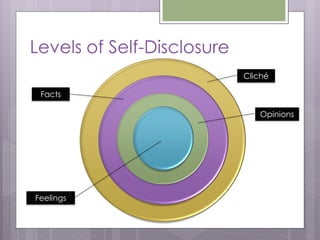
 “Itis the process of deliberately revealing
  information about oneself that is significant
  and that would not normally be known by
  others” [Adler & Towne, 1987]
Levels of Self-Disclosure
                            Cliché

 Facts

                               Opinions


Feelings
Stages of Interpersonal
Relationships
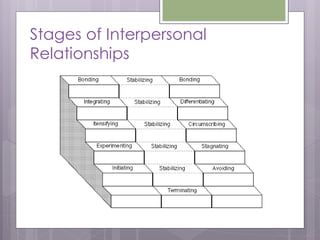
Stages of Interpersonal
Relationships
Initiating
 To
   show that you are interested in making
 contact and to show that you are a person
 worth talking to.
Experimenting
 Initially,
         people tend to look for a common
  ground.

 The  hallmark of this stage is small talk. “Small
  talk is like Listerine: we don’t like it but we
  get a doze of it everyday” Mark Knapp
Intensifying
 The amount of personal information
  disclosed increases.
 Forms of addresses become more informal.
Integrating
 As
   the relationship strengthens, the parties
 begin to take on an identity as a social unit.
 [Adler & Towne, 1987]
Bonding
 Atthis stage, parties make symbolic public
 gestures to show the world of the
 relationship.
Differentiating
 After both parties have established their
 commonality, they now seek to re-establish
 their individual identities.

 Thekey to successful differentiation is the
 need to maintain commitment to a
 relationship while creating the space for
 members to be individuals as well. [Adler &
 Towne, 1987]
Circumscribing
 The
    communication concentrates more on
 superficial and public topics with less
 breadth or depth

 Communicationdecreases in amount and
 becomes more restricted to certain "safe"
 topics
Stagnating
 Communication     about the relationship
  ceases
 Participants may sit in each other's
  presence for long periods without
  communicating
 There is a great amount of tension in the
  relationship and it is evident the relationship
  is in jeopardy. [Thomlison, 2000]
Avoiding
 Parties in the relationship begin to put
  distance between each other, sometimes
  in guises of excuses or more direct “I don’t
  want to be with/see you today”. [Adler &
  Towne, 1987]

 Includes  avoidance of physical contact as
  well as ignoring the other nonverbally and
  verbally when they are in the same physical
  space [Thomlison, 2000]
Terminating
 Thisfinal stage may include dialogues of
  where the relationship has gone and the
  desire to disassociate [Adler & Towne, 1987]

 Open    access ceases and it is clear the
  relationship, in its current form, no longer
  exists [Thomlison, 2000]
Four Principles of
Interpersonal
Communication
Interpersonal Communication
is in-escapable
 We   constantly communicate with others.

 Gestures,posture, facial expressions,
 clothing, etc. play a role in substituting
 spoken language in its absence

 People   are judged by behaviour, not by
 intent.
Interpersonal Communication
is irreversible
 Messages  cannot be taken back once
 uttered or shown.

 Actionsand spoken messages make an
 impression that cannot be erased.
Interpersonal Communication
is complicated
 No   form of communication is simple.

 Thenumber of variables involved can make
 the simplest requests complex
Interpersonal Communication
is complicated
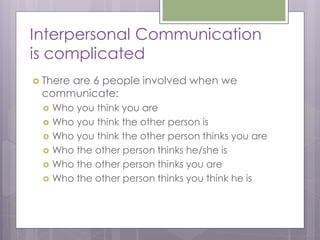
 There
     are 6 people involved when we
 communicate:
    Who you think you are
    Who you think the other person is
    Who you think the other person thinks you are
    Who the other person thinks he/she is
    Who the other person thinks you are
    Who the other person thinks you think he is
Interpersonal Communication
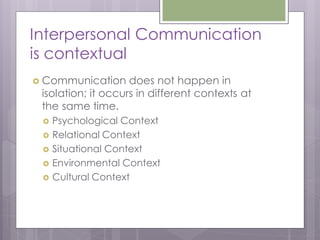
is contextual
 Communication     does not happen in
 isolation; it occurs in different contexts at
 the same time.
    Psychological Context
    Relational Context
    Situational Context
    Environmental Context
    Cultural Context
Models of Interpersonal
Communication
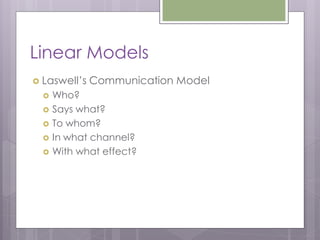
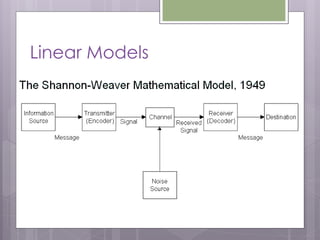
Linear Models
 Laswell’s   Communication Model
     Who?
     Says what?
     To whom?
     In what channel?
     With what effect?
Linear Models
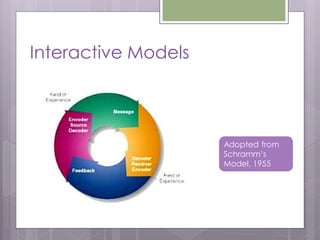
Interactive Models


                     Adopted from
                     Schramm’s
                     Model, 1955
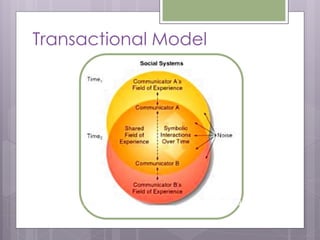
Transactional Model
Theories on Interpersonal
Communication
Confucianism
A study and theory of relationship within
 hierarchies.

 When  each person within a society plays his
 or her part well in the social order, social
 harmony will be achieved.
Social Exchange Theory
 “Relationships
               grow, develop and deteriorate
 and dissolve as a consequence of an unfolding
 social-exchange process…” [Huston & Burgess,
 1979]

 Alsoknown as the “Theory of Interdependence”
 [Thibaut and Kelley,1959]
Social Penetration Theory
 Itis customary for the individuals within the
  relationship to undergo the process of self-
  disclosure [Ledbetter, 2012]

 Example:   A facebook user’s profile

 The user’s level of self-disclosure is directly
  related to the level of interdependence
  with other people.
Questions?
Thank you!
References
 Looking  Out/Looking In, by Ronal Adler and
  Neil Towne, Rinehart and Winston Inc., 1987,
  p. 16-19, p. 278-2-97
 Interpersonal Communication: An Everyday
  Encounter, by Julia Wood, Wadsworth
  Group, 2002, p. 12-18, p. 28-33
 Speech Communication: A Contemporary
  Introduction, by Gordon Zimmerman,
  James Owen & David Seibert, West
  Publishing Company, 1986, p. 205-207
References
 An  interpersonal primer with implications for
  public relations by T. Dean Thomlison 2000
 Social Intercourse: From Greeting to Goodbye,
  by Mark L. Knapp, Boston: Allyn and Bacon,
  1978, p. 33
 Social Behavior as Exchange, by George
  Homans, 1958, p. 4
 "Attitudes Toward Online Social Connection
  And Self-Disclosure As Predictors Of Facebook
  Communication And Relational Closeness.“ by
  Andrew M. Ledbetter, 2012
References:
 "Confucius". iep.utm.edu. Internet
  Encyclopedia of Philosophy. Retrieved July
  25, 2012.
 http://www.pstcc.edu/facstaff/dking/interp
  r.htm. Retrieved July 27, 2012

Report on interpersonal communication

  • 1.
    Interpersonal Communication Prepared by: Karla MaolenVisbal MA in Speech Communication University of the Philippines Diliman
  • 2.
    What is Interpersonal Communication? InterpersonalCommunication came from the Latin word “inter”, meaning between.  Itpertains to relations between persons. [dictionary.com]  “The dyad [or communication between two people] is the building block of human social interaction.” [Zimmerman, Owen and Seibert, 1986]
  • 3.
    What is Interpersonal Communication? “Interpersonal Communication is a selective, systemic, unique and on-going process of interaction between people, who reflect and build personal knowledge of one another and create shared meanings.”[Wood, 2002]
  • 4.
    Why do wecommunicate to form relationships?
  • 5.
    Maslow’s Hierarchy ofNeeds  “There are many reasons why we seek interaction, and we meet many human needs by communicating.” [Maslow, 1968]  “Communication is a primary means of meeting our needs at each level in the hierarchy.” [Wood, 2002]
  • 6.
    Maslow’s Hierarchy ofNeeds Self- actualization Most Abstract Self-Esteem Needs Belonging Needs Safety and Protection Needs Most Basic Physical Needs for Survival
  • 7.
    Maslow’s Hierarchy ofNeeds Physical Needs for Survival  Atthe most basic level, human needs air, food and water in order to survive.  We rely on communication to communicate what we need (e.g. a baby crying for milk) or if something is amiss (e.g. when we are in pain)
  • 8.
    Maslow’s Hierarchy ofNeeds Safety and Protection Needs  We meet safety needs by communicating what we need (e.g. fix a leaking roof, report threats to police or authority, etc.)  News announcements are also made if food threats or natural calamities are taking place.
  • 9.
    Maslow’s Hierarchy ofNeeds Belonging Needs  Thismay also refer to social needs. We want other people’s acceptance and affirmation.  We want to be included in groups.  Our fear of rejection prevents us from disclosing information about ourselves [Powell, 1969]
  • 10.
    Maslow’s Hierarchy ofNeeds Self-Esteem Needs  Value that we give ourselves and value other people gives us.  Derived from positive evaluation of other people.
  • 11.
    Maslow’s Hierarchy ofNeeds Self- Actualization  The most abstract human need.  “It is defined as the fully using and developing our unique talents, capacities and potentials.” [Maslow, 1970]
  • 12.
    Adler and Towne,1987  We like people who are similar to us.  We like people who are different from us.  We like people who like us.  We are attracted to people who can help us.  We like competent people.  We like people who discloses themselves to us.  We feel strongly towards people we encounter often.
  • 13.
  • 14.
    Interpersonal vs. Impersonal Allcommunication happens between people yet many interactions don’t involve us personally [Wood, 2002]  When we talk about interpersonal communication, we are referring to the quality of interaction between individuals [Adler & Towne, 1987]
  • 15.
    Interpersonal vs. Impersonal Inimpersonal interactions, we tend to classify the other person by using labels. [Adler & Towne, 1987]  I-IT relationship  We do not acknowledge the humanity of other people, sometimes not even their existence. [Buber, 1970].
  • 16.
    Interpersonal vs. Impersonal  The degree to which the communicators rely socially constructed rules to interact with other people determine the degree of our relationship with other people. [Adler & Towne, 1987]  I-You relationships  We don’t look at other people as objects, but we don’t see them as unique individuals either. [Buber, 1970].
  • 17.
    Interpersonal vs. Impersonal The amount of information the communicators have about each other also determines the level of their relationship with one another. [Adler & Towne, 1987]  I-Thou relationships  The rarest kind of relationship…the highest form of human dialogue because each person affirms the other as cherished and unique. [Buber, 1970]
  • 18.
  • 19.
    Self-Disclosure  “Itis theprocess of deliberately revealing information about oneself that is significant and that would not normally be known by others” [Adler & Towne, 1987]
  • 20.
    Levels of Self-Disclosure Cliché Facts Opinions Feelings
  • 21.
  • 22.
  • 23.
    Initiating  To show that you are interested in making contact and to show that you are a person worth talking to.
  • 24.
    Experimenting  Initially, people tend to look for a common ground.  The hallmark of this stage is small talk. “Small talk is like Listerine: we don’t like it but we get a doze of it everyday” Mark Knapp
  • 25.
    Intensifying  The amountof personal information disclosed increases.  Forms of addresses become more informal.
  • 26.
    Integrating  As the relationship strengthens, the parties begin to take on an identity as a social unit. [Adler & Towne, 1987]
  • 27.
    Bonding  Atthis stage,parties make symbolic public gestures to show the world of the relationship.
  • 28.
    Differentiating  After bothparties have established their commonality, they now seek to re-establish their individual identities.  Thekey to successful differentiation is the need to maintain commitment to a relationship while creating the space for members to be individuals as well. [Adler & Towne, 1987]
  • 29.
    Circumscribing  The communication concentrates more on superficial and public topics with less breadth or depth  Communicationdecreases in amount and becomes more restricted to certain "safe" topics
  • 30.
    Stagnating  Communication about the relationship ceases  Participants may sit in each other's presence for long periods without communicating  There is a great amount of tension in the relationship and it is evident the relationship is in jeopardy. [Thomlison, 2000]
  • 31.
    Avoiding  Parties inthe relationship begin to put distance between each other, sometimes in guises of excuses or more direct “I don’t want to be with/see you today”. [Adler & Towne, 1987]  Includes avoidance of physical contact as well as ignoring the other nonverbally and verbally when they are in the same physical space [Thomlison, 2000]
  • 32.
    Terminating  Thisfinal stagemay include dialogues of where the relationship has gone and the desire to disassociate [Adler & Towne, 1987]  Open access ceases and it is clear the relationship, in its current form, no longer exists [Thomlison, 2000]
  • 33.
  • 34.
    Interpersonal Communication is in-escapable We constantly communicate with others.  Gestures,posture, facial expressions, clothing, etc. play a role in substituting spoken language in its absence  People are judged by behaviour, not by intent.
  • 35.
    Interpersonal Communication is irreversible Messages cannot be taken back once uttered or shown.  Actionsand spoken messages make an impression that cannot be erased.
  • 36.
    Interpersonal Communication is complicated No form of communication is simple.  Thenumber of variables involved can make the simplest requests complex
  • 37.
    Interpersonal Communication is complicated There are 6 people involved when we communicate:  Who you think you are  Who you think the other person is  Who you think the other person thinks you are  Who the other person thinks he/she is  Who the other person thinks you are  Who the other person thinks you think he is
  • 38.
    Interpersonal Communication is contextual Communication does not happen in isolation; it occurs in different contexts at the same time.  Psychological Context  Relational Context  Situational Context  Environmental Context  Cultural Context
  • 39.
  • 40.
    Linear Models  Laswell’s Communication Model  Who?  Says what?  To whom?  In what channel?  With what effect?
  • 41.
  • 42.
    Interactive Models Adopted from Schramm’s Model, 1955
  • 43.
  • 44.
  • 45.
    Confucianism A study andtheory of relationship within hierarchies.  When each person within a society plays his or her part well in the social order, social harmony will be achieved.
  • 46.
    Social Exchange Theory “Relationships grow, develop and deteriorate and dissolve as a consequence of an unfolding social-exchange process…” [Huston & Burgess, 1979]  Alsoknown as the “Theory of Interdependence” [Thibaut and Kelley,1959]
  • 47.
    Social Penetration Theory Itis customary for the individuals within the relationship to undergo the process of self- disclosure [Ledbetter, 2012]  Example: A facebook user’s profile  The user’s level of self-disclosure is directly related to the level of interdependence with other people.
  • 48.
  • 49.
  • 50.
    References  Looking Out/Looking In, by Ronal Adler and Neil Towne, Rinehart and Winston Inc., 1987, p. 16-19, p. 278-2-97  Interpersonal Communication: An Everyday Encounter, by Julia Wood, Wadsworth Group, 2002, p. 12-18, p. 28-33  Speech Communication: A Contemporary Introduction, by Gordon Zimmerman, James Owen & David Seibert, West Publishing Company, 1986, p. 205-207
  • 51.
    References  An interpersonal primer with implications for public relations by T. Dean Thomlison 2000  Social Intercourse: From Greeting to Goodbye, by Mark L. Knapp, Boston: Allyn and Bacon, 1978, p. 33  Social Behavior as Exchange, by George Homans, 1958, p. 4  "Attitudes Toward Online Social Connection And Self-Disclosure As Predictors Of Facebook Communication And Relational Closeness.“ by Andrew M. Ledbetter, 2012
  • 52.
    References:  "Confucius". iep.utm.edu.Internet Encyclopedia of Philosophy. Retrieved July 25, 2012.  http://www.pstcc.edu/facstaff/dking/interp r.htm. Retrieved July 27, 2012