Chapter 33 
Surface Roughness and Measurement; 
Friction, Wear, and Lubrication 
Manufacturing, Engineering & Technology, Fifth Edition, by Serope Kalpakjian and Steven R. Schmid. 
ISBN 0-13-148965-8. © 2006 Pearson Education, Inc., Upper Saddle River, NJ. All rights reserved.
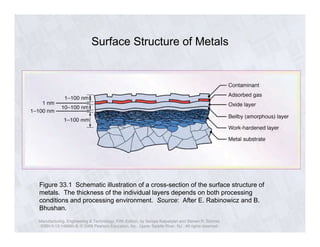
Surface Structure of Metals 
Figure 33.1 Schematic illustration of a cross-section of the surface structure of 
metals. The thickness of the individual layers depends on both processing 
conditions and processing environment. Source: After E. Rabinowicz and B. 
Bhushan. 
Manufacturing, Engineering & Technology, Fifth Edition, by Serope Kalpakjian and Steven R. Schmid. 
ISBN 0-13-148965-8. © 2006 Pearson Education, Inc., Upper Saddle River, NJ. All rights reserved.
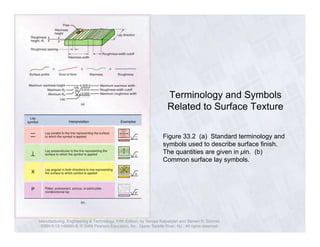
Terminology and Symbols 
Related to Surface Texture 
Figure 33.2 (a) Standard terminology and 
symbols used to describe surface finish. 
The quantities are given in μin. (b) 
Common surface lay symbols. 
Manufacturing, Engineering & Technology, Fifth Edition, by Serope Kalpakjian and Steven R. Schmid. 
ISBN 0-13-148965-8. © 2006 Pearson Education, Inc., Upper Saddle River, NJ. All rights reserved.
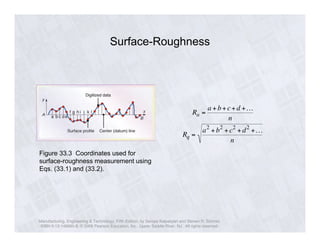
Surface-Roughness 
Figure 33.3 Coordinates used for 
surface-roughness measurement using 
Eqs. (33.1) and (33.2). 
! 
Ra = 
a + b + c + d +K 
Manufacturing, Engineering & Technology, Fifth Edition, by Serope Kalpakjian and Steven R. Schmid. 
ISBN 0-13-148965-8. © 2006 Pearson Education, Inc., Upper Saddle River, NJ. All rights reserved. 
n 
Rq = 
a 
2 
+ b 
2 
+ c 
2 
+ d 
2 
+K 
n
Manufacturing, Engineering & Technology, Fifth Edition, by Serope Kalpakjian and Steven R. Schmid. 
ISBN 0-13-148965-8. © 2006 Pearson Education, Inc., Upper Saddle River, NJ. All rights reserved. 
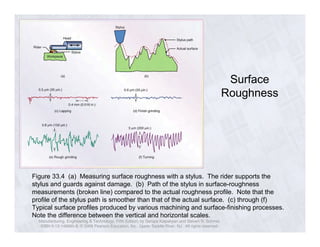
Surface 
Roughness 
Figure 33.4 (a) Measuring surface roughness with a stylus. The rider supports the 
stylus and guards against damage. (b) Path of the stylus in surface-roughness 
measurements (broken line) compared to the actual roughness profile. Note that the 
profile of the stylus path is smoother than that of the actual surface. (c) through (f) 
Typical surface profiles produced by various machining and surface-finishing processes. 
Note the difference between the vertical and horizontal scales.
Real Contact Area 
Figure 33.5 Schematic illustration of the interface of two bodies in contact 
showing real areas of contact at the asperities. In engineering surfaces, the 
ratio of the apparent-to-real areas of contact can be as high as 4 to 5 orders 
of magnitude. 
Manufacturing, Engineering & Technology, Fifth Edition, by Serope Kalpakjian and Steven R. Schmid. 
ISBN 0-13-148965-8. © 2006 Pearson Education, Inc., Upper Saddle River, NJ. All rights reserved.
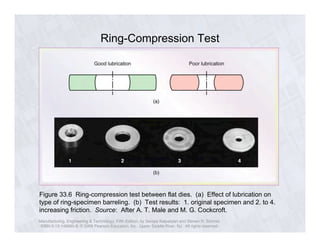
Ring-Compression Test 
Figure 33.6 Ring-compression test between flat dies. (a) Effect of lubrication on 
type of ring-specimen barreling. (b) Test results: 1. original specimen and 2. to 4. 
increasing friction. Source: After A. T. Male and M. G. Cockcroft. 
Manufacturing, Engineering & Technology, Fifth Edition, by Serope Kalpakjian and Steven R. Schmid. 
ISBN 0-13-148965-8. © 2006 Pearson Education, Inc., Upper Saddle River, NJ. All rights reserved.
Manufacturing, Engineering & Technology, Fifth Edition, by Serope Kalpakjian and Steven R. Schmid. 
ISBN 0-13-148965-8. © 2006 Pearson Education, Inc., Upper Saddle River, NJ. All rights reserved. 
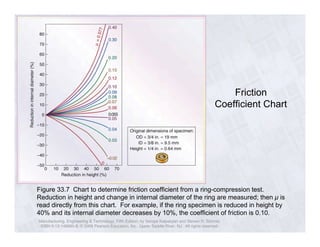
Friction 
Coefficient Chart 
Figure 33.7 Chart to determine friction coefficient from a ring-compression test. 
Reduction in height and change in internal diameter of the ring are measured; then μ is 
read directly from this chart. For example, if the ring specimen is reduced in height by 
40% and its internal diameter decreases by 10%, the coefficient of friction is 0.10.
Manufacturing, Engineering & Technology, Fifth Edition, by Serope Kalpakjian and Steven R. Schmid. 
ISBN 0-13-148965-8. © 2006 Pearson Education, Inc., Upper Saddle River, NJ. All rights reserved. 
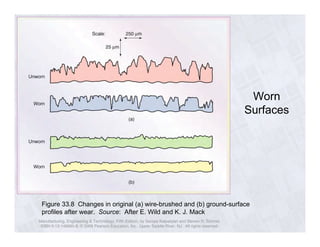
Worn 
Surfaces 
Figure 33.8 Changes in original (a) wire-brushed and (b) ground-surface 
profiles after wear. Source: After E. Wild and K. J. Mack
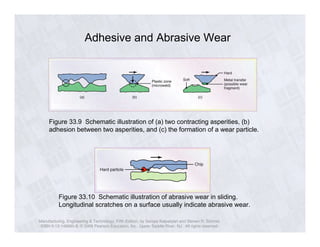
Adhesive and Abrasive Wear 
Figure 33.9 Schematic illustration of (a) two contracting asperities, (b) 
adhesion between two asperities, and (c) the formation of a wear particle. 
Figure 33.10 Schematic illustration of abrasive wear in sliding. 
Longitudinal scratches on a surface usually indicate abrasive wear. 
Manufacturing, Engineering & Technology, Fifth Edition, by Serope Kalpakjian and Steven R. Schmid. 
ISBN 0-13-148965-8. © 2006 Pearson Education, Inc., Upper Saddle River, NJ. All rights reserved.
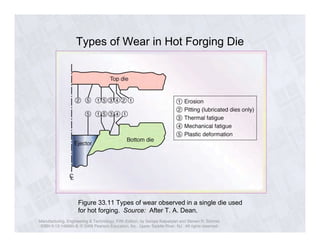
Types of Wear in Hot Forging Die 
Figure 33.11 Types of wear observed in a single die used 
for hot forging. Source: After T. A. Dean. 
Manufacturing, Engineering & Technology, Fifth Edition, by Serope Kalpakjian and Steven R. Schmid. 
ISBN 0-13-148965-8. © 2006 Pearson Education, Inc., Upper Saddle River, NJ. All rights reserved.
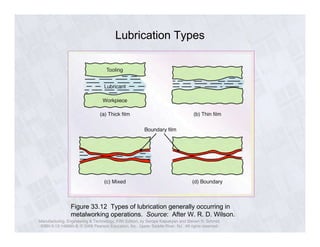
Lubrication Types 
Figure 33.12 Types of lubrication generally occurring in 
metalworking operations. Source: After W. R. D. Wilson. 
Manufacturing, Engineering & Technology, Fifth Edition, by Serope Kalpakjian and Steven R. Schmid. 
ISBN 0-13-148965-8. © 2006 Pearson Education, Inc., Upper Saddle River, NJ. All rights reserved.

Ch33 surface roughness

  • 1.
    Chapter 33 SurfaceRoughness and Measurement; Friction, Wear, and Lubrication Manufacturing, Engineering & Technology, Fifth Edition, by Serope Kalpakjian and Steven R. Schmid. ISBN 0-13-148965-8. © 2006 Pearson Education, Inc., Upper Saddle River, NJ. All rights reserved.
  • 2.
    Surface Structure ofMetals Figure 33.1 Schematic illustration of a cross-section of the surface structure of metals. The thickness of the individual layers depends on both processing conditions and processing environment. Source: After E. Rabinowicz and B. Bhushan. Manufacturing, Engineering & Technology, Fifth Edition, by Serope Kalpakjian and Steven R. Schmid. ISBN 0-13-148965-8. © 2006 Pearson Education, Inc., Upper Saddle River, NJ. All rights reserved.
  • 3.
    Terminology and Symbols Related to Surface Texture Figure 33.2 (a) Standard terminology and symbols used to describe surface finish. The quantities are given in μin. (b) Common surface lay symbols. Manufacturing, Engineering & Technology, Fifth Edition, by Serope Kalpakjian and Steven R. Schmid. ISBN 0-13-148965-8. © 2006 Pearson Education, Inc., Upper Saddle River, NJ. All rights reserved.
  • 4.
    Surface-Roughness Figure 33.3Coordinates used for surface-roughness measurement using Eqs. (33.1) and (33.2). ! Ra = a + b + c + d +K Manufacturing, Engineering & Technology, Fifth Edition, by Serope Kalpakjian and Steven R. Schmid. ISBN 0-13-148965-8. © 2006 Pearson Education, Inc., Upper Saddle River, NJ. All rights reserved. n Rq = a 2 + b 2 + c 2 + d 2 +K n
  • 5.
    Manufacturing, Engineering &Technology, Fifth Edition, by Serope Kalpakjian and Steven R. Schmid. ISBN 0-13-148965-8. © 2006 Pearson Education, Inc., Upper Saddle River, NJ. All rights reserved. Surface Roughness Figure 33.4 (a) Measuring surface roughness with a stylus. The rider supports the stylus and guards against damage. (b) Path of the stylus in surface-roughness measurements (broken line) compared to the actual roughness profile. Note that the profile of the stylus path is smoother than that of the actual surface. (c) through (f) Typical surface profiles produced by various machining and surface-finishing processes. Note the difference between the vertical and horizontal scales.
  • 6.
    Real Contact Area Figure 33.5 Schematic illustration of the interface of two bodies in contact showing real areas of contact at the asperities. In engineering surfaces, the ratio of the apparent-to-real areas of contact can be as high as 4 to 5 orders of magnitude. Manufacturing, Engineering & Technology, Fifth Edition, by Serope Kalpakjian and Steven R. Schmid. ISBN 0-13-148965-8. © 2006 Pearson Education, Inc., Upper Saddle River, NJ. All rights reserved.
  • 7.
    Ring-Compression Test Figure33.6 Ring-compression test between flat dies. (a) Effect of lubrication on type of ring-specimen barreling. (b) Test results: 1. original specimen and 2. to 4. increasing friction. Source: After A. T. Male and M. G. Cockcroft. Manufacturing, Engineering & Technology, Fifth Edition, by Serope Kalpakjian and Steven R. Schmid. ISBN 0-13-148965-8. © 2006 Pearson Education, Inc., Upper Saddle River, NJ. All rights reserved.
  • 8.
    Manufacturing, Engineering &Technology, Fifth Edition, by Serope Kalpakjian and Steven R. Schmid. ISBN 0-13-148965-8. © 2006 Pearson Education, Inc., Upper Saddle River, NJ. All rights reserved. Friction Coefficient Chart Figure 33.7 Chart to determine friction coefficient from a ring-compression test. Reduction in height and change in internal diameter of the ring are measured; then μ is read directly from this chart. For example, if the ring specimen is reduced in height by 40% and its internal diameter decreases by 10%, the coefficient of friction is 0.10.
  • 9.
    Manufacturing, Engineering &Technology, Fifth Edition, by Serope Kalpakjian and Steven R. Schmid. ISBN 0-13-148965-8. © 2006 Pearson Education, Inc., Upper Saddle River, NJ. All rights reserved. Worn Surfaces Figure 33.8 Changes in original (a) wire-brushed and (b) ground-surface profiles after wear. Source: After E. Wild and K. J. Mack
  • 10.
    Adhesive and AbrasiveWear Figure 33.9 Schematic illustration of (a) two contracting asperities, (b) adhesion between two asperities, and (c) the formation of a wear particle. Figure 33.10 Schematic illustration of abrasive wear in sliding. Longitudinal scratches on a surface usually indicate abrasive wear. Manufacturing, Engineering & Technology, Fifth Edition, by Serope Kalpakjian and Steven R. Schmid. ISBN 0-13-148965-8. © 2006 Pearson Education, Inc., Upper Saddle River, NJ. All rights reserved.
  • 11.
    Types of Wearin Hot Forging Die Figure 33.11 Types of wear observed in a single die used for hot forging. Source: After T. A. Dean. Manufacturing, Engineering & Technology, Fifth Edition, by Serope Kalpakjian and Steven R. Schmid. ISBN 0-13-148965-8. © 2006 Pearson Education, Inc., Upper Saddle River, NJ. All rights reserved.
  • 12.
    Lubrication Types Figure33.12 Types of lubrication generally occurring in metalworking operations. Source: After W. R. D. Wilson. Manufacturing, Engineering & Technology, Fifth Edition, by Serope Kalpakjian and Steven R. Schmid. ISBN 0-13-148965-8. © 2006 Pearson Education, Inc., Upper Saddle River, NJ. All rights reserved.