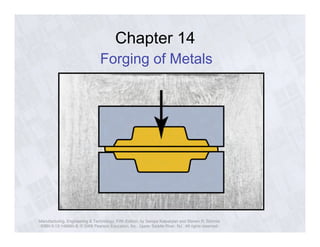
Chapter 14 
Forging of Metals 
Manufacturing, Engineering & Technology, Fifth Edition, by Serope Kalpakjian and Steven R. Schmid. 
ISBN 0-13-148965-8. © 2006 Pearson Education, Inc., Upper Saddle River, NJ. All rights reserved.
Forged Components 
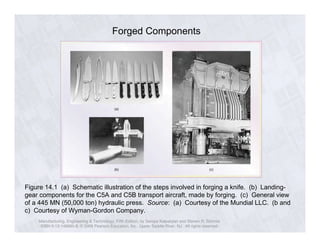
Figure 14.1 (a) Schematic illustration of the steps involved in forging a knife. (b) Landing-gear 
components for the C5A and C5B transport aircraft, made by forging. (c) General view 
of a 445 MN (50,000 ton) hydraulic press. Source: (a) Courtesy of the Mundial LLC. (b and 
c) Courtesy of Wyman-Gordon Company. 
Manufacturing, Engineering & Technology, Fifth Edition, by Serope Kalpakjian and Steven R. Schmid. 
ISBN 0-13-148965-8. © 2006 Pearson Education, Inc., Upper Saddle River, NJ. All rights reserved.
Microstructure as a Function of Manufacturing 
Method 
Figure 14.2 Schematic illustration of a part made by three different processes showing grain 
flow. (a) Casting by the processes described in Chapter 11. (b) Machining form a blank, 
described in Part IV of this book, and (c) forging. Each process has its own advantages and 
limitations regarding external and internal characteristics, material properties, dimensional 
accuracy, surface finish, and the economics of production. Source: Courtesy of Forging 
Industry Association. 
Manufacturing, Engineering & Technology, Fifth Edition, by Serope Kalpakjian and Steven R. Schmid. 
ISBN 0-13-148965-8. © 2006 Pearson Education, Inc., Upper Saddle River, NJ. All rights reserved.
Characteristics of Forging 
Manufacturing, Engineering & Technology, Fifth Edition, by Serope Kalpakjian and Steven R. Schmid. 
ISBN 0-13-148965-8. © 2006 Pearson Education, Inc., Upper Saddle River, NJ. All rights reserved.
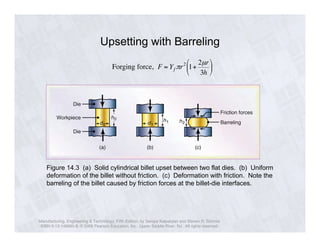
Upsetting with Barreling 
! 
# 
$ 
Forging force, F = Yf"r2 1+ 
2μr 
3h 
% 
& 
( 
' 
Figure 14.3 (a) Solid cylindrical billet upset between two flat dies. (b) Uniform 
deformation of the billet without friction. (c) Deformation with friction. Note the 
barreling of the billet caused by friction forces at the billet-die interfaces. 
Manufacturing, Engineering & Technology, Fifth Edition, by Serope Kalpakjian and Steven R. Schmid. 
ISBN 0-13-148965-8. © 2006 Pearson Education, Inc., Upper Saddle River, NJ. All rights reserved.
Cogging Operation on a Rectangular Bar 
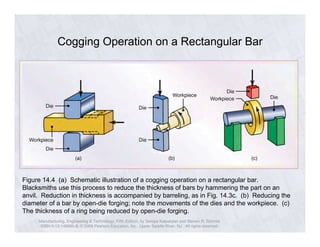
Figure 14.4 (a) Schematic illustration of a cogging operation on a rectangular bar. 
Blacksmiths use this process to reduce the thickness of bars by hammering the part on an 
anvil. Reduction in thickness is accompanied by barreling, as in Fig. 14.3c. (b) Reducing the 
diameter of a bar by open-die forging; note the movements of the dies and the workpiece. (c) 
The thickness of a ring being reduced by open-die forging. 
Manufacturing, Engineering & Technology, Fifth Edition, by Serope Kalpakjian and Steven R. Schmid. 
ISBN 0-13-148965-8. © 2006 Pearson Education, Inc., Upper Saddle River, NJ. All rights reserved.
Impression-Die Forging 
Figure 14.5 (a) through (c) Stages in impression-die forging of a solid round billet. Note 
the formation of flash, which is excess metal that is subsequently trimmed off (see Fig. 
14.7). (d) Standard terminology for various features of a forging die. 
Manufacturing, Engineering & Technology, Fifth Edition, by Serope Kalpakjian and Steven R. Schmid. 
ISBN 0-13-148965-8. © 2006 Pearson Education, Inc., Upper Saddle River, NJ. All rights reserved.
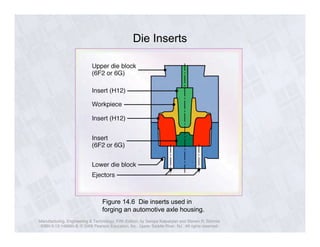
Die Inserts 
Figure 14.6 Die inserts used in 
forging an automotive axle housing. 
Manufacturing, Engineering & Technology, Fifth Edition, by Serope Kalpakjian and Steven R. Schmid. 
ISBN 0-13-148965-8. © 2006 Pearson Education, Inc., Upper Saddle River, NJ. All rights reserved.
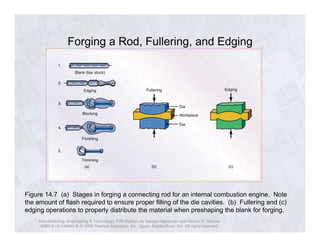
Forging a Rod, Fullering, and Edging 
Figure 14.7 (a) Stages in forging a connecting rod for an internal combustion engine. Note 
the amount of flash required to ensure proper filling of the die cavities. (b) Fullering and (c) 
edging operations to properly distribute the material when preshaping the blank for forging. 
Manufacturing, Engineering & Technology, Fifth Edition, by Serope Kalpakjian and Steven R. Schmid. 
ISBN 0-13-148965-8. © 2006 Pearson Education, Inc., Upper Saddle River, NJ. All rights reserved.
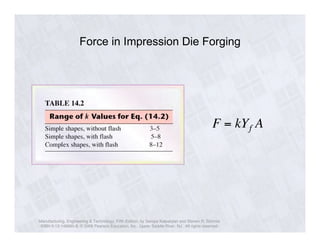
Force in Impression Die Forging 
! 
F = kYf A 
Manufacturing, Engineering & Technology, Fifth Edition, by Serope Kalpakjian and Steven R. Schmid. 
ISBN 0-13-148965-8. © 2006 Pearson Education, Inc., Upper Saddle River, NJ. All rights reserved.
Trimming Flash After Forging 
Figure 14.8 Trimming flash from a forged part. Note that 
the thin material at the center is removed by punching. 
Manufacturing, Engineering & Technology, Fifth Edition, by Serope Kalpakjian and Steven R. Schmid. 
ISBN 0-13-148965-8. © 2006 Pearson Education, Inc., Upper Saddle River, NJ. All rights reserved.
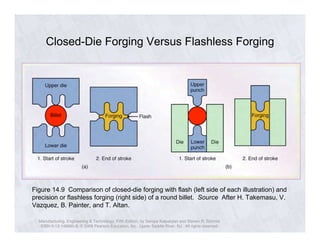
Closed-Die Forging Versus Flashless Forging 
Figure 14.9 Comparison of closed-die forging with flash (left side of each illustration) and 
precision or flashless forging (right side) of a round billet. Source After H. Takemasu, V. 
Vazquez, B. Painter, and T. Altan. 
Manufacturing, Engineering & Technology, Fifth Edition, by Serope Kalpakjian and Steven R. Schmid. 
ISBN 0-13-148965-8. © 2006 Pearson Education, Inc., Upper Saddle River, NJ. All rights reserved.
The Coining 
Process 
Figure 14.10 (a) Schematic illustration of the coining process. The earliest coins were 
made by open-die forging and lacked precision and sharp details. (b) An example of a 
modern coining operation, showing the workpiece and tooling. Note the detail and superior 
finish that can be achieve in this process. Source: Courtesy of C & W Steel Stamp Co., Inc. 
Manufacturing, Engineering & Technology, Fifth Edition, by Serope Kalpakjian and Steven R. Schmid. 
ISBN 0-13-148965-8. © 2006 Pearson Education, Inc., Upper Saddle River, NJ. All rights reserved. 
(b)
Heading 
Figure 14.11 (a) Heading operation to form heads on fasteners, such as nails and rivets. 
(b) Sequence of operations to produce a typical bolt head by heading. 
Manufacturing, Engineering & Technology, Fifth Edition, by Serope Kalpakjian and Steven R. Schmid. 
ISBN 0-13-148965-8. © 2006 Pearson Education, Inc., Upper Saddle River, NJ. All rights reserved.
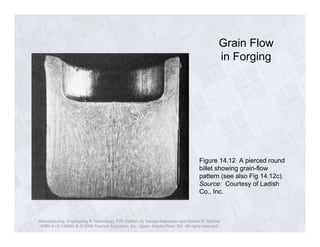
Grain Flow 
in Forging 
Figure 14.12 A pierced round 
billet showing grain-flow 
pattern (see also Fig 14.12c). 
Source: Courtesy of Ladish 
Co., Inc. 
Manufacturing, Engineering & Technology, Fifth Edition, by Serope Kalpakjian and Steven R. Schmid. 
ISBN 0-13-148965-8. © 2006 Pearson Education, Inc., Upper Saddle River, NJ. All rights reserved.
Stepped Pin 
Figure 14.13 (a) The stepped pin used in Case Study 14.1. (b) Illustration of the 
manufacturing steps used to produce the stepped pin. Source: Courtesy of National 
Machinery, LLC. 
Manufacturing, Engineering & Technology, Fifth Edition, by Serope Kalpakjian and Steven R. Schmid. 
ISBN 0-13-148965-8. © 2006 Pearson Education, Inc., Upper Saddle River, NJ. All rights reserved.
Manufacturing, Engineering & Technology, Fifth Edition, by Serope Kalpakjian and Steven R. Schmid. 
ISBN 0-13-148965-8. © 2006 Pearson Education, Inc., Upper Saddle River, NJ. All rights reserved. 
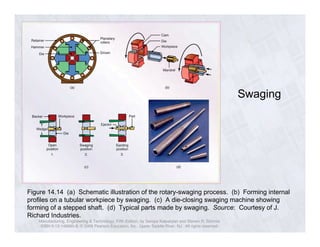
Swaging 
Figure 14.14 (a) Schematic illustration of the rotary-swaging process. (b) Forming internal 
profiles on a tubular workpiece by swaging. (c) A die-closing swaging machine showing 
forming of a stepped shaft. (d) Typical parts made by swaging. Source: Courtesy of J. 
Richard Industries.
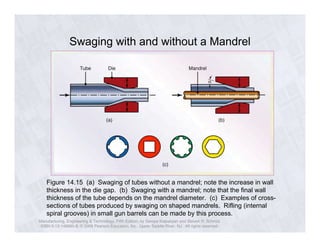
Swaging with and without a Mandrel 
Figure 14.15 (a) Swaging of tubes without a mandrel; note the increase in wall 
thickness in the die gap. (b) Swaging with a mandrel; note that the final wall 
thickness of the tube depends on the mandrel diameter. (c) Examples of cross-sections 
of tubes produced by swaging on shaped mandrels. Rifling (internal 
spiral grooves) in small gun barrels can be made by this process. 
Manufacturing, Engineering & Technology, Fifth Edition, by Serope Kalpakjian and Steven R. Schmid. 
ISBN 0-13-148965-8. © 2006 Pearson Education, Inc., Upper Saddle River, NJ. All rights reserved.
Metals in Decreasing Order of Forgeability 
Manufacturing, Engineering & Technology, Fifth Edition, by Serope Kalpakjian and Steven R. Schmid. 
ISBN 0-13-148965-8. © 2006 Pearson Education, Inc., Upper Saddle River, NJ. All rights reserved.
Defects in Forged Parts 
Figure 14.16 Examples of defects in forged parts. (a) Laps formed by web buckling during 
forging; web thickness should be increased to avoid this problem. (b) Internal defects 
caused by an oversized billet. Die cavities are filled prematurely, and the material at the 
center flows past the filled regions as the die closes. 
Manufacturing, Engineering & Technology, Fifth Edition, by Serope Kalpakjian and Steven R. Schmid. 
ISBN 0-13-148965-8. © 2006 Pearson Education, Inc., Upper Saddle River, NJ. All rights reserved.
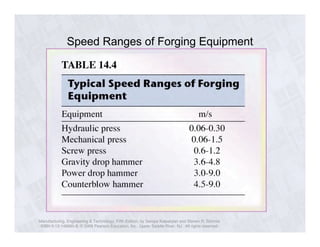
Speed Ranges of Forging Equipment 
Manufacturing, Engineering & Technology, Fifth Edition, by Serope Kalpakjian and Steven R. Schmid. 
ISBN 0-13-148965-8. © 2006 Pearson Education, Inc., Upper Saddle River, NJ. All rights reserved.
Principles of Various Forging Machines 
Figure 14.17 Schematic illustration of the principles of various forging machines. 
(a) Mechanical press with an eccentric drive; the eccentric shaft can be replaced by 
a crankshaft to give the up-and-down motion to the ram. (b) Knuckle-joint press. 
(c) Screw press. (d) Hydraulic press. 
Manufacturing, Engineering & Technology, Fifth Edition, by Serope Kalpakjian and Steven R. Schmid. 
ISBN 0-13-148965-8. © 2006 Pearson Education, Inc., Upper Saddle River, NJ. All rights reserved.
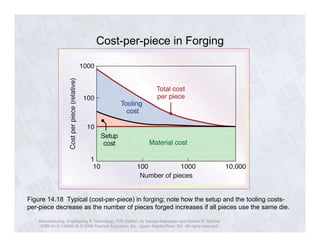
Cost-per-piece in Forging 
Figure 14.18 Typical (cost-per-piece) in forging; note how the setup and the tooling costs-per- 
piece decrease as the number of pieces forged increases if all pieces use the same die. 
Manufacturing, Engineering & Technology, Fifth Edition, by Serope Kalpakjian and Steven R. Schmid. 
ISBN 0-13-148965-8. © 2006 Pearson Education, Inc., Upper Saddle River, NJ. All rights reserved.
Costs of a Rod Made by Forging and Casting 
Figure 14.19 Relative unit 
costs of a small connecting 
rod made by various forging 
and casting processes. 
Note that, for large 
quantities, forging is more 
economical. Sand casting 
is the most economical 
process for fewer then 
about 20,000 pieces. 
Manufacturing, Engineering & Technology, Fifth Edition, by Serope Kalpakjian and Steven R. Schmid. 
ISBN 0-13-148965-8. © 2006 Pearson Education, Inc., Upper Saddle River, NJ. All rights reserved.
Lotus Elise Series 2 and Vertical Suspension Uprights 
Figure 14.20 (a) The Lotus Elise Series 2 Sportscar; (b) illustration of the original 
design for the vertical suspension uprights, using an aluminum extrusion; (c) retrofit 
design, using a steel forging; (d) optimized steel forging design for new car models. 
Source: Courtesy of Lotus Engineering and the American Iron and Steel Institute. 
Manufacturing, Engineering & Technology, Fifth Edition, by Serope Kalpakjian and Steven R. Schmid. 
ISBN 0-13-148965-8. © 2006 Pearson Education, Inc., Upper Saddle River, NJ. All rights reserved.
Comparison of Suspension Designs for the Lotus 
Manufacturing, Engineering & Technology, Fifth Edition, by Serope Kalpakjian and Steven R. Schmid. 
ISBN 0-13-148965-8. © 2006 Pearson Education, Inc., Upper Saddle River, NJ. All rights reserved.

Ch14 forging Erdi Karaçal Mechanical Engineer University of Gaziantep

  • 1.
    Chapter 14 Forgingof Metals Manufacturing, Engineering & Technology, Fifth Edition, by Serope Kalpakjian and Steven R. Schmid. ISBN 0-13-148965-8. © 2006 Pearson Education, Inc., Upper Saddle River, NJ. All rights reserved.
  • 2.
    Forged Components Figure14.1 (a) Schematic illustration of the steps involved in forging a knife. (b) Landing-gear components for the C5A and C5B transport aircraft, made by forging. (c) General view of a 445 MN (50,000 ton) hydraulic press. Source: (a) Courtesy of the Mundial LLC. (b and c) Courtesy of Wyman-Gordon Company. Manufacturing, Engineering & Technology, Fifth Edition, by Serope Kalpakjian and Steven R. Schmid. ISBN 0-13-148965-8. © 2006 Pearson Education, Inc., Upper Saddle River, NJ. All rights reserved.
  • 3.
    Microstructure as aFunction of Manufacturing Method Figure 14.2 Schematic illustration of a part made by three different processes showing grain flow. (a) Casting by the processes described in Chapter 11. (b) Machining form a blank, described in Part IV of this book, and (c) forging. Each process has its own advantages and limitations regarding external and internal characteristics, material properties, dimensional accuracy, surface finish, and the economics of production. Source: Courtesy of Forging Industry Association. Manufacturing, Engineering & Technology, Fifth Edition, by Serope Kalpakjian and Steven R. Schmid. ISBN 0-13-148965-8. © 2006 Pearson Education, Inc., Upper Saddle River, NJ. All rights reserved.
  • 4.
    Characteristics of Forging Manufacturing, Engineering & Technology, Fifth Edition, by Serope Kalpakjian and Steven R. Schmid. ISBN 0-13-148965-8. © 2006 Pearson Education, Inc., Upper Saddle River, NJ. All rights reserved.
  • 5.
    Upsetting with Barreling ! # $ Forging force, F = Yf"r2 1+ 2μr 3h % & ( ' Figure 14.3 (a) Solid cylindrical billet upset between two flat dies. (b) Uniform deformation of the billet without friction. (c) Deformation with friction. Note the barreling of the billet caused by friction forces at the billet-die interfaces. Manufacturing, Engineering & Technology, Fifth Edition, by Serope Kalpakjian and Steven R. Schmid. ISBN 0-13-148965-8. © 2006 Pearson Education, Inc., Upper Saddle River, NJ. All rights reserved.
  • 6.
    Cogging Operation ona Rectangular Bar Figure 14.4 (a) Schematic illustration of a cogging operation on a rectangular bar. Blacksmiths use this process to reduce the thickness of bars by hammering the part on an anvil. Reduction in thickness is accompanied by barreling, as in Fig. 14.3c. (b) Reducing the diameter of a bar by open-die forging; note the movements of the dies and the workpiece. (c) The thickness of a ring being reduced by open-die forging. Manufacturing, Engineering & Technology, Fifth Edition, by Serope Kalpakjian and Steven R. Schmid. ISBN 0-13-148965-8. © 2006 Pearson Education, Inc., Upper Saddle River, NJ. All rights reserved.
  • 7.
    Impression-Die Forging Figure14.5 (a) through (c) Stages in impression-die forging of a solid round billet. Note the formation of flash, which is excess metal that is subsequently trimmed off (see Fig. 14.7). (d) Standard terminology for various features of a forging die. Manufacturing, Engineering & Technology, Fifth Edition, by Serope Kalpakjian and Steven R. Schmid. ISBN 0-13-148965-8. © 2006 Pearson Education, Inc., Upper Saddle River, NJ. All rights reserved.
  • 8.
    Die Inserts Figure14.6 Die inserts used in forging an automotive axle housing. Manufacturing, Engineering & Technology, Fifth Edition, by Serope Kalpakjian and Steven R. Schmid. ISBN 0-13-148965-8. © 2006 Pearson Education, Inc., Upper Saddle River, NJ. All rights reserved.
  • 9.
    Forging a Rod,Fullering, and Edging Figure 14.7 (a) Stages in forging a connecting rod for an internal combustion engine. Note the amount of flash required to ensure proper filling of the die cavities. (b) Fullering and (c) edging operations to properly distribute the material when preshaping the blank for forging. Manufacturing, Engineering & Technology, Fifth Edition, by Serope Kalpakjian and Steven R. Schmid. ISBN 0-13-148965-8. © 2006 Pearson Education, Inc., Upper Saddle River, NJ. All rights reserved.
  • 10.
    Force in ImpressionDie Forging ! F = kYf A Manufacturing, Engineering & Technology, Fifth Edition, by Serope Kalpakjian and Steven R. Schmid. ISBN 0-13-148965-8. © 2006 Pearson Education, Inc., Upper Saddle River, NJ. All rights reserved.
  • 11.
    Trimming Flash AfterForging Figure 14.8 Trimming flash from a forged part. Note that the thin material at the center is removed by punching. Manufacturing, Engineering & Technology, Fifth Edition, by Serope Kalpakjian and Steven R. Schmid. ISBN 0-13-148965-8. © 2006 Pearson Education, Inc., Upper Saddle River, NJ. All rights reserved.
  • 12.
    Closed-Die Forging VersusFlashless Forging Figure 14.9 Comparison of closed-die forging with flash (left side of each illustration) and precision or flashless forging (right side) of a round billet. Source After H. Takemasu, V. Vazquez, B. Painter, and T. Altan. Manufacturing, Engineering & Technology, Fifth Edition, by Serope Kalpakjian and Steven R. Schmid. ISBN 0-13-148965-8. © 2006 Pearson Education, Inc., Upper Saddle River, NJ. All rights reserved.
  • 13.
    The Coining Process Figure 14.10 (a) Schematic illustration of the coining process. The earliest coins were made by open-die forging and lacked precision and sharp details. (b) An example of a modern coining operation, showing the workpiece and tooling. Note the detail and superior finish that can be achieve in this process. Source: Courtesy of C & W Steel Stamp Co., Inc. Manufacturing, Engineering & Technology, Fifth Edition, by Serope Kalpakjian and Steven R. Schmid. ISBN 0-13-148965-8. © 2006 Pearson Education, Inc., Upper Saddle River, NJ. All rights reserved. (b)
  • 14.
    Heading Figure 14.11(a) Heading operation to form heads on fasteners, such as nails and rivets. (b) Sequence of operations to produce a typical bolt head by heading. Manufacturing, Engineering & Technology, Fifth Edition, by Serope Kalpakjian and Steven R. Schmid. ISBN 0-13-148965-8. © 2006 Pearson Education, Inc., Upper Saddle River, NJ. All rights reserved.
  • 15.
    Grain Flow inForging Figure 14.12 A pierced round billet showing grain-flow pattern (see also Fig 14.12c). Source: Courtesy of Ladish Co., Inc. Manufacturing, Engineering & Technology, Fifth Edition, by Serope Kalpakjian and Steven R. Schmid. ISBN 0-13-148965-8. © 2006 Pearson Education, Inc., Upper Saddle River, NJ. All rights reserved.
  • 16.
    Stepped Pin Figure14.13 (a) The stepped pin used in Case Study 14.1. (b) Illustration of the manufacturing steps used to produce the stepped pin. Source: Courtesy of National Machinery, LLC. Manufacturing, Engineering & Technology, Fifth Edition, by Serope Kalpakjian and Steven R. Schmid. ISBN 0-13-148965-8. © 2006 Pearson Education, Inc., Upper Saddle River, NJ. All rights reserved.
  • 17.
    Manufacturing, Engineering &Technology, Fifth Edition, by Serope Kalpakjian and Steven R. Schmid. ISBN 0-13-148965-8. © 2006 Pearson Education, Inc., Upper Saddle River, NJ. All rights reserved. Swaging Figure 14.14 (a) Schematic illustration of the rotary-swaging process. (b) Forming internal profiles on a tubular workpiece by swaging. (c) A die-closing swaging machine showing forming of a stepped shaft. (d) Typical parts made by swaging. Source: Courtesy of J. Richard Industries.
  • 18.
    Swaging with andwithout a Mandrel Figure 14.15 (a) Swaging of tubes without a mandrel; note the increase in wall thickness in the die gap. (b) Swaging with a mandrel; note that the final wall thickness of the tube depends on the mandrel diameter. (c) Examples of cross-sections of tubes produced by swaging on shaped mandrels. Rifling (internal spiral grooves) in small gun barrels can be made by this process. Manufacturing, Engineering & Technology, Fifth Edition, by Serope Kalpakjian and Steven R. Schmid. ISBN 0-13-148965-8. © 2006 Pearson Education, Inc., Upper Saddle River, NJ. All rights reserved.
  • 19.
    Metals in DecreasingOrder of Forgeability Manufacturing, Engineering & Technology, Fifth Edition, by Serope Kalpakjian and Steven R. Schmid. ISBN 0-13-148965-8. © 2006 Pearson Education, Inc., Upper Saddle River, NJ. All rights reserved.
  • 20.
    Defects in ForgedParts Figure 14.16 Examples of defects in forged parts. (a) Laps formed by web buckling during forging; web thickness should be increased to avoid this problem. (b) Internal defects caused by an oversized billet. Die cavities are filled prematurely, and the material at the center flows past the filled regions as the die closes. Manufacturing, Engineering & Technology, Fifth Edition, by Serope Kalpakjian and Steven R. Schmid. ISBN 0-13-148965-8. © 2006 Pearson Education, Inc., Upper Saddle River, NJ. All rights reserved.
  • 21.
    Speed Ranges ofForging Equipment Manufacturing, Engineering & Technology, Fifth Edition, by Serope Kalpakjian and Steven R. Schmid. ISBN 0-13-148965-8. © 2006 Pearson Education, Inc., Upper Saddle River, NJ. All rights reserved.
  • 22.
    Principles of VariousForging Machines Figure 14.17 Schematic illustration of the principles of various forging machines. (a) Mechanical press with an eccentric drive; the eccentric shaft can be replaced by a crankshaft to give the up-and-down motion to the ram. (b) Knuckle-joint press. (c) Screw press. (d) Hydraulic press. Manufacturing, Engineering & Technology, Fifth Edition, by Serope Kalpakjian and Steven R. Schmid. ISBN 0-13-148965-8. © 2006 Pearson Education, Inc., Upper Saddle River, NJ. All rights reserved.
  • 23.
    Cost-per-piece in Forging Figure 14.18 Typical (cost-per-piece) in forging; note how the setup and the tooling costs-per- piece decrease as the number of pieces forged increases if all pieces use the same die. Manufacturing, Engineering & Technology, Fifth Edition, by Serope Kalpakjian and Steven R. Schmid. ISBN 0-13-148965-8. © 2006 Pearson Education, Inc., Upper Saddle River, NJ. All rights reserved.
  • 24.
    Costs of aRod Made by Forging and Casting Figure 14.19 Relative unit costs of a small connecting rod made by various forging and casting processes. Note that, for large quantities, forging is more economical. Sand casting is the most economical process for fewer then about 20,000 pieces. Manufacturing, Engineering & Technology, Fifth Edition, by Serope Kalpakjian and Steven R. Schmid. ISBN 0-13-148965-8. © 2006 Pearson Education, Inc., Upper Saddle River, NJ. All rights reserved.
  • 25.
    Lotus Elise Series2 and Vertical Suspension Uprights Figure 14.20 (a) The Lotus Elise Series 2 Sportscar; (b) illustration of the original design for the vertical suspension uprights, using an aluminum extrusion; (c) retrofit design, using a steel forging; (d) optimized steel forging design for new car models. Source: Courtesy of Lotus Engineering and the American Iron and Steel Institute. Manufacturing, Engineering & Technology, Fifth Edition, by Serope Kalpakjian and Steven R. Schmid. ISBN 0-13-148965-8. © 2006 Pearson Education, Inc., Upper Saddle River, NJ. All rights reserved.
  • 26.
    Comparison of SuspensionDesigns for the Lotus Manufacturing, Engineering & Technology, Fifth Edition, by Serope Kalpakjian and Steven R. Schmid. ISBN 0-13-148965-8. © 2006 Pearson Education, Inc., Upper Saddle River, NJ. All rights reserved.