Surface Treatment
BY
WAQAS AHMED
Surface Treatment
Treatment of metals can be of essential importance in
many industries. It is not a new process, but a process
that dates back as early as mankind started using gold
decoratively before 4000 BC. Today there can be several
reasons why it is necessary to change the surface
properties of metals. For example surface treatment of
metals used for:
•
Decoration and/or reflectivity
•
Improved hardness (eg. for resistance to damage
and wear)
•
Prevention of corrosion
Basic process is:The process of metal surface
treatment involves more than a few steps. Firstly,
the stamping compounds and mill oils are
cleaned away from the surface leading to rinsing.
This is followed by the application of an organicinorganic sealer. And finally, the surface is rinsed
with water that’s free of contaminants e.g. water
obtained through reverse osmosis or
deionization.
Surface treatment has further processes
mentioned below.
• Case hardening
• Hard Facing
• Ion Implantation
• Electroplating
• Vapor Deposition
Case Hardening
• Case hardening or surface hardening is the process
of hardening the surface of a metal object while
allowing the metal deeper underneath to remain
soft, thus forming a thin layer of harder metal (called
the "case") at the surface.
• Case hardening is a manufacturing process involving
changes in composition of metallic objects.
• low carbon steel will be given added strength by
applying material that makes for a stronger alloy.
• Examples of this would include gun barrels and high
pressure pipelines.
A replica Colt 1873 revolver, showing
case hardening colors on the frame
Hard Facing
• To
harden the surface of (metal), as by chilling or casehard
ening
• In hard facing, a relatively thick layer, edge or point of
wear resistant hard metal is deposited by any of the
welding techniques. A number of layers are usually
deposited (weld overlap).
• Hard facing alloys are available as electrodes, rod, wire
and powder.
• Typical applications of hard facing are valve seats, oilwell drilling tools, and dies for hot metalworking, worn
parts .
Ion Implantation
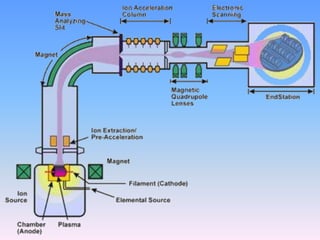
• Ion implantation is a materials engineering process by which ions of a
material are accelerated in an electrical field and impacted into a solid.
This process is used to change the physical, chemical, or electrical
properties of the solid. Ion implantation is used in semiconductor device
fabrication and in metal finishing, as well as various applications
in materials science research.
• In ion implantation, ions (charged atoms) are introduced on the surface of
work piece material. The ions are accelerated in a vacuum to such an
extent that they penetrate the substance to few µm.
• Effective for aluminum, stainless steels, titanium, tool and die steels,
carbides and chromium coatings.
• In semiconductors, this process is called doping where the base material is
doped with alloying element e.g. n-type & p-type semiconductors.
Electroplating
• In electroplating, the work piece material (cathode) is
plated with a different metal (anode), while both are
suspended in a bath containing a water-base electrolyte
solution. In basic process, metal ions from the anode are
discharged under the potential from the external source of
electricity, combine with the ion in the solution, and are
deposited on the cathode.
• Common plating materials are
chromium, nickel, copper, cadmium, zinc and tin.
• Typical electroplating applications are copper plating
aluminium wire and plastic boards for printed
circuits, chrome plating hardware, tin plating copper
electrical terminals for ease of soldering.
Vapor Deposition
• Vapor deposition is a process in which the substrate
(workpiece surface) is subjected to chemical reactions
by gases that contains chemical compounds of the
material to be deposited.
• The deposited materials may be
metals, alloys, carbides, nitrides, borides, ceramics or
various oxides.
• The substrate may be a plastic, paper, metal or glass.
• Applications are coating cutting
tools, drills, reamers, milling cutters, punches, dies and
wear surfaces.
Joining
Joining is a manufacturing process in which
different materials are combined to one another
and final composite has composition of both the
materials.
Joining is further characterized into
following types:
•
•
•
•

Welding
Brazing
Soldering
Riveting
Welding
• Definition:Welding is a fabrication process that
joins materials, usually metals or thermoplastics, by
causing coalescence.
• Basic Process
Firstly,melting the workpieces and
adding a filler material to form a pool of molten
material that cools to become a strong joint, but
sometimes pressure is used in conjunction with
heat, or by itself, to produce the weld.
• Many different energy sources can be used for
welding, including a gas flame, an electric arc,
a laser, an electron beam, friction, and
ultrasound.
• Welding has
• Safety regarding welding is very important as
it is dangerous.
Types
Welding has further types:
•
•
•
•
•

Electric arc welding
Resistance seam welding
Oxyfuel gas welding
Laser-Beam welding
Thermit welding
Brazing
• Definition:Brazing is a joining process in which a
filler metal is melted and drawn into a capillary
formed by the assembly of two or more work
pieces.
• Basic process
The filler metal reacts metallurgically
with the workpiece(s) and solidifies in the
capillary, forming a strong joint.
• Brazing is similar to soldering, but occurs at
temperatures in excess of 450 °C (842 °F).
• Brazing has the advantage of producing less
thermal stresses than welding, and brazed
assemblies tend to be more ductile than
weldments because alloying elements can not
segregate and precipitate.
Types
•
•
•
•
•
•
•

Dip brazing
Cast iron welding
Furnace brazing
Torch brazing
Silver brazing
Braze welding
Vacuum brazing
Soldering
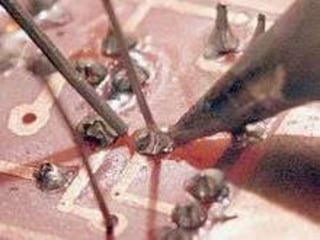
Definition:Soldering is a joining process that
occurs at temperatures below 450 °C (842 °F).
Basic process
Filler is melted and drawn into a
capillary to form a join, although at a lower
temperature.
• Suitable for very low temperature metals.

• Mostly electric components such as
semiconductor chips, mother boards of
computers, etc are soldered.
Riveting
• Riveting is one of the most ancient metalwork
joining processes.
• A rivet is essentially a two-headed and
unthreaded bolt which holds two other pieces
of metal together.
• When it is necessary to remove rivets, one of
the rivet's heads is sheared off with a cold
chisel. The rivet is then driven out with a
hammer and punch.
Cutting
• Cutting is a collection of processes where in
material is brought to a specified geometry
by removing excess material using various
kinds of tooling to leave a finished part that
meets specifications.
Modern technologies
• Manual technologies: saw, chisel, shear or
snips
• Machine technologies:
turning, milling, drilling, grinding, sawing
• Welding/burning technologies: burning by
laser, oxy-fuel burning, and plasma
• Erosion technologies: by water jet, electric
discharge, or abrasive flow machining.
Types
Basically cutting is characterized as follows:
• Milling
• Turning
• Threading
• Grinding
• Filing
Milling
• Milling:• Milling is the complex shaping of metal or
other materials by removing material to form
the final shape. It is generally done on a milling
machine, a power-driven machine that in its
basic form consists of a milling cutter that
rotates about the spindle axis (like a drill), and
a worktable that can move in multiple
directions (usually two dimensions [x and y
axis] relative to the workpiece). The spindle
usually moves in the
Turning
• Turning is a metal cutting process for producing a cylindrical surface
with a single point tool. The workpiece is rotated on a spindle and
the cutting tool is fed into it radially, axially or both. Producing
surfaces perpendicular to the workpiece axis is called facing.
Producing surfaces using both radial and axial feeds is called
profiling.
• A lathe is a machine tool which spins a block or cylinder of material
so that when abrasive, cutting, or deformation tools are applied to
the workpiece, it can be shaped to produce an object which
has rotational symmetry about an axis of rotation. Examples of
objects that can be produced on a lathe
include candlestick holders, table legs, bowls, baseball
• bats, crankshafts, camshafts, and bearing mounts
Threading
• Three types of tools which are used for
threading
• Bottoming type
• Plug type
• Tapper type
GRINDING
• Grinding:• Grinding uses an abrasive process to remove
material from the workpiece. A grinding
machine is a machine tool used for producing
very fine finishes, making very light cuts, or
high precision forms using anabrasive wheel
as the cutting device. This wheel can be made
up of various sizes and types of
stones,diamonds or inorganic materials.
Filing
• Filing:• Filing is combination of grinding and saw
tooth cutting using a file. Prior to the
development of modern machining
equipment it provided a relatively accurate
means for the production of small
parts, especially those with flat surfaces.
BROACHING
• Broaching is a machining operation used to
cut keyways into shafts. Electron beam
machining (EBM) is a machining process
where high-velocity electrons are directed
toward a work piece, creating heat and
vaporizing the material. Ultrasonic machining
uses ultrasonic vibrations to machine very
hard or brittle materials.

Surface treatment

  • 2.
  • 3.
    Surface Treatment Treatment ofmetals can be of essential importance in many industries. It is not a new process, but a process that dates back as early as mankind started using gold decoratively before 4000 BC. Today there can be several reasons why it is necessary to change the surface properties of metals. For example surface treatment of metals used for: • Decoration and/or reflectivity • Improved hardness (eg. for resistance to damage and wear) • Prevention of corrosion
  • 4.
    Basic process is:Theprocess of metal surface treatment involves more than a few steps. Firstly, the stamping compounds and mill oils are cleaned away from the surface leading to rinsing. This is followed by the application of an organicinorganic sealer. And finally, the surface is rinsed with water that’s free of contaminants e.g. water obtained through reverse osmosis or deionization.
  • 5.
    Surface treatment hasfurther processes mentioned below. • Case hardening • Hard Facing • Ion Implantation • Electroplating • Vapor Deposition
  • 6.
    Case Hardening • Casehardening or surface hardening is the process of hardening the surface of a metal object while allowing the metal deeper underneath to remain soft, thus forming a thin layer of harder metal (called the "case") at the surface. • Case hardening is a manufacturing process involving changes in composition of metallic objects. • low carbon steel will be given added strength by applying material that makes for a stronger alloy. • Examples of this would include gun barrels and high pressure pipelines.
  • 7.
    A replica Colt1873 revolver, showing case hardening colors on the frame
  • 9.
    Hard Facing • To hardenthe surface of (metal), as by chilling or casehard ening • In hard facing, a relatively thick layer, edge or point of wear resistant hard metal is deposited by any of the welding techniques. A number of layers are usually deposited (weld overlap). • Hard facing alloys are available as electrodes, rod, wire and powder. • Typical applications of hard facing are valve seats, oilwell drilling tools, and dies for hot metalworking, worn parts .
  • 11.
    Ion Implantation • Ionimplantation is a materials engineering process by which ions of a material are accelerated in an electrical field and impacted into a solid. This process is used to change the physical, chemical, or electrical properties of the solid. Ion implantation is used in semiconductor device fabrication and in metal finishing, as well as various applications in materials science research. • In ion implantation, ions (charged atoms) are introduced on the surface of work piece material. The ions are accelerated in a vacuum to such an extent that they penetrate the substance to few µm. • Effective for aluminum, stainless steels, titanium, tool and die steels, carbides and chromium coatings. • In semiconductors, this process is called doping where the base material is doped with alloying element e.g. n-type & p-type semiconductors.
  • 13.
    Electroplating • In electroplating,the work piece material (cathode) is plated with a different metal (anode), while both are suspended in a bath containing a water-base electrolyte solution. In basic process, metal ions from the anode are discharged under the potential from the external source of electricity, combine with the ion in the solution, and are deposited on the cathode. • Common plating materials are chromium, nickel, copper, cadmium, zinc and tin. • Typical electroplating applications are copper plating aluminium wire and plastic boards for printed circuits, chrome plating hardware, tin plating copper electrical terminals for ease of soldering.
  • 15.
    Vapor Deposition • Vapordeposition is a process in which the substrate (workpiece surface) is subjected to chemical reactions by gases that contains chemical compounds of the material to be deposited. • The deposited materials may be metals, alloys, carbides, nitrides, borides, ceramics or various oxides. • The substrate may be a plastic, paper, metal or glass. • Applications are coating cutting tools, drills, reamers, milling cutters, punches, dies and wear surfaces.
  • 17.
    Joining Joining is amanufacturing process in which different materials are combined to one another and final composite has composition of both the materials.
  • 18.
    Joining is furthercharacterized into following types: • • • • Welding Brazing Soldering Riveting
  • 19.
    Welding • Definition:Welding isa fabrication process that joins materials, usually metals or thermoplastics, by causing coalescence. • Basic Process Firstly,melting the workpieces and adding a filler material to form a pool of molten material that cools to become a strong joint, but sometimes pressure is used in conjunction with heat, or by itself, to produce the weld.
  • 20.
    • Many differentenergy sources can be used for welding, including a gas flame, an electric arc, a laser, an electron beam, friction, and ultrasound. • Welding has • Safety regarding welding is very important as it is dangerous.
  • 22.
    Types Welding has furthertypes: • • • • • Electric arc welding Resistance seam welding Oxyfuel gas welding Laser-Beam welding Thermit welding
  • 23.
    Brazing • Definition:Brazing isa joining process in which a filler metal is melted and drawn into a capillary formed by the assembly of two or more work pieces. • Basic process The filler metal reacts metallurgically with the workpiece(s) and solidifies in the capillary, forming a strong joint.
  • 24.
    • Brazing issimilar to soldering, but occurs at temperatures in excess of 450 °C (842 °F). • Brazing has the advantage of producing less thermal stresses than welding, and brazed assemblies tend to be more ductile than weldments because alloying elements can not segregate and precipitate.
  • 25.
    Types • • • • • • • Dip brazing Cast ironwelding Furnace brazing Torch brazing Silver brazing Braze welding Vacuum brazing
  • 26.
    Soldering Definition:Soldering is ajoining process that occurs at temperatures below 450 °C (842 °F). Basic process Filler is melted and drawn into a capillary to form a join, although at a lower temperature.
  • 27.
    • Suitable forvery low temperature metals. • Mostly electric components such as semiconductor chips, mother boards of computers, etc are soldered.
  • 29.
    Riveting • Riveting isone of the most ancient metalwork joining processes. • A rivet is essentially a two-headed and unthreaded bolt which holds two other pieces of metal together. • When it is necessary to remove rivets, one of the rivet's heads is sheared off with a cold chisel. The rivet is then driven out with a hammer and punch.
  • 30.
    Cutting • Cutting isa collection of processes where in material is brought to a specified geometry by removing excess material using various kinds of tooling to leave a finished part that meets specifications.
  • 31.
    Modern technologies • Manualtechnologies: saw, chisel, shear or snips • Machine technologies: turning, milling, drilling, grinding, sawing • Welding/burning technologies: burning by laser, oxy-fuel burning, and plasma • Erosion technologies: by water jet, electric discharge, or abrasive flow machining.
  • 32.
    Types Basically cutting ischaracterized as follows: • Milling • Turning • Threading • Grinding • Filing
  • 33.
    Milling • Milling:• Millingis the complex shaping of metal or other materials by removing material to form the final shape. It is generally done on a milling machine, a power-driven machine that in its basic form consists of a milling cutter that rotates about the spindle axis (like a drill), and a worktable that can move in multiple directions (usually two dimensions [x and y axis] relative to the workpiece). The spindle usually moves in the
  • 35.
    Turning • Turning isa metal cutting process for producing a cylindrical surface with a single point tool. The workpiece is rotated on a spindle and the cutting tool is fed into it radially, axially or both. Producing surfaces perpendicular to the workpiece axis is called facing. Producing surfaces using both radial and axial feeds is called profiling. • A lathe is a machine tool which spins a block or cylinder of material so that when abrasive, cutting, or deformation tools are applied to the workpiece, it can be shaped to produce an object which has rotational symmetry about an axis of rotation. Examples of objects that can be produced on a lathe include candlestick holders, table legs, bowls, baseball • bats, crankshafts, camshafts, and bearing mounts
  • 37.
    Threading • Three typesof tools which are used for threading • Bottoming type • Plug type • Tapper type
  • 39.
    GRINDING • Grinding:• Grindinguses an abrasive process to remove material from the workpiece. A grinding machine is a machine tool used for producing very fine finishes, making very light cuts, or high precision forms using anabrasive wheel as the cutting device. This wheel can be made up of various sizes and types of stones,diamonds or inorganic materials.
  • 41.
    Filing • Filing:• Filingis combination of grinding and saw tooth cutting using a file. Prior to the development of modern machining equipment it provided a relatively accurate means for the production of small parts, especially those with flat surfaces.
  • 43.
    BROACHING • Broaching isa machining operation used to cut keyways into shafts. Electron beam machining (EBM) is a machining process where high-velocity electrons are directed toward a work piece, creating heat and vaporizing the material. Ultrasonic machining uses ultrasonic vibrations to machine very hard or brittle materials.