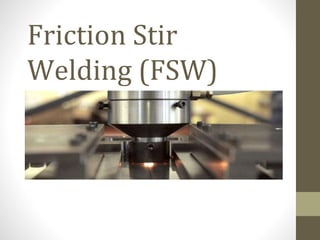
Friction Stir
Welding (FSW)
What is stir welding ?
•Stir welding is a solid state joining
process that uses a non consumable
toot to joint two facing work pieces
without melting the workpiece
material.
Introduction
• FSW was invented by Wayne Thomas in 1991.
• It is low energy input, capable of producing very
high strength welds in wide range of materials at
lower cost.
• FSW process takes place in the solid phase
below the melting point of the materials to be
joined.
• FSW welding belongs to plastic welding
category. Due to,
• Heated to plastic state
• Pressure required
Working principle
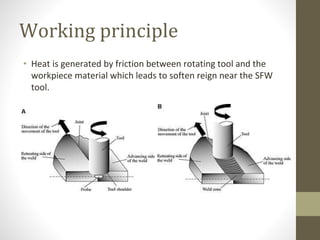
• Heat is generated by friction between rotating tool and the
workpiece material which leads to soften reign near the SFW
tool.
Process
• A cylindrical tool with a profiled threaded probe
is used
• The tool which rotated at constant speed and is
then placed between the work piece materials.
• The metallic parts should be clamped properly
so the joint faces cannot be forced apart by the
process.
Microstructure Analysis
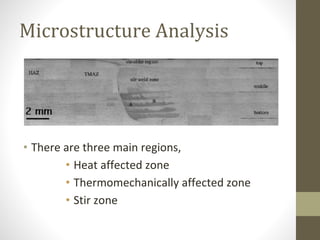
• There are three main regions,
• Heat affected zone
• Thermomechanically affected zone
• Stir zone
Tool parameters
• Tool : HSS (High Speed Steel)
• Tool pin profile : Hexagonal
• Tool dimensions :
• Tool length = 80 mm
• Tool diameter = 18 mm
• Tool pin diameter = 6 mm
• Tool pin length = 5.8 mm
• Coating material : TiAlN (PVD – Physical Vapor Deposition )
• Coating thickness = 4mm
• Coating done in vaccum at low pressure in the temperature
range of 450-900 c
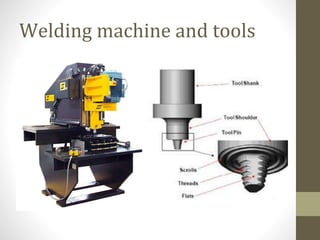
Welding machine and tools
Comparison with other
welding
•Reduced distortion
•Reduced defect rate
•Simplifies dissimilar alloy welding
•Eliminate consumables
•Reduces health and hazard and no
weld pool
Advantages
• Good mechanical properties as in weld condition
• Improved safety due to absence of toxic fumes
• No consumables
• Easily automated on simple milling machines
• Can operate on all positons
• Low environment impact
• High superior weld strength
• Generally good weld appearance
Disadvantages
• Exit hole left when tool is withdrawn.
• Large down forces required with heavy
duty clamping necessary to hold the plates
to weld.
• Slower traverse rate than fusion welding
• Less flexible than manual and arc
processes
Applications
• Shipbuilding and offshore :- hulls and
superstructure, helicopter landing platforms
• Aerospace :- wings , fuselages , empennages
• Automotive :- Aluminum engine cradles and
suspension struts
• Railway rolling stock :- Railway tankers and
goods wagons
• Fabrications and robotics
• Personal computers :- components of computer

Friction stir welding (sfw)

  • 1.
  • 2.
    What is stirwelding ? •Stir welding is a solid state joining process that uses a non consumable toot to joint two facing work pieces without melting the workpiece material.
  • 3.
    Introduction • FSW wasinvented by Wayne Thomas in 1991. • It is low energy input, capable of producing very high strength welds in wide range of materials at lower cost. • FSW process takes place in the solid phase below the melting point of the materials to be joined. • FSW welding belongs to plastic welding category. Due to, • Heated to plastic state • Pressure required
  • 4.
    Working principle • Heatis generated by friction between rotating tool and the workpiece material which leads to soften reign near the SFW tool.
  • 5.
    Process • A cylindricaltool with a profiled threaded probe is used • The tool which rotated at constant speed and is then placed between the work piece materials. • The metallic parts should be clamped properly so the joint faces cannot be forced apart by the process.
  • 6.
    Microstructure Analysis • Thereare three main regions, • Heat affected zone • Thermomechanically affected zone • Stir zone
  • 7.
    Tool parameters • Tool: HSS (High Speed Steel) • Tool pin profile : Hexagonal • Tool dimensions : • Tool length = 80 mm • Tool diameter = 18 mm • Tool pin diameter = 6 mm • Tool pin length = 5.8 mm • Coating material : TiAlN (PVD – Physical Vapor Deposition ) • Coating thickness = 4mm • Coating done in vaccum at low pressure in the temperature range of 450-900 c
  • 8.
  • 9.
    Comparison with other welding •Reduceddistortion •Reduced defect rate •Simplifies dissimilar alloy welding •Eliminate consumables •Reduces health and hazard and no weld pool
  • 10.
    Advantages • Good mechanicalproperties as in weld condition • Improved safety due to absence of toxic fumes • No consumables • Easily automated on simple milling machines • Can operate on all positons • Low environment impact • High superior weld strength • Generally good weld appearance
  • 11.
    Disadvantages • Exit holeleft when tool is withdrawn. • Large down forces required with heavy duty clamping necessary to hold the plates to weld. • Slower traverse rate than fusion welding • Less flexible than manual and arc processes
  • 12.
    Applications • Shipbuilding andoffshore :- hulls and superstructure, helicopter landing platforms • Aerospace :- wings , fuselages , empennages • Automotive :- Aluminum engine cradles and suspension struts • Railway rolling stock :- Railway tankers and goods wagons • Fabrications and robotics • Personal computers :- components of computer