Surface Coating
Technology Presented by:
Akhilesh Kumar (12BME026)
Nandeesh kumar (12bme027)
Sumit kumar (12bme028)
Khushwant Mali (12bme029)
Himanshu meena (12bme030)
Introduction
• A coating is a covering that is applied to the surface of an object, usually
referred to as the substrate.
• The purpose of application of coating is the value enhancement of the
substrate by improving its appearance, corrosion resistant property, wear
resistance, etc. Process of coating involves application of thin film of
functional material to a substrate.
• The functional material may be metallic or non-metallic; organic or
inorganic; solid,liquid or gas. This can be genuine criteria of classification of
coatings.
What's coming
• Metallic and non-metallic coatings their comparison.
• Different coating processes,
• Applications of various coating processes, and
• Advantages and disadvantages of coatings.
Metallic & Non-metallic Coatings
• Non-Metallic Coatings
-Non-metals are used as coating material in case of non- metallic coatings.
Common types of such coatings are plastic or rubber coating. This involves
application of a layer of the given polymer onto a substrate material. Different
categories of such coating are
Described below.
• (a) Wire and Cable Coating
• (b) Planer Coating
• (c) Contour Coating
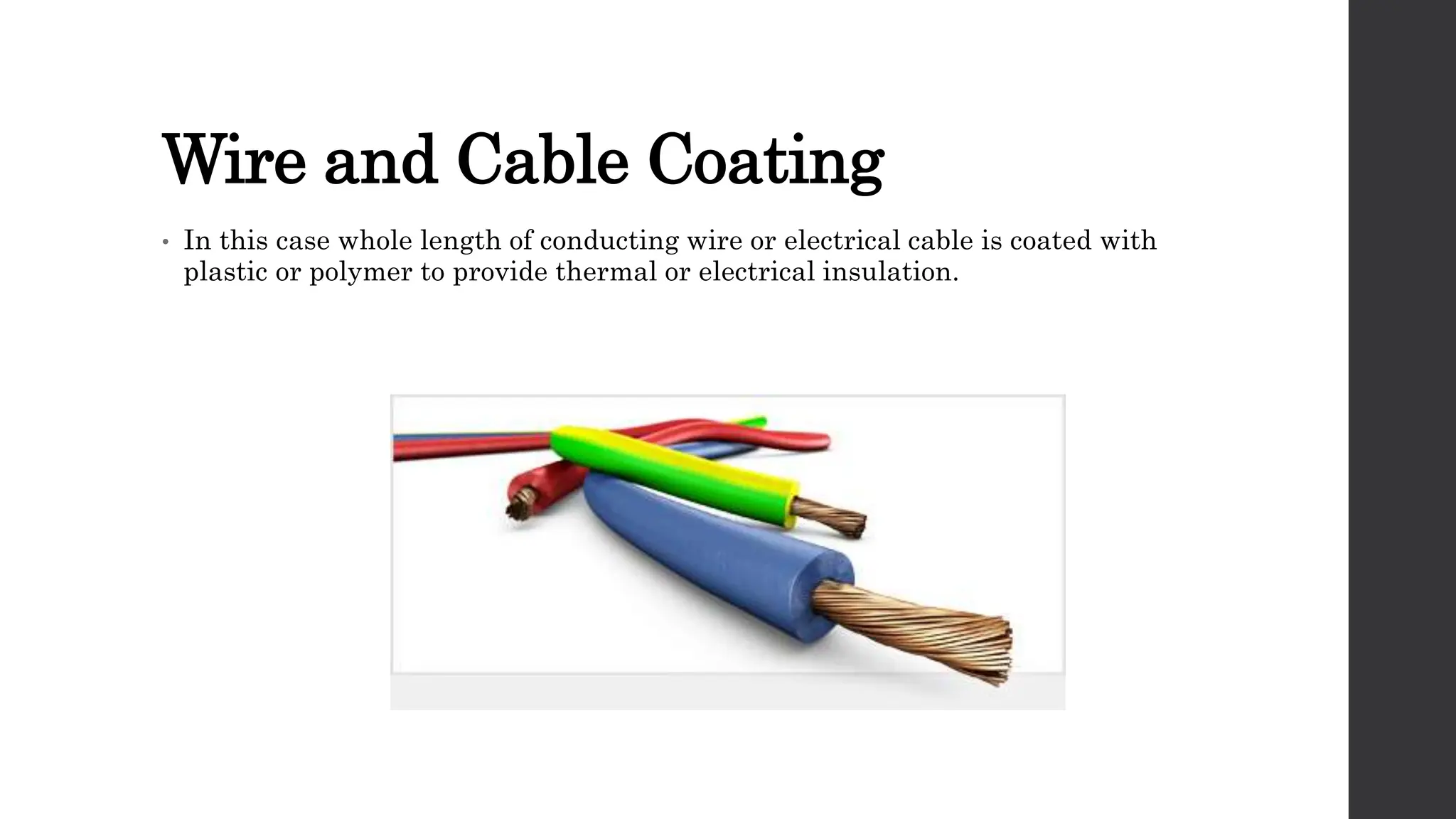
Wire and Cable Coating
• In this case whole length of conducting wire or electrical cable is coated with
plastic or polymer to provide thermal or electrical insulation.
• Planer Coating
-It involves coating of a flat film over a flat surface.
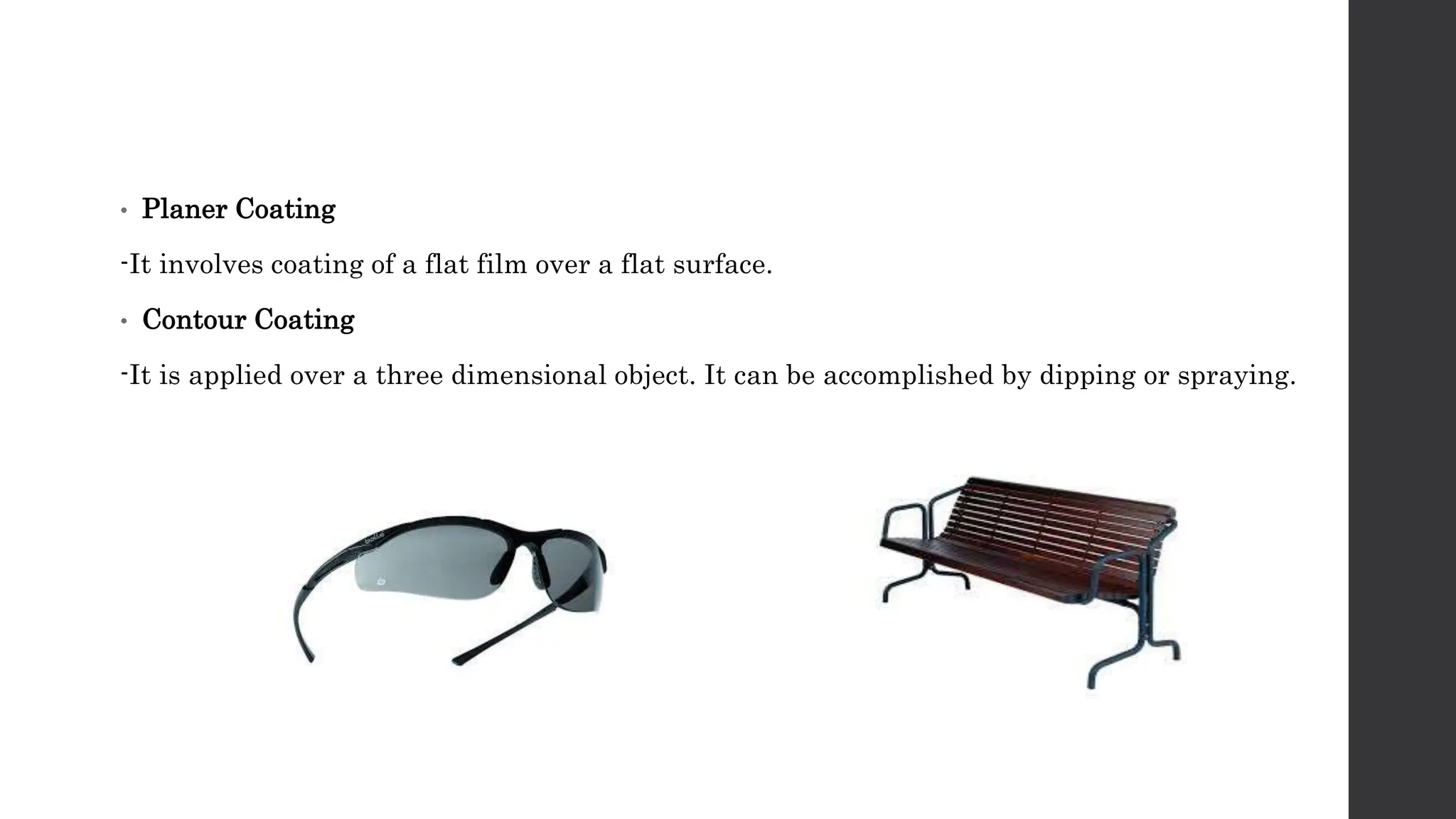
• Contour Coating
-It is applied over a three dimensional object. It can be accomplished by dipping or spraying.
Metallic Coatings
Metallic coating can be applied over metallic as well as non-metallic substrates.
Sometimes non-metallic like plastics are coated to give metallic appearance. Some
important metallic coating methods are described below.
Electroplating
• Electroplating is also known as electro-chemical plating, is an electrolytic process.
• In this process metal ions in an electrolyte solution are deposited onto a cathode.
• In the electrolytic process, anode is generally made of metal being plated so it
• serves as source of coating metal. Work piece where coating is to be applied made as cathode. Direct
current from an external power source is passed through
• electrolyte solution. The electrolyte is an aqueous solution of acids, bases or salts.
• Electrolyte conducts electric current by the movement of plate metal ions in
• solution. For optimum results the parts to be plated should be chemically cleaned.
Working Principle
The process of electroplating is based on Faraday’s
law (two laws).
According to these two laws it is stated that :
(a) the mass of a substance liberated in electrolysis
is proportional to the quantity of electricity passed through the cell, and
(b) the mass of the material liberated is proportional to its electrochemical equivalent (ratio of atomic weight to
valence).
Mathematically effect can be stated as
V = K I t
where V is the volume of metal plated in m3,
I is the flowing current in ampere,
t is the time for which current passes through, and
K is a constant depending on electrochemical equivalent
and density of electrolyte is m2/A – S.
Methods of Electroplating
Large variety of equipment can be used for electroplating. Selection of electroplating equipment depends upon
workpiece size, geometry, throughput requirements, electrolyte and metal to be plated. Main methods
used for electroplating are :
(a) Barrel plating
(b) Rack plating
(c) Strip plating
Barrel Plating
Barrel plating is done in rotating barrels. These barrels are oriented
either horizontally or at an angle of 35⁰. This method is used for
plating of many small pats in a batch. In this case electrical contacts
are maintained through the tumbling action of the parts themselves
and by means of an externally connected conductor that projects into
the barrel. There are some limitations in barrel plating, the tumbling action
which is inherent in the process may damage the soft metal parts,
threads, other parts with good finish, and some other parts with sharp
edges.
• Rack Plating
In some cases when barrel plating is difficult and impossible like parts to the plated are too
large and heavy and complex, rack plating is recommended. In rack plating racks are made of
heavy gauge copper wire formed into suitable shape for holding the work piece and passing
current through the same. Work piece are hanged on hooks or held by clips. To avoid plating on
the racks, themselves, these are covered with insulation except the locations where work piece
make contacts.
• Strip Plating
In case of strip plating, a continuous strip is pulled through the
plating solution by means of a take up reel. Long wires can be plated
by this way. Small sheet metal parts held in a long strip can also be
plated by this method. This process can maintain high production
rates. The process can be set up so that only specific regions of the
parts are plated, examples are contact points plated with gold or silver
to make electrical contacts.
Electroplating may have plating of different metals. Plating of some of important
metals are described here.
Zinc Plating
Zinc plated steel products are fasteners
wire goods, electric switch boxes and sheet
metal parts. Zinc coating provide high
resistant to corrosion. Zinc can also be
plated on large area sheet metal wiring
galvanization.
Nickel Plating
Normally nickel plating is done for corrosion resistant purpose and decorative
purpose. In these cases brass, steel, zinc die castings serve as substrate material.
Automotive trims are also plated with nickel.
Gold Plating
It is a method of depositing a thin layer of gold on the substrate of other
metal.
Most often substrate is silver or copper. It provides corrosion resistant and
highly
electrically conductive layer which is used in electrical connectors and printed
circuit boards. The major problem in gold plating on copper is copper atoms
have a tendency to diffuse through the gold layer, causing tarnishing of its
surface and formation of an oxide/sulphide layer. To avoid this a layer of some
barrier metal like nickel is applied before gold plating on the substrate of
copper as nickel atoms do not defuse to good. Some metal may also be gold
plated to improve their aesthetic value for ornamental purpose.
Chrome Plating
Chrome plating is a finishing treatment given to a metal surface using
electrolytic deposition of chromium (chromium plating). A decorative bright
chrome plating of thickness 10 μm over nickel plating is done on steels. It is
used in case of metal furniture, automotive trims, etc. Chromium plating is a
hard plating providing wear resistance properly to the surface.
Tin Plating
Tin plating is used for ferrous and non-ferrous metallic surfaces. Tin is a
nontoxic,
ductile and corrosion resistance material so it is widely used in food
packaging. Sheet metal coated with tin can be processed further without any
damage to their surface, this is possible due to excellent ductility of tin and its
alloys. Electroplating of tin is also used in electronics industry because of its
ability to protect the base metal from oxidation. It is used to protect
solderability.
Alloy Plating
In some cases electroplating of two metals is done simultaneously, it is called
alloy plating Nickel-Cobalt is a common electroplated alloy.
There are some more methods like electroplating having a light difference,
which are
being described here.
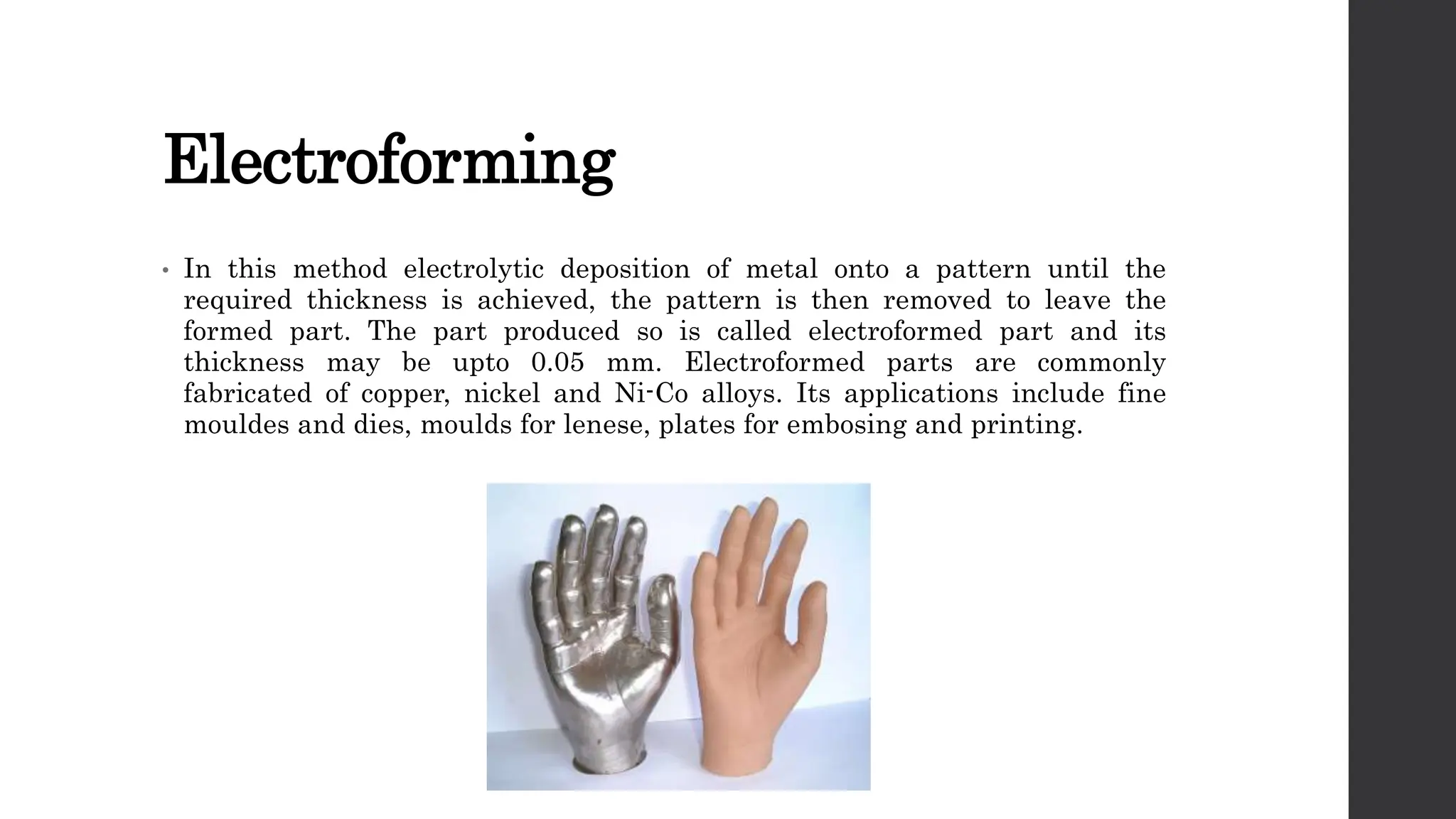
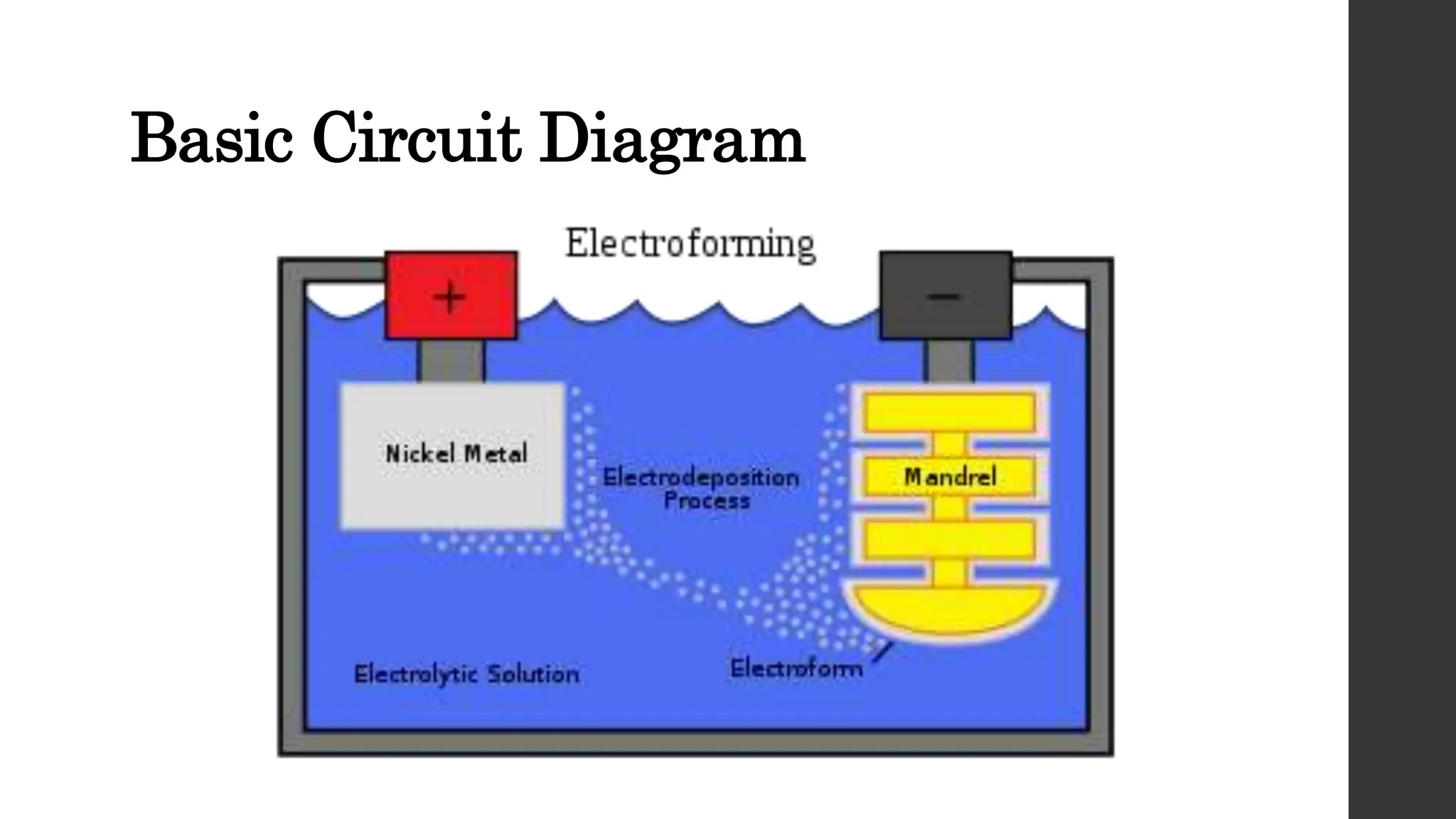
Electroforming
• In this method electrolytic deposition of metal onto a pattern until the
required thickness is achieved, the pattern is then removed to leave the
formed part. The part produced so is called electroformed part and its
thickness may be upto 0.05 mm. Electroformed parts are commonly
fabricated of copper, nickel and Ni-Co alloys. Its applications include fine
mouldes and dies, moulds for lenese, plates for embosing and printing.
Basic Circuit Diagram
Types of Electroforming Processes
• Electroless Plating
• Hot Dipping
• Wire Spraying
• Powder Spraying
• Vacuum Metallizing
• High Velocity Oxygen Fuel Spraying (HVOF)
Electroless Plating
• As indicated by its name it is a plating process done entirely by chemical
reaction, no external source of electric current is required in this case.
Deposition of metal onto a part surface occurs in an aqueous solution
containing ions of the desired plating metal. The process uses a reducing
agent, and the work part surface acts as a catalyst for the reaction.
Normally, Ni and Ni alloys are used for this plating. It is costlier as
compared to other similar methods. Nickel plating by this method is used to
get high resistance to corrosion end wear. Electroless copper plating is used
to plate through holes of printed circuit boards.
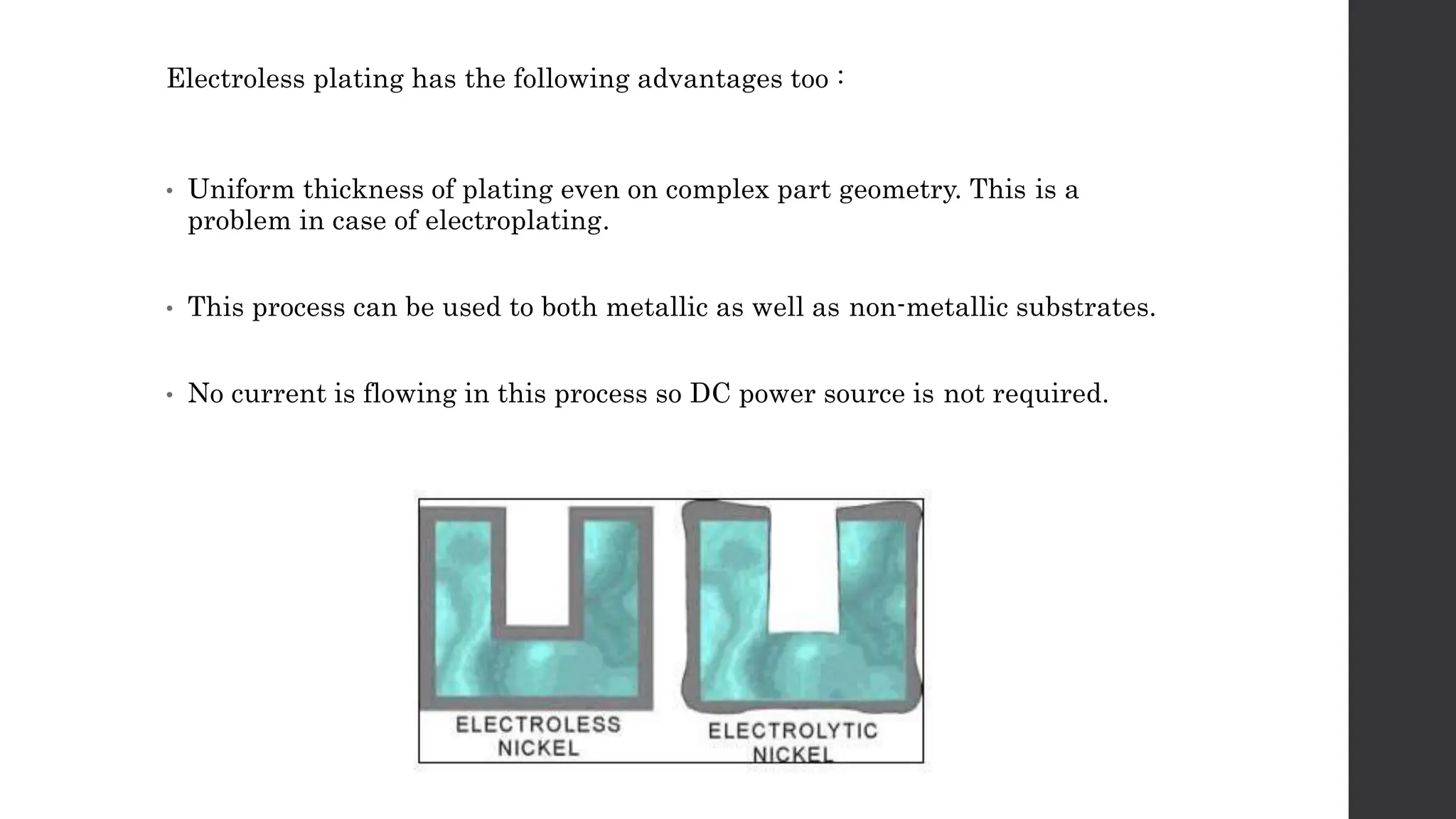
Electroless plating has the following advantages too :
• Uniform thickness of plating even on complex part geometry. This is a
problem in case of electroplating.
• This process can be used to both metallic as well as non-metallic substrates.
• No current is flowing in this process so DC power source is not required.
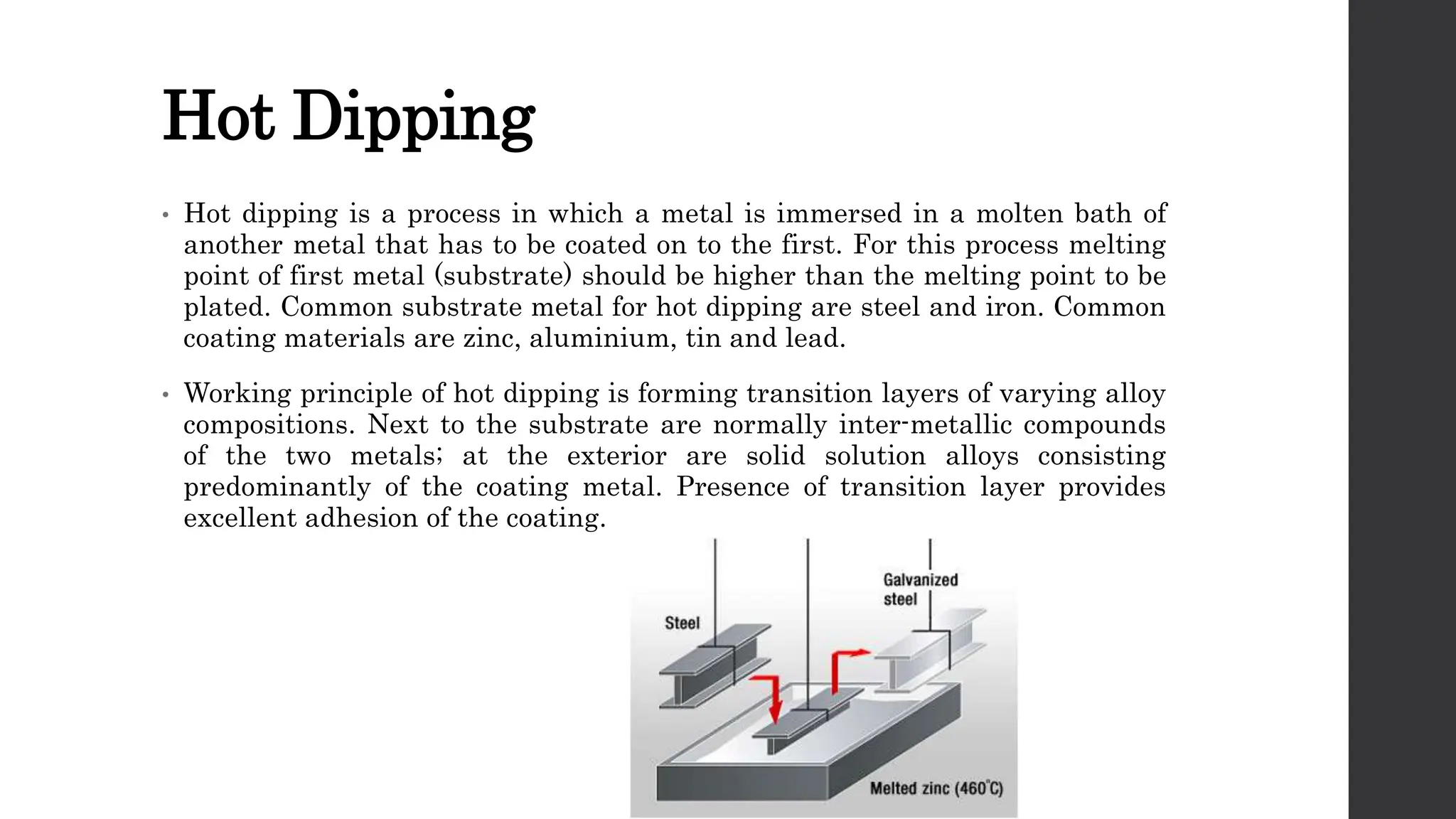
Hot Dipping
• Hot dipping is a process in which a metal is immersed in a molten bath of
another metal that has to be coated on to the first. For this process melting
point of first metal (substrate) should be higher than the melting point to be
plated. Common substrate metal for hot dipping are steel and iron. Common
coating materials are zinc, aluminium, tin and lead.
• Working principle of hot dipping is forming transition layers of varying alloy
compositions. Next to the substrate are normally inter-metallic compounds
of the two metals; at the exterior are solid solution alloys consisting
predominantly of the coating metal. Presence of transition layer provides
excellent adhesion of the coating.
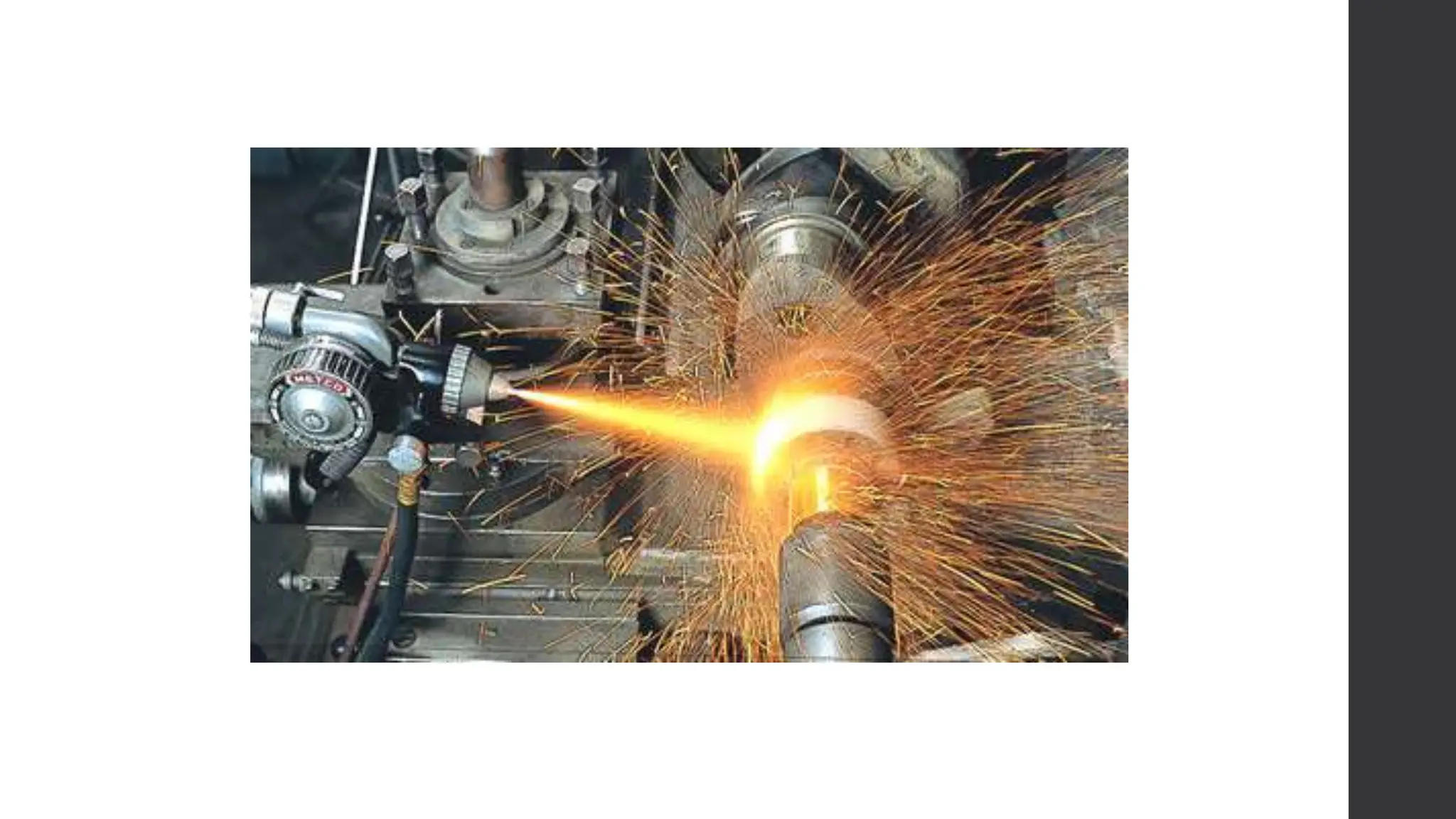
Wire Spraying
• In this process, special type of spray gun is used. The spray gun consists of a gas
torch. The gas torch is connected to oxygen and acetylene cylinders in the same way
as in case of oxy-acetylene welding. The torch draws mixture of two gases through
high pressure in the cylinders and develops an oxy-acetylene flame.
• The metal to be sprayed is fed into the gun in the form of wire. The flame at the end
of torch melts the fed metal and it is automised.
• The gun is also equipped with another passage which is directly connected to the
output of an air compressor. The compressed air coming out from the compressor
carries the automised metal particles on the surface of the substrate metal with
very high velocity.
• The high velocity bombardment of the particles is done by maintaining a certain
distance from the substrate metal and so these particles spread over the substrate
metal surface. The sprayed molten metal cools down and freeze to form a deposited
layer. The required thickness of coated metal can be maintained by laying down
many such layers one over another.
Coating Quality
• Usually measured by measuring its porosity, oxide content, macro and micro
hardness, bond strength and surface roughness.
• Coating quality generally increases with increasing velocity of particles.
• Thickness of the coating can vary from 20 micrometers to several
milimeters.
Powder Spraying
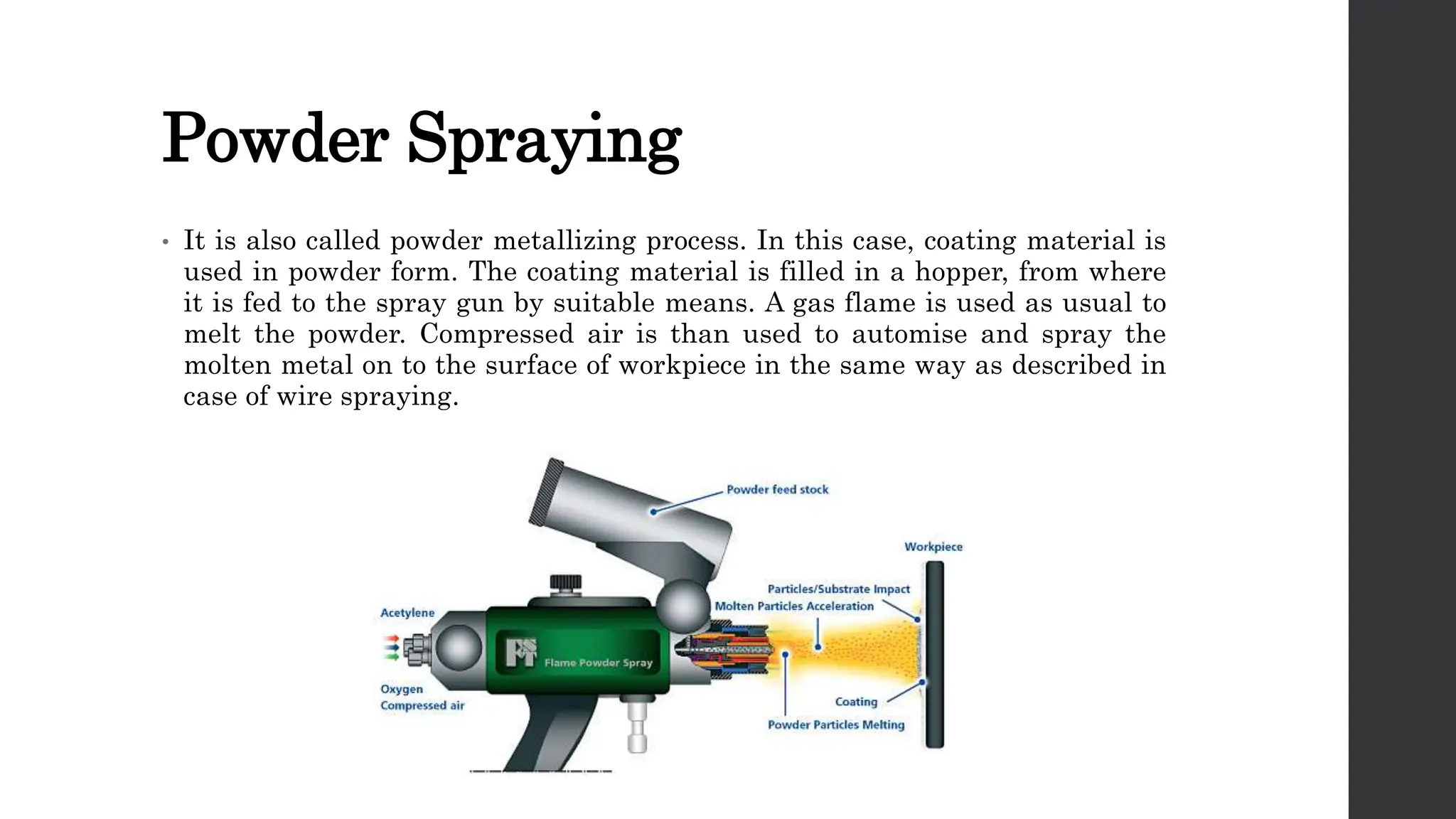
• It is also called powder metallizing process. In this case, coating material is
used in powder form. The coating material is filled in a hopper, from where
it is fed to the spray gun by suitable means. A gas flame is used as usual to
melt the powder. Compressed air is than used to automise and spray the
molten metal on to the surface of workpiece in the same way as described in
case of wire spraying.
• There is one more important technique of powder spraying named as plasma
spraying. In this case, plasma gun is used. Plasma gun is made of copper
carrying a non-consumable tungsten electrode. The gun body is made of
doubled wall and water is circulated between the walls to cooling purpose. A
DC powder supply is used to supply a high intensity current in to the circuit
in which the copper body is made an anode and the tungsten electrode a
cathode. A high intensity arc is struck between the anode and cathode. The
established arc is shielded with the help of inert gas. The hot gas comes out
from the nozzle of the body at very high velocity in the form of a very bright
and shining flame (plasma) carrying a very high heat intensity. The powder
of coating material is fed into the stream of plasma, which melts it readily
and automise it. The automised molten metal is carried to the work surface
at high velocity by this plasma stream and deposited there.
Plasma Spraying
• The wire gun process is generally preferred due to easy availability of
coating material in wire form and low cost of its operation.
• Powder coating by spray is denser and faster.
• Plasma coating is preferred in case of coating of carbides of metals, titanium,
chromium, oxides of zireorium, titanium, etc.
Vacuum Metallizing
• It is a vapour deposition process, any metal can be coated on a base material
through this process.
• Some non-metals can also be coated on substrate metal. This process is very
effective for deposing a thin metal film or a film of a metal compound on a
substrate base.
• Normally coating materials used in this method are aluminium, chromium,
silver, nickel, gold, platinum, germanium, etc. The substrate material can be
different metals, cermics, glass, plastics, paper and cloths.
• In this process, substrate (workpiece) and coating material are placed in a
high vacuum chamber. The coating material is heated by electrical means.
Due to vacuum, hot coating material atoms leaves the surface in metal
vapour form and condense at the surface of the substrate material. The
workpiece is kept slowly rotating during the process so that the entire
surface is exposed to the advancing coating metal vapours.
Advantages of vapour deposition method are listed below :
• Thin coating of metal is possible by this method so little quantity is
consumed here. This method is most suitable for coatings of very costly
metals.
• Decorative coating on household items are possible through this method.
• Effective and low cost coatings for corrosion and thermal resistance are
possible.
High Velocity Oxygen Fuel Spraying
(HVOF)
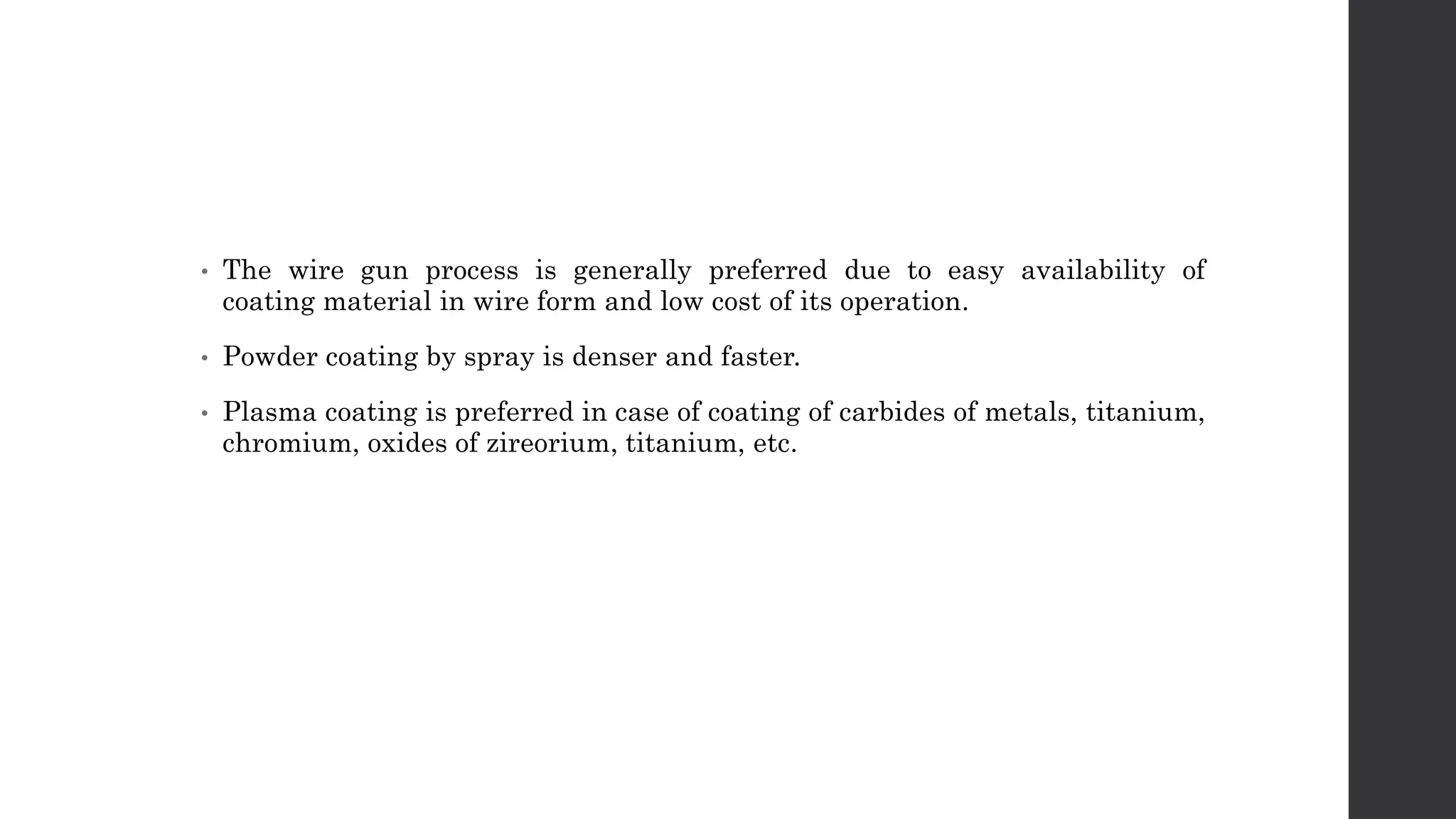
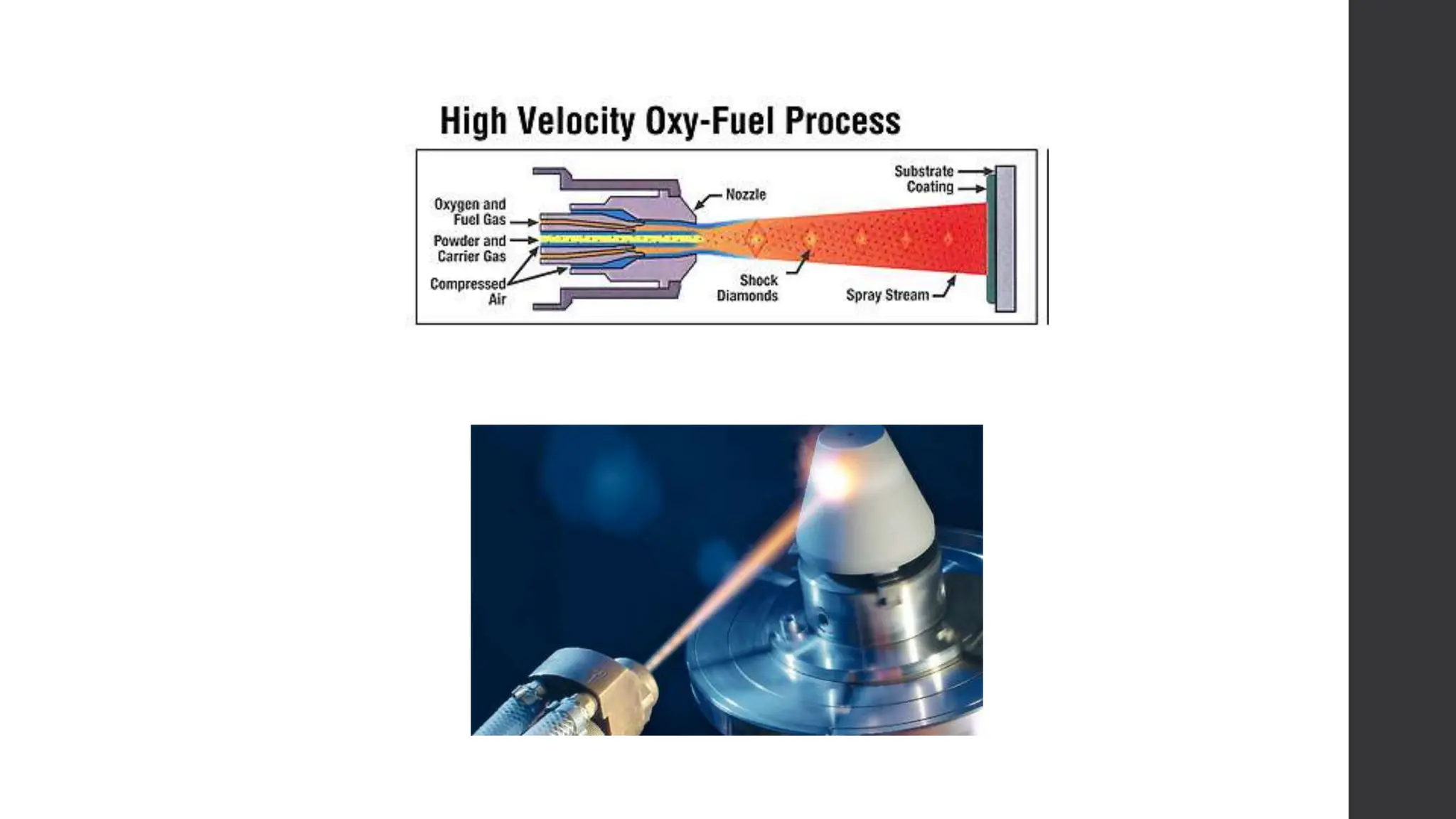
• It is one of the ways of metal spraying. In this case, a mixture of gaseous or
liquid fuel and oxygen is fed into a combustion chamber, where they are
ignited and burnt continuously. The generated hot gas at a pressure
approximately 1 Mpa emanates through a conversing-diversing nozzle and
travels through a straight section. The velocity of gasses at two exit of barrel
(straight section) exceeds the velocity of sound. A powder feed stock is
injected into the gas stream, which accelerates the powder upto 800 m/s. The
stream of hot gas and power is described towards the surface to be coated.
The powder partially melts in the stream, and get deposited on the
substrate. The resulting coating in this way has low porosity and high bond
strength.
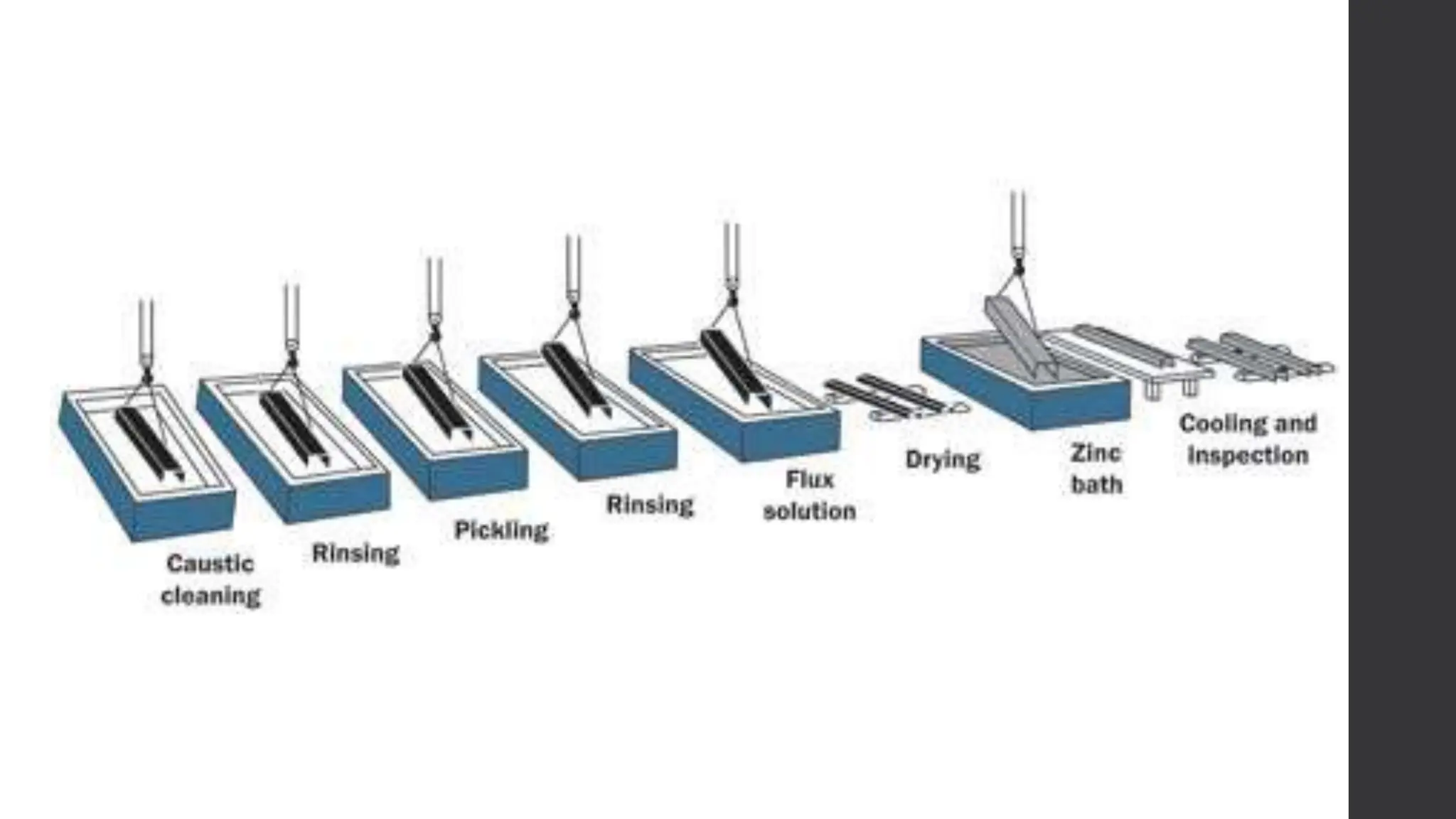
Galvanizing
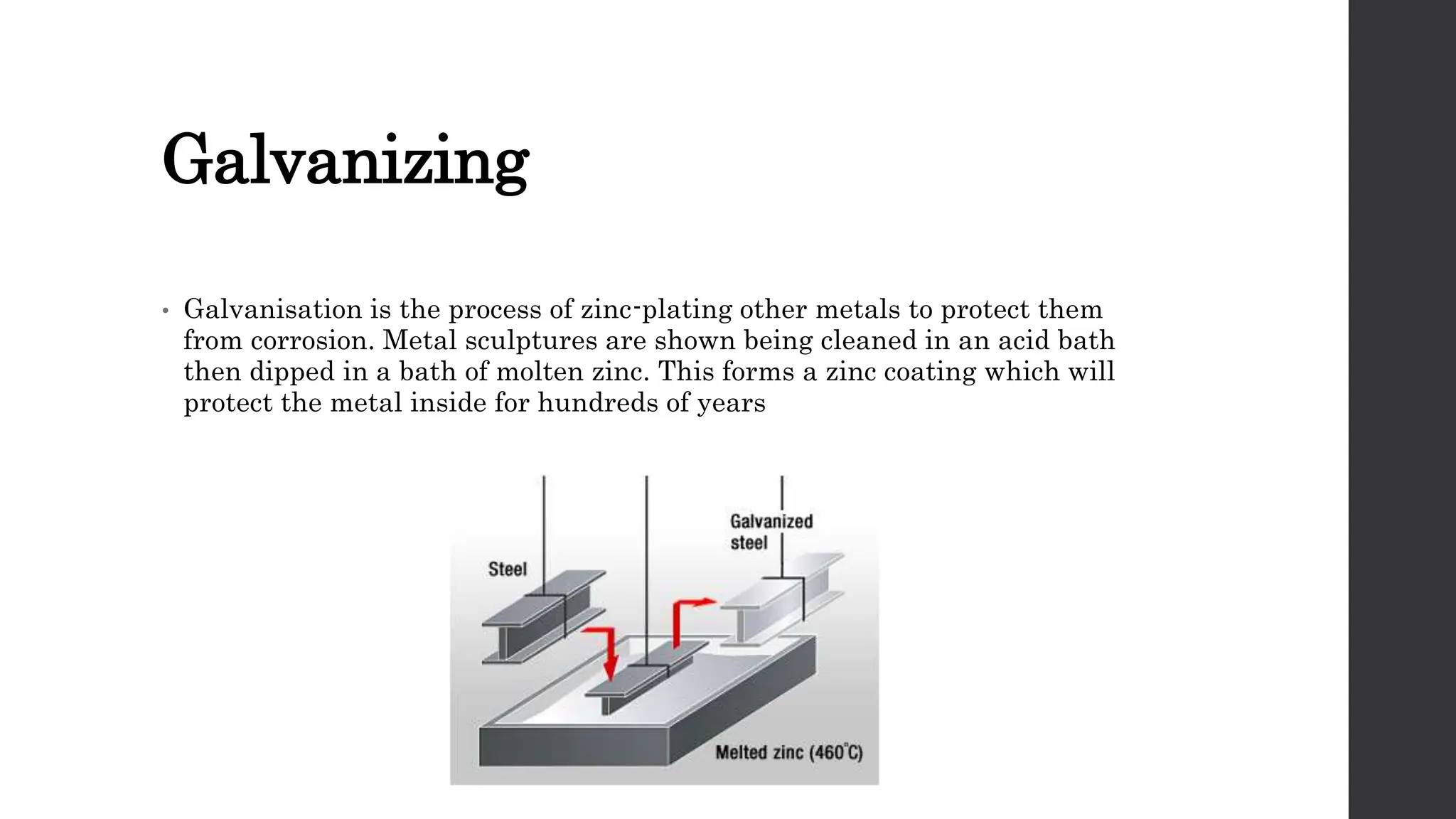
• Galvanisation is the process of zinc-plating other metals to protect them
from corrosion. Metal sculptures are shown being cleaned in an acid bath
then dipped in a bath of molten zinc. This forms a zinc coating which will
protect the metal inside for hundreds of years
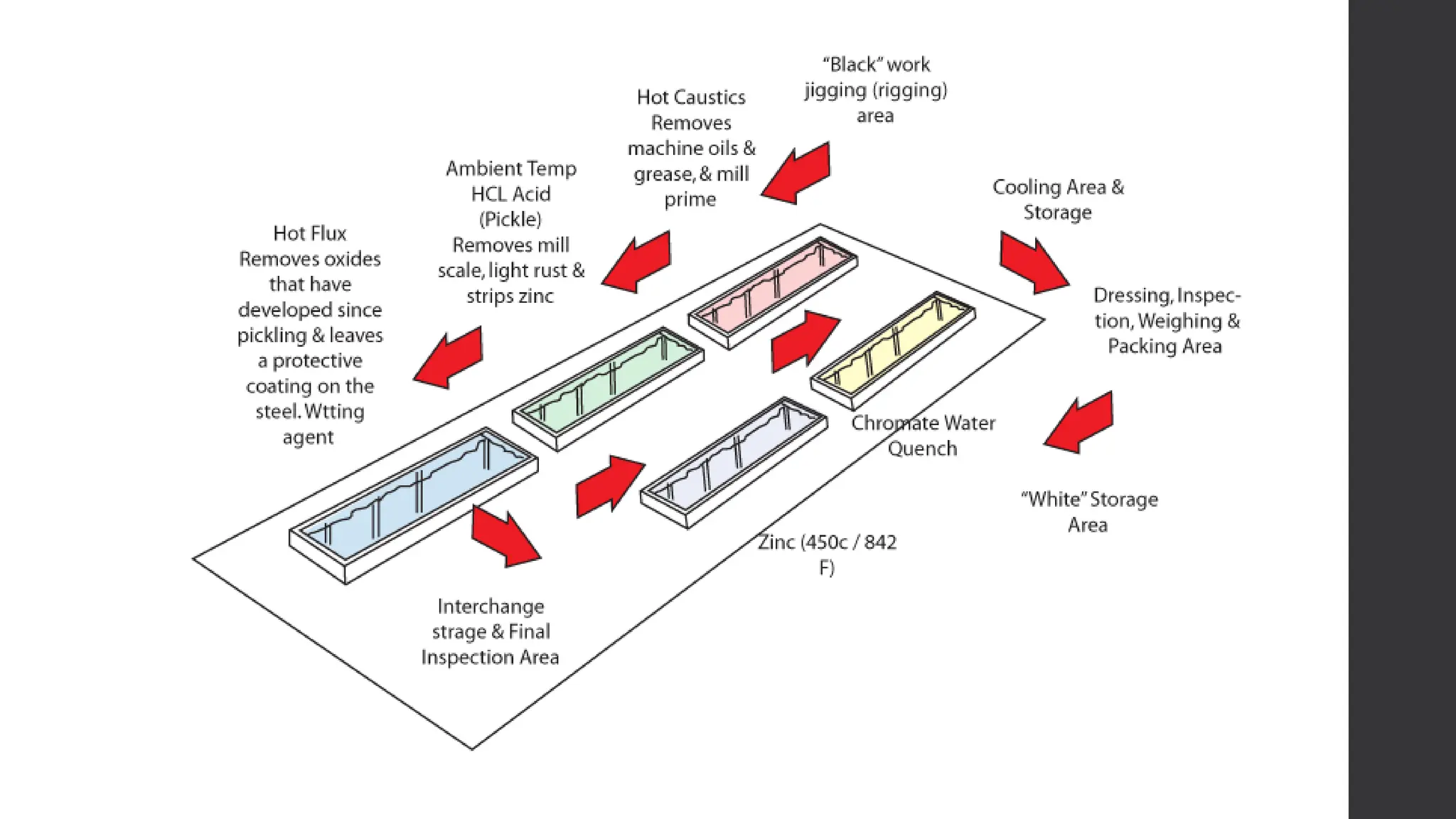
Hot-dip Galvanization
• Hot-dip galvanization is a form of galvanization. It is the process of
coating iron, steel or aluminium with a layer of zinc by immersing
the metal in a bath of molten zinc at a temperature of around 840 °F
(449 °C). When exposed to the atmosphere, the pure zinc (Zn) reacts with
oxygen (O2) to form zinc oxide (ZnO), which further reacts with carbon
dioxide (CO2) to form zinc carbonate (ZnCO3), a usually dull grey, fairly
strong material that stops further corrosion in many circumstances,
protecting the steel below from the elements
Sherardising
• Sherardizing is a process of galvanization of ferrous metal surfaces, also
called vapour galvanising and dry galvanizing
• This process involves heating the steel parts up to ca. 500°C in a closed
rotating drum that also contains metallic zincdust and possibly an inert
filler, such as sand.[5] At temperatures above 300°C, zinc evaporates and
diffuses into the steel substrate forming diffusion bonded Zn-Fe-phases
• Sherardising is ideal for small parts and parts that require coating of inner
surfaces, such as batches of small items. Part size is only limited by the
drum size. It is reported that pipes up to 6 m in length for the oil industry
are sherardised
• During and shortly after World War I, German 5 Pfennig and 10 Pfennig
coins were sherardised
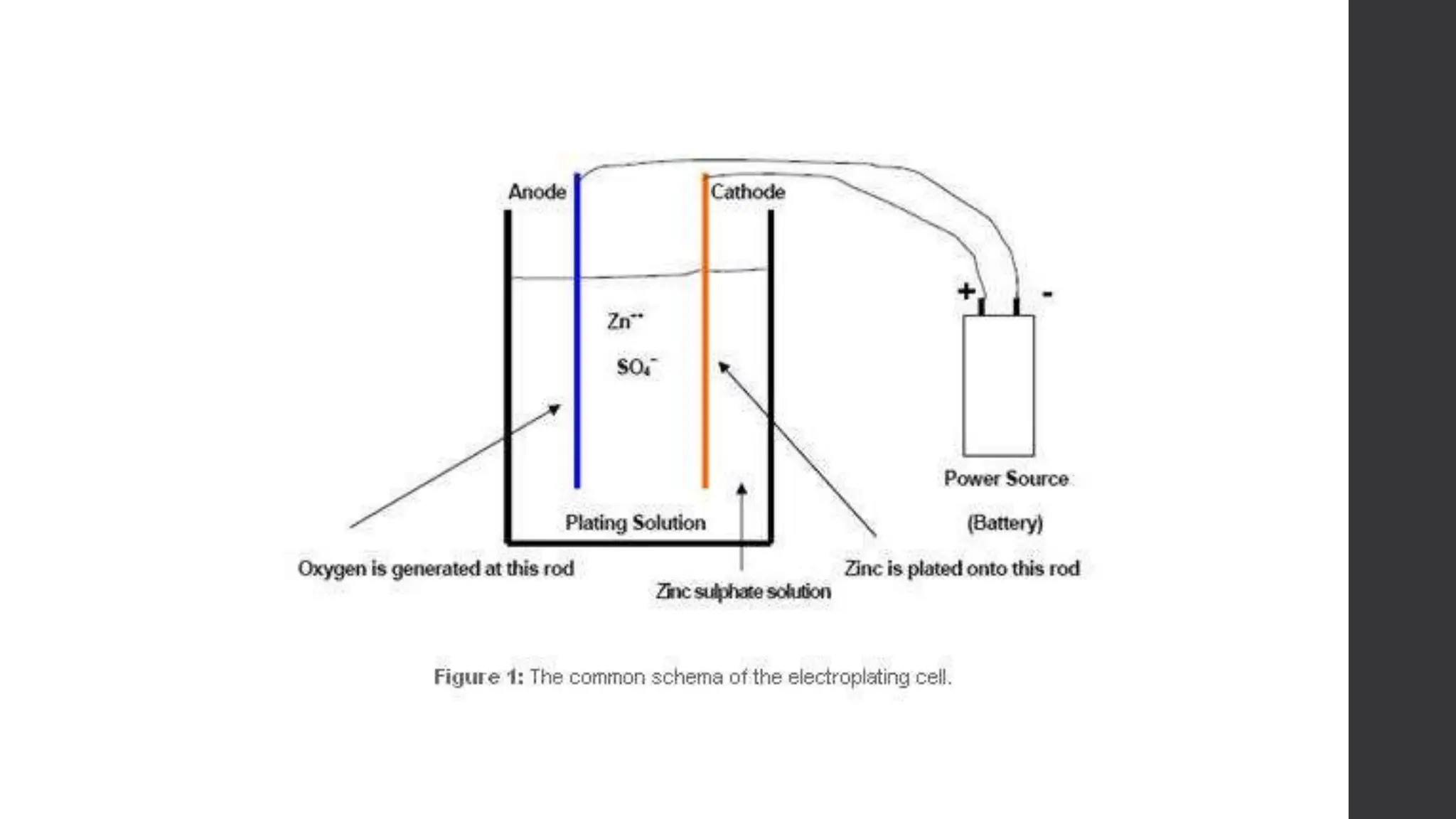
Electroplating Galvanising
• Electrogalvaning is a process in which a layer of zinc is bonded to steel in
order to protect against corrosion. The process involves electroplating,
running a current of electricity through a saline/zinc solution with
a zinc anode and steel conductor
• Zinc electroplating maintains a dominant position among other
electroplating process options, based upon electroplated tonnage per annum.
According to the International Zinc Association, more than 5 million tons are
used yearly for both Hot Dip Galvanizing and Electroplating.[1] ThePlating of
Zinc was developed at the beginning of the 20th century
• The corrosion protection afforded by the electrodeposited zinc layer is
primarily due to the anodic potential dissolution of zinc versus iron (the
substrate in most cases). Zinc acts as a sacrificial anode for protecting the
iron (steel).
• Steel is preserved from corrosion by cathodic protection electroplated zinc
articles may receive a topcoat to further enhance corrosion protection and
friction performance
Cold Dip Galvanising
• The term “cold galvanizing” is more of a marketing term than an actual
process. Cold galvanizing is simply painting a piece of steel with zinc-rich
paint
• It gives the same cathodic protection as hot dip galvanizing, but it is applied
as a paint.
• It will not have the durability of hot-dip galvanizing in terms of abrasion
resistance, cathodic protection, and service life.
• The cathodic protection offered by zinc-rich paint is less than hot-dip
galvanizing because there are binders and other elements in the paint which
limit connectivity of the zinc particles.
Flow Galvanising
• Galvanized mild steel is the standard and most common material used in
fabricating ductwork
• For insulation purposes, metal ducts are typically lined with faced fiber
glass blankets (duct liner) or wrapped externally with fiber glass blankets
(duct wrap). When called for, a double walled duct is used. This will usually
have an inner perferated liner, then a 1–2" layer of fiberglass insulation
contained inside an outer soild pipe.
• Ducts are used in heating, ventilation, and air conditioning (HVAC) to
deliver and remove air. The needed airflows include, for example, supply
air, return air, and exhaust air
• This modified process uses a metal spraying gun.the gun is equiped with a
device to produce a oxygen flame
• Air pressure is used to spray this molted zinc on to the surface of sheet
metal
• This process is suitable for galvanizing of flat sheet metal only.
• The thickness of coating by this process can be maintained to a uniform
value.
Anodizing
• It is an electrochemical oxidation of the aluminium surface to produce a
stable film of aluminium oxide Al2 O3.
• Anodizing is a process of deposition of oxide film on a metal surface with the
help of and anode and oxidation
• The process involves cleaning the work-piece either in a hot soak cleaner or
solvent bath.
• After cleaning the work-piece is dipped in an electrolyte and made anode.
• Now when current passes through electrolyte a chemical reaction takes place
and oxygen is librated which reacts with metal surface to convert it into an oxide.
• Deeper the penetration of the chemical reaction the thicker will be the oxide
film formed
• After the formation of oxide layer into the third stage of the process is
providing desired colour and stability to anodizing film
• Colour of the deposited layer depend upon the selection of an acid as an
electrolyte . Sulphuric acid provides a thin transparent film over the metal
surface.
• Thickness of the coating depend upon concentration of the bath, intensity of
current passing the electrolyte, and its temperature.
Anodizing of different type of metal are
possible.
• Anodizing of steel is done to make it wear and corrosion resistant. It
appears as a block film over different type of steel.
• Several galvanized machine parts are anodized to improve their
resistance for rusting and corrosion.
• Mn, Brass, Copper, Bronze, Zinc , Silver parts can be anodized.
Main purpose of anodizing are listed
bellow.
• It provide protective coating on the metal surface which is corrosion
resistant and wear resistant up to some extent.
• It can provide a specific colour base to a surface that can be substitute of
painting.
• Aluminuim provide very good surface properties after anodizing.
Specifying Anodizing
• Examples - AAM10C32A31
• AA- Aluminum Association
• M- Mechanical Finish
• C- Chemical pretreatment
• A- Anodic coating process
Advantages of Anodizing
• Highly durable.
• Inexpensive to produce and maintain.
• Maintain metallic appearance of aluminum.
• Environmentally friendly.
Physical Vapor Deposition
• Physical vapor deposition (PVD) describes a variety
of vacuum deposition methods used to deposit thin
films by the condensation of a vaporized form of the
desired film material onto various work piece surfaces
(e.g., onto semiconductor wafers).
• The coating method involves purely physical processes
such as high-temperature vacuum evaporation with
subsequent condensation.
PVD Process
• PVD coating is made up of thin layers of metal that
are bonded together through a rig
• A rig is a setup in which the surrounding atmospheric
temperature is dropped to 1 tor(1/760 of our everyday
atmosphere).
• The coating is then heated with a plasma torch that
reaches 17,540.33 Fahrenheit.
• Inside the Plasma Spray-Physical Vapor Deposition, or PS-PVD, Ceramic
powder is introduced into the plasma flame, which vaporizes it and then
condenses it on the (cooler) workpiece to form the ceramic coating.
Uses
• It is widely used in automotive world.
• It is the newest alternative to chrome plating that has been used for trucks
and cars for years.
• It increases durability and weigh less than chrome coating, which is an
advantage because a vehicle's acceleration and fuel efficiency will increase.
Chemical Vapor Deposition
• Chemical vapor deposition (CVD) is a chemical process
used to produce high-purity, high-performance solid
materials. The process is often used in the
semiconductor industry to produce thin films.
• In typical CVD, the wafer (substrate) is exposed to one
or more volatile precursors, which react and/or
decompose on the substrate surface to produce the
desired deposit. Frequently, volatile by-products are also
produced, which are removed by gas flow through the
reaction chamber.
Fundamental CVD Processes
• Convective and diffusive transport of reactants to the reaction zone
• Gas phase reactions
• Transport of reactants to the substrate surface.
• Chemical and physical adsorption
• Surface reactions leading to film formation
• Desorption of volatile byproducts
• Convective and diffusive transport of by-products away from the reaction
zone
Roll to Roll Coating
• Gravure Coating
• Reverse Roll Coating
• Knife-Over-Roll Coating
• Air Knife Coating
Gravure Coating
The gravure coating process relies
on an engraved roller running in a
coating bath, which fills the
engraved dots or lines of the roller
with the coating material. The
excess coating on the roller is wiped
off by the Doctor Blade and the
coating is then deposited onto the
substrate as it passes between the
Engraved roller and a Pressure
Roller.
Reverse Roll Coating
• In this procedure, the coating
material is measured onto the
applicator roller by precision
setting of the gap between the
upper metering roller and the
application roller below it. The
coating is 'wiped' off the application
roller by the substrate as it passes
around the support roller at the
bottom. The diagram illustrates a
3-roll reverse roll coating process,
although 4-roll versions are
common
Knife-Over Roll Coating
• This process relies on a coating
being applied to the substrate
which then passes through a
'gap' between a 'knife' and a
support roller. As the coating
and substrate pass through, the
excess is scraped off. This
process can be used for high
viscosity coatings and very high
coat weights, such as plastisols
and rubber coatings
Air Knife Coating
• A simple process where the
coating is applied to the
substrate and the excess is
'blown off' by a powerful jet from
the air knife. This procedure is
typically used for aqueous
coatings and is particularly
noisy.
Spray Coating
•Spray coating is
a painting technique where a
device sprays a coating (paint,
ink, varnish, etc.) through the
air onto a surface. The most
common types employ
compressed gas(usually air) to
atomize and direct the paint
particles.
Spin Coating
Dip Coating
• Immersion: The substrate is immersed in the solution of
the coating material at a constant speed (preferably jitter-
free).
• Start-up: The substrate has remained inside the solution
for a while and is starting to be pulled up.
• Deposition: The thin layer deposits itself on the substrate
while it is pulled up. The withdrawing is carried out at a
constant speed to avoid any jitters. The speed determines
the thickness of the coating (faster withdrawal gives
thicker coating material).
• Drainage: Excess liquid will drain from the surface.
• Evaporation: The solvent evaporates from the liquid,
forming the thin layer. For volatile solvents, such
as alcohols, evaporation starts already during the
deposition & drainage steps.
Flow Coating
• An automated method of applying
industrial liquid coatings that
involves directing numerous
individual streams of coating over
one or multiple parts that move
horizontally on a conveyor. Flow
coating can be used to cover multi-
dimensional surfaces of a variety of
shapes.
Surface coating technology mechanical engineering.pptx

Surface coating technology mechanical engineering.pptx

  • 1.
    Surface Coating Technology Presentedby: Akhilesh Kumar (12BME026) Nandeesh kumar (12bme027) Sumit kumar (12bme028) Khushwant Mali (12bme029) Himanshu meena (12bme030)
  • 2.
    Introduction • A coatingis a covering that is applied to the surface of an object, usually referred to as the substrate. • The purpose of application of coating is the value enhancement of the substrate by improving its appearance, corrosion resistant property, wear resistance, etc. Process of coating involves application of thin film of functional material to a substrate. • The functional material may be metallic or non-metallic; organic or inorganic; solid,liquid or gas. This can be genuine criteria of classification of coatings.
  • 3.
    What's coming • Metallicand non-metallic coatings their comparison. • Different coating processes, • Applications of various coating processes, and • Advantages and disadvantages of coatings.
  • 4.
    Metallic & Non-metallicCoatings • Non-Metallic Coatings -Non-metals are used as coating material in case of non- metallic coatings. Common types of such coatings are plastic or rubber coating. This involves application of a layer of the given polymer onto a substrate material. Different categories of such coating are Described below. • (a) Wire and Cable Coating • (b) Planer Coating • (c) Contour Coating
  • 5.
    Wire and CableCoating • In this case whole length of conducting wire or electrical cable is coated with plastic or polymer to provide thermal or electrical insulation.
  • 6.
    • Planer Coating -Itinvolves coating of a flat film over a flat surface. • Contour Coating -It is applied over a three dimensional object. It can be accomplished by dipping or spraying.
  • 7.
    Metallic Coatings Metallic coatingcan be applied over metallic as well as non-metallic substrates. Sometimes non-metallic like plastics are coated to give metallic appearance. Some important metallic coating methods are described below. Electroplating • Electroplating is also known as electro-chemical plating, is an electrolytic process. • In this process metal ions in an electrolyte solution are deposited onto a cathode. • In the electrolytic process, anode is generally made of metal being plated so it • serves as source of coating metal. Work piece where coating is to be applied made as cathode. Direct current from an external power source is passed through • electrolyte solution. The electrolyte is an aqueous solution of acids, bases or salts. • Electrolyte conducts electric current by the movement of plate metal ions in • solution. For optimum results the parts to be plated should be chemically cleaned.
  • 8.
    Working Principle The processof electroplating is based on Faraday’s law (two laws). According to these two laws it is stated that : (a) the mass of a substance liberated in electrolysis is proportional to the quantity of electricity passed through the cell, and (b) the mass of the material liberated is proportional to its electrochemical equivalent (ratio of atomic weight to valence). Mathematically effect can be stated as V = K I t where V is the volume of metal plated in m3, I is the flowing current in ampere, t is the time for which current passes through, and K is a constant depending on electrochemical equivalent and density of electrolyte is m2/A – S.
  • 9.
    Methods of Electroplating Largevariety of equipment can be used for electroplating. Selection of electroplating equipment depends upon workpiece size, geometry, throughput requirements, electrolyte and metal to be plated. Main methods used for electroplating are : (a) Barrel plating (b) Rack plating (c) Strip plating Barrel Plating Barrel plating is done in rotating barrels. These barrels are oriented either horizontally or at an angle of 35⁰. This method is used for plating of many small pats in a batch. In this case electrical contacts are maintained through the tumbling action of the parts themselves and by means of an externally connected conductor that projects into the barrel. There are some limitations in barrel plating, the tumbling action which is inherent in the process may damage the soft metal parts, threads, other parts with good finish, and some other parts with sharp edges.
  • 10.
    • Rack Plating Insome cases when barrel plating is difficult and impossible like parts to the plated are too large and heavy and complex, rack plating is recommended. In rack plating racks are made of heavy gauge copper wire formed into suitable shape for holding the work piece and passing current through the same. Work piece are hanged on hooks or held by clips. To avoid plating on the racks, themselves, these are covered with insulation except the locations where work piece make contacts. • Strip Plating In case of strip plating, a continuous strip is pulled through the plating solution by means of a take up reel. Long wires can be plated by this way. Small sheet metal parts held in a long strip can also be plated by this method. This process can maintain high production rates. The process can be set up so that only specific regions of the parts are plated, examples are contact points plated with gold or silver to make electrical contacts.
  • 11.
    Electroplating may haveplating of different metals. Plating of some of important metals are described here. Zinc Plating Zinc plated steel products are fasteners wire goods, electric switch boxes and sheet metal parts. Zinc coating provide high resistant to corrosion. Zinc can also be plated on large area sheet metal wiring galvanization. Nickel Plating Normally nickel plating is done for corrosion resistant purpose and decorative purpose. In these cases brass, steel, zinc die castings serve as substrate material. Automotive trims are also plated with nickel.
  • 12.
    Gold Plating It isa method of depositing a thin layer of gold on the substrate of other metal. Most often substrate is silver or copper. It provides corrosion resistant and highly electrically conductive layer which is used in electrical connectors and printed circuit boards. The major problem in gold plating on copper is copper atoms have a tendency to diffuse through the gold layer, causing tarnishing of its surface and formation of an oxide/sulphide layer. To avoid this a layer of some barrier metal like nickel is applied before gold plating on the substrate of copper as nickel atoms do not defuse to good. Some metal may also be gold plated to improve their aesthetic value for ornamental purpose.
  • 14.
    Chrome Plating Chrome platingis a finishing treatment given to a metal surface using electrolytic deposition of chromium (chromium plating). A decorative bright chrome plating of thickness 10 μm over nickel plating is done on steels. It is used in case of metal furniture, automotive trims, etc. Chromium plating is a hard plating providing wear resistance properly to the surface.
  • 15.
    Tin Plating Tin platingis used for ferrous and non-ferrous metallic surfaces. Tin is a nontoxic, ductile and corrosion resistance material so it is widely used in food packaging. Sheet metal coated with tin can be processed further without any damage to their surface, this is possible due to excellent ductility of tin and its alloys. Electroplating of tin is also used in electronics industry because of its ability to protect the base metal from oxidation. It is used to protect solderability. Alloy Plating In some cases electroplating of two metals is done simultaneously, it is called alloy plating Nickel-Cobalt is a common electroplated alloy. There are some more methods like electroplating having a light difference, which are being described here.
  • 16.
    Electroforming • In thismethod electrolytic deposition of metal onto a pattern until the required thickness is achieved, the pattern is then removed to leave the formed part. The part produced so is called electroformed part and its thickness may be upto 0.05 mm. Electroformed parts are commonly fabricated of copper, nickel and Ni-Co alloys. Its applications include fine mouldes and dies, moulds for lenese, plates for embosing and printing.
  • 17.
  • 18.
    Types of ElectroformingProcesses • Electroless Plating • Hot Dipping • Wire Spraying • Powder Spraying • Vacuum Metallizing • High Velocity Oxygen Fuel Spraying (HVOF)
  • 19.
    Electroless Plating • Asindicated by its name it is a plating process done entirely by chemical reaction, no external source of electric current is required in this case. Deposition of metal onto a part surface occurs in an aqueous solution containing ions of the desired plating metal. The process uses a reducing agent, and the work part surface acts as a catalyst for the reaction. Normally, Ni and Ni alloys are used for this plating. It is costlier as compared to other similar methods. Nickel plating by this method is used to get high resistance to corrosion end wear. Electroless copper plating is used to plate through holes of printed circuit boards.
  • 20.
    Electroless plating hasthe following advantages too : • Uniform thickness of plating even on complex part geometry. This is a problem in case of electroplating. • This process can be used to both metallic as well as non-metallic substrates. • No current is flowing in this process so DC power source is not required.
  • 21.
    Hot Dipping • Hotdipping is a process in which a metal is immersed in a molten bath of another metal that has to be coated on to the first. For this process melting point of first metal (substrate) should be higher than the melting point to be plated. Common substrate metal for hot dipping are steel and iron. Common coating materials are zinc, aluminium, tin and lead. • Working principle of hot dipping is forming transition layers of varying alloy compositions. Next to the substrate are normally inter-metallic compounds of the two metals; at the exterior are solid solution alloys consisting predominantly of the coating metal. Presence of transition layer provides excellent adhesion of the coating.
  • 22.
    Wire Spraying • Inthis process, special type of spray gun is used. The spray gun consists of a gas torch. The gas torch is connected to oxygen and acetylene cylinders in the same way as in case of oxy-acetylene welding. The torch draws mixture of two gases through high pressure in the cylinders and develops an oxy-acetylene flame. • The metal to be sprayed is fed into the gun in the form of wire. The flame at the end of torch melts the fed metal and it is automised. • The gun is also equipped with another passage which is directly connected to the output of an air compressor. The compressed air coming out from the compressor carries the automised metal particles on the surface of the substrate metal with very high velocity. • The high velocity bombardment of the particles is done by maintaining a certain distance from the substrate metal and so these particles spread over the substrate metal surface. The sprayed molten metal cools down and freeze to form a deposited layer. The required thickness of coated metal can be maintained by laying down many such layers one over another.
  • 25.
    Coating Quality • Usuallymeasured by measuring its porosity, oxide content, macro and micro hardness, bond strength and surface roughness. • Coating quality generally increases with increasing velocity of particles. • Thickness of the coating can vary from 20 micrometers to several milimeters.
  • 26.
    Powder Spraying • Itis also called powder metallizing process. In this case, coating material is used in powder form. The coating material is filled in a hopper, from where it is fed to the spray gun by suitable means. A gas flame is used as usual to melt the powder. Compressed air is than used to automise and spray the molten metal on to the surface of workpiece in the same way as described in case of wire spraying.
  • 27.
    • There isone more important technique of powder spraying named as plasma spraying. In this case, plasma gun is used. Plasma gun is made of copper carrying a non-consumable tungsten electrode. The gun body is made of doubled wall and water is circulated between the walls to cooling purpose. A DC powder supply is used to supply a high intensity current in to the circuit in which the copper body is made an anode and the tungsten electrode a cathode. A high intensity arc is struck between the anode and cathode. The established arc is shielded with the help of inert gas. The hot gas comes out from the nozzle of the body at very high velocity in the form of a very bright and shining flame (plasma) carrying a very high heat intensity. The powder of coating material is fed into the stream of plasma, which melts it readily and automise it. The automised molten metal is carried to the work surface at high velocity by this plasma stream and deposited there. Plasma Spraying
  • 29.
    • The wiregun process is generally preferred due to easy availability of coating material in wire form and low cost of its operation. • Powder coating by spray is denser and faster. • Plasma coating is preferred in case of coating of carbides of metals, titanium, chromium, oxides of zireorium, titanium, etc.
  • 30.
    Vacuum Metallizing • Itis a vapour deposition process, any metal can be coated on a base material through this process. • Some non-metals can also be coated on substrate metal. This process is very effective for deposing a thin metal film or a film of a metal compound on a substrate base. • Normally coating materials used in this method are aluminium, chromium, silver, nickel, gold, platinum, germanium, etc. The substrate material can be different metals, cermics, glass, plastics, paper and cloths.
  • 31.
    • In thisprocess, substrate (workpiece) and coating material are placed in a high vacuum chamber. The coating material is heated by electrical means. Due to vacuum, hot coating material atoms leaves the surface in metal vapour form and condense at the surface of the substrate material. The workpiece is kept slowly rotating during the process so that the entire surface is exposed to the advancing coating metal vapours. Advantages of vapour deposition method are listed below : • Thin coating of metal is possible by this method so little quantity is consumed here. This method is most suitable for coatings of very costly metals. • Decorative coating on household items are possible through this method. • Effective and low cost coatings for corrosion and thermal resistance are possible.
  • 32.
    High Velocity OxygenFuel Spraying (HVOF) • It is one of the ways of metal spraying. In this case, a mixture of gaseous or liquid fuel and oxygen is fed into a combustion chamber, where they are ignited and burnt continuously. The generated hot gas at a pressure approximately 1 Mpa emanates through a conversing-diversing nozzle and travels through a straight section. The velocity of gasses at two exit of barrel (straight section) exceeds the velocity of sound. A powder feed stock is injected into the gas stream, which accelerates the powder upto 800 m/s. The stream of hot gas and power is described towards the surface to be coated. The powder partially melts in the stream, and get deposited on the substrate. The resulting coating in this way has low porosity and high bond strength.
  • 34.
    Galvanizing • Galvanisation isthe process of zinc-plating other metals to protect them from corrosion. Metal sculptures are shown being cleaned in an acid bath then dipped in a bath of molten zinc. This forms a zinc coating which will protect the metal inside for hundreds of years
  • 35.
    Hot-dip Galvanization • Hot-dipgalvanization is a form of galvanization. It is the process of coating iron, steel or aluminium with a layer of zinc by immersing the metal in a bath of molten zinc at a temperature of around 840 °F (449 °C). When exposed to the atmosphere, the pure zinc (Zn) reacts with oxygen (O2) to form zinc oxide (ZnO), which further reacts with carbon dioxide (CO2) to form zinc carbonate (ZnCO3), a usually dull grey, fairly strong material that stops further corrosion in many circumstances, protecting the steel below from the elements
  • 37.
    Sherardising • Sherardizing isa process of galvanization of ferrous metal surfaces, also called vapour galvanising and dry galvanizing • This process involves heating the steel parts up to ca. 500°C in a closed rotating drum that also contains metallic zincdust and possibly an inert filler, such as sand.[5] At temperatures above 300°C, zinc evaporates and diffuses into the steel substrate forming diffusion bonded Zn-Fe-phases • Sherardising is ideal for small parts and parts that require coating of inner surfaces, such as batches of small items. Part size is only limited by the drum size. It is reported that pipes up to 6 m in length for the oil industry are sherardised • During and shortly after World War I, German 5 Pfennig and 10 Pfennig coins were sherardised
  • 39.
    Electroplating Galvanising • Electrogalvaningis a process in which a layer of zinc is bonded to steel in order to protect against corrosion. The process involves electroplating, running a current of electricity through a saline/zinc solution with a zinc anode and steel conductor • Zinc electroplating maintains a dominant position among other electroplating process options, based upon electroplated tonnage per annum. According to the International Zinc Association, more than 5 million tons are used yearly for both Hot Dip Galvanizing and Electroplating.[1] ThePlating of Zinc was developed at the beginning of the 20th century • The corrosion protection afforded by the electrodeposited zinc layer is primarily due to the anodic potential dissolution of zinc versus iron (the substrate in most cases). Zinc acts as a sacrificial anode for protecting the iron (steel). • Steel is preserved from corrosion by cathodic protection electroplated zinc articles may receive a topcoat to further enhance corrosion protection and friction performance
  • 41.
    Cold Dip Galvanising •The term “cold galvanizing” is more of a marketing term than an actual process. Cold galvanizing is simply painting a piece of steel with zinc-rich paint • It gives the same cathodic protection as hot dip galvanizing, but it is applied as a paint. • It will not have the durability of hot-dip galvanizing in terms of abrasion resistance, cathodic protection, and service life. • The cathodic protection offered by zinc-rich paint is less than hot-dip galvanizing because there are binders and other elements in the paint which limit connectivity of the zinc particles.
  • 43.
    Flow Galvanising • Galvanizedmild steel is the standard and most common material used in fabricating ductwork • For insulation purposes, metal ducts are typically lined with faced fiber glass blankets (duct liner) or wrapped externally with fiber glass blankets (duct wrap). When called for, a double walled duct is used. This will usually have an inner perferated liner, then a 1–2" layer of fiberglass insulation contained inside an outer soild pipe. • Ducts are used in heating, ventilation, and air conditioning (HVAC) to deliver and remove air. The needed airflows include, for example, supply air, return air, and exhaust air • This modified process uses a metal spraying gun.the gun is equiped with a device to produce a oxygen flame • Air pressure is used to spray this molted zinc on to the surface of sheet metal
  • 44.
    • This processis suitable for galvanizing of flat sheet metal only. • The thickness of coating by this process can be maintained to a uniform value.
  • 46.
    Anodizing • It isan electrochemical oxidation of the aluminium surface to produce a stable film of aluminium oxide Al2 O3.
  • 47.
    • Anodizing isa process of deposition of oxide film on a metal surface with the help of and anode and oxidation • The process involves cleaning the work-piece either in a hot soak cleaner or solvent bath. • After cleaning the work-piece is dipped in an electrolyte and made anode. • Now when current passes through electrolyte a chemical reaction takes place and oxygen is librated which reacts with metal surface to convert it into an oxide. • Deeper the penetration of the chemical reaction the thicker will be the oxide film formed
  • 48.
    • After theformation of oxide layer into the third stage of the process is providing desired colour and stability to anodizing film • Colour of the deposited layer depend upon the selection of an acid as an electrolyte . Sulphuric acid provides a thin transparent film over the metal surface. • Thickness of the coating depend upon concentration of the bath, intensity of current passing the electrolyte, and its temperature.
  • 49.
    Anodizing of differenttype of metal are possible. • Anodizing of steel is done to make it wear and corrosion resistant. It appears as a block film over different type of steel. • Several galvanized machine parts are anodized to improve their resistance for rusting and corrosion. • Mn, Brass, Copper, Bronze, Zinc , Silver parts can be anodized.
  • 50.
    Main purpose ofanodizing are listed bellow. • It provide protective coating on the metal surface which is corrosion resistant and wear resistant up to some extent. • It can provide a specific colour base to a surface that can be substitute of painting. • Aluminuim provide very good surface properties after anodizing.
  • 51.
    Specifying Anodizing • Examples- AAM10C32A31 • AA- Aluminum Association • M- Mechanical Finish • C- Chemical pretreatment • A- Anodic coating process
  • 52.
    Advantages of Anodizing •Highly durable. • Inexpensive to produce and maintain. • Maintain metallic appearance of aluminum. • Environmentally friendly.
  • 53.
    Physical Vapor Deposition •Physical vapor deposition (PVD) describes a variety of vacuum deposition methods used to deposit thin films by the condensation of a vaporized form of the desired film material onto various work piece surfaces (e.g., onto semiconductor wafers). • The coating method involves purely physical processes such as high-temperature vacuum evaporation with subsequent condensation.
  • 54.
    PVD Process • PVDcoating is made up of thin layers of metal that are bonded together through a rig • A rig is a setup in which the surrounding atmospheric temperature is dropped to 1 tor(1/760 of our everyday atmosphere). • The coating is then heated with a plasma torch that reaches 17,540.33 Fahrenheit.
  • 55.
    • Inside thePlasma Spray-Physical Vapor Deposition, or PS-PVD, Ceramic powder is introduced into the plasma flame, which vaporizes it and then condenses it on the (cooler) workpiece to form the ceramic coating.
  • 57.
    Uses • It iswidely used in automotive world. • It is the newest alternative to chrome plating that has been used for trucks and cars for years. • It increases durability and weigh less than chrome coating, which is an advantage because a vehicle's acceleration and fuel efficiency will increase.
  • 58.
    Chemical Vapor Deposition •Chemical vapor deposition (CVD) is a chemical process used to produce high-purity, high-performance solid materials. The process is often used in the semiconductor industry to produce thin films. • In typical CVD, the wafer (substrate) is exposed to one or more volatile precursors, which react and/or decompose on the substrate surface to produce the desired deposit. Frequently, volatile by-products are also produced, which are removed by gas flow through the reaction chamber.
  • 59.
    Fundamental CVD Processes •Convective and diffusive transport of reactants to the reaction zone • Gas phase reactions • Transport of reactants to the substrate surface. • Chemical and physical adsorption • Surface reactions leading to film formation • Desorption of volatile byproducts • Convective and diffusive transport of by-products away from the reaction zone
  • 61.
    Roll to RollCoating • Gravure Coating • Reverse Roll Coating • Knife-Over-Roll Coating • Air Knife Coating
  • 62.
    Gravure Coating The gravurecoating process relies on an engraved roller running in a coating bath, which fills the engraved dots or lines of the roller with the coating material. The excess coating on the roller is wiped off by the Doctor Blade and the coating is then deposited onto the substrate as it passes between the Engraved roller and a Pressure Roller.
  • 63.
    Reverse Roll Coating •In this procedure, the coating material is measured onto the applicator roller by precision setting of the gap between the upper metering roller and the application roller below it. The coating is 'wiped' off the application roller by the substrate as it passes around the support roller at the bottom. The diagram illustrates a 3-roll reverse roll coating process, although 4-roll versions are common
  • 64.
    Knife-Over Roll Coating •This process relies on a coating being applied to the substrate which then passes through a 'gap' between a 'knife' and a support roller. As the coating and substrate pass through, the excess is scraped off. This process can be used for high viscosity coatings and very high coat weights, such as plastisols and rubber coatings
  • 65.
    Air Knife Coating •A simple process where the coating is applied to the substrate and the excess is 'blown off' by a powerful jet from the air knife. This procedure is typically used for aqueous coatings and is particularly noisy.
  • 66.
    Spray Coating •Spray coatingis a painting technique where a device sprays a coating (paint, ink, varnish, etc.) through the air onto a surface. The most common types employ compressed gas(usually air) to atomize and direct the paint particles.
  • 67.
  • 68.
    Dip Coating • Immersion:The substrate is immersed in the solution of the coating material at a constant speed (preferably jitter- free). • Start-up: The substrate has remained inside the solution for a while and is starting to be pulled up. • Deposition: The thin layer deposits itself on the substrate while it is pulled up. The withdrawing is carried out at a constant speed to avoid any jitters. The speed determines the thickness of the coating (faster withdrawal gives thicker coating material). • Drainage: Excess liquid will drain from the surface. • Evaporation: The solvent evaporates from the liquid, forming the thin layer. For volatile solvents, such as alcohols, evaporation starts already during the deposition & drainage steps.
  • 69.
    Flow Coating • Anautomated method of applying industrial liquid coatings that involves directing numerous individual streams of coating over one or multiple parts that move horizontally on a conveyor. Flow coating can be used to cover multi- dimensional surfaces of a variety of shapes.