
Dr. Ahmed Abdelbary
1.1 Introduction to Tribology
1.2 Properties of Tribo-materials
1.3 Friction
1.4 Wear
1.5 Lubricants and Lubrication
1.6 Tribology of Non-metals
1.7 Practical Applications of Tribology
1.8 Failures in Tribo-Systems
Contents
1. Principles of Engineering Tribology
Contents
2. Space Tribology
Fig. Mars Exploration Program NASA, Oct. 11, 2019
2.1 Definition
2.2 Features of Space Tribology
2.3 Tribology Challenges in Space Applications
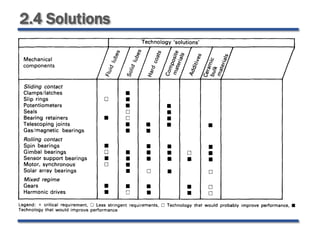
2.4 Solutions
1.1 Introductionto Tribology
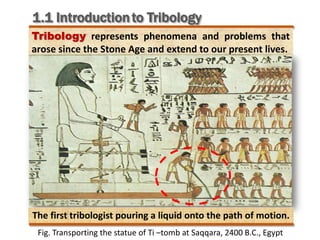
Tribology represents phenomena and problems that
arose since the Stone Age and extend to our present lives.
Fig. Transporting the statue of Ti –tomb at Saqqara, 2400 B.C., Egypt
The first tribologist pouring a liquid onto the path of motion.
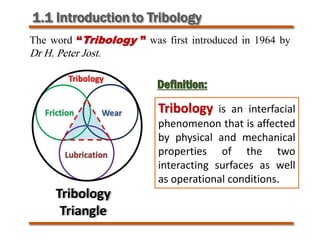
Tribology
Triangle
The word “Tribology ” was first introduced in 1964 by
Dr H. Peter Jost.
Tribology is an interfacial
phenomenon that is affected
by physical and mechanical
properties of the two
interacting surfaces as well
as operational conditions.
Definition:
1.1 Introductionto Tribology
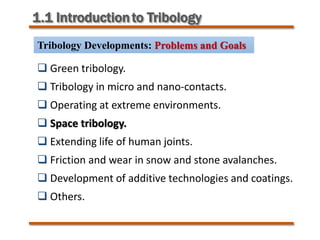
Tribology Developments: Problems and Goals
 Green tribology.
 Tribology in micro and nano-contacts.
 Operating at extreme environments.
 Space tribology.
 Extending life of human joints.
 Friction and wear in snow and stone avalanches.
 Development of additive technologies and coatings.
 Others.
1.2 Properties of Tribo-materials
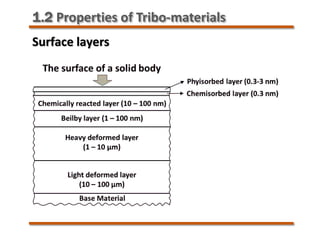
Surface layers
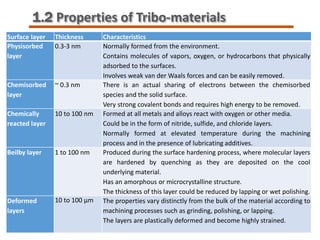
Surface layer Thickness Characteristics
Physisorbed
layer
0.3-3 nm Normally formed from the environment.
Contains molecules of vapors, oxygen, or hydrocarbons that physically
adsorbed to the surfaces.
Involves weak van der Waals forces and can be easily removed.
Chemisorbed
layer
~ 0.3 nm There is an actual sharing of electrons between the chemisorbed
species and the solid surface.
Very strong covalent bonds and requires high energy to be removed.
Chemically
reacted layer
10 to 100 nm Formed at all metals and alloys react with oxygen or other media.
Could be in the form of nitride, sulfide, and chloride layers.
Normally formed at elevated temperature during the machining
process and in the presence of lubricating additives.
Beilby layer 1 to 100 nm Produced during the surface hardening process, where molecular layers
are hardened by quenching as they are deposited on the cool
underlying material.
Has an amorphous or microcrystalline structure.
The thickness of this layer could be reduced by lapping or wet polishing.
Deformed
layers
10 to 100 μm The properties vary distinctly from the bulk of the material according to
machining processes such as grinding, polishing, or lapping.
The layers are plastically deformed and become highly strained.
1.2 Properties of Tribo-materials
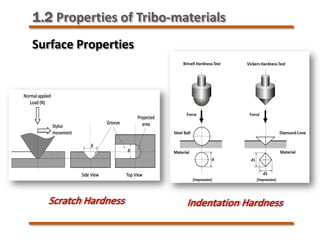
Surface Properties
Indentation Hardness
Scratch Hardness
1.2 Properties of Tribo-materials
Surface Properties
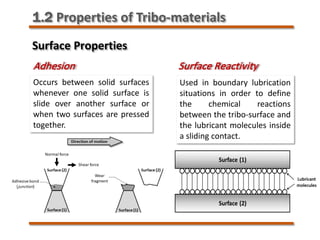
Adhesion
Occurs between solid surfaces
whenever one solid surface is
slide over another surface or
when two surfaces are pressed
together.
Surface Reactivity
Used in boundary lubrication
situations in order to define
the chemical reactions
between the tribo-surface and
the lubricant molecules inside
a sliding contact.
1.2 Properties of Tribo-materials
Surface Properties
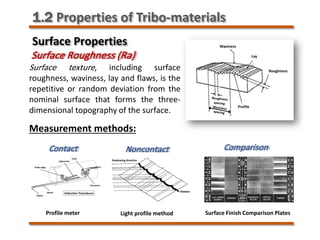
Surface Roughness (Ra)
Surface texture, including surface
roughness, waviness, lay and flaws, is the
repetitive or random deviation from the
nominal surface that forms the three-
dimensional topography of the surface.
Measurement methods:
Contact Noncontact Comparison
Surface Finish Comparison Plates
Light profile method
Profile meter
1.2 Properties of Tribo-materials
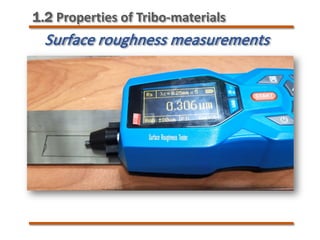
Surface roughness measurements
1.2 Properties of Tribo-materials
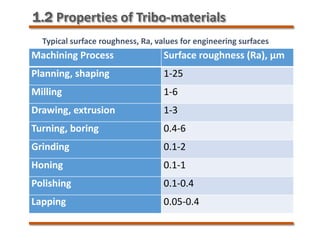
Machining Process Surface roughness (Ra), μm
Planning, shaping 1-25
Milling 1-6
Drawing, extrusion 1-3
Turning, boring 0.4-6
Grinding 0.1-2
Honing 0.1-1
Polishing 0.1-0.4
Lapping 0.05-0.4
Typical surface roughness, Ra, values for engineering surfaces
1.2 Properties of Tribo-materials
Lubrication Properties
Lubricity of a lubricant is governed by a number of physical,
mechanical, and chemical properties:
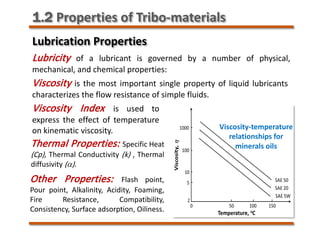
Viscosity is the most important single property of liquid lubricants
characterizes the flow resistance of simple fluids.
Viscosity Index is used to
express the effect of temperature
on kinematic viscosity. Viscosity-temperature
relationships for
minerals oils
Thermal Properties: Specific Heat
(Cp), Thermal Conductivity (k) , Thermal
diffusivity (α).
Other Properties: Flash point,
Pour point, Alkalinity, Acidity, Foaming,
Fire Resistance, Compatibility,
Consistency, Surface adsorption, Oiliness.
1.2 Properties of Tribo-materials
1.3 Friction
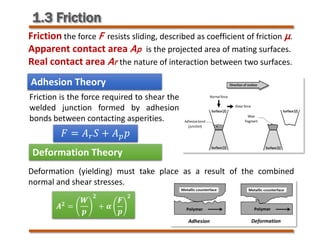
Friction the force F resists sliding, described as coefficient of friction µ.
Apparent contact area Ap is the projected area of mating surfaces.
Real contact area Ar the nature of interaction between two surfaces.
Adhesion Theory
Deformation Theory
Friction is the force required to shear the
welded junction formed by adhesion
bonds between contacting asperities.
𝐹𝐹 = 𝐴𝐴𝑟𝑟𝑆𝑆 + 𝐴𝐴𝑝𝑝𝑝𝑝
Deformation (yielding) must take place as a result of the combined
normal and shear stresses.
𝑨𝑨𝟐𝟐
=
𝑾𝑾
𝒑𝒑
𝟐𝟐
+ 𝜶𝜶
𝑭𝑭
𝒑𝒑
𝟐𝟐
1.3 Friction
Asperity Interlocking Theory
Stick-Slip Theory
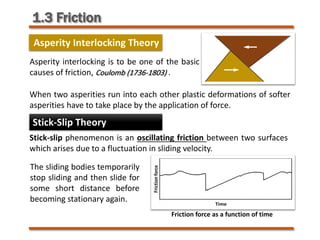
Asperity interlocking is to be one of the basic
causes of friction, Coulomb (1736-1803) .
When two asperities run into each other plastic deformations of softer
asperities have to take place by the application of force.
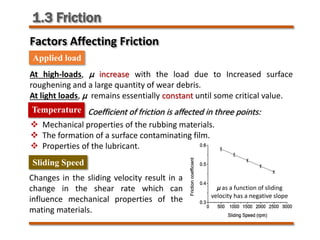
Stick-slip phenomenon is an oscillating friction between two surfaces
which arises due to a fluctuation in sliding velocity.
The sliding bodies temporarily
stop sliding and then slide for
some short distance before
becoming stationary again.
Friction force as a function of time
1.3 Friction
Factors Affecting Friction
Applied load
At high-loads, µ increase with the load due to Increased surface
roughening and a large quantity of wear debris.
At light loads, µ remains essentially constant until some critical value.
Temperature Coefficient of friction is affected in three points:
 Mechanical properties of the rubbing materials.
 The formation of a surface contaminating film.
 Properties of the lubricant.
Sliding Speed
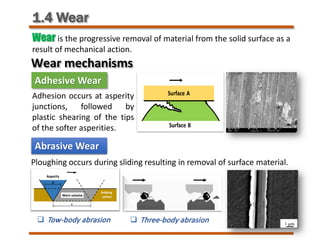
Changes in the sliding velocity result in a
change in the shear rate which can
influence mechanical properties of the
mating materials.
µ as a function of sliding
velocity has a negative slope
1.4 Wear
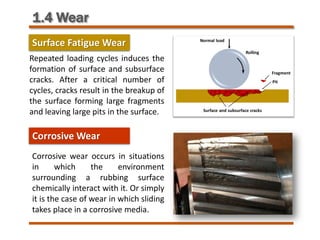
Wear is the progressive removal of material from the solid surface as a
result of mechanical action.
Wear mechanisms
Adhesive Wear
Adhesion occurs at asperity
junctions, followed by
plastic shearing of the tips
of the softer asperities.
Abrasive Wear
Ploughing occurs during sliding resulting in removal of surface material.
 Tow-body abrasion  Three-body abrasion
1.4 Wear
Surface Fatigue Wear
Repeated loading cycles induces the
formation of surface and subsurface
cracks. After a critical number of
cycles, cracks result in the breakup of
the surface forming large fragments
and leaving large pits in the surface.
Corrosive Wear
Corrosive wear occurs in situations
in which the environment
surrounding a rubbing surface
chemically interact with it. Or simply
it is the case of wear in which sliding
takes place in a corrosive media.
1.4 Wear
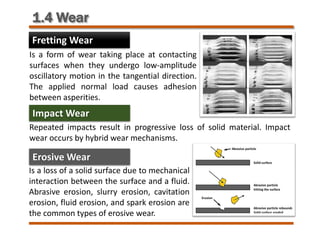
Fretting Wear
Is a form of wear taking place at contacting
surfaces when they undergo low-amplitude
oscillatory motion in the tangential direction.
The applied normal load causes adhesion
between asperities.
Impact Wear
Repeated impacts result in progressive loss of solid material. Impact
wear occurs by hybrid wear mechanisms.
Erosive Wear
Is a loss of a solid surface due to mechanical
interaction between the surface and a fluid.
Abrasive erosion, slurry erosion, cavitation
erosion, fluid erosion, and spark erosion are
the common types of erosive wear.
1.4 Wear
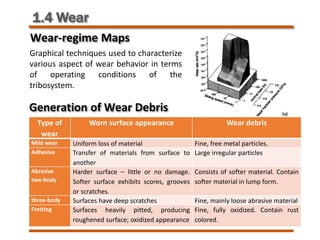
Graphical techniques used to characterize
various aspect of wear behavior in terms
of operating conditions of the
tribosystem.
Wear-regime Maps
Generation of Wear Debris
Type of
wear
Worn surface appearance Wear debris
Mild wear Uniform loss of material Fine, free metal particles.
Adhesive Transfer of materials from surface to
another
Large irregular particles
Abrasive
two-body
Harder surface – little or no damage.
Softer surface exhibits scores, grooves
or scratches.
Consists of softer material. Contain
softer material in lump form.
three-body Surfaces have deep scratches Fine, mainly loose abrasive material
Fretting Surfaces heavily pitted, producing
roughened surface; oxidized appearance
Fine, fully oxidized. Contain rust
colored.
1.4 Wear
Measurement of Wear
Tribometery: is a set of technologies that allows measuring of the
friction and wear behavior of a tribosystems.
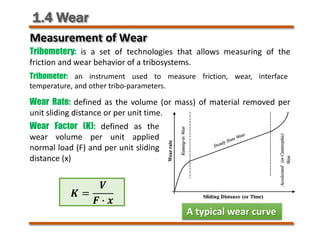
Wear Rate: defined as the volume (or mass) of material removed per
unit sliding distance or per unit time.
Wear Factor (K): defined as the
wear volume per unit applied
normal load (F) and per unit sliding
distance (x)
A typical wear curve
𝑲𝑲 =
𝑽𝑽
𝑭𝑭 � 𝒙𝒙
Tribometer: an instrument used to measure friction, wear, interface
temperature, and other tribo-parameters.
1.4 Wear
Measurement of Wear
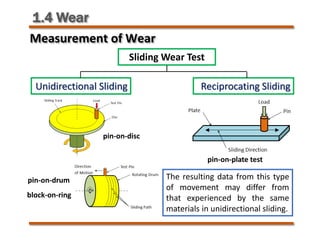
Sliding Wear Test
Unidirectional Sliding Reciprocating Sliding
block-on-ring
pin-on-drum
pin-on-plate test
The resulting data from this type
of movement may differ from
that experienced by the same
materials in unidirectional sliding.
pin-on-disc
1.4 Wear
Rolling Wear Test
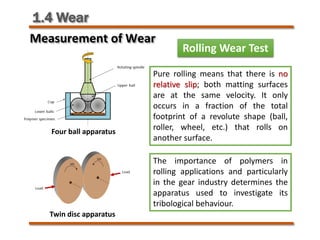
Four ball apparatus
Twin disc apparatus
The importance of polymers in
rolling applications and particularly
in the gear industry determines the
apparatus used to investigate its
tribological behaviour.
Pure rolling means that there is no
relative slip; both matting surfaces
are at the same velocity. It only
occurs in a fraction of the total
footprint of a revolute shape (ball,
roller, wheel, etc.) that rolls on
another surface.
Measurement of Wear
1.4 Wear
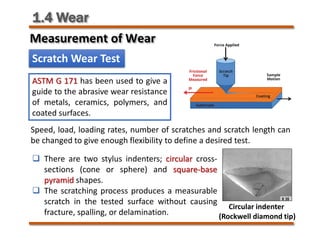
Scratch Wear Test
ASTM G 171 has been used to give a
guide to the abrasive wear resistance
of metals, ceramics, polymers, and
coated surfaces.
Circular indenter
(Rockwell diamond tip)
Speed, load, loading rates, number of scratches and scratch length can
be changed to give enough flexibility to define a desired test.
 There are two stylus indenters; circular cross-
sections (cone or sphere) and square-base
pyramid shapes.
 The scratching process produces a measurable
scratch in the tested surface without causing
fracture, spalling, or delamination.
Measurement of Wear
1.4 Wear
Measurement of Wear
Abrasion Wear Test
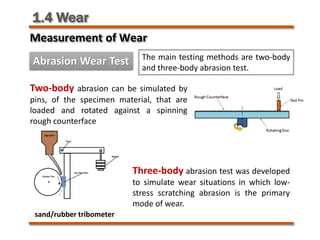
sand/rubber tribometer
The main testing methods are two-body
and three-body abrasion test.
Two-body abrasion can be simulated by
pins, of the specimen material, that are
loaded and rotated against a spinning
rough counterface
Three-body abrasion test was developed
to simulate wear situations in which low-
stress scratching abrasion is the primary
mode of wear.
1.5 Lubricants and lubrication
Lubricant is a substance which is capable of altering the nature of the
surface interaction between contacting solids.
Lubrication is the application of substances between two objects in
relative movement to allow smooth operation as much as necessary.
Types of lubricants
Solid lubricants
Lamellar structure solids: Molybdenum disulphide, Boron nitride , Cadmium
chloride, Sulphides, Selenides molybdenum, Tungsten, Tantalum, Titanium.
Soft metals: Lead, Tin, Bismuth, Indium, Cadmium, Silver.
Polymers: Polytetrafluoroethylene (PTFE), Polyimide (PI), Polyamide (PA), and
Ultra High Molecular Weight Polyethylene (UHMWPE).
Oxides: fluorides and sulfates
New composite coatings: physical or chemical vapor deposition (PVD - CVD)
technology.
Soaps: Lithium, Calcium, Sodium, Potassium salts
1.5 Lubricants and lubrication
Liquid lubricants
Mineral oils: are refined from petroleum.
Synthetic oils: hydrocarbon, Chlorofluorocarbons, Esters, Silicones, Silanes,
Polyphenyl ethers (PPEs), and Perfluoropolyether (PFPE).
Natural biodegradable lubricants: vegetable oils.
Gaseous lubricants
Air (up to 650 oC), CO (up to 650 oC), He and N (up to 1000 oC and more),
Hydrogen (higher cooling capacity, but flammable), Methane.
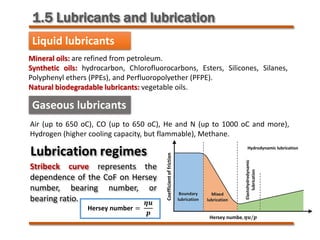
Lubrication regimes
Stribeck curve represents the
dependence of the CoF on Hersey
number, bearing number, or
bearing ratio.
Hersey number =
𝜼𝜼𝜼𝜼
𝒑𝒑
1.5 Lubricants and lubrication
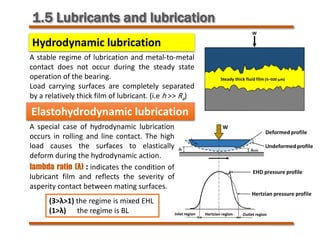
Hydrodynamic lubrication
A stable regime of lubrication and metal-to-metal
contact does not occur during the steady state
operation of the bearing.
Load carrying surfaces are completely separated
by a relatively thick film of lubricant. (i.e h >> Ra)
Elastohydrodynamic lubrication
A special case of hydrodynamic lubrication
occurs in rolling and line contact. The high
load causes the surfaces to elastically
deform during the hydrodynamic action.
lambda ratio (λ) : indicates the condition of
lubricant film and reflects the severity of
asperity contact between mating surfaces.
(3>λ>1) the regime is mixed EHL
(1>λ) the regime is BL
1.5 Lubricants and lubrication
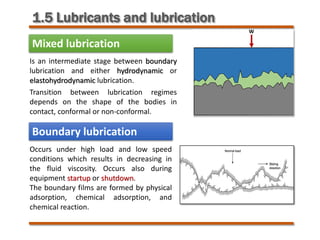
Mixed lubrication
Is an intermediate stage between boundary
lubrication and either hydrodynamic or
elastohydrodynamic lubrication.
Transition between lubrication regimes
depends on the shape of the bodies in
contact, conformal or non-conformal.
Boundary lubrication
Occurs under high load and low speed
conditions which results in decreasing in
the fluid viscosity. Occurs also during
equipment startup or shutdown.
The boundary films are formed by physical
adsorption, chemical adsorption, and
chemical reaction.
1.5 Lubricants and lubrication
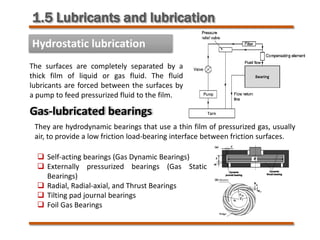
Hydrostatic lubrication
The surfaces are completely separated by a
thick film of liquid or gas fluid. The fluid
lubricants are forced between the surfaces by
a pump to feed pressurized fluid to the film.
Gas-lubricated bearings
They are hydrodynamic bearings that use a thin film of pressurized gas, usually
air, to provide a low friction load-bearing interface between friction surfaces.
 Self-acting bearings (Gas Dynamic Bearings)
 Externally pressurized bearings (Gas Static
Bearings)
 Radial, Radial-axial, and Thrust Bearings
 Tilting pad journal bearings
 Foil Gas Bearings
1.5 Lubricants and lubrication
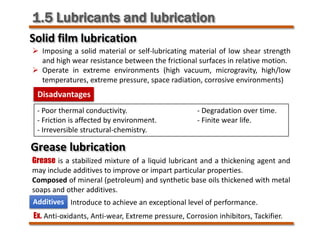
Solid film lubrication
Grease lubrication
 Imposing a solid material or self-lubricating material of low shear strength
and high wear resistance between the frictional surfaces in relative motion.
 Operate in extreme environments (high vacuum, microgravity, high/low
temperatures, extreme pressure, space radiation, corrosive environments)
Disadvantages
- Poor thermal conductivity. - Degradation over time.
- Friction is affected by environment. - Finite wear life.
- Irreversible structural-chemistry.
Grease is a stabilized mixture of a liquid lubricant and a thickening agent and
may include additives to improve or impart particular properties.
Composed of mineral (petroleum) and synthetic base oils thickened with metal
soaps and other additives.
Additives Introduce to achieve an exceptional level of performance.
Ex. Anti-oxidants, Anti-wear, Extreme pressure, Corrosion inhibitors, Tackifier.
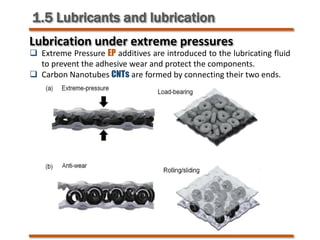
Lubrication under extreme pressures
 Extreme Pressure EP additives are introduced to the lubricating fluid
to prevent the adhesive wear and protect the components.
 Carbon Nanotubes CNTs are formed by connecting their two ends.
1.5 Lubricants and lubrication
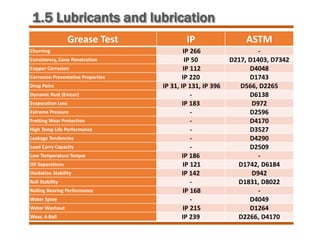
Grease Test IP ASTM
Churning IP 266 -
Consistency, Cone Penetration IP 50 D217, D1403, D7342
Copper Corrosion IP 112 D4048
Corrosion Preventative Properties IP 220 D1743
Drop Point IP 31, IP 131, IP 396 D566, D2265
Dynamic Rust (Emcor) - D6138
Evaporation Loss IP 183 D972
Extreme Pressure - D2596
Fretting Wear Protection - D4170
High Temp Life Performance - D3527
Leakage Tendencies - D4290
Load Carry Capacity - D2509
Low Temperature Torque IP 186 -
Oil Separations IP 121 D1742, D6184
Oxidation Stability IP 142 D942
Roll Stability - D1831, D8022
Rolling Bearing Performance IP 168 -
Water Spray - D4049
Water Washout IP 215 D1264
Wear, 4-Ball IP 239 D2266, D4170
1.6 Tribology of Non-metals
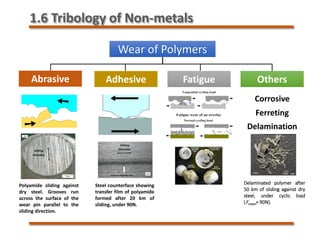
Wear of Polymers
Abrasive Adhesive Fatigue Others
Polyamide sliding against
dry steel. Grooves run
across the surface of the
wear pin parallel to the
sliding direction.
Steel counterface showing
transfer film of polyamide
formed after 20 km of
sliding, under 90N.
Corrosive
Ferreting
Delamination
Delaminated polymer after
50 km of sliding against dry
steel, under cyclic load
(Fmean= 90N).
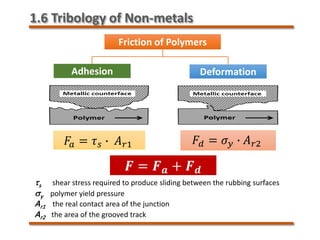
Friction of Polymers
𝑭𝑭 = 𝑭𝑭𝒂𝒂 + 𝑭𝑭𝒅𝒅
𝐹𝐹𝑎𝑎 = 𝜏𝜏𝑠𝑠 � 𝐴𝐴𝑟𝑟1 𝐹𝐹𝑑𝑑 = 𝜎𝜎𝑦𝑦 � 𝐴𝐴𝑟𝑟2
τs shear stress required to produce sliding between the rubbing surfaces
σy polymer yield pressure
Ar1 the real contact area of the junction
Ar2 the area of the grooved track
Adhesion Deformation
1.6 Tribology of Non-metals
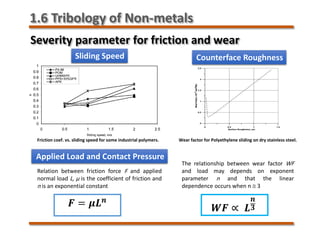
Severity parameter for friction and wear
Sliding Speed
Friction coef. vs. sliding speed for some industrial polymers.
Counterface Roughness
Wear factor for Polyethylene sliding on dry stainless steel.
Applied Load and Contact Pressure
𝑭𝑭 = 𝝁𝝁𝑳𝑳𝒏𝒏
𝑾𝑾𝑾𝑾 ∝ 𝑳𝑳
𝒏𝒏
𝟑𝟑
Relation between friction force F and applied
normal load L, µ is the coefficient of friction and
n is an exponential constant
The relationship between wear factor WF
and load may depends on exponent
parameter n and that the linear
dependence occurs when n ≅ 3
1.6 Tribology of Non-metals
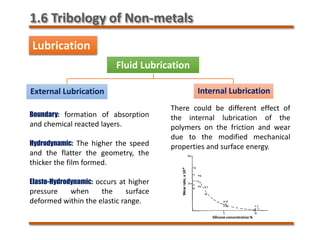
Lubrication
Fluid Lubrication
External Lubrication Internal Lubrication
Boundary: formation of absorption
and chemical reacted layers.
Hydrodynamic: The higher the speed
and the flatter the geometry, the
thicker the film formed.
Elasto-Hydrodynamic: occurs at higher
pressure when the surface
deformed within the elastic range.
There could be different effect of
the internal lubrication of the
polymers on the friction and wear
due to the modified mechanical
properties and surface energy.
1.6 Tribology of Non-metals
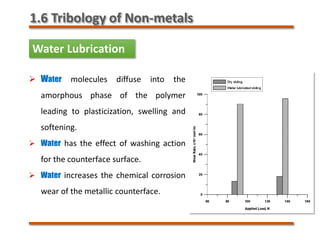
Water Lubrication
 Water molecules diffuse into the
amorphous phase of the polymer
leading to plasticization, swelling and
softening.
 Water has the effect of washing action
for the counterface surface.
 Water increases the chemical corrosion
wear of the metallic counterface.
1.6 Tribology of Non-metals
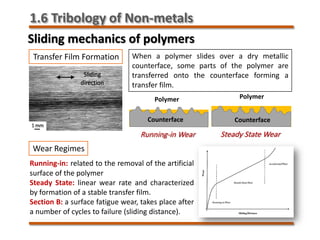
Sliding mechanics of polymers
Transfer Film Formation
Wear Regimes
Counterface
Polymer
Running-in Wear
Counterface
Polymer
Steady State Wear
When a polymer slides over a dry metallic
counterface, some parts of the polymer are
transferred onto the counterface forming a
transfer film.
Running-in: related to the removal of the artificial
surface of the polymer
Steady State: linear wear rate and characterized
by formation of a stable transfer film.
Section B: a surface fatigue wear, takes place after
a number of cycles to failure (sliding distance).
1.6 Tribology of Non-metals
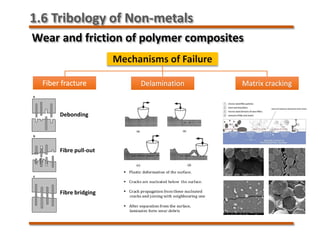
Wear and friction of polymer composites
Debonding
Fibre pull-out
Fibre bridging
1.6 Tribology of Non-metals
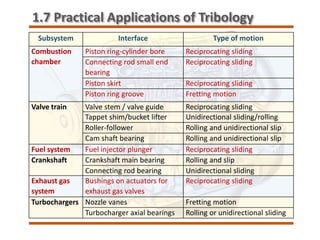
Subsystem Interface Type of motion
Combustion
chamber
Piston ring-cylinder bore Reciprocating sliding
Connecting rod small end
bearing
Reciprocating sliding
Piston skirt Reciprocating sliding
Piston ring groove Fretting motion
Valve train Valve stem / valve guide Reciprocating sliding
Tappet shim/bucket lifter Unidirectional sliding/rolling
Roller-follower Rolling and unidirectional slip
Cam shaft bearing Rolling and unidirectional slip
Fuel system Fuel injector plunger Reciprocating sliding
Crankshaft Crankshaft main bearing Rolling and slip
Connecting rod bearing Unidirectional sliding
Exhaust gas
system
Bushings on actuators for
exhaust gas valves
Reciprocating sliding
Turbochargers Nozzle vanes Fretting motion
Turbocharger axial bearings Rolling or unidirectional sliding
1.7 Practical Applications of Tribology
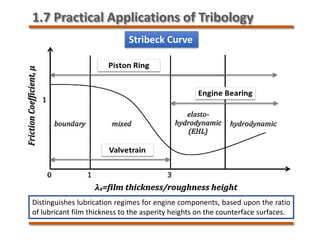
Stribeck Curve
Distinguishes lubrication regimes for engine components, based upon the ratio
of lubricant film thickness to the asperity heights on the counterface surfaces.
1.7 Practical Applications of Tribology
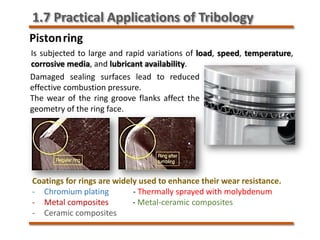
Pistonring
Damaged sealing surfaces lead to reduced
effective combustion pressure.
The wear of the ring groove flanks affect the
geometry of the ring face.
Coatings for rings are widely used to enhance their wear resistance.
- Chromium plating - Thermally sprayed with molybdenum
- Metal composites - Metal-ceramic composites
- Ceramic composites
Is subjected to large and rapid variations of load, speed, temperature,
corrosive media, and lubricant availability.
1.7 Practical Applications of Tribology
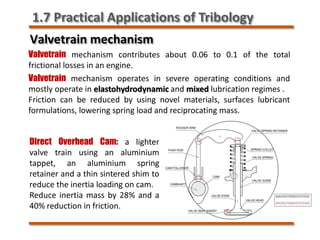
Valvetrain mechanism
Valvetrain mechanism contributes about 0.06 to 0.1 of the total
frictional losses in an engine.
Valvetrain mechanism operates in severe operating conditions and
mostly operate in elastohydrodynamic and mixed lubrication regimes .
Friction can be reduced by using novel materials, surfaces lubricant
formulations, lowering spring load and reciprocating mass.
Direct Overhead Cam: a lighter
valve train using an aluminium
tappet, an aluminium spring
retainer and a thin sintered shim to
reduce the inertia loading on cam.
Reduce inertia mass by 28% and a
40% reduction in friction.
1.7 Practical Applications of Tribology
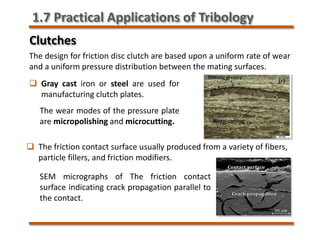
Clutches
The design for friction disc clutch are based upon a uniform rate of wear
and a uniform pressure distribution between the mating surfaces.
 Gray cast iron or steel are used for
manufacturing clutch plates.
 The friction contact surface usually produced from a variety of fibers,
particle fillers, and friction modifiers.
The wear modes of the pressure plate
are micropolishing and microcutting.
SEM micrographs of The friction contact
surface indicating crack propagation parallel to
the contact.
1.7 Practical Applications of Tribology
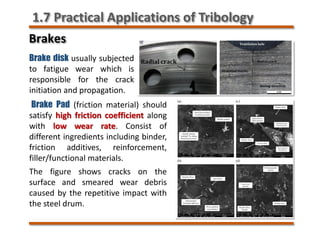
Brakes
Brake disk usually subjected
to fatigue wear which is
responsible for the crack
initiation and propagation.
Brake Pad (friction material) should
satisfy high friction coefficient along
with low wear rate. Consist of
different ingredients including binder,
friction additives, reinforcement,
filler/functional materials.
The figure shows cracks on the
surface and smeared wear debris
caused by the repetitive impact with
the steel drum.
1.7 Practical Applications of Tribology
Automotive lubricants
Engine oils
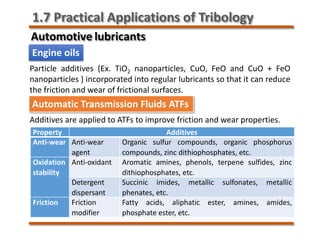
Particle additives (Ex. TiO2 nanoparticles, CuO, FeO and CuO + FeO
nanoparticles ) incorporated into regular lubricants so that it can reduce
the friction and wear of frictional surfaces.
Automatic Transmission Fluids ATFs
Additives are applied to ATFs to improve friction and wear properties.
Property Additives
Anti-wear Anti-wear
agent
Organic sulfur compounds, organic phosphorus
compounds, zinc dithiophosphates, etc.
Oxidation
stability
Anti-oxidant Aromatic amines, phenols, terpene sulfides, zinc
dithiophosphates, etc.
Detergent
dispersant
Succinic imides, metallic sulfonates, metallic
phenates, etc.
Friction Friction
modifier
Fatty acids, aliphatic ester, amines, amides,
phosphate ester, etc.
1.7 Practical Applications of Tribology
Automotive lubricants
Gear Lubricant
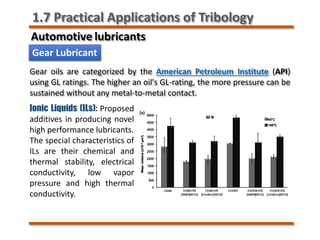
Gear oils are categorized by the American Petroleum Institute (API)
using GL ratings. The higher an oil's GL-rating, the more pressure can be
sustained without any metal-to-metal contact.
Ionic Liquids (ILs): Proposed
additives in producing novel
high performance lubricants.
The special characteristics of
ILs are their chemical and
thermal stability, electrical
conductivity, low vapor
pressure and high thermal
conductivity.
1.7 Practical Applications of Tribology
Micro/Nano scale friction and wear (MEMS & NEMS)
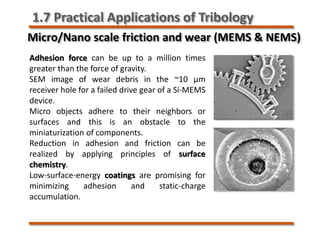
Adhesion force can be up to a million times
greater than the force of gravity.
SEM image of wear debris in the ~10 μm
receiver hole for a failed drive gear of a Si-MEMS
device.
Micro objects adhere to their neighbors or
surfaces and this is an obstacle to the
miniaturization of components.
Reduction in adhesion and friction can be
realized by applying principles of surface
chemistry.
Low-surface-energy coatings are promising for
minimizing adhesion and static-charge
accumulation.
1.7 Practical Applications of Tribology
Surface oxidation
Surface texturing (LST)
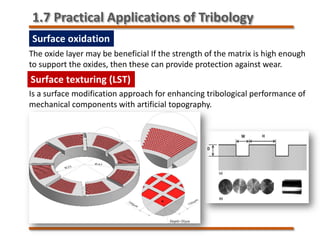
The oxide layer may be beneficial If the strength of the matrix is high enough
to support the oxides, then these can provide protection against wear.
Is a surface modification approach for enhancing tribological performance of
mechanical components with artificial topography.
1.7 Practical Applications of Tribology
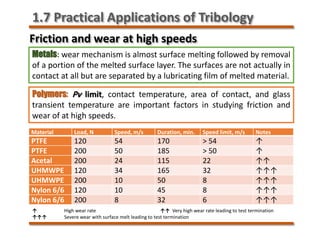
Friction and wear at high speeds
Metals: wear mechanism is almost surface melting followed by removal
of a portion of the melted surface layer. The surfaces are not actually in
contact at all but are separated by a lubricating film of melted material.
Polymers: Pv limit, contact temperature, area of contact, and glass
transient temperature are important factors in studying friction and
wear of at high speeds.
Material Load, N Speed, m/s Duration, min. Speed limit, m/s Notes
PTFE 120 54 170 ˃ 54 ↑
PTFE 200 50 185 ˃ 50 ↑
Acetal 200 24 115 22 ↑↑
UHMWPE 120 34 165 32 ↑↑↑
UHMWPE 200 10 50 8 ↑↑↑
Nylon 6/6 120 10 45 8 ↑↑↑
Nylon 6/6 200 8 32 6 ↑↑↑
↑ High wear rate ↑↑ Very high wear rate leading to test termination
↑↑↑ Severe wear with surface melt leading to test termination
1.7 Practical Applications of Tribology
1.8 Failures of Tribo-systems
Failure of Bearings
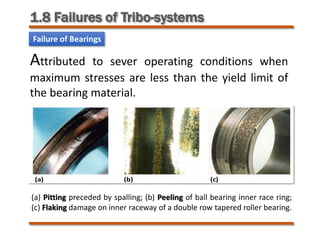
(a) Pitting preceded by spalling; (b) Peeling of ball bearing inner race ring;
(c) Flaking damage on inner raceway of a double row tapered roller bearing.
Attributed to sever operating conditions when
maximum stresses are less than the yield limit of
the bearing material.
Failure of Bearings
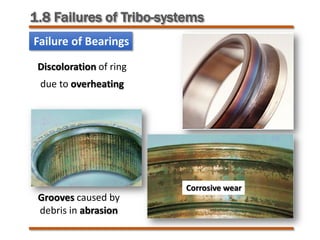
Discoloration of ring
due to overheating
Grooves caused by
debris in abrasion
Corrosive wear
1.8 Failures of Tribo-systems
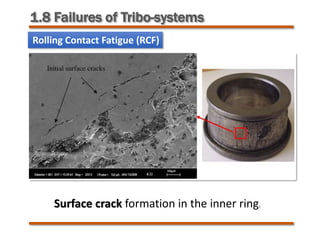
Rolling Contact Fatigue (RCF)
Surface crack formation in the inner ring.
1.8 Failures of Tribo-systems
Rolling Contact Fatigue (RCF)
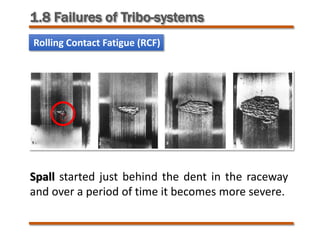
Spall started just behind the dent in the raceway
and over a period of time it becomes more severe.
1.8 Failures of Tribo-systems
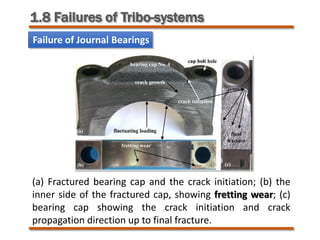
Failure of Journal Bearings
(a) Fractured bearing cap and the crack initiation; (b) the
inner side of the fractured cap, showing fretting wear; (c)
bearing cap showing the crack initiation and crack
propagation direction up to final fracture.
1.8 Failures of Tribo-systems
Thrust Bearings
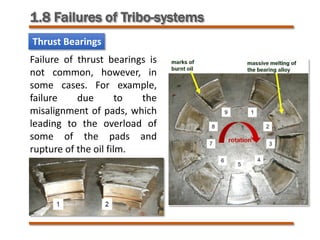
Failure of thrust bearings is
not common, however, in
some cases. For example,
failure due to the
misalignment of pads, which
leading to the overload of
some of the pads and
rupture of the oil film.
1.8 Failures of Tribo-systems
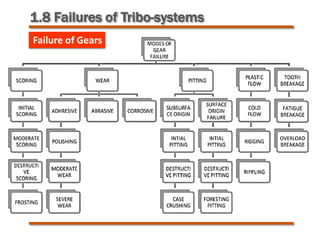
Failure of Gears
1.8 Failures of Tribo-systems
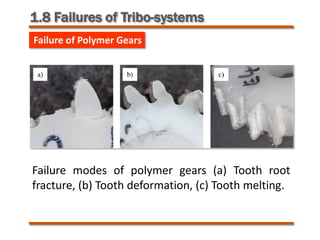
Failure of Polymer Gears
Failure modes of polymer gears (a) Tooth root
fracture, (b) Tooth deformation, (c) Tooth melting.
1.8 Failures of Tribo-systems
2.1 Definition
Space Tribology is the tribological branch
that studies the reliability of the satellite
and space vehicle.
Space Tribology covers almost all the
normal tribological conditions, such as
hydrodynamic, elastohydrodynamic,
mixed, and boundary lubrication regimes.
2.2 Features of Space Tribology
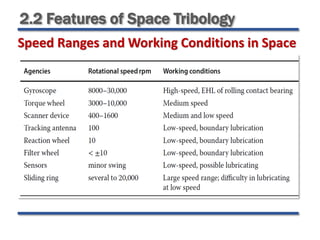
Speed Ranges and Working Conditions in Space
2.2 Features of Space Tribology
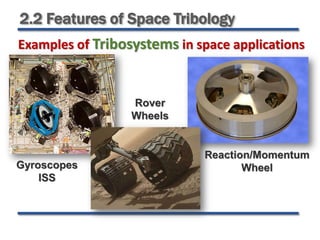
Examples of Tribosystems in space applications
Reaction/Momentum
Wheel
Rover
Wheels
Gyroscopes
ISS
2.2 Features of Space Tribology
Solar arrays
Solar arrays, that rotate at one revolution per day
experience no wear problems, but other rolling
elements need low wear rates in order to satisfy
long mission-lifetime requirements.
2.3 Tribological Challenges
High vacuum
• Up to 10-12 Pa
• Contamination sensitivity of the lubricant to
outgassing from surrounding materials.
• Evaporation characteristics of the lubricant.
• Lack of 02 leading to inability to repair
damaged oxide surfaces.
• Creep of lubricant.
• Catalytic or direct reaction. of
2.3 Tribological Challenges
Extreme temperatures
Explorations and most astronomical and military
surveillance satellites can undergo either low- or
high- temperature periods of operation or both.
2.3 Tribological Challenges
Long-term missions
Practice to design components that depend on
very accurate control of friction, because the
coefficient of friction (CoF) inevitably changes
with time.
2.3 Tribological Challenges
Fretting Wear
Distance travelled by the gimbals is usually short
compared to that travelled by a continuously
rotating bearing, but the gimbal motion is
oscillatory, often with very small arcs. Because
gimbals of Gyros operate in the boundary regime,
fretting wear can occur, depending on the magnitude
of the contact stress within the bearing (preload).
2.3 Tribological Challenges
Testing in TriboLAB
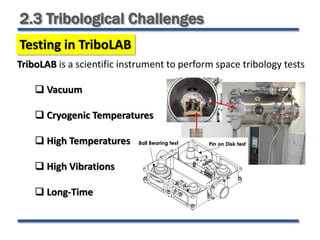
TriboLAB is a scientific instrument to perform space tribology tests
 Vacuum
 Cryogenic Temperatures
 High Temperatures
 High Vibrations
 Long-Time
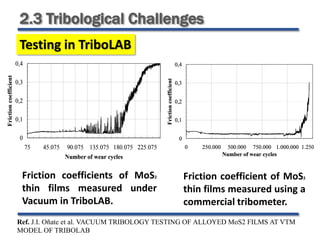
Friction coefficients of MoS2
thin films measured under
Vacuum in TriboLAB.
Friction coefficient of MoS2
thin films measured using a
commercial tribometer.
Ref. J.I. Oñate et al. VACUUM TRIBOLOGY TESTING OF ALLOYED MoS2 FILMS AT VTM
MODEL OF TRIBOLAB
2.3 Tribological Challenges
Testing in TriboLAB
2.4 Solutions
 Lubrication (Solid or ILs lubricants).
 Antiwear coatings.
 Self-lubricating composites.
Current technologies:
2.4 Solutions
2.4 Solutions
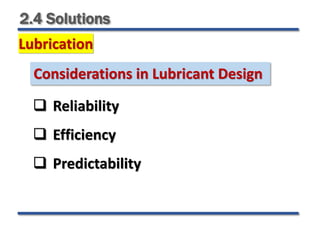
Lubrication
 Reliability
 Efficiency
 Predictability
Considerations in Lubricant Design
2.4 Solutions
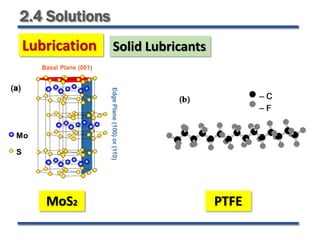
Lubrication Solid Lubricants
 Molybdenum disulfide (MoS2) [Powder or PVD coating]
 Polytetrafluoroethylene (PTFE)
 Metals with low shear strength such as Lead (Pb)
Lamellar solids, Polymers, Metal salts, and Soft
metals
Examples
2.4 Solutions
PTFE
MoS2
Lubrication Solid Lubricants
2.4 Solutions
ILs Composed of cations and
anions, particles of opposite
charge that display strong
polarity and form ionic bonds.
 Multiply Alkylated Cyclopentanes (MAC)
 Perfluoroalkyl Polyethers (PFPE)
Examples
 Low vapor pressure
 High thermal stability
 High chemical stability
 High electric conductivity
 Stable under BL conditions
Lubrication
Lubrication Ionic Liquids (ILs)
The operating regime (Boundary BL, Mixed, EHL) must be
considered when selecting a lubricant for space application.
2.4 Solutions
Antiwear Coatings
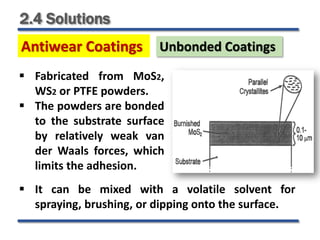
 Fabricated from MoS2,
WS2 or PTFE powders.
 The powders are bonded
to the substrate surface
by relatively weak van
der Waals forces, which
limits the adhesion.
Unbonded Coatings
 It can be mixed with a volatile solvent for
spraying, brushing, or dipping onto the surface.
2.4 Solutions
Antiwear Coatings Bonded Coatings
 Consist of two components: solid lubricant and
the binder material.
 Binder materials:
 Thermoplastic and Thermosetting resins for lower
temperatures.
 Phosphates and Silicates for moderately temperatures.
 Ceramics for higher temperatures.
 Heat-Cured Resin-Bonded Coatings
 Air-Cured Resin-Bonded Coatings
2.4 Solutions
Antiwear Coatings
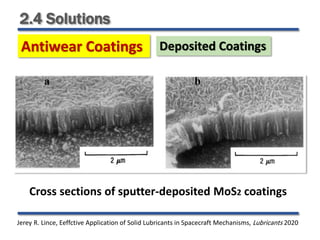
Cross sections of sputter-deposited MoS2 coatings
Jerey R. Lince, Eeffctive Application of Solid Lubricants in Spacecraft Mechanisms, Lubricants 2020
Deposited Coatings
2.4 Solutions
Antiwear Coatings Deposited Hard Coatings
Jerey R. Lince, Eeffctive Application of Solid Lubricants in Spacecraft Mechanisms, Lubricants 2020
Titanium-based hard coatings (TiC & TiN) are useful because
their COF are not greater in the vacuum of space compare to air.
Hard Coating materials
Deposition Technology
2.4 Solutions
Antiwear Coatings
The common coating methods are evaporation plating,
centrifugal plating and RF sputtering.
Ion plating is generally used for steel ball coating. The
processing temperature is about 120∘C, the film thickness is
about 0.3μm and the combined strength of the coating is
strong. After coating, the steel ball still keeps a good precision.
The coating materials are TiN, TiC and Ti.
The sputtering is generally used for plating the ring. The
sputtering materials are the soft metals, such as Ag, Au and Pb,
or non-metals, such as MoS2, PTFE or WS2.
2.4 Solutions
Self-lubricating Composites
Bearing cage made from composite for space
applications is composed of PTFE and MoS2
lubricant powders contained in a glass fiber
matrix for reinforcement. It is generally
accepted that the PTFE forms the transfer film
on the ball and race surfaces. The addition of
the MoS2 serves to minimize wear of the balls
due to contact with the glass fibers.
2.4 Solutions
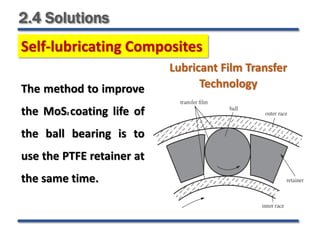
Lubricant Film Transfer
Technology
The method to improve
the MoS2 coating life of
the ball bearing is to
use the PTFE retainer at
the same time.
Self-lubricating Composites
2.4 Solutions
 Highly Hydrogenated Diamond-Like Carbon (HH-DLC)
 Cubic Boron Nitride (c-BN)
 Laser Surface Texturing (LST)
 Hybrid Liquid/Solid Lubrication
 Adaptive “Chameleon” Lubrication
Future of Tribological Solids on Spacecraft
Further Readings

Space Tribology2.pdf

  • 1.
  • 2.
    1.1 Introduction toTribology 1.2 Properties of Tribo-materials 1.3 Friction 1.4 Wear 1.5 Lubricants and Lubrication 1.6 Tribology of Non-metals 1.7 Practical Applications of Tribology 1.8 Failures in Tribo-Systems Contents 1. Principles of Engineering Tribology
  • 3.
    Contents 2. Space Tribology Fig.Mars Exploration Program NASA, Oct. 11, 2019 2.1 Definition 2.2 Features of Space Tribology 2.3 Tribology Challenges in Space Applications 2.4 Solutions
  • 4.
    1.1 Introductionto Tribology Tribologyrepresents phenomena and problems that arose since the Stone Age and extend to our present lives. Fig. Transporting the statue of Ti –tomb at Saqqara, 2400 B.C., Egypt The first tribologist pouring a liquid onto the path of motion.
  • 5.
    Tribology Triangle The word “Tribology” was first introduced in 1964 by Dr H. Peter Jost. Tribology is an interfacial phenomenon that is affected by physical and mechanical properties of the two interacting surfaces as well as operational conditions. Definition: 1.1 Introductionto Tribology
  • 6.
    1.1 Introductionto Tribology TribologyDevelopments: Problems and Goals  Green tribology.  Tribology in micro and nano-contacts.  Operating at extreme environments.  Space tribology.  Extending life of human joints.  Friction and wear in snow and stone avalanches.  Development of additive technologies and coatings.  Others.
  • 7.
    1.2 Properties ofTribo-materials Surface layers
  • 8.
    Surface layer ThicknessCharacteristics Physisorbed layer 0.3-3 nm Normally formed from the environment. Contains molecules of vapors, oxygen, or hydrocarbons that physically adsorbed to the surfaces. Involves weak van der Waals forces and can be easily removed. Chemisorbed layer ~ 0.3 nm There is an actual sharing of electrons between the chemisorbed species and the solid surface. Very strong covalent bonds and requires high energy to be removed. Chemically reacted layer 10 to 100 nm Formed at all metals and alloys react with oxygen or other media. Could be in the form of nitride, sulfide, and chloride layers. Normally formed at elevated temperature during the machining process and in the presence of lubricating additives. Beilby layer 1 to 100 nm Produced during the surface hardening process, where molecular layers are hardened by quenching as they are deposited on the cool underlying material. Has an amorphous or microcrystalline structure. The thickness of this layer could be reduced by lapping or wet polishing. Deformed layers 10 to 100 μm The properties vary distinctly from the bulk of the material according to machining processes such as grinding, polishing, or lapping. The layers are plastically deformed and become highly strained. 1.2 Properties of Tribo-materials
  • 9.
    Surface Properties Indentation Hardness ScratchHardness 1.2 Properties of Tribo-materials
  • 10.
    Surface Properties Adhesion Occurs betweensolid surfaces whenever one solid surface is slide over another surface or when two surfaces are pressed together. Surface Reactivity Used in boundary lubrication situations in order to define the chemical reactions between the tribo-surface and the lubricant molecules inside a sliding contact. 1.2 Properties of Tribo-materials
  • 11.
    Surface Properties Surface Roughness(Ra) Surface texture, including surface roughness, waviness, lay and flaws, is the repetitive or random deviation from the nominal surface that forms the three- dimensional topography of the surface. Measurement methods: Contact Noncontact Comparison Surface Finish Comparison Plates Light profile method Profile meter 1.2 Properties of Tribo-materials
  • 12.
    Surface roughness measurements 1.2Properties of Tribo-materials
  • 13.
    Machining Process Surfaceroughness (Ra), μm Planning, shaping 1-25 Milling 1-6 Drawing, extrusion 1-3 Turning, boring 0.4-6 Grinding 0.1-2 Honing 0.1-1 Polishing 0.1-0.4 Lapping 0.05-0.4 Typical surface roughness, Ra, values for engineering surfaces 1.2 Properties of Tribo-materials
  • 14.
    Lubrication Properties Lubricity ofa lubricant is governed by a number of physical, mechanical, and chemical properties: Viscosity is the most important single property of liquid lubricants characterizes the flow resistance of simple fluids. Viscosity Index is used to express the effect of temperature on kinematic viscosity. Viscosity-temperature relationships for minerals oils Thermal Properties: Specific Heat (Cp), Thermal Conductivity (k) , Thermal diffusivity (α). Other Properties: Flash point, Pour point, Alkalinity, Acidity, Foaming, Fire Resistance, Compatibility, Consistency, Surface adsorption, Oiliness. 1.2 Properties of Tribo-materials
  • 15.
    1.3 Friction Friction theforce F resists sliding, described as coefficient of friction µ. Apparent contact area Ap is the projected area of mating surfaces. Real contact area Ar the nature of interaction between two surfaces. Adhesion Theory Deformation Theory Friction is the force required to shear the welded junction formed by adhesion bonds between contacting asperities. 𝐹𝐹 = 𝐴𝐴𝑟𝑟𝑆𝑆 + 𝐴𝐴𝑝𝑝𝑝𝑝 Deformation (yielding) must take place as a result of the combined normal and shear stresses. 𝑨𝑨𝟐𝟐 = 𝑾𝑾 𝒑𝒑 𝟐𝟐 + 𝜶𝜶 𝑭𝑭 𝒑𝒑 𝟐𝟐
  • 16.
    1.3 Friction Asperity InterlockingTheory Stick-Slip Theory Asperity interlocking is to be one of the basic causes of friction, Coulomb (1736-1803) . When two asperities run into each other plastic deformations of softer asperities have to take place by the application of force. Stick-slip phenomenon is an oscillating friction between two surfaces which arises due to a fluctuation in sliding velocity. The sliding bodies temporarily stop sliding and then slide for some short distance before becoming stationary again. Friction force as a function of time
  • 17.
    1.3 Friction Factors AffectingFriction Applied load At high-loads, µ increase with the load due to Increased surface roughening and a large quantity of wear debris. At light loads, µ remains essentially constant until some critical value. Temperature Coefficient of friction is affected in three points:  Mechanical properties of the rubbing materials.  The formation of a surface contaminating film.  Properties of the lubricant. Sliding Speed Changes in the sliding velocity result in a change in the shear rate which can influence mechanical properties of the mating materials. µ as a function of sliding velocity has a negative slope
  • 18.
    1.4 Wear Wear isthe progressive removal of material from the solid surface as a result of mechanical action. Wear mechanisms Adhesive Wear Adhesion occurs at asperity junctions, followed by plastic shearing of the tips of the softer asperities. Abrasive Wear Ploughing occurs during sliding resulting in removal of surface material.  Tow-body abrasion  Three-body abrasion
  • 19.
    1.4 Wear Surface FatigueWear Repeated loading cycles induces the formation of surface and subsurface cracks. After a critical number of cycles, cracks result in the breakup of the surface forming large fragments and leaving large pits in the surface. Corrosive Wear Corrosive wear occurs in situations in which the environment surrounding a rubbing surface chemically interact with it. Or simply it is the case of wear in which sliding takes place in a corrosive media.
  • 20.
    1.4 Wear Fretting Wear Isa form of wear taking place at contacting surfaces when they undergo low-amplitude oscillatory motion in the tangential direction. The applied normal load causes adhesion between asperities. Impact Wear Repeated impacts result in progressive loss of solid material. Impact wear occurs by hybrid wear mechanisms. Erosive Wear Is a loss of a solid surface due to mechanical interaction between the surface and a fluid. Abrasive erosion, slurry erosion, cavitation erosion, fluid erosion, and spark erosion are the common types of erosive wear.
  • 21.
    1.4 Wear Graphical techniquesused to characterize various aspect of wear behavior in terms of operating conditions of the tribosystem. Wear-regime Maps Generation of Wear Debris Type of wear Worn surface appearance Wear debris Mild wear Uniform loss of material Fine, free metal particles. Adhesive Transfer of materials from surface to another Large irregular particles Abrasive two-body Harder surface – little or no damage. Softer surface exhibits scores, grooves or scratches. Consists of softer material. Contain softer material in lump form. three-body Surfaces have deep scratches Fine, mainly loose abrasive material Fretting Surfaces heavily pitted, producing roughened surface; oxidized appearance Fine, fully oxidized. Contain rust colored.
  • 22.
    1.4 Wear Measurement ofWear Tribometery: is a set of technologies that allows measuring of the friction and wear behavior of a tribosystems. Wear Rate: defined as the volume (or mass) of material removed per unit sliding distance or per unit time. Wear Factor (K): defined as the wear volume per unit applied normal load (F) and per unit sliding distance (x) A typical wear curve 𝑲𝑲 = 𝑽𝑽 𝑭𝑭 � 𝒙𝒙 Tribometer: an instrument used to measure friction, wear, interface temperature, and other tribo-parameters.
  • 23.
    1.4 Wear Measurement ofWear Sliding Wear Test Unidirectional Sliding Reciprocating Sliding block-on-ring pin-on-drum pin-on-plate test The resulting data from this type of movement may differ from that experienced by the same materials in unidirectional sliding. pin-on-disc
  • 24.
    1.4 Wear Rolling WearTest Four ball apparatus Twin disc apparatus The importance of polymers in rolling applications and particularly in the gear industry determines the apparatus used to investigate its tribological behaviour. Pure rolling means that there is no relative slip; both matting surfaces are at the same velocity. It only occurs in a fraction of the total footprint of a revolute shape (ball, roller, wheel, etc.) that rolls on another surface. Measurement of Wear
  • 25.
    1.4 Wear Scratch WearTest ASTM G 171 has been used to give a guide to the abrasive wear resistance of metals, ceramics, polymers, and coated surfaces. Circular indenter (Rockwell diamond tip) Speed, load, loading rates, number of scratches and scratch length can be changed to give enough flexibility to define a desired test.  There are two stylus indenters; circular cross- sections (cone or sphere) and square-base pyramid shapes.  The scratching process produces a measurable scratch in the tested surface without causing fracture, spalling, or delamination. Measurement of Wear
  • 26.
    1.4 Wear Measurement ofWear Abrasion Wear Test sand/rubber tribometer The main testing methods are two-body and three-body abrasion test. Two-body abrasion can be simulated by pins, of the specimen material, that are loaded and rotated against a spinning rough counterface Three-body abrasion test was developed to simulate wear situations in which low- stress scratching abrasion is the primary mode of wear.
  • 27.
    1.5 Lubricants andlubrication Lubricant is a substance which is capable of altering the nature of the surface interaction between contacting solids. Lubrication is the application of substances between two objects in relative movement to allow smooth operation as much as necessary. Types of lubricants Solid lubricants Lamellar structure solids: Molybdenum disulphide, Boron nitride , Cadmium chloride, Sulphides, Selenides molybdenum, Tungsten, Tantalum, Titanium. Soft metals: Lead, Tin, Bismuth, Indium, Cadmium, Silver. Polymers: Polytetrafluoroethylene (PTFE), Polyimide (PI), Polyamide (PA), and Ultra High Molecular Weight Polyethylene (UHMWPE). Oxides: fluorides and sulfates New composite coatings: physical or chemical vapor deposition (PVD - CVD) technology. Soaps: Lithium, Calcium, Sodium, Potassium salts
  • 28.
    1.5 Lubricants andlubrication Liquid lubricants Mineral oils: are refined from petroleum. Synthetic oils: hydrocarbon, Chlorofluorocarbons, Esters, Silicones, Silanes, Polyphenyl ethers (PPEs), and Perfluoropolyether (PFPE). Natural biodegradable lubricants: vegetable oils. Gaseous lubricants Air (up to 650 oC), CO (up to 650 oC), He and N (up to 1000 oC and more), Hydrogen (higher cooling capacity, but flammable), Methane. Lubrication regimes Stribeck curve represents the dependence of the CoF on Hersey number, bearing number, or bearing ratio. Hersey number = 𝜼𝜼𝜼𝜼 𝒑𝒑
  • 29.
    1.5 Lubricants andlubrication Hydrodynamic lubrication A stable regime of lubrication and metal-to-metal contact does not occur during the steady state operation of the bearing. Load carrying surfaces are completely separated by a relatively thick film of lubricant. (i.e h >> Ra) Elastohydrodynamic lubrication A special case of hydrodynamic lubrication occurs in rolling and line contact. The high load causes the surfaces to elastically deform during the hydrodynamic action. lambda ratio (λ) : indicates the condition of lubricant film and reflects the severity of asperity contact between mating surfaces. (3>λ>1) the regime is mixed EHL (1>λ) the regime is BL
  • 30.
    1.5 Lubricants andlubrication Mixed lubrication Is an intermediate stage between boundary lubrication and either hydrodynamic or elastohydrodynamic lubrication. Transition between lubrication regimes depends on the shape of the bodies in contact, conformal or non-conformal. Boundary lubrication Occurs under high load and low speed conditions which results in decreasing in the fluid viscosity. Occurs also during equipment startup or shutdown. The boundary films are formed by physical adsorption, chemical adsorption, and chemical reaction.
  • 31.
    1.5 Lubricants andlubrication Hydrostatic lubrication The surfaces are completely separated by a thick film of liquid or gas fluid. The fluid lubricants are forced between the surfaces by a pump to feed pressurized fluid to the film. Gas-lubricated bearings They are hydrodynamic bearings that use a thin film of pressurized gas, usually air, to provide a low friction load-bearing interface between friction surfaces.  Self-acting bearings (Gas Dynamic Bearings)  Externally pressurized bearings (Gas Static Bearings)  Radial, Radial-axial, and Thrust Bearings  Tilting pad journal bearings  Foil Gas Bearings
  • 32.
    1.5 Lubricants andlubrication Solid film lubrication Grease lubrication  Imposing a solid material or self-lubricating material of low shear strength and high wear resistance between the frictional surfaces in relative motion.  Operate in extreme environments (high vacuum, microgravity, high/low temperatures, extreme pressure, space radiation, corrosive environments) Disadvantages - Poor thermal conductivity. - Degradation over time. - Friction is affected by environment. - Finite wear life. - Irreversible structural-chemistry. Grease is a stabilized mixture of a liquid lubricant and a thickening agent and may include additives to improve or impart particular properties. Composed of mineral (petroleum) and synthetic base oils thickened with metal soaps and other additives. Additives Introduce to achieve an exceptional level of performance. Ex. Anti-oxidants, Anti-wear, Extreme pressure, Corrosion inhibitors, Tackifier.
  • 33.
    Lubrication under extremepressures  Extreme Pressure EP additives are introduced to the lubricating fluid to prevent the adhesive wear and protect the components.  Carbon Nanotubes CNTs are formed by connecting their two ends. 1.5 Lubricants and lubrication
  • 34.
    1.5 Lubricants andlubrication Grease Test IP ASTM Churning IP 266 - Consistency, Cone Penetration IP 50 D217, D1403, D7342 Copper Corrosion IP 112 D4048 Corrosion Preventative Properties IP 220 D1743 Drop Point IP 31, IP 131, IP 396 D566, D2265 Dynamic Rust (Emcor) - D6138 Evaporation Loss IP 183 D972 Extreme Pressure - D2596 Fretting Wear Protection - D4170 High Temp Life Performance - D3527 Leakage Tendencies - D4290 Load Carry Capacity - D2509 Low Temperature Torque IP 186 - Oil Separations IP 121 D1742, D6184 Oxidation Stability IP 142 D942 Roll Stability - D1831, D8022 Rolling Bearing Performance IP 168 - Water Spray - D4049 Water Washout IP 215 D1264 Wear, 4-Ball IP 239 D2266, D4170
  • 35.
    1.6 Tribology ofNon-metals Wear of Polymers Abrasive Adhesive Fatigue Others Polyamide sliding against dry steel. Grooves run across the surface of the wear pin parallel to the sliding direction. Steel counterface showing transfer film of polyamide formed after 20 km of sliding, under 90N. Corrosive Ferreting Delamination Delaminated polymer after 50 km of sliding against dry steel, under cyclic load (Fmean= 90N).
  • 36.
    Friction of Polymers 𝑭𝑭= 𝑭𝑭𝒂𝒂 + 𝑭𝑭𝒅𝒅 𝐹𝐹𝑎𝑎 = 𝜏𝜏𝑠𝑠 � 𝐴𝐴𝑟𝑟1 𝐹𝐹𝑑𝑑 = 𝜎𝜎𝑦𝑦 � 𝐴𝐴𝑟𝑟2 τs shear stress required to produce sliding between the rubbing surfaces σy polymer yield pressure Ar1 the real contact area of the junction Ar2 the area of the grooved track Adhesion Deformation 1.6 Tribology of Non-metals
  • 37.
    Severity parameter forfriction and wear Sliding Speed Friction coef. vs. sliding speed for some industrial polymers. Counterface Roughness Wear factor for Polyethylene sliding on dry stainless steel. Applied Load and Contact Pressure 𝑭𝑭 = 𝝁𝝁𝑳𝑳𝒏𝒏 𝑾𝑾𝑾𝑾 ∝ 𝑳𝑳 𝒏𝒏 𝟑𝟑 Relation between friction force F and applied normal load L, µ is the coefficient of friction and n is an exponential constant The relationship between wear factor WF and load may depends on exponent parameter n and that the linear dependence occurs when n ≅ 3 1.6 Tribology of Non-metals
  • 38.
    Lubrication Fluid Lubrication External LubricationInternal Lubrication Boundary: formation of absorption and chemical reacted layers. Hydrodynamic: The higher the speed and the flatter the geometry, the thicker the film formed. Elasto-Hydrodynamic: occurs at higher pressure when the surface deformed within the elastic range. There could be different effect of the internal lubrication of the polymers on the friction and wear due to the modified mechanical properties and surface energy. 1.6 Tribology of Non-metals
  • 39.
    Water Lubrication  Watermolecules diffuse into the amorphous phase of the polymer leading to plasticization, swelling and softening.  Water has the effect of washing action for the counterface surface.  Water increases the chemical corrosion wear of the metallic counterface. 1.6 Tribology of Non-metals
  • 40.
    Sliding mechanics ofpolymers Transfer Film Formation Wear Regimes Counterface Polymer Running-in Wear Counterface Polymer Steady State Wear When a polymer slides over a dry metallic counterface, some parts of the polymer are transferred onto the counterface forming a transfer film. Running-in: related to the removal of the artificial surface of the polymer Steady State: linear wear rate and characterized by formation of a stable transfer film. Section B: a surface fatigue wear, takes place after a number of cycles to failure (sliding distance). 1.6 Tribology of Non-metals
  • 41.
    Wear and frictionof polymer composites Debonding Fibre pull-out Fibre bridging 1.6 Tribology of Non-metals
  • 42.
    Subsystem Interface Typeof motion Combustion chamber Piston ring-cylinder bore Reciprocating sliding Connecting rod small end bearing Reciprocating sliding Piston skirt Reciprocating sliding Piston ring groove Fretting motion Valve train Valve stem / valve guide Reciprocating sliding Tappet shim/bucket lifter Unidirectional sliding/rolling Roller-follower Rolling and unidirectional slip Cam shaft bearing Rolling and unidirectional slip Fuel system Fuel injector plunger Reciprocating sliding Crankshaft Crankshaft main bearing Rolling and slip Connecting rod bearing Unidirectional sliding Exhaust gas system Bushings on actuators for exhaust gas valves Reciprocating sliding Turbochargers Nozzle vanes Fretting motion Turbocharger axial bearings Rolling or unidirectional sliding 1.7 Practical Applications of Tribology
  • 43.
    Stribeck Curve Distinguishes lubricationregimes for engine components, based upon the ratio of lubricant film thickness to the asperity heights on the counterface surfaces. 1.7 Practical Applications of Tribology
  • 44.
    Pistonring Damaged sealing surfaceslead to reduced effective combustion pressure. The wear of the ring groove flanks affect the geometry of the ring face. Coatings for rings are widely used to enhance their wear resistance. - Chromium plating - Thermally sprayed with molybdenum - Metal composites - Metal-ceramic composites - Ceramic composites Is subjected to large and rapid variations of load, speed, temperature, corrosive media, and lubricant availability. 1.7 Practical Applications of Tribology
  • 45.
    Valvetrain mechanism Valvetrain mechanismcontributes about 0.06 to 0.1 of the total frictional losses in an engine. Valvetrain mechanism operates in severe operating conditions and mostly operate in elastohydrodynamic and mixed lubrication regimes . Friction can be reduced by using novel materials, surfaces lubricant formulations, lowering spring load and reciprocating mass. Direct Overhead Cam: a lighter valve train using an aluminium tappet, an aluminium spring retainer and a thin sintered shim to reduce the inertia loading on cam. Reduce inertia mass by 28% and a 40% reduction in friction. 1.7 Practical Applications of Tribology
  • 46.
    Clutches The design forfriction disc clutch are based upon a uniform rate of wear and a uniform pressure distribution between the mating surfaces.  Gray cast iron or steel are used for manufacturing clutch plates.  The friction contact surface usually produced from a variety of fibers, particle fillers, and friction modifiers. The wear modes of the pressure plate are micropolishing and microcutting. SEM micrographs of The friction contact surface indicating crack propagation parallel to the contact. 1.7 Practical Applications of Tribology
  • 47.
    Brakes Brake disk usuallysubjected to fatigue wear which is responsible for the crack initiation and propagation. Brake Pad (friction material) should satisfy high friction coefficient along with low wear rate. Consist of different ingredients including binder, friction additives, reinforcement, filler/functional materials. The figure shows cracks on the surface and smeared wear debris caused by the repetitive impact with the steel drum. 1.7 Practical Applications of Tribology
  • 48.
    Automotive lubricants Engine oils Particleadditives (Ex. TiO2 nanoparticles, CuO, FeO and CuO + FeO nanoparticles ) incorporated into regular lubricants so that it can reduce the friction and wear of frictional surfaces. Automatic Transmission Fluids ATFs Additives are applied to ATFs to improve friction and wear properties. Property Additives Anti-wear Anti-wear agent Organic sulfur compounds, organic phosphorus compounds, zinc dithiophosphates, etc. Oxidation stability Anti-oxidant Aromatic amines, phenols, terpene sulfides, zinc dithiophosphates, etc. Detergent dispersant Succinic imides, metallic sulfonates, metallic phenates, etc. Friction Friction modifier Fatty acids, aliphatic ester, amines, amides, phosphate ester, etc. 1.7 Practical Applications of Tribology
  • 49.
    Automotive lubricants Gear Lubricant Gearoils are categorized by the American Petroleum Institute (API) using GL ratings. The higher an oil's GL-rating, the more pressure can be sustained without any metal-to-metal contact. Ionic Liquids (ILs): Proposed additives in producing novel high performance lubricants. The special characteristics of ILs are their chemical and thermal stability, electrical conductivity, low vapor pressure and high thermal conductivity. 1.7 Practical Applications of Tribology
  • 50.
    Micro/Nano scale frictionand wear (MEMS & NEMS) Adhesion force can be up to a million times greater than the force of gravity. SEM image of wear debris in the ~10 μm receiver hole for a failed drive gear of a Si-MEMS device. Micro objects adhere to their neighbors or surfaces and this is an obstacle to the miniaturization of components. Reduction in adhesion and friction can be realized by applying principles of surface chemistry. Low-surface-energy coatings are promising for minimizing adhesion and static-charge accumulation. 1.7 Practical Applications of Tribology
  • 51.
    Surface oxidation Surface texturing(LST) The oxide layer may be beneficial If the strength of the matrix is high enough to support the oxides, then these can provide protection against wear. Is a surface modification approach for enhancing tribological performance of mechanical components with artificial topography. 1.7 Practical Applications of Tribology
  • 52.
    Friction and wearat high speeds Metals: wear mechanism is almost surface melting followed by removal of a portion of the melted surface layer. The surfaces are not actually in contact at all but are separated by a lubricating film of melted material. Polymers: Pv limit, contact temperature, area of contact, and glass transient temperature are important factors in studying friction and wear of at high speeds. Material Load, N Speed, m/s Duration, min. Speed limit, m/s Notes PTFE 120 54 170 ˃ 54 ↑ PTFE 200 50 185 ˃ 50 ↑ Acetal 200 24 115 22 ↑↑ UHMWPE 120 34 165 32 ↑↑↑ UHMWPE 200 10 50 8 ↑↑↑ Nylon 6/6 120 10 45 8 ↑↑↑ Nylon 6/6 200 8 32 6 ↑↑↑ ↑ High wear rate ↑↑ Very high wear rate leading to test termination ↑↑↑ Severe wear with surface melt leading to test termination 1.7 Practical Applications of Tribology
  • 53.
    1.8 Failures ofTribo-systems Failure of Bearings (a) Pitting preceded by spalling; (b) Peeling of ball bearing inner race ring; (c) Flaking damage on inner raceway of a double row tapered roller bearing. Attributed to sever operating conditions when maximum stresses are less than the yield limit of the bearing material.
  • 54.
    Failure of Bearings Discolorationof ring due to overheating Grooves caused by debris in abrasion Corrosive wear 1.8 Failures of Tribo-systems
  • 55.
    Rolling Contact Fatigue(RCF) Surface crack formation in the inner ring. 1.8 Failures of Tribo-systems
  • 56.
    Rolling Contact Fatigue(RCF) Spall started just behind the dent in the raceway and over a period of time it becomes more severe. 1.8 Failures of Tribo-systems
  • 57.
    Failure of JournalBearings (a) Fractured bearing cap and the crack initiation; (b) the inner side of the fractured cap, showing fretting wear; (c) bearing cap showing the crack initiation and crack propagation direction up to final fracture. 1.8 Failures of Tribo-systems
  • 58.
    Thrust Bearings Failure ofthrust bearings is not common, however, in some cases. For example, failure due to the misalignment of pads, which leading to the overload of some of the pads and rupture of the oil film. 1.8 Failures of Tribo-systems
  • 59.
    Failure of Gears 1.8Failures of Tribo-systems
  • 60.
    Failure of PolymerGears Failure modes of polymer gears (a) Tooth root fracture, (b) Tooth deformation, (c) Tooth melting. 1.8 Failures of Tribo-systems
  • 62.
    2.1 Definition Space Tribologyis the tribological branch that studies the reliability of the satellite and space vehicle. Space Tribology covers almost all the normal tribological conditions, such as hydrodynamic, elastohydrodynamic, mixed, and boundary lubrication regimes.
  • 63.
    2.2 Features ofSpace Tribology Speed Ranges and Working Conditions in Space
  • 64.
    2.2 Features ofSpace Tribology Examples of Tribosystems in space applications Reaction/Momentum Wheel Rover Wheels Gyroscopes ISS
  • 65.
    2.2 Features ofSpace Tribology Solar arrays Solar arrays, that rotate at one revolution per day experience no wear problems, but other rolling elements need low wear rates in order to satisfy long mission-lifetime requirements.
  • 66.
    2.3 Tribological Challenges Highvacuum • Up to 10-12 Pa • Contamination sensitivity of the lubricant to outgassing from surrounding materials. • Evaporation characteristics of the lubricant. • Lack of 02 leading to inability to repair damaged oxide surfaces. • Creep of lubricant. • Catalytic or direct reaction. of
  • 67.
    2.3 Tribological Challenges Extremetemperatures Explorations and most astronomical and military surveillance satellites can undergo either low- or high- temperature periods of operation or both.
  • 68.
    2.3 Tribological Challenges Long-termmissions Practice to design components that depend on very accurate control of friction, because the coefficient of friction (CoF) inevitably changes with time.
  • 69.
    2.3 Tribological Challenges FrettingWear Distance travelled by the gimbals is usually short compared to that travelled by a continuously rotating bearing, but the gimbal motion is oscillatory, often with very small arcs. Because gimbals of Gyros operate in the boundary regime, fretting wear can occur, depending on the magnitude of the contact stress within the bearing (preload).
  • 70.
    2.3 Tribological Challenges Testingin TriboLAB TriboLAB is a scientific instrument to perform space tribology tests  Vacuum  Cryogenic Temperatures  High Temperatures  High Vibrations  Long-Time
  • 71.
    Friction coefficients ofMoS2 thin films measured under Vacuum in TriboLAB. Friction coefficient of MoS2 thin films measured using a commercial tribometer. Ref. J.I. Oñate et al. VACUUM TRIBOLOGY TESTING OF ALLOYED MoS2 FILMS AT VTM MODEL OF TRIBOLAB 2.3 Tribological Challenges Testing in TriboLAB
  • 72.
    2.4 Solutions  Lubrication(Solid or ILs lubricants).  Antiwear coatings.  Self-lubricating composites. Current technologies:
  • 73.
  • 74.
    2.4 Solutions Lubrication  Reliability Efficiency  Predictability Considerations in Lubricant Design
  • 75.
    2.4 Solutions Lubrication SolidLubricants  Molybdenum disulfide (MoS2) [Powder or PVD coating]  Polytetrafluoroethylene (PTFE)  Metals with low shear strength such as Lead (Pb) Lamellar solids, Polymers, Metal salts, and Soft metals Examples
  • 76.
  • 77.
    2.4 Solutions ILs Composedof cations and anions, particles of opposite charge that display strong polarity and form ionic bonds.  Multiply Alkylated Cyclopentanes (MAC)  Perfluoroalkyl Polyethers (PFPE) Examples  Low vapor pressure  High thermal stability  High chemical stability  High electric conductivity  Stable under BL conditions Lubrication Lubrication Ionic Liquids (ILs) The operating regime (Boundary BL, Mixed, EHL) must be considered when selecting a lubricant for space application.
  • 78.
    2.4 Solutions Antiwear Coatings Fabricated from MoS2, WS2 or PTFE powders.  The powders are bonded to the substrate surface by relatively weak van der Waals forces, which limits the adhesion. Unbonded Coatings  It can be mixed with a volatile solvent for spraying, brushing, or dipping onto the surface.
  • 79.
    2.4 Solutions Antiwear CoatingsBonded Coatings  Consist of two components: solid lubricant and the binder material.  Binder materials:  Thermoplastic and Thermosetting resins for lower temperatures.  Phosphates and Silicates for moderately temperatures.  Ceramics for higher temperatures.  Heat-Cured Resin-Bonded Coatings  Air-Cured Resin-Bonded Coatings
  • 80.
    2.4 Solutions Antiwear Coatings Crosssections of sputter-deposited MoS2 coatings Jerey R. Lince, Eeffctive Application of Solid Lubricants in Spacecraft Mechanisms, Lubricants 2020 Deposited Coatings
  • 81.
    2.4 Solutions Antiwear CoatingsDeposited Hard Coatings Jerey R. Lince, Eeffctive Application of Solid Lubricants in Spacecraft Mechanisms, Lubricants 2020 Titanium-based hard coatings (TiC & TiN) are useful because their COF are not greater in the vacuum of space compare to air. Hard Coating materials Deposition Technology
  • 82.
    2.4 Solutions Antiwear Coatings Thecommon coating methods are evaporation plating, centrifugal plating and RF sputtering. Ion plating is generally used for steel ball coating. The processing temperature is about 120∘C, the film thickness is about 0.3μm and the combined strength of the coating is strong. After coating, the steel ball still keeps a good precision. The coating materials are TiN, TiC and Ti. The sputtering is generally used for plating the ring. The sputtering materials are the soft metals, such as Ag, Au and Pb, or non-metals, such as MoS2, PTFE or WS2.
  • 83.
    2.4 Solutions Self-lubricating Composites Bearingcage made from composite for space applications is composed of PTFE and MoS2 lubricant powders contained in a glass fiber matrix for reinforcement. It is generally accepted that the PTFE forms the transfer film on the ball and race surfaces. The addition of the MoS2 serves to minimize wear of the balls due to contact with the glass fibers.
  • 84.
    2.4 Solutions Lubricant FilmTransfer Technology The method to improve the MoS2 coating life of the ball bearing is to use the PTFE retainer at the same time. Self-lubricating Composites
  • 85.
    2.4 Solutions  HighlyHydrogenated Diamond-Like Carbon (HH-DLC)  Cubic Boron Nitride (c-BN)  Laser Surface Texturing (LST)  Hybrid Liquid/Solid Lubrication  Adaptive “Chameleon” Lubrication Future of Tribological Solids on Spacecraft
  • 86.