Chapter 20 
Rapid-Prototyping Operations 
Manufacturing, Engineering & Technology, Fifth Edition, by Serope Kalpakjian and Steven R. Schmid. 
ISBN 0-13-148965-8. © 2006 Pearson Education, Inc., Upper Saddle River, NJ. All rights reserved.
Parts Made by Rapid-Prototyping 
(a) 
(b) 
Manufacturing, Engineering & Technology, Fifth Edition, by Serope Kalpakjian and Steven R. Schmid. 
ISBN 0-13-148965-8. © 2006 Pearson Education, Inc., Upper Saddle River, NJ. All rights reserved. 
(c) 
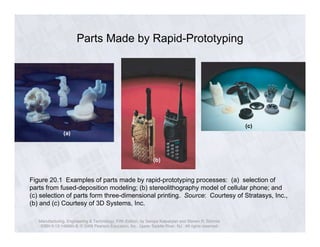
Figure 20.1 Examples of parts made by rapid-prototyping processes: (a) selection of 
parts from fused-deposition modeling; (b) stereolithography model of cellular phone; and 
(c) selection of parts form three-dimensional printing. Source: Courtesy of Stratasys, Inc., 
(b) and (c) Courtesy of 3D Systems, Inc.
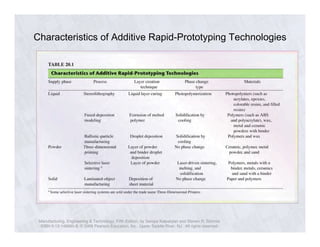
Characteristics of Additive Rapid-Prototyping Technologies 
Manufacturing, Engineering & Technology, Fifth Edition, by Serope Kalpakjian and Steven R. Schmid. 
ISBN 0-13-148965-8. © 2006 Pearson Education, Inc., Upper Saddle River, NJ. All rights reserved.
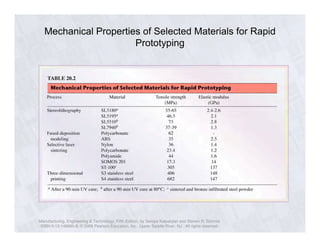
Mechanical Properties of Selected Materials for Rapid 
Prototyping 
Manufacturing, Engineering & Technology, Fifth Edition, by Serope Kalpakjian and Steven R. Schmid. 
ISBN 0-13-148965-8. © 2006 Pearson Education, Inc., Upper Saddle River, NJ. All rights reserved.
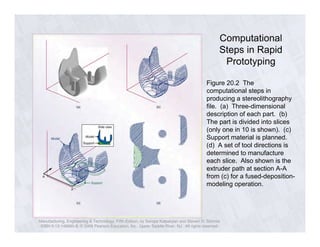
Computational 
Steps in Rapid 
Prototyping 
Figure 20.2 The 
computational steps in 
producing a stereolithography 
file. (a) Three-dimensional 
description of each part. (b) 
The part is divided into slices 
(only one in 10 is shown). (c) 
Support material is planned. 
(d) A set of tool directions is 
determined to manufacture 
each slice. Also shown is the 
extruder path at section A-A 
from (c) for a fused-deposition-modeling 
Manufacturing, Engineering & Technology, Fifth Edition, by Serope Kalpakjian and Steven R. Schmid. 
ISBN 0-13-148965-8. © 2006 Pearson Education, Inc., Upper Saddle River, NJ. All rights reserved. 
operation.
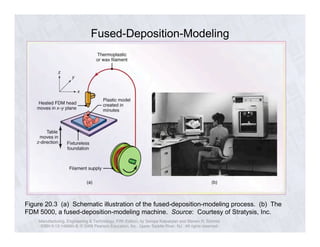
Fused-Deposition-Modeling 
Figure 20.3 (a) Schematic illustration of the fused-deposition-modeling process. (b) The 
FDM 5000, a fused-deposition-modeling machine. Source: Courtesy of Stratysis, Inc. 
Manufacturing, Engineering & Technology, Fifth Edition, by Serope Kalpakjian and Steven R. Schmid. 
ISBN 0-13-148965-8. © 2006 Pearson Education, Inc., Upper Saddle River, NJ. All rights reserved.
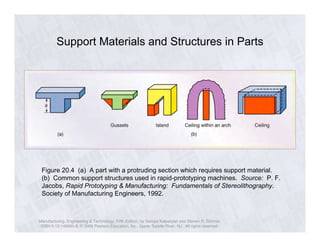
Support Materials and Structures in Parts 
Figure 20.4 (a) A part with a protruding section which requires support material. 
(b) Common support structures used in rapid-prototyping machines. Source: P. F. 
Jacobs, Rapid Prototyping & Manufacturing: Fundamentals of Stereolithography. 
Society of Manufacturing Engineers, 1992. 
Manufacturing, Engineering & Technology, Fifth Edition, by Serope Kalpakjian and Steven R. Schmid. 
ISBN 0-13-148965-8. © 2006 Pearson Education, Inc., Upper Saddle River, NJ. All rights reserved.
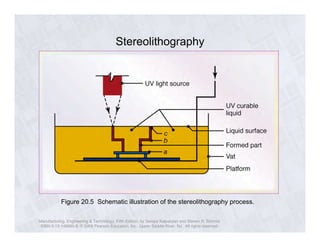
Stereolithography 
Figure 20.5 Schematic illustration of the stereolithography process. 
Manufacturing, Engineering & Technology, Fifth Edition, by Serope Kalpakjian and Steven R. Schmid. 
ISBN 0-13-148965-8. © 2006 Pearson Education, Inc., Upper Saddle River, NJ. All rights reserved.
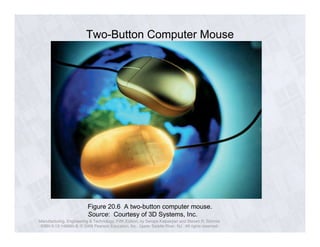
Two-Button Computer Mouse 
Figure 20.6 A two-button computer mouse. 
Source: Courtesy of 3D Systems, Inc. 
Manufacturing, Engineering & Technology, Fifth Edition, by Serope Kalpakjian and Steven R. Schmid. 
ISBN 0-13-148965-8. © 2006 Pearson Education, Inc., Upper Saddle River, NJ. All rights reserved.
Selective-Laser-Sintering 
Figure 20.7 Schematic illustration of the selective-laser-sintering process. 
Source: After C. Deckard and P. F. McClure. 
Manufacturing, Engineering & Technology, Fifth Edition, by Serope Kalpakjian and Steven R. Schmid. 
ISBN 0-13-148965-8. © 2006 Pearson Education, Inc., Upper Saddle River, NJ. All rights reserved.
Three-Dimensional-Printing 
Figure 20.8 Schematic illustration of the three-dimensional-printing process. 
Source: After E. Sachs and M. Cima. 
Manufacturing, Engineering & Technology, Fifth Edition, by Serope Kalpakjian and Steven R. Schmid. 
ISBN 0-13-148965-8. © 2006 Pearson Education, Inc., Upper Saddle River, NJ. All rights reserved.
Three-Dimensional-Printing to Produce Metal Parts 
Figure 20.9 Three-dimensional-printing using (a) part-build, (b) sinter, and (c) infiltration 
steps to produce metal parts. (d) An example of a bronze-infiltrated stainless-steel part 
produced through three-dimensional printing. Source: Courtesy of ProMetal. 
Manufacturing, Engineering & Technology, Fifth Edition, by Serope Kalpakjian and Steven R. Schmid. 
ISBN 0-13-148965-8. © 2006 Pearson Education, Inc., Upper Saddle River, NJ. All rights reserved.
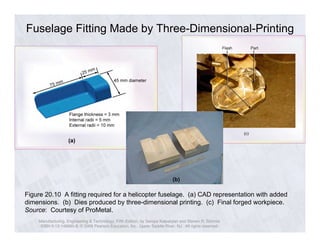
Fuselage Fitting Made by Three-Dimensional-Printing 
(a) 
(b) 
Figure 20.10 A fitting required for a helicopter fuselage. (a) CAD representation with added 
dimensions. (b) Dies produced by three-dimensional printing. (c) Final forged workpiece. 
Source: Courtesy of ProMetal. 
Manufacturing, Engineering & Technology, Fifth Edition, by Serope Kalpakjian and Steven R. Schmid. 
ISBN 0-13-148965-8. © 2006 Pearson Education, Inc., Upper Saddle River, NJ. All rights reserved.
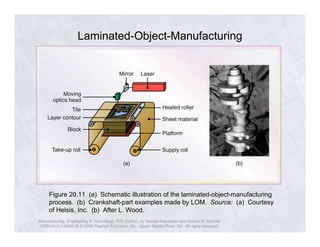
Laminated-Object-Manufacturing 
Figure 20.11 (a) Schematic illustration of the laminated-object-manufacturing 
process. (b) Crankshaft-part examples made by LOM. Source: (a) Courtesy 
of Helsis, Inc. (b) After L. Wood. 
Manufacturing, Engineering & Technology, Fifth Edition, by Serope Kalpakjian and Steven R. Schmid. 
ISBN 0-13-148965-8. © 2006 Pearson Education, Inc., Upper Saddle River, NJ. All rights reserved.
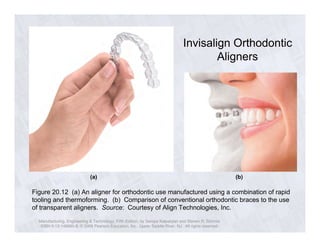
Invisalign Orthodontic 
Aligners 
(a) (b) 
Figure 20.12 (a) An aligner for orthodontic use manufactured using a combination of rapid 
tooling and thermoforming. (b) Comparison of conventional orthodontic braces to the use 
of transparent aligners. Source: Courtesy of Align Technologies, Inc. 
Manufacturing, Engineering & Technology, Fifth Edition, by Serope Kalpakjian and Steven R. Schmid. 
ISBN 0-13-148965-8. © 2006 Pearson Education, Inc., Upper Saddle River, NJ. All rights reserved.
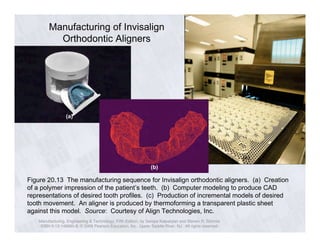
Manufacturing of Invisalign 
Orthodontic Aligners 
(a) 
(b) 
Figure 20.13 The manufacturing sequence for Invisalign orthodontic aligners. (a) Creation 
of a polymer impression of the patient’s teeth. (b) Computer modeling to produce CAD 
representations of desired tooth profiles. (c) Production of incremental models of desired 
tooth movement. An aligner is produced by thermoforming a transparent plastic sheet 
against this model. Source: Courtesy of Align Technologies, Inc. 
Manufacturing, Engineering & Technology, Fifth Edition, by Serope Kalpakjian and Steven R. Schmid. 
ISBN 0-13-148965-8. © 2006 Pearson Education, Inc., Upper Saddle River, NJ. All rights reserved. 
(c)
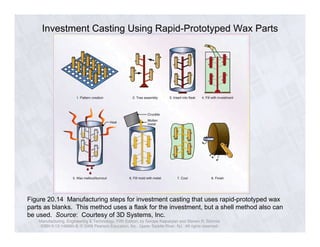
Investment Casting Using Rapid-Prototyped Wax Parts 
Figure 20.14 Manufacturing steps for investment casting that uses rapid-prototyped wax 
parts as blanks. This method uses a flask for the investment, but a shell method also can 
be used. Source: Courtesy of 3D Systems, Inc. 
Manufacturing, Engineering & Technology, Fifth Edition, by Serope Kalpakjian and Steven R. Schmid. 
ISBN 0-13-148965-8. © 2006 Pearson Education, Inc., Upper Saddle River, NJ. All rights reserved.
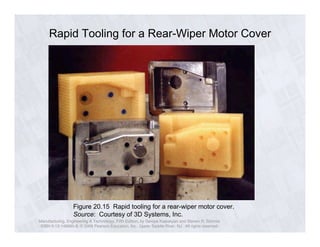
Rapid Tooling for a Rear-Wiper Motor Cover 
Figure 20.15 Rapid tooling for a rear-wiper motor cover. 
Source: Courtesy of 3D Systems, Inc. 
Manufacturing, Engineering & Technology, Fifth Edition, by Serope Kalpakjian and Steven R. Schmid. 
ISBN 0-13-148965-8. © 2006 Pearson Education, Inc., Upper Saddle River, NJ. All rights reserved.

Ch20 rapid prototype Erdi Karaçal Mechanical Engineer University of Gaziantep

  • 1.
    Chapter 20 Rapid-PrototypingOperations Manufacturing, Engineering & Technology, Fifth Edition, by Serope Kalpakjian and Steven R. Schmid. ISBN 0-13-148965-8. © 2006 Pearson Education, Inc., Upper Saddle River, NJ. All rights reserved.
  • 2.
    Parts Made byRapid-Prototyping (a) (b) Manufacturing, Engineering & Technology, Fifth Edition, by Serope Kalpakjian and Steven R. Schmid. ISBN 0-13-148965-8. © 2006 Pearson Education, Inc., Upper Saddle River, NJ. All rights reserved. (c) Figure 20.1 Examples of parts made by rapid-prototyping processes: (a) selection of parts from fused-deposition modeling; (b) stereolithography model of cellular phone; and (c) selection of parts form three-dimensional printing. Source: Courtesy of Stratasys, Inc., (b) and (c) Courtesy of 3D Systems, Inc.
  • 3.
    Characteristics of AdditiveRapid-Prototyping Technologies Manufacturing, Engineering & Technology, Fifth Edition, by Serope Kalpakjian and Steven R. Schmid. ISBN 0-13-148965-8. © 2006 Pearson Education, Inc., Upper Saddle River, NJ. All rights reserved.
  • 4.
    Mechanical Properties ofSelected Materials for Rapid Prototyping Manufacturing, Engineering & Technology, Fifth Edition, by Serope Kalpakjian and Steven R. Schmid. ISBN 0-13-148965-8. © 2006 Pearson Education, Inc., Upper Saddle River, NJ. All rights reserved.
  • 5.
    Computational Steps inRapid Prototyping Figure 20.2 The computational steps in producing a stereolithography file. (a) Three-dimensional description of each part. (b) The part is divided into slices (only one in 10 is shown). (c) Support material is planned. (d) A set of tool directions is determined to manufacture each slice. Also shown is the extruder path at section A-A from (c) for a fused-deposition-modeling Manufacturing, Engineering & Technology, Fifth Edition, by Serope Kalpakjian and Steven R. Schmid. ISBN 0-13-148965-8. © 2006 Pearson Education, Inc., Upper Saddle River, NJ. All rights reserved. operation.
  • 6.
    Fused-Deposition-Modeling Figure 20.3(a) Schematic illustration of the fused-deposition-modeling process. (b) The FDM 5000, a fused-deposition-modeling machine. Source: Courtesy of Stratysis, Inc. Manufacturing, Engineering & Technology, Fifth Edition, by Serope Kalpakjian and Steven R. Schmid. ISBN 0-13-148965-8. © 2006 Pearson Education, Inc., Upper Saddle River, NJ. All rights reserved.
  • 7.
    Support Materials andStructures in Parts Figure 20.4 (a) A part with a protruding section which requires support material. (b) Common support structures used in rapid-prototyping machines. Source: P. F. Jacobs, Rapid Prototyping & Manufacturing: Fundamentals of Stereolithography. Society of Manufacturing Engineers, 1992. Manufacturing, Engineering & Technology, Fifth Edition, by Serope Kalpakjian and Steven R. Schmid. ISBN 0-13-148965-8. © 2006 Pearson Education, Inc., Upper Saddle River, NJ. All rights reserved.
  • 8.
    Stereolithography Figure 20.5Schematic illustration of the stereolithography process. Manufacturing, Engineering & Technology, Fifth Edition, by Serope Kalpakjian and Steven R. Schmid. ISBN 0-13-148965-8. © 2006 Pearson Education, Inc., Upper Saddle River, NJ. All rights reserved.
  • 9.
    Two-Button Computer Mouse Figure 20.6 A two-button computer mouse. Source: Courtesy of 3D Systems, Inc. Manufacturing, Engineering & Technology, Fifth Edition, by Serope Kalpakjian and Steven R. Schmid. ISBN 0-13-148965-8. © 2006 Pearson Education, Inc., Upper Saddle River, NJ. All rights reserved.
  • 10.
    Selective-Laser-Sintering Figure 20.7Schematic illustration of the selective-laser-sintering process. Source: After C. Deckard and P. F. McClure. Manufacturing, Engineering & Technology, Fifth Edition, by Serope Kalpakjian and Steven R. Schmid. ISBN 0-13-148965-8. © 2006 Pearson Education, Inc., Upper Saddle River, NJ. All rights reserved.
  • 11.
    Three-Dimensional-Printing Figure 20.8Schematic illustration of the three-dimensional-printing process. Source: After E. Sachs and M. Cima. Manufacturing, Engineering & Technology, Fifth Edition, by Serope Kalpakjian and Steven R. Schmid. ISBN 0-13-148965-8. © 2006 Pearson Education, Inc., Upper Saddle River, NJ. All rights reserved.
  • 12.
    Three-Dimensional-Printing to ProduceMetal Parts Figure 20.9 Three-dimensional-printing using (a) part-build, (b) sinter, and (c) infiltration steps to produce metal parts. (d) An example of a bronze-infiltrated stainless-steel part produced through three-dimensional printing. Source: Courtesy of ProMetal. Manufacturing, Engineering & Technology, Fifth Edition, by Serope Kalpakjian and Steven R. Schmid. ISBN 0-13-148965-8. © 2006 Pearson Education, Inc., Upper Saddle River, NJ. All rights reserved.
  • 13.
    Fuselage Fitting Madeby Three-Dimensional-Printing (a) (b) Figure 20.10 A fitting required for a helicopter fuselage. (a) CAD representation with added dimensions. (b) Dies produced by three-dimensional printing. (c) Final forged workpiece. Source: Courtesy of ProMetal. Manufacturing, Engineering & Technology, Fifth Edition, by Serope Kalpakjian and Steven R. Schmid. ISBN 0-13-148965-8. © 2006 Pearson Education, Inc., Upper Saddle River, NJ. All rights reserved.
  • 14.
    Laminated-Object-Manufacturing Figure 20.11(a) Schematic illustration of the laminated-object-manufacturing process. (b) Crankshaft-part examples made by LOM. Source: (a) Courtesy of Helsis, Inc. (b) After L. Wood. Manufacturing, Engineering & Technology, Fifth Edition, by Serope Kalpakjian and Steven R. Schmid. ISBN 0-13-148965-8. © 2006 Pearson Education, Inc., Upper Saddle River, NJ. All rights reserved.
  • 15.
    Invisalign Orthodontic Aligners (a) (b) Figure 20.12 (a) An aligner for orthodontic use manufactured using a combination of rapid tooling and thermoforming. (b) Comparison of conventional orthodontic braces to the use of transparent aligners. Source: Courtesy of Align Technologies, Inc. Manufacturing, Engineering & Technology, Fifth Edition, by Serope Kalpakjian and Steven R. Schmid. ISBN 0-13-148965-8. © 2006 Pearson Education, Inc., Upper Saddle River, NJ. All rights reserved.
  • 16.
    Manufacturing of Invisalign Orthodontic Aligners (a) (b) Figure 20.13 The manufacturing sequence for Invisalign orthodontic aligners. (a) Creation of a polymer impression of the patient’s teeth. (b) Computer modeling to produce CAD representations of desired tooth profiles. (c) Production of incremental models of desired tooth movement. An aligner is produced by thermoforming a transparent plastic sheet against this model. Source: Courtesy of Align Technologies, Inc. Manufacturing, Engineering & Technology, Fifth Edition, by Serope Kalpakjian and Steven R. Schmid. ISBN 0-13-148965-8. © 2006 Pearson Education, Inc., Upper Saddle River, NJ. All rights reserved. (c)
  • 17.
    Investment Casting UsingRapid-Prototyped Wax Parts Figure 20.14 Manufacturing steps for investment casting that uses rapid-prototyped wax parts as blanks. This method uses a flask for the investment, but a shell method also can be used. Source: Courtesy of 3D Systems, Inc. Manufacturing, Engineering & Technology, Fifth Edition, by Serope Kalpakjian and Steven R. Schmid. ISBN 0-13-148965-8. © 2006 Pearson Education, Inc., Upper Saddle River, NJ. All rights reserved.
  • 18.
    Rapid Tooling fora Rear-Wiper Motor Cover Figure 20.15 Rapid tooling for a rear-wiper motor cover. Source: Courtesy of 3D Systems, Inc. Manufacturing, Engineering & Technology, Fifth Edition, by Serope Kalpakjian and Steven R. Schmid. ISBN 0-13-148965-8. © 2006 Pearson Education, Inc., Upper Saddle River, NJ. All rights reserved.