


Metallurgical Testing
By - K.Sevugarajan
Contact details
Metz Lab Pvt.Ltd.
First floor, Thangavel Nagar
Walajabad Main Road,
Mannivakkam-600048
Cell: +91-8190810222
Mail: sevugarajan@metzlab.org
www.metzlab.org
www.metzlab.org
• Classification of testing
• Importance of testing
• Destructive testing
• Mechanical testing(hardness, tensile and impact)
• Metallographic testing(microstructure, case
depth etc,.)
• Chemical testing(spectro,edax etc)
• Other testing
Metallurgical testing-Course content
www.metzlab.org
Destructive Examination
• Destructive Examination renders the material
unfit for further service.
www.metzlab.org
Common methods used in Destructive
Examination
• Tensile testing
• Impact testing
• Bend testing
• Hardness testing
• Chemical analysis
• Metallography
• Peel testing
• Spark testing
www.metzlab.org
Tensile Strength Testing
• “Tensile” is a test in which a prepared sample
is pulled until the sample breaks.
• Test Measurements are recorded in PSI (Pounds
per Square Inch) E7018 = 70,000 PSI Tensile
• Test samples called “Tensile Bolts” can reveal a
welds Tensile strength, Elastic limit, Yield
point, and Ductility.
www.metzlab.org
Tensile Strength Testing
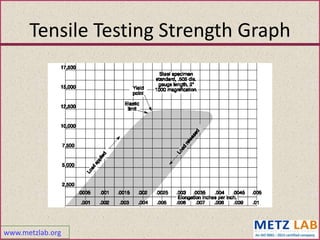
• The Elastic Limit of metal is the stress (load) it
can withstand and still return to the original
length after the load is released.
• Yield Strength occurs when the test sample
stretches however will not return to its
original length.
• Ductility is the ability of a metal to stretch or
elongate before it breaks.
www.metzlab.org
7
Properties Obtained from the Tensile Test
 Elastic limit
 Tensile strength, Necking
 Poisson’s ratio
 Modulus of resilience (Er)
 Tensile toughness
 Ductility
www.metzlab.org
8
(c)2003 Brooks/Cole, a division of Thomson Learning, Inc. Thomson Learning™ is a trademark used herein under license.
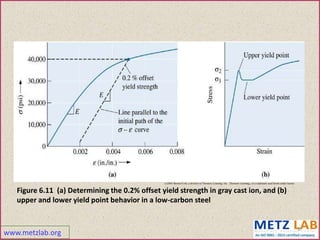
Figure 6.11 (a) Determining the 0.2% offset yield strength in gray cast ion, and (b)
upper and lower yield point behavior in a low-carbon steel
www.metzlab.org
9
(c)2003 Brooks/Cole, a division of Thomson Learning, Inc. Thomson Learning™ is a trademark used herein under license.
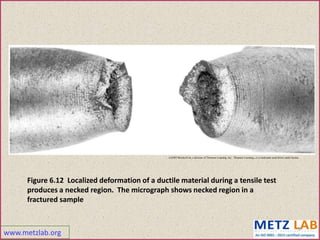
Figure 6.12 Localized deformation of a ductile material during a tensile test
produces a necked region. The micrograph shows necked region in a
fractured sample
www.metzlab.org
10
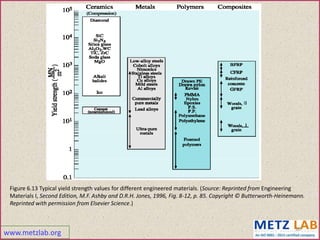
Figure 6.13 Typical yield strength values for different engineered materials. (Source: Reprinted from Engineering
Materials I, Second Edition, M.F. Ashby and D.R.H. Jones, 1996, Fig. 8-12, p. 85. Copyright © Butterworth-Heinemann.
Reprinted with permission from Elsevier Science.)
www.metzlab.org
Tensile Testing Strength Graph
www.metzlab.org
12
Strain Rate Effects and Impact Behavior
 Impact test - Measures the ability of a material to absorb the sudden
application of a load without breaking.
 Impact energy - The energy required to fracture a standard specimen
when the load is applied suddenly.
 Impact toughness - Energy absorbed by a material, usually notched,
during fracture, under the conditions of impact test.
 Fracture toughness - The resistance of a material to failure in the
presence of a flaw.
www.metzlab.org
13
(c)2003 Brooks/Cole, a division of Thomson Learning, Inc. Thomson Learning™ is a trademark used herein under license.
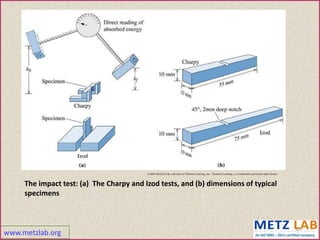
The impact test: (a) The Charpy and Izod tests, and (b) dimensions of typical
specimens
www.metzlab.org
Impact Testing
• An Impact tester uses a heavy pendulum that
is able to measure the amount of force
required to shear or fracture a test sample
taken from welds “Heat Affected Zone” (HAZ)
• Impact testing may be performed using either
the Izod or Charpy method. (Both methods are
similar)
www.metzlab.org
Impact Testing
• A Charpy or Izod test measures the welds
ability to withstand an Impact force.
• Low Charpy test readings indicate brittle weld
metal
• Higher Charpy readings indicate the samples
toughness.
www.metzlab.org
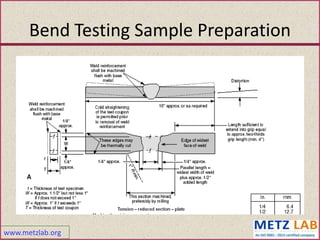
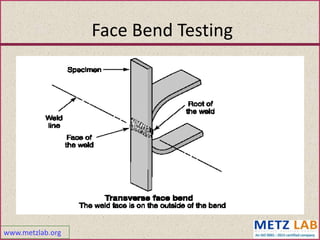
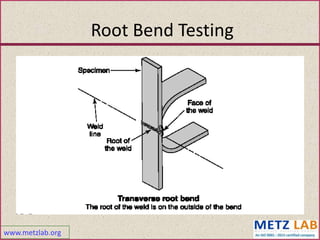
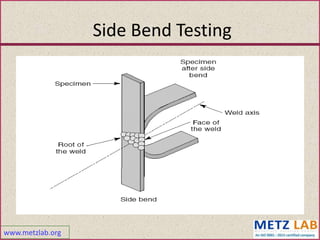
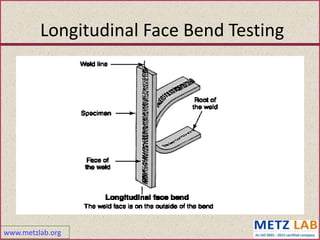
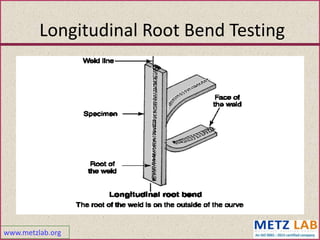
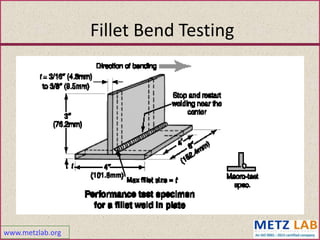
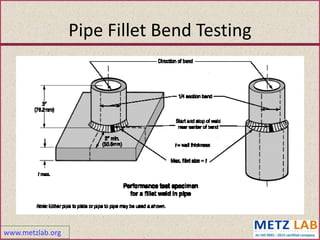
Bend Testing
• Bend test samples are referred to as
“Test Coupons”
• The most common bend tests are
– Guided face and root bend testing
– Guided side bend testing
– Longitudinal root and side bend testing
– Fillet weld bend testing
– Unguided bend testing
www.metzlab.org
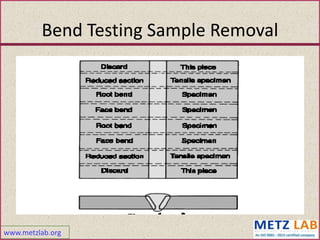
Bend Testing Sample Removal
www.metzlab.org
Bend Testing Sample Preparation
www.metzlab.org
Face Bend Testing
www.metzlab.org
Root Bend Testing
www.metzlab.org
Side Bend Testing
www.metzlab.org
Longitudinal Face Bend Testing
www.metzlab.org
Longitudinal Root Bend Testing
www.metzlab.org
Fillet Bend Testing
www.metzlab.org
Pipe Fillet Bend Testing
www.metzlab.org
Hardness testing
• Hardness may be defined as the
resistance to permanent indentation.
• Three common hardness measuring
tests are
– Rockwell test
– Scleroscope test
– Brinell
– Microhardness test
www.metzlab.org
27
Hardness of Materials
 Hardness test - Measures the resistance of a material to penetration
by a sharp object.
 Macrohardness - Overall bulk hardness of materials measured using
loads >2 N.
 Microhardness Hardness of materials typically measured using loads
less than 2 N using such test as Knoop (HK).
 Nano-hardness - Hardness of materials measured at 1–10 nm length
scale using extremely small (~100 µN) forces.
www.metzlab.org
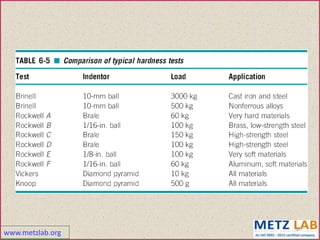
28
(c)2003 Brooks/Cole, a division of Thomson Learning, Inc. Thomson Learning™ is a trademark used herein under
license.
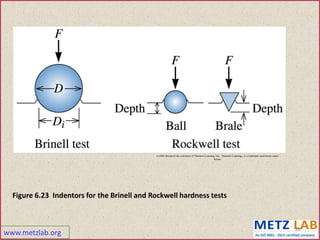
Figure 6.23 Indentors for the Brinell and Rockwell hardness tests
www.metzlab.org
Hardness testing
• The Rockwell testing machine operates
somewhat like a press, using a indenter to
penetrate the surface of the test sample.
• The depth of the indentation determines
the materials hardness on a scale of 0-100
www.metzlab.org
Hardness testing
• The Sceleroscpoe testing machine measures
the amount “bounce” that a diamond tip
hammer rebounds off the test sample after
being dropped.
• The Brinell method presses the “indenter”
into a sample for a given period of time.
• The ability for the sample to resist
indentation determines hardness.
www.metzlab.org
Hardness testing
• Microhardness testers allow you to
measure a materials hardness while leaving
the least amount of damage possible on
the metals surface.
• After the indenter is used a powerful
microscope is used to determine the the
amount of indentation into the
components surface.
www.metzlab.org
32
www.metzlab.org
Chemical Analysis
• Chemical analysis is used in metallurgical
laboratories to determine the metals grain
and crystalline structures.
• Samples are then place under a high power
microscope to view the results.
• This is referred to as “Metalography”
www.metzlab.org
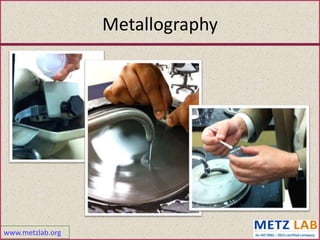
Metallography
www.metzlab.org
Objective
• To prepare the specimens surfaces to be examined
for their microstructure study by the microscope .
• To learn and to gain experience in the preparation of
metallographic specimens.
35
www.metzlab.org
Introduction
• Metallography is basically the study of the structures and
constitution of metals and alloys, using metallurgical
microscopes and magnifications, so that the physical and
mechanical properties of an alloy can be related to its
observed microstructure.
• It provides information about the specimen under
investigation, including the size and shape of the grains
(crystallites), the presence of micro defects (such as
segregation, hair cracks, and nonmetallic inclusions), and
the nature and distribution of secondary phases.
36
www.metzlab.org
Metallography
• Cutting
• Grounding – emery paper (240, 300, 400, 600)
• Polishing (0.5, 0.1, 0.05μ)
• Etching –Nitol/ Kellers Solution
• Microscopy
www.metzlab.org
• Soft non-ferrous metals - Initial grinding is recommended with 320 grit SiC
• abrasive paper followed by 320 400, 600 and , 800 grit SiC paper. because
These materials are relatively soft they do not easily break down the SiC
paper.
• The initial grinding with 320 grit is generally sufficient for minimizing initial
deformation and yet maintaining adequate removal rates.
•
• For extremely soft materials such as tin, lead and zinc it is also
recommended that the abrasive paper be lightly coated with a paraffin wax.
The wax reduces
• the tendency of the SiC abrasive to embed into the soft specimen.
Grinding Soft non-ferrous metals
www.metzlab.org
• Ferrous metals - are relatively easy to grind with the depth of
deformation being a major consideration.
120 grit SiC abrasives provide a good initial start with subsequent use
of 240 or 320, 400, 600 and 800 grit SiC.
• Super alloys - are generally of moderate hardness but have extremely
stable elevated temperature characteristics and corrosion resistance.
• the procedures for preparing super alloys is very similar to that for
most non-ferrous metals.
Grinding Ferrous metals
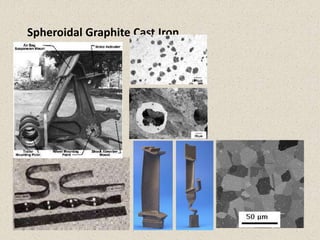
Spheroidal Graphite Cast Iron
www.metzlab.org
• Polishing is the process of creating a smooth
and shiny surface by rubbing it or using a
chemical action, leaving a surface with a
significant reflection
• Aluminum Oxide(0.5, 0.1, 0.05μ)
Polishing
www.metzlab.org
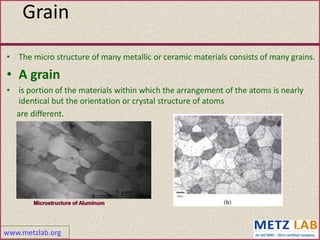
Grain
• The micro structure of many metallic or ceramic materials consists of many grains.
• A grain
• is portion of the materials within which the arrangement of the atoms is nearly
identical but the orientation or crystal structure of atoms
are different.
42
www.metzlab.org
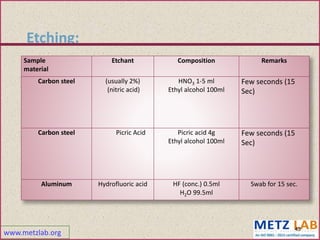
Etching:
Sample
material
Etchant Composition Remarks
Carbon steel (usually 2%)
(nitric acid)
HNO3 1-5 ml
Ethyl alcohol 100ml
Few seconds (15
Sec)
Carbon steel Picric Acid Picric acid 4g
Ethyl alcohol 100ml
Few seconds (15
Sec)
Aluminum Hydrofluoric acid HF (conc.) 0.5ml
H2O 99.5ml
Swab for 15 sec.
43
www.metzlab.org
Hydrostatic Testing to Destruction
• Pressure testing or leak testing can be
performed with either gasses or liquids.
• When this pressure exceeds the limitations of
the structures design it will rupture under
force.
• This rupture will allow engineers to
understand the welds weakest areas.
www.metzlab.org
Peel testing
• Lap joints may be tested to destruction using a
Peel test.
• Peel testing is most commonly used to check
the strength of resistance spot welds or stud
weld
• Spot weld peel tests are considered successful
when the spot weld nugget is torn out of the
test sample pieces in tact.
www.metzlab.org
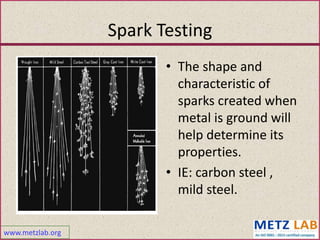
Spark Testing
• The shape and
characteristic of
sparks created when
metal is ground will
help determine its
properties.
• IE: carbon steel ,
mild steel.
Thank You !

Metallrgical Testing

  • 1.
    Metallurgical Testing By -K.Sevugarajan Contact details Metz Lab Pvt.Ltd. First floor, Thangavel Nagar Walajabad Main Road, Mannivakkam-600048 Cell: +91-8190810222 Mail: sevugarajan@metzlab.org www.metzlab.org
  • 2.
    www.metzlab.org • Classification oftesting • Importance of testing • Destructive testing • Mechanical testing(hardness, tensile and impact) • Metallographic testing(microstructure, case depth etc,.) • Chemical testing(spectro,edax etc) • Other testing Metallurgical testing-Course content
  • 3.
    www.metzlab.org Destructive Examination • DestructiveExamination renders the material unfit for further service.
  • 4.
    www.metzlab.org Common methods usedin Destructive Examination • Tensile testing • Impact testing • Bend testing • Hardness testing • Chemical analysis • Metallography • Peel testing • Spark testing
  • 5.
    www.metzlab.org Tensile Strength Testing •“Tensile” is a test in which a prepared sample is pulled until the sample breaks. • Test Measurements are recorded in PSI (Pounds per Square Inch) E7018 = 70,000 PSI Tensile • Test samples called “Tensile Bolts” can reveal a welds Tensile strength, Elastic limit, Yield point, and Ductility.
  • 6.
    www.metzlab.org Tensile Strength Testing •The Elastic Limit of metal is the stress (load) it can withstand and still return to the original length after the load is released. • Yield Strength occurs when the test sample stretches however will not return to its original length. • Ductility is the ability of a metal to stretch or elongate before it breaks.
  • 7.
    www.metzlab.org 7 Properties Obtained fromthe Tensile Test  Elastic limit  Tensile strength, Necking  Poisson’s ratio  Modulus of resilience (Er)  Tensile toughness  Ductility
  • 8.
    www.metzlab.org 8 (c)2003 Brooks/Cole, adivision of Thomson Learning, Inc. Thomson Learning™ is a trademark used herein under license. Figure 6.11 (a) Determining the 0.2% offset yield strength in gray cast ion, and (b) upper and lower yield point behavior in a low-carbon steel
  • 9.
    www.metzlab.org 9 (c)2003 Brooks/Cole, adivision of Thomson Learning, Inc. Thomson Learning™ is a trademark used herein under license. Figure 6.12 Localized deformation of a ductile material during a tensile test produces a necked region. The micrograph shows necked region in a fractured sample
  • 10.
    www.metzlab.org 10 Figure 6.13 Typicalyield strength values for different engineered materials. (Source: Reprinted from Engineering Materials I, Second Edition, M.F. Ashby and D.R.H. Jones, 1996, Fig. 8-12, p. 85. Copyright © Butterworth-Heinemann. Reprinted with permission from Elsevier Science.)
  • 11.
  • 12.
    www.metzlab.org 12 Strain Rate Effectsand Impact Behavior  Impact test - Measures the ability of a material to absorb the sudden application of a load without breaking.  Impact energy - The energy required to fracture a standard specimen when the load is applied suddenly.  Impact toughness - Energy absorbed by a material, usually notched, during fracture, under the conditions of impact test.  Fracture toughness - The resistance of a material to failure in the presence of a flaw.
  • 13.
    www.metzlab.org 13 (c)2003 Brooks/Cole, adivision of Thomson Learning, Inc. Thomson Learning™ is a trademark used herein under license. The impact test: (a) The Charpy and Izod tests, and (b) dimensions of typical specimens
  • 14.
    www.metzlab.org Impact Testing • AnImpact tester uses a heavy pendulum that is able to measure the amount of force required to shear or fracture a test sample taken from welds “Heat Affected Zone” (HAZ) • Impact testing may be performed using either the Izod or Charpy method. (Both methods are similar)
  • 15.
    www.metzlab.org Impact Testing • ACharpy or Izod test measures the welds ability to withstand an Impact force. • Low Charpy test readings indicate brittle weld metal • Higher Charpy readings indicate the samples toughness.
  • 16.
    www.metzlab.org Bend Testing • Bendtest samples are referred to as “Test Coupons” • The most common bend tests are – Guided face and root bend testing – Guided side bend testing – Longitudinal root and side bend testing – Fillet weld bend testing – Unguided bend testing
  • 17.
  • 18.
  • 19.
  • 20.
  • 21.
  • 22.
  • 23.
  • 24.
  • 25.
  • 26.
    www.metzlab.org Hardness testing • Hardnessmay be defined as the resistance to permanent indentation. • Three common hardness measuring tests are – Rockwell test – Scleroscope test – Brinell – Microhardness test
  • 27.
    www.metzlab.org 27 Hardness of Materials Hardness test - Measures the resistance of a material to penetration by a sharp object.  Macrohardness - Overall bulk hardness of materials measured using loads >2 N.  Microhardness Hardness of materials typically measured using loads less than 2 N using such test as Knoop (HK).  Nano-hardness - Hardness of materials measured at 1–10 nm length scale using extremely small (~100 µN) forces.
  • 28.
    www.metzlab.org 28 (c)2003 Brooks/Cole, adivision of Thomson Learning, Inc. Thomson Learning™ is a trademark used herein under license. Figure 6.23 Indentors for the Brinell and Rockwell hardness tests
  • 29.
    www.metzlab.org Hardness testing • TheRockwell testing machine operates somewhat like a press, using a indenter to penetrate the surface of the test sample. • The depth of the indentation determines the materials hardness on a scale of 0-100
  • 30.
    www.metzlab.org Hardness testing • TheSceleroscpoe testing machine measures the amount “bounce” that a diamond tip hammer rebounds off the test sample after being dropped. • The Brinell method presses the “indenter” into a sample for a given period of time. • The ability for the sample to resist indentation determines hardness.
  • 31.
    www.metzlab.org Hardness testing • Microhardnesstesters allow you to measure a materials hardness while leaving the least amount of damage possible on the metals surface. • After the indenter is used a powerful microscope is used to determine the the amount of indentation into the components surface.
  • 32.
  • 33.
    www.metzlab.org Chemical Analysis • Chemicalanalysis is used in metallurgical laboratories to determine the metals grain and crystalline structures. • Samples are then place under a high power microscope to view the results. • This is referred to as “Metalography”
  • 34.
  • 35.
    www.metzlab.org Objective • To preparethe specimens surfaces to be examined for their microstructure study by the microscope . • To learn and to gain experience in the preparation of metallographic specimens. 35
  • 36.
    www.metzlab.org Introduction • Metallography isbasically the study of the structures and constitution of metals and alloys, using metallurgical microscopes and magnifications, so that the physical and mechanical properties of an alloy can be related to its observed microstructure. • It provides information about the specimen under investigation, including the size and shape of the grains (crystallites), the presence of micro defects (such as segregation, hair cracks, and nonmetallic inclusions), and the nature and distribution of secondary phases. 36
  • 37.
    www.metzlab.org Metallography • Cutting • Grounding– emery paper (240, 300, 400, 600) • Polishing (0.5, 0.1, 0.05μ) • Etching –Nitol/ Kellers Solution • Microscopy
  • 38.
    www.metzlab.org • Soft non-ferrousmetals - Initial grinding is recommended with 320 grit SiC • abrasive paper followed by 320 400, 600 and , 800 grit SiC paper. because These materials are relatively soft they do not easily break down the SiC paper. • The initial grinding with 320 grit is generally sufficient for minimizing initial deformation and yet maintaining adequate removal rates. • • For extremely soft materials such as tin, lead and zinc it is also recommended that the abrasive paper be lightly coated with a paraffin wax. The wax reduces • the tendency of the SiC abrasive to embed into the soft specimen. Grinding Soft non-ferrous metals
  • 39.
    www.metzlab.org • Ferrous metals- are relatively easy to grind with the depth of deformation being a major consideration. 120 grit SiC abrasives provide a good initial start with subsequent use of 240 or 320, 400, 600 and 800 grit SiC. • Super alloys - are generally of moderate hardness but have extremely stable elevated temperature characteristics and corrosion resistance. • the procedures for preparing super alloys is very similar to that for most non-ferrous metals. Grinding Ferrous metals
  • 40.
  • 41.
    www.metzlab.org • Polishing isthe process of creating a smooth and shiny surface by rubbing it or using a chemical action, leaving a surface with a significant reflection • Aluminum Oxide(0.5, 0.1, 0.05μ) Polishing
  • 42.
    www.metzlab.org Grain • The microstructure of many metallic or ceramic materials consists of many grains. • A grain • is portion of the materials within which the arrangement of the atoms is nearly identical but the orientation or crystal structure of atoms are different. 42
  • 43.
    www.metzlab.org Etching: Sample material Etchant Composition Remarks Carbonsteel (usually 2%) (nitric acid) HNO3 1-5 ml Ethyl alcohol 100ml Few seconds (15 Sec) Carbon steel Picric Acid Picric acid 4g Ethyl alcohol 100ml Few seconds (15 Sec) Aluminum Hydrofluoric acid HF (conc.) 0.5ml H2O 99.5ml Swab for 15 sec. 43
  • 44.
    www.metzlab.org Hydrostatic Testing toDestruction • Pressure testing or leak testing can be performed with either gasses or liquids. • When this pressure exceeds the limitations of the structures design it will rupture under force. • This rupture will allow engineers to understand the welds weakest areas.
  • 45.
    www.metzlab.org Peel testing • Lapjoints may be tested to destruction using a Peel test. • Peel testing is most commonly used to check the strength of resistance spot welds or stud weld • Spot weld peel tests are considered successful when the spot weld nugget is torn out of the test sample pieces in tact.
  • 46.
    www.metzlab.org Spark Testing • Theshape and characteristic of sparks created when metal is ground will help determine its properties. • IE: carbon steel , mild steel.
  • 47.