Metallurgy &Metallurgy &
Material ScienceMaterial Science
Dr.S.Jose
Dept of Mechanical Engg.,
TKM College of Engineering, Kollam
2
 Diffusion methods (case hardening)
 Selective hardening methods
 Layer additions
 Metal Coating
Surface Treatments
3
 Diffusion methods (case hardening)
 Carburising
 Cyaniding
 Nitriding
 Carbonitriding
 Selective hardening methods
 Flame hardening
 Induction hardening
 Laser hardening
 Electron Beam Hardening
Surface Treatments
4
 Layer additions
 Physical vapour deposition
 Chemical vapour deposition
 Thermal spraying
 Metal Coating
 Galvanising
 Electroplating
 Metal cladding
Surface Treatments
Case Hardening
 The primary purpose of case hardening is to
produce a surface which is resistant to wear
while maintaining the overall toughness and
strength of the steel core.
 Normally used on steel with a low carbon
content and introduces carbon by diffusion
(carburising) into the local surfaces
requiring treatment.
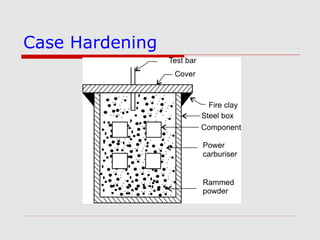
 Heating steel in the presence of a solid,
liquid or gas rich in carbon.
Case Hardening
Cyaniding
 Hardening the surface of steel with
carbon and nitrogen obtained from
a bath of liquid cyanide solution.
 Steel is heated in molten cyanide
at about 850 °C followed by
quenching.
 Carbon and nitrogen are absorbed
by steel.
Carbonitriding
 Hardening the surface of steel with
carbon and nitrogen
 Steel is heated in a gaseous
mixture of ammonia and
hydrocarons
Nitriding
 Another process called Nitriding consists
of the diffusion of nitrogen.
 Nitrogen is introduced into steel by
passing ammonia gas through a muffle
furnace containing the steel to be
nitrided.
 Temperature used is below the lower
critical temperature
 Greater resistance to wear and
corrosion, greater surface hardness.
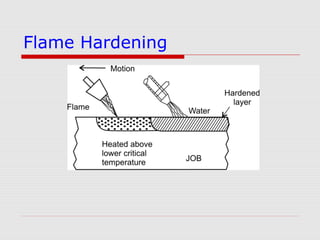
Flame Hardening
 Heating the surface being hardened above the
upper critical temperature with an oxy
acetylene flame before quenching it in a spray
of water.
 This is a surface hardening process resulting in
a hard surface layer of about 2mm to 6mm
deep.
 The main difference between this process and
other surface hardening processes is that the
composition of the steel being hardened is not
changed.
Flame Hardening
Flame Hardening
 The steel must itself have sufficient
hardenability .
 Limits this process to steels having carbon
contents of above 0.35%.
 Steels with carbon contents of 0.4%-0.7% are
most suitable for this process.
 Steels with higher C content and high alloy
steels may not be suitable as they a liable to
cracking.
 Result similar to the conventional hardening
process but with less hardness penetration.
Induction Hardening
 Surface to be hardened is heated
using inductive heating.
 Depth of hardness can be closely
monitored by controlling current.
 Time required for the process is less.
 Used for producing hard surfaces on
crankshafts, axles, gears etc.
Layer Additions
 Physical vapour deposition
 Chemical vapour deposition
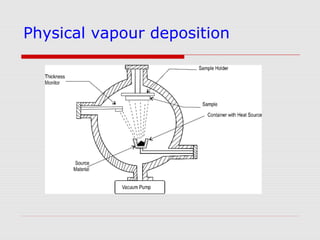
Physical vapour deposition
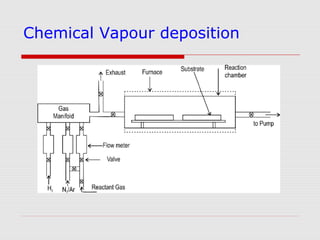
Chemical Vapour deposition
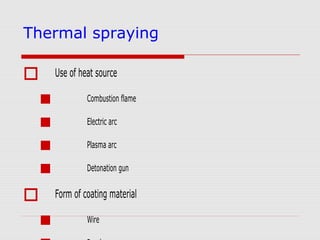
Thermal spraying
 Use of heat source
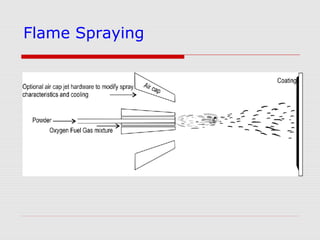
 Combustion flame
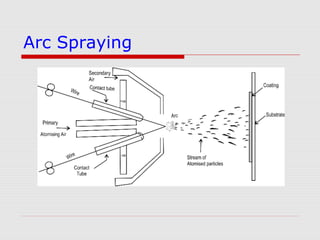
 Electric arc
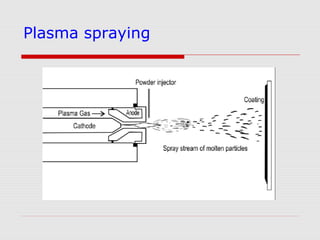
 Plasma arc
 Detonation gun
 Form of coating material
 Wire
Arc Spraying
Flame Spraying
Plasma spraying
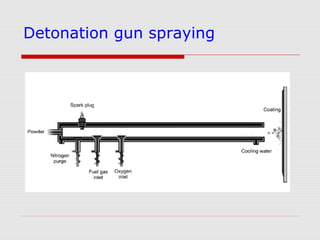
Detonation gun spraying