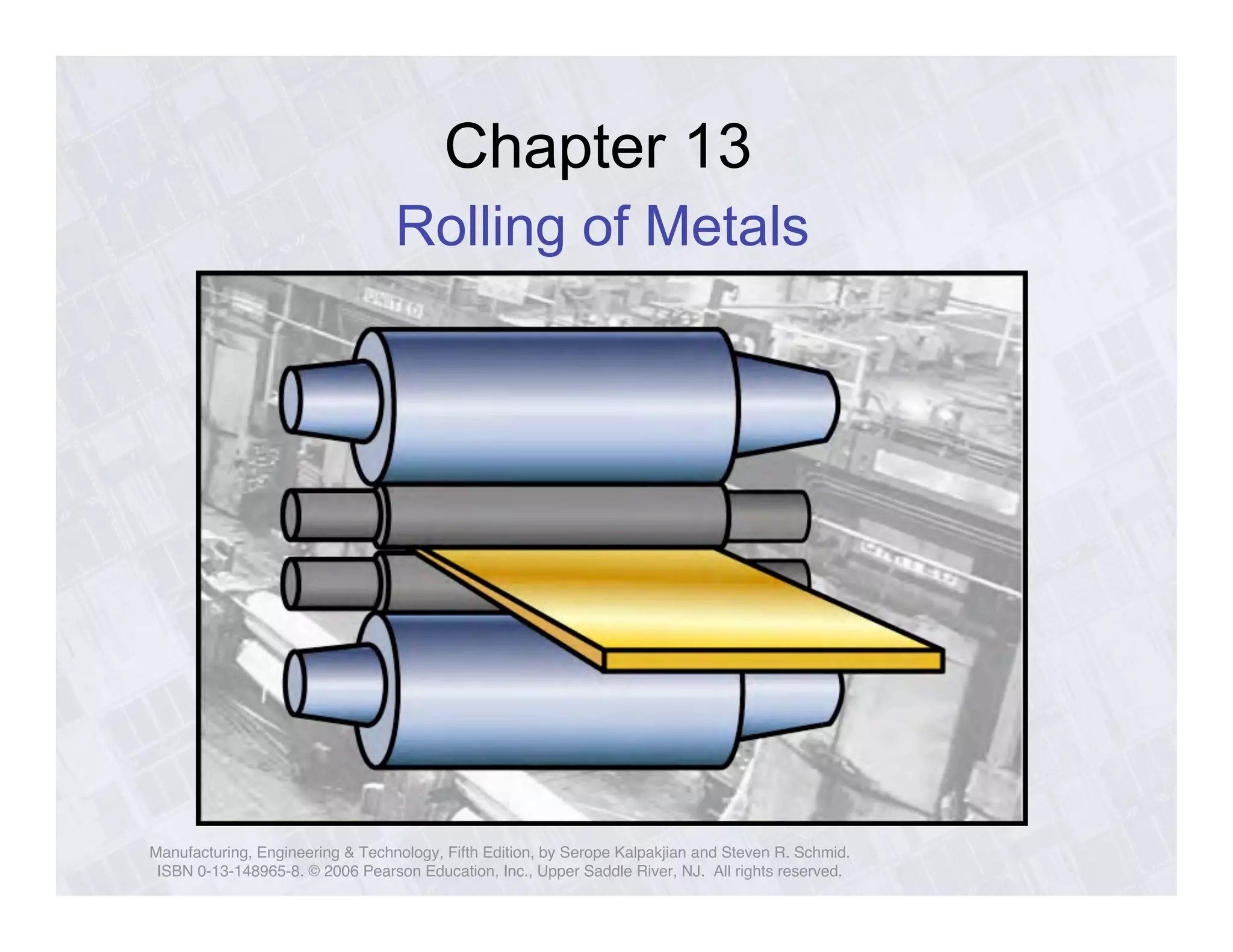
Chapter 13 
Rolling of Metals 
Manufacturing, Engineering & Technology, Fifth Edition, by Serope Kalpakjian and Steven R. Schmid. 
ISBN 0-13-148965-8. © 2006 Pearson Education, Inc., Upper Saddle River, NJ. All rights reserved.
Flat-Rolling and 
Shape-Rolling 
Processes 
Figure 13.1 Schematic 
outline of various flat-rolling 
Manufacturing, Engineering & Technology, Fifth Edition, by Serope Kalpakjian and Steven R. Schmid. 
ISBN 0-13-148965-8. © 2006 Pearson Education, Inc., Upper Saddle River, NJ. All rights reserved. 
and shape-rolling 
processes. Source: 
After the American Iron 
and Steel Institute.
Flat-Rolling Process 
Figure 13.2 (a) Schematic illustration of the flat-rolling process. (b) Friction forces acting on 
strip surfaces. (c) Roll force, F, and the torque, T, acting on the rolls. The width of the strip, 
w, usually increases during rolling, as shown later in Fig. 13.5. 
Manufacturing, Engineering & Technology, Fifth Edition, by Serope Kalpakjian and Steven R. Schmid. 
ISBN 0-13-148965-8. © 2006 Pearson Education, Inc., Upper Saddle River, NJ. All rights reserved.
Roll Arrangements 
Figure 13.3 Schematic illustration of various roll arrangements: (a) four-high 
rolling mill showing various features. The stiffness of the housing, the rolls, and the 
roll bearings are all important in controlling and maintaining the thickness of the 
rolled strip; (b) two-hill mill; (c) three-high mill; and (d) cluster (or Sendzimir) mill. 
Manufacturing, Engineering & Technology, Fifth Edition, by Serope Kalpakjian and Steven R. Schmid. 
ISBN 0-13-148965-8. © 2006 Pearson Education, Inc., Upper Saddle River, NJ. All rights reserved.
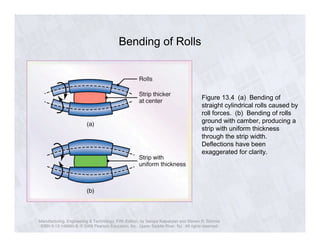
Bending of Rolls 
Figure 13.4 (a) Bending of 
straight cylindrical rolls caused by 
roll forces. (b) Bending of rolls 
ground with camber, producing a 
strip with uniform thickness 
through the strip width. 
Deflections have been 
exaggerated for clarity. 
Manufacturing, Engineering & Technology, Fifth Edition, by Serope Kalpakjian and Steven R. Schmid. 
ISBN 0-13-148965-8. © 2006 Pearson Education, Inc., Upper Saddle River, NJ. All rights reserved.
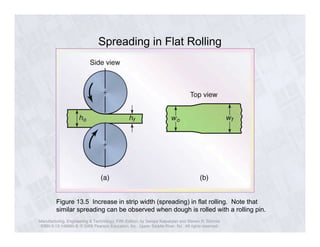
Spreading in Flat Rolling 
Figure 13.5 Increase in strip width (spreading) in flat rolling. Note that 
similar spreading can be observed when dough is rolled with a rolling pin. 
Manufacturing, Engineering & Technology, Fifth Edition, by Serope Kalpakjian and Steven R. Schmid. 
ISBN 0-13-148965-8. © 2006 Pearson Education, Inc., Upper Saddle River, NJ. All rights reserved.
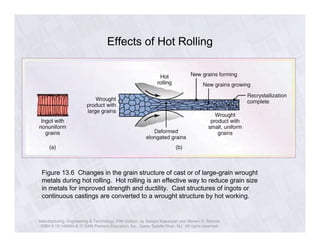
Effects of Hot Rolling 
Figure 13.6 Changes in the grain structure of cast or of large-grain wrought 
metals during hot rolling. Hot rolling is an effective way to reduce grain size 
in metals for improved strength and ductility. Cast structures of ingots or 
continuous castings are converted to a wrought structure by hot working. 
Manufacturing, Engineering & Technology, Fifth Edition, by Serope Kalpakjian and Steven R. Schmid. 
ISBN 0-13-148965-8. © 2006 Pearson Education, Inc., Upper Saddle River, NJ. All rights reserved.
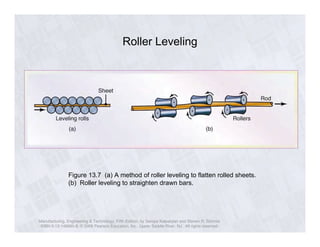
Roller Leveling 
Figure 13.7 (a) A method of roller leveling to flatten rolled sheets. 
(b) Roller leveling to straighten drawn bars. 
Manufacturing, Engineering & Technology, Fifth Edition, by Serope Kalpakjian and Steven R. Schmid. 
ISBN 0-13-148965-8. © 2006 Pearson Education, Inc., Upper Saddle River, NJ. All rights reserved.
Defects in Flat Rolling 
Figure 13.8 Schematic 
illustration of typical 
defects in flat rolling: (a) 
wavy edges; (b) zipper 
cracks in the center of the 
strip; (c) edge cracks; and 
(d) alligatoring. 
Manufacturing, Engineering & Technology, Fifth Edition, by Serope Kalpakjian and Steven R. Schmid. 
ISBN 0-13-148965-8. © 2006 Pearson Education, Inc., Upper Saddle River, NJ. All rights reserved.
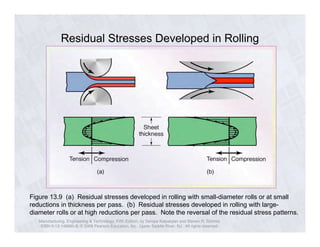
Residual Stresses Developed in Rolling 
Figure 13.9 (a) Residual stresses developed in rolling with small-diameter rolls or at small 
reductions in thickness per pass. (b) Residual stresses developed in rolling with large-diameter 
rolls or at high reductions per pass. Note the reversal of the residual stress patterns. 
Manufacturing, Engineering & Technology, Fifth Edition, by Serope Kalpakjian and Steven R. Schmid. 
ISBN 0-13-148965-8. © 2006 Pearson Education, Inc., Upper Saddle River, NJ. All rights reserved.
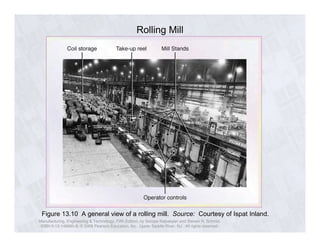
Rolling Mill 
Figure 13.10 A general view of a rolling mill. Source: Courtesy of Ispat Inland. 
Manufacturing, Engineering & Technology, Fifth Edition, by Serope Kalpakjian and Steven R. Schmid. 
ISBN 0-13-148965-8. © 2006 Pearson Education, Inc., Upper Saddle River, NJ. All rights reserved.
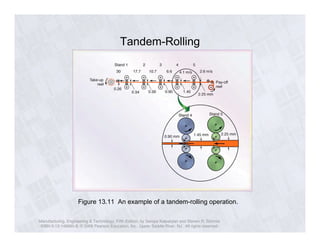
Tandem-Rolling 
Figure 13.11 An example of a tandem-rolling operation. 
Manufacturing, Engineering & Technology, Fifth Edition, by Serope Kalpakjian and Steven R. Schmid. 
ISBN 0-13-148965-8. © 2006 Pearson Education, Inc., Upper Saddle River, NJ. All rights reserved.
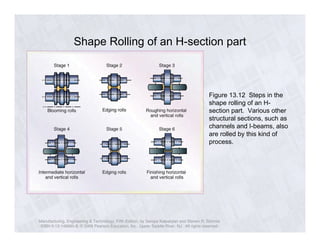
Shape Rolling of an H-section part 
Figure 13.12 Steps in the 
shape rolling of an H-section 
Manufacturing, Engineering & Technology, Fifth Edition, by Serope Kalpakjian and Steven R. Schmid. 
ISBN 0-13-148965-8. © 2006 Pearson Education, Inc., Upper Saddle River, NJ. All rights reserved. 
part. Various other 
structural sections, such as 
channels and I-beams, also 
are rolled by this kind of 
process.
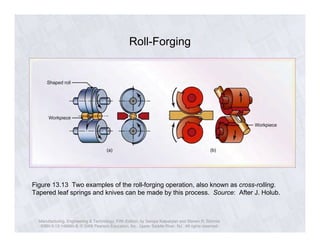
Roll-Forging 
Figure 13.13 Two examples of the roll-forging operation, also known as cross-rolling. 
Tapered leaf springs and knives can be made by this process. Source: After J. Holub. 
Manufacturing, Engineering & Technology, Fifth Edition, by Serope Kalpakjian and Steven R. Schmid. 
ISBN 0-13-148965-8. © 2006 Pearson Education, Inc., Upper Saddle River, NJ. All rights reserved.
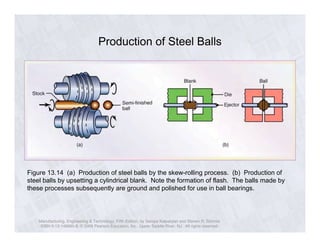
Production of Steel Balls 
Figure 13.14 (a) Production of steel balls by the skew-rolling process. (b) Production of 
steel balls by upsetting a cylindrical blank. Note the formation of flash. The balls made by 
these processes subsequently are ground and polished for use in ball bearings. 
Manufacturing, Engineering & Technology, Fifth Edition, by Serope Kalpakjian and Steven R. Schmid. 
ISBN 0-13-148965-8. © 2006 Pearson Education, Inc., Upper Saddle River, NJ. All rights reserved.
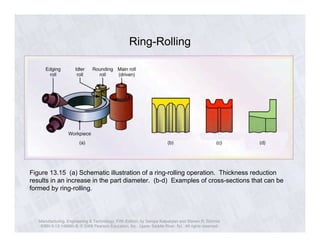
Ring-Rolling 
Figure 13.15 (a) Schematic illustration of a ring-rolling operation. Thickness reduction 
results in an increase in the part diameter. (b-d) Examples of cross-sections that can be 
formed by ring-rolling. 
Manufacturing, Engineering & Technology, Fifth Edition, by Serope Kalpakjian and Steven R. Schmid. 
ISBN 0-13-148965-8. © 2006 Pearson Education, Inc., Upper Saddle River, NJ. All rights reserved.
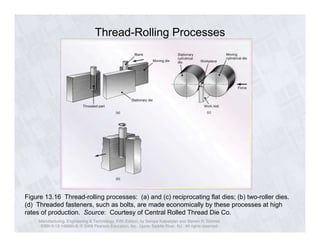
Thread-Rolling Processes 
Figure 13.16 Thread-rolling processes: (a) and (c) reciprocating flat dies; (b) two-roller dies. 
(d) Threaded fasteners, such as bolts, are made economically by these processes at high 
rates of production. Source: Courtesy of Central Rolled Thread Die Co. 
Manufacturing, Engineering & Technology, Fifth Edition, by Serope Kalpakjian and Steven R. Schmid. 
ISBN 0-13-148965-8. © 2006 Pearson Education, Inc., Upper Saddle River, NJ. All rights reserved.
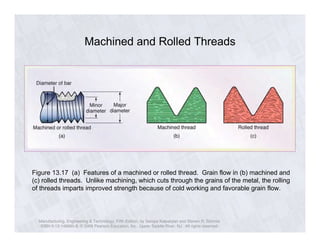
Machined and Rolled Threads 
Figure 13.17 (a) Features of a machined or rolled thread. Grain flow in (b) machined and 
(c) rolled threads. Unlike machining, which cuts through the grains of the metal, the rolling 
of threads imparts improved strength because of cold working and favorable grain flow. 
Manufacturing, Engineering & Technology, Fifth Edition, by Serope Kalpakjian and Steven R. Schmid. 
ISBN 0-13-148965-8. © 2006 Pearson Education, Inc., Upper Saddle River, NJ. All rights reserved.
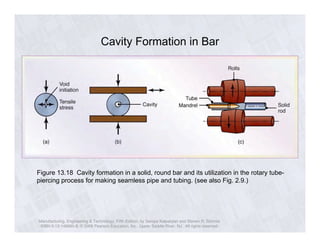
Cavity Formation in Bar 
Figure 13.18 Cavity formation in a solid, round bar and its utilization in the rotary tube-piercing 
process for making seamless pipe and tubing. (see also Fig. 2.9.) 
Manufacturing, Engineering & Technology, Fifth Edition, by Serope Kalpakjian and Steven R. Schmid. 
ISBN 0-13-148965-8. © 2006 Pearson Education, Inc., Upper Saddle River, NJ. All rights reserved.
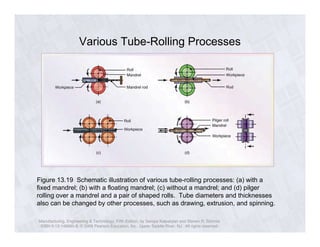
Various Tube-Rolling Processes 
Figure 13.19 Schematic illustration of various tube-rolling processes: (a) with a 
fixed mandrel; (b) with a floating mandrel; (c) without a mandrel; and (d) pilger 
rolling over a mandrel and a pair of shaped rolls. Tube diameters and thicknesses 
also can be changed by other processes, such as drawing, extrusion, and spinning. 
Manufacturing, Engineering & Technology, Fifth Edition, by Serope Kalpakjian and Steven R. Schmid. 
ISBN 0-13-148965-8. © 2006 Pearson Education, Inc., Upper Saddle River, NJ. All rights reserved.
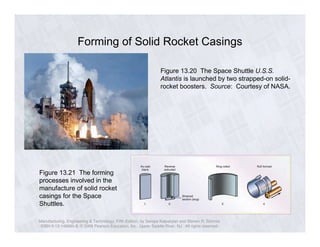
Forming of Solid Rocket Casings 
Figure 13.20 The Space Shuttle U.S.S. 
Atlantis is launched by two strapped-on solid-rocket 
boosters. Source: Courtesy of NASA. 
Figure 13.21 The forming 
processes involved in the 
manufacture of solid rocket 
casings for the Space 
Shuttles. 
Manufacturing, Engineering & Technology, Fifth Edition, by Serope Kalpakjian and Steven R. Schmid. 
ISBN 0-13-148965-8. © 2006 Pearson Education, Inc., Upper Saddle River, NJ. All rights reserved.

Ch13 rolling Erdi Karaçal Mechanical Engineer University of Gaziantep

  • 1.
    Chapter 13 Rollingof Metals Manufacturing, Engineering & Technology, Fifth Edition, by Serope Kalpakjian and Steven R. Schmid. ISBN 0-13-148965-8. © 2006 Pearson Education, Inc., Upper Saddle River, NJ. All rights reserved.
  • 2.
    Flat-Rolling and Shape-Rolling Processes Figure 13.1 Schematic outline of various flat-rolling Manufacturing, Engineering & Technology, Fifth Edition, by Serope Kalpakjian and Steven R. Schmid. ISBN 0-13-148965-8. © 2006 Pearson Education, Inc., Upper Saddle River, NJ. All rights reserved. and shape-rolling processes. Source: After the American Iron and Steel Institute.
  • 3.
    Flat-Rolling Process Figure13.2 (a) Schematic illustration of the flat-rolling process. (b) Friction forces acting on strip surfaces. (c) Roll force, F, and the torque, T, acting on the rolls. The width of the strip, w, usually increases during rolling, as shown later in Fig. 13.5. Manufacturing, Engineering & Technology, Fifth Edition, by Serope Kalpakjian and Steven R. Schmid. ISBN 0-13-148965-8. © 2006 Pearson Education, Inc., Upper Saddle River, NJ. All rights reserved.
  • 4.
    Roll Arrangements Figure13.3 Schematic illustration of various roll arrangements: (a) four-high rolling mill showing various features. The stiffness of the housing, the rolls, and the roll bearings are all important in controlling and maintaining the thickness of the rolled strip; (b) two-hill mill; (c) three-high mill; and (d) cluster (or Sendzimir) mill. Manufacturing, Engineering & Technology, Fifth Edition, by Serope Kalpakjian and Steven R. Schmid. ISBN 0-13-148965-8. © 2006 Pearson Education, Inc., Upper Saddle River, NJ. All rights reserved.
  • 5.
    Bending of Rolls Figure 13.4 (a) Bending of straight cylindrical rolls caused by roll forces. (b) Bending of rolls ground with camber, producing a strip with uniform thickness through the strip width. Deflections have been exaggerated for clarity. Manufacturing, Engineering & Technology, Fifth Edition, by Serope Kalpakjian and Steven R. Schmid. ISBN 0-13-148965-8. © 2006 Pearson Education, Inc., Upper Saddle River, NJ. All rights reserved.
  • 6.
    Spreading in FlatRolling Figure 13.5 Increase in strip width (spreading) in flat rolling. Note that similar spreading can be observed when dough is rolled with a rolling pin. Manufacturing, Engineering & Technology, Fifth Edition, by Serope Kalpakjian and Steven R. Schmid. ISBN 0-13-148965-8. © 2006 Pearson Education, Inc., Upper Saddle River, NJ. All rights reserved.
  • 7.
    Effects of HotRolling Figure 13.6 Changes in the grain structure of cast or of large-grain wrought metals during hot rolling. Hot rolling is an effective way to reduce grain size in metals for improved strength and ductility. Cast structures of ingots or continuous castings are converted to a wrought structure by hot working. Manufacturing, Engineering & Technology, Fifth Edition, by Serope Kalpakjian and Steven R. Schmid. ISBN 0-13-148965-8. © 2006 Pearson Education, Inc., Upper Saddle River, NJ. All rights reserved.
  • 8.
    Roller Leveling Figure13.7 (a) A method of roller leveling to flatten rolled sheets. (b) Roller leveling to straighten drawn bars. Manufacturing, Engineering & Technology, Fifth Edition, by Serope Kalpakjian and Steven R. Schmid. ISBN 0-13-148965-8. © 2006 Pearson Education, Inc., Upper Saddle River, NJ. All rights reserved.
  • 9.
    Defects in FlatRolling Figure 13.8 Schematic illustration of typical defects in flat rolling: (a) wavy edges; (b) zipper cracks in the center of the strip; (c) edge cracks; and (d) alligatoring. Manufacturing, Engineering & Technology, Fifth Edition, by Serope Kalpakjian and Steven R. Schmid. ISBN 0-13-148965-8. © 2006 Pearson Education, Inc., Upper Saddle River, NJ. All rights reserved.
  • 10.
    Residual Stresses Developedin Rolling Figure 13.9 (a) Residual stresses developed in rolling with small-diameter rolls or at small reductions in thickness per pass. (b) Residual stresses developed in rolling with large-diameter rolls or at high reductions per pass. Note the reversal of the residual stress patterns. Manufacturing, Engineering & Technology, Fifth Edition, by Serope Kalpakjian and Steven R. Schmid. ISBN 0-13-148965-8. © 2006 Pearson Education, Inc., Upper Saddle River, NJ. All rights reserved.
  • 11.
    Rolling Mill Figure13.10 A general view of a rolling mill. Source: Courtesy of Ispat Inland. Manufacturing, Engineering & Technology, Fifth Edition, by Serope Kalpakjian and Steven R. Schmid. ISBN 0-13-148965-8. © 2006 Pearson Education, Inc., Upper Saddle River, NJ. All rights reserved.
  • 12.
    Tandem-Rolling Figure 13.11An example of a tandem-rolling operation. Manufacturing, Engineering & Technology, Fifth Edition, by Serope Kalpakjian and Steven R. Schmid. ISBN 0-13-148965-8. © 2006 Pearson Education, Inc., Upper Saddle River, NJ. All rights reserved.
  • 13.
    Shape Rolling ofan H-section part Figure 13.12 Steps in the shape rolling of an H-section Manufacturing, Engineering & Technology, Fifth Edition, by Serope Kalpakjian and Steven R. Schmid. ISBN 0-13-148965-8. © 2006 Pearson Education, Inc., Upper Saddle River, NJ. All rights reserved. part. Various other structural sections, such as channels and I-beams, also are rolled by this kind of process.
  • 14.
    Roll-Forging Figure 13.13Two examples of the roll-forging operation, also known as cross-rolling. Tapered leaf springs and knives can be made by this process. Source: After J. Holub. Manufacturing, Engineering & Technology, Fifth Edition, by Serope Kalpakjian and Steven R. Schmid. ISBN 0-13-148965-8. © 2006 Pearson Education, Inc., Upper Saddle River, NJ. All rights reserved.
  • 15.
    Production of SteelBalls Figure 13.14 (a) Production of steel balls by the skew-rolling process. (b) Production of steel balls by upsetting a cylindrical blank. Note the formation of flash. The balls made by these processes subsequently are ground and polished for use in ball bearings. Manufacturing, Engineering & Technology, Fifth Edition, by Serope Kalpakjian and Steven R. Schmid. ISBN 0-13-148965-8. © 2006 Pearson Education, Inc., Upper Saddle River, NJ. All rights reserved.
  • 16.
    Ring-Rolling Figure 13.15(a) Schematic illustration of a ring-rolling operation. Thickness reduction results in an increase in the part diameter. (b-d) Examples of cross-sections that can be formed by ring-rolling. Manufacturing, Engineering & Technology, Fifth Edition, by Serope Kalpakjian and Steven R. Schmid. ISBN 0-13-148965-8. © 2006 Pearson Education, Inc., Upper Saddle River, NJ. All rights reserved.
  • 17.
    Thread-Rolling Processes Figure13.16 Thread-rolling processes: (a) and (c) reciprocating flat dies; (b) two-roller dies. (d) Threaded fasteners, such as bolts, are made economically by these processes at high rates of production. Source: Courtesy of Central Rolled Thread Die Co. Manufacturing, Engineering & Technology, Fifth Edition, by Serope Kalpakjian and Steven R. Schmid. ISBN 0-13-148965-8. © 2006 Pearson Education, Inc., Upper Saddle River, NJ. All rights reserved.
  • 18.
    Machined and RolledThreads Figure 13.17 (a) Features of a machined or rolled thread. Grain flow in (b) machined and (c) rolled threads. Unlike machining, which cuts through the grains of the metal, the rolling of threads imparts improved strength because of cold working and favorable grain flow. Manufacturing, Engineering & Technology, Fifth Edition, by Serope Kalpakjian and Steven R. Schmid. ISBN 0-13-148965-8. © 2006 Pearson Education, Inc., Upper Saddle River, NJ. All rights reserved.
  • 19.
    Cavity Formation inBar Figure 13.18 Cavity formation in a solid, round bar and its utilization in the rotary tube-piercing process for making seamless pipe and tubing. (see also Fig. 2.9.) Manufacturing, Engineering & Technology, Fifth Edition, by Serope Kalpakjian and Steven R. Schmid. ISBN 0-13-148965-8. © 2006 Pearson Education, Inc., Upper Saddle River, NJ. All rights reserved.
  • 20.
    Various Tube-Rolling Processes Figure 13.19 Schematic illustration of various tube-rolling processes: (a) with a fixed mandrel; (b) with a floating mandrel; (c) without a mandrel; and (d) pilger rolling over a mandrel and a pair of shaped rolls. Tube diameters and thicknesses also can be changed by other processes, such as drawing, extrusion, and spinning. Manufacturing, Engineering & Technology, Fifth Edition, by Serope Kalpakjian and Steven R. Schmid. ISBN 0-13-148965-8. © 2006 Pearson Education, Inc., Upper Saddle River, NJ. All rights reserved.
  • 21.
    Forming of SolidRocket Casings Figure 13.20 The Space Shuttle U.S.S. Atlantis is launched by two strapped-on solid-rocket boosters. Source: Courtesy of NASA. Figure 13.21 The forming processes involved in the manufacture of solid rocket casings for the Space Shuttles. Manufacturing, Engineering & Technology, Fifth Edition, by Serope Kalpakjian and Steven R. Schmid. ISBN 0-13-148965-8. © 2006 Pearson Education, Inc., Upper Saddle River, NJ. All rights reserved.