ahmadkhan_99@hotmail.com
                           1
Sequence
 What & Why of Elctroplating

 Factors Influencing Electro Deposition
   Current density
   Cathode Efficiency
   Agitation
   Bath composition & Solution concentration
   Water Requirement
   The presence of impurities & Filtration

 Hydrogen Embrittlement and its Effects
What is Electroplating
 Electroplating is often called "electro deposition", and
  the two terms are used interchangeably.
 As a matter of fact, "electroplating" can be considered
  to occur by the process of electro deposition.
 Electro deposition is the process of producing a
  coating, usually metallic, on a surface by the action of
  electric current.
What is Electroplating
 The  deposition of a metallic
 coating onto an object is achieved
 by putting a negative charge on
 the object to be coated and
 immersing it into a solution which
 contains a salt of the metal to be
 deposited (in other words, the
 object to be plated is made the
 cathode of an electrolytic cell)
What is Electroplating
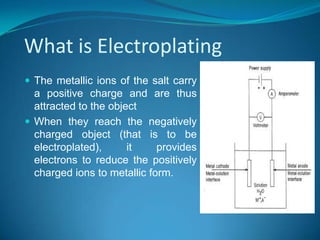
 The metallic ions of the salt carry
  a positive charge and are thus
  attracted to the object
 When they reach the negatively
  charged object (that is to be
  electroplated),      it    provides
  electrons to reduce the positively
  charged ions to metallic form.
Why Electroplating
 Electroplating is a surface coating method that forms

  an adherent layer of one metal on another

 To achieve the desired electrical and corrosion
  resistance, reduce wear & friction, improve heat
  tolerance and for decoration purposes
Requisites of Electroplating

 Clean substrates, solutions, and containers, etc.
  Even low impurity levels would result in poor-quality films
 Good resist adhesion on the substrate is required
 The plating solution must have easy access to recesses, and
  be compatible with the resist and substrate materials
 Uniform current distribution on the substrate surface
Factors Influencing Electro Deposition
  Current density
  Cathode Efficiency
  Agitation
  Bath composition and Solution concentration
  Water Requirement
  The presence of impurities               (from poor cleaning, poor anodes, water
   contaminants, poor water rinse before plating bath etc)   & Filtration
Factors Influencing Electro Deposition
 Current Density
  It is the application of current (Amperes) per unit area
  Current density for a particular bath are defined on the
   basis of bath composition and required deposition
   thickness and deposition rates
  Selection of current density is critical as poor selection
   will result in defects in deposition quality like porosity,
   poor deposition thickness
  Areas of the parts to be plated, must carefully be
   calculated and current densities be selected accordingly
Factors Influencing Electro Deposition
 Cathode Efficiency
  The ratio of the weight of metal actually deposited to
 the weight that would have resulted if all the current
 had been used for depositing it is called the cathode
 efficiency
  Cathode efficiency in plating depends on:
     Electrolyte or bath
     Concentration of chemical composition
     pH and agitation
     Current density
Factors Influencing Electro Deposition
 Cathode Efficiency
  Effects of poor Cathode Efficiency
        If any of the depending factors are disturbed then
        cathode efficiency will adversely suffer and result in:

           Poor deposition
           Process will be less cot effective in terms of
            electricity consumption, solution composition and
            early anode dissolution
Factors Influencing Electro Deposition
 Agitation
  In a plating solution
          near the cathode, as metal is depleted, the solution becomes
          less dense and tends to rise along the face of cathode
         Opposite occurs at the face of anode: solution tends to stream
          down
         The solution is required to be agitated for homoginaty
  This problem, if not catered (through agitation) wherever
   required, will cause
     non-uniform deposition of metal on the substrate
     Cathode efficiency will greatly suffer
Factors Influencing Electro Deposition
 Bath Composition and Solution Concentration
  Metal Ions
  Electrolytes
  Organic Additives
    Brighteners
    Levelers
    Structure Modifiers
    Wetting Agents
Factors Influencing Electro Deposition
Bath Composition and Solution Concentration
1.Metal Ions
    The metal ions to be plated are present in solution
2.Electrolytes
   Electrolytes give conductivity to the bath and high
    concentration of the electrolyte ensures max conductivity
   Electrolytes control the bath PH value which if higher than
    required level, will lead to deposition of Metal Hydroxyl ions
    (not desired)
   Conductivity of electrolyte effects “Throwing Power” (ability
    of the bath to give even deposit) of the bath
Factors Influencing Electro Deposition
 Bath Composition and Solution Concentration
 3.Organic Additives
    Brighteners
       To cause an even, fine grained deposit
    Levelers
       To produce a level deposit where otherwise there would be
     rapid deposition of metal
    Structure Modifiers
       To optimize particular deposit properties e.g hardness etc
    Wetting Agents
       To accelerate the release of hydrogen gas bubbles from
     solution surface
Factors Influencing Electro Deposition
 Water Requirement
 • Water is the main ingredient in all of the baths used and
   its quality will effect the various operations
 • Impurities present in most water supplies may include
   dissolved mineral salts; organic compounds; suspended
   solids and microorganisms
 • De-ionized water requirement is critical
   •   Final rinse before Plating bath to avoid bath contamination
   •   Plating bath to avoid contamination
   •   Final rinse before dispatch to avoid stains caused by Ca, Mg salts
       present in non treated water
Factors Influencing Electro Deposition
 Presence of Impurities and Filtration
 • Water is the main ingredient in all of the baths used and
   falk;sjdkjfalkjd
Hydrogen Embrittlement
 Hydrogen embrittlement is a generic term used to describe a
  variety of fracture phenomena having a common relationship
  to the presence of hydrogen in the metal as a solute or in the
  atmosphere as a gas
 In general any process producing atomic H at a metal surface
  will induce considerable hydrogen absorption in that metal
  (Electroplating, Electroless plating, Acid Pickling, Electrolytic
  cleaning)
 Hydrogen embrittlement alters the Fatigue limit characteristics
  of the metal
Effects of Hydrogen Embrittlement
 Corrosion reactions can generate Hydrogen, and choosing
  proper coating to prevent corrosion is important
 Problems as a result of H embrittlement/hydriding:
      • Failure of aircraft components
      • Blisters in Cu, Al, and Steel components
      • Reductions in mechanical properties of materials

Surface treatment plating process

  • 1.
  • 2.
    Sequence  What &Why of Elctroplating  Factors Influencing Electro Deposition  Current density  Cathode Efficiency  Agitation  Bath composition & Solution concentration  Water Requirement  The presence of impurities & Filtration  Hydrogen Embrittlement and its Effects
  • 3.
    What is Electroplating Electroplating is often called "electro deposition", and the two terms are used interchangeably.  As a matter of fact, "electroplating" can be considered to occur by the process of electro deposition.  Electro deposition is the process of producing a coating, usually metallic, on a surface by the action of electric current.
  • 4.
    What is Electroplating The deposition of a metallic coating onto an object is achieved by putting a negative charge on the object to be coated and immersing it into a solution which contains a salt of the metal to be deposited (in other words, the object to be plated is made the cathode of an electrolytic cell)
  • 5.
    What is Electroplating The metallic ions of the salt carry a positive charge and are thus attracted to the object  When they reach the negatively charged object (that is to be electroplated), it provides electrons to reduce the positively charged ions to metallic form.
  • 6.
    Why Electroplating  Electroplatingis a surface coating method that forms an adherent layer of one metal on another  To achieve the desired electrical and corrosion resistance, reduce wear & friction, improve heat tolerance and for decoration purposes
  • 7.
    Requisites of Electroplating Clean substrates, solutions, and containers, etc. Even low impurity levels would result in poor-quality films  Good resist adhesion on the substrate is required  The plating solution must have easy access to recesses, and be compatible with the resist and substrate materials  Uniform current distribution on the substrate surface
  • 8.
    Factors Influencing ElectroDeposition  Current density  Cathode Efficiency  Agitation  Bath composition and Solution concentration  Water Requirement  The presence of impurities (from poor cleaning, poor anodes, water contaminants, poor water rinse before plating bath etc) & Filtration
  • 9.
    Factors Influencing ElectroDeposition Current Density  It is the application of current (Amperes) per unit area  Current density for a particular bath are defined on the basis of bath composition and required deposition thickness and deposition rates  Selection of current density is critical as poor selection will result in defects in deposition quality like porosity, poor deposition thickness  Areas of the parts to be plated, must carefully be calculated and current densities be selected accordingly
  • 10.
    Factors Influencing ElectroDeposition Cathode Efficiency  The ratio of the weight of metal actually deposited to the weight that would have resulted if all the current had been used for depositing it is called the cathode efficiency  Cathode efficiency in plating depends on:  Electrolyte or bath  Concentration of chemical composition  pH and agitation  Current density
  • 11.
    Factors Influencing ElectroDeposition Cathode Efficiency  Effects of poor Cathode Efficiency If any of the depending factors are disturbed then cathode efficiency will adversely suffer and result in:  Poor deposition  Process will be less cot effective in terms of electricity consumption, solution composition and early anode dissolution
  • 12.
    Factors Influencing ElectroDeposition Agitation  In a plating solution  near the cathode, as metal is depleted, the solution becomes less dense and tends to rise along the face of cathode  Opposite occurs at the face of anode: solution tends to stream down  The solution is required to be agitated for homoginaty  This problem, if not catered (through agitation) wherever required, will cause  non-uniform deposition of metal on the substrate  Cathode efficiency will greatly suffer
  • 13.
    Factors Influencing ElectroDeposition Bath Composition and Solution Concentration  Metal Ions  Electrolytes  Organic Additives  Brighteners  Levelers  Structure Modifiers  Wetting Agents
  • 14.
    Factors Influencing ElectroDeposition Bath Composition and Solution Concentration 1.Metal Ions The metal ions to be plated are present in solution 2.Electrolytes  Electrolytes give conductivity to the bath and high concentration of the electrolyte ensures max conductivity  Electrolytes control the bath PH value which if higher than required level, will lead to deposition of Metal Hydroxyl ions (not desired)  Conductivity of electrolyte effects “Throwing Power” (ability of the bath to give even deposit) of the bath
  • 15.
    Factors Influencing ElectroDeposition Bath Composition and Solution Concentration 3.Organic Additives  Brighteners To cause an even, fine grained deposit  Levelers To produce a level deposit where otherwise there would be rapid deposition of metal  Structure Modifiers To optimize particular deposit properties e.g hardness etc  Wetting Agents To accelerate the release of hydrogen gas bubbles from solution surface
  • 16.
    Factors Influencing ElectroDeposition Water Requirement • Water is the main ingredient in all of the baths used and its quality will effect the various operations • Impurities present in most water supplies may include dissolved mineral salts; organic compounds; suspended solids and microorganisms • De-ionized water requirement is critical • Final rinse before Plating bath to avoid bath contamination • Plating bath to avoid contamination • Final rinse before dispatch to avoid stains caused by Ca, Mg salts present in non treated water
  • 17.
    Factors Influencing ElectroDeposition Presence of Impurities and Filtration • Water is the main ingredient in all of the baths used and falk;sjdkjfalkjd
  • 18.
    Hydrogen Embrittlement  Hydrogenembrittlement is a generic term used to describe a variety of fracture phenomena having a common relationship to the presence of hydrogen in the metal as a solute or in the atmosphere as a gas  In general any process producing atomic H at a metal surface will induce considerable hydrogen absorption in that metal (Electroplating, Electroless plating, Acid Pickling, Electrolytic cleaning)  Hydrogen embrittlement alters the Fatigue limit characteristics of the metal
  • 19.
    Effects of HydrogenEmbrittlement  Corrosion reactions can generate Hydrogen, and choosing proper coating to prevent corrosion is important  Problems as a result of H embrittlement/hydriding: • Failure of aircraft components • Blisters in Cu, Al, and Steel components • Reductions in mechanical properties of materials

Editor's Notes

  • #11 If any of the depending factors are wrongThen cathode efficiency will adversely suffer andResult in poor deposition, Process will be less cot effective in terms of electricity consumption, solution composition and early anode dissolution
  • #12 If any of the depending factors are wrongThen cathode efficiency will adversely suffer andResult in poor deposition, Process will be less cot effective in terms of electricity consumption, solution composition and early anode dissolution