Chapter 10 Gases John Bookstaver St. Charles Community College Cottleville, MO Chemistry, The Central Science , 11th edition Theodore L. Brown; H. Eugene LeMay, Jr.; and Bruce E. Bursten
Characteristics of Gases Unlike liquids and solids, gases expand to fill their containers; are highly compressible; have extremely low densities.
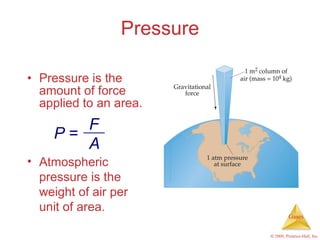
Pressure is the amount of force applied to an area. Pressure Atmospheric pressure is the weight of air per unit of area. P  = F A
Units of Pressure Pascals 1 Pa = 1 N/m 2 Bar 1 bar = 10 5  Pa = 100 kPa
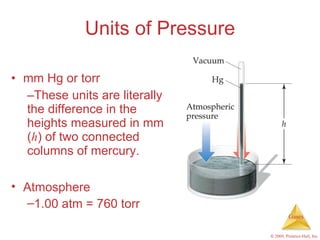
Units of Pressure mm Hg or torr These units are literally the difference in the heights measured in mm ( h ) of two connected columns of mercury. Atmosphere 1.00 atm = 760 torr
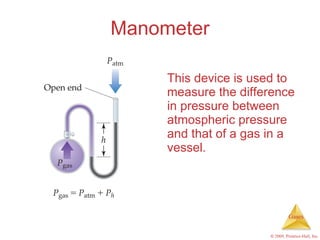
Manometer This device is used to measure the difference in pressure between atmospheric pressure and that of a gas in a vessel.
Standard Pressure Normal atmospheric pressure at sea level is referred to as  standard pressure . It is equal to 1.00 atm 760 torr (760 mm Hg) 101.325 kPa
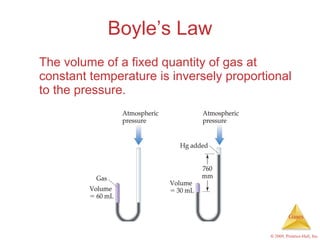
Boyle’s Law The volume of a fixed quantity of gas at constant temperature is inversely proportional to the pressure.
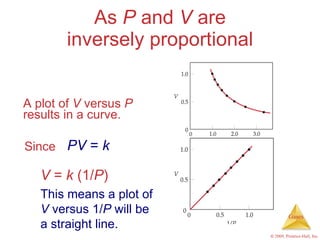
As  P  and  V  are inversely proportional A plot of  V  versus  P  results in a curve. Since V  =  k  (1/ P ) This means a plot of  V  versus 1/ P  will be a straight line. PV  =  k
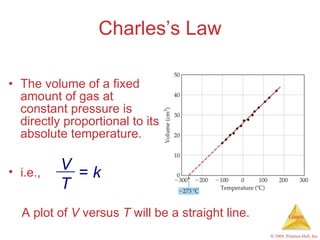
Charles’s Law The volume of a fixed amount of gas at constant pressure is directly proportional to its absolute temperature. A plot of  V  versus  T  will be a straight line. i.e., V T =  k
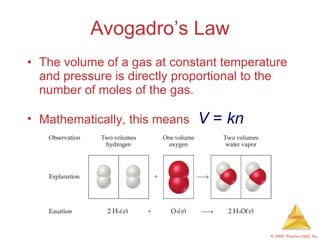
Avogadro’s Law The volume of a gas at constant temperature and pressure is directly proportional to the number of moles of the gas. Mathematically, this means V  =  kn
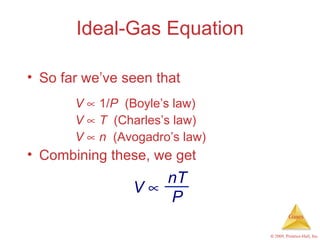
Ideal-Gas Equation V     1/ P   (Boyle’s law) V      T   (Charles’s law) V      n   (Avogadro’s law) So far we’ve seen that Combining these, we get V    nT P
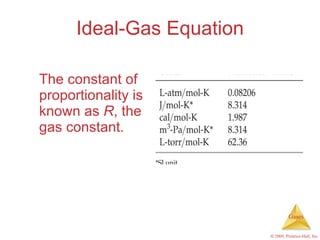
Ideal-Gas Equation The constant of proportionality is known as  R , the gas constant.
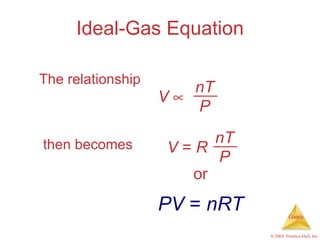
Ideal-Gas Equation The relationship then becomes or PV  =  nRT nT P V    nT P V  =  R
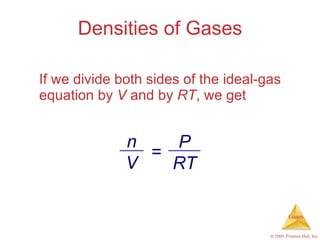
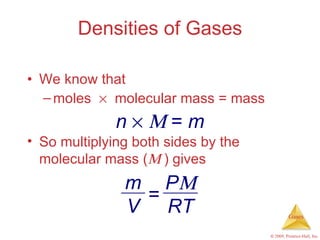
Densities of Gases If we divide both sides of the ideal-gas equation by  V  and by  RT , we get n V P RT =
We know that moles     molecular mass = mass Densities of Gases So multiplying both sides by the molecular mass (  ) gives n        =  m P  RT m V =
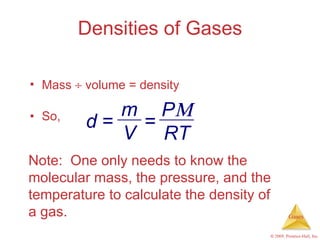
Densities of Gases Mass    volume = density So, Note:  One only needs to know the molecular mass, the pressure, and the temperature to calculate the density of a gas. P  RT m V = d  =
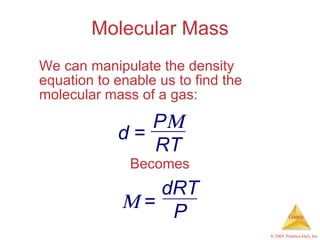
Molecular Mass We can manipulate the density equation to enable us to find the molecular mass of a gas: Becomes P  RT d  = dRT P    =
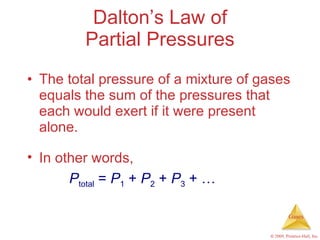
Dalton’s Law of Partial Pressures The total pressure of a mixture of gases equals the sum of the pressures that each would exert if it were present alone. In other words, P total  =  P 1  +  P 2  +  P 3  + …
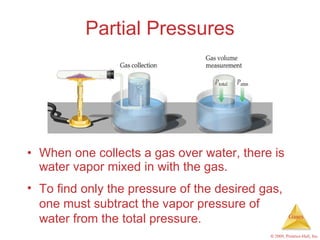
Partial Pressures When one collects a gas over water, there is water vapor mixed in with the gas. To find only the pressure of the desired gas, one must subtract the vapor pressure of water from the total pressure.
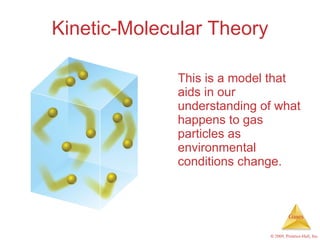
Kinetic-Molecular Theory This is a model that aids in our understanding of what happens to gas particles as environmental conditions change.
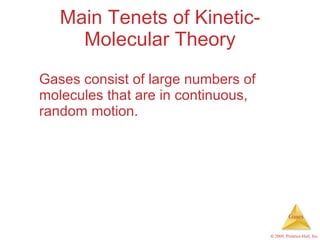
Main Tenets of Kinetic-Molecular Theory Gases consist of large numbers of molecules that are in continuous, random motion.
Main Tenets of Kinetic-Molecular Theory The combined volume of all the molecules of the gas is negligible relative to the total volume in which the gas is contained.
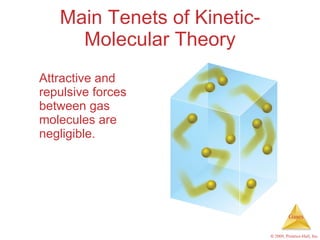
Main Tenets of Kinetic-Molecular Theory Attractive and repulsive forces between gas molecules are negligible.
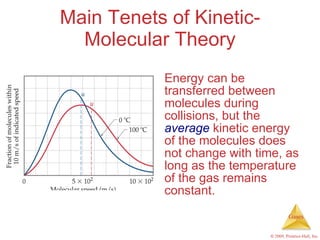
Main Tenets of Kinetic-Molecular Theory Energy can be transferred between molecules during collisions, but the  average  kinetic energy of the molecules does not change with time, as long as the temperature of the gas remains constant.
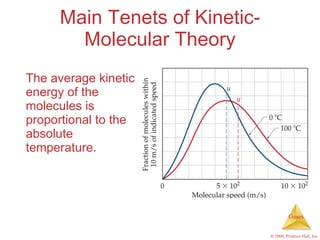
Main Tenets of Kinetic-Molecular Theory The average kinetic energy of the molecules is proportional to the absolute temperature.
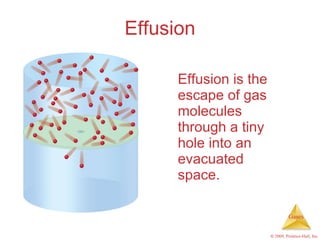
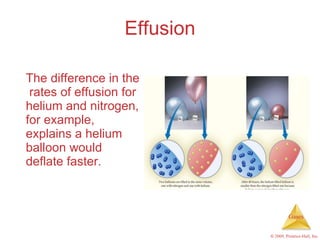
Effusion Effusion is the escape of gas molecules through a tiny hole into an evacuated space.
Effusion The difference in the  rates of effusion for helium and nitrogen, for example, explains a helium balloon would deflate faster.
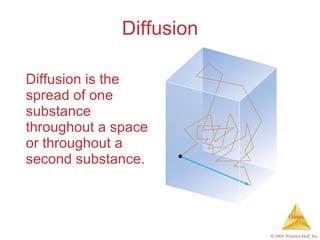
Diffusion Diffusion is the spread of one substance throughout a space or throughout a second substance.
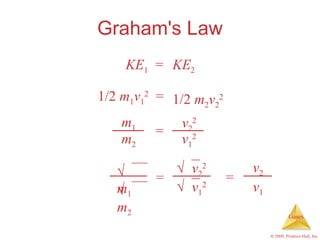
Graham's Law KE 1 KE 2 = 1/2  m 1 v 1 2 1/2  m 2 v 2 2 = = m 1 m 2 v 2 2 v 1 2  m 1  m 2  v 2 2  v 1 2 = v 2 v 1 =
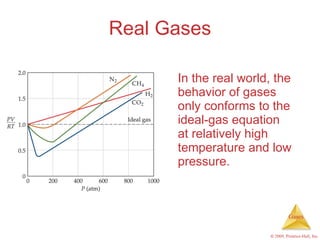
Real Gases In the real world, the behavior of gases only conforms to the ideal-gas equation at relatively high temperature and low pressure.
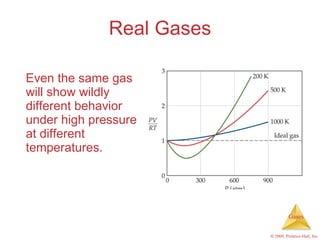
Real Gases Even the same gas will show wildly different behavior under high pressure at different temperatures.
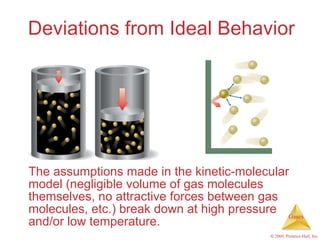
Deviations from Ideal Behavior The assumptions made in the kinetic-molecular model (negligible volume of gas molecules themselves, no attractive forces between gas molecules, etc.) break down at high pressure and/or low temperature.
Corrections for Nonideal Behavior The ideal-gas equation can be adjusted to take these deviations from ideal behavior into account. The corrected ideal-gas equation is known as the  van der Waals equation .
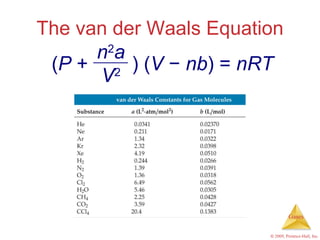
The van der Waals Equation ) ( V   −   nb ) =  nRT n 2 a V 2 ( P  +

AP Chemistry Chapter 10 Outline

  • 1.
    Chapter 10 GasesJohn Bookstaver St. Charles Community College Cottleville, MO Chemistry, The Central Science , 11th edition Theodore L. Brown; H. Eugene LeMay, Jr.; and Bruce E. Bursten
  • 2.
    Characteristics of GasesUnlike liquids and solids, gases expand to fill their containers; are highly compressible; have extremely low densities.
  • 3.
    Pressure is theamount of force applied to an area. Pressure Atmospheric pressure is the weight of air per unit of area. P = F A
  • 4.
    Units of PressurePascals 1 Pa = 1 N/m 2 Bar 1 bar = 10 5 Pa = 100 kPa
  • 5.
    Units of Pressuremm Hg or torr These units are literally the difference in the heights measured in mm ( h ) of two connected columns of mercury. Atmosphere 1.00 atm = 760 torr
  • 6.
    Manometer This deviceis used to measure the difference in pressure between atmospheric pressure and that of a gas in a vessel.
  • 7.
    Standard Pressure Normalatmospheric pressure at sea level is referred to as standard pressure . It is equal to 1.00 atm 760 torr (760 mm Hg) 101.325 kPa
  • 8.
    Boyle’s Law Thevolume of a fixed quantity of gas at constant temperature is inversely proportional to the pressure.
  • 9.
    As P and V are inversely proportional A plot of V versus P results in a curve. Since V = k (1/ P ) This means a plot of V versus 1/ P will be a straight line. PV = k
  • 10.
    Charles’s Law Thevolume of a fixed amount of gas at constant pressure is directly proportional to its absolute temperature. A plot of V versus T will be a straight line. i.e., V T = k
  • 11.
    Avogadro’s Law Thevolume of a gas at constant temperature and pressure is directly proportional to the number of moles of the gas. Mathematically, this means V = kn
  • 12.
    Ideal-Gas Equation V  1/ P (Boyle’s law) V  T (Charles’s law) V  n (Avogadro’s law) So far we’ve seen that Combining these, we get V  nT P
  • 13.
    Ideal-Gas Equation Theconstant of proportionality is known as R , the gas constant.
  • 14.
    Ideal-Gas Equation Therelationship then becomes or PV = nRT nT P V  nT P V = R
  • 15.
    Densities of GasesIf we divide both sides of the ideal-gas equation by V and by RT , we get n V P RT =
  • 16.
    We know thatmoles  molecular mass = mass Densities of Gases So multiplying both sides by the molecular mass (  ) gives n   = m P  RT m V =
  • 17.
    Densities of GasesMass  volume = density So, Note: One only needs to know the molecular mass, the pressure, and the temperature to calculate the density of a gas. P  RT m V = d =
  • 18.
    Molecular Mass Wecan manipulate the density equation to enable us to find the molecular mass of a gas: Becomes P  RT d = dRT P  =
  • 19.
    Dalton’s Law ofPartial Pressures The total pressure of a mixture of gases equals the sum of the pressures that each would exert if it were present alone. In other words, P total = P 1 + P 2 + P 3 + …
  • 20.
    Partial Pressures Whenone collects a gas over water, there is water vapor mixed in with the gas. To find only the pressure of the desired gas, one must subtract the vapor pressure of water from the total pressure.
  • 21.
    Kinetic-Molecular Theory Thisis a model that aids in our understanding of what happens to gas particles as environmental conditions change.
  • 22.
    Main Tenets ofKinetic-Molecular Theory Gases consist of large numbers of molecules that are in continuous, random motion.
  • 23.
    Main Tenets ofKinetic-Molecular Theory The combined volume of all the molecules of the gas is negligible relative to the total volume in which the gas is contained.
  • 24.
    Main Tenets ofKinetic-Molecular Theory Attractive and repulsive forces between gas molecules are negligible.
  • 25.
    Main Tenets ofKinetic-Molecular Theory Energy can be transferred between molecules during collisions, but the average kinetic energy of the molecules does not change with time, as long as the temperature of the gas remains constant.
  • 26.
    Main Tenets ofKinetic-Molecular Theory The average kinetic energy of the molecules is proportional to the absolute temperature.
  • 27.
    Effusion Effusion isthe escape of gas molecules through a tiny hole into an evacuated space.
  • 28.
    Effusion The differencein the rates of effusion for helium and nitrogen, for example, explains a helium balloon would deflate faster.
  • 29.
    Diffusion Diffusion isthe spread of one substance throughout a space or throughout a second substance.
  • 30.
    Graham's Law KE1 KE 2 = 1/2 m 1 v 1 2 1/2 m 2 v 2 2 = = m 1 m 2 v 2 2 v 1 2  m 1  m 2  v 2 2  v 1 2 = v 2 v 1 =
  • 31.
    Real Gases Inthe real world, the behavior of gases only conforms to the ideal-gas equation at relatively high temperature and low pressure.
  • 32.
    Real Gases Eventhe same gas will show wildly different behavior under high pressure at different temperatures.
  • 33.
    Deviations from IdealBehavior The assumptions made in the kinetic-molecular model (negligible volume of gas molecules themselves, no attractive forces between gas molecules, etc.) break down at high pressure and/or low temperature.
  • 34.
    Corrections for NonidealBehavior The ideal-gas equation can be adjusted to take these deviations from ideal behavior into account. The corrected ideal-gas equation is known as the van der Waals equation .
  • 35.
    The van derWaals Equation ) ( V − nb ) = nRT n 2 a V 2 ( P +