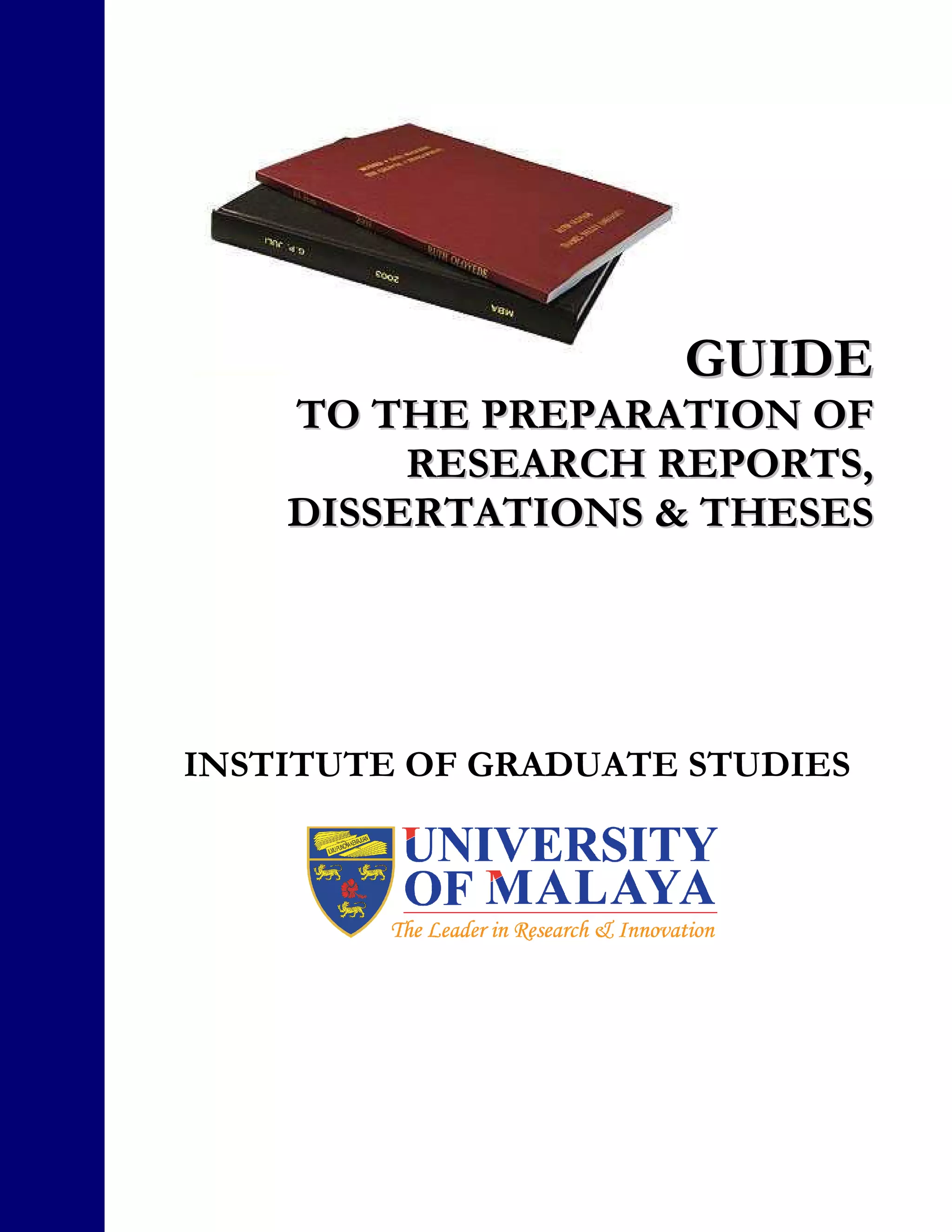
GUIDE 
TO THE PREPARATION OF 
RESEARCH REPORTS, 
DISSERTATIONS & THESES 
INSTITUTE OF GRADUATE STUDIES
GUIDE 
TO THE PREPARATION OF RESEARCH REPORTS, 
DISSERTATIONS & THESES 
INSTITUTE OF GRADUATE STUDIES 
UNIVERSITY OF MALAYA 
KUALA LUMPUR 
2010
TABLE OF CONTENTS 
1.0 INTRODUCTION 
1 
2.0 ORDER OF CONTENTS 
2.1 Preface 
2.2 Text 
2.3 Supplementary 
2 
2 
4 
6 
3.0 SUBMISSION 7 
4.0 FORMAT 8 
4.1 Binding 
4.2 Length 
4.3 Paper and Duplicating 
4.4 Printing 
4.4.1 Print Quality 
4.4.2 Line Spacing 
4.5 Margins 
4.6 Page Numbering 
4.7 Footnotes 
4.8 Tables 
4.9 Figures 
8 
8 
9 
9 
9 
9 
10 
10 
11 
11 
11 
5.0 MISCELLANEOUS INFORMATION 
5.1 Bibliography 
5.2 Units of Measurement 
5.3 Research Ethics 
12 
12 
12 
12
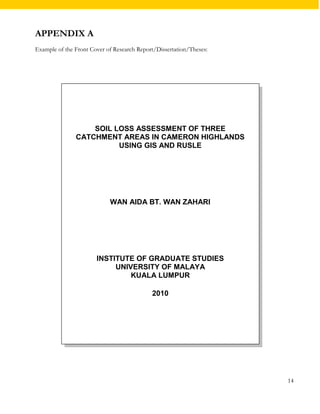
APPENDIX A 
Example of the Front Cover of Research Reports / Dissertations / Theses 14 
APPENDIX B 
Example of the Title Page of a Research Report 15 
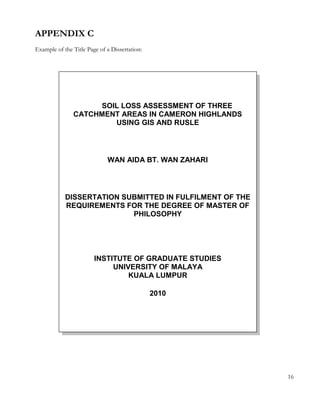
APPENDIX C 
Example of the Title Page of a Dissertation 16 
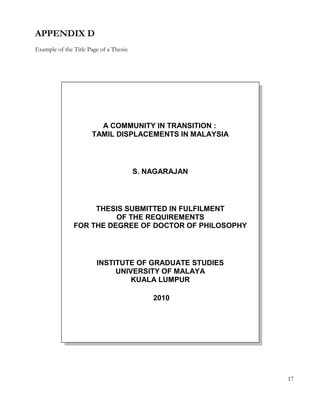
APPENDIX D 
Example of the Title Page of a Thesis 17 
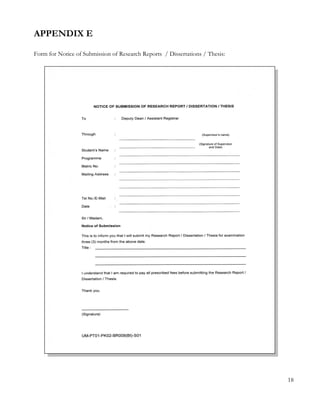
APPENDIX E 
Form for Notice of Submission of Research Reports / Dissertations / Thesis 18 
APPENDIX F 
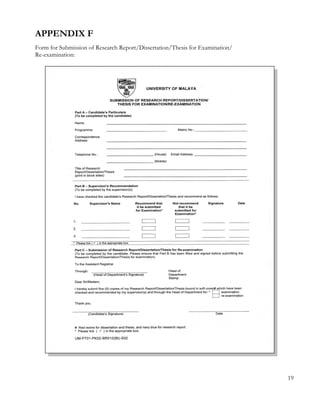
Form for Submission of Research Reports / Dissertations / Thesis for 
Examination/ Re-examination 19 
APPENDIX G 
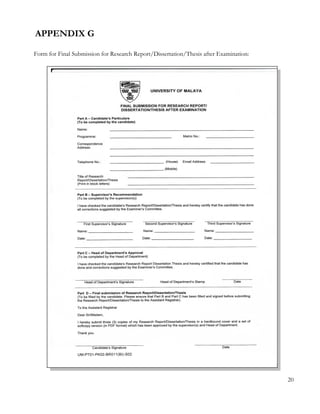
Form for Final Submission for Research Reports / Dissertations / Thesis after 
Examination 20
1.0 INTRODUCTION 
In the process of completing a postgraduate programme in the University of Malaya and being awarded 
the degree, a candidate may be required to submit either a research report, a dissertation or a thesis, 
depending on the requirements of the specific programme. 
In view of this requirement, the Institute of Graduate Studies, University of Malaya has taken the initiative 
to provide general guidelines for the submission of research reports, dissertations and theses. These 
guidelines will assist students to meet the minimal format requirements set by the University to complete 
the final form of a research report, dissertation or thesis. Each individual academy, faculty, institute or 
centre may have its own additional format requirements. 
1
2.0 ORDER OF CONTENTS 
The structure of the research report, dissertation or thesis is based on a standard format which contains 
the following sections: 
 Preface 
 Text 
 Supplementary 
2.1. Preface 
This section consists of the following: 
2.1.1 Title Page 
The title page is the first page after the front cover and should include the research title which has 
been approved by the Faculty, name of candidate according to the registration records, and the 
statement “…submission of research report/dissertation/thesis for the fulfilment of the Degree of 
Master of …/Doctor of Philosophy” and finally the year of submission. Refer to Appendix A for 
example of front cover and Appendix B, C and D for examples of the title page. 
2.1.2 Original Literary Work Declaration 
This subsection is compulsory. Please refer to the format given in Appendix C. 
2.1.3 Abstract 
Generally the abstract is written after the completion of the text of the research 
report/dissertation/thesis. It summarizes the structure of the whole text and the major facts it 
contains. It should be written in the language of the research report/dissertation/thesis and 
translated to Bahasa Malaysia or English and contain not more than 500 words. The abstract 
should be placed on the page immediately after the title page. 
2
2.1.4 Acknowledgements 
Most research reports, dissertations or theses have their subsection to convey appreciation to 
those who have been involved in the study. 
2.1.5 Table of Contents 
The Table of Contents lists the chapters, topics and sub-topics together with their page numbers. 
Sub-topics and topics should be labelled according to the chapter, for e.g., the first topic in 
Chapter 1 should be marked 1.1 and the first sub-topic, 1.1.1. The use of letters in parenthesis for 
e.g., (a), (b), (c) is appropriate as a means of differentiating sub-topics of the same topic. This 
numbering system provides a clear picture of the relationship between chapters and topics and 
shows how they are connected. 
2.1.6 List of Figures 
This list contains the titles of figures, together with their page numbers, which are listed in the text. 
For e.g., figures in Chapter 3 are numbered sequentially: Figure 3.1, Figure 3.2. 
2.1.7 List of Tables 
This list contains the titles of tables, together with their page numbers, which are listed in the text. 
The numbering system is according to chapter, for e.g.: tables in Chapter 3 are numbered 
sequentially: Table 3.1, Table 3.2. 
2.1.8 List of Symbols and Abbreviations 
The symbols and abbreviations must be in accordance to international convention. 
2.1.9 List of Appendices 
This list is optional and contains the titles of appendices placed in the supplementary section. 
3
2.2 Text 
Candidates and supervisors should ensure that the text follows the agreed conventions of the individual 
Faculty. Normally, the text consists of the following chapters: 
2.2.1 Introduction 
This chapter contains the introduction to the issues in which the research is concerned, the aims 
and objectives of the study, and the outline of the research approach. 
2.2.2 Literature Review 
This chapter surveys previous literature and studies relevant to the field of study. The literature 
review should be comprehensive and include recent publications. 
2.2.3 Methodology 
This chapter describes and explains the research methodology used in the study. The sub-topics 
for this chapter include the key research questions, the research design, and the research 
procedures adopted. It may also, where appropriate, indicate sampling methods, research 
instruments and statistical methods employed. The purpose of this is to inform the reader on the 
methods used to collect the data and generate the findings reported. 
2.2.4 Results 
Results are commonly presented in the form of text, figures and tables, complete with data 
analysis. 
4
2.2.5 Discussion 
This chapter contains the interpretation of the results. The findings of the research should be 
compared and contrasted with those of previous studies presented in the literature review. The 
purpose of this chapter is to discuss the findings of the research. 
2.2.6 Conclusion 
In this section, the findings are summarized and their implications discussed. This section may 
include suggestions for future work. 
5
2.3 Supplementary 
Specific items which were not included in the main body of the text, should be put in this Supplementary 
Section. Typically, this section includes the following: 
2.3.1 Instrumentation 
Research instruments such as questionnaires, maps or computer programmes. 
2.3.2 Appendix 
Appendices consist of additional illustration of data sources, raw data and quoted citations which 
are too long to be placed in the text. The appendix supports the written text of the research 
report/dissertation/thesis. Appendices can be divided into Appendix A, B, C. 
2.3.3 Bibliography 
All works or studies referred to in the research, report/dissertation/ thesis in the form of 
quotations or citations must be included in the bibliography. The references should be written 
consistently in the American Psychological Association (APA) format or in another format 
approved by the faculty. Each reference should be written in single spacing format and a double 
space should be left between references. This list of references should not be numbered. 
6
3.0 SUBMISSION 
A candidate is required to submit the “Notice of Submission of Research Report/ Dissertation/Thesis” 
(Appendix E) to the Dean or Director of the relevant faculty/academy/institute/centre at least three 
months before the actual date of submission. 
Submission of research report/dissertation/thesis has to be done within the candidature period. Five (5) 
preliminary softbound copies of the manuscript to be examined should be submitted together with the 
“Submission of Research Report/Dissertation/Thesis for Examination/Re-examination” form (Appendix 
F) to the Dean or Director of the faculty/academy/institute/centre. 
Three (3) hardbound copies of the final manuscript should be submitted to the Dean or Director’s office 
after the final corrections or amendments (if any) have been made, together with the “Final Submission 
for Research Report/Dissertation/Thesis after Examination” form (Appendix G). Please refer to Chapter 
4 on the format of Research Report/Dissertation/ Thesis. 
All the required forms can be downloaded from the IGS website at 
http://www.ips.um.edu.my/students.htm. 
7
4.0 FORMAT 
4.1 Binding 
The five (5) preliminary copies of the manuscript to be examined should be softbound and the three (3) 
final copies to be deposited in the University should be hardbound. The title, author, name of the 
university and year of submission must be printed on the front cover. The spine of the manuscripts 
should show the title, author, year of submission and type of degree. 
The cover for both soft and hard bound copies should be made from rexine and the colour should be 
navy blue for research report and dark red or maroon for dissertation/thesis. The letters for the Front 
Cover should be printed in gold of font size 15, font type Times New Roman and in uppercase letters. 
4.2 Length 
The maximum length (excluding footnotes, appendices, tables and prefaces) for a submission for 
examination: 
 Research Report : 20,000 words 
 Dissertation : 30,000 words (all mixed-mode programmes except 
for the Master of Laws) 
: 60,000 words (all research mode programmes 
except for the Master of Laws) 
 Thesis : 100,000 words 
For the degree of Master of Laws by research, a dissertation of not exceeding 75,000 words is 
required. For the mixed-mode of Master of Laws, a dissertation of not more than 60,000 words is 
required. 
A candidate who wishes to exceed the number of words specified must apply to the Senate through the 
respective Faculty at least three months before the submission of the dissertation/thesis for examination 
and provide reasons for the inability to adhere to the prescribed length. 
A candidate may not resubmit previous research work which he or she has submitted to this or any other 
University for the award of a degree. The candidate may, however, incorporate any part of such work, 
provided that there is a clear indication in the research report/dissertation/thesis of its sources. 
8
The candidate may also include any other printed or published work by an individual or a working group 
to validate his or her findings. Where the contribution is from a working group, the candidate is required 
to provide a statement indicating which part of the work was carried out by the candidate. The statement 
should be signed by the rest of the group indicating their consent (this may be included in the Appendix). 
Approved research reports/dissertations/theses or parts of their content are allowed for publication if 
they are accompanied by a statement that the work was conducted towards the fulfilment of a particular 
degree. A candidate, is strongly encouraged to publish papers based on the work during his or her course 
of study, and due reference must be made to the University in all such papers. 
4.3 Paper and Duplicating 
Manuscripts should be printed on high quality A4 paper (201 X 297 mm; 80 grams). Computer pin-feed 
printout paper is not permitted. The final manuscript, in hardbound copies, must be typed and duplicated 
by offset printing or good quality photocopying. All copies must be clean and neat in order to ensure easy 
reading. 
4.4 Printing 
4.4.1 Printing Quality 
Sections must be typed using Times New Roman, font size 12. For mathematical texts, the use of 
Equation Editor or Latex is advisable. Script fonts are not permitted. A high quality laser or ink-jet 
printer should be used for the printing. 
4.4.2 Line Spacing 
The body of the text should be typed with double spacing. Single-spacing is only permitted in 
tables, long quotations, footnotes, citation and in the bibliography. 
9
4.5 Margins 
The text should have the following margins: 
Top : 2.0 cm 
Right : 2.0 cm 
Left : 4.0 cm 
Bottom : 2.0 cm 
Additional guidelines need to be followed: 
 Do not type more than one sentence after the bottom margin. If it is necessary to do so, it should 
only be for a footnote or the completion of the last sentence of the chapter, topic or sub-topic or 
information in a figure. 
 All tables and figures must be placed within the specified margins. 
 The last paragraph of the page should contain at least two sentences. If it does not, the paragraph 
should begin on the next page. 
4.6 Page Numbering 
All page numbers should be printed 1.0 cm from the bottom margin and placed at the right hand side 
without any punctuation. 
 Font size 8 recommended for numbers. 
 Roman numerals (i, ii, iii etc) should be used in the Preface section. Although the Title Page is the 
first page of the Preface, no number is printed on it. Numbering begins on the second page with 
(ii). 
 Arabic numerals (1, 2, 3) are used on the pages of the text (starting with the introduction page) and 
supplementary sections. 
10
4.7 Footnotes 
There are differences in the use of footnotes in various disciplines. For example, footnotes are commonly 
used in the Social Sciences but rarely in Science and Technology. Footnotes should use a smaller font than 
the text (font size 8). Please refer to the faculty for the recommended convention for writing of footnotes. 
4.9 Tables 
Tables are printed within the body of the text at the centre of the frame and labelled according to the 
chapter in which they appear. Thus, for example, tables in Chapter 3 are numbered sequentially: Table 3.1, 
Table 3.2. 
The label should be placed above the table itself and has the following format: 
Table 3.1 : Short Title 
If the table occupies more than one page, the continued table on the following page should indicate that it 
is a continuation: for example: ‘Table 3.7, continued’. If the table contains a citation, the source of the 
reference should be placed below the table. 
4.10 Figures 
Figures, like tables are printed within the body of the text at the centre of the frame and labelled according 
to the chapter in which they appear. Thus, for example, figures in Chapter 3 are numbered sequentially: 
Figure 3.1, Figure 3.2. 
Figures, unlike text or tables, contain graphs, illustrations or photographs and their labels are placed at the 
bottom of the figure rather than at the top (using the same format used for tables). 
If the figure occupies more than one page, the continued figure on the following page should indicate that 
it is a continuation: for example: ‘Figure 3.7, continued’. 
If the figure contains a citation, the source of the reference should be placed at the bottom, after the label. 
11
MISCELLANEOUS INFORMATION 
5.1 Bibliography 
The use of the American Psychological Association (APA) parenthetical citation system is highly 
recommended by the University. Please refer to the ‘APA Formatting and Style Guide’ prepared by the 
UM library available at http://umlib.um.edu.my/contents.asp?tid=32&vs=en. 
Candidates are also encouraged to refer to previous research reports, dissertations or theses and additional 
information related to the preparation and presentation of research available at the UM library. 
Candidates are recommended to use the EndNote software for easy preparation of citation in the test and 
the bibliographical listing. The UM main library provides training for postgraduate candidates to 
familiarize themselves with the EndNote application. 
5.2 Units of Measurement 
The International System of Units (SI) must be used for all scientific and laboratory data. If other units of 
measurement are used, they need to be converted to SI units and placed in parenthesis. 
5.3 Research Ethics 
Research Ethics involves all the moral and professional issues relating to research. The most serious 
breach of ethical standards in writing research report/dissertation/thesis is the offence of plagiarism: the 
expropriation of the intellectual property of another. Plagiarism is defined as the use of original work, 
ideas or actual texts created by others, without acknowledging the original source. Such acknowledgement 
should be made by: 
(i) including the source in the bibliography; and/or 
(ii) including the citation by acknowledging the source in the text. 
For example: 
‘Civic education turned away from concentrating on the founding to concentrating on openness based on 
history and social science’ (Bloom, 1987). 
12
If the quoted citation contains more than four sentences, it should be placed within a paragraph of its own 
with a 1 cm indentation. For example: 
The general theory of relativity, on its own, cannot explain these features or answer these questions because of its 
prediction that the universe started off with infinite density at the big bang singularity. At the singularity, general 
relativity and all other physical laws break down: one couldn’t predict what will come out of the singularity 
(Hawking, 1988). 
If only part of the quotation is cited, the citation should be marked with an ellipsis (…), for example: 
‘There must be give and take, with the teacher being a participant as well as leader and … a source of answers’ 
(Sizer, 1984). 
If the author interprets the writings of others, the interpretation should be placed in a square parenthesis, 
for example: 
‘The principle [sanctity of contracts] is closely associated with that of freedom of contract…’ (Peden, 1982). 
If a primary source cannot be found, the candidate is allowed to quote the secondary source in the text. 
Both sources need to be acknowledged, for example: 
Skinner (1968), quoted by Conant (1972), was... 
The final research report/dissertation/thesis submitted must be produced by the candidate. 
13
APPENDIX A 
Example of the Front Cover of Research Report/Dissertation/Theses: 
14 
SOIL LOSS ASSESSMENT OF THREE 
CATCHMENT AREAS IN CAMERON HIGHLANDS 
USING GIS AND RUSLE 
WAN AIDA BT. WAN ZAHARI 
INSTITUTE OF GRADUATE STUDIES 
UNIVERSITY OF MALAYA 
KUALA LUMPUR 
2010
APPENDIX B 
Example of the Title Page of a Research Report: 
15 
INSTITUTIONAL INVESTORS OWNERSHIP AND ITS 
EFFECTS ON CORPORATE PERFORMANCE AND 
INVESMENT DECISION 
ADILAH BINTI AZHARI 
SUBMITTED TO THE GRADUATE SCHOOL OF 
BUSINESS 
FACULTY OF BUSINESS AND ACCOUNTANCY 
UNIVERSITY OF MALAYA, IN PARTIAL FULFILMENT 
OF THE REQUIREMENT FOR THE DEGREE OF 
MASTER OF BUSINESS ADMINISTRATION 
2010
APPENDIX C 
Example of the Title Page of a Dissertation: 
16 
SOIL LOSS ASSESSMENT OF THREE 
CATCHMENT AREAS IN CAMERON HIGHLANDS 
USING GIS AND RUSLE 
WAN AIDA BT. WAN ZAHARI 
DISSERTATION SUBMITTED IN FULFILMENT OF THE 
REQUIREMENTS FOR THE DEGREE OF MASTER OF 
PHILOSOPHY 
INSTITUTE OF GRADUATE STUDIES 
UNIVERSITY OF MALAYA 
KUALA LUMPUR 
2010
APPENDIX D 
Example of the Title Page of a Thesis: 
17 
A COMMUNITY IN TRANSITION : 
TAMIL DISPLACEMENTS IN MALAYSIA 
S. NAGARAJAN 
THESIS SUBMITTED IN FULFILMENT 
OF THE REQUIREMENTS 
FOR THE DEGREE OF DOCTOR OF PHILOSOPHY 
INSTITUTE OF GRADUATE STUDIES 
UNIVERSITY OF MALAYA 
KUALA LUMPUR 
2010
APPENDIX E 
Form for Notice of Submission of Research Reports / Dissertations / Thesis: 
18
APPENDIX F 
Form for Submission of Research Report/Dissertation/Thesis for Examination/ 
Re-examination: 
19
APPENDIX G 
Form for Final Submission for Research Report/Dissertation/Thesis after Examination: 
20

Thesis writing apa format

  • 1.
    GUIDE TO THEPREPARATION OF RESEARCH REPORTS, DISSERTATIONS & THESES INSTITUTE OF GRADUATE STUDIES
  • 2.
    GUIDE TO THEPREPARATION OF RESEARCH REPORTS, DISSERTATIONS & THESES INSTITUTE OF GRADUATE STUDIES UNIVERSITY OF MALAYA KUALA LUMPUR 2010
  • 3.
    TABLE OF CONTENTS 1.0 INTRODUCTION 1 2.0 ORDER OF CONTENTS 2.1 Preface 2.2 Text 2.3 Supplementary 2 2 4 6 3.0 SUBMISSION 7 4.0 FORMAT 8 4.1 Binding 4.2 Length 4.3 Paper and Duplicating 4.4 Printing 4.4.1 Print Quality 4.4.2 Line Spacing 4.5 Margins 4.6 Page Numbering 4.7 Footnotes 4.8 Tables 4.9 Figures 8 8 9 9 9 9 10 10 11 11 11 5.0 MISCELLANEOUS INFORMATION 5.1 Bibliography 5.2 Units of Measurement 5.3 Research Ethics 12 12 12 12
  • 4.
    APPENDIX A Exampleof the Front Cover of Research Reports / Dissertations / Theses 14 APPENDIX B Example of the Title Page of a Research Report 15 APPENDIX C Example of the Title Page of a Dissertation 16 APPENDIX D Example of the Title Page of a Thesis 17 APPENDIX E Form for Notice of Submission of Research Reports / Dissertations / Thesis 18 APPENDIX F Form for Submission of Research Reports / Dissertations / Thesis for Examination/ Re-examination 19 APPENDIX G Form for Final Submission for Research Reports / Dissertations / Thesis after Examination 20
  • 5.
    1.0 INTRODUCTION Inthe process of completing a postgraduate programme in the University of Malaya and being awarded the degree, a candidate may be required to submit either a research report, a dissertation or a thesis, depending on the requirements of the specific programme. In view of this requirement, the Institute of Graduate Studies, University of Malaya has taken the initiative to provide general guidelines for the submission of research reports, dissertations and theses. These guidelines will assist students to meet the minimal format requirements set by the University to complete the final form of a research report, dissertation or thesis. Each individual academy, faculty, institute or centre may have its own additional format requirements. 1
  • 6.
    2.0 ORDER OFCONTENTS The structure of the research report, dissertation or thesis is based on a standard format which contains the following sections:  Preface  Text  Supplementary 2.1. Preface This section consists of the following: 2.1.1 Title Page The title page is the first page after the front cover and should include the research title which has been approved by the Faculty, name of candidate according to the registration records, and the statement “…submission of research report/dissertation/thesis for the fulfilment of the Degree of Master of …/Doctor of Philosophy” and finally the year of submission. Refer to Appendix A for example of front cover and Appendix B, C and D for examples of the title page. 2.1.2 Original Literary Work Declaration This subsection is compulsory. Please refer to the format given in Appendix C. 2.1.3 Abstract Generally the abstract is written after the completion of the text of the research report/dissertation/thesis. It summarizes the structure of the whole text and the major facts it contains. It should be written in the language of the research report/dissertation/thesis and translated to Bahasa Malaysia or English and contain not more than 500 words. The abstract should be placed on the page immediately after the title page. 2
  • 7.
    2.1.4 Acknowledgements Mostresearch reports, dissertations or theses have their subsection to convey appreciation to those who have been involved in the study. 2.1.5 Table of Contents The Table of Contents lists the chapters, topics and sub-topics together with their page numbers. Sub-topics and topics should be labelled according to the chapter, for e.g., the first topic in Chapter 1 should be marked 1.1 and the first sub-topic, 1.1.1. The use of letters in parenthesis for e.g., (a), (b), (c) is appropriate as a means of differentiating sub-topics of the same topic. This numbering system provides a clear picture of the relationship between chapters and topics and shows how they are connected. 2.1.6 List of Figures This list contains the titles of figures, together with their page numbers, which are listed in the text. For e.g., figures in Chapter 3 are numbered sequentially: Figure 3.1, Figure 3.2. 2.1.7 List of Tables This list contains the titles of tables, together with their page numbers, which are listed in the text. The numbering system is according to chapter, for e.g.: tables in Chapter 3 are numbered sequentially: Table 3.1, Table 3.2. 2.1.8 List of Symbols and Abbreviations The symbols and abbreviations must be in accordance to international convention. 2.1.9 List of Appendices This list is optional and contains the titles of appendices placed in the supplementary section. 3
  • 8.
    2.2 Text Candidatesand supervisors should ensure that the text follows the agreed conventions of the individual Faculty. Normally, the text consists of the following chapters: 2.2.1 Introduction This chapter contains the introduction to the issues in which the research is concerned, the aims and objectives of the study, and the outline of the research approach. 2.2.2 Literature Review This chapter surveys previous literature and studies relevant to the field of study. The literature review should be comprehensive and include recent publications. 2.2.3 Methodology This chapter describes and explains the research methodology used in the study. The sub-topics for this chapter include the key research questions, the research design, and the research procedures adopted. It may also, where appropriate, indicate sampling methods, research instruments and statistical methods employed. The purpose of this is to inform the reader on the methods used to collect the data and generate the findings reported. 2.2.4 Results Results are commonly presented in the form of text, figures and tables, complete with data analysis. 4
  • 9.
    2.2.5 Discussion Thischapter contains the interpretation of the results. The findings of the research should be compared and contrasted with those of previous studies presented in the literature review. The purpose of this chapter is to discuss the findings of the research. 2.2.6 Conclusion In this section, the findings are summarized and their implications discussed. This section may include suggestions for future work. 5
  • 10.
    2.3 Supplementary Specificitems which were not included in the main body of the text, should be put in this Supplementary Section. Typically, this section includes the following: 2.3.1 Instrumentation Research instruments such as questionnaires, maps or computer programmes. 2.3.2 Appendix Appendices consist of additional illustration of data sources, raw data and quoted citations which are too long to be placed in the text. The appendix supports the written text of the research report/dissertation/thesis. Appendices can be divided into Appendix A, B, C. 2.3.3 Bibliography All works or studies referred to in the research, report/dissertation/ thesis in the form of quotations or citations must be included in the bibliography. The references should be written consistently in the American Psychological Association (APA) format or in another format approved by the faculty. Each reference should be written in single spacing format and a double space should be left between references. This list of references should not be numbered. 6
  • 11.
    3.0 SUBMISSION Acandidate is required to submit the “Notice of Submission of Research Report/ Dissertation/Thesis” (Appendix E) to the Dean or Director of the relevant faculty/academy/institute/centre at least three months before the actual date of submission. Submission of research report/dissertation/thesis has to be done within the candidature period. Five (5) preliminary softbound copies of the manuscript to be examined should be submitted together with the “Submission of Research Report/Dissertation/Thesis for Examination/Re-examination” form (Appendix F) to the Dean or Director of the faculty/academy/institute/centre. Three (3) hardbound copies of the final manuscript should be submitted to the Dean or Director’s office after the final corrections or amendments (if any) have been made, together with the “Final Submission for Research Report/Dissertation/Thesis after Examination” form (Appendix G). Please refer to Chapter 4 on the format of Research Report/Dissertation/ Thesis. All the required forms can be downloaded from the IGS website at http://www.ips.um.edu.my/students.htm. 7
  • 12.
    4.0 FORMAT 4.1Binding The five (5) preliminary copies of the manuscript to be examined should be softbound and the three (3) final copies to be deposited in the University should be hardbound. The title, author, name of the university and year of submission must be printed on the front cover. The spine of the manuscripts should show the title, author, year of submission and type of degree. The cover for both soft and hard bound copies should be made from rexine and the colour should be navy blue for research report and dark red or maroon for dissertation/thesis. The letters for the Front Cover should be printed in gold of font size 15, font type Times New Roman and in uppercase letters. 4.2 Length The maximum length (excluding footnotes, appendices, tables and prefaces) for a submission for examination:  Research Report : 20,000 words  Dissertation : 30,000 words (all mixed-mode programmes except for the Master of Laws) : 60,000 words (all research mode programmes except for the Master of Laws)  Thesis : 100,000 words For the degree of Master of Laws by research, a dissertation of not exceeding 75,000 words is required. For the mixed-mode of Master of Laws, a dissertation of not more than 60,000 words is required. A candidate who wishes to exceed the number of words specified must apply to the Senate through the respective Faculty at least three months before the submission of the dissertation/thesis for examination and provide reasons for the inability to adhere to the prescribed length. A candidate may not resubmit previous research work which he or she has submitted to this or any other University for the award of a degree. The candidate may, however, incorporate any part of such work, provided that there is a clear indication in the research report/dissertation/thesis of its sources. 8
  • 13.
    The candidate mayalso include any other printed or published work by an individual or a working group to validate his or her findings. Where the contribution is from a working group, the candidate is required to provide a statement indicating which part of the work was carried out by the candidate. The statement should be signed by the rest of the group indicating their consent (this may be included in the Appendix). Approved research reports/dissertations/theses or parts of their content are allowed for publication if they are accompanied by a statement that the work was conducted towards the fulfilment of a particular degree. A candidate, is strongly encouraged to publish papers based on the work during his or her course of study, and due reference must be made to the University in all such papers. 4.3 Paper and Duplicating Manuscripts should be printed on high quality A4 paper (201 X 297 mm; 80 grams). Computer pin-feed printout paper is not permitted. The final manuscript, in hardbound copies, must be typed and duplicated by offset printing or good quality photocopying. All copies must be clean and neat in order to ensure easy reading. 4.4 Printing 4.4.1 Printing Quality Sections must be typed using Times New Roman, font size 12. For mathematical texts, the use of Equation Editor or Latex is advisable. Script fonts are not permitted. A high quality laser or ink-jet printer should be used for the printing. 4.4.2 Line Spacing The body of the text should be typed with double spacing. Single-spacing is only permitted in tables, long quotations, footnotes, citation and in the bibliography. 9
  • 14.
    4.5 Margins Thetext should have the following margins: Top : 2.0 cm Right : 2.0 cm Left : 4.0 cm Bottom : 2.0 cm Additional guidelines need to be followed:  Do not type more than one sentence after the bottom margin. If it is necessary to do so, it should only be for a footnote or the completion of the last sentence of the chapter, topic or sub-topic or information in a figure.  All tables and figures must be placed within the specified margins.  The last paragraph of the page should contain at least two sentences. If it does not, the paragraph should begin on the next page. 4.6 Page Numbering All page numbers should be printed 1.0 cm from the bottom margin and placed at the right hand side without any punctuation.  Font size 8 recommended for numbers.  Roman numerals (i, ii, iii etc) should be used in the Preface section. Although the Title Page is the first page of the Preface, no number is printed on it. Numbering begins on the second page with (ii).  Arabic numerals (1, 2, 3) are used on the pages of the text (starting with the introduction page) and supplementary sections. 10
  • 15.
    4.7 Footnotes Thereare differences in the use of footnotes in various disciplines. For example, footnotes are commonly used in the Social Sciences but rarely in Science and Technology. Footnotes should use a smaller font than the text (font size 8). Please refer to the faculty for the recommended convention for writing of footnotes. 4.9 Tables Tables are printed within the body of the text at the centre of the frame and labelled according to the chapter in which they appear. Thus, for example, tables in Chapter 3 are numbered sequentially: Table 3.1, Table 3.2. The label should be placed above the table itself and has the following format: Table 3.1 : Short Title If the table occupies more than one page, the continued table on the following page should indicate that it is a continuation: for example: ‘Table 3.7, continued’. If the table contains a citation, the source of the reference should be placed below the table. 4.10 Figures Figures, like tables are printed within the body of the text at the centre of the frame and labelled according to the chapter in which they appear. Thus, for example, figures in Chapter 3 are numbered sequentially: Figure 3.1, Figure 3.2. Figures, unlike text or tables, contain graphs, illustrations or photographs and their labels are placed at the bottom of the figure rather than at the top (using the same format used for tables). If the figure occupies more than one page, the continued figure on the following page should indicate that it is a continuation: for example: ‘Figure 3.7, continued’. If the figure contains a citation, the source of the reference should be placed at the bottom, after the label. 11
  • 16.
    MISCELLANEOUS INFORMATION 5.1Bibliography The use of the American Psychological Association (APA) parenthetical citation system is highly recommended by the University. Please refer to the ‘APA Formatting and Style Guide’ prepared by the UM library available at http://umlib.um.edu.my/contents.asp?tid=32&vs=en. Candidates are also encouraged to refer to previous research reports, dissertations or theses and additional information related to the preparation and presentation of research available at the UM library. Candidates are recommended to use the EndNote software for easy preparation of citation in the test and the bibliographical listing. The UM main library provides training for postgraduate candidates to familiarize themselves with the EndNote application. 5.2 Units of Measurement The International System of Units (SI) must be used for all scientific and laboratory data. If other units of measurement are used, they need to be converted to SI units and placed in parenthesis. 5.3 Research Ethics Research Ethics involves all the moral and professional issues relating to research. The most serious breach of ethical standards in writing research report/dissertation/thesis is the offence of plagiarism: the expropriation of the intellectual property of another. Plagiarism is defined as the use of original work, ideas or actual texts created by others, without acknowledging the original source. Such acknowledgement should be made by: (i) including the source in the bibliography; and/or (ii) including the citation by acknowledging the source in the text. For example: ‘Civic education turned away from concentrating on the founding to concentrating on openness based on history and social science’ (Bloom, 1987). 12
  • 17.
    If the quotedcitation contains more than four sentences, it should be placed within a paragraph of its own with a 1 cm indentation. For example: The general theory of relativity, on its own, cannot explain these features or answer these questions because of its prediction that the universe started off with infinite density at the big bang singularity. At the singularity, general relativity and all other physical laws break down: one couldn’t predict what will come out of the singularity (Hawking, 1988). If only part of the quotation is cited, the citation should be marked with an ellipsis (…), for example: ‘There must be give and take, with the teacher being a participant as well as leader and … a source of answers’ (Sizer, 1984). If the author interprets the writings of others, the interpretation should be placed in a square parenthesis, for example: ‘The principle [sanctity of contracts] is closely associated with that of freedom of contract…’ (Peden, 1982). If a primary source cannot be found, the candidate is allowed to quote the secondary source in the text. Both sources need to be acknowledged, for example: Skinner (1968), quoted by Conant (1972), was... The final research report/dissertation/thesis submitted must be produced by the candidate. 13
  • 18.
    APPENDIX A Exampleof the Front Cover of Research Report/Dissertation/Theses: 14 SOIL LOSS ASSESSMENT OF THREE CATCHMENT AREAS IN CAMERON HIGHLANDS USING GIS AND RUSLE WAN AIDA BT. WAN ZAHARI INSTITUTE OF GRADUATE STUDIES UNIVERSITY OF MALAYA KUALA LUMPUR 2010
  • 19.
    APPENDIX B Exampleof the Title Page of a Research Report: 15 INSTITUTIONAL INVESTORS OWNERSHIP AND ITS EFFECTS ON CORPORATE PERFORMANCE AND INVESMENT DECISION ADILAH BINTI AZHARI SUBMITTED TO THE GRADUATE SCHOOL OF BUSINESS FACULTY OF BUSINESS AND ACCOUNTANCY UNIVERSITY OF MALAYA, IN PARTIAL FULFILMENT OF THE REQUIREMENT FOR THE DEGREE OF MASTER OF BUSINESS ADMINISTRATION 2010
  • 20.
    APPENDIX C Exampleof the Title Page of a Dissertation: 16 SOIL LOSS ASSESSMENT OF THREE CATCHMENT AREAS IN CAMERON HIGHLANDS USING GIS AND RUSLE WAN AIDA BT. WAN ZAHARI DISSERTATION SUBMITTED IN FULFILMENT OF THE REQUIREMENTS FOR THE DEGREE OF MASTER OF PHILOSOPHY INSTITUTE OF GRADUATE STUDIES UNIVERSITY OF MALAYA KUALA LUMPUR 2010
  • 21.
    APPENDIX D Exampleof the Title Page of a Thesis: 17 A COMMUNITY IN TRANSITION : TAMIL DISPLACEMENTS IN MALAYSIA S. NAGARAJAN THESIS SUBMITTED IN FULFILMENT OF THE REQUIREMENTS FOR THE DEGREE OF DOCTOR OF PHILOSOPHY INSTITUTE OF GRADUATE STUDIES UNIVERSITY OF MALAYA KUALA LUMPUR 2010
  • 22.
    APPENDIX E Formfor Notice of Submission of Research Reports / Dissertations / Thesis: 18
  • 23.
    APPENDIX F Formfor Submission of Research Report/Dissertation/Thesis for Examination/ Re-examination: 19
  • 24.
    APPENDIX G Formfor Final Submission for Research Report/Dissertation/Thesis after Examination: 20