A guide to in-text and reference 
citation methods
Formatting Basics 
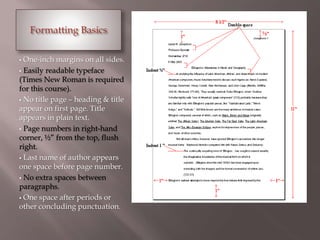
 One-inch margins on all sides. 
 Easily readable typeface 
(Times New Roman is required 
for this course). 
 No title page – heading & title 
appear on first page. Title 
appears in plain text. 
 Page numbers in right-hand 
corner, ½” from the top, flush 
right. 
 Last name of author appears 
one space before page number. 
 No extra spaces between 
paragraphs. 
 One space after periods or 
other concluding punctuation.
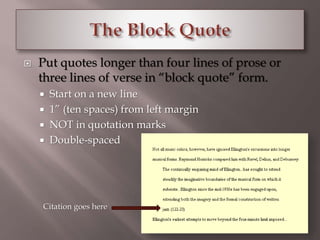
 Put quotes longer than four lines of prose or 
three lines of verse in “block quote” form. 
 Start on a new line 
 1” (ten spaces) from left margin 
 NOT in quotation marks 
 Double-spaced 
Citation goes here
 Always acknowledge (use direct quotations with): 
 A direct quotation 
 A statistic 
 An idea 
 Someone else’s opinion 
 Concrete facts not considered “common knowledge” 
 Information not commonly known 
 Information taken from the computer (CDs, the Internet, 
etc.) 
 Illustrations, photographs, or charts that aren’t yours 
Source: 
Silverman, Jay, Elaine Hughes, and Diana Roberts Weinbroer. Rules of Thumb: A Guide for Writers. New York: McGraw Hill, 2002.
 Paraphrasing 
 Putting someone else’s idea in your own words 
 Summarizing 
 Condensing someone else’s words or ideas 
 Quoting 
 Using someone else’s words directly
GENERAL RULES 
 Ideally, no more than 25 percent of your paper 
should be direct quotations. 
 Paraphrase as much as you can. 
 Use direct quotations when citing a statistic or 
original theory. 
 Use author's words if they capture a point 
exactly. 
 When in doubt, cite!
Don’t leave your poor quotes alone at the party. Introduce them! 
 Model Signal Phrases: 
“In the words of researchers 
Long and McKinzie…” 
“As Paul Rudnick has noted…” 
“Melinda Stuart, mother of a 
child killed by a drunk 
driver, points out…” 
“…,writes Michelle Moore, …” 
Note: Never use “says.” 
 Verbs in Signal Phrases: 
acknowledges admits 
agrees asserts 
believes claims 
comments confirms 
contends declares 
denies disputes 
emphasizes endorses 
grants illustrates 
implies notes 
observes points out 
reasons refutes 
suggests writes
A method in which you give your source in parentheses immediately 
after giving your information. 
Four common citations: 
 Author and page number 
 Title and page number 
 Page number only 
 Secondhand quotations 
The first word of your citation must match the corresponding 
entry on your Works Cited page!
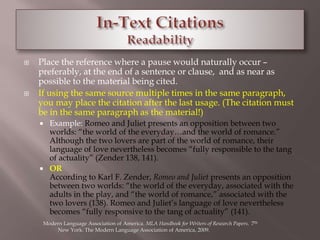
 Place the reference where a pause would naturally occur – 
preferably, at the end of a sentence or clause, and as near as 
possible to the material being cited. 
 If using the same source multiple times in the same paragraph, 
you may place the citation after the last usage. (The citation must 
be in the same paragraph as the material!) 
 Example: Romeo and Juliet presents an opposition between two 
worlds: “the world of the everyday…and the world of romance.” 
Although the two lovers are part of the world of romance, their 
language of love nevertheless becomes “fully responsible to the tang 
of actuality” (Zender 138, 141). 
 OR 
According to Karl F. Zender, Romeo and Juliet presents an opposition 
between two worlds: “the world of the everyday, associated with the 
adults in the play, and “the world of romance,” associated with the 
two lovers (138). Romeo and Juliet’s language of love nevertheless 
becomes “fully responsive to the tang of actuality” (141). 
Modern Language Association of America. MLA Handbook for Writers of Research Papers. 7th. 
New York: The Modern Language Association of America, 2009.
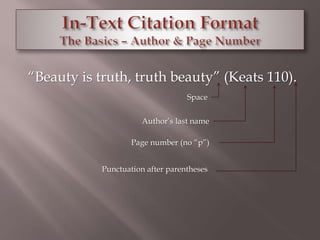
“Beauty is truth, truth beauty” (Keats 110). 
Space 
Author’s last name 
Page number (no “p”) 
Punctuation after parentheses
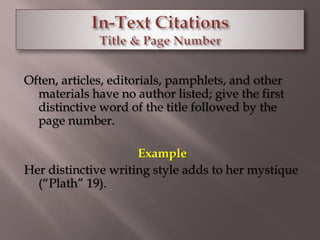
Often, articles, editorials, pamphlets, and other 
materials have no author listed; give the first 
distinctive word of the title followed by the 
page number. 
Example 
Her distinctive writing style adds to her mystique 
(“Plath” 19).
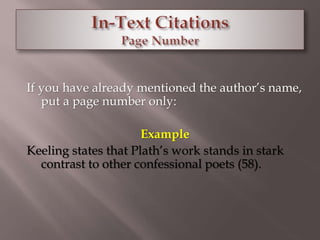
If you have already mentioned the author’s name, 
put a page number only: 
Example 
Keeling states that Plath’s work stands in stark 
contrast to other confessional poets (58).
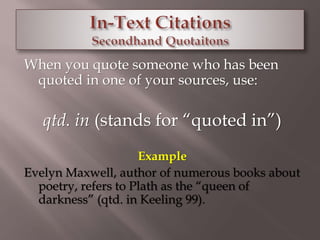
When you quote someone who has been 
quoted in one of your sources, use: 
qtd. in (stands for “quoted in”) 
Example 
Evelyn Maxwell, author of numerous books about 
poetry, refers to Plath as the “queen of 
darkness” (qtd. in Keeling 99).
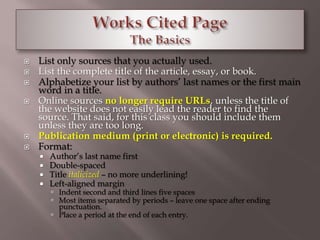
 List only sources that you actually used. 
 List the complete title of the article, essay, or book. 
 Alphabetize your list by authors’ last names or the first main 
word in a title. 
 Online sources no longer require URLs, unless the title of 
the website does not easily lead the reader to find the 
source. That said, for this class you should include them 
unless they are too long. 
 Publication medium (print or electronic) is required. 
 Format: 
 Author’s last name first 
 Double-spaced 
 Title italicized – no more underlining! 
 Left-aligned margin 
 Indent second and third lines five spaces 
 Most items separated by periods – leave one space after ending 
punctuation. 
 Place a period at the end of each entry.
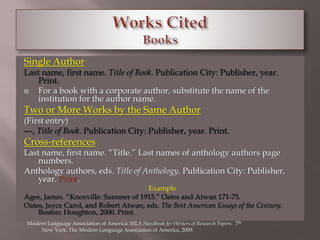
Single Author 
Last name, first name. Title of Book. Publication City: Publisher, year. 
Print. 
 For a book with a corporate author, substitute the name of the 
institution for the author name. 
Two or More Works by the Same Author 
(First entry) 
---, Title of Book. Publication City: Publisher, year. Print. 
Cross-references 
Last name, first name. “Title.” Last names of anthology authors page 
numbers. 
Anthology authors, eds. Title of Anthology. Publication City: Publisher, 
year. Print. 
Example 
Agee, James. “Knoxville: Summer of 1915.” Oates and Atwan 171-75. 
Oates, Joyce Carol, and Robert Atwan, eds. The Best American Essays of the Century. 
Boston: Houghton, 2000. Print. 
Modern Language Association of America. MLA Handbook for Writers of Research Papers. 7th. 
New York: The Modern Language Association of America, 2009.
Book by Two or More Authors 
Last name, First name, and First name Last Name. Title of Book. Publication 
City: Publisher, year. Print. 
 Booth, Wayne C., Gregory G. Colomb, and Joseph M. Williams. The Craft of 
Research. 2nd ed. Chicago: U of Chicago P, 2003. Print. 
A Work in an Anthology 
Last name, First name. “Section Title.” Book Title. Ed. Editor’s Name. 
Publication City: Publisher, year. Pages. Print. 
 Bordo, Susan. “The Moral Content of Nobokov’s Lolita.” Aesthetic Subjects. Ed. 
Pamela R. Matthews and David McWhirter. Minneapolis: U of Minnesota P, 2003. 
125-52. Print. 
An Article in a Reference Book 
“Article Name.” Reference Book Title. Edition. Year. Print. 
 “Azimuthal Equidistant Projection.” Merriam-Webster’s Collegiate Dictionary. 11th 
ed. 2003. Print. 
 For more variations, see MLA Handbook p. 160-61. 
Modern Language Association of America. MLA Handbook for Writers of Research Papers. 7th. 
New York: The Modern Language Association of America, 2009.
A Translation 
Author name. Title. Trans. Translator name. Publication City: Publisher. Year. 
Print. 
 Homer. The Odyssey. Trans. Robert Fagles. New York: Viking, 1996. Print. 
An Illustrated/Graphic Book. 
Author name. Book Title. Introd. Introducer’s name. Illus. Illustrator’s name. 
Publication City: Publisher. Year. Print. 
 Baum, L. Frank. The Wonderful Wizard of Oz. Introd. Regina Barreca. Illus. W.W. 
Denslow. New York: Signet-Penguin, 2006. Print. 
 If referring mostly to the illustrator’s work, begin the entry with the illustrator’s name, followed by illus. 
and By, Author’s Name, after the title. 
Book Published in a Second or Subsequent Edition 
Baker, Nancy L., and Nancy Huling. A Research Guide for Undergraduate Students: English 
and American Literature. 6th ed. New York: MLA, 2006. Print. 
Modern Language Association of America. MLA Handbook for Writers of Research Papers. 7th. 
New York: The Modern Language Association of America, 2009.
Multivolume Work 
Spiegelman, Art. Maus: A Survivor’s Tale. 2 vols. New York: Pantheon- 
Random. 1986-91. Print. 
 If you use only one volume of the work, state the number of the volume (“Vol. 2”) and give publication 
information for that volume alone, plus page numbers when you refer to that work in the text. 
Book in a series 
Anderson, Danny, and Jill S. Kuhnheim, eds. Cultural Studies in the 
Curriculum: Teaching Latin America. New York: MLA, 2003. Print. Teaching 
Langs., Lits., and Cultures. 
Original date 
of publication 
Publisher’s Imprint 
goes here 
Morrison, Toni. Sula. 1973. New York: Vintage-Random, 2004. Print. 
Book Without Stated Publication Information or Pagination 
No place of publication: n.p. 
No pagination given: n. pag. 
No publisher given: n.p. 
No date of publication given: n.d. 
Modern Language Association of America. MLA Handbook for Writers of Research Papers. 7th. 
New York: The Modern Language Association of America, 2009.
Article in a Scholarly Journal: Basic 
Author’s name. “Title of the Article.” Journal Title volume #.issue# (year): 
pages. Print. 
Piper, Andrew. “Rethinking the Print Object: Goethe and the Book of Everything.” 
PMLA 121.1(2006): 124-38. Print. 
 For an article from a journal that uses only issue numbers, omit the volume 
number. 
Article in a Scholarly Journal With More Than One Series 
Author’s name. “Title of the Article.” Journal Title # ser. volume #.issue# 
(year): pages. Print. 
Striner, Richard. “Political Newtonism: The Cosmic Model of Politics in Europe and 
America.” William and Mary Quarterly 3rd ser. 52.4 (1995): 583-608. Print. 
 For an article divided into a new series and an original series, use ns or os before 
the volume number. 
Helming, Steven. “A Martyr to Happiness: Why Adorno Matters.” Kenyon Review ns 28.4 (2006): 156- 
72. Print. 
Modern Language Association of America. MLA Handbook for Writers of Research Papers. 7th. 
New York: The Modern Language Association of America, 2009.
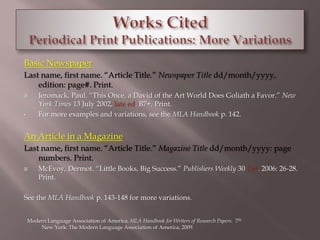
Basic Newspaper 
Last name, first name. “Article Title.” Newspaper Title dd/month/yyyy, 
edition: page#. Print. 
 Jeromack, Paul. “This Once, a David of the Art World Does Goliath a Favor.” New 
York Times 13 July 2002, late ed. B7+. Print. 
• For more examples and variations, see the MLA Handbook p. 142. 
An Article in a Magazine 
Last name, first name. “Article Title.” Magazine Title dd/month/yyyy: page 
numbers. Print. 
 McEvoy, Dermot. “Little Books, Big Success.” Publishers Weekly 30 Oct. 2006: 26-28. 
Print. 
See the MLA Handbook p. 143-148 for more variations. 
Modern Language Association of America. MLA Handbook for Writers of Research Papers. 7th. 
New York: The Modern Language Association of America, 2009.
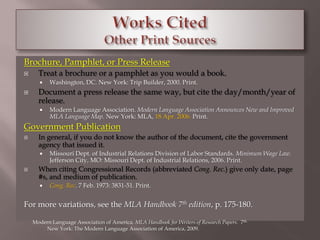
Brochure, Pamphlet, or Press Release 
 Treat a brochure or a pamphlet as you would a book. 
 Washington, DC. New York: Trip Builder, 2000. Print. 
 Document a press release the same way, but cite the day/month/year of 
release. 
 Modern Language Association. Modern Language Association Announces New and Improved 
MLA Language Map. New York: MLA, 18 Apr. 2006. Print. 
Government Publication 
 In general, if you do not know the author of the document, cite the government 
agency that issued it. 
 Missouri Dept. of Industrial Relations Division of Labor Standards. Minimum Wage Law. 
Jefferson City, MO: Missouri Dept. of Industrial Relations, 2006. Print. 
 When citing Congressional Records (abbreviated Cong. Rec.) give only date, page 
#s, and medium of publication. 
 Cong. Rec. 7 Feb. 1973: 3831-51. Print. 
For more variations, see the MLA Handbook 7th edition, p. 175-180. 
Modern Language Association of America. MLA Handbook for Writers of Research Papers. 7th. 
New York: The Modern Language Association of America, 2009.
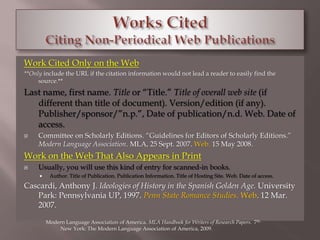
Work Cited Only on the Web 
**Only include the URL if the citation information would not lead a reader to easily find the 
source.** 
Last name, first name. Title or “Title.” Title of overall web site (if 
different than title of document). Version/edition (if any). 
Publisher/sponsor/”n.p.”, Date of publication/n.d. Web. Date of 
access. 
 Committee on Scholarly Editions. “Guidelines for Editors of Scholarly Editions.” 
Modern Language Association. MLA, 25 Sept. 2007. Web. 15 May 2008. 
Work on the Web That Also Appears in Print 
 Usually, you will use this kind of entry for scanned-in books. 
 Author. Title of Publication. Publication Information. Title of Hosting Site. Web. Date of access. 
Cascardi, Anthony J. Ideologies of History in the Spanish Golden Age. University 
Park: Pennsylvania UP, 1997. Penn State Romance Studies. Web. 12 Mar. 
2007. 
Modern Language Association of America. MLA Handbook for Writers of Research Papers. 7th. 
New York: The Modern Language Association of America, 2009.
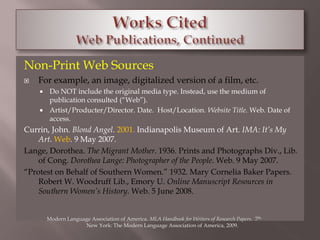
Non-Print Web Sources 
 For example, an image, digitalized version of a film, etc. 
 Do NOT include the original media type. Instead, use the medium of 
publication consulted (“Web”). 
 Artist/Producter/Director. Date. Host/Location. Website Title. Web. Date of 
access. 
Currin, John. Blond Angel. 2001. Indianapolis Museum of Art. IMA: It’s My 
Art. Web. 9 May 2007. 
Lange, Dorothea. The Migrant Mother. 1936. Prints and Photographs Div., Lib. 
of Cong. Dorothea Lange: Photographer of the People. Web. 9 May 2007. 
“Protest on Behalf of Southern Women.” 1932. Mary Cornelia Baker Papers. 
Robert W. Woodruff Lib., Emory U. Online Manuscript Resources in 
Southern Women’s History. Web. 5 June 2008. 
Modern Language Association of America. MLA Handbook for Writers of Research Papers. 7th. 
New York: The Modern Language Association of America, 2009.
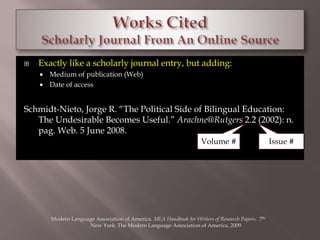
 Exactly like a scholarly journal entry, but adding: 
 Medium of publication (Web) 
 Date of access 
Schmidt-Nieto, Jorge R. “The Political Side of Bilingual Education: 
The Undesirable Becomes Useful.” Arachne@Rutgers 2.2 (2002): n. 
pag. Web. 5 June 2008. 
Volume # Issue # 
Modern Language Association of America. MLA Handbook for Writers of Research Papers. 7th. 
New York: The Modern Language Association of America, 2009.
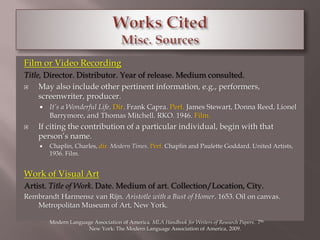
Film or Video Recording 
Title, Director. Distributor. Year of release. Medium consulted. 
 May also include other pertinent information, e.g., performers, 
screenwriter, producer. 
 It’s a Wonderful Life. Dir. Frank Capra. Perf. James Stewart, Donna Reed, Lionel 
Barrymore, and Thomas Mitchell. RKO. 1946. Film. 
 If citing the contribution of a particular individual, begin with that 
person’s name. 
 Chaplin, Charles, dir. Modern Times. Perf. Chaplin and Paulette Goddard. United Artists, 
1936. Film. 
Work of Visual Art 
Artist. Title of Work. Date. Medium of art. Collection/Location, City. 
Rembrandt Harmensz van Rijn. Aristotle with a Bust of Homer. 1653. Oil on canvas. 
Metropolitan Museum of Art, New York. 
Modern Language Association of America. MLA Handbook for Writers of Research Papers. 7th. 
New York: The Modern Language Association of America, 2009.
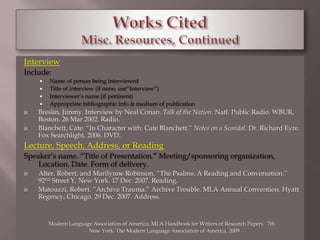
Interview 
Include: 
 Name of person being interviewed 
 Title of interview (if none, use“Interview”) 
 Interviewer’s name (if pertinent) 
 Appropriate bibliographic info & medium of publication 
 Breslin, Jimmy. Interview by Neal Conan. Talk of the Nation. Natl. Public Radio. WBUR, 
Boston. 26 Mar 2002. Radio. 
 Blanchett, Cate. “In Character with: Cate Blanchett.” Notes on a Scandal. Dr. Richard Eyre. 
Fox Searchlight, 2006. DVD. 
Lecture, Speech, Address, or Reading 
Speaker’s name. “Title of Presentation.” Meeting/sponsoring organization, 
Location. Date. Form of delivery. 
 Alter, Robert, and Marilynne Robinson. “The Psalms: A Reading and Conversation.” 
92nd Street Y, New York. 17 Dec. 2007. Reading. 
 Matouzzi, Robert. “Archive Trauma.” Archive Trouble. MLA Annual Convention. Hyatt 
Regency, Chicago. 29 Dec. 2007. Address. 
Modern Language Association of America. MLA Handbook for Writers of Research Papers. 7th. 
New York: The Modern Language Association of America, 2009

Writing in MLA Style

  • 1.
    A guide toin-text and reference citation methods
  • 2.
    Formatting Basics One-inch margins on all sides.  Easily readable typeface (Times New Roman is required for this course).  No title page – heading & title appear on first page. Title appears in plain text.  Page numbers in right-hand corner, ½” from the top, flush right.  Last name of author appears one space before page number.  No extra spaces between paragraphs.  One space after periods or other concluding punctuation.
  • 3.
     Put quoteslonger than four lines of prose or three lines of verse in “block quote” form.  Start on a new line  1” (ten spaces) from left margin  NOT in quotation marks  Double-spaced Citation goes here
  • 4.
     Always acknowledge(use direct quotations with):  A direct quotation  A statistic  An idea  Someone else’s opinion  Concrete facts not considered “common knowledge”  Information not commonly known  Information taken from the computer (CDs, the Internet, etc.)  Illustrations, photographs, or charts that aren’t yours Source: Silverman, Jay, Elaine Hughes, and Diana Roberts Weinbroer. Rules of Thumb: A Guide for Writers. New York: McGraw Hill, 2002.
  • 5.
     Paraphrasing Putting someone else’s idea in your own words  Summarizing  Condensing someone else’s words or ideas  Quoting  Using someone else’s words directly
  • 6.
    GENERAL RULES Ideally, no more than 25 percent of your paper should be direct quotations.  Paraphrase as much as you can.  Use direct quotations when citing a statistic or original theory.  Use author's words if they capture a point exactly.  When in doubt, cite!
  • 7.
    Don’t leave yourpoor quotes alone at the party. Introduce them!  Model Signal Phrases: “In the words of researchers Long and McKinzie…” “As Paul Rudnick has noted…” “Melinda Stuart, mother of a child killed by a drunk driver, points out…” “…,writes Michelle Moore, …” Note: Never use “says.”  Verbs in Signal Phrases: acknowledges admits agrees asserts believes claims comments confirms contends declares denies disputes emphasizes endorses grants illustrates implies notes observes points out reasons refutes suggests writes
  • 8.
    A method inwhich you give your source in parentheses immediately after giving your information. Four common citations:  Author and page number  Title and page number  Page number only  Secondhand quotations The first word of your citation must match the corresponding entry on your Works Cited page!
  • 9.
     Place thereference where a pause would naturally occur – preferably, at the end of a sentence or clause, and as near as possible to the material being cited.  If using the same source multiple times in the same paragraph, you may place the citation after the last usage. (The citation must be in the same paragraph as the material!)  Example: Romeo and Juliet presents an opposition between two worlds: “the world of the everyday…and the world of romance.” Although the two lovers are part of the world of romance, their language of love nevertheless becomes “fully responsible to the tang of actuality” (Zender 138, 141).  OR According to Karl F. Zender, Romeo and Juliet presents an opposition between two worlds: “the world of the everyday, associated with the adults in the play, and “the world of romance,” associated with the two lovers (138). Romeo and Juliet’s language of love nevertheless becomes “fully responsive to the tang of actuality” (141). Modern Language Association of America. MLA Handbook for Writers of Research Papers. 7th. New York: The Modern Language Association of America, 2009.
  • 10.
    “Beauty is truth,truth beauty” (Keats 110). Space Author’s last name Page number (no “p”) Punctuation after parentheses
  • 11.
    Often, articles, editorials,pamphlets, and other materials have no author listed; give the first distinctive word of the title followed by the page number. Example Her distinctive writing style adds to her mystique (“Plath” 19).
  • 12.
    If you havealready mentioned the author’s name, put a page number only: Example Keeling states that Plath’s work stands in stark contrast to other confessional poets (58).
  • 13.
    When you quotesomeone who has been quoted in one of your sources, use: qtd. in (stands for “quoted in”) Example Evelyn Maxwell, author of numerous books about poetry, refers to Plath as the “queen of darkness” (qtd. in Keeling 99).
  • 14.
     List onlysources that you actually used.  List the complete title of the article, essay, or book.  Alphabetize your list by authors’ last names or the first main word in a title.  Online sources no longer require URLs, unless the title of the website does not easily lead the reader to find the source. That said, for this class you should include them unless they are too long.  Publication medium (print or electronic) is required.  Format:  Author’s last name first  Double-spaced  Title italicized – no more underlining!  Left-aligned margin  Indent second and third lines five spaces  Most items separated by periods – leave one space after ending punctuation.  Place a period at the end of each entry.
  • 15.
    Single Author Lastname, first name. Title of Book. Publication City: Publisher, year. Print.  For a book with a corporate author, substitute the name of the institution for the author name. Two or More Works by the Same Author (First entry) ---, Title of Book. Publication City: Publisher, year. Print. Cross-references Last name, first name. “Title.” Last names of anthology authors page numbers. Anthology authors, eds. Title of Anthology. Publication City: Publisher, year. Print. Example Agee, James. “Knoxville: Summer of 1915.” Oates and Atwan 171-75. Oates, Joyce Carol, and Robert Atwan, eds. The Best American Essays of the Century. Boston: Houghton, 2000. Print. Modern Language Association of America. MLA Handbook for Writers of Research Papers. 7th. New York: The Modern Language Association of America, 2009.
  • 16.
    Book by Twoor More Authors Last name, First name, and First name Last Name. Title of Book. Publication City: Publisher, year. Print.  Booth, Wayne C., Gregory G. Colomb, and Joseph M. Williams. The Craft of Research. 2nd ed. Chicago: U of Chicago P, 2003. Print. A Work in an Anthology Last name, First name. “Section Title.” Book Title. Ed. Editor’s Name. Publication City: Publisher, year. Pages. Print.  Bordo, Susan. “The Moral Content of Nobokov’s Lolita.” Aesthetic Subjects. Ed. Pamela R. Matthews and David McWhirter. Minneapolis: U of Minnesota P, 2003. 125-52. Print. An Article in a Reference Book “Article Name.” Reference Book Title. Edition. Year. Print.  “Azimuthal Equidistant Projection.” Merriam-Webster’s Collegiate Dictionary. 11th ed. 2003. Print.  For more variations, see MLA Handbook p. 160-61. Modern Language Association of America. MLA Handbook for Writers of Research Papers. 7th. New York: The Modern Language Association of America, 2009.
  • 17.
    A Translation Authorname. Title. Trans. Translator name. Publication City: Publisher. Year. Print.  Homer. The Odyssey. Trans. Robert Fagles. New York: Viking, 1996. Print. An Illustrated/Graphic Book. Author name. Book Title. Introd. Introducer’s name. Illus. Illustrator’s name. Publication City: Publisher. Year. Print.  Baum, L. Frank. The Wonderful Wizard of Oz. Introd. Regina Barreca. Illus. W.W. Denslow. New York: Signet-Penguin, 2006. Print.  If referring mostly to the illustrator’s work, begin the entry with the illustrator’s name, followed by illus. and By, Author’s Name, after the title. Book Published in a Second or Subsequent Edition Baker, Nancy L., and Nancy Huling. A Research Guide for Undergraduate Students: English and American Literature. 6th ed. New York: MLA, 2006. Print. Modern Language Association of America. MLA Handbook for Writers of Research Papers. 7th. New York: The Modern Language Association of America, 2009.
  • 18.
    Multivolume Work Spiegelman,Art. Maus: A Survivor’s Tale. 2 vols. New York: Pantheon- Random. 1986-91. Print.  If you use only one volume of the work, state the number of the volume (“Vol. 2”) and give publication information for that volume alone, plus page numbers when you refer to that work in the text. Book in a series Anderson, Danny, and Jill S. Kuhnheim, eds. Cultural Studies in the Curriculum: Teaching Latin America. New York: MLA, 2003. Print. Teaching Langs., Lits., and Cultures. Original date of publication Publisher’s Imprint goes here Morrison, Toni. Sula. 1973. New York: Vintage-Random, 2004. Print. Book Without Stated Publication Information or Pagination No place of publication: n.p. No pagination given: n. pag. No publisher given: n.p. No date of publication given: n.d. Modern Language Association of America. MLA Handbook for Writers of Research Papers. 7th. New York: The Modern Language Association of America, 2009.
  • 19.
    Article in aScholarly Journal: Basic Author’s name. “Title of the Article.” Journal Title volume #.issue# (year): pages. Print. Piper, Andrew. “Rethinking the Print Object: Goethe and the Book of Everything.” PMLA 121.1(2006): 124-38. Print.  For an article from a journal that uses only issue numbers, omit the volume number. Article in a Scholarly Journal With More Than One Series Author’s name. “Title of the Article.” Journal Title # ser. volume #.issue# (year): pages. Print. Striner, Richard. “Political Newtonism: The Cosmic Model of Politics in Europe and America.” William and Mary Quarterly 3rd ser. 52.4 (1995): 583-608. Print.  For an article divided into a new series and an original series, use ns or os before the volume number. Helming, Steven. “A Martyr to Happiness: Why Adorno Matters.” Kenyon Review ns 28.4 (2006): 156- 72. Print. Modern Language Association of America. MLA Handbook for Writers of Research Papers. 7th. New York: The Modern Language Association of America, 2009.
  • 20.
    Basic Newspaper Lastname, first name. “Article Title.” Newspaper Title dd/month/yyyy, edition: page#. Print.  Jeromack, Paul. “This Once, a David of the Art World Does Goliath a Favor.” New York Times 13 July 2002, late ed. B7+. Print. • For more examples and variations, see the MLA Handbook p. 142. An Article in a Magazine Last name, first name. “Article Title.” Magazine Title dd/month/yyyy: page numbers. Print.  McEvoy, Dermot. “Little Books, Big Success.” Publishers Weekly 30 Oct. 2006: 26-28. Print. See the MLA Handbook p. 143-148 for more variations. Modern Language Association of America. MLA Handbook for Writers of Research Papers. 7th. New York: The Modern Language Association of America, 2009.
  • 21.
    Brochure, Pamphlet, orPress Release  Treat a brochure or a pamphlet as you would a book.  Washington, DC. New York: Trip Builder, 2000. Print.  Document a press release the same way, but cite the day/month/year of release.  Modern Language Association. Modern Language Association Announces New and Improved MLA Language Map. New York: MLA, 18 Apr. 2006. Print. Government Publication  In general, if you do not know the author of the document, cite the government agency that issued it.  Missouri Dept. of Industrial Relations Division of Labor Standards. Minimum Wage Law. Jefferson City, MO: Missouri Dept. of Industrial Relations, 2006. Print.  When citing Congressional Records (abbreviated Cong. Rec.) give only date, page #s, and medium of publication.  Cong. Rec. 7 Feb. 1973: 3831-51. Print. For more variations, see the MLA Handbook 7th edition, p. 175-180. Modern Language Association of America. MLA Handbook for Writers of Research Papers. 7th. New York: The Modern Language Association of America, 2009.
  • 22.
    Work Cited Onlyon the Web **Only include the URL if the citation information would not lead a reader to easily find the source.** Last name, first name. Title or “Title.” Title of overall web site (if different than title of document). Version/edition (if any). Publisher/sponsor/”n.p.”, Date of publication/n.d. Web. Date of access.  Committee on Scholarly Editions. “Guidelines for Editors of Scholarly Editions.” Modern Language Association. MLA, 25 Sept. 2007. Web. 15 May 2008. Work on the Web That Also Appears in Print  Usually, you will use this kind of entry for scanned-in books.  Author. Title of Publication. Publication Information. Title of Hosting Site. Web. Date of access. Cascardi, Anthony J. Ideologies of History in the Spanish Golden Age. University Park: Pennsylvania UP, 1997. Penn State Romance Studies. Web. 12 Mar. 2007. Modern Language Association of America. MLA Handbook for Writers of Research Papers. 7th. New York: The Modern Language Association of America, 2009.
  • 23.
    Non-Print Web Sources  For example, an image, digitalized version of a film, etc.  Do NOT include the original media type. Instead, use the medium of publication consulted (“Web”).  Artist/Producter/Director. Date. Host/Location. Website Title. Web. Date of access. Currin, John. Blond Angel. 2001. Indianapolis Museum of Art. IMA: It’s My Art. Web. 9 May 2007. Lange, Dorothea. The Migrant Mother. 1936. Prints and Photographs Div., Lib. of Cong. Dorothea Lange: Photographer of the People. Web. 9 May 2007. “Protest on Behalf of Southern Women.” 1932. Mary Cornelia Baker Papers. Robert W. Woodruff Lib., Emory U. Online Manuscript Resources in Southern Women’s History. Web. 5 June 2008. Modern Language Association of America. MLA Handbook for Writers of Research Papers. 7th. New York: The Modern Language Association of America, 2009.
  • 24.
     Exactly likea scholarly journal entry, but adding:  Medium of publication (Web)  Date of access Schmidt-Nieto, Jorge R. “The Political Side of Bilingual Education: The Undesirable Becomes Useful.” Arachne@Rutgers 2.2 (2002): n. pag. Web. 5 June 2008. Volume # Issue # Modern Language Association of America. MLA Handbook for Writers of Research Papers. 7th. New York: The Modern Language Association of America, 2009.
  • 25.
    Film or VideoRecording Title, Director. Distributor. Year of release. Medium consulted.  May also include other pertinent information, e.g., performers, screenwriter, producer.  It’s a Wonderful Life. Dir. Frank Capra. Perf. James Stewart, Donna Reed, Lionel Barrymore, and Thomas Mitchell. RKO. 1946. Film.  If citing the contribution of a particular individual, begin with that person’s name.  Chaplin, Charles, dir. Modern Times. Perf. Chaplin and Paulette Goddard. United Artists, 1936. Film. Work of Visual Art Artist. Title of Work. Date. Medium of art. Collection/Location, City. Rembrandt Harmensz van Rijn. Aristotle with a Bust of Homer. 1653. Oil on canvas. Metropolitan Museum of Art, New York. Modern Language Association of America. MLA Handbook for Writers of Research Papers. 7th. New York: The Modern Language Association of America, 2009.
  • 26.
    Interview Include: Name of person being interviewed  Title of interview (if none, use“Interview”)  Interviewer’s name (if pertinent)  Appropriate bibliographic info & medium of publication  Breslin, Jimmy. Interview by Neal Conan. Talk of the Nation. Natl. Public Radio. WBUR, Boston. 26 Mar 2002. Radio.  Blanchett, Cate. “In Character with: Cate Blanchett.” Notes on a Scandal. Dr. Richard Eyre. Fox Searchlight, 2006. DVD. Lecture, Speech, Address, or Reading Speaker’s name. “Title of Presentation.” Meeting/sponsoring organization, Location. Date. Form of delivery.  Alter, Robert, and Marilynne Robinson. “The Psalms: A Reading and Conversation.” 92nd Street Y, New York. 17 Dec. 2007. Reading.  Matouzzi, Robert. “Archive Trauma.” Archive Trouble. MLA Annual Convention. Hyatt Regency, Chicago. 29 Dec. 2007. Address. Modern Language Association of America. MLA Handbook for Writers of Research Papers. 7th. New York: The Modern Language Association of America, 2009