Gases Pressure Boyle’s Law Charles’ Law Gay-Lussac’s Law Avogadro’s Law Ideal Gas Equation Dalton’s Law Effusion and Diffusion Kinetic-Molecular Theory Real Gases James K Hardy
Elemental states at 25 o C He Rn Xe I Kr Br Se Ar Cl S Ne F O P N C H Li Na Cs Rb K Tl Hg Au Hf Ls Ba Fr Pt Ir Os Re W Ta Po Bi Pb Be Mg Sr Ca Cd Ag Zr Y Pd Rh Ru Tc Mo Nb Ac Ra Zn Cu Ti Sc Ni Co Fe Mn Cr V In Sb Sn Ga Ge Al Gd Cm Tb Bk Sm Pu Eu Am Nd U Pm Np Ce Th Pr Pa Yb No Lu Lr Er Fm Tm Md Dy Cf Ho Es At Te As Si B 5 - 2 Solid Liquid Gas
Observed properties of matter   State Property Solid   Liquid   Gas Density High High   Low   (like solids) Shape Fixed   Takes shape Expands    of lower part  to fill the   of container  container Compressibility Small Small   Large Thermal Very Small Moderate expansion   Small
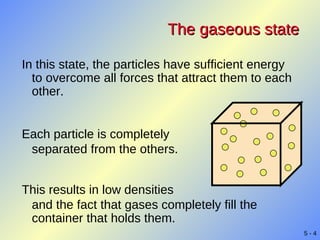
The gaseous state In this state, the particles have sufficient energy to overcome all forces that attract them to each other. Each particle is completely separated from the others. This results in low densities and the fact that gases completely fill the container that holds them.
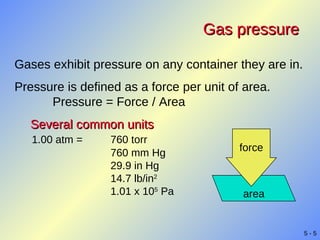
Gas pressure Gases exhibit pressure on any container they are in. Pressure is defined as a force per unit of area. Pressure = Force / Area   Several common units 1.00 atm = 760 torr 760 mm Hg 29.9 in Hg 14.7 lb/in 2 1.01 x 10 5  Pa force area
Barometer Device used to measure atmospheric pressure. One atm 760 mm Hg 29.9 in Hg vacuum
The gas laws Since gases are highly compressible and will expand when heated, these properties have been studied extensively. The relationships between volume, pressure, temperature and moles are referred to as the  gas laws . To understand the relationships, we must introduce a few concepts.
Units we will be using Volume liters, although other units  could be used.  Temperature Must use an absolute scale. K - Kelvin is most often used. Pressure Atm, torr, mm Hg , lb/in 2 . - use what is appropriate. Moles We specify the amounts in molar quantities.
Gas laws Laws that show the relationship between volume and various properties of gases Boyle’s Law Charles’ Law Gay-Lussac’s Law Avogadro’s Law The   Ideal Gas Equation  combines several of these laws into a single relationship.
Boyle’s law The volume of a gas is inversely proportional to its pressure. PV = k or P 1  V 1  = P 2  V 2 Temperature and number of moles must be held constant!
Boyle’s law Increasing the pressure on a sample on gas decreases it volume at constant temperature. Note the effect here as weight is added.
Charles’ law The volume of a gas is directly proportional to the absolute temperature (K). V T =  k or V 1   V 2 T 1   T 2 Pressure and number of moles must be held constant! =
Charles’ law When you heat a sample of a gas, its volume increases. The pressure  and number of moles must be held constant.
Charles’ Law Placing an air filled balloon near liquid nitrogen (77 K) will cause the volume to be reduced.  Pressure and  the number of moles are constant.
Gay-Lussac’s Law Law of of Combining Volumes. At constant temperature and pressure, the volumes of gases involved in a chemical reaction are in the ratios of small whole numbers. Studies by Joseph Gay-Lussac led to a better understanding of molecules and their reactions.
Gay-Lussac’s Law Example. Reaction of hydrogen and oxygen gases. Two ‘volumes’ of hydrogen will combine with one ‘volume’ of oxygen to produce two volumes of water. We now know that the equation is: 2 H 2  (g)  + O 2  (g)  2 H 2 O  (g) + H 2 H 2 O 2 H 2 O H 2 O
Avogadro’s law Equal volumes of gas at the same temperature and pressure contain equal numbers of molecules. V = k n V 1   V 2 n 1   n 2 =
Avogadro’s law If you have more moles of a gas, it takes up more space at the same temperature and pressure.
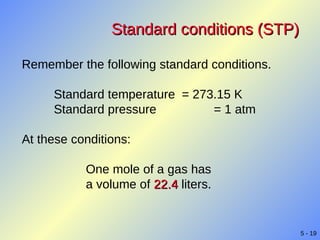
Standard conditions (STP) Remember the following standard conditions. Standard temperature  = 273.15 K Standard pressure = 1 atm At these conditions: One mole of a gas has  a volume of   22.4  liters.
The ideal gas law A combination of Boyle’s, Charles’ and Avogadro’s Laws PV = nRT P  = pressure, atm  V  = volume, L     n  = moles     T  = temperature, K   R  = 0.082 06 L atm/K mol   (gas law constant)
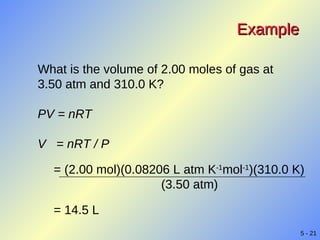
Example What is the volume of 2.00 moles of gas at 3.50 atm and 310.0 K? PV = nRT V  = nRT / P = (2.00 mol)(0.08206 L atm K -1 mol -1 )(310.0 K) (3.50 atm) = 14.5 L
Ideal gas law PV nT ( 1 atm ) ( 22.4 L ) ( 1 mol ) ( 273.15 K) R = =  0.08206 atm L mol -1  K -1 R  = R can be determined from standard conditions.
Ideal gas law When you only allow volume and one other factor to vary, you end up with one of the other gas laws. Just remember Boyle   Pressure Charles   Temperature Avogadro   Moles
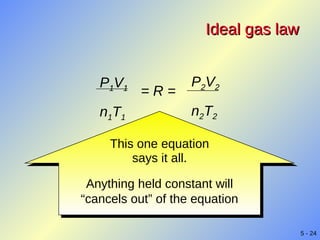
Ideal gas law P 1 V 1 n 1 T 1 = R = P 2 V 2 n 2 T 2 This one equation says it all. Anything held constant will “ cancels out” of the equation
Ideal gas law Example - if n and T are held constant P 1 V 1 n 1 T 1 = P 2 V 2 n 2 T 2 This leaves us P 1 V 1   =  P 2 V 2 Boyle’s Law
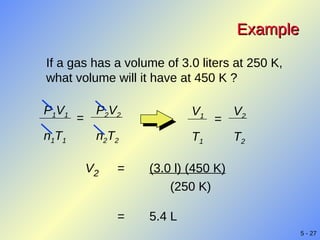
Example If a gas has a volume of 3.0 liters at 250 K, what volume will it have at 450 K ? P 1 V 1 n 1 T 1 = P 2 V 2 n 2 T 2 V 1 T 1 = V 2 T 2 Cancel P and n They don’t change We end up with Charles’ Law
Example If a gas has a volume of 3.0 liters at 250 K, what volume will it have at 450 K ? V 2 = (3.0 l) (450 K) (250 K) =  5.4 L P 1 V 1 n 1 T 1 = P 2 V 2 n 2 T 2 V 1 T 1 = V 2 T 2
Dalton’s law of  partial pressures The total pressure of a gaseous mixture is the sum of the partial pressure of all the gases. P T = P 1  +  P 2  +  P 3  + ..... Air is a mixture of gases - each adds it own pressure to the total. P air  =  P N 2  +  P O 2  +  P Ar  +  P CO 2  +  P H 2 O
Partial pressure example Mixtures of helium and oxygen are used in scuba diving tanks to help prevent “the bends.”  For a particular dive, 46 liters of O 2  and 12 liters of He were pumped in to a 5 liter tank.  Both gases were added at 1.0 atm pressure at 25 o C. Determine the partial pressure for both gases in the scuba tank at 25 o C.
Partial pressure example First calculate the number of moles of each gas using  PV = nRT . n O 2   =     = 1.9 mol n He   =   = 0.49 mol (1.0 atm) (46 l) (0.08206 l atm K -1  mol -1 )(298.15K) (1.0 atm) (12 l) (0.08206 l atm K -1  mol -1 )(298.15K)
Partial pressure example Now calculate the partial pressures of each. P O 2  =    = 9.3 atm P O 2  =   = 2.4 atm Total pressure in the tank is 11.7 atm. (1.9 mol) (298.15 K) (0.08206 l atm K -1  mol -1 ) (5.0 l) (0.49 mol) (298.15 K) (0.08206 l atm K -1  mol -1 ) (5.0 l)
Relates the rates of effusion of two gases to their molar masses. This law notes that larger molecules move more slowly. Graham’s law Rate  A   MM  B Rate  B   MM  A =
Diffusion
Diffusion and effusion Diffusion The random and spontaneous mixing of molecules. Effusion The escape of molecules through small holes in a barrier.
Kinetic-molecular theory This theory explains the behavior of gases. Gases consist of very small particles (molecules) which are separated by large distances. Gas molecules move at very high speeds - hydrogen molecules travel at almost 4000 mph at 25 o C. Pressure is the result of molecules hitting the container.  At 25  o C and 1 atm, a molecule hits another molecule and average of 10 10  times/sec.
Kinetic-molecular theory No attractive forces exist between ideal gas molecules or the container they are in. Energy of motion is called kinetic energy.  Average kinetic energy =  mv 2 Because gas molecules hit each other frequently, their speed and direction is constantly changing. The distribution of gas molecule speeds can be calculated for various temperatures. 1 2
Kinetic-molecular theory O 2  at 25 o C O 2  at 700 o C H 2  at 25 o C Average speed Fraction having each speed 0 500 1000 1500 2000 2500 3000 Molecular speed (m/s)
Real gases We can plot the compressibility factor ( PV/nRT ) for gases.  If the gas is ideal, it should always give a value of 1. Obviously, none of these gases are ‘ideal.’ Compressibility factor 0  5  10 Pressure, atm H 2 N 2 CH 4 C 2 H 4 NH 3
Real gases As pressure approaches zero, all gases approach ideal behavior. At high pressure, gases deviate significantly from ideal behavior. Why? Attractive forces actually do exist between molecules. Molecules are not points -- they have volume.
Van der Waals equation This equation is a modification of the ideal gas relationship.  It accounts for attractive forces and molecular volume. Correction for  Molecular volume Correction for attractive forces between molecules P  + an 2 V 2 ( V - nb ) =  nRT ( )
Van der Waals constants   a   b Gas Formula   L 2  atm mol -2  L mol -1 Ammonia   NH 3 4.170 0.037 07 Argon   Ar 1.345 0.032 19 Chlorine   Cl 2 6.493 0.056 22 Helium   He 0.034 12 0.023 70 Hydrogen   H 2 0.244 4 0.026 61 Nitrogen   N 2 1.390 0.039 13 Water   H 2 O 5.464 0.030 49 Xenon   Xe 4.194 0.051 05

Gas

  • 1.
    Gases Pressure Boyle’sLaw Charles’ Law Gay-Lussac’s Law Avogadro’s Law Ideal Gas Equation Dalton’s Law Effusion and Diffusion Kinetic-Molecular Theory Real Gases James K Hardy
  • 2.
    Elemental states at25 o C He Rn Xe I Kr Br Se Ar Cl S Ne F O P N C H Li Na Cs Rb K Tl Hg Au Hf Ls Ba Fr Pt Ir Os Re W Ta Po Bi Pb Be Mg Sr Ca Cd Ag Zr Y Pd Rh Ru Tc Mo Nb Ac Ra Zn Cu Ti Sc Ni Co Fe Mn Cr V In Sb Sn Ga Ge Al Gd Cm Tb Bk Sm Pu Eu Am Nd U Pm Np Ce Th Pr Pa Yb No Lu Lr Er Fm Tm Md Dy Cf Ho Es At Te As Si B 5 - 2 Solid Liquid Gas
  • 3.
    Observed properties ofmatter State Property Solid Liquid Gas Density High High Low (like solids) Shape Fixed Takes shape Expands of lower part to fill the of container container Compressibility Small Small Large Thermal Very Small Moderate expansion Small
  • 4.
    The gaseous stateIn this state, the particles have sufficient energy to overcome all forces that attract them to each other. Each particle is completely separated from the others. This results in low densities and the fact that gases completely fill the container that holds them.
  • 5.
    Gas pressure Gasesexhibit pressure on any container they are in. Pressure is defined as a force per unit of area. Pressure = Force / Area Several common units 1.00 atm = 760 torr 760 mm Hg 29.9 in Hg 14.7 lb/in 2 1.01 x 10 5 Pa force area
  • 6.
    Barometer Device usedto measure atmospheric pressure. One atm 760 mm Hg 29.9 in Hg vacuum
  • 7.
    The gas lawsSince gases are highly compressible and will expand when heated, these properties have been studied extensively. The relationships between volume, pressure, temperature and moles are referred to as the gas laws . To understand the relationships, we must introduce a few concepts.
  • 8.
    Units we willbe using Volume liters, although other units could be used. Temperature Must use an absolute scale. K - Kelvin is most often used. Pressure Atm, torr, mm Hg , lb/in 2 . - use what is appropriate. Moles We specify the amounts in molar quantities.
  • 9.
    Gas laws Lawsthat show the relationship between volume and various properties of gases Boyle’s Law Charles’ Law Gay-Lussac’s Law Avogadro’s Law The Ideal Gas Equation combines several of these laws into a single relationship.
  • 10.
    Boyle’s law Thevolume of a gas is inversely proportional to its pressure. PV = k or P 1 V 1 = P 2 V 2 Temperature and number of moles must be held constant!
  • 11.
    Boyle’s law Increasingthe pressure on a sample on gas decreases it volume at constant temperature. Note the effect here as weight is added.
  • 12.
    Charles’ law Thevolume of a gas is directly proportional to the absolute temperature (K). V T = k or V 1 V 2 T 1 T 2 Pressure and number of moles must be held constant! =
  • 13.
    Charles’ law Whenyou heat a sample of a gas, its volume increases. The pressure and number of moles must be held constant.
  • 14.
    Charles’ Law Placingan air filled balloon near liquid nitrogen (77 K) will cause the volume to be reduced. Pressure and the number of moles are constant.
  • 15.
    Gay-Lussac’s Law Lawof of Combining Volumes. At constant temperature and pressure, the volumes of gases involved in a chemical reaction are in the ratios of small whole numbers. Studies by Joseph Gay-Lussac led to a better understanding of molecules and their reactions.
  • 16.
    Gay-Lussac’s Law Example.Reaction of hydrogen and oxygen gases. Two ‘volumes’ of hydrogen will combine with one ‘volume’ of oxygen to produce two volumes of water. We now know that the equation is: 2 H 2 (g) + O 2 (g) 2 H 2 O (g) + H 2 H 2 O 2 H 2 O H 2 O
  • 17.
    Avogadro’s law Equalvolumes of gas at the same temperature and pressure contain equal numbers of molecules. V = k n V 1 V 2 n 1 n 2 =
  • 18.
    Avogadro’s law Ifyou have more moles of a gas, it takes up more space at the same temperature and pressure.
  • 19.
    Standard conditions (STP)Remember the following standard conditions. Standard temperature = 273.15 K Standard pressure = 1 atm At these conditions: One mole of a gas has a volume of 22.4 liters.
  • 20.
    The ideal gaslaw A combination of Boyle’s, Charles’ and Avogadro’s Laws PV = nRT P = pressure, atm V = volume, L n = moles T = temperature, K R = 0.082 06 L atm/K mol (gas law constant)
  • 21.
    Example What isthe volume of 2.00 moles of gas at 3.50 atm and 310.0 K? PV = nRT V = nRT / P = (2.00 mol)(0.08206 L atm K -1 mol -1 )(310.0 K) (3.50 atm) = 14.5 L
  • 22.
    Ideal gas lawPV nT ( 1 atm ) ( 22.4 L ) ( 1 mol ) ( 273.15 K) R = = 0.08206 atm L mol -1 K -1 R = R can be determined from standard conditions.
  • 23.
    Ideal gas lawWhen you only allow volume and one other factor to vary, you end up with one of the other gas laws. Just remember Boyle Pressure Charles Temperature Avogadro Moles
  • 24.
    Ideal gas lawP 1 V 1 n 1 T 1 = R = P 2 V 2 n 2 T 2 This one equation says it all. Anything held constant will “ cancels out” of the equation
  • 25.
    Ideal gas lawExample - if n and T are held constant P 1 V 1 n 1 T 1 = P 2 V 2 n 2 T 2 This leaves us P 1 V 1 = P 2 V 2 Boyle’s Law
  • 26.
    Example If agas has a volume of 3.0 liters at 250 K, what volume will it have at 450 K ? P 1 V 1 n 1 T 1 = P 2 V 2 n 2 T 2 V 1 T 1 = V 2 T 2 Cancel P and n They don’t change We end up with Charles’ Law
  • 27.
    Example If agas has a volume of 3.0 liters at 250 K, what volume will it have at 450 K ? V 2 = (3.0 l) (450 K) (250 K) = 5.4 L P 1 V 1 n 1 T 1 = P 2 V 2 n 2 T 2 V 1 T 1 = V 2 T 2
  • 28.
    Dalton’s law of partial pressures The total pressure of a gaseous mixture is the sum of the partial pressure of all the gases. P T = P 1 + P 2 + P 3 + ..... Air is a mixture of gases - each adds it own pressure to the total. P air = P N 2 + P O 2 + P Ar + P CO 2 + P H 2 O
  • 29.
    Partial pressure exampleMixtures of helium and oxygen are used in scuba diving tanks to help prevent “the bends.” For a particular dive, 46 liters of O 2 and 12 liters of He were pumped in to a 5 liter tank. Both gases were added at 1.0 atm pressure at 25 o C. Determine the partial pressure for both gases in the scuba tank at 25 o C.
  • 30.
    Partial pressure exampleFirst calculate the number of moles of each gas using PV = nRT . n O 2 = = 1.9 mol n He = = 0.49 mol (1.0 atm) (46 l) (0.08206 l atm K -1 mol -1 )(298.15K) (1.0 atm) (12 l) (0.08206 l atm K -1 mol -1 )(298.15K)
  • 31.
    Partial pressure exampleNow calculate the partial pressures of each. P O 2 = = 9.3 atm P O 2 = = 2.4 atm Total pressure in the tank is 11.7 atm. (1.9 mol) (298.15 K) (0.08206 l atm K -1 mol -1 ) (5.0 l) (0.49 mol) (298.15 K) (0.08206 l atm K -1 mol -1 ) (5.0 l)
  • 32.
    Relates the ratesof effusion of two gases to their molar masses. This law notes that larger molecules move more slowly. Graham’s law Rate A MM B Rate B MM A =
  • 33.
  • 34.
    Diffusion and effusionDiffusion The random and spontaneous mixing of molecules. Effusion The escape of molecules through small holes in a barrier.
  • 35.
    Kinetic-molecular theory Thistheory explains the behavior of gases. Gases consist of very small particles (molecules) which are separated by large distances. Gas molecules move at very high speeds - hydrogen molecules travel at almost 4000 mph at 25 o C. Pressure is the result of molecules hitting the container. At 25 o C and 1 atm, a molecule hits another molecule and average of 10 10 times/sec.
  • 36.
    Kinetic-molecular theory Noattractive forces exist between ideal gas molecules or the container they are in. Energy of motion is called kinetic energy. Average kinetic energy = mv 2 Because gas molecules hit each other frequently, their speed and direction is constantly changing. The distribution of gas molecule speeds can be calculated for various temperatures. 1 2
  • 37.
    Kinetic-molecular theory O2 at 25 o C O 2 at 700 o C H 2 at 25 o C Average speed Fraction having each speed 0 500 1000 1500 2000 2500 3000 Molecular speed (m/s)
  • 38.
    Real gases Wecan plot the compressibility factor ( PV/nRT ) for gases. If the gas is ideal, it should always give a value of 1. Obviously, none of these gases are ‘ideal.’ Compressibility factor 0 5 10 Pressure, atm H 2 N 2 CH 4 C 2 H 4 NH 3
  • 39.
    Real gases Aspressure approaches zero, all gases approach ideal behavior. At high pressure, gases deviate significantly from ideal behavior. Why? Attractive forces actually do exist between molecules. Molecules are not points -- they have volume.
  • 40.
    Van der Waalsequation This equation is a modification of the ideal gas relationship. It accounts for attractive forces and molecular volume. Correction for Molecular volume Correction for attractive forces between molecules P + an 2 V 2 ( V - nb ) = nRT ( )
  • 41.
    Van der Waalsconstants a b Gas Formula L 2 atm mol -2 L mol -1 Ammonia NH 3 4.170 0.037 07 Argon Ar 1.345 0.032 19 Chlorine Cl 2 6.493 0.056 22 Helium He 0.034 12 0.023 70 Hydrogen H 2 0.244 4 0.026 61 Nitrogen N 2 1.390 0.039 13 Water H 2 O 5.464 0.030 49 Xenon Xe 4.194 0.051 05